PhD Research: Project Alignment & Organizational Development
VerifiedAdded on 2022/09/07
|5
|1843
|26
Report
AI Summary
This research proposal, submitted by a PhD student, investigates the critical role of project alignment in enhancing organizational development and performance. The literature review analyzes existing research on project alignment, its definition, and implementation, highlighting the need for a structured approach to improve organizational outcomes. The study aims to address gaps in current research by exploring how project alignment influences organizational development and performance, with specific research questions focusing on the typical alignments required, alignment with business strategies, and the benefits of such alignment. The methodology involves a literature review and a comparative analysis of organizations with and without project alignment to assess project success rates. The expected outcomes include a better understanding of project alignment and its benefits, which will enable organizations to succeed in projects, enhance organizational development, simplify planning, and improve conflict management.
Research Proposal
By:
Education Program: PhD Management
Title: Project Alignments Implementation towards Organizational Development Performance
Literature Review
A literature review helps understand the opinions of a certain subject matter based on past
studies. There is notable progress in analyzing the project alignment is and how it is implemented
in different organizations in the past literature. In terms of its definition and implementation
process, various studies have deeply analyzed it. For instance, a research paper by Patanakul et
al, 2016 has considered project alignment as an excellent way to cast organization spending in a
new light. According to their research, the resources used in project development and
implementation can be minimized through project alignment. Its ability to help improve project
success rates has also been addressed in the research. A different research paper by
Sirisomboonsuket al (2018) which scrutinized project alignment with organizational strategies
and goals has revealed that project alignment is all about abandoning the traditional project
management approaches to adopt the enterprise project management. Enterprise project
management has been considered as the centralized and organization level entity which must
be planned to specifically encourage new projects with greater organizational strategies in mind.
Enterprise project management has been praised because of its ability to produce projects which
are in line with the business aims. However; there is a gap in the literature when it comes to
addressing project alignment and its role in organizational development performance. This paper
closes that gap by looking at the role of project alignment in organizational development
performance.
Research Background
Most of the organization projects that are commissioned with the aim of improving the
performance of an organization fails in their initial implementation stages. Most of these
projects (70%) which end up failing share two common traits: there is inadequate planning for
those projects, and their implementation is taken as an afterthought. Effective project
implementation does not happen by accident; it is achieved through careful planning of the
project right from project alignment. Project alignment is defined as the process of ensuring
that the organization projects begin with a shared vision of success (Chumo,2016). It’s all
about making sure that project team members and representative members of the organization
play in the same ballpark at any point in time. According to Nicholas & Steyn (2017), project
By:
Education Program: PhD Management
Title: Project Alignments Implementation towards Organizational Development Performance
Literature Review
A literature review helps understand the opinions of a certain subject matter based on past
studies. There is notable progress in analyzing the project alignment is and how it is implemented
in different organizations in the past literature. In terms of its definition and implementation
process, various studies have deeply analyzed it. For instance, a research paper by Patanakul et
al, 2016 has considered project alignment as an excellent way to cast organization spending in a
new light. According to their research, the resources used in project development and
implementation can be minimized through project alignment. Its ability to help improve project
success rates has also been addressed in the research. A different research paper by
Sirisomboonsuket al (2018) which scrutinized project alignment with organizational strategies
and goals has revealed that project alignment is all about abandoning the traditional project
management approaches to adopt the enterprise project management. Enterprise project
management has been considered as the centralized and organization level entity which must
be planned to specifically encourage new projects with greater organizational strategies in mind.
Enterprise project management has been praised because of its ability to produce projects which
are in line with the business aims. However; there is a gap in the literature when it comes to
addressing project alignment and its role in organizational development performance. This paper
closes that gap by looking at the role of project alignment in organizational development
performance.
Research Background
Most of the organization projects that are commissioned with the aim of improving the
performance of an organization fails in their initial implementation stages. Most of these
projects (70%) which end up failing share two common traits: there is inadequate planning for
those projects, and their implementation is taken as an afterthought. Effective project
implementation does not happen by accident; it is achieved through careful planning of the
project right from project alignment. Project alignment is defined as the process of ensuring
that the organization projects begin with a shared vision of success (Chumo,2016). It’s all
about making sure that project team members and representative members of the organization
play in the same ballpark at any point in time. According to Nicholas & Steyn (2017), project
Paraphrase This Document
Need a fresh take? Get an instant paraphrase of this document with our AI Paraphraser

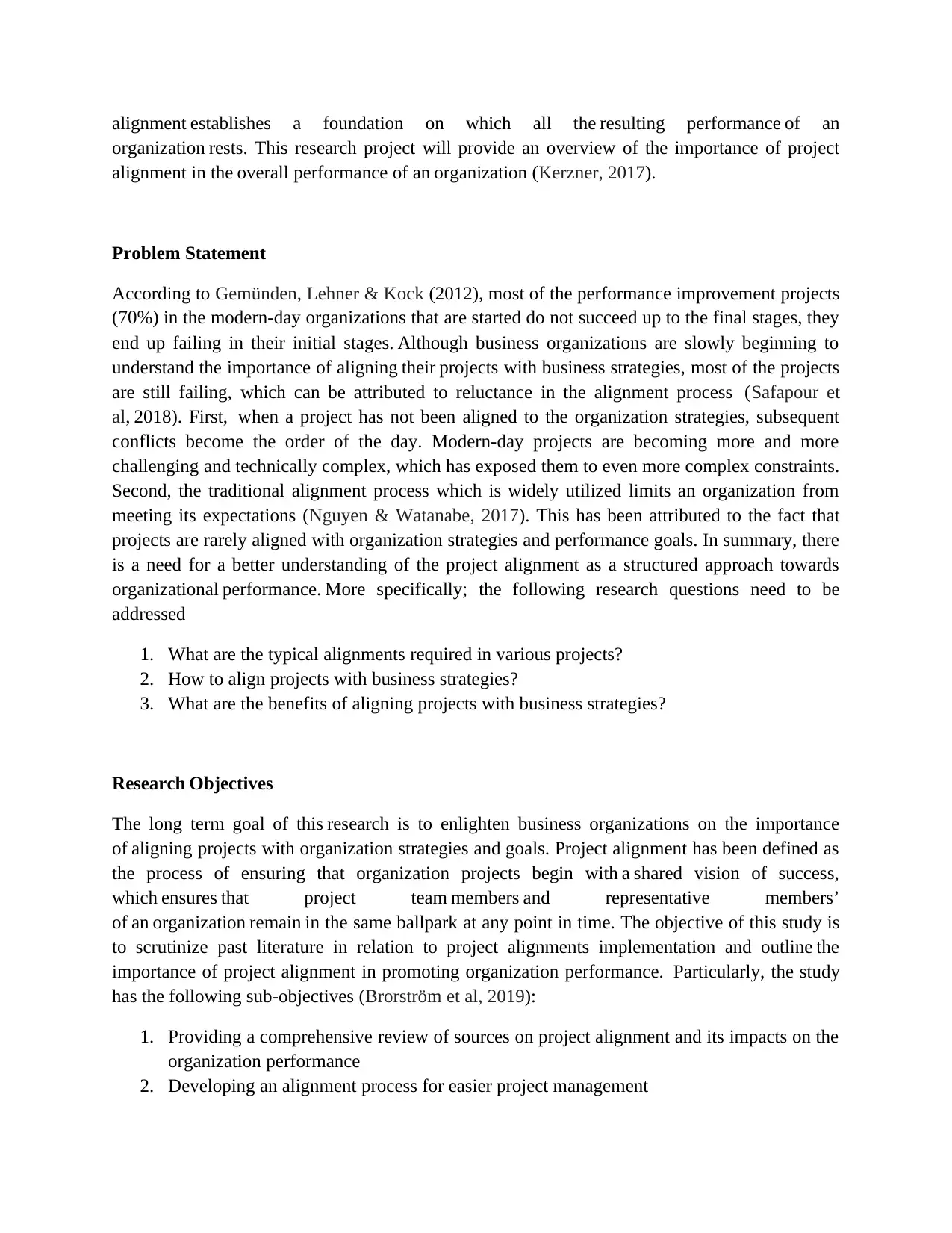
alignment establishes a foundation on which all the resulting performance of an
organization rests. This research project will provide an overview of the importance of project
alignment in the overall performance of an organization (Kerzner, 2017).
Problem Statement
According to Gemünden, Lehner & Kock (2012), most of the performance improvement projects
(70%) in the modern-day organizations that are started do not succeed up to the final stages, they
end up failing in their initial stages. Although business organizations are slowly beginning to
understand the importance of aligning their projects with business strategies, most of the projects
are still failing, which can be attributed to reluctance in the alignment process (Safapour et
al, 2018). First, when a project has not been aligned to the organization strategies, subsequent
conflicts become the order of the day. Modern-day projects are becoming more and more
challenging and technically complex, which has exposed them to even more complex constraints.
Second, the traditional alignment process which is widely utilized limits an organization from
meeting its expectations (Nguyen & Watanabe, 2017). This has been attributed to the fact that
projects are rarely aligned with organization strategies and performance goals. In summary, there
is a need for a better understanding of the project alignment as a structured approach towards
organizational performance. More specifically; the following research questions need to be
addressed
1. What are the typical alignments required in various projects?
2. How to align projects with business strategies?
3. What are the benefits of aligning projects with business strategies?
Research Objectives
The long term goal of this research is to enlighten business organizations on the importance
of aligning projects with organization strategies and goals. Project alignment has been defined as
the process of ensuring that organization projects begin with a shared vision of success,
which ensures that project team members and representative members’
of an organization remain in the same ballpark at any point in time. The objective of this study is
to scrutinize past literature in relation to project alignments implementation and outline the
importance of project alignment in promoting organization performance. Particularly, the study
has the following sub-objectives (Brorström et al, 2019):
1. Providing a comprehensive review of sources on project alignment and its impacts on the
organization performance
2. Developing an alignment process for easier project management
organization rests. This research project will provide an overview of the importance of project
alignment in the overall performance of an organization (Kerzner, 2017).
Problem Statement
According to Gemünden, Lehner & Kock (2012), most of the performance improvement projects
(70%) in the modern-day organizations that are started do not succeed up to the final stages, they
end up failing in their initial stages. Although business organizations are slowly beginning to
understand the importance of aligning their projects with business strategies, most of the projects
are still failing, which can be attributed to reluctance in the alignment process (Safapour et
al, 2018). First, when a project has not been aligned to the organization strategies, subsequent
conflicts become the order of the day. Modern-day projects are becoming more and more
challenging and technically complex, which has exposed them to even more complex constraints.
Second, the traditional alignment process which is widely utilized limits an organization from
meeting its expectations (Nguyen & Watanabe, 2017). This has been attributed to the fact that
projects are rarely aligned with organization strategies and performance goals. In summary, there
is a need for a better understanding of the project alignment as a structured approach towards
organizational performance. More specifically; the following research questions need to be
addressed
1. What are the typical alignments required in various projects?
2. How to align projects with business strategies?
3. What are the benefits of aligning projects with business strategies?
Research Objectives
The long term goal of this research is to enlighten business organizations on the importance
of aligning projects with organization strategies and goals. Project alignment has been defined as
the process of ensuring that organization projects begin with a shared vision of success,
which ensures that project team members and representative members’
of an organization remain in the same ballpark at any point in time. The objective of this study is
to scrutinize past literature in relation to project alignments implementation and outline the
importance of project alignment in promoting organization performance. Particularly, the study
has the following sub-objectives (Brorström et al, 2019):
1. Providing a comprehensive review of sources on project alignment and its impacts on the
organization performance
2. Developing an alignment process for easier project management

3. Reviewing the current organizational practices and researches in regard to project
alignment
Methodology
The primary research method for this study will be the literature review. Project alignment
classification through structured approaches will be the very first step to understand the role of
project alignment in organization performance. The project alignment approaches in different
sources and their effectiveness will be reviewed. Based on the understanding, a classification
method will be developed to categorize different project alignment approaches for the purposes
of identifying the best alignments in different scenarios. In the second phase of the study,
existing alignment approaches will be identified based on a comprehensive review of the modern
industry practices and academic sources. Finally, after the classification of different alignment
approaches, a conceptual framework based on the effectiveness of different alignment
approaches will be outlined.
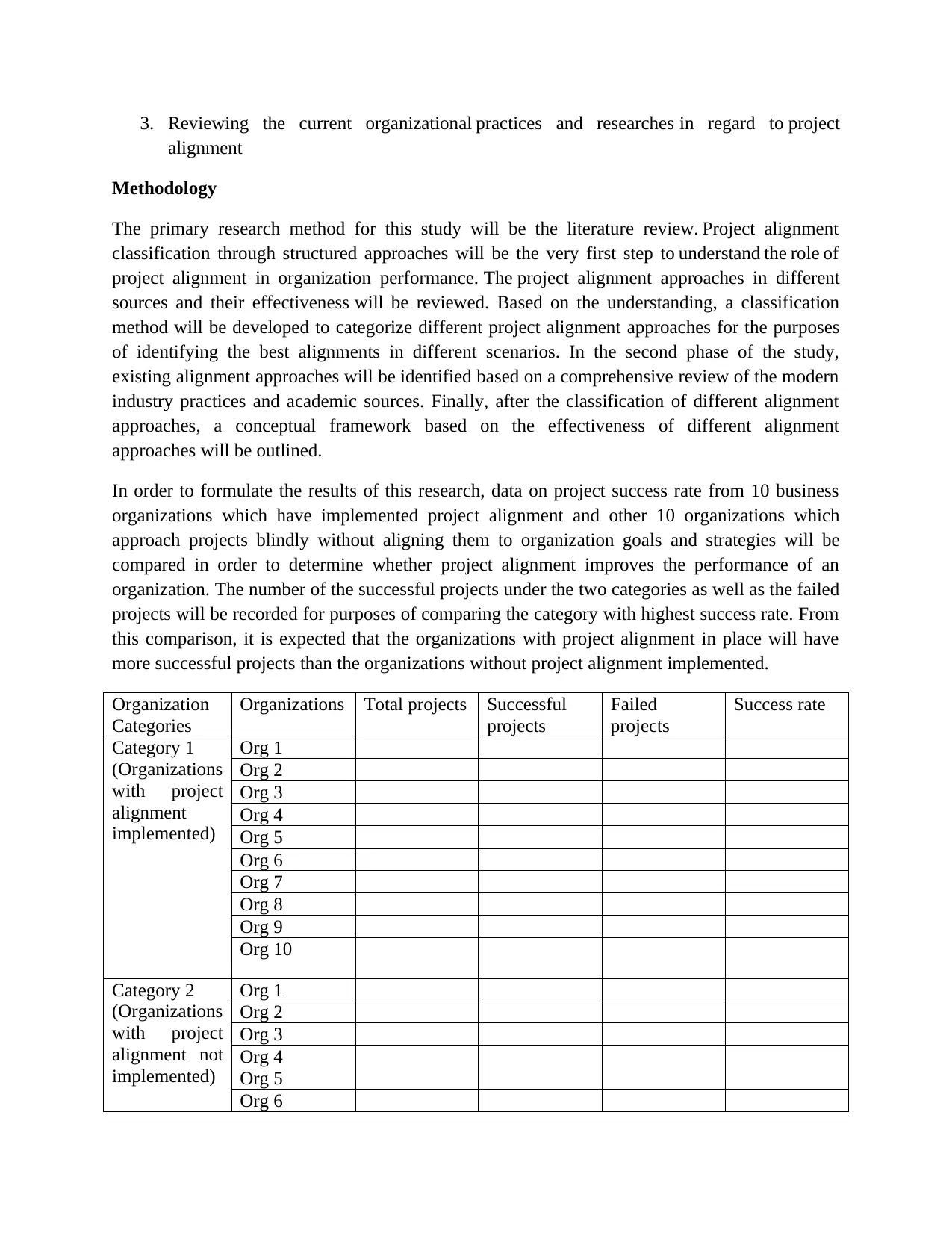
In order to formulate the results of this research, data on project success rate from 10 business
organizations which have implemented project alignment and other 10 organizations which
approach projects blindly without aligning them to organization goals and strategies will be
compared in order to determine whether project alignment improves the performance of an
organization. The number of the successful projects under the two categories as well as the failed
projects will be recorded for purposes of comparing the category with highest success rate. From
this comparison, it is expected that the organizations with project alignment in place will have
more successful projects than the organizations without project alignment implemented.
Organization
Categories
Organizations Total projects Successful
projects
Failed
projects
Success rate
Category 1
(Organizations
with project
alignment
implemented)
Org 1
Org 2
Org 3
Org 4
Org 5
Org 6
Org 7
Org 8
Org 9
Org 10
Category 2
(Organizations
with project
alignment not
implemented)
Org 1
Org 2
Org 3
Org 4
Org 5
Org 6
alignment
Methodology
The primary research method for this study will be the literature review. Project alignment
classification through structured approaches will be the very first step to understand the role of
project alignment in organization performance. The project alignment approaches in different
sources and their effectiveness will be reviewed. Based on the understanding, a classification
method will be developed to categorize different project alignment approaches for the purposes
of identifying the best alignments in different scenarios. In the second phase of the study,
existing alignment approaches will be identified based on a comprehensive review of the modern
industry practices and academic sources. Finally, after the classification of different alignment
approaches, a conceptual framework based on the effectiveness of different alignment
approaches will be outlined.
In order to formulate the results of this research, data on project success rate from 10 business
organizations which have implemented project alignment and other 10 organizations which
approach projects blindly without aligning them to organization goals and strategies will be
compared in order to determine whether project alignment improves the performance of an
organization. The number of the successful projects under the two categories as well as the failed
projects will be recorded for purposes of comparing the category with highest success rate. From
this comparison, it is expected that the organizations with project alignment in place will have
more successful projects than the organizations without project alignment implemented.
Organization
Categories
Organizations Total projects Successful
projects
Failed
projects
Success rate
Category 1
(Organizations
with project
alignment
implemented)
Org 1
Org 2
Org 3
Org 4
Org 5
Org 6
Org 7
Org 8
Org 9
Org 10
Category 2
(Organizations
with project
alignment not
implemented)
Org 1
Org 2
Org 3
Org 4
Org 5
Org 6
⊘ This is a preview!⊘
Do you want full access?
Subscribe today to unlock all pages.

Trusted by 1+ million students worldwide

Org 7
Org 8
Org 9
Org 10
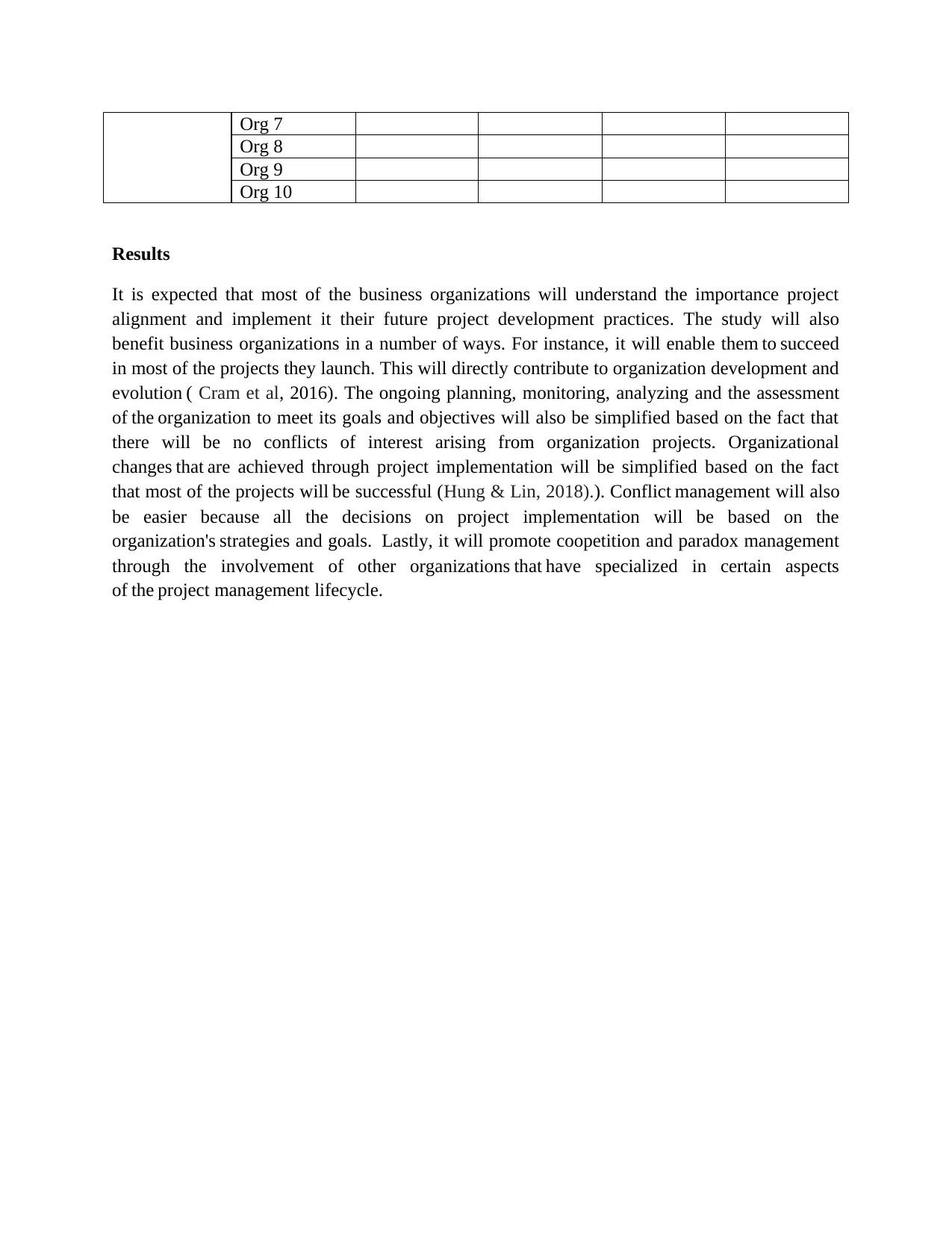
Results
It is expected that most of the business organizations will understand the importance project
alignment and implement it their future project development practices. The study will also
benefit business organizations in a number of ways. For instance, it will enable them to succeed
in most of the projects they launch. This will directly contribute to organization development and
evolution ( Cram et al, 2016). The ongoing planning, monitoring, analyzing and the assessment
of the organization to meet its goals and objectives will also be simplified based on the fact that
there will be no conflicts of interest arising from organization projects. Organizational
changes that are achieved through project implementation will be simplified based on the fact
that most of the projects will be successful (Hung & Lin, 2018).). Conflict management will also
be easier because all the decisions on project implementation will be based on the
organization's strategies and goals. Lastly, it will promote coopetition and paradox management
through the involvement of other organizations that have specialized in certain aspects
of the project management lifecycle.
Org 8
Org 9
Org 10
Results
It is expected that most of the business organizations will understand the importance project
alignment and implement it their future project development practices. The study will also
benefit business organizations in a number of ways. For instance, it will enable them to succeed
in most of the projects they launch. This will directly contribute to organization development and
evolution ( Cram et al, 2016). The ongoing planning, monitoring, analyzing and the assessment
of the organization to meet its goals and objectives will also be simplified based on the fact that
there will be no conflicts of interest arising from organization projects. Organizational
changes that are achieved through project implementation will be simplified based on the fact
that most of the projects will be successful (Hung & Lin, 2018).). Conflict management will also
be easier because all the decisions on project implementation will be based on the
organization's strategies and goals. Lastly, it will promote coopetition and paradox management
through the involvement of other organizations that have specialized in certain aspects
of the project management lifecycle.
Paraphrase This Document
Need a fresh take? Get an instant paraphrase of this document with our AI Paraphraser

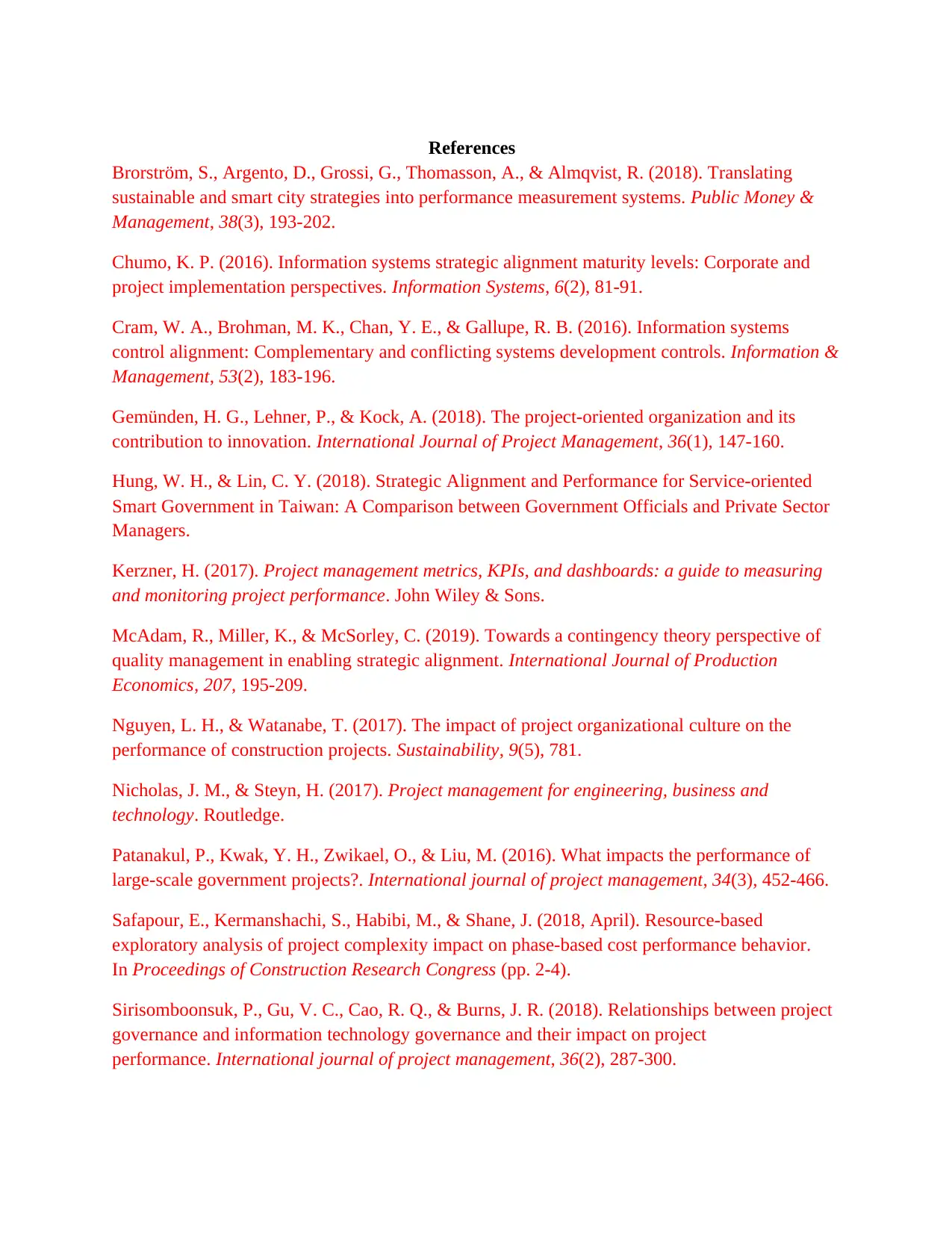
References
Brorström, S., Argento, D., Grossi, G., Thomasson, A., & Almqvist, R. (2018). Translating
sustainable and smart city strategies into performance measurement systems. Public Money &
Management, 38(3), 193-202.
Chumo, K. P. (2016). Information systems strategic alignment maturity levels: Corporate and
project implementation perspectives. Information Systems, 6(2), 81-91.
Cram, W. A., Brohman, M. K., Chan, Y. E., & Gallupe, R. B. (2016). Information systems
control alignment: Complementary and conflicting systems development controls. Information &
Management, 53(2), 183-196.
Gemünden, H. G., Lehner, P., & Kock, A. (2018). The project-oriented organization and its
contribution to innovation. International Journal of Project Management, 36(1), 147-160.
Hung, W. H., & Lin, C. Y. (2018). Strategic Alignment and Performance for Service-oriented
Smart Government in Taiwan: A Comparison between Government Officials and Private Sector
Managers.
Kerzner, H. (2017). Project management metrics, KPIs, and dashboards: a guide to measuring
and monitoring project performance. John Wiley & Sons.
McAdam, R., Miller, K., & McSorley, C. (2019). Towards a contingency theory perspective of
quality management in enabling strategic alignment. International Journal of Production
Economics, 207, 195-209.
Nguyen, L. H., & Watanabe, T. (2017). The impact of project organizational culture on the
performance of construction projects. Sustainability, 9(5), 781.
Nicholas, J. M., & Steyn, H. (2017). Project management for engineering, business and
technology. Routledge.
Patanakul, P., Kwak, Y. H., Zwikael, O., & Liu, M. (2016). What impacts the performance of
large-scale government projects?. International journal of project management, 34(3), 452-466.
Safapour, E., Kermanshachi, S., Habibi, M., & Shane, J. (2018, April). Resource-based
exploratory analysis of project complexity impact on phase-based cost performance behavior.
In Proceedings of Construction Research Congress (pp. 2-4).
Sirisomboonsuk, P., Gu, V. C., Cao, R. Q., & Burns, J. R. (2018). Relationships between project
governance and information technology governance and their impact on project
performance. International journal of project management, 36(2), 287-300.
Brorström, S., Argento, D., Grossi, G., Thomasson, A., & Almqvist, R. (2018). Translating
sustainable and smart city strategies into performance measurement systems. Public Money &
Management, 38(3), 193-202.
Chumo, K. P. (2016). Information systems strategic alignment maturity levels: Corporate and
project implementation perspectives. Information Systems, 6(2), 81-91.
Cram, W. A., Brohman, M. K., Chan, Y. E., & Gallupe, R. B. (2016). Information systems
control alignment: Complementary and conflicting systems development controls. Information &
Management, 53(2), 183-196.
Gemünden, H. G., Lehner, P., & Kock, A. (2018). The project-oriented organization and its
contribution to innovation. International Journal of Project Management, 36(1), 147-160.
Hung, W. H., & Lin, C. Y. (2018). Strategic Alignment and Performance for Service-oriented
Smart Government in Taiwan: A Comparison between Government Officials and Private Sector
Managers.
Kerzner, H. (2017). Project management metrics, KPIs, and dashboards: a guide to measuring
and monitoring project performance. John Wiley & Sons.
McAdam, R., Miller, K., & McSorley, C. (2019). Towards a contingency theory perspective of
quality management in enabling strategic alignment. International Journal of Production
Economics, 207, 195-209.
Nguyen, L. H., & Watanabe, T. (2017). The impact of project organizational culture on the
performance of construction projects. Sustainability, 9(5), 781.
Nicholas, J. M., & Steyn, H. (2017). Project management for engineering, business and
technology. Routledge.
Patanakul, P., Kwak, Y. H., Zwikael, O., & Liu, M. (2016). What impacts the performance of
large-scale government projects?. International journal of project management, 34(3), 452-466.
Safapour, E., Kermanshachi, S., Habibi, M., & Shane, J. (2018, April). Resource-based
exploratory analysis of project complexity impact on phase-based cost performance behavior.
In Proceedings of Construction Research Congress (pp. 2-4).
Sirisomboonsuk, P., Gu, V. C., Cao, R. Q., & Burns, J. R. (2018). Relationships between project
governance and information technology governance and their impact on project
performance. International journal of project management, 36(2), 287-300.
1 out of 5
Related Documents
Your All-in-One AI-Powered Toolkit for Academic Success.
+13062052269
info@desklib.com
Available 24*7 on WhatsApp / Email
Unlock your academic potential
Copyright © 2020–2026 A2Z Services. All Rights Reserved. Developed and managed by ZUCOL.