Project Report: Funding Strategies and Financial Analysis of BAT
VerifiedAdded on 2023/01/10
|12
|3222
|83
Project
AI Summary
This project report analyzes the financial information of British American Tobacco (BAT), a FTSE-listed company. It delves into BAT's funding sources, including retained earnings, additional paid-up capital, accumulated other comprehensive income, and common stock. The report provides a detailed calculation of the weighted average cost of capital (WACC) for BAT, considering the cost of debt and equity. It explores various funding sources, such as angel investors, venture capital, bank financing, and retained earnings, outlining their respective pros and cons. The project also examines the role of risk, tax, and gearing in influencing funding choices. Overall, the report offers a comprehensive financial analysis of BAT's funding strategies and their implications.

PROJECT

Paraphrase This Document
Need a fresh take? Get an instant paraphrase of this document with our AI Paraphraser
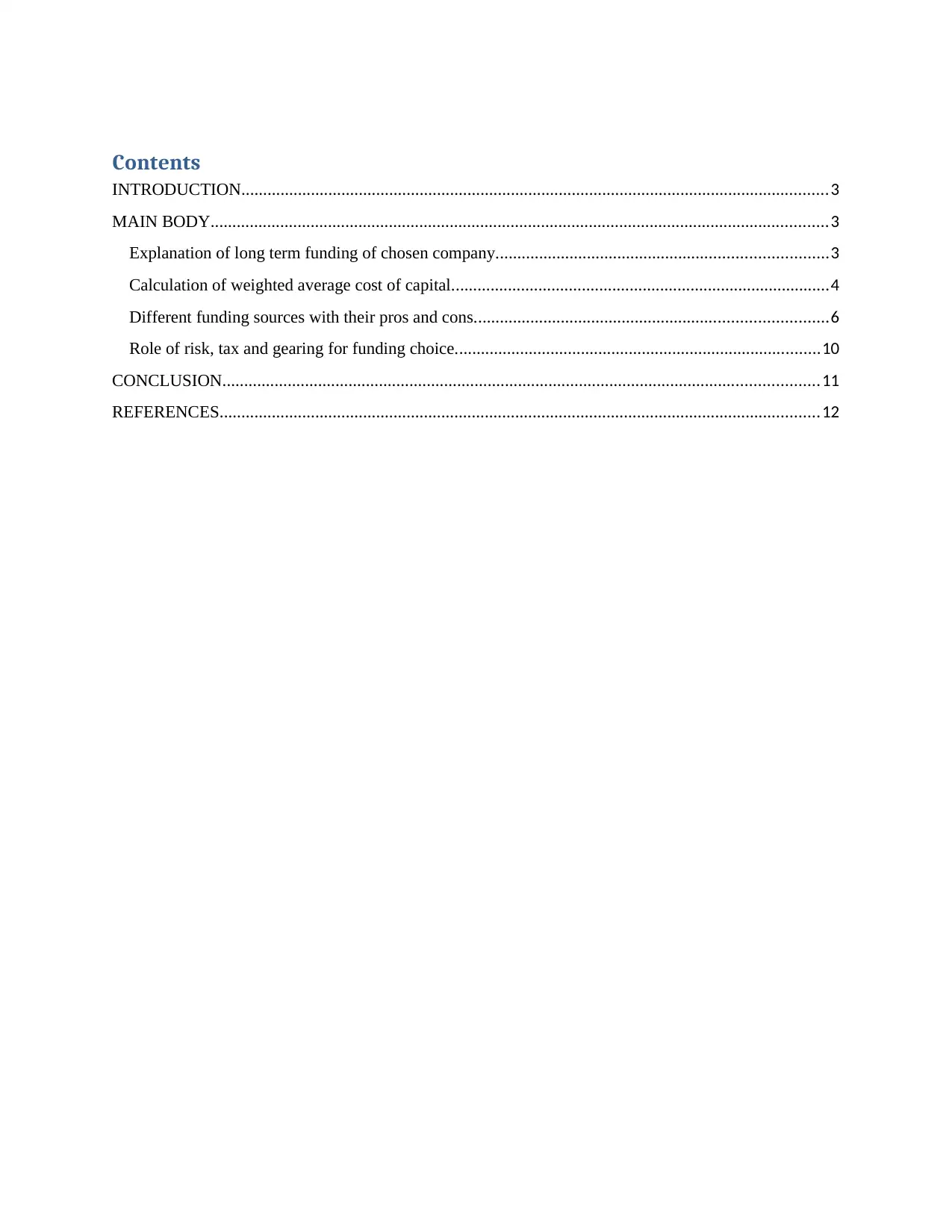
Contents
INTRODUCTION.......................................................................................................................................3
MAIN BODY..............................................................................................................................................3
Explanation of long term funding of chosen company............................................................................3
Calculation of weighted average cost of capital.......................................................................................4
Different funding sources with their pros and cons.................................................................................6
Role of risk, tax and gearing for funding choice....................................................................................10
CONCLUSION.........................................................................................................................................11
REFERENCES..........................................................................................................................................12
INTRODUCTION.......................................................................................................................................3
MAIN BODY..............................................................................................................................................3
Explanation of long term funding of chosen company............................................................................3
Calculation of weighted average cost of capital.......................................................................................4
Different funding sources with their pros and cons.................................................................................6
Role of risk, tax and gearing for funding choice....................................................................................10
CONCLUSION.........................................................................................................................................11
REFERENCES..........................................................................................................................................12
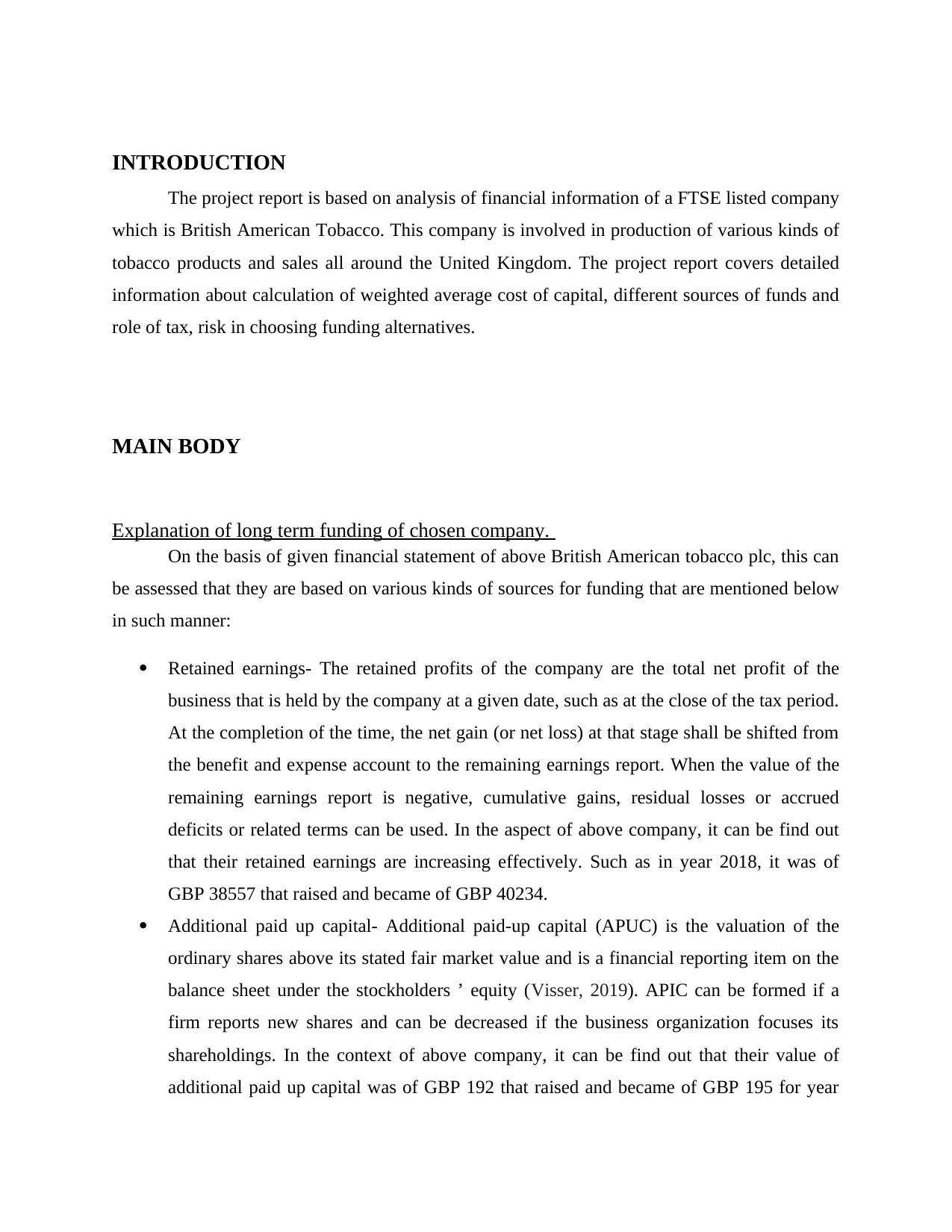
INTRODUCTION
The project report is based on analysis of financial information of a FTSE listed company
which is British American Tobacco. This company is involved in production of various kinds of
tobacco products and sales all around the United Kingdom. The project report covers detailed
information about calculation of weighted average cost of capital, different sources of funds and
role of tax, risk in choosing funding alternatives.
MAIN BODY
Explanation of long term funding of chosen company.
On the basis of given financial statement of above British American tobacco plc, this can
be assessed that they are based on various kinds of sources for funding that are mentioned below
in such manner:
Retained earnings- The retained profits of the company are the total net profit of the
business that is held by the company at a given date, such as at the close of the tax period.
At the completion of the time, the net gain (or net loss) at that stage shall be shifted from
the benefit and expense account to the remaining earnings report. When the value of the
remaining earnings report is negative, cumulative gains, residual losses or accrued
deficits or related terms can be used. In the aspect of above company, it can be find out
that their retained earnings are increasing effectively. Such as in year 2018, it was of
GBP 38557 that raised and became of GBP 40234.
Additional paid up capital- Additional paid-up capital (APUC) is the valuation of the
ordinary shares above its stated fair market value and is a financial reporting item on the
balance sheet under the stockholders ’ equity (Visser, 2019). APIC can be formed if a
firm reports new shares and can be decreased if the business organization focuses its
shareholdings. In the context of above company, it can be find out that their value of
additional paid up capital was of GBP 192 that raised and became of GBP 195 for year
The project report is based on analysis of financial information of a FTSE listed company
which is British American Tobacco. This company is involved in production of various kinds of
tobacco products and sales all around the United Kingdom. The project report covers detailed
information about calculation of weighted average cost of capital, different sources of funds and
role of tax, risk in choosing funding alternatives.
MAIN BODY
Explanation of long term funding of chosen company.
On the basis of given financial statement of above British American tobacco plc, this can
be assessed that they are based on various kinds of sources for funding that are mentioned below
in such manner:
Retained earnings- The retained profits of the company are the total net profit of the
business that is held by the company at a given date, such as at the close of the tax period.
At the completion of the time, the net gain (or net loss) at that stage shall be shifted from
the benefit and expense account to the remaining earnings report. When the value of the
remaining earnings report is negative, cumulative gains, residual losses or accrued
deficits or related terms can be used. In the aspect of above company, it can be find out
that their retained earnings are increasing effectively. Such as in year 2018, it was of
GBP 38557 that raised and became of GBP 40234.
Additional paid up capital- Additional paid-up capital (APUC) is the valuation of the
ordinary shares above its stated fair market value and is a financial reporting item on the
balance sheet under the stockholders ’ equity (Visser, 2019). APIC can be formed if a
firm reports new shares and can be decreased if the business organization focuses its
shareholdings. In the context of above company, it can be find out that their value of
additional paid up capital was of GBP 192 that raised and became of GBP 195 for year
⊘ This is a preview!⊘
Do you want full access?
Subscribe today to unlock all pages.

Trusted by 1+ million students worldwide
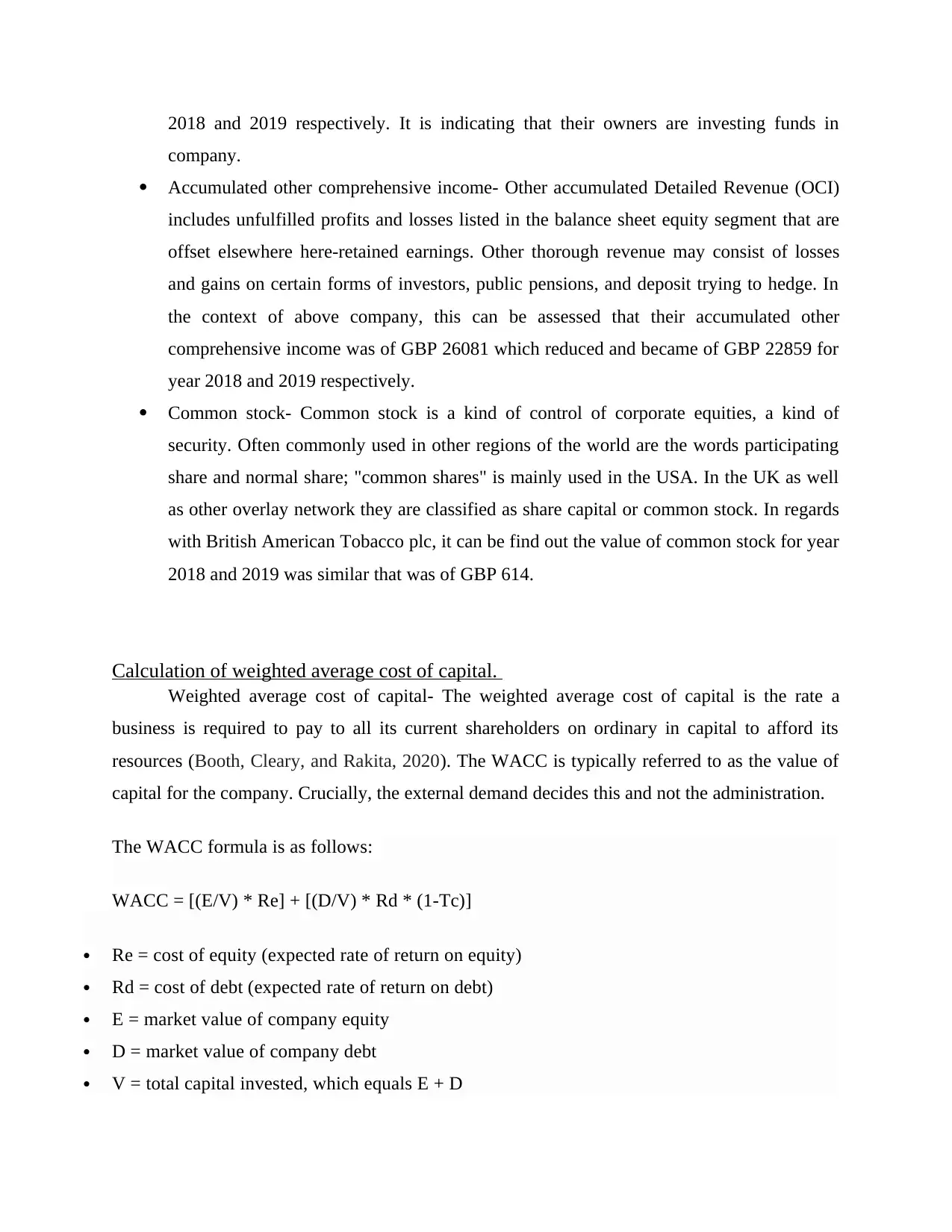
2018 and 2019 respectively. It is indicating that their owners are investing funds in
company.
Accumulated other comprehensive income- Other accumulated Detailed Revenue (OCI)
includes unfulfilled profits and losses listed in the balance sheet equity segment that are
offset elsewhere here-retained earnings. Other thorough revenue may consist of losses
and gains on certain forms of investors, public pensions, and deposit trying to hedge. In
the context of above company, this can be assessed that their accumulated other
comprehensive income was of GBP 26081 which reduced and became of GBP 22859 for
year 2018 and 2019 respectively.
Common stock- Common stock is a kind of control of corporate equities, a kind of
security. Often commonly used in other regions of the world are the words participating
share and normal share; "common shares" is mainly used in the USA. In the UK as well
as other overlay network they are classified as share capital or common stock. In regards
with British American Tobacco plc, it can be find out the value of common stock for year
2018 and 2019 was similar that was of GBP 614.
Calculation of weighted average cost of capital.
Weighted average cost of capital- The weighted average cost of capital is the rate a
business is required to pay to all its current shareholders on ordinary in capital to afford its
resources (Booth, Cleary, and Rakita, 2020). The WACC is typically referred to as the value of
capital for the company. Crucially, the external demand decides this and not the administration.
The WACC formula is as follows:
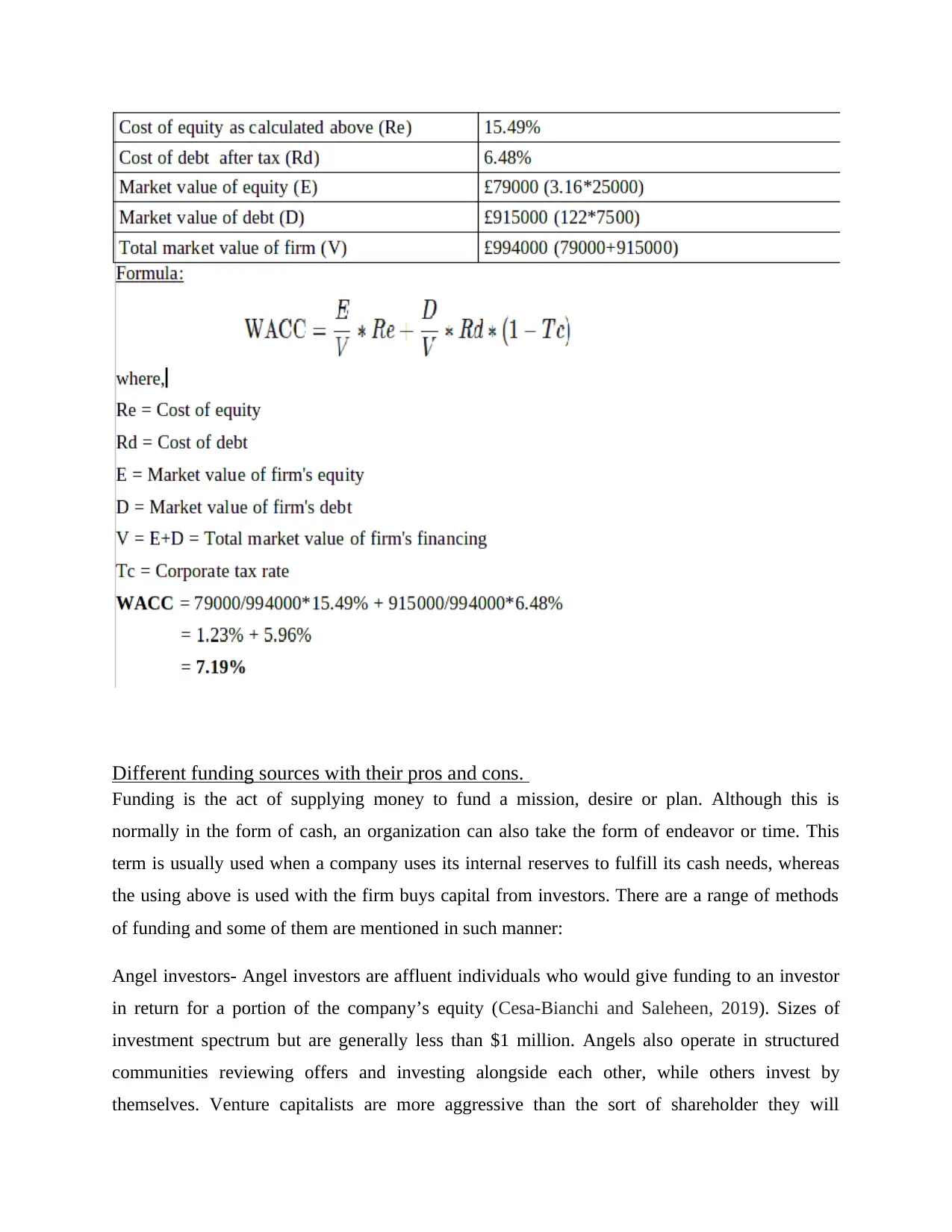
WACC = [(E/V) * Re] + [(D/V) * Rd * (1-Tc)]
Re = cost of equity (expected rate of return on equity)
Rd = cost of debt (expected rate of return on debt)
E = market value of company equity
D = market value of company debt
V = total capital invested, which equals E + D
company.
Accumulated other comprehensive income- Other accumulated Detailed Revenue (OCI)
includes unfulfilled profits and losses listed in the balance sheet equity segment that are
offset elsewhere here-retained earnings. Other thorough revenue may consist of losses
and gains on certain forms of investors, public pensions, and deposit trying to hedge. In
the context of above company, this can be assessed that their accumulated other
comprehensive income was of GBP 26081 which reduced and became of GBP 22859 for
year 2018 and 2019 respectively.
Common stock- Common stock is a kind of control of corporate equities, a kind of
security. Often commonly used in other regions of the world are the words participating
share and normal share; "common shares" is mainly used in the USA. In the UK as well
as other overlay network they are classified as share capital or common stock. In regards
with British American Tobacco plc, it can be find out the value of common stock for year
2018 and 2019 was similar that was of GBP 614.
Calculation of weighted average cost of capital.
Weighted average cost of capital- The weighted average cost of capital is the rate a
business is required to pay to all its current shareholders on ordinary in capital to afford its
resources (Booth, Cleary, and Rakita, 2020). The WACC is typically referred to as the value of
capital for the company. Crucially, the external demand decides this and not the administration.
The WACC formula is as follows:
WACC = [(E/V) * Re] + [(D/V) * Rd * (1-Tc)]
Re = cost of equity (expected rate of return on equity)
Rd = cost of debt (expected rate of return on debt)
E = market value of company equity
D = market value of company debt
V = total capital invested, which equals E + D
Paraphrase This Document
Need a fresh take? Get an instant paraphrase of this document with our AI Paraphraser
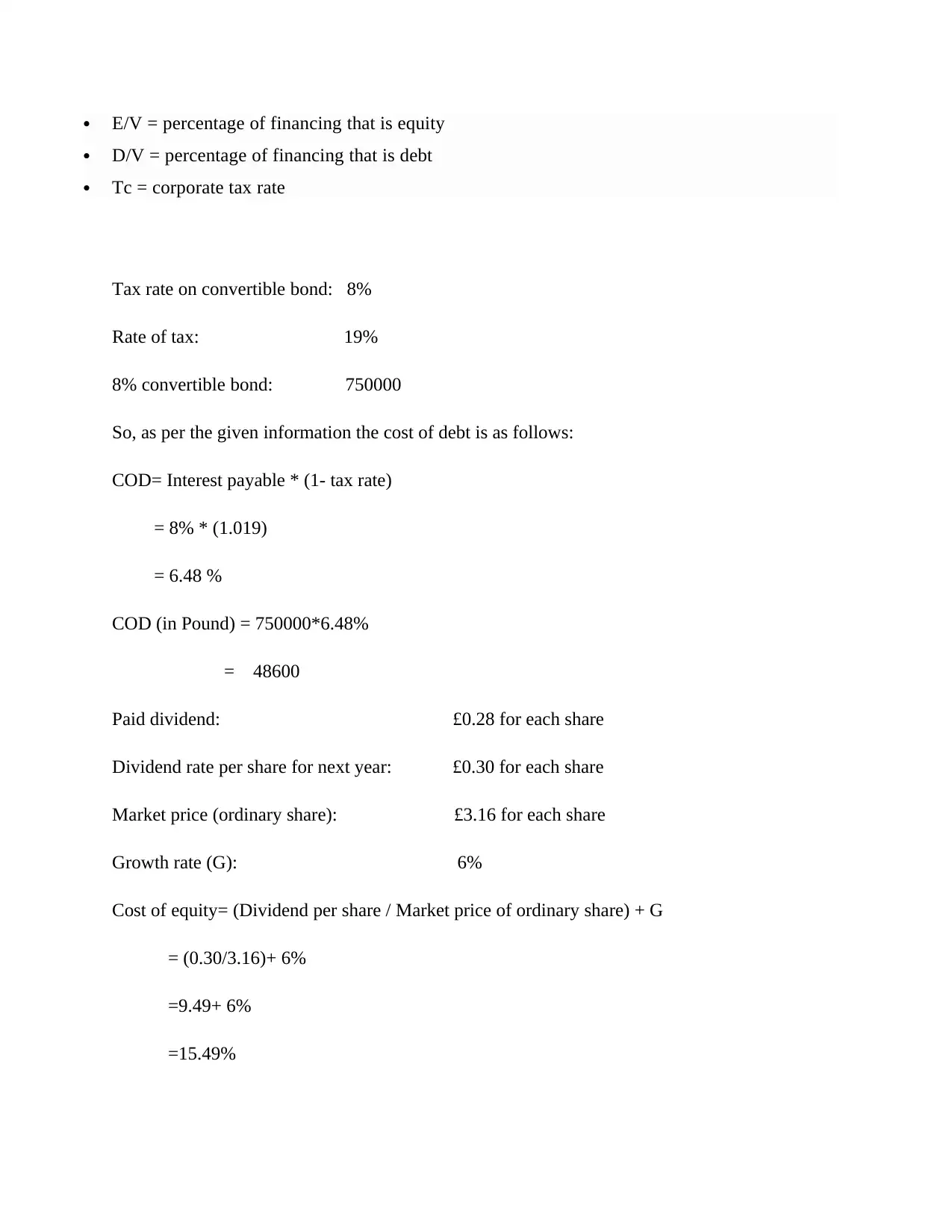
E/V = percentage of financing that is equity
D/V = percentage of financing that is debt
Tc = corporate tax rate
Tax rate on convertible bond: 8%
Rate of tax: 19%
8% convertible bond: 750000
So, as per the given information the cost of debt is as follows:
COD= Interest payable * (1- tax rate)
= 8% * (1.019)
= 6.48 %
COD (in Pound) = 750000*6.48%
= 48600
Paid dividend: £0.28 for each share
Dividend rate per share for next year: £0.30 for each share
Market price (ordinary share): £3.16 for each share
Growth rate (G): 6%
Cost of equity= (Dividend per share / Market price of ordinary share) + G
= (0.30/3.16)+ 6%
=9.49+ 6%
=15.49%
D/V = percentage of financing that is debt
Tc = corporate tax rate
Tax rate on convertible bond: 8%
Rate of tax: 19%
8% convertible bond: 750000
So, as per the given information the cost of debt is as follows:
COD= Interest payable * (1- tax rate)
= 8% * (1.019)
= 6.48 %
COD (in Pound) = 750000*6.48%
= 48600
Paid dividend: £0.28 for each share
Dividend rate per share for next year: £0.30 for each share
Market price (ordinary share): £3.16 for each share
Growth rate (G): 6%
Cost of equity= (Dividend per share / Market price of ordinary share) + G
= (0.30/3.16)+ 6%
=9.49+ 6%
=15.49%
Different funding sources with their pros and cons.
Funding is the act of supplying money to fund a mission, desire or plan. Although this is
normally in the form of cash, an organization can also take the form of endeavor or time. This
term is usually used when a company uses its internal reserves to fulfill its cash needs, whereas
the using above is used with the firm buys capital from investors. There are a range of methods
of funding and some of them are mentioned in such manner:
Angel investors- Angel investors are affluent individuals who would give funding to an investor
in return for a portion of the company’s equity (Cesa-Bianchi and Saleheen, 2019). Sizes of
investment spectrum but are generally less than $1 million. Angels also operate in structured
communities reviewing offers and investing alongside each other, while others invest by
themselves. Venture capitalists are more aggressive than the sort of shareholder they will
Funding is the act of supplying money to fund a mission, desire or plan. Although this is
normally in the form of cash, an organization can also take the form of endeavor or time. This
term is usually used when a company uses its internal reserves to fulfill its cash needs, whereas
the using above is used with the firm buys capital from investors. There are a range of methods
of funding and some of them are mentioned in such manner:
Angel investors- Angel investors are affluent individuals who would give funding to an investor
in return for a portion of the company’s equity (Cesa-Bianchi and Saleheen, 2019). Sizes of
investment spectrum but are generally less than $1 million. Angels also operate in structured
communities reviewing offers and investing alongside each other, while others invest by
themselves. Venture capitalists are more aggressive than the sort of shareholder they will
⊘ This is a preview!⊘
Do you want full access?
Subscribe today to unlock all pages.
Trusted by 1+ million students worldwide
encounter in a friends / community Ring, but are typically less intense than a Private equity
Company. In the context of above British American Tobacco plc this source of fund can be used
in order to fulfill need of funds. This has below mentioned pros and cons that are as follows:
Pros-
Angels usually have business expertise, and will provide invaluable advice and access to
their system.
Flexible partnership arrangements are popular as angels are less restrictive than VC
Firms.
Cons-
Not ideal for around £ 5,000 investment or greater than £150,000 investment
Take much longer to find an appropriate angel investor
Abandoning a share of the company
Less systemic aid accessible from either a BA than in an investment firm
Venture capital funding- Most businesspeople claim VC Funding is the secret to their growth.
Venture capitalists are creditors who are able to bring in a substantial amount of money in return
for the preferred equity, but they only get their cash back if another business either acquires it or
takes action (Bals, 2019). VCs are institutional traders with a whole lot of money. Usually
they’re looking for investment funds that can deliver a 6X return on that investment, so
companies’ better prepared to go big. Such as in the aspect of above company, they can use
these sources of finance in order to fulfill need of funds.
Pros-
If the startup fails or closes down, there is no needed to give the venture capitalist
shareholders. For start-ups, thus, venture capital funding is crucial. This will not put the
responsibility on the start-up on start repaying as is the situation for loans.
Company. In the context of above British American Tobacco plc this source of fund can be used
in order to fulfill need of funds. This has below mentioned pros and cons that are as follows:
Pros-
Angels usually have business expertise, and will provide invaluable advice and access to
their system.
Flexible partnership arrangements are popular as angels are less restrictive than VC
Firms.
Cons-
Not ideal for around £ 5,000 investment or greater than £150,000 investment
Take much longer to find an appropriate angel investor
Abandoning a share of the company
Less systemic aid accessible from either a BA than in an investment firm
Venture capital funding- Most businesspeople claim VC Funding is the secret to their growth.
Venture capitalists are creditors who are able to bring in a substantial amount of money in return
for the preferred equity, but they only get their cash back if another business either acquires it or
takes action (Bals, 2019). VCs are institutional traders with a whole lot of money. Usually
they’re looking for investment funds that can deliver a 6X return on that investment, so
companies’ better prepared to go big. Such as in the aspect of above company, they can use
these sources of finance in order to fulfill need of funds.
Pros-
If the startup fails or closes down, there is no needed to give the venture capitalist
shareholders. For start-ups, thus, venture capital funding is crucial. This will not put the
responsibility on the start-up on start repaying as is the situation for loans.
Paraphrase This Document
Need a fresh take? Get an instant paraphrase of this document with our AI Paraphraser
Finding and locating VC within minutes, shareholders, is very easy since they are
recorded in various directories. This decreases the energy, commitment and cost invested
in seeking financing for the company.
Cons-
Venture capitalist supplies the start-ups with massive funding in exchange for a share in
the firm's equity. If the company works, it can help them gain massive sums of income.
Typically VC is a member of the commission. They are actively involved in decision-
making at the business. VC's will want their investment decisions protected. When there
is a conflict in view between the VC and the creator of the company, so things will get
messy. Any large judgment needs investor approval.
Paying for venture capital entails a huge deal of risk. So, it generally takes a long time for
VC's to make a decision if they really want to spend or not. Venture funding may be a
tremendous source of financing open to start-ups. Yet a huge downside is the lengthy
delay prior to actually having received the funds.
Bank financing- Bank loans are the most searched after funding vehicle and can be accessed at
the closest loan company (Cornée, 2019). Bank lending can be difficult considering that there are
several various forms of funding choices and interest levels to go along with. Before starting it is
essential to educate oneself on the procedure and the alternatives. Such as above British
American Tobacco plc can get financial assistance by help of banks. This source of fund has
below mentioned advantages and disadvantages such as:
Pros-
Companies should just think about getting the daily mortgage payments on time for bank
loans. This is an additional benefit over overdraft charges, where companies have to pay
the remaining price when the bank requests that. However, banks typically don't track
whether the spend the loan so long as make the payments on time, and they can use in
however company find fit.
recorded in various directories. This decreases the energy, commitment and cost invested
in seeking financing for the company.
Cons-
Venture capitalist supplies the start-ups with massive funding in exchange for a share in
the firm's equity. If the company works, it can help them gain massive sums of income.
Typically VC is a member of the commission. They are actively involved in decision-
making at the business. VC's will want their investment decisions protected. When there
is a conflict in view between the VC and the creator of the company, so things will get
messy. Any large judgment needs investor approval.
Paying for venture capital entails a huge deal of risk. So, it generally takes a long time for
VC's to make a decision if they really want to spend or not. Venture funding may be a
tremendous source of financing open to start-ups. Yet a huge downside is the lengthy
delay prior to actually having received the funds.
Bank financing- Bank loans are the most searched after funding vehicle and can be accessed at
the closest loan company (Cornée, 2019). Bank lending can be difficult considering that there are
several various forms of funding choices and interest levels to go along with. Before starting it is
essential to educate oneself on the procedure and the alternatives. Such as above British
American Tobacco plc can get financial assistance by help of banks. This source of fund has
below mentioned advantages and disadvantages such as:
Pros-
Companies should just think about getting the daily mortgage payments on time for bank
loans. This is an additional benefit over overdraft charges, where companies have to pay
the remaining price when the bank requests that. However, banks typically don't track
whether the spend the loan so long as make the payments on time, and they can use in
however company find fit.
Although firms that issue bonds to collect money frequently offer creditors a portion of
their earnings, banks allow lenders to pay just the amount of principal and interest on a
loan (Zhang, Aerts and Pan, 2019).
Cons-
Loan lenders have to make deposits to their banks annually. Those that fall well behind
payouts face the possibility of their investments being seized. Even if the company
manages to make missed fees, the bank can still document to the credit reporting agencies
– a move that has an adverse effect on the credit score of firms. With a lower rating, it
gets harder to obtain loans. The debt pressure is a drawback relative to investors
increasing capital as creditors do not need daily repayments. They are usually only paid
off handsomely on earnings, instead.
Since many loans necessitate some method of leverage, entrepreneurs and individual
firms can find it very difficult to get ones mortgage applications authorized with no
assets. If these lenders decide for personal debt, they would be struck by rising interest
rates.
Retained earnings- With the basic explanation that they are the end result of operating a firm,
remaining profits/earnings are considered the inner source of financing with a corporation. Also
known as the 'plow Back of Profits' concept (Pakdel and Ashrafi, 2019). Retained profits can be
treated as income left after the stockholders have paid a rate of return or the investment-owners
drawings. This source of funding is being used by above company which has below mentioned
advantages and disadvantages:
Pros-
First, they are lengthy-term finance, and no one can ask for payouts from them.
Secondly, because there is no new stock to be given, leverage and participation of the
company is not diminished.
Thirdly, there really are no fixed interest or incarnation payment obligations.
their earnings, banks allow lenders to pay just the amount of principal and interest on a
loan (Zhang, Aerts and Pan, 2019).
Cons-
Loan lenders have to make deposits to their banks annually. Those that fall well behind
payouts face the possibility of their investments being seized. Even if the company
manages to make missed fees, the bank can still document to the credit reporting agencies
– a move that has an adverse effect on the credit score of firms. With a lower rating, it
gets harder to obtain loans. The debt pressure is a drawback relative to investors
increasing capital as creditors do not need daily repayments. They are usually only paid
off handsomely on earnings, instead.
Since many loans necessitate some method of leverage, entrepreneurs and individual
firms can find it very difficult to get ones mortgage applications authorized with no
assets. If these lenders decide for personal debt, they would be struck by rising interest
rates.
Retained earnings- With the basic explanation that they are the end result of operating a firm,
remaining profits/earnings are considered the inner source of financing with a corporation. Also
known as the 'plow Back of Profits' concept (Pakdel and Ashrafi, 2019). Retained profits can be
treated as income left after the stockholders have paid a rate of return or the investment-owners
drawings. This source of funding is being used by above company which has below mentioned
advantages and disadvantages:
Pros-
First, they are lengthy-term finance, and no one can ask for payouts from them.
Secondly, because there is no new stock to be given, leverage and participation of the
company is not diminished.
Thirdly, there really are no fixed interest or incarnation payment obligations.
⊘ This is a preview!⊘
Do you want full access?
Subscribe today to unlock all pages.
Trusted by 1+ million students worldwide
Fourthly, retained earnings as an internal stream of funding are cost-effective in spite of
the fact that no problem expenses are correlated with them varying from 2 to 3 per cent.
Cons-
There is almost no downside of producing or using remaining profits to fund the business'
expenditures. Considering that the funds internally developed are not free because the funds
belonging to the owners are, and the expense of such funds is equivalent to the equity level
(Gilli, Maringer and Schumann, 2019). There will be only one option that can be discussed, i.e.
forms of debt funding. The intent of researching the alternative relates to different-point
thinking.
Role of risk, tax and gearing for funding choice.
Risk- Financial risk is one of several categories of financing-related risks, including
financial transactions which include risk of default business loans. It is often assumed that this
concerns only downside risk, which implies the opportunities for capital loss and confusion as to
its degree. A business is exposed to different types of risks (Owen, Deakins and Savic, 2019).
Such uncertainties would be taken into account before determining the source of funding. For
example, if a business depends heavily on debt funding, they are considered to be highly
leveraged because it brings the considerable capital risk. This means, because mortgage
repayments are not done in schedule that will result in court proceedings and there is a possibility
of failure as a consequence. High capital structure also impacts per-share earnings. So a company
must analyze the level of leverage it can accept for choosing on a capital structure. In the aspect
of above British American Tobacco plc, this is essential for them to consider it before choosing
any source of finance for funding.
Tax- This is also an aspect before choosing any source of finance. Companies should choose
only those source of finance on tax rate is lower. It is so because if tax rate will higher then this
can be difficult for companies to repay the loan in an effective manner. Such as in the context of
the fact that no problem expenses are correlated with them varying from 2 to 3 per cent.
Cons-
There is almost no downside of producing or using remaining profits to fund the business'
expenditures. Considering that the funds internally developed are not free because the funds
belonging to the owners are, and the expense of such funds is equivalent to the equity level
(Gilli, Maringer and Schumann, 2019). There will be only one option that can be discussed, i.e.
forms of debt funding. The intent of researching the alternative relates to different-point
thinking.
Role of risk, tax and gearing for funding choice.
Risk- Financial risk is one of several categories of financing-related risks, including
financial transactions which include risk of default business loans. It is often assumed that this
concerns only downside risk, which implies the opportunities for capital loss and confusion as to
its degree. A business is exposed to different types of risks (Owen, Deakins and Savic, 2019).
Such uncertainties would be taken into account before determining the source of funding. For
example, if a business depends heavily on debt funding, they are considered to be highly
leveraged because it brings the considerable capital risk. This means, because mortgage
repayments are not done in schedule that will result in court proceedings and there is a possibility
of failure as a consequence. High capital structure also impacts per-share earnings. So a company
must analyze the level of leverage it can accept for choosing on a capital structure. In the aspect
of above British American Tobacco plc, this is essential for them to consider it before choosing
any source of finance for funding.
Tax- This is also an aspect before choosing any source of finance. Companies should choose
only those source of finance on tax rate is lower. It is so because if tax rate will higher then this
can be difficult for companies to repay the loan in an effective manner. Such as in the context of
Paraphrase This Document
Need a fresh take? Get an instant paraphrase of this document with our AI Paraphraser
above company, it is necessary for them to select only those source of finance on which rate of
taxation is lower as compared to other source of finance.
Gearing- Gearing describes the relation, or proportion, of the loans to capital of a company.
Leverage ratio shows the depth with which borrowers vs. the stockholders finance the company
profitability — in many other words, it measures the leverage of a firm (Haggard, Maxfield and
Lee, 2019). When the debt-to - equity risk is increased, then a company can be considered highly
geared, or heavily leveraged.
As a small example, British American tobacco plc cannot advertise extra money from investors
at a decent cost in money to finance its growth; but instead, it acquires a short-term loan of
$10,000,000. British American tobacco plc currently holds $2,000,000 of equity; thus the debt-
to-equity (D/E) ratio is 5x—[$10,000,000 (total liabilities) divided by $2,000,000 (shareholders'
equity) is 5x]. British American tobacco plc would certainly be treated as highly geared.
Recommendation-
On the basis of analysis of all factors, it can be suggested to above company that they
should choose only those source of finance which are lower risky and with minimum tax rate.
From analysis of range of financial sources, it can be recommended to above company that they
should choose option of getting fund from banks. It is so because of lower risk and tax rate. If
they will do so then this will be easier for them to repay the loan in less time and with lower cost.
CONCLUSION
On the basis of above project report this can be concluded that companies have range of
funding option and each of them has own importance. By assessing financial statement of above
chosen company, calculation of weighted average capital has been done in the report. The further
part of report concludes about various kinds of funding sources such as angel investors, banks
and many more. As well as different kinds of factors are also mentioned such as tax, risk and
many more. From end part of report this can be concluded that British American Tobacco plc
should choose bank for taking financial assistance.
taxation is lower as compared to other source of finance.
Gearing- Gearing describes the relation, or proportion, of the loans to capital of a company.
Leverage ratio shows the depth with which borrowers vs. the stockholders finance the company
profitability — in many other words, it measures the leverage of a firm (Haggard, Maxfield and
Lee, 2019). When the debt-to - equity risk is increased, then a company can be considered highly
geared, or heavily leveraged.
As a small example, British American tobacco plc cannot advertise extra money from investors
at a decent cost in money to finance its growth; but instead, it acquires a short-term loan of
$10,000,000. British American tobacco plc currently holds $2,000,000 of equity; thus the debt-
to-equity (D/E) ratio is 5x—[$10,000,000 (total liabilities) divided by $2,000,000 (shareholders'
equity) is 5x]. British American tobacco plc would certainly be treated as highly geared.
Recommendation-
On the basis of analysis of all factors, it can be suggested to above company that they
should choose only those source of finance which are lower risky and with minimum tax rate.
From analysis of range of financial sources, it can be recommended to above company that they
should choose option of getting fund from banks. It is so because of lower risk and tax rate. If
they will do so then this will be easier for them to repay the loan in less time and with lower cost.
CONCLUSION
On the basis of above project report this can be concluded that companies have range of
funding option and each of them has own importance. By assessing financial statement of above
chosen company, calculation of weighted average capital has been done in the report. The further
part of report concludes about various kinds of funding sources such as angel investors, banks
and many more. As well as different kinds of factors are also mentioned such as tax, risk and
many more. From end part of report this can be concluded that British American Tobacco plc
should choose bank for taking financial assistance.
REFERENCES
Books and journal:
Visser, H., 2019. Islamic finance: Principles and practice. Edward Elgar Publishing.
Booth, L., Cleary, W.S. and Rakita, I., 2020. Introduction to corporate finance. John Wiley &
Sons.
Cesa-Bianchi, A., Imbs, J. and Saleheen, J., 2019. Finance and synchronization. Journal of
International Economics, 116, pp.74-87.
Cornée, S., 2019. The relevance of soft information for predicting small business credit default:
Evidence from a social bank. Journal of Small Business Management, 57(3), pp.699-719.
Pakdel, M. and Ashrafi, M., 2019. Relationship between Working Capital Management and the
Performance of Firm in Different Business Cycles. Dutch Journal of Finance and
Management, 3(1), p.em0057.
Owen, R., Deakins, D. and Savic, M., 2019. Finance pathways for young innovative small‐and
medium‐size enterprises: a demand‐side examination of finance gaps and policy implications for
the post‐global financial crisis finance escalator. Strategic Change, 28(1), pp.19-36.
Haggard, S., Maxfield, S. and Lee, C.H. eds., 2019. The politics of finance in developing
countries. Cornell University Press.
Gilli, M., Maringer, D. and Schumann, E., 2019. Numerical methods and optimization in finance.
Academic Press.
Zhang, S., Aerts, W. and Pan, H., 2019. Causal language intensity in performance commentary
and financial analyst behaviour. Journal of Business Finance & Accounting, 46(1-2), pp.3-31.
Bals, C., 2019. Toward a supply chain finance (SCF) ecosystem–Proposing a framework and
agenda for future research. Journal of purchasing and supply Management, 25(2), pp.105-117.
Books and journal:
Visser, H., 2019. Islamic finance: Principles and practice. Edward Elgar Publishing.
Booth, L., Cleary, W.S. and Rakita, I., 2020. Introduction to corporate finance. John Wiley &
Sons.
Cesa-Bianchi, A., Imbs, J. and Saleheen, J., 2019. Finance and synchronization. Journal of
International Economics, 116, pp.74-87.
Cornée, S., 2019. The relevance of soft information for predicting small business credit default:
Evidence from a social bank. Journal of Small Business Management, 57(3), pp.699-719.
Pakdel, M. and Ashrafi, M., 2019. Relationship between Working Capital Management and the
Performance of Firm in Different Business Cycles. Dutch Journal of Finance and
Management, 3(1), p.em0057.
Owen, R., Deakins, D. and Savic, M., 2019. Finance pathways for young innovative small‐and
medium‐size enterprises: a demand‐side examination of finance gaps and policy implications for
the post‐global financial crisis finance escalator. Strategic Change, 28(1), pp.19-36.
Haggard, S., Maxfield, S. and Lee, C.H. eds., 2019. The politics of finance in developing
countries. Cornell University Press.
Gilli, M., Maringer, D. and Schumann, E., 2019. Numerical methods and optimization in finance.
Academic Press.
Zhang, S., Aerts, W. and Pan, H., 2019. Causal language intensity in performance commentary
and financial analyst behaviour. Journal of Business Finance & Accounting, 46(1-2), pp.3-31.
Bals, C., 2019. Toward a supply chain finance (SCF) ecosystem–Proposing a framework and
agenda for future research. Journal of purchasing and supply Management, 25(2), pp.105-117.
⊘ This is a preview!⊘
Do you want full access?
Subscribe today to unlock all pages.
Trusted by 1+ million students worldwide

1 out of 12


Related Documents


Your All-in-One AI-Powered Toolkit for Academic Success.
+13062052269
info@desklib.com
Available 24*7 on WhatsApp / Email
![[object Object]](/_next/static/media/star-bottom.7253800d.svg)
Unlock your academic potential
Copyright © 2020–2026 A2Z Services. All Rights Reserved. Developed and managed by ZUCOL.