Risk Management in Project Life Cycle: Hybrid Vehicle Design Analysis

Verified

Added on  2022/10/04

|10
|2084
|23
Report
AI Summary
This report delves into the concept of the project life cycle, outlining its various phases and emphasizing its significance in effective risk management. The standard and professional project life cycles are discussed, highlighting their unique characteristics and applications. The report then explores the implications of the project life cycle on risk management, particularly in the context of a hybrid passenger vehicle design project. It identifies potential risks across the vehicle's life cycle, including technical, financial, and operational challenges. A comprehensive risk management plan is developed, detailing strategies for risk identification, assessment, and mitigation. The plan includes a table that outlines potential risks, their affected activities, responsible parties, and proposed mitigation strategies. The report concludes by underscoring the importance of proactive risk management throughout the project life cycle to ensure project success and minimize potential negative impacts. The student has provided the assignment solution for publication on Desklib, a platform offering students AI-powered study tools and resources.
Document Page
Running head: RISK MANAGEMENT
RISK MANAGEMENT
Name of the Student
Name of the University
Author Note
tabler-icon-diamond-filled.svg

Paraphrase This Document

Need a fresh take? Get an instant paraphrase of this document with our AI Paraphraser
Document Page
1RISK MANAGEMENT
Project Life Cycle
The Project Life Cycle is known to refer to the four steps which are followed by most of
the project managers when they move in the team through the different stage of project
completion. The standard project life cycle is the most familiar project life cycle methods which
are used by most of the people in the present era. According to the authors Alexander,
Ackermann and Love (2019) the project life cycle is a standard tool which is known to provide a
framework in order to manage various type of project which are happening in the business
organization. The leaders of the project management have conducted various types of researches
which are based on the four stages of project life cycle (Volkov and Kuzina 2016). The author
also says that it is very critical for most of the organization to manage their work and carry out
various types of assignment with the help of the project life cycle (Jin, Hashemi and Ding
2019).
The project life cycle is the standard process which helps the teams to achieve various
types of projects lead to success. Lesser known but there is a growing of the popularity of the
Professional project life cycle model also (Zue and Paik 2017). In the Professional business the
main product of their business is that people or the customers unlike other business organization
who are known to provide various types and range of products to the people. In a short out put it
can be said that the business organizations which are known to use Professional project life cycle
for their professional business lend various types of services to the other organization in
exchange of profit (Fuller,George and Schneider 2017). Therefore due to the constant
involvement of the clients and people in their business organization the professional
organizations require a unique product life cycle process that will help them improve the
Document Page
2RISK MANAGEMENT
operations which are followed by the business organizations. The Professional project life cycle
is therefore required b most of the business organization as because it provides a feedback loop
to ensure the success of the project.
The Standard project life cycle
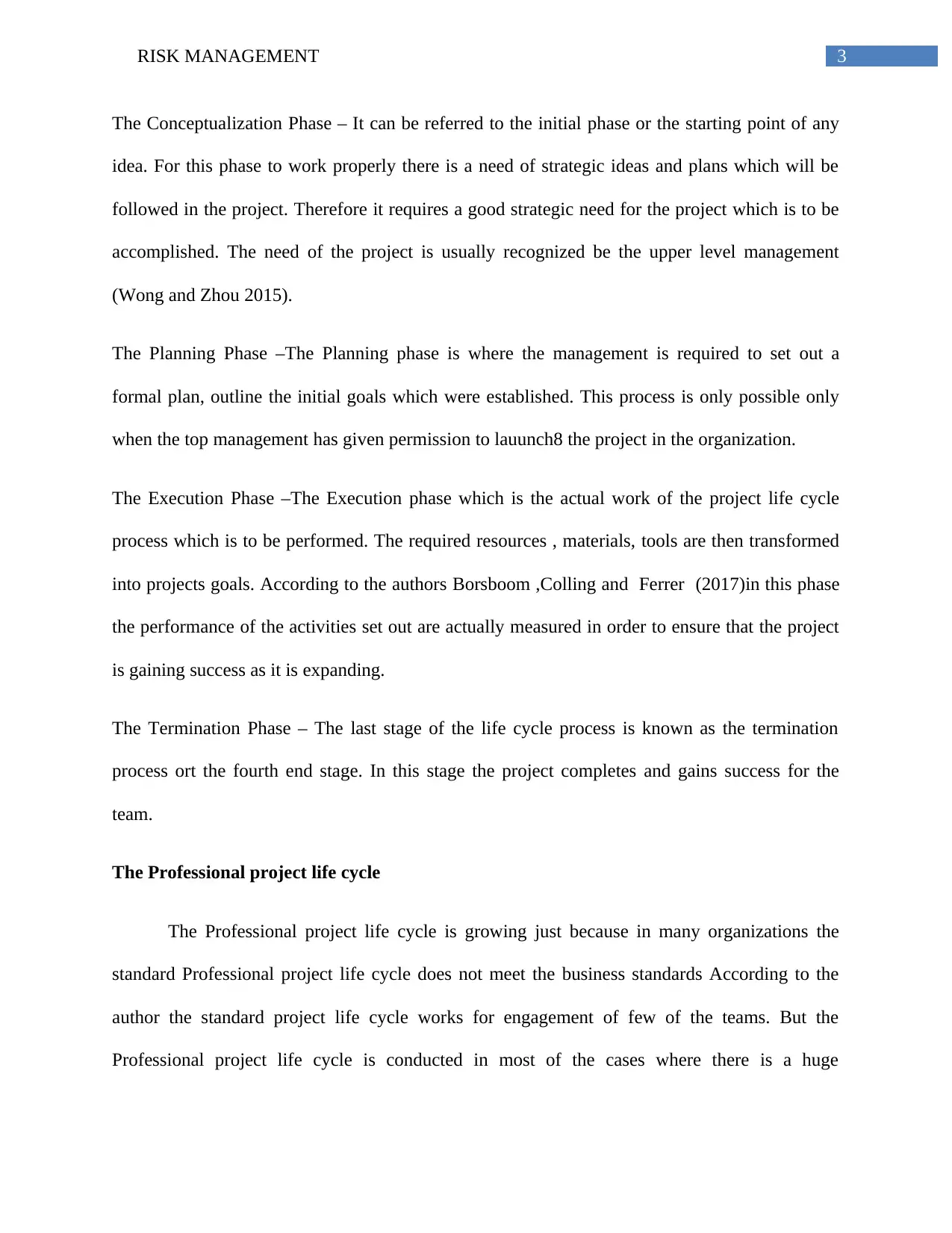
The standard project life cycle is used by the leaders to ensure that the project which is delivered
to the client is one of the best services provided. The standard project life cycle involves few of
the four steps and phrases which are discussed below :
Fig 1. Represents the Standard project life cycle
Source : Borsboom ,Colling and Ferrer (2017)
Document Page
3RISK MANAGEMENT
The Conceptualization Phase – It can be referred to the initial phase or the starting point of any
idea. For this phase to work properly there is a need of strategic ideas and plans which will be
followed in the project. Therefore it requires a good strategic need for the project which is to be
accomplished. The need of the project is usually recognized be the upper level management
(Wong and Zhou 2015).
The Planning Phase –The Planning phase is where the management is required to set out a
formal plan, outline the initial goals which were established. This process is only possible only
when the top management has given permission to lauunch8 the project in the organization.
The Execution Phase –The Execution phase which is the actual work of the project life cycle
process which is to be performed. The required resources , materials, tools are then transformed
into projects goals. According to the authors Borsboom ,Colling and Ferrer (2017)in this phase
the performance of the activities set out are actually measured in order to ensure that the project
is gaining success as it is expanding.
The Termination Phase – The last stage of the life cycle process is known as the termination
process ort the fourth end stage. In this stage the project completes and gains success for the
team.
The Professional project life cycle
The Professional project life cycle is growing just because in many organizations the
standard Professional project life cycle does not meet the business standards According to the
author the standard project life cycle works for engagement of few of the teams. But the
Professional project life cycle is conducted in most of the cases where there is a huge
tabler-icon-diamond-filled.svg

Paraphrase This Document

Need a fresh take? Get an instant paraphrase of this document with our AI Paraphraser
Document Page
4RISK MANAGEMENT
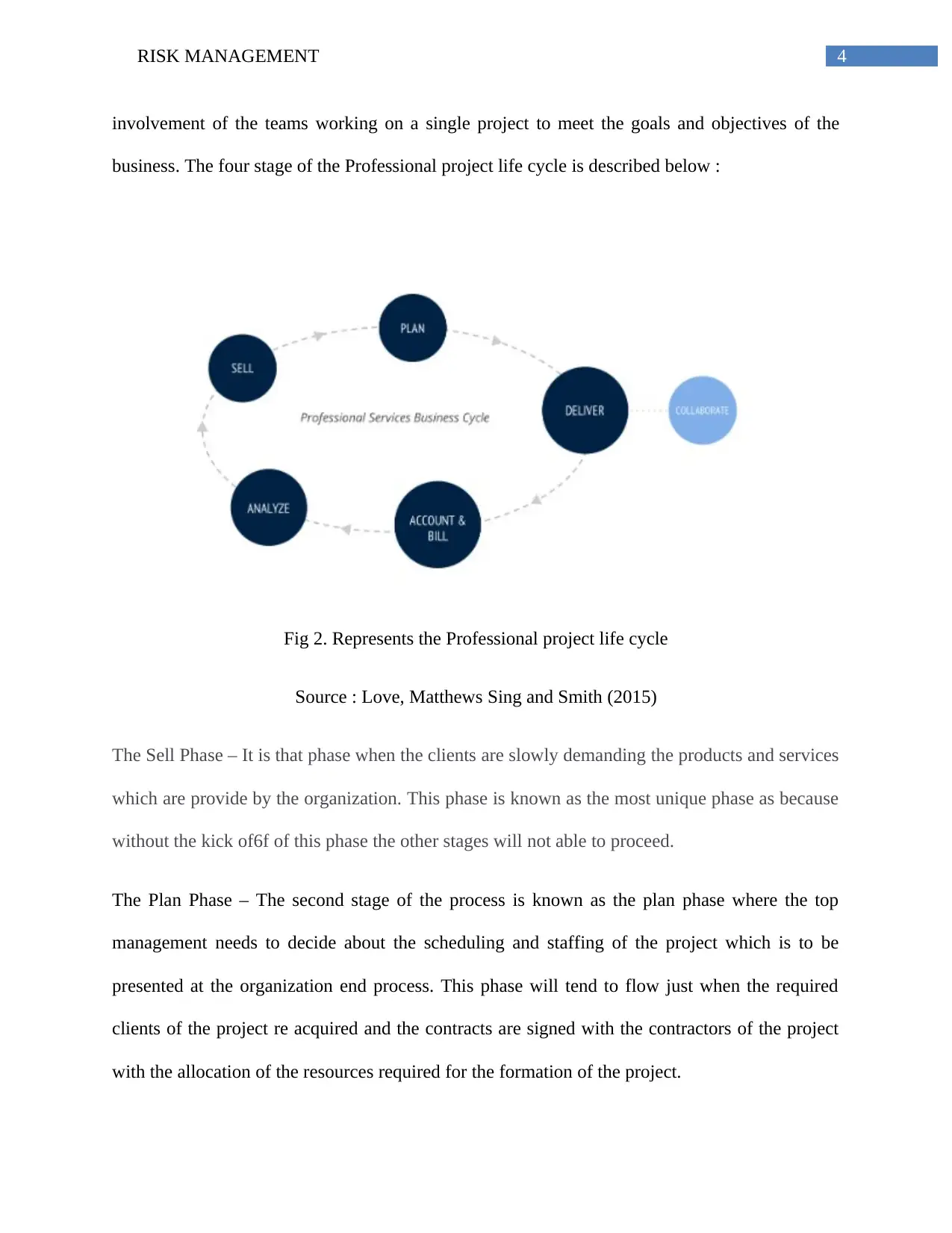
involvement of the teams working on a single project to meet the goals and objectives of the
business. The four stage of the Professional project life cycle is described below :
Fig 2. Represents the Professional project life cycle
Source : Love, Matthews Sing and Smith (2015)
The Sell Phase – It is that phase when the clients are slowly demanding the products and services
which are provide by the organization. This phase is known as the most unique phase as because
without the kick of6f of this phase the other stages will not able to proceed.
The Plan Phase – The second stage of the process is known as the plan phase where the top
management needs to decide about the scheduling and staffing of the project which is to be
presented at the organization end process. This phase will tend to flow just when the required
clients of the project re acquired and the contracts are signed with the contractors of the project
with the allocation of the resources required for the formation of the project.
Document Page
5RISK MANAGEMENT
The Deliver Phase – This phase is also known as the execution phase where the previously
developed things such as the plans and the process are set into motion. The organizations’
resources and the tools are moved towards their respective duties. In this process it is
recommended that as the changes in the plans arise the project manger should be able to take
care of those things. The project manager should also plan the budget of the project before the
deadline of the project.
The Account and Bill Phase – The account and the billing process of the project life cycle
involves various processes in order to recognize the revenue that will be earned and the financial
opportunities which are required to be gained. The product life cycle stages goes from the
execution phase and continues to execution phase of the product (Wong and Zhou 2015)
The Analyze Phase –The last stage of the life cycle process is the analyze phase where the top
management will have to involve managing performance of the product. They will also have to
go through the new trend and innovations and forecast them in to the business intelligence data.
The lack of the Analyze Phase is the most important difference between the Professional project
life cycle and the Standard project life cycle.
Implications of Project Life Cycle in the effective management of risk
The Risk identification is one of the first stages in the Project Life Cycle. The risk might
have a negative impact of the project life cycle therefore it need to be prevented. The effective
management of risk involves few of the stages such as the analysis of risk at each stage of the
life cycle of the product. The next stage might include the identification of the key stakeholders
of the project and the last stage which involves the preliminary assessment of the possible
efe4cts of those risks. Few of the potential risks which are known to affect the product life cycle
Document Page
6RISK MANAGEMENT
process according to the authors Love, Matthews Sing and Smith (2015) are technical things,
cost of the project, scheduling clients, contractual nature, financial, political and environmental
risks. Therefore it is always recommended that the project manager should make a list of the
potential risks which might be involved for a short time or a longhop time with the product life
cycle. The project manager should make a proper allocation of the resources and set a team who
will identify risks and determine the probability and then allocate the resources required for the
mitigation of the risks.
Risk
Descriptio
n
Shutter
factor
Affected
activity
Responsibility Proposed
strategy
1Lack of
experienced
person
Hiring people
without any
experience
It will be
indicated in
the project
life cycle
Human Resource Competencies
are required
to be
implemented
2 Project team
modification
Resignation
from the
employees
It will be
indicated in
the project
Project manager Training
given to the
employees
tabler-icon-diamond-filled.svg

Paraphrase This Document

Need a fresh take? Get an instant paraphrase of this document with our AI Paraphraser
Document Page
7RISK MANAGEMENT
life cycle
3 Lack of
interest from
the employee
or team
members
Modifications
from the
competitive
company
It will be
indicated in
the project
life cycle
Team leader Discuss the
modality of
the project
with the
members
4 Bankruptcy
risk of target
company
New political
factors raised
It will be
indicated in
the project
life cycle
External market SWOT of the
competitive
company and
determine
new
strategies.,
Fig 3. Represents the Risk Assessment and Management plan
Source: Self Made
Document Page
8RISK MANAGEMENT
References
Alexander, J., Ackermann, F. and Love, P.E., 2019. Taking a Holistic Exploration of the Project
Life Cycle in Public–Private Partnerships. Project Management Journal, p.8756972819848226.
Chong, U. and Hopkins, O., 2016. An international experience on the evolution of road costs
during the project life cycle. Transport Policy, 48, pp.60-66.
de Bekker-Grob, E.W., Berlin, C., Levitan, B., Raza, K., Christoforidi, K., Cleemput, I.,
Pelouchova, J., Enzmann, H., Cook, N. and Hansson, M.G., 2017. Giving patients’ preferences a
voice in medical treatment life cycle: the PREFER public–private project.
Fraser-Thomas, J., Green, P., Anderson, L., Auksi, M., Belshaw, C., Besito, R., Khan, T.,
McCrady, K., Silver, M. and Wolman, L., 2017. A physical literacy strategy for urban
indigenous families through the life cycle. Journal of Exercise, Movement, and Sport (SCAPPS
refereed abstracts repository), 49(1), pp.83-83.
Fuller, M.A., Valacich, J.S., George, J.F. and Schneider, C., 2017. Information Systems Project
Management: A Process and Team Approach, Edition 1.1. Prospect Press.
Jin, R., Zhong, B., Ma, L., Hashemi, A. and Ding, L., 2019. Integrating BIM with building
performance analysis in project life-cycle. Automation in Construction, 106, p.102861.
Kliem, R.L. and Ludin, I.S., 2019. Reducing project risk. Routledge.
Love, P.E., Liu, J., Matthews, J., Sing, C.P. and Smith, J., 2015. Future proofing PPPs: Life-
cycle performance measurement and building information modelling. Automation in Construction, 56, pp.26-35.
Document Page
9RISK MANAGEMENT
Schowanek, D., Borsboom-Patel, T., Bouvy, A., Colling, J., de Ferrer, J.A., Eggers, D., Groenke,
K., Gruenenwald, T., Martinsson, J., Mckeown, P. and Miller, B., 2018. Correction to: New and
updated life cycle inventories for surfactants used in European detergents: summary of the
ERASM surfactant life cycle and ecofootprinting project. The International Journal of Life Cycle
Assessment, 23(4), pp.887-889.
Volkov, A. and Kuzina, O., 2016. Complementary assets in the methodology of implementation
unified information model of the city environment project life cycle. Procedia engineering, 153,
pp.838-843.
Wong, J.K.W. and Zhou, J., 2015. Enhancing environmental sustainability over building life
cycles through green BIM: A review. Automation in Construction, 57, pp.156-165
Zue, C. and Paik, K., 2017. 16 A Global Health Project Life Cycle. Global Health Informatics:
Principles of EHealth and MHealth to Improve Quality of Care, p.197.
chevron_up_icon
1 out of 10
circle_padding
hide_on_mobile
zoom_out_icon
[object Object]