MS 969 - Tabuk Substation #12: Project Management, Risk, and Quality
VerifiedAdded on 2023/06/15
|27
|4246
|339
Report
AI Summary
This report analyzes the project management aspects of constructing Tabuk Substation #12, focusing on risk management, quality evaluation, and strategic planning. It begins with an introduction to the project's context, driven by the growing power demand in the Tabuk area. The report details project scope management, including defining objectives, goals, sub-phases, and tasks. It identifies the roles and responsibilities of the project manager, emphasizing their importance in managing the project's various services, ensuring worker safety, and maintaining clear communication. A comprehensive risk assessment is conducted, covering market, economic, ecological, technical, and policy factors, leading to the identification of potential risks such as confusion, market uncertainty, and process delays. The report outlines a risk management strategy, emphasizing proactive decision-making and strategy adjustments to mitigate threats. Quality evaluation is addressed through quality planning and assurance, advocating for frequent auditing and testing. The project management section includes a work breakdown structure and a project plan, detailing tasks, resources, budget, and schedule. The report concludes by highlighting the importance of quality and continuous improvement throughout the project lifecycle.
Project Managemnt on Electrical Power Engineering
Paraphrase This Document
Need a fresh take? Get an instant paraphrase of this document with our AI Paraphraser

Executive Summary
This report represents the risk management and project management for a construction of substation in
Tabuk area. The strategy required for implementing a project, then the steps required for the completion
of the project are investigated. The project management tool is used for managing the project. The roles
and responsibilities of the project manager are defined. The value of risk assessment and risk
management is highlighted.
This report represents the risk management and project management for a construction of substation in
Tabuk area. The strategy required for implementing a project, then the steps required for the completion
of the project are investigated. The project management tool is used for managing the project. The roles
and responsibilities of the project manager are defined. The value of risk assessment and risk
management is highlighted.

Table of Contents
1. Introduction.......................................................................................................................................3
1.1 Project Description....................................................................................................................3
2. Project Scope Management...............................................................................................................4
2.1 Defining Scope............................................................................................................................4
2.2 Project Requirements................................................................................................................6
2.2.1 Developing Strategies.........................................................................................................6
3. Project Manager's Roles and Responsibilities.................................................................................7
4. Risk Assessment.................................................................................................................................7
4.1 Risks............................................................................................................................................8
5. Risk Management..............................................................................................................................9
6. Quality Evaluation...........................................................................................................................10
6.1 Quality Planning and Assurance............................................................................................10
7. Project Management.......................................................................................................................10
7.1 Work Breakdown Structure...................................................................................................10
7.2 Project Plan..............................................................................................................................11
7.2.1 Resources..........................................................................................................................19
7.2.2 Milestones.........................................................................................................................21
7.2.3 Cost estimation.................................................................................................................21
7.2.4 Gantt chart.......................................................................................................................25
8. Conclusion........................................................................................................................................25
References................................................................................................................................................26
1. Introduction.......................................................................................................................................3
1.1 Project Description....................................................................................................................3
2. Project Scope Management...............................................................................................................4
2.1 Defining Scope............................................................................................................................4
2.2 Project Requirements................................................................................................................6
2.2.1 Developing Strategies.........................................................................................................6
3. Project Manager's Roles and Responsibilities.................................................................................7
4. Risk Assessment.................................................................................................................................7
4.1 Risks............................................................................................................................................8
5. Risk Management..............................................................................................................................9
6. Quality Evaluation...........................................................................................................................10
6.1 Quality Planning and Assurance............................................................................................10
7. Project Management.......................................................................................................................10
7.1 Work Breakdown Structure...................................................................................................10
7.2 Project Plan..............................................................................................................................11
7.2.1 Resources..........................................................................................................................19
7.2.2 Milestones.........................................................................................................................21
7.2.3 Cost estimation.................................................................................................................21
7.2.4 Gantt chart.......................................................................................................................25
8. Conclusion........................................................................................................................................25
References................................................................................................................................................26
⊘ This is a preview!⊘
Do you want full access?
Subscribe today to unlock all pages.

Trusted by 1+ million students worldwide

1. Introduction
The two hotels named AL Muruj and AL Wurud belongs to Tabuk area, and this makes it
a fast load growing area. Because of their high power demand, this area is fed more power from
the present Tabuk’s 2nd and 3rd Substations (S/S). For the Tabuk area to meet the power
requirements, Tabuk S/S # 12’s construction was determined. The Saudi Electricity Company in
the Western Region gave the proposal for expanding its 132kV systems in the Tabuk area.
The object of this report is to provide complete project, which wide scope where all the
aspects of the project are analysed. The researcher of this report will concentrate on managing
the risk, its quality and the project’s strategic plan, so as to make it a complete project. The
project management tool will be utilised to meet the scopes of the project. The roles and
responsibilities of the project manager will be determined. The necessary strategies required will
be projected.
1.1 Project Description
The Scope of Work and Technical Specifications 14WN142 and associated PROJECT
Conceptual Design Drawings are provided to complete the Final Acceptance of the project
Tabuk Substation # 12. In Tabuk area, the company wants 132 kV indoor GIS type Substation
i.e., arranged in a double-bus-single breaker. The project manager is required to monitor the
project execution with the contractor on Lump Sum Turkey for designing, material procurement,
engineering, quality management, construction, inspections, commissioning, transport and for
delivery. He is also responsible for providing civil, architectural and electromechanical services
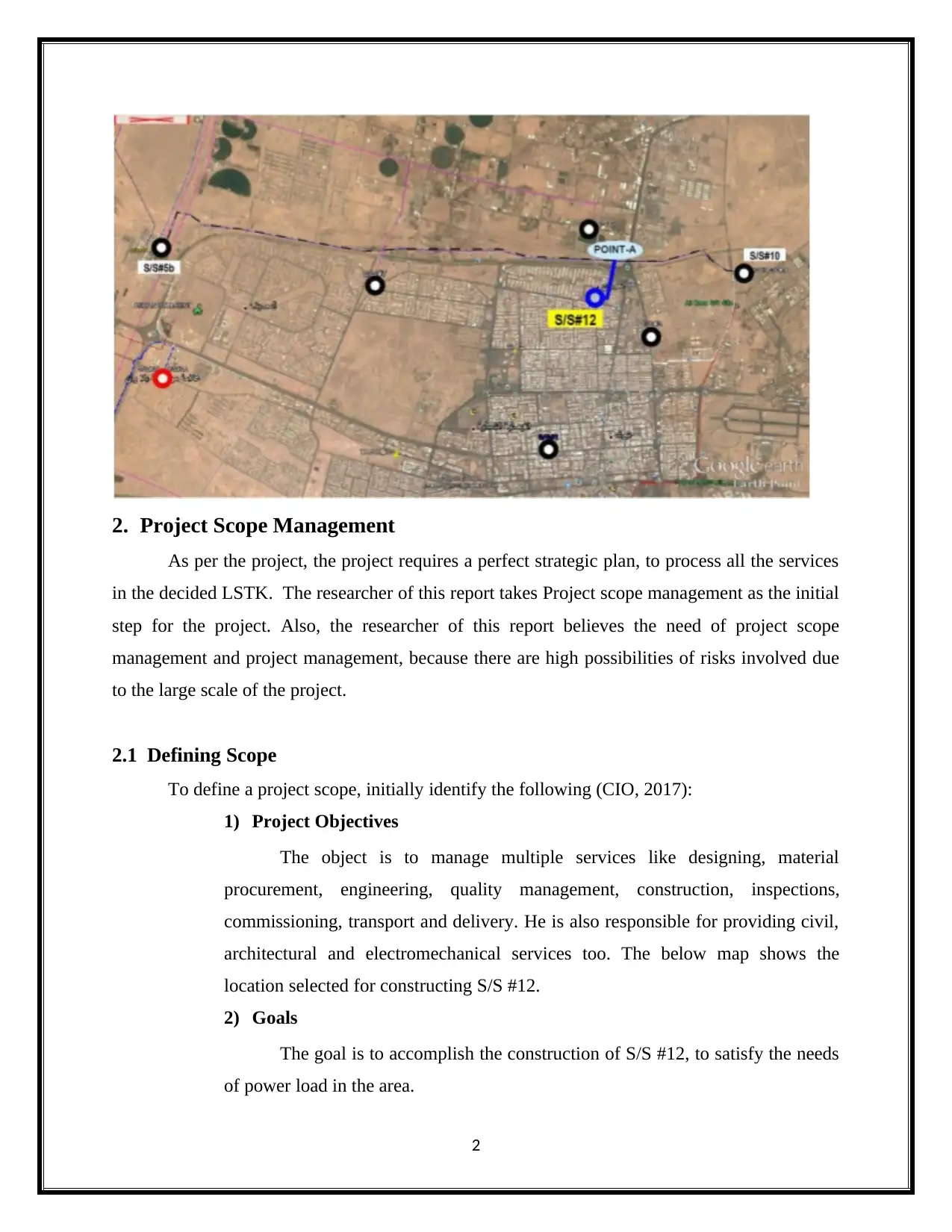
too. The below map shows the location selected for constructing S/S #12.
1
The two hotels named AL Muruj and AL Wurud belongs to Tabuk area, and this makes it
a fast load growing area. Because of their high power demand, this area is fed more power from
the present Tabuk’s 2nd and 3rd Substations (S/S). For the Tabuk area to meet the power
requirements, Tabuk S/S # 12’s construction was determined. The Saudi Electricity Company in
the Western Region gave the proposal for expanding its 132kV systems in the Tabuk area.
The object of this report is to provide complete project, which wide scope where all the
aspects of the project are analysed. The researcher of this report will concentrate on managing
the risk, its quality and the project’s strategic plan, so as to make it a complete project. The
project management tool will be utilised to meet the scopes of the project. The roles and
responsibilities of the project manager will be determined. The necessary strategies required will
be projected.
1.1 Project Description
The Scope of Work and Technical Specifications 14WN142 and associated PROJECT
Conceptual Design Drawings are provided to complete the Final Acceptance of the project
Tabuk Substation # 12. In Tabuk area, the company wants 132 kV indoor GIS type Substation
i.e., arranged in a double-bus-single breaker. The project manager is required to monitor the
project execution with the contractor on Lump Sum Turkey for designing, material procurement,
engineering, quality management, construction, inspections, commissioning, transport and for
delivery. He is also responsible for providing civil, architectural and electromechanical services
too. The below map shows the location selected for constructing S/S #12.
1
Paraphrase This Document
Need a fresh take? Get an instant paraphrase of this document with our AI Paraphraser

2. Project Scope Management
As per the project, the project requires a perfect strategic plan, to process all the services
in the decided LSTK. The researcher of this report takes Project scope management as the initial
step for the project. Also, the researcher of this report believes the need of project scope
management and project management, because there are high possibilities of risks involved due
to the large scale of the project.
2.1 Defining Scope
To define a project scope, initially identify the following (CIO, 2017):
1) Project Objectives
The object is to manage multiple services like designing, material
procurement, engineering, quality management, construction, inspections,
commissioning, transport and delivery. He is also responsible for providing civil,
architectural and electromechanical services too. The below map shows the
location selected for constructing S/S #12.
2) Goals
The goal is to accomplish the construction of S/S #12, to satisfy the needs
of power load in the area.
2
As per the project, the project requires a perfect strategic plan, to process all the services
in the decided LSTK. The researcher of this report takes Project scope management as the initial
step for the project. Also, the researcher of this report believes the need of project scope
management and project management, because there are high possibilities of risks involved due
to the large scale of the project.
2.1 Defining Scope
To define a project scope, initially identify the following (CIO, 2017):
1) Project Objectives
The object is to manage multiple services like designing, material
procurement, engineering, quality management, construction, inspections,
commissioning, transport and delivery. He is also responsible for providing civil,
architectural and electromechanical services too. The below map shows the
location selected for constructing S/S #12.
2) Goals
The goal is to accomplish the construction of S/S #12, to satisfy the needs
of power load in the area.
2

3) Sub-Phases
The sub phases for this project are:
i. Material procurement
ii. Engineering
iii. Quality management
iv. Construction
v. Inspections
vi. Commissioning
vii. Transport
viii. Delivery
4) Tasks
The main tasks are listed below:
a) Defining scope
b) Identifying the roles and responsibilities
c) Assessing the risks
d) Managing the risks
e) Quality check
f) Project compilations
5) Resources
6) Budget
7) Schedule
The tasks, resources, budget and schedule are discussed in the later sections of this report. The
other scopes of this report includes the limitations. Mentioning clear project scope for the
stakeholders, head management and to team is a must, to deliver the project requirements.
2.2 Project Requirements
The resources required are listed below:
1) National Grid Saudi Arabia Company
3
The sub phases for this project are:
i. Material procurement
ii. Engineering
iii. Quality management
iv. Construction
v. Inspections
vi. Commissioning
vii. Transport
viii. Delivery
4) Tasks
The main tasks are listed below:
a) Defining scope
b) Identifying the roles and responsibilities
c) Assessing the risks
d) Managing the risks
e) Quality check
f) Project compilations
5) Resources
6) Budget
7) Schedule
The tasks, resources, budget and schedule are discussed in the later sections of this report. The
other scopes of this report includes the limitations. Mentioning clear project scope for the
stakeholders, head management and to team is a must, to deliver the project requirements.
2.2 Project Requirements
The resources required are listed below:
1) National Grid Saudi Arabia Company
3
⊘ This is a preview!⊘
Do you want full access?
Subscribe today to unlock all pages.

Trusted by 1+ million students worldwide

2) Workers/laborers
3) Substation operator
4) Assistant Substation operator
5) Project engineer as a manager
6) Contractor
7) Assistant Contractors
8) Senior Supervisor
9) Quality Engineers
10) Risk analysts
11) Raw materials for construction.
2.2.1 Developing Strategies
After defining the scope, validating and controlling the scope is essential.
Validating Scope
This scope concentrates on customer acceptance. It comes in to play at the end i.e., after
the acceptance of project deliverables by the customer. The customer/ client provides feedback
on completed project (Monnappa, 2017).
Controlling Scope
This scope concentrates on project’s status monitoring and to manage the changes
(Monnappa, 2017).
For both Validating the scope and to control the scope Project management is the tool
utilized by the researcher in this report (Monnappa, 2017). The project Management will be
carried out in the further sections of the report.
Active risk mitigation is the strategy. The strategy is to take immediate steps on
improvising the process.
3. Project Manager's Roles and Responsibilities
The project manager has a prominent role to play in power engineering project, as it is
correlated with the project’s results.
The project manager has the following roles to play (Milivojević et al., 2006):
4
3) Substation operator
4) Assistant Substation operator
5) Project engineer as a manager
6) Contractor
7) Assistant Contractors
8) Senior Supervisor
9) Quality Engineers
10) Risk analysts
11) Raw materials for construction.
2.2.1 Developing Strategies
After defining the scope, validating and controlling the scope is essential.
Validating Scope
This scope concentrates on customer acceptance. It comes in to play at the end i.e., after
the acceptance of project deliverables by the customer. The customer/ client provides feedback
on completed project (Monnappa, 2017).
Controlling Scope
This scope concentrates on project’s status monitoring and to manage the changes
(Monnappa, 2017).
For both Validating the scope and to control the scope Project management is the tool
utilized by the researcher in this report (Monnappa, 2017). The project Management will be
carried out in the further sections of the report.
Active risk mitigation is the strategy. The strategy is to take immediate steps on
improvising the process.
3. Project Manager's Roles and Responsibilities
The project manager has a prominent role to play in power engineering project, as it is
correlated with the project’s results.
The project manager has the following roles to play (Milivojević et al., 2006):
4
Paraphrase This Document
Need a fresh take? Get an instant paraphrase of this document with our AI Paraphraser

1) Manage the Power Electronics project
2) Planning
3) Dividing roles
4) Motivating
5) To define the problems.
6) Manage the problem related to delegation.
7) Time management
8) Conduct team Meetings and ensure clear communication.
9) The safety of the workers is the responsivity of the project manager.
10) For setting the goals.
11) To meet the time and cost.
12) To ease the confusions and misunderstandings.
13) To accurately update the status to the project to senior management and
other stakeholders.
4. Risk Assessment
As a large scale project, this project compulsory requires Risk Assessments and this is the
tough task which requires more focus. The risk assessment helps this project to find the exact
resources and experience for working on the risks. The assessment induces in identifying the
performance of the following:
1) Work operations in construction.
2) Technology
3) Engineering work
4) Quality management
5) In various inspections of the project.
6) Delivery
Risk Evaluation includes the following areas to be assessed (Chuansheng, Xiaoxi and
Dapeng, 2011):
1) Market factor
a) Market price
b) Demand in the market.
5
2) Planning
3) Dividing roles
4) Motivating
5) To define the problems.
6) Manage the problem related to delegation.
7) Time management
8) Conduct team Meetings and ensure clear communication.
9) The safety of the workers is the responsivity of the project manager.
10) For setting the goals.
11) To meet the time and cost.
12) To ease the confusions and misunderstandings.
13) To accurately update the status to the project to senior management and
other stakeholders.
4. Risk Assessment
As a large scale project, this project compulsory requires Risk Assessments and this is the
tough task which requires more focus. The risk assessment helps this project to find the exact
resources and experience for working on the risks. The assessment induces in identifying the
performance of the following:
1) Work operations in construction.
2) Technology
3) Engineering work
4) Quality management
5) In various inspections of the project.
6) Delivery
Risk Evaluation includes the following areas to be assessed (Chuansheng, Xiaoxi and
Dapeng, 2011):
1) Market factor
a) Market price
b) Demand in the market.
5

2) Economic Factor
i. Increase in material and labour cost.
ii. Diversity in financing channel.
iii. Capital income
iv. Uncertainty in economic benefit.
3) Ecological Factor
a) Level of noise pollution.
b) Weather
c) Quality of water.
4) Technical Factor
i. Quality of construction.
ii. Final status
iii. Cost overflow
5) Policy Factor
a) New laws
b) Support from the Government.
4.1 Risks
The identified risks are listed below:
1) Confusion and conflicts, due to lots of services are being handled.
2) Increased risks.
3) Market uncertainty
4) Multiple services
5) More number of heads for each process or service.
6) Communication gap
7) Co-operation
8) Team management
9) Process delay leading to Project delay.
10) Information delay
11) Quality construction
12) Uncertainty
6
i. Increase in material and labour cost.
ii. Diversity in financing channel.
iii. Capital income
iv. Uncertainty in economic benefit.
3) Ecological Factor
a) Level of noise pollution.
b) Weather
c) Quality of water.
4) Technical Factor
i. Quality of construction.
ii. Final status
iii. Cost overflow
5) Policy Factor
a) New laws
b) Support from the Government.
4.1 Risks
The identified risks are listed below:
1) Confusion and conflicts, due to lots of services are being handled.
2) Increased risks.
3) Market uncertainty
4) Multiple services
5) More number of heads for each process or service.
6) Communication gap
7) Co-operation
8) Team management
9) Process delay leading to Project delay.
10) Information delay
11) Quality construction
12) Uncertainty
6
⊘ This is a preview!⊘
Do you want full access?
Subscribe today to unlock all pages.

Trusted by 1+ million students worldwide

13) Power system security
5. Risk Management
Risk management in power engineering projects require more attention, it ensures to have
strong perception and the process should be improvised immediately (Szymański, 2017). The
accuracy level of the risk assessment is interrelated to the evaluation model (Ferreira, Vieira and
Borbinha, 2014).
The researchers of this report has found that Risk management’s purpose includes the
following (Chuansheng, Xiaoxi and Dapeng, 2011):
a) To provide support in taking decisions, in uncertainty conditions.
b) Make adjustments to the strategy, for encountering the threats.
c) For choosing a proactive approach.
d) For increasing the chances of project success, to meet the time and cost.
The following are the steps involved in the risk management (Chuansheng, Xiaoxi and Dapeng,
2011):
a) Identifying the risks
b) Evaluating the risks
c) Prioritizing risks or taking risk related decisions.
d) Implementation on risks.
e) Supervising the risks.
6. Quality Evaluation
6.1 Quality Planning and Assurance
The author of this report has researched and come to a conclusion that whatever might be
the plan and process, maintaining the quality is important. Hence, this project is suggested to
undergo quality auditing to evaluate the current condition of the project. Henceforth, frequent
reviewing and testing is considered in the project plan. This helps in assessment and updating the
flaws.
7
5. Risk Management
Risk management in power engineering projects require more attention, it ensures to have
strong perception and the process should be improvised immediately (Szymański, 2017). The
accuracy level of the risk assessment is interrelated to the evaluation model (Ferreira, Vieira and
Borbinha, 2014).
The researchers of this report has found that Risk management’s purpose includes the
following (Chuansheng, Xiaoxi and Dapeng, 2011):
a) To provide support in taking decisions, in uncertainty conditions.
b) Make adjustments to the strategy, for encountering the threats.
c) For choosing a proactive approach.
d) For increasing the chances of project success, to meet the time and cost.
The following are the steps involved in the risk management (Chuansheng, Xiaoxi and Dapeng,
2011):
a) Identifying the risks
b) Evaluating the risks
c) Prioritizing risks or taking risk related decisions.
d) Implementation on risks.
e) Supervising the risks.
6. Quality Evaluation
6.1 Quality Planning and Assurance
The author of this report has researched and come to a conclusion that whatever might be
the plan and process, maintaining the quality is important. Hence, this project is suggested to
undergo quality auditing to evaluate the current condition of the project. Henceforth, frequent
reviewing and testing is considered in the project plan. This helps in assessment and updating the
flaws.
7
Paraphrase This Document
Need a fresh take? Get an instant paraphrase of this document with our AI Paraphraser

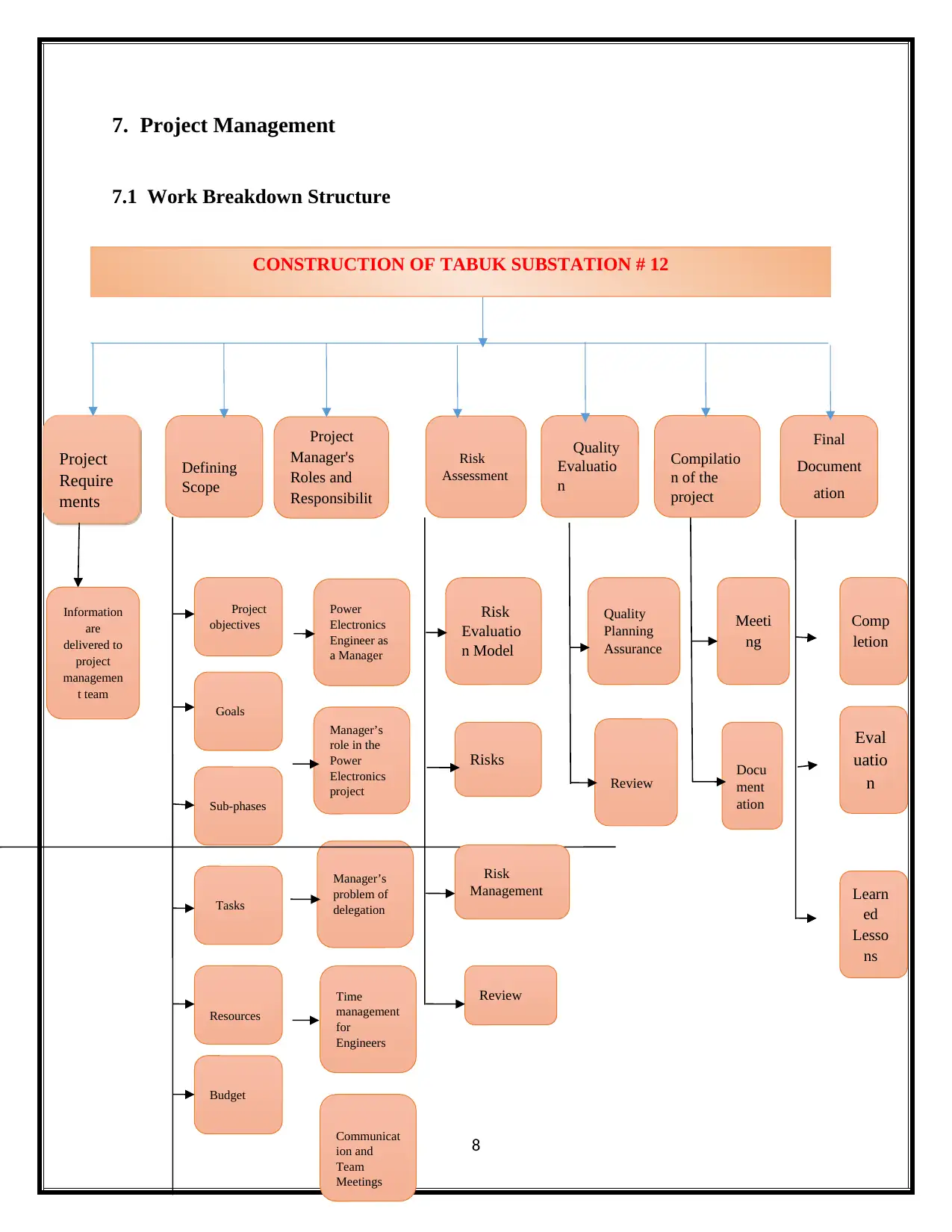
7. Project Management
7.1 Work Breakdown Structure
8
Project
Require
ments
Defining
Scope
Project
Manager's
Roles and
Responsibilit
ies
Risk
Assessment
Quality
Evaluatio
n
Compilatio
n of the
project
Final
Document
ation
Power
Electronics
Engineer as
a Manager
Risk
Evaluatio
n Model
Quality
Planning
Assurance
Meeti
ng
Comp
letion
Project
objectives
Manager’s
role in the
Power
Electronics
project
Manager’s
problem of
delegation
Risks
Risk
Management
Review
Review Docu
ment
ation
Eval
uatio
n
Learn
ed
Lesso
ns
Information
are
delivered to
project
managemen
t team
CONSTRUCTION OF TABUK SUBSTATION # 12
Goals
Sub-phases
Tasks
Resources
Budget
Time
management
for
Engineers
Communicat
ion and
Team
Meetings
7.1 Work Breakdown Structure
8
Project
Require
ments
Defining
Scope
Project
Manager's
Roles and
Responsibilit
ies
Risk
Assessment
Quality
Evaluatio
n
Compilatio
n of the
project
Final
Document
ation
Power
Electronics
Engineer as
a Manager
Risk
Evaluatio
n Model
Quality
Planning
Assurance
Meeti
ng
Comp
letion
Project
objectives
Manager’s
role in the
Power
Electronics
project
Manager’s
problem of
delegation
Risks
Risk
Management
Review
Review Docu
ment
ation
Eval
uatio
n
Learn
ed
Lesso
ns
Information
are
delivered to
project
managemen
t team
CONSTRUCTION OF TABUK SUBSTATION # 12
Goals
Sub-phases
Tasks
Resources
Budget
Time
management
for
Engineers
Communicat
ion and
Team
Meetings

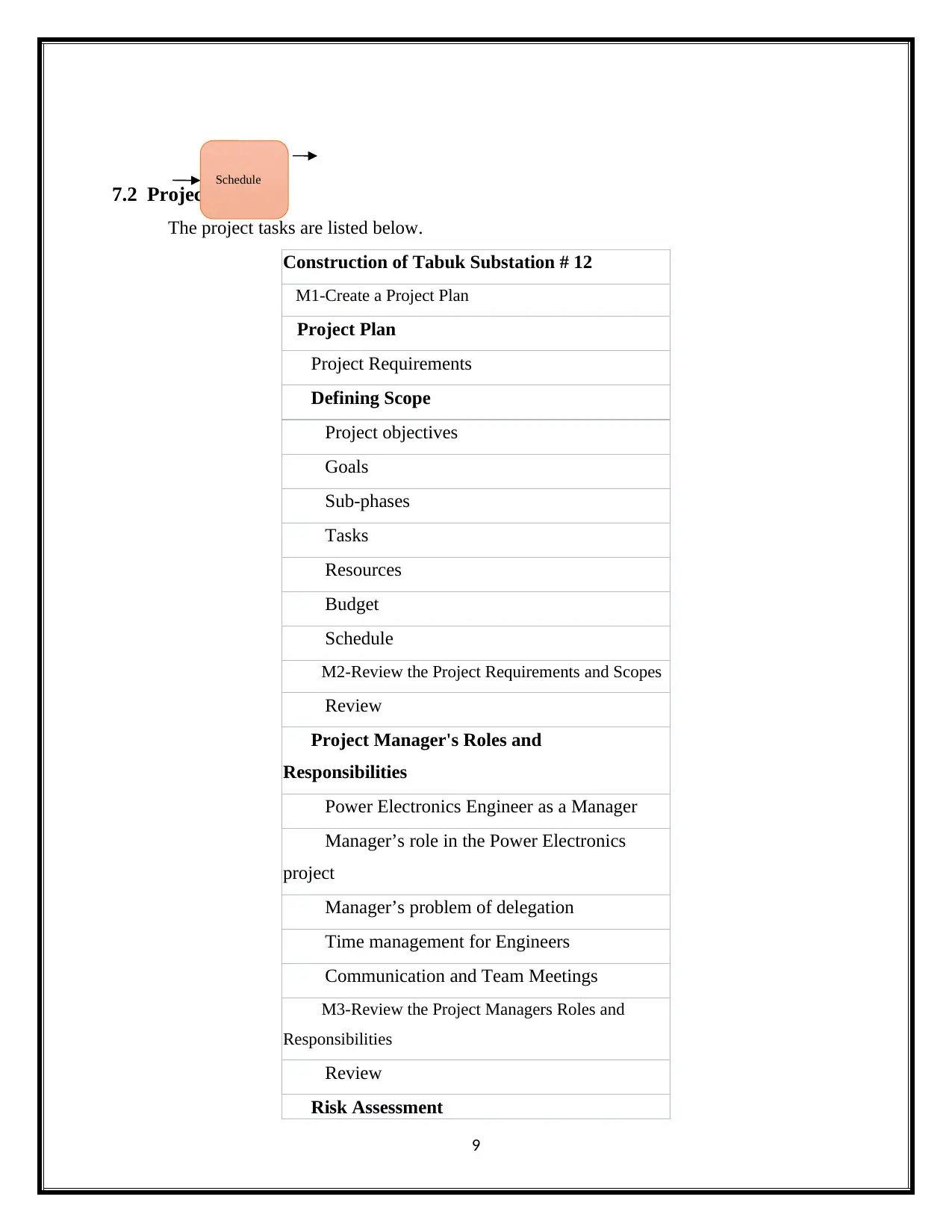
7.2 Project Plan
The project tasks are listed below.
Construction of Tabuk Substation # 12
M1-Create a Project Plan
Project Plan
Project Requirements
Defining Scope
Project objectives
Goals
Sub-phases
Tasks
Resources
Budget
Schedule
M2-Review the Project Requirements and Scopes
Review
Project Manager's Roles and
Responsibilities
Power Electronics Engineer as a Manager
Manager’s role in the Power Electronics
project
Manager’s problem of delegation
Time management for Engineers
Communication and Team Meetings
M3-Review the Project Managers Roles and
Responsibilities
Review
Risk Assessment
9
Schedule
The project tasks are listed below.
Construction of Tabuk Substation # 12
M1-Create a Project Plan
Project Plan
Project Requirements
Defining Scope
Project objectives
Goals
Sub-phases
Tasks
Resources
Budget
Schedule
M2-Review the Project Requirements and Scopes
Review
Project Manager's Roles and
Responsibilities
Power Electronics Engineer as a Manager
Manager’s role in the Power Electronics
project
Manager’s problem of delegation
Time management for Engineers
Communication and Team Meetings
M3-Review the Project Managers Roles and
Responsibilities
Review
Risk Assessment
9
Schedule
⊘ This is a preview!⊘
Do you want full access?
Subscribe today to unlock all pages.

Trusted by 1+ million students worldwide
1 out of 27
Related Documents
Your All-in-One AI-Powered Toolkit for Academic Success.
+13062052269
info@desklib.com
Available 24*7 on WhatsApp / Email
Unlock your academic potential
Copyright © 2020–2026 A2Z Services. All Rights Reserved. Developed and managed by ZUCOL.