Project Management Assignment - EPM System Implementation and Analysis

Verified

Added on  2022/08/23

|4
|497
|22
Project
AI Summary
This project management assignment focuses on the application of Enterprise Performance Management (EPM) systems within the context of software development. The assignment analyzes how EPM systems, leveraging data analysis and financial strategies, can enhance project outcomes and business performance. The solution highlights the importance of EPM in providing better analytics for corporate advisors and staff, leading to more informed decision-making. It also discusses the significance of data sharing across departments, the role of the CFO in data entry, and the benefits of adhering to best practices in EPM to achieve organizational success. The assignment references the evolution from simple reporting to sophisticated analytics and the importance of considering various factors, such as cost, support, and scalability, when selecting an EPM solution. The paper uses two references in support of the arguments made.
Document Page
Running head: PROJECT MANGEMENT
PROJECT MANGEMENT
Name of the Student:
Name of the University:
Author Note:
tabler-icon-diamond-filled.svg

Paraphrase This Document

Need a fresh take? Get an instant paraphrase of this document with our AI Paraphraser
Document Page
1PROJECT MANGEMENT
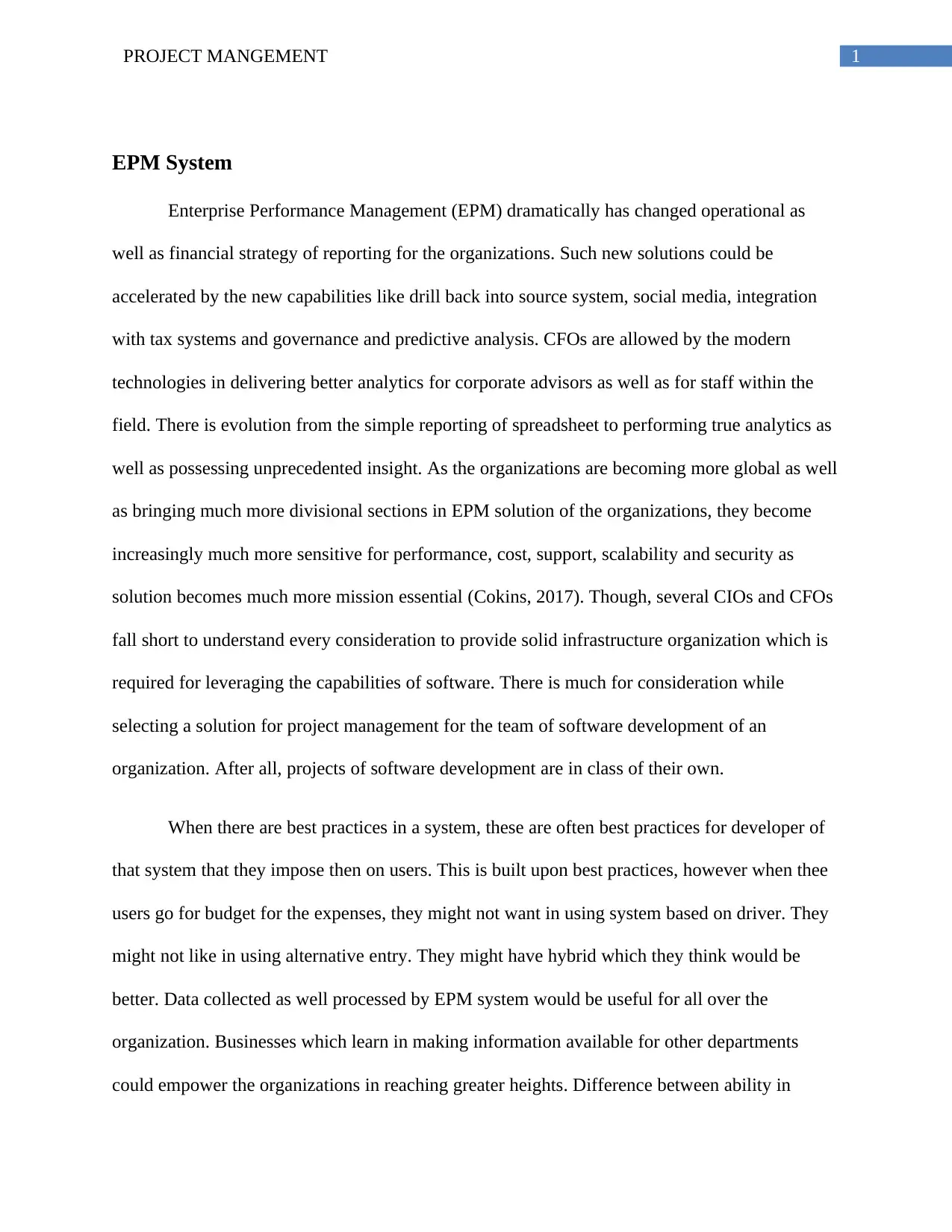
EPM System
Enterprise Performance Management (EPM) dramatically has changed operational as
well as financial strategy of reporting for the organizations. Such new solutions could be
accelerated by the new capabilities like drill back into source system, social media, integration
with tax systems and governance and predictive analysis. CFOs are allowed by the modern
technologies in delivering better analytics for corporate advisors as well as for staff within the
field. There is evolution from the simple reporting of spreadsheet to performing true analytics as
well as possessing unprecedented insight. As the organizations are becoming more global as well
as bringing much more divisional sections in EPM solution of the organizations, they become
increasingly much more sensitive for performance, cost, support, scalability and security as
solution becomes much more mission essential (Cokins, 2017). Though, several CIOs and CFOs
fall short to understand every consideration to provide solid infrastructure organization which is
required for leveraging the capabilities of software. There is much for consideration while
selecting a solution for project management for the team of software development of an
organization. After all, projects of software development are in class of their own.
When there are best practices in a system, these are often best practices for developer of
that system that they impose then on users. This is built upon best practices, however when thee
users go for budget for the expenses, they might not want in using system based on driver. They
might not like in using alternative entry. They might have hybrid which they think would be
better. Data collected as well processed by EPM system would be useful for all over the
organization. Businesses which learn in making information available for other departments
could empower the organizations in reaching greater heights. Difference between ability in
Document Page
2PROJECT MANGEMENT
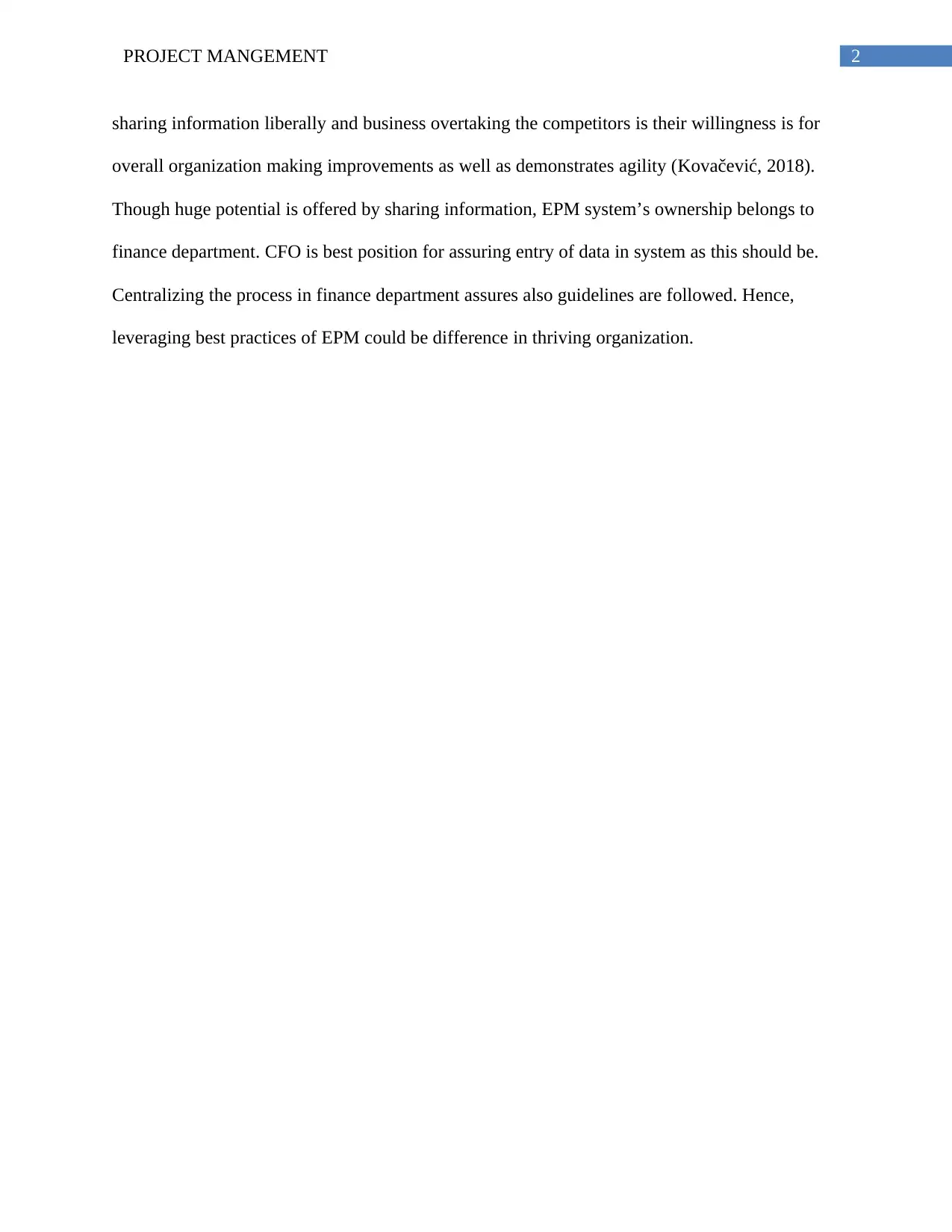
sharing information liberally and business overtaking the competitors is their willingness is for
overall organization making improvements as well as demonstrates agility (Kovačević, 2018).
Though huge potential is offered by sharing information, EPM system’s ownership belongs to
finance department. CFO is best position for assuring entry of data in system as this should be.
Centralizing the process in finance department assures also guidelines are followed. Hence,
leveraging best practices of EPM could be difference in thriving organization.
Document Page
3PROJECT MANGEMENT
References
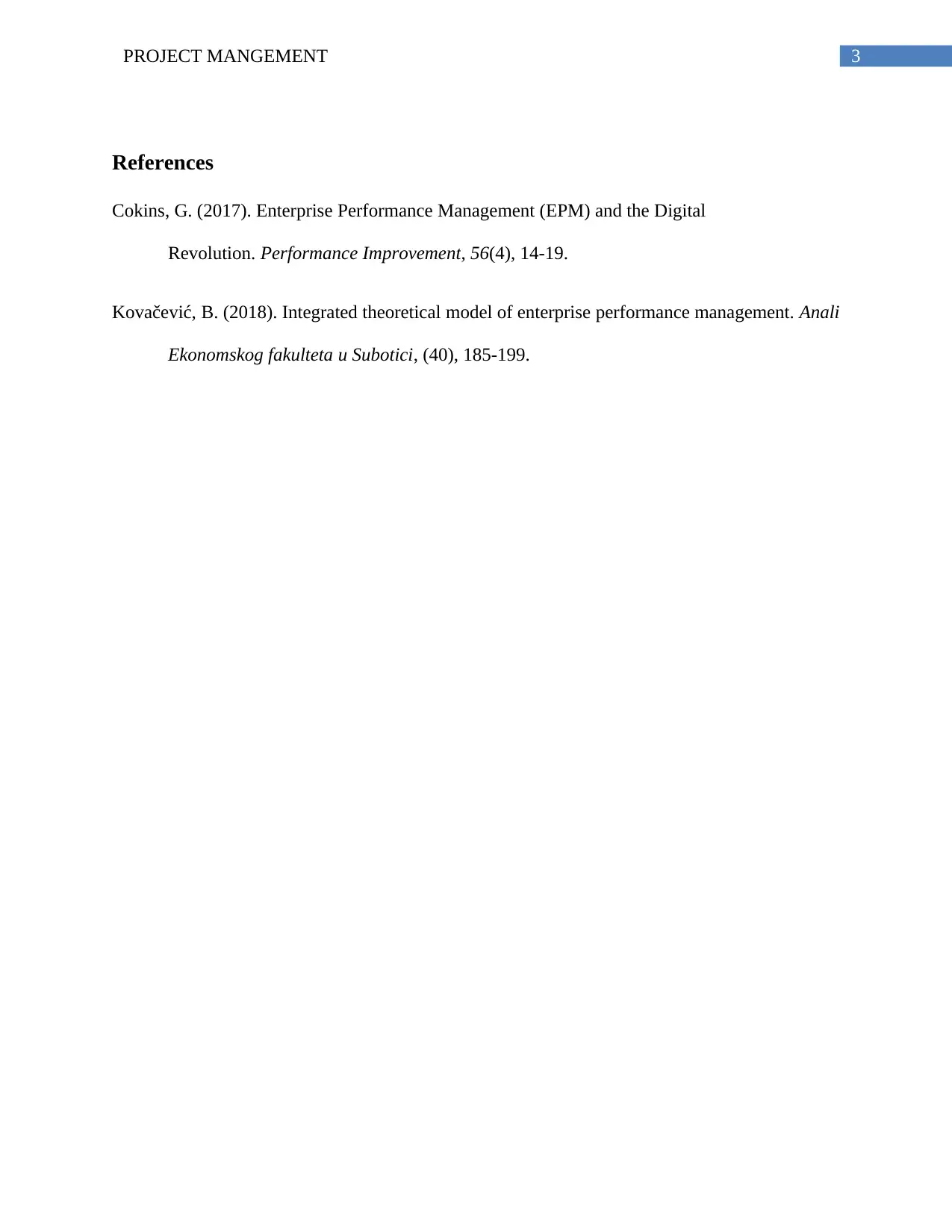
Cokins, G. (2017). Enterprise Performance Management (EPM) and the Digital
Revolution. Performance Improvement, 56(4), 14-19.
Kovačević, B. (2018). Integrated theoretical model of enterprise performance management. Anali
Ekonomskog fakulteta u Subotici, (40), 185-199.
chevron_up_icon
1 out of 4
circle_padding
hide_on_mobile
zoom_out_icon
[object Object]