Methodology Analysis: Agile, Waterfall, PRINCE2 in Project Management

Verified

Added on  2023/01/11

|6
|1816
|88
Report
AI Summary
This report provides an analysis and comparison of three prominent project management methodologies: Agile, Waterfall, and PRINCE2. It examines their strengths and weaknesses in the context of a university project involving the refurbishment and redevelopment of Chapman Hall in Queen's Building. The report discusses the suitability of each methodology for the project, considering factors such as flexibility, risk management, and the need for structured planning. Ultimately, the report recommends PRINCE2 as the most appropriate methodology due to its controlled environment, suitability for organizations with fixed structures, and effective risk management capabilities. The conclusion emphasizes the importance of selecting the right methodology to ensure project success and risk mitigation.
Document Page
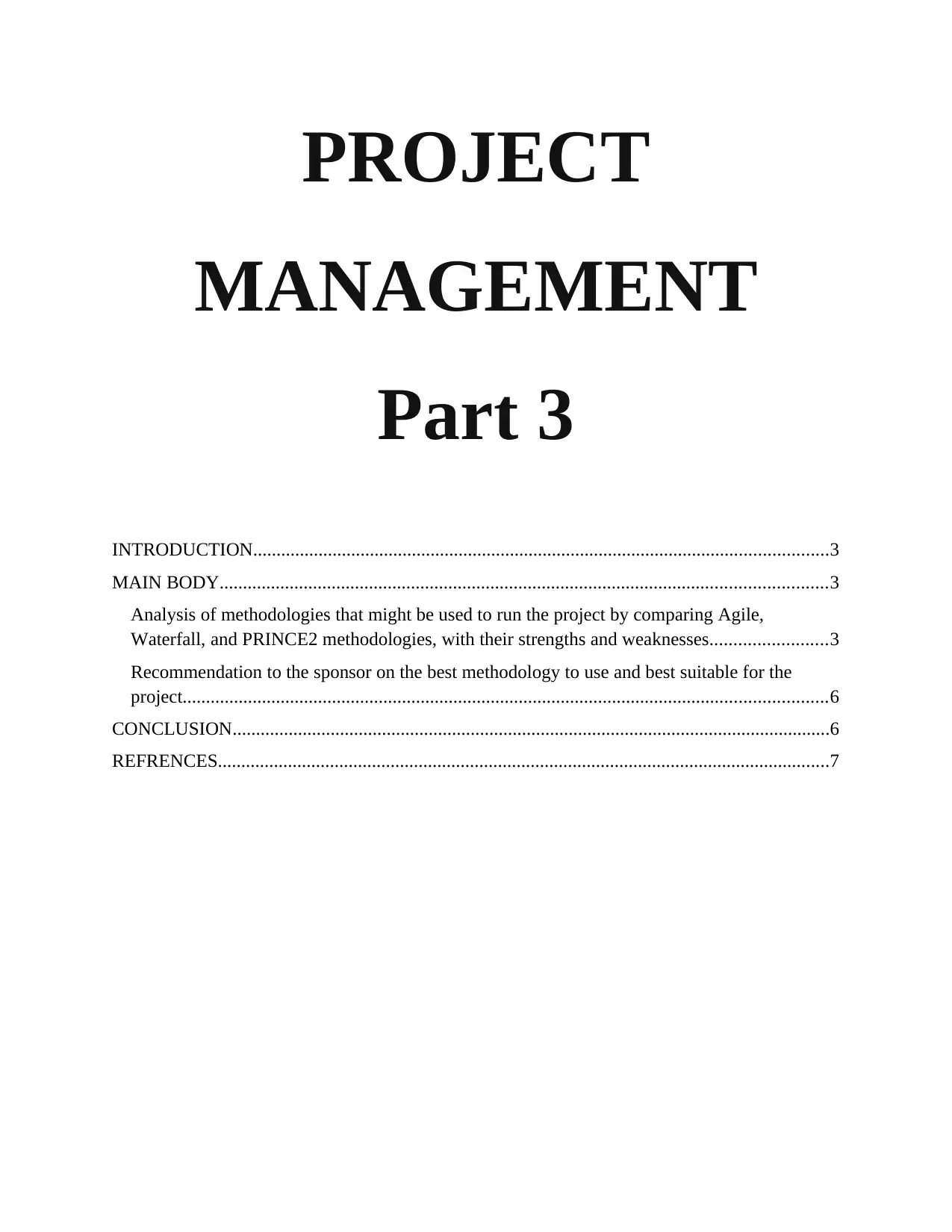
PROJECT
MANAGEMENT
Part 3
INTRODUCTION...........................................................................................................................3
MAIN BODY..................................................................................................................................3
Analysis of methodologies that might be used to run the project by comparing Agile,
Waterfall, and PRINCE2 methodologies, with their strengths and weaknesses.........................3
Recommendation to the sponsor on the best methodology to use and best suitable for the
project..........................................................................................................................................6
CONCLUSION................................................................................................................................6
REFRENCES...................................................................................................................................7
tabler-icon-diamond-filled.svg

Paraphrase This Document

Need a fresh take? Get an instant paraphrase of this document with our AI Paraphraser
Document Page
INTRODUCTION
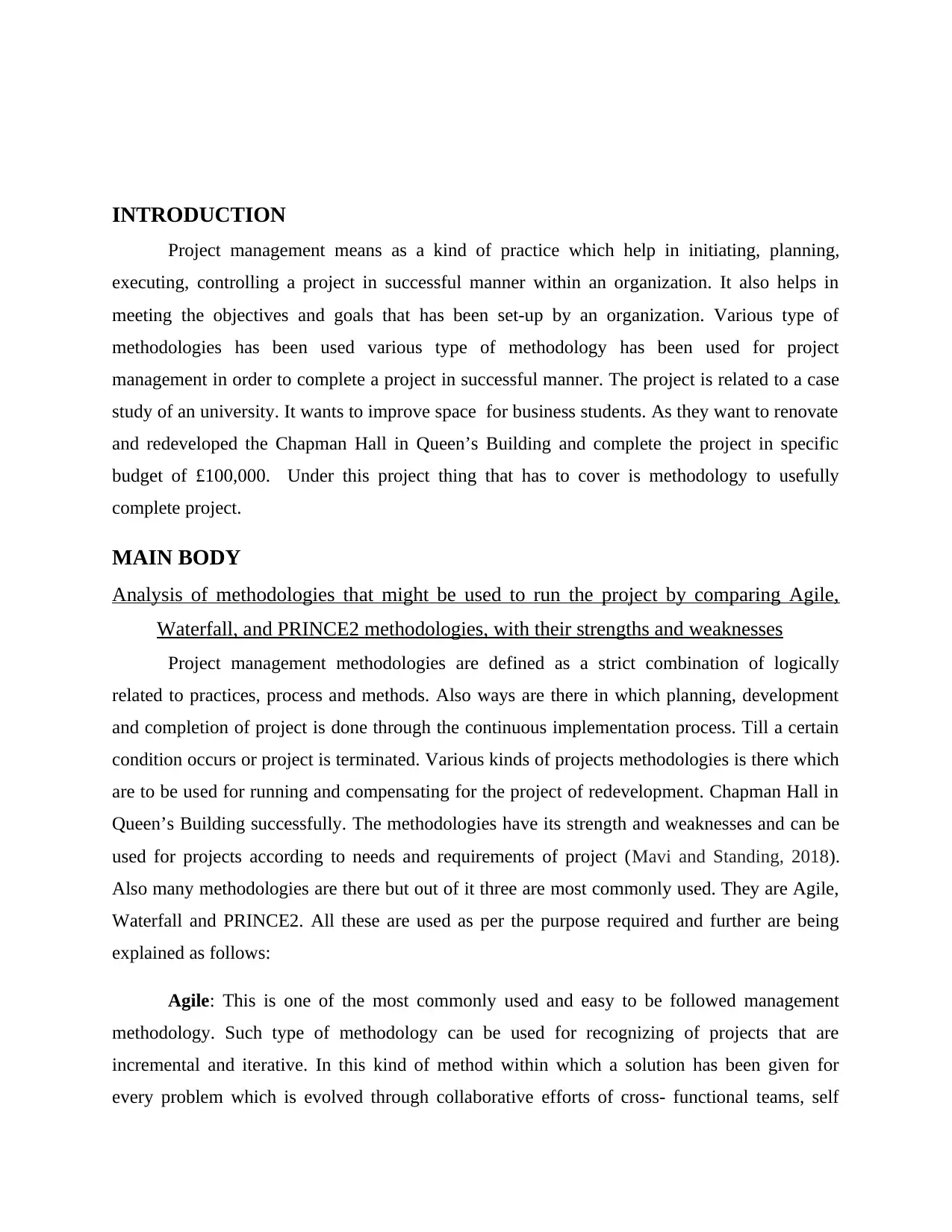
Project management means as a kind of practice which help in initiating, planning,
executing, controlling a project in successful manner within an organization. It also helps in
meeting the objectives and goals that has been set-up by an organization. Various type of
methodologies has been used various type of methodology has been used for project
management in order to complete a project in successful manner. The project is related to a case
study of an university. It wants to improve space for business students. As they want to renovate
and redeveloped the Chapman Hall in Queen’s Building and complete the project in specific
budget of £100,000. Under this project thing that has to cover is methodology to usefully
complete project.
MAIN BODY
Analysis of methodologies that might be used to run the project by comparing Agile,
Waterfall, and PRINCE2 methodologies, with their strengths and weaknesses
Project management methodologies are defined as a strict combination of logically
related to practices, process and methods. Also ways are there in which planning, development
and completion of project is done through the continuous implementation process. Till a certain
condition occurs or project is terminated. Various kinds of projects methodologies is there which
are to be used for running and compensating for the project of redevelopment. Chapman Hall in
Queen’s Building successfully. The methodologies have its strength and weaknesses and can be
used for projects according to needs and requirements of project (Mavi and Standing, 2018).
Also many methodologies are there but out of it three are most commonly used. They are Agile,
Waterfall and PRINCE2. All these are used as per the purpose required and further are being
explained as follows:
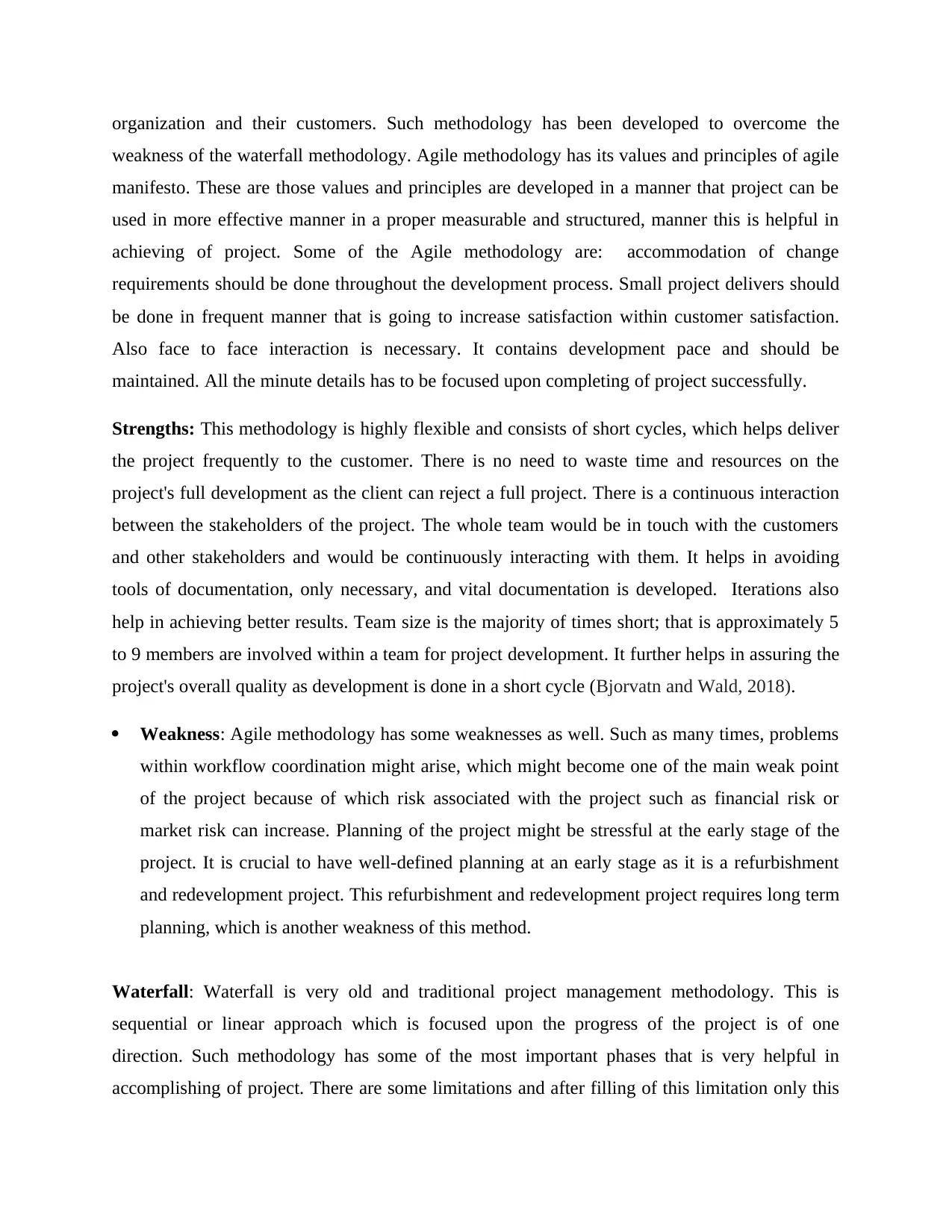
Agile: This is one of the most commonly used and easy to be followed management
methodology. Such type of methodology can be used for recognizing of projects that are
incremental and iterative. In this kind of method within which a solution has been given for
every problem which is evolved through collaborative efforts of cross- functional teams, self
Document Page
organization and their customers. Such methodology has been developed to overcome the
weakness of the waterfall methodology. Agile methodology has its values and principles of agile
manifesto. These are those values and principles are developed in a manner that project can be
used in more effective manner in a proper measurable and structured, manner this is helpful in
achieving of project. Some of the Agile methodology are: accommodation of change
requirements should be done throughout the development process. Small project delivers should
be done in frequent manner that is going to increase satisfaction within customer satisfaction.
Also face to face interaction is necessary. It contains development pace and should be
maintained. All the minute details has to be focused upon completing of project successfully.
Strengths: This methodology is highly flexible and consists of short cycles, which helps deliver
the project frequently to the customer. There is no need to waste time and resources on the
project's full development as the client can reject a full project. There is a continuous interaction
between the stakeholders of the project. The whole team would be in touch with the customers
and other stakeholders and would be continuously interacting with them. It helps in avoiding
tools of documentation, only necessary, and vital documentation is developed. Iterations also
help in achieving better results. Team size is the majority of times short; that is approximately 5
to 9 members are involved within a team for project development. It further helps in assuring the
project's overall quality as development is done in a short cycle (Bjorvatn and Wald, 2018).
Weakness: Agile methodology has some weaknesses as well. Such as many times, problems
within workflow coordination might arise, which might become one of the main weak point
of the project because of which risk associated with the project such as financial risk or
market risk can increase. Planning of the project might be stressful at the early stage of the
project. It is crucial to have well-defined planning at an early stage as it is a refurbishment
and redevelopment project. This refurbishment and redevelopment project requires long term
planning, which is another weakness of this method.
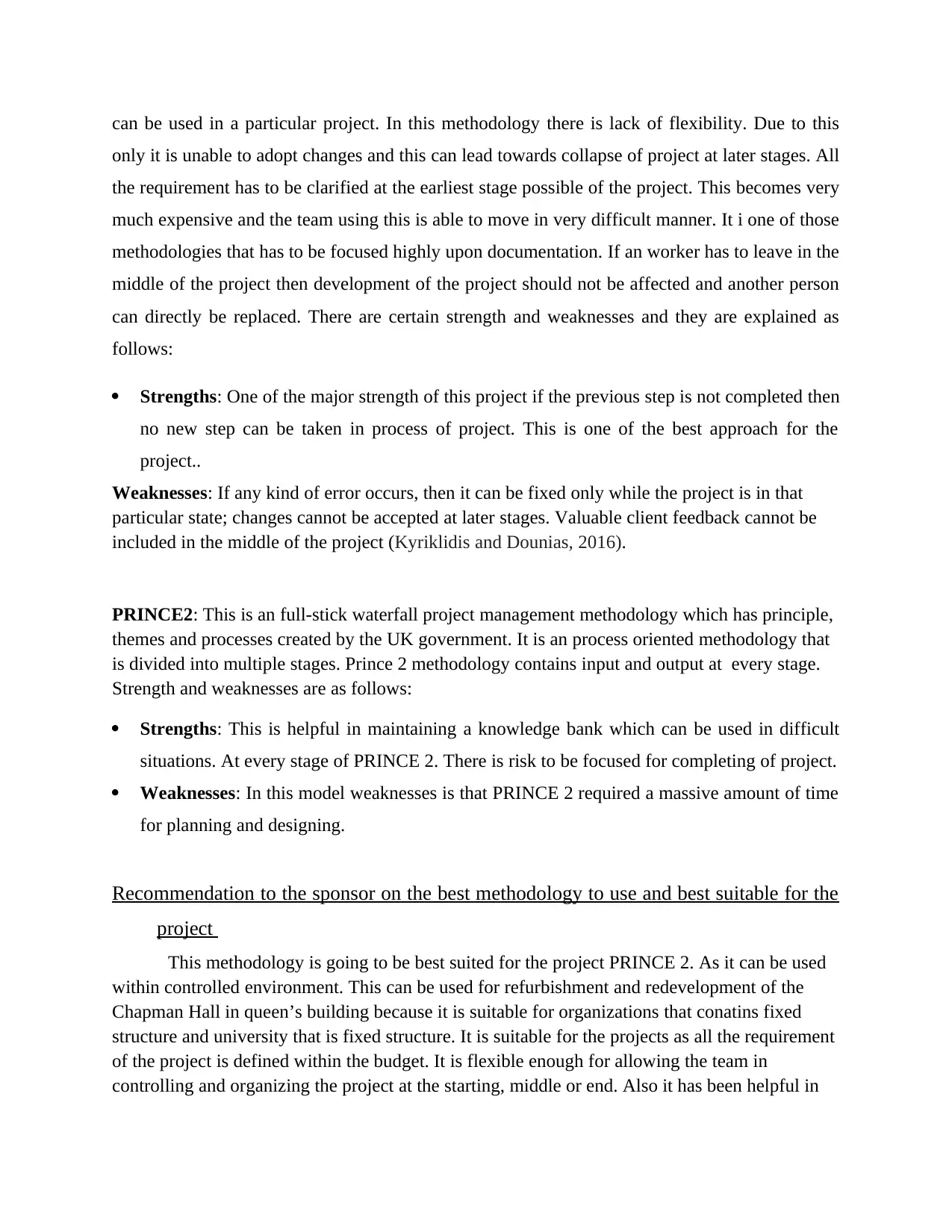
Waterfall: Waterfall is very old and traditional project management methodology. This is
sequential or linear approach which is focused upon the progress of the project is of one
direction. Such methodology has some of the most important phases that is very helpful in
accomplishing of project. There are some limitations and after filling of this limitation only this
Document Page
can be used in a particular project. In this methodology there is lack of flexibility. Due to this
only it is unable to adopt changes and this can lead towards collapse of project at later stages. All
the requirement has to be clarified at the earliest stage possible of the project. This becomes very
much expensive and the team using this is able to move in very difficult manner. It i one of those
methodologies that has to be focused highly upon documentation. If an worker has to leave in the
middle of the project then development of the project should not be affected and another person
can directly be replaced. There are certain strength and weaknesses and they are explained as
follows:
Strengths: One of the major strength of this project if the previous step is not completed then
no new step can be taken in process of project. This is one of the best approach for the
project..
Weaknesses: If any kind of error occurs, then it can be fixed only while the project is in that
particular state; changes cannot be accepted at later stages. Valuable client feedback cannot be
included in the middle of the project (Kyriklidis and Dounias, 2016).
PRINCE2: This is an full-stick waterfall project management methodology which has principle,
themes and processes created by the UK government. It is an process oriented methodology that
is divided into multiple stages. Prince 2 methodology contains input and output at every stage.
Strength and weaknesses are as follows:
Strengths: This is helpful in maintaining a knowledge bank which can be used in difficult
situations. At every stage of PRINCE 2. There is risk to be focused for completing of project.
Weaknesses: In this model weaknesses is that PRINCE 2 required a massive amount of time
for planning and designing.
Recommendation to the sponsor on the best methodology to use and best suitable for the
project
This methodology is going to be best suited for the project PRINCE 2. As it can be used
within controlled environment. This can be used for refurbishment and redevelopment of the
Chapman Hall in queen’s building because it is suitable for organizations that conatins fixed
structure and university that is fixed structure. It is suitable for the projects as all the requirement
of the project is defined within the budget. It is flexible enough for allowing the team in
controlling and organizing the project at the starting, middle or end. Also it has been helpful in
tabler-icon-diamond-filled.svg

Paraphrase This Document

Need a fresh take? Get an instant paraphrase of this document with our AI Paraphraser
Document Page
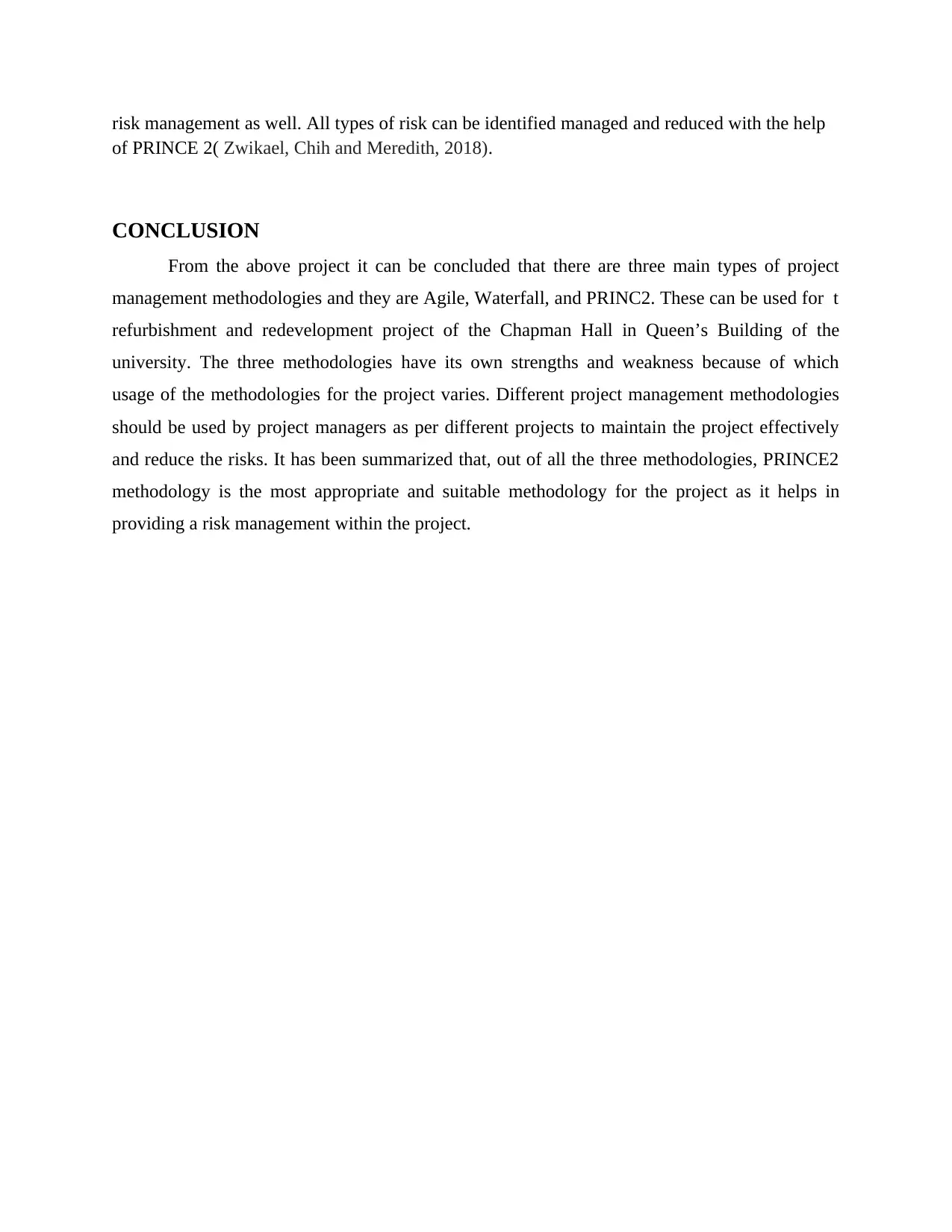
risk management as well. All types of risk can be identified managed and reduced with the help
of PRINCE 2( Zwikael, Chih and Meredith, 2018).
CONCLUSION
From the above project it can be concluded that there are three main types of project
management methodologies and they are Agile, Waterfall, and PRINC2. These can be used for t
refurbishment and redevelopment project of the Chapman Hall in Queen’s Building of the
university. The three methodologies have its own strengths and weakness because of which
usage of the methodologies for the project varies. Different project management methodologies
should be used by project managers as per different projects to maintain the project effectively
and reduce the risks. It has been summarized that, out of all the three methodologies, PRINCE2
methodology is the most appropriate and suitable methodology for the project as it helps in
providing a risk management within the project.
Document Page
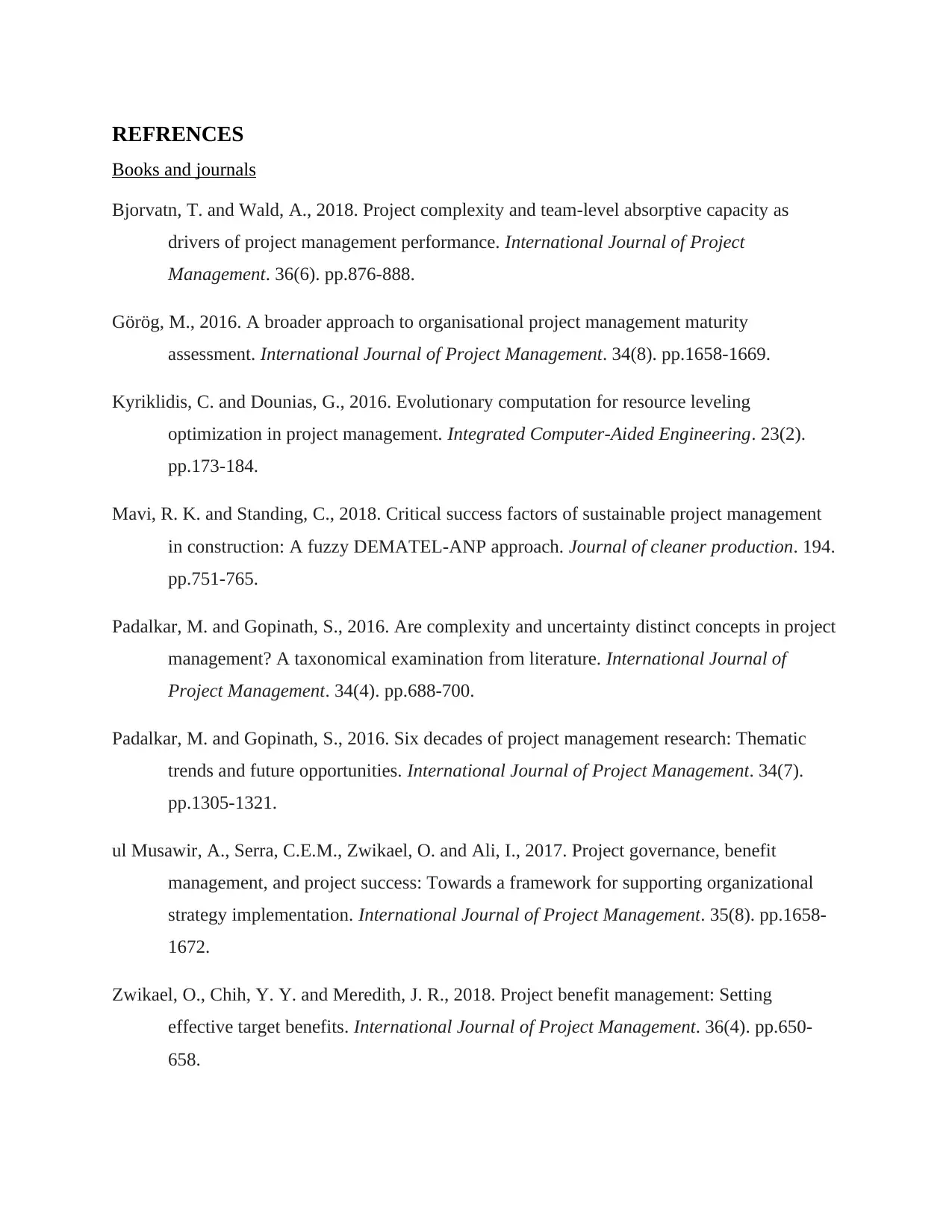
REFRENCES
Books and journals
Bjorvatn, T. and Wald, A., 2018. Project complexity and team-level absorptive capacity as
drivers of project management performance. International Journal of Project
Management. 36(6). pp.876-888.
Görög, M., 2016. A broader approach to organisational project management maturity
assessment. International Journal of Project Management. 34(8). pp.1658-1669.
Kyriklidis, C. and Dounias, G., 2016. Evolutionary computation for resource leveling
optimization in project management. Integrated Computer-Aided Engineering. 23(2).
pp.173-184.
Mavi, R. K. and Standing, C., 2018. Critical success factors of sustainable project management
in construction: A fuzzy DEMATEL-ANP approach. Journal of cleaner production. 194.
pp.751-765.
Padalkar, M. and Gopinath, S., 2016. Are complexity and uncertainty distinct concepts in project
management? A taxonomical examination from literature. International Journal of
Project Management. 34(4). pp.688-700.
Padalkar, M. and Gopinath, S., 2016. Six decades of project management research: Thematic
trends and future opportunities. International Journal of Project Management. 34(7).
pp.1305-1321.
ul Musawir, A., Serra, C.E.M., Zwikael, O. and Ali, I., 2017. Project governance, benefit
management, and project success: Towards a framework for supporting organizational
strategy implementation. International Journal of Project Management. 35(8). pp.1658-
1672.
Zwikael, O., Chih, Y. Y. and Meredith, J. R., 2018. Project benefit management: Setting
effective target benefits. International Journal of Project Management. 36(4). pp.650-
658.
chevron_up_icon
1 out of 6
circle_padding
hide_on_mobile
zoom_out_icon
[object Object]