Project Management: Review of PLC Application and Impact

Verified

Added on  2023/04/10

|7
|1299
|197
Report
AI Summary
This report provides a comprehensive review and critique of the application of the Project Life Cycle (PLC) in a project context, specifically focusing on the implementation of operation management principles within the organization "Primark." The analysis includes a detailed examination of the PLC's phases: initiation, planning, execution, and closure. The report evaluates the broader influence and impact of the project, alongside a deep dive into performance measurement, including milestones, targets, deliverables, and benchmarks. Key performance indicators (KPIs) are also assessed to gauge project success. The report also covers project monitoring and evaluation methodologies, emphasizing the importance of reliability and validity, and the use of logic models to illustrate project execution and goals. The report incorporates relevant academic references to support its findings, providing a well-rounded analysis of the PLC's effectiveness in project management.
Document Page
Running head: PROJECT MANAGEMENT
Task 3: Project management
Name of the Student
Name of the University
Author’s Note
tabler-icon-diamond-filled.svg

Paraphrase This Document

Need a fresh take? Get an instant paraphrase of this document with our AI Paraphraser
Document Page
1
PROJECT MANAGEMENT
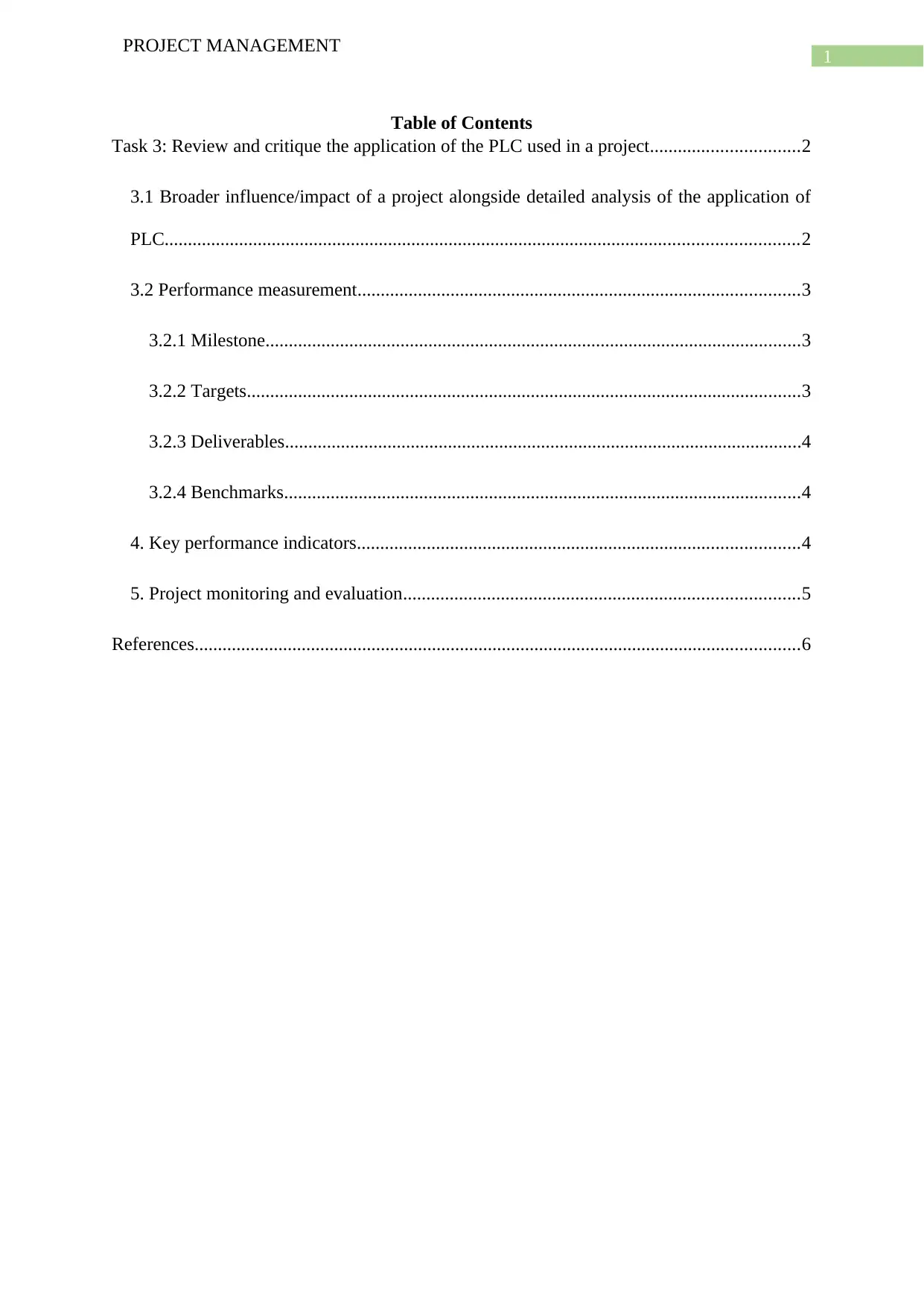
Table of Contents
Task 3: Review and critique the application of the PLC used in a project................................2
3.1 Broader influence/impact of a project alongside detailed analysis of the application of
PLC........................................................................................................................................2
3.2 Performance measurement...............................................................................................3
3.2.1 Milestone...................................................................................................................3
3.2.2 Targets.......................................................................................................................3
3.2.3 Deliverables...............................................................................................................4
3.2.4 Benchmarks...............................................................................................................4
4. Key performance indicators...............................................................................................4
5. Project monitoring and evaluation.....................................................................................5
References..................................................................................................................................6
Document Page
2
PROJECT MANAGEMENT
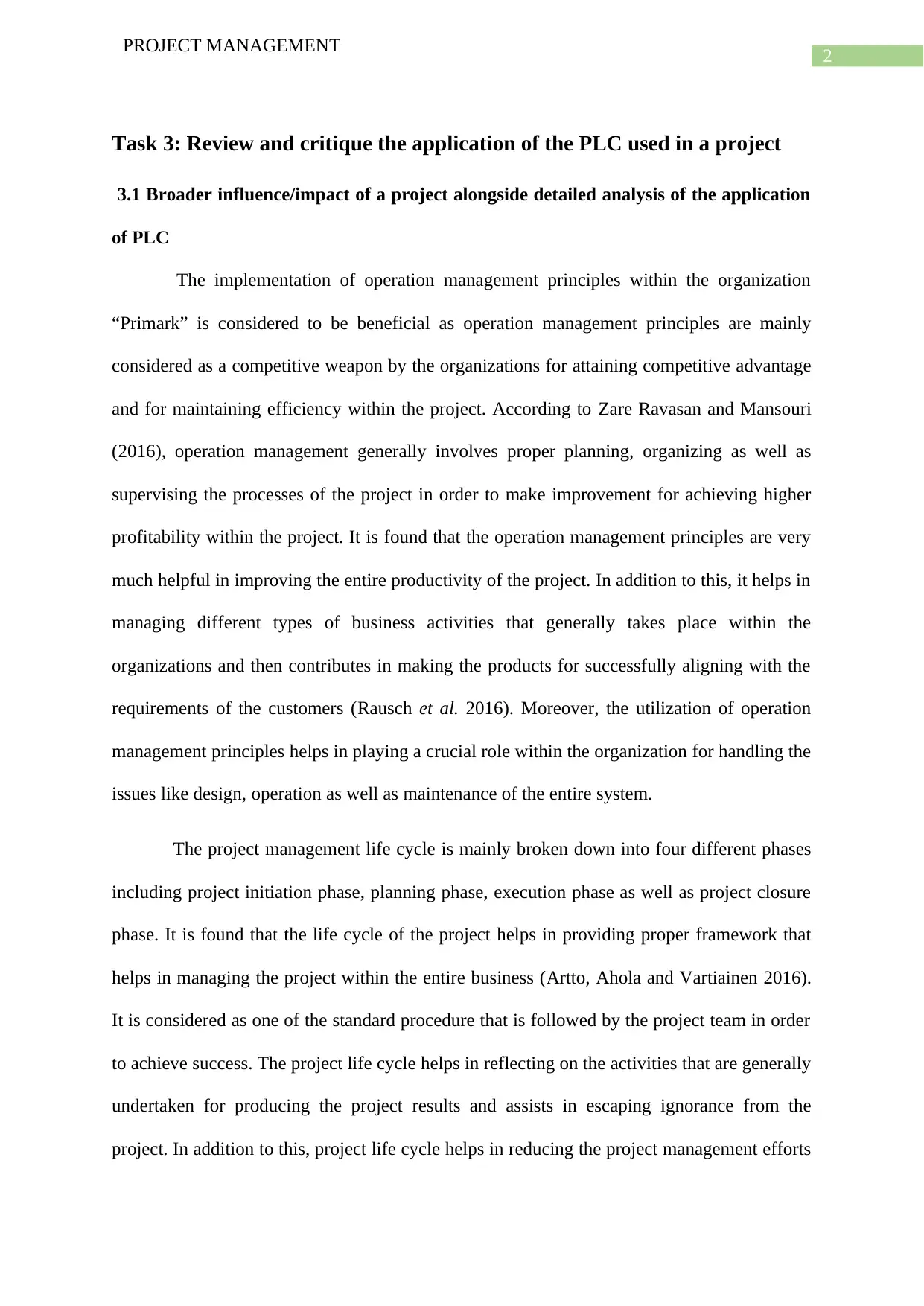
Task 3: Review and critique the application of the PLC used in a project
3.1 Broader influence/impact of a project alongside detailed analysis of the application
of PLC
The implementation of operation management principles within the organization
“Primark” is considered to be beneficial as operation management principles are mainly
considered as a competitive weapon by the organizations for attaining competitive advantage
and for maintaining efficiency within the project. According to Zare Ravasan and Mansouri
(2016), operation management generally involves proper planning, organizing as well as
supervising the processes of the project in order to make improvement for achieving higher
profitability within the project. It is found that the operation management principles are very
much helpful in improving the entire productivity of the project. In addition to this, it helps in
managing different types of business activities that generally takes place within the
organizations and then contributes in making the products for successfully aligning with the
requirements of the customers (Rausch et al. 2016). Moreover, the utilization of operation
management principles helps in playing a crucial role within the organization for handling the
issues like design, operation as well as maintenance of the entire system.
The project management life cycle is mainly broken down into four different phases
including project initiation phase, planning phase, execution phase as well as project closure
phase. It is found that the life cycle of the project helps in providing proper framework that
helps in managing the project within the entire business (Artto, Ahola and Vartiainen 2016).
It is considered as one of the standard procedure that is followed by the project team in order
to achieve success. The project life cycle helps in reflecting on the activities that are generally
undertaken for producing the project results and assists in escaping ignorance from the
project. In addition to this, project life cycle helps in reducing the project management efforts
Document Page
3
PROJECT MANAGEMENT
by dividing the project into number of phases. With the help of project life cycle, the project
can be made manageable, and assists in separating the work which generally has distinct as
well as unrelated project phases in nature (Stark 2015). Moreover, it also helps in making the
entire project much more predictable.
3.2 Performance measurement
It is found that the performance of the project can be measured successfully by
focussing on the project milestone, targets, deliverables as well as benchmarks of the project.
The key performance indicators are generally helpful in giving important information by
enabling the assess of the project performance.
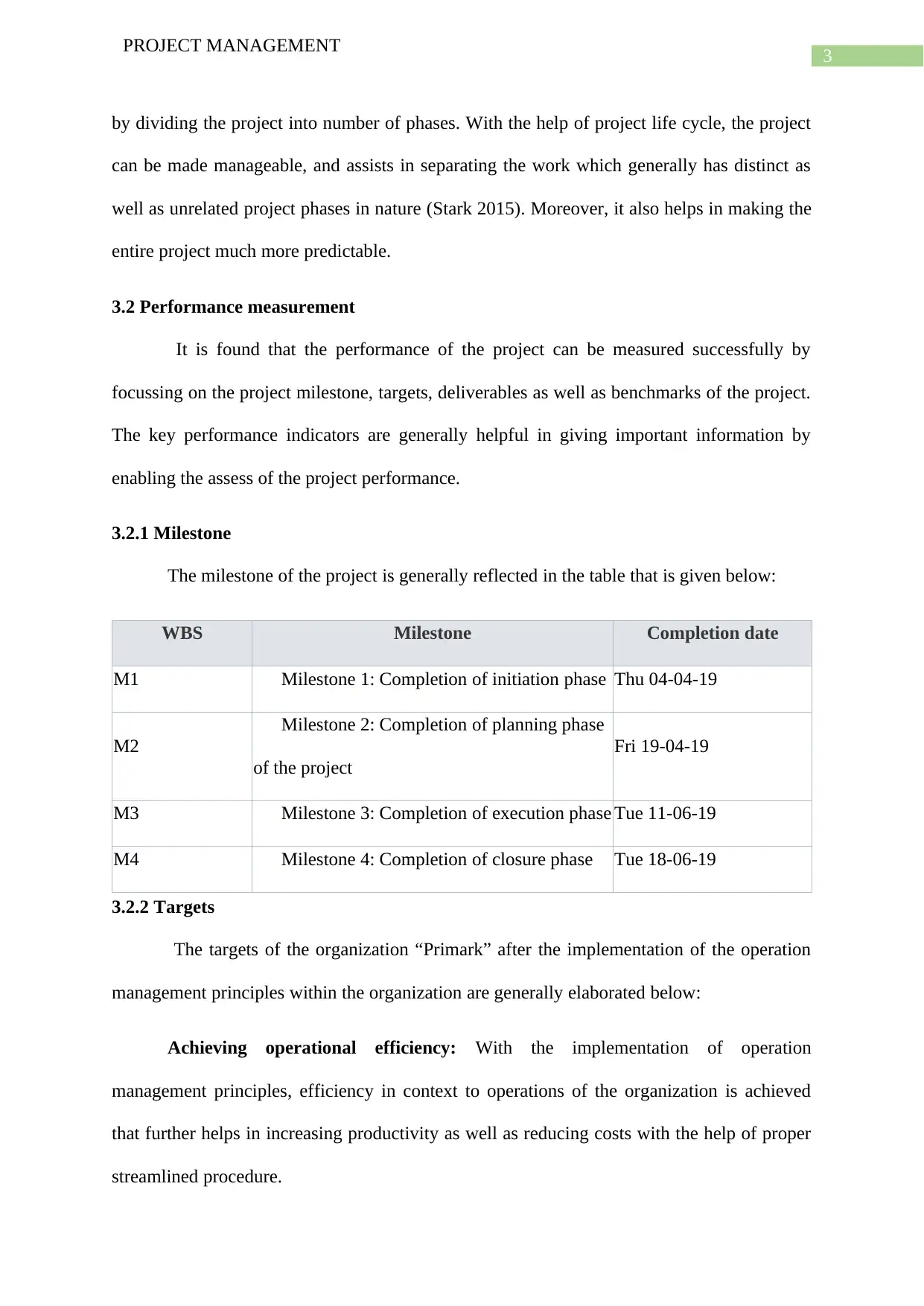
3.2.1 Milestone
The milestone of the project is generally reflected in the table that is given below:
WBS Milestone Completion date
M1 Milestone 1: Completion of initiation phase Thu 04-04-19
M2
Milestone 2: Completion of planning phase
of the project
Fri 19-04-19
M3 Milestone 3: Completion of execution phase Tue 11-06-19
M4 Milestone 4: Completion of closure phase Tue 18-06-19
3.2.2 Targets
The targets of the organization “Primark” after the implementation of the operation
management principles within the organization are generally elaborated below:
Achieving operational efficiency: With the implementation of operation
management principles, efficiency in context to operations of the organization is achieved
that further helps in increasing productivity as well as reducing costs with the help of proper
streamlined procedure.
tabler-icon-diamond-filled.svg

Paraphrase This Document

Need a fresh take? Get an instant paraphrase of this document with our AI Paraphraser
Document Page
4
PROJECT MANAGEMENT
Proper supply chain management: With the implementation of operation
management principles, it is quite necessary to manage the supply chain management for
maintaining the quality of goods as well as services from store to the consumers.
Managing the relationships with the customers: The implementation of operation
management helps in improving the customer service by increasing the customer relationship.
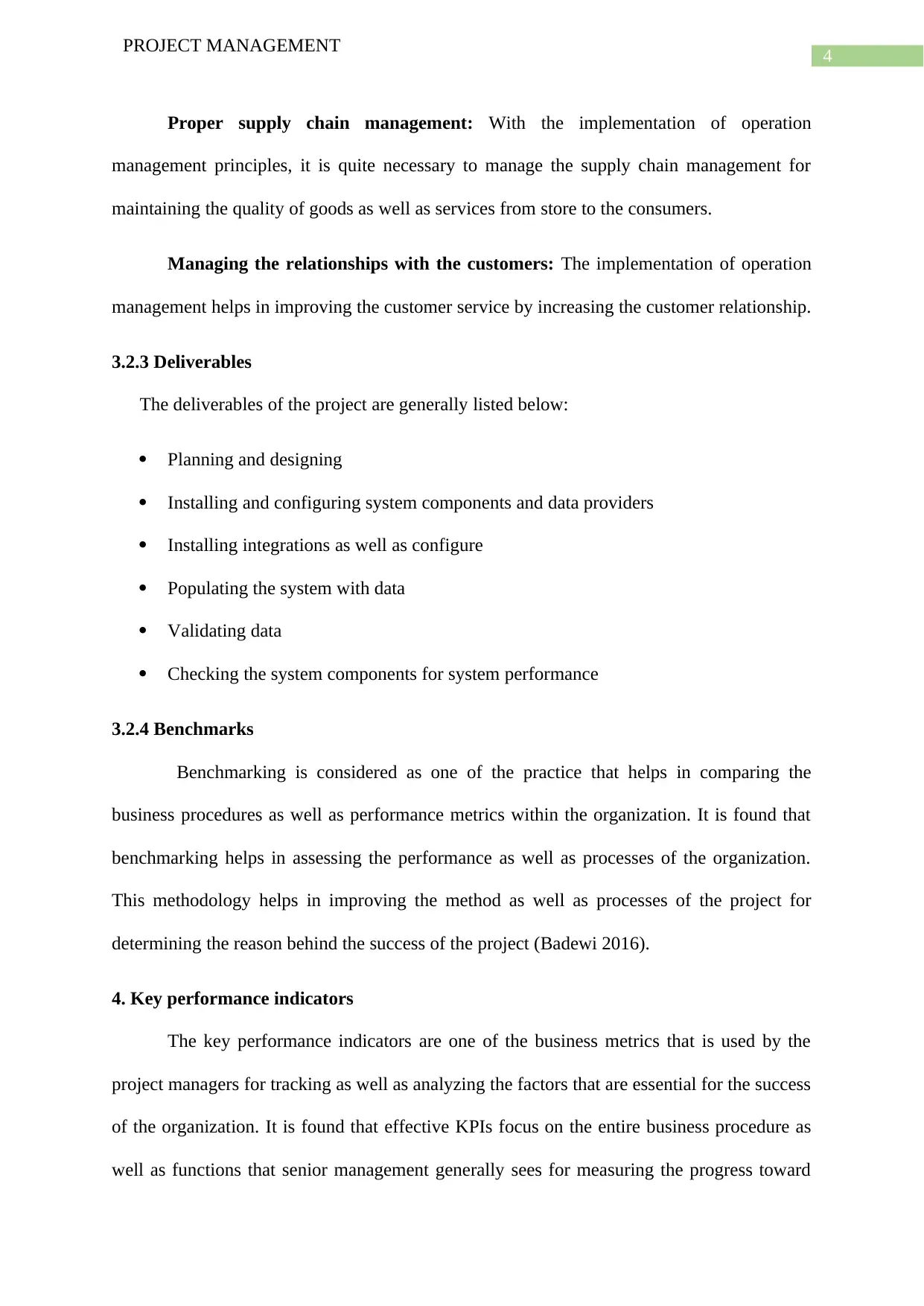
3.2.3 Deliverables
The deliverables of the project are generally listed below:
Planning and designing
Installing and configuring system components and data providers
Installing integrations as well as configure
Populating the system with data
Validating data
Checking the system components for system performance
3.2.4 Benchmarks
Benchmarking is considered as one of the practice that helps in comparing the
business procedures as well as performance metrics within the organization. It is found that
benchmarking helps in assessing the performance as well as processes of the organization.
This methodology helps in improving the method as well as processes of the project for
determining the reason behind the success of the project (Badewi 2016).
4. Key performance indicators
The key performance indicators are one of the business metrics that is used by the
project managers for tracking as well as analyzing the factors that are essential for the success
of the organization. It is found that effective KPIs focus on the entire business procedure as
well as functions that senior management generally sees for measuring the progress toward
Document Page
5
PROJECT MANAGEMENT
the strategic goals as well as performance targets (Kaiser, El Arbi and Ahlemann 2015). The
various key performance indicators that are mainly associated with the project are generally
elaborated below:
Achieving project objectives: It is found that with the implementation of operation
management principles, the goals and objectives of the project is achieved that helps in
indicating that the project is performing effectively.
Benefits achieved: It is found that the implementation of operation management
principles help in improving operational efficiency, proper supply chain management as well
as helps in managing the relationships with the customers (Kerzner 2017).
5. Project monitoring and evaluation
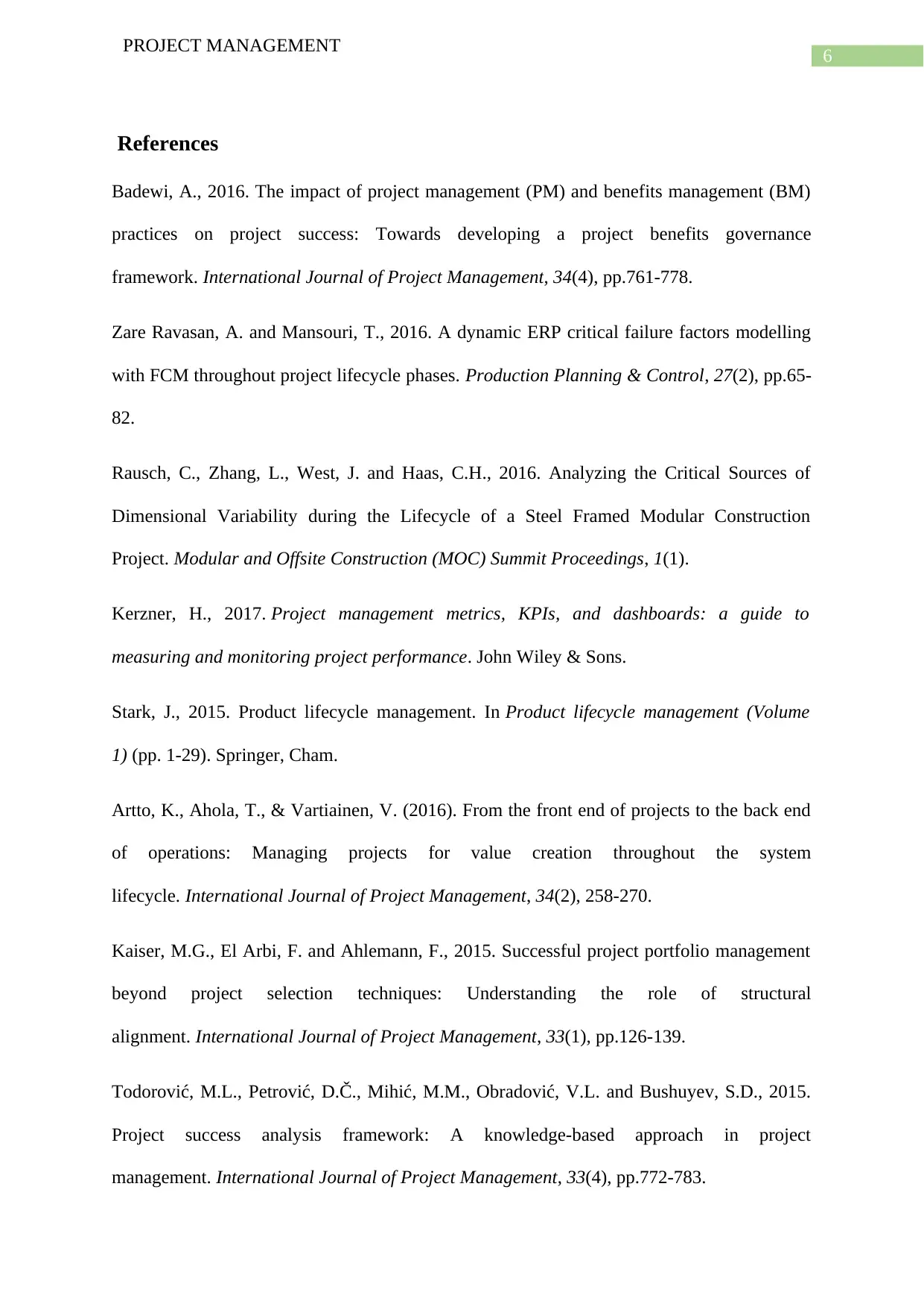
Project monitoring of the project is necessary to keep the project on track so that the
project can gets completed on time. It is found that reliability as well as validity are generally
considered as the important technical properties that helps in indicating the quality that is
generally maintained within the entire project (Rausch et al. 2016).
In addition to this, it is found that a logic model is generally created for displaying as
well as illustrating how the project will be executed including the operation, activities as well
as goals of the project. Moreover, logic models can be utilized in program for
implementation, evaluation as well as communication.
Document Page
6
PROJECT MANAGEMENT
References
Badewi, A., 2016. The impact of project management (PM) and benefits management (BM)
practices on project success: Towards developing a project benefits governance
framework. International Journal of Project Management, 34(4), pp.761-778.
Zare Ravasan, A. and Mansouri, T., 2016. A dynamic ERP critical failure factors modelling
with FCM throughout project lifecycle phases. Production Planning & Control, 27(2), pp.65-
82.
Rausch, C., Zhang, L., West, J. and Haas, C.H., 2016. Analyzing the Critical Sources of
Dimensional Variability during the Lifecycle of a Steel Framed Modular Construction
Project. Modular and Offsite Construction (MOC) Summit Proceedings, 1(1).
Kerzner, H., 2017. Project management metrics, KPIs, and dashboards: a guide to
measuring and monitoring project performance. John Wiley & Sons.
Stark, J., 2015. Product lifecycle management. In Product lifecycle management (Volume
1) (pp. 1-29). Springer, Cham.
Artto, K., Ahola, T., & Vartiainen, V. (2016). From the front end of projects to the back end
of operations: Managing projects for value creation throughout the system
lifecycle. International Journal of Project Management, 34(2), 258-270.
Kaiser, M.G., El Arbi, F. and Ahlemann, F., 2015. Successful project portfolio management
beyond project selection techniques: Understanding the role of structural
alignment. International Journal of Project Management, 33(1), pp.126-139.
Todorović, M.L., Petrović, D.Č., Mihić, M.M., Obradović, V.L. and Bushuyev, S.D., 2015.
Project success analysis framework: A knowledge-based approach in project
management. International Journal of Project Management, 33(4), pp.772-783.
chevron_up_icon
1 out of 7
circle_padding
hide_on_mobile
zoom_out_icon
[object Object]