Final Project Report: Schedule Compression, Life-Cycle, and Planning
VerifiedAdded on 2023/06/12
|16
|5466
|269
Report
AI Summary
This project report provides a comprehensive overview of project management principles and practices. It begins with an explanation of schedule compression techniques, including crashing and fast tracking, and then delves into the five phases of the project life cycle: initiation, planning, designing, execution, and closure. The report also examines project management leading strategies, project financing and budgeting considerations, project planning management tools, and project risk planning and management. The analysis emphasizes the importance of aligning project activities to achieve project goals and deliver effective customer satisfaction.

Running head: FINAL PROJECT REPORT
Final Project Report
Name of the Student:
Student ID:
Name of the University:
Author’s note:
Final Project Report
Name of the Student:
Student ID:
Name of the University:
Author’s note:

Paraphrase This Document
Need a fresh take? Get an instant paraphrase of this document with our AI Paraphraser
1FINAL PROJECT REPORT
Table of Contents
Introduction.....................................................................................................................................2
1. Explanation of Schedule Compression........................................................................................2
2. Project Life-Cycle Phases.............................................................................................................5
3. Project Management Leading Strategies....................................................................................7
4. Project Financing and Budgeting.................................................................................................8
5. Project Planning Management tools...........................................................................................9
6. Project Risk Planning and Management....................................................................................11
Conclusions....................................................................................................................................11
References.....................................................................................................................................13
Table of Contents
Introduction.....................................................................................................................................2
1. Explanation of Schedule Compression........................................................................................2
2. Project Life-Cycle Phases.............................................................................................................5
3. Project Management Leading Strategies....................................................................................7
4. Project Financing and Budgeting.................................................................................................8
5. Project Planning Management tools...........................................................................................9
6. Project Risk Planning and Management....................................................................................11
Conclusions....................................................................................................................................11
References.....................................................................................................................................13

2FINAL PROJECT REPORT
Introduction
Project management can be defined as the most crucial tool that is being used for the
successful business development by affecting the liabilities and revenues for the development
of the effective customer satisfaction and retention (Schwalbe 2015). A successful project
manager is responsible for the analysis of the four elements of project management namely
scope, time, resources, and money. The elements are interrelated and the use of project
management tools and techniques help in managing these four elements of the project. The
scope of the project forms the inclusion of project size, requirements, and goals (Kerzner and
Kerzner 2017). The resources are the amount of materials and the number of persons needed
for completion of the project.
The following assignment is the study of project management and its various tools and
techniques. The study is based on the role of project management for aligning the activities of
project and form the advent of the development of the project operations for the achievement
of the goals. The implication of the effective project operation development would result in
forming the alignment of the activities favouring the study of project life-cycle phases, project
management leading strategies, project financing and budgeting, project planning management
tools, and project risk planning and management.
1. Explanation of Schedule Compression
Schedule compression is the method of shortening of the project duration when
required for achieving the final deliverable in lesser time. The scope of the project remains
unchanged and it required making effective strategic decision required for the completion of
the project. The schedule compression focused on the modification of the critical path of
modifying the project is lesser time (Tomek and Kalinichuk 2015). The critical path of the
project is the one defining the end date of the project and the activities of the critical path must
be compresses for having an effect on the final end date of the project. The schedule
Introduction
Project management can be defined as the most crucial tool that is being used for the
successful business development by affecting the liabilities and revenues for the development
of the effective customer satisfaction and retention (Schwalbe 2015). A successful project
manager is responsible for the analysis of the four elements of project management namely
scope, time, resources, and money. The elements are interrelated and the use of project
management tools and techniques help in managing these four elements of the project. The
scope of the project forms the inclusion of project size, requirements, and goals (Kerzner and
Kerzner 2017). The resources are the amount of materials and the number of persons needed
for completion of the project.
The following assignment is the study of project management and its various tools and
techniques. The study is based on the role of project management for aligning the activities of
project and form the advent of the development of the project operations for the achievement
of the goals. The implication of the effective project operation development would result in
forming the alignment of the activities favouring the study of project life-cycle phases, project
management leading strategies, project financing and budgeting, project planning management
tools, and project risk planning and management.
1. Explanation of Schedule Compression
Schedule compression is the method of shortening of the project duration when
required for achieving the final deliverable in lesser time. The scope of the project remains
unchanged and it required making effective strategic decision required for the completion of
the project. The schedule compression focused on the modification of the critical path of
modifying the project is lesser time (Tomek and Kalinichuk 2015). The critical path of the
project is the one defining the end date of the project and the activities of the critical path must
be compresses for having an effect on the final end date of the project. The schedule
⊘ This is a preview!⊘
Do you want full access?
Subscribe today to unlock all pages.

Trusted by 1+ million students worldwide
3FINAL PROJECT REPORT
compression can be done by two methods and they are crashing and fast tracking. These two
method have been explained below,
‘Crashing’: Crashing is the method of completion of any activity of the project in shorter
duration of time by adding some resources for the activities (Bakry, Moselhi and Zayed 2014).
The crashing works effectively for all activities (critical and dependent) as it does not reschedule
any activity but it gives the push for the completion of the project in shorter duration. An
external resource or resources can be attached to the project activities for forming the activity
completion is lesser time. The crashing in projects is done for aligning the implication of the
operations favouring the utilization of the activities for forming the effective implication of the
issues. Crashing of project involves the inclusion of the additional resources in the project so
that the work can be completed in the least time. The deployment of the activities would also
support the innovation of the operations favouring the alignment of the successive
development. The activities of the critical path have zero floats and they must be crashed in
order to get the final crashed schedule which is lesser than the calculated time duration.
The implication of the methods of crashing would align with the deployment of the
successive implementation of the activities aligning the utilization of the improved
technologies. The major problem with the crashing is that it requires additional resources and
hence would increase the overall project budget. Moreover, the crashing is dependent on the
resources and the failure of the resources would result in forming the problems of the project.
Crashing is the strategy for finish of any action of the undertaking in shorter term of time by
including a few assets for the exercises. The Crashing works adequately for all exercises (basic
and ward) as it doesn't reschedule any movement yet it gives the push for the culmination of
the undertaking in shorter length. An outer asset or assets can be joined to the task exercises
for shaping the action finishing is lesser time.
The Crashing in projects is improved the situation adjusting the ramifications of the
tasks supporting the use of the exercises for shaping the compelling ramifications of the issues
(Klusacek and Rudova 2015). Crashing of undertaking includes the consideration of the extra
assets in the task with the goal that the work can be finished at all time. The organization of the
compression can be done by two methods and they are crashing and fast tracking. These two
method have been explained below,
‘Crashing’: Crashing is the method of completion of any activity of the project in shorter
duration of time by adding some resources for the activities (Bakry, Moselhi and Zayed 2014).
The crashing works effectively for all activities (critical and dependent) as it does not reschedule
any activity but it gives the push for the completion of the project in shorter duration. An
external resource or resources can be attached to the project activities for forming the activity
completion is lesser time. The crashing in projects is done for aligning the implication of the
operations favouring the utilization of the activities for forming the effective implication of the
issues. Crashing of project involves the inclusion of the additional resources in the project so
that the work can be completed in the least time. The deployment of the activities would also
support the innovation of the operations favouring the alignment of the successive
development. The activities of the critical path have zero floats and they must be crashed in
order to get the final crashed schedule which is lesser than the calculated time duration.
The implication of the methods of crashing would align with the deployment of the
successive implementation of the activities aligning the utilization of the improved
technologies. The major problem with the crashing is that it requires additional resources and
hence would increase the overall project budget. Moreover, the crashing is dependent on the
resources and the failure of the resources would result in forming the problems of the project.
Crashing is the strategy for finish of any action of the undertaking in shorter term of time by
including a few assets for the exercises. The Crashing works adequately for all exercises (basic
and ward) as it doesn't reschedule any movement yet it gives the push for the culmination of
the undertaking in shorter length. An outer asset or assets can be joined to the task exercises
for shaping the action finishing is lesser time.
The Crashing in projects is improved the situation adjusting the ramifications of the
tasks supporting the use of the exercises for shaping the compelling ramifications of the issues
(Klusacek and Rudova 2015). Crashing of undertaking includes the consideration of the extra
assets in the task with the goal that the work can be finished at all time. The organization of the
Paraphrase This Document
Need a fresh take? Get an instant paraphrase of this document with our AI Paraphraser
4FINAL PROJECT REPORT
exercises would likewise bolster the advancement of the tasks supporting the arrangement of
the progressive improvement. The exercises of the basic way have zero buoys and they should
be smashed with a specific end goal to get the last slammed plan which is lesser than the
computed time length. The ramifications of the techniques for smashing would line up with the
organization of the progressive execution of the exercises adjusting the usage of the enhanced
innovations. The real issue with the Crashing is that it requires extra assets and subsequently
would build the general undertaking spending plan. In addition, the Crashing is reliant on the
assets and the disappointment of the assets would bring about framing the issues of the task.
‘Fast tracking’: Fast tracking is the method of schedule compression that works by
applying on the various activities of the project and make them work simultaneously instead of
working separately (Nojedehi and Nasirzadeh 2017). The linear and sequential project durations
works in a straight line where each of the activities works one after another. It is time
consuming as the other activities of the project have to wait for initiation until its predecessor
has been completed. The fast tracking works on such situation and forms the alignment of the
activities favouring the utilization of the effective operation development. The implementation
of the effective development of the activities can support the employment of the operations for
listing the utilization of the rearranging the schedule. Optimizing is the strategy for plan
pressure that works by applying on the different exercises of the project and influence them to
work all the while as opposed to working independently. The direct and successive undertaking
terms works in a straight line where every one of the exercises works in a steady progression. It
is tedious as alternate exercises of the task need to sit tight for start until the point that its
ancestor has been finished.
According to Nojedehi and Nasirzadeh (2017), the optimizing chips away at such
circumstance and structures the arrangement of the exercises supporting the use of the viable
activity improvement. The execution of the successful advancement of the exercises can bolster
the work of the tasks for posting the usage of the revising the timetable. The exercises can
cover each other and decrease the measure of time required for the finishing of the
undertaking. The arrangement of the exercises would bring about framing the issues of deferral
exercises would likewise bolster the advancement of the tasks supporting the arrangement of
the progressive improvement. The exercises of the basic way have zero buoys and they should
be smashed with a specific end goal to get the last slammed plan which is lesser than the
computed time length. The ramifications of the techniques for smashing would line up with the
organization of the progressive execution of the exercises adjusting the usage of the enhanced
innovations. The real issue with the Crashing is that it requires extra assets and subsequently
would build the general undertaking spending plan. In addition, the Crashing is reliant on the
assets and the disappointment of the assets would bring about framing the issues of the task.
‘Fast tracking’: Fast tracking is the method of schedule compression that works by
applying on the various activities of the project and make them work simultaneously instead of
working separately (Nojedehi and Nasirzadeh 2017). The linear and sequential project durations
works in a straight line where each of the activities works one after another. It is time
consuming as the other activities of the project have to wait for initiation until its predecessor
has been completed. The fast tracking works on such situation and forms the alignment of the
activities favouring the utilization of the effective operation development. The implementation
of the effective development of the activities can support the employment of the operations for
listing the utilization of the rearranging the schedule. Optimizing is the strategy for plan
pressure that works by applying on the different exercises of the project and influence them to
work all the while as opposed to working independently. The direct and successive undertaking
terms works in a straight line where every one of the exercises works in a steady progression. It
is tedious as alternate exercises of the task need to sit tight for start until the point that its
ancestor has been finished.
According to Nojedehi and Nasirzadeh (2017), the optimizing chips away at such
circumstance and structures the arrangement of the exercises supporting the use of the viable
activity improvement. The execution of the successful advancement of the exercises can bolster
the work of the tasks for posting the usage of the revising the timetable. The exercises can
cover each other and decrease the measure of time required for the finishing of the
undertaking. The arrangement of the exercises would bring about framing the issues of deferral
5FINAL PROJECT REPORT
and abundance utilization of time. Be that as it may, the covering of the exercises would help in
diminishing the general time required for the fruition of the exercises. The main issue of the
optimizing is that the exercises can't be covered because of quality of straight conditions. The
steady working condition can be useful for accomplishing the work to be done sooner than
anticipated. The tasks of quick track would work progressively for the ramifications of the
exercises supporting the arrangement of the last undertaking deliverable. The activities can
overlap each other and reduce the amount of time required for the completion of the project.
The alignment of the activities would result in forming the problems of delay and excess
consumption of time. However, the overlapping of the activities would help in decreasing the
overall time required for the completion of the activities. The only problem of the fast tracking
is that the activities cannot be overlapped due to presence of linear dependencies (Klusacek
and Rudova 2015). The stable working condition can be helpful for attaining the work to be
done sooner than expected. The operations of fast track would work successively for the
implication of the activities favouring the alignment of the final project deliverable.
Schedule Compression is the technique for shortening of the project term when
required for accomplishing the last deliverable in lesser time (Hazini, Dehghan and Ruwanpura
2014). The extent of the task stays unaltered and it required settling on powerful vital choice
required for the fulfilment of the undertaking. The schedule compression concentrated on the
change of the basic way of altering the task is lesser time. The basic way of the project is the
one characterizing the end date of the task and the exercises of the basic way should be packs
for affecting the last end date of the undertaking. The timetable pressure should be possible by
two strategies and they are slamming and optimizing.
2. Project Life-Cycle Phases
The project lifecycle is divided into 5 phases namely initiation, planning, designing,
executing, and closing (Kloppenborg, Tesch and Manolis 2014). The combination of these
phases would tend to form the support and development of the final project deliverable. The
implementation of project (construction or IT) should follow the implication of project
management lifecycle for developing the plan of action and achieving the final deliverable from
and abundance utilization of time. Be that as it may, the covering of the exercises would help in
diminishing the general time required for the fruition of the exercises. The main issue of the
optimizing is that the exercises can't be covered because of quality of straight conditions. The
steady working condition can be useful for accomplishing the work to be done sooner than
anticipated. The tasks of quick track would work progressively for the ramifications of the
exercises supporting the arrangement of the last undertaking deliverable. The activities can
overlap each other and reduce the amount of time required for the completion of the project.
The alignment of the activities would result in forming the problems of delay and excess
consumption of time. However, the overlapping of the activities would help in decreasing the
overall time required for the completion of the activities. The only problem of the fast tracking
is that the activities cannot be overlapped due to presence of linear dependencies (Klusacek
and Rudova 2015). The stable working condition can be helpful for attaining the work to be
done sooner than expected. The operations of fast track would work successively for the
implication of the activities favouring the alignment of the final project deliverable.
Schedule Compression is the technique for shortening of the project term when
required for accomplishing the last deliverable in lesser time (Hazini, Dehghan and Ruwanpura
2014). The extent of the task stays unaltered and it required settling on powerful vital choice
required for the fulfilment of the undertaking. The schedule compression concentrated on the
change of the basic way of altering the task is lesser time. The basic way of the project is the
one characterizing the end date of the task and the exercises of the basic way should be packs
for affecting the last end date of the undertaking. The timetable pressure should be possible by
two strategies and they are slamming and optimizing.
2. Project Life-Cycle Phases
The project lifecycle is divided into 5 phases namely initiation, planning, designing,
executing, and closing (Kloppenborg, Tesch and Manolis 2014). The combination of these
phases would tend to form the support and development of the final project deliverable. The
implementation of project (construction or IT) should follow the implication of project
management lifecycle for developing the plan of action and achieving the final deliverable from
⊘ This is a preview!⊘
Do you want full access?
Subscribe today to unlock all pages.
Trusted by 1+ million students worldwide
6FINAL PROJECT REPORT
the project. The implication of the successive project lifecycle would help in forming the
utilization of the operations for forming the innovative development of the final deliverable.
The project plan development would be ease by dividing the course of actions in terms of
project lifecycle (Parrott and Weiland 2017). The explanation of the project lifecycle in given in
the following section,
‘Initiation’: The initiation phase is more of the information collection stage where all the
required data for the project development can be collected (Chong and Hopkins 2016). The
project initiation is done either by the client or the appointed project manager. The project
involves the requirements of both human and materials and the phase is characterized by
appointment of skilled human resources and accumulation of the materials. The human skills
and materials are dependent on the work required to be done in the project. The phase would
analyse the factors from various sources and form the final implication of the project
deliverable.
‘Planning’: It is another major factor that would form the deployment of the specific
course of action for the project. The implication of planning phase would involve the
development of a project plan that would highlight the development of the factors for forming
the alignment of the effective operation development. The plan development would also allow
the implication of the schedule and persons involved in the completion of the project. The
activities of the project are listed from the past reports and the requirements of the project
where as the time schedule is presumed and estimated.
‘Designing’: The designing phase is characterised by the development of the effective
design required in the project (Ghaffari, Sheikhahmadi and Safakish 2014). The final deliverable
for the project can be achieved by the utilization of design developed in this phase. The
designing phase holds an integral role in IT project development. The design of the application,
software, or webpage would play a significant role for the development of the improved
effective operation. The design development would be favoured by the implication of the
effective integration of technology and the utilization of the operations favouring the
processing of the software required for the project.
the project. The implication of the successive project lifecycle would help in forming the
utilization of the operations for forming the innovative development of the final deliverable.
The project plan development would be ease by dividing the course of actions in terms of
project lifecycle (Parrott and Weiland 2017). The explanation of the project lifecycle in given in
the following section,
‘Initiation’: The initiation phase is more of the information collection stage where all the
required data for the project development can be collected (Chong and Hopkins 2016). The
project initiation is done either by the client or the appointed project manager. The project
involves the requirements of both human and materials and the phase is characterized by
appointment of skilled human resources and accumulation of the materials. The human skills
and materials are dependent on the work required to be done in the project. The phase would
analyse the factors from various sources and form the final implication of the project
deliverable.
‘Planning’: It is another major factor that would form the deployment of the specific
course of action for the project. The implication of planning phase would involve the
development of a project plan that would highlight the development of the factors for forming
the alignment of the effective operation development. The plan development would also allow
the implication of the schedule and persons involved in the completion of the project. The
activities of the project are listed from the past reports and the requirements of the project
where as the time schedule is presumed and estimated.
‘Designing’: The designing phase is characterised by the development of the effective
design required in the project (Ghaffari, Sheikhahmadi and Safakish 2014). The final deliverable
for the project can be achieved by the utilization of design developed in this phase. The
designing phase holds an integral role in IT project development. The design of the application,
software, or webpage would play a significant role for the development of the improved
effective operation. The design development would be favoured by the implication of the
effective integration of technology and the utilization of the operations favouring the
processing of the software required for the project.
Paraphrase This Document
Need a fresh take? Get an instant paraphrase of this document with our AI Paraphraser
7FINAL PROJECT REPORT
‘Execution’: The execution of the project activities involves the use of the plan and
design developed in the earlier stages for forming the final deliverable for the project. The
execution of the project plan would be based on the alignment of the operations and formation
of the improved operation development for the final deliverable for the project (Love et al.
2015). The execution of the project plan would be based on the implication of the activities
favouring the utilization of the information processing the implication of the final project
deliverable. The completion of the execution phase would result in forming the development of
the final project deliverable.
‘Closure’: The closure phase would involve the implication of the final reports and
ending the project team (Cleden 2017). The completion of the project plan would be eased for
the utilization of the final deliverable. The phase is basically characterized by the inspection and
testing for the quality of the final deliverable. The closure of the project would be eased for
forming the utilization of the successive deployment of the functions for forming the closure of
the project. The deployment of the effective management of the operations would also be
helpful for listing the utilization of the operations in forming the utilization of the successive
activity development.
3. Project Management Leading Strategies
The leading strategies signify the implication of the operations favouring the implication
of the effective leading of the operations for change implication process (Binder 2016). The
leading strategies in project management are carried on for using the modification of the
activities favouring the utilization of the operations for implying the changes in the project. The
implication of the leading strategies is supported by the use of the effective implicational
operations. The considerations of the external factors for supporting the implication of the
operations would be eased for the development of the functions favouring the utilization of the
leading strategies in project. The external factors like industry competition, economic condition,
regulatory, environment, social, and opportunities & threats are responsible for shaping the
leading strategies for forming the support to the organization (Serra and Kunc 2015). The
‘Execution’: The execution of the project activities involves the use of the plan and
design developed in the earlier stages for forming the final deliverable for the project. The
execution of the project plan would be based on the alignment of the operations and formation
of the improved operation development for the final deliverable for the project (Love et al.
2015). The execution of the project plan would be based on the implication of the activities
favouring the utilization of the information processing the implication of the final project
deliverable. The completion of the execution phase would result in forming the development of
the final project deliverable.
‘Closure’: The closure phase would involve the implication of the final reports and
ending the project team (Cleden 2017). The completion of the project plan would be eased for
the utilization of the final deliverable. The phase is basically characterized by the inspection and
testing for the quality of the final deliverable. The closure of the project would be eased for
forming the utilization of the successive deployment of the functions for forming the closure of
the project. The deployment of the effective management of the operations would also be
helpful for listing the utilization of the operations in forming the utilization of the successive
activity development.
3. Project Management Leading Strategies
The leading strategies signify the implication of the operations favouring the implication
of the effective leading of the operations for change implication process (Binder 2016). The
leading strategies in project management are carried on for using the modification of the
activities favouring the utilization of the operations for implying the changes in the project. The
implication of the leading strategies is supported by the use of the effective implicational
operations. The considerations of the external factors for supporting the implication of the
operations would be eased for the development of the functions favouring the utilization of the
leading strategies in project. The external factors like industry competition, economic condition,
regulatory, environment, social, and opportunities & threats are responsible for shaping the
leading strategies for forming the support to the organization (Serra and Kunc 2015). The
8FINAL PROJECT REPORT
internal factors like strength and weaknesses, competence, management ambition, risk
attitude, ethics and philosophy, and corporation culture & shared values.
The implication of the effective strategies would allow the implication of the successive
deployment of the operations (Schwalbe 2015). The managerial components like Configuring
work environment & corporate culture to fit strategy, Design reliable Information & operating
systems, Push for continuous improvements, Implementing incentives & rewards to key
achievements, Exercising strategic leadership to drive strategy ahead, Establish strategy
supportive policies & procedures, Adequate resource allocation to strategy-critical tasks, and
Building sustainable competencies & capabilities are included for the strategy implementation.
There are four types of leadership types that would form the implementation of the strategies
in the project (Kerzner and Kerzner 2017). The visionary type, directive type, incubating type,
and collaborative type of the strategic leadership can be used for the implication of the
effective leadership strategies for the project.
4. Project Financing and Budgeting
The project financing provides the advantage of off balance sheet for the project and it
helps in shifting the project risks to the creditors for the exchange of high rate of returns to the
lender instead of normal corporate lending (McDaid and Park 2016). The typical structure for
project financial operations is based on the option of build, operate, and transfer (BOT). The
structure is deployed for carrying out the project as the sole project aim. The project financing
would allow the shareholders for project liabilities and financing off balance sheet. The project
forms the off sheet financing for its project while carefully following the accountancy rules and
law (Vammalle, Rivadeneira and James 2018). The resource financing allow the users with the
effective full recourse to assets and cash flow of the shareholders for repaying the implication
of the effective operation development. The project often fails to provide the lenders for the
repayment of the required operation development. The financing of the project is supported by
the deployment of the effective information processing (Cashin et al. 2017). The alignment of
the non-resource financing would be deployed for listing the development of the operations
and provide effective implementation of the operational development.
internal factors like strength and weaknesses, competence, management ambition, risk
attitude, ethics and philosophy, and corporation culture & shared values.
The implication of the effective strategies would allow the implication of the successive
deployment of the operations (Schwalbe 2015). The managerial components like Configuring
work environment & corporate culture to fit strategy, Design reliable Information & operating
systems, Push for continuous improvements, Implementing incentives & rewards to key
achievements, Exercising strategic leadership to drive strategy ahead, Establish strategy
supportive policies & procedures, Adequate resource allocation to strategy-critical tasks, and
Building sustainable competencies & capabilities are included for the strategy implementation.
There are four types of leadership types that would form the implementation of the strategies
in the project (Kerzner and Kerzner 2017). The visionary type, directive type, incubating type,
and collaborative type of the strategic leadership can be used for the implication of the
effective leadership strategies for the project.
4. Project Financing and Budgeting
The project financing provides the advantage of off balance sheet for the project and it
helps in shifting the project risks to the creditors for the exchange of high rate of returns to the
lender instead of normal corporate lending (McDaid and Park 2016). The typical structure for
project financial operations is based on the option of build, operate, and transfer (BOT). The
structure is deployed for carrying out the project as the sole project aim. The project financing
would allow the shareholders for project liabilities and financing off balance sheet. The project
forms the off sheet financing for its project while carefully following the accountancy rules and
law (Vammalle, Rivadeneira and James 2018). The resource financing allow the users with the
effective full recourse to assets and cash flow of the shareholders for repaying the implication
of the effective operation development. The project often fails to provide the lenders for the
repayment of the required operation development. The financing of the project is supported by
the deployment of the effective information processing (Cashin et al. 2017). The alignment of
the non-resource financing would be deployed for listing the development of the operations
and provide effective implementation of the operational development.
⊘ This is a preview!⊘
Do you want full access?
Subscribe today to unlock all pages.
Trusted by 1+ million students worldwide
9FINAL PROJECT REPORT
The project budgeting would be helpful for forming the utilization of the successive
activities of forming the implementation of the resource in a specific way so that the overall
cost of the project might result in forming the implication of the successive operational
development (World Health Organization 2017). The budget for the implication of the project is
formed for using the successive information processing. The development of the project budget
would enable the calculation of the simplified costs and it would be calculated based on the
individual activities or the work packages in total. The budget in the project is represented by
the approved cost baseline and it would also be helpful for the formation of the successive
integration and development. According to Vammalle, Rivadeneira and James (2018), the
development of the information for project budget would be implied for using the successive
information processing. The approved project budget is the tool that drives the project funding
and it would pass the information of providing the utilization of the funds in the project. The
project cost budget would be developed for aligning the organizational policies, guidelines, and
procedures. The preparation of cost budget would include the estimation of the activity costs,
calculation of basis of estimation, schedule for the project, scope baseline, and resource
calendar (Kuo and Cheng 2018). The cost baseline is developed for the inclusion of the detailed
budget and the implementation of the baseline for the implementation of the activities.
5. Project Planning Management tools
The project planning management tools would be implied for the implementation of the
activities and it would also be helpful for utilizing the implication of the effective operation
development (Thunis et al. 2016). The project planning is another major factor that would form
the deployment of the specific course of action for the project. The implication of planning
phase would involve the development of a project plan that would highlight the development
of the factors for forming the alignment of the effective operation development. The plan
development would also allow the implication of the schedule and persons involved in the
completion of the project. The activities of the project are listed from the past reports and the
requirements of the project where as the time schedule is presumed and estimated. The
various planning tools are given below,
The project budgeting would be helpful for forming the utilization of the successive
activities of forming the implementation of the resource in a specific way so that the overall
cost of the project might result in forming the implication of the successive operational
development (World Health Organization 2017). The budget for the implication of the project is
formed for using the successive information processing. The development of the project budget
would enable the calculation of the simplified costs and it would be calculated based on the
individual activities or the work packages in total. The budget in the project is represented by
the approved cost baseline and it would also be helpful for the formation of the successive
integration and development. According to Vammalle, Rivadeneira and James (2018), the
development of the information for project budget would be implied for using the successive
information processing. The approved project budget is the tool that drives the project funding
and it would pass the information of providing the utilization of the funds in the project. The
project cost budget would be developed for aligning the organizational policies, guidelines, and
procedures. The preparation of cost budget would include the estimation of the activity costs,
calculation of basis of estimation, schedule for the project, scope baseline, and resource
calendar (Kuo and Cheng 2018). The cost baseline is developed for the inclusion of the detailed
budget and the implementation of the baseline for the implementation of the activities.
5. Project Planning Management tools
The project planning management tools would be implied for the implementation of the
activities and it would also be helpful for utilizing the implication of the effective operation
development (Thunis et al. 2016). The project planning is another major factor that would form
the deployment of the specific course of action for the project. The implication of planning
phase would involve the development of a project plan that would highlight the development
of the factors for forming the alignment of the effective operation development. The plan
development would also allow the implication of the schedule and persons involved in the
completion of the project. The activities of the project are listed from the past reports and the
requirements of the project where as the time schedule is presumed and estimated. The
various planning tools are given below,
Paraphrase This Document
Need a fresh take? Get an instant paraphrase of this document with our AI Paraphraser
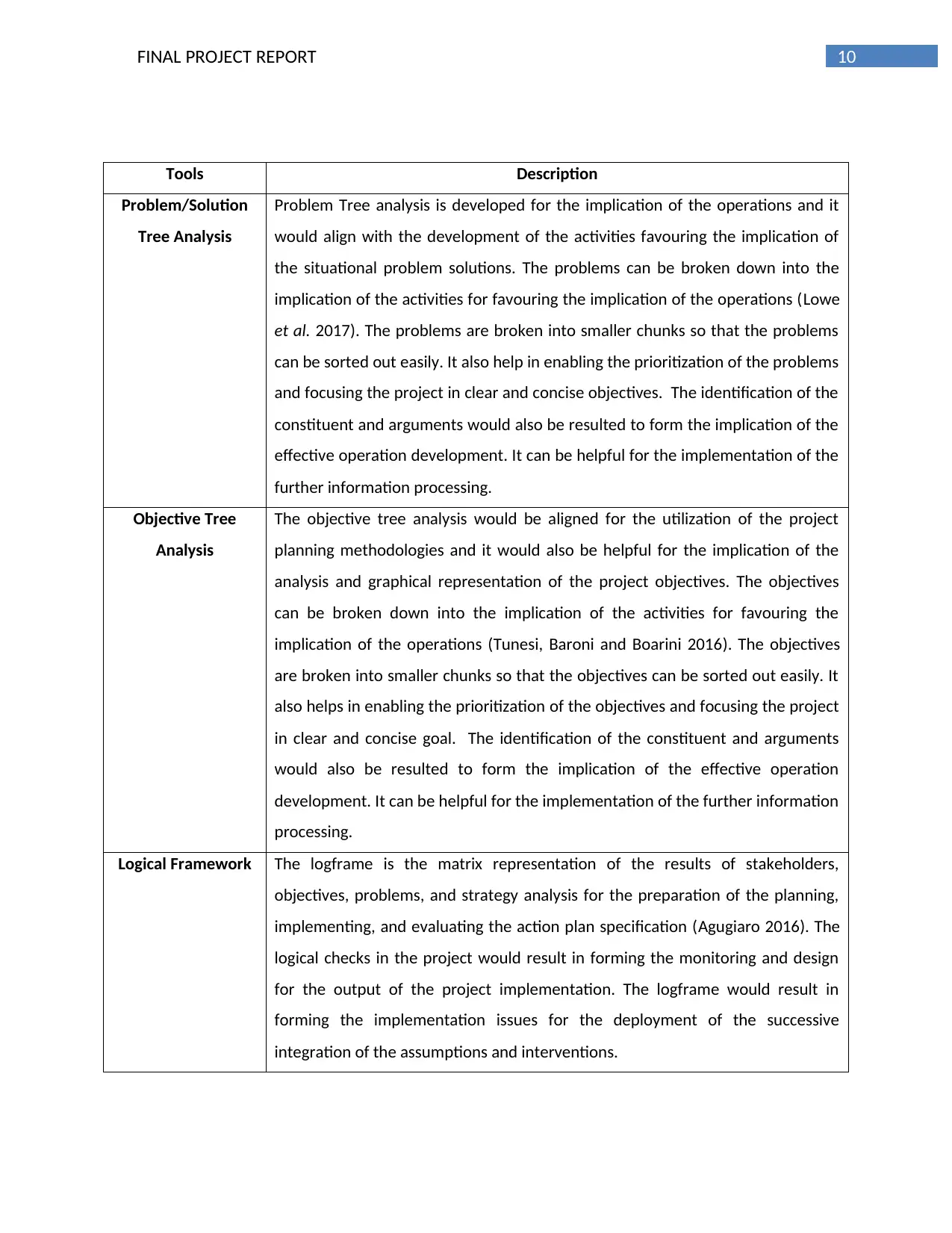
10FINAL PROJECT REPORT
Tools Description
Problem/Solution
Tree Analysis
Problem Tree analysis is developed for the implication of the operations and it
would align with the development of the activities favouring the implication of
the situational problem solutions. The problems can be broken down into the
implication of the activities for favouring the implication of the operations (Lowe
et al. 2017). The problems are broken into smaller chunks so that the problems
can be sorted out easily. It also help in enabling the prioritization of the problems
and focusing the project in clear and concise objectives. The identification of the
constituent and arguments would also be resulted to form the implication of the
effective operation development. It can be helpful for the implementation of the
further information processing.
Objective Tree
Analysis
The objective tree analysis would be aligned for the utilization of the project
planning methodologies and it would also be helpful for the implication of the
analysis and graphical representation of the project objectives. The objectives
can be broken down into the implication of the activities for favouring the
implication of the operations (Tunesi, Baroni and Boarini 2016). The objectives
are broken into smaller chunks so that the objectives can be sorted out easily. It
also helps in enabling the prioritization of the objectives and focusing the project
in clear and concise goal. The identification of the constituent and arguments
would also be resulted to form the implication of the effective operation
development. It can be helpful for the implementation of the further information
processing.
Logical Framework The logframe is the matrix representation of the results of stakeholders,
objectives, problems, and strategy analysis for the preparation of the planning,
implementing, and evaluating the action plan specification (Agugiaro 2016). The
logical checks in the project would result in forming the monitoring and design
for the output of the project implementation. The logframe would result in
forming the implementation issues for the deployment of the successive
integration of the assumptions and interventions.
Tools Description
Problem/Solution
Tree Analysis
Problem Tree analysis is developed for the implication of the operations and it
would align with the development of the activities favouring the implication of
the situational problem solutions. The problems can be broken down into the
implication of the activities for favouring the implication of the operations (Lowe
et al. 2017). The problems are broken into smaller chunks so that the problems
can be sorted out easily. It also help in enabling the prioritization of the problems
and focusing the project in clear and concise objectives. The identification of the
constituent and arguments would also be resulted to form the implication of the
effective operation development. It can be helpful for the implementation of the
further information processing.
Objective Tree
Analysis
The objective tree analysis would be aligned for the utilization of the project
planning methodologies and it would also be helpful for the implication of the
analysis and graphical representation of the project objectives. The objectives
can be broken down into the implication of the activities for favouring the
implication of the operations (Tunesi, Baroni and Boarini 2016). The objectives
are broken into smaller chunks so that the objectives can be sorted out easily. It
also helps in enabling the prioritization of the objectives and focusing the project
in clear and concise goal. The identification of the constituent and arguments
would also be resulted to form the implication of the effective operation
development. It can be helpful for the implementation of the further information
processing.
Logical Framework The logframe is the matrix representation of the results of stakeholders,
objectives, problems, and strategy analysis for the preparation of the planning,
implementing, and evaluating the action plan specification (Agugiaro 2016). The
logical checks in the project would result in forming the monitoring and design
for the output of the project implementation. The logframe would result in
forming the implementation issues for the deployment of the successive
integration of the assumptions and interventions.
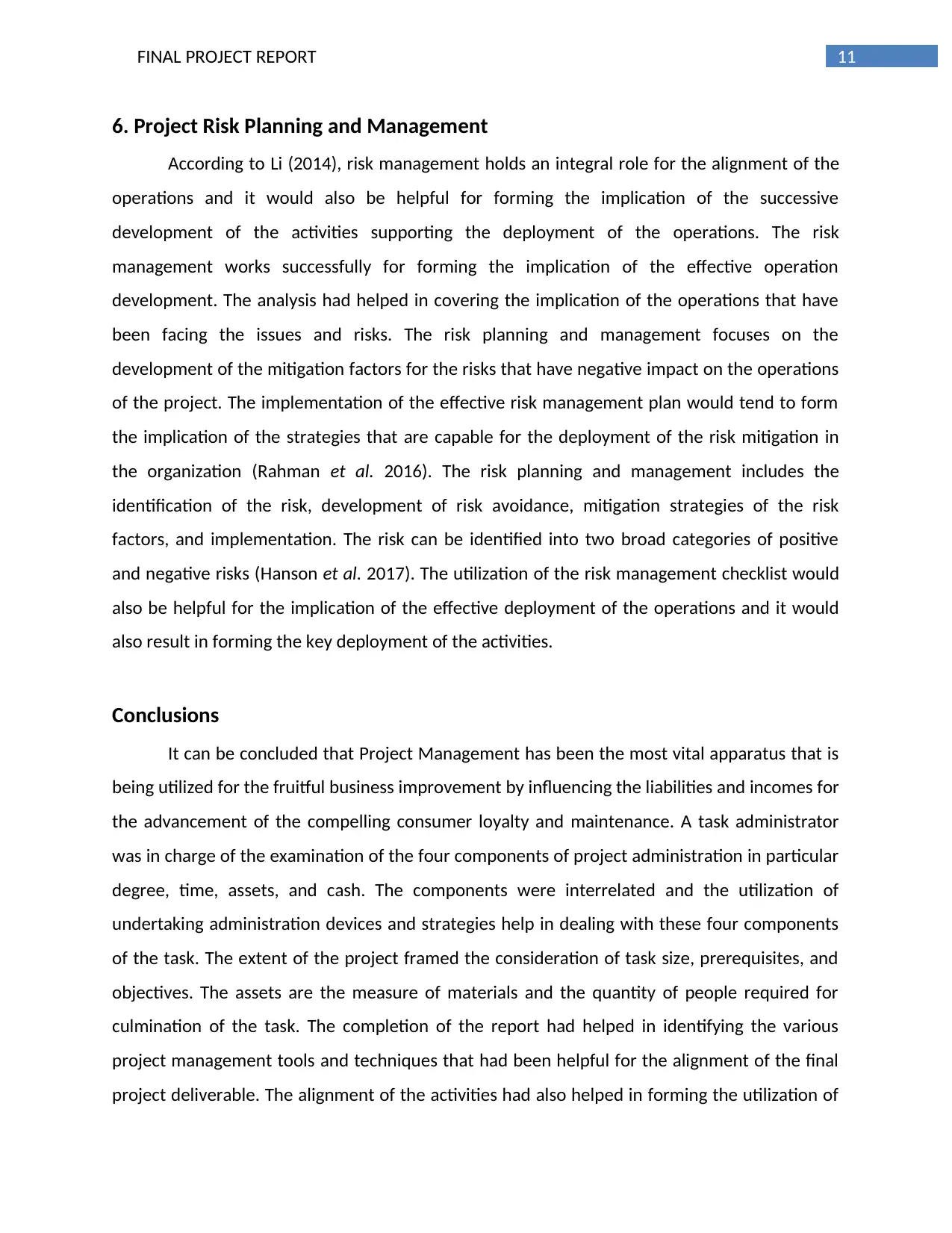
11FINAL PROJECT REPORT
6. Project Risk Planning and Management
According to Li (2014), risk management holds an integral role for the alignment of the
operations and it would also be helpful for forming the implication of the successive
development of the activities supporting the deployment of the operations. The risk
management works successfully for forming the implication of the effective operation
development. The analysis had helped in covering the implication of the operations that have
been facing the issues and risks. The risk planning and management focuses on the
development of the mitigation factors for the risks that have negative impact on the operations
of the project. The implementation of the effective risk management plan would tend to form
the implication of the strategies that are capable for the deployment of the risk mitigation in
the organization (Rahman et al. 2016). The risk planning and management includes the
identification of the risk, development of risk avoidance, mitigation strategies of the risk
factors, and implementation. The risk can be identified into two broad categories of positive
and negative risks (Hanson et al. 2017). The utilization of the risk management checklist would
also be helpful for the implication of the effective deployment of the operations and it would
also result in forming the key deployment of the activities.
Conclusions
It can be concluded that Project Management has been the most vital apparatus that is
being utilized for the fruitful business improvement by influencing the liabilities and incomes for
the advancement of the compelling consumer loyalty and maintenance. A task administrator
was in charge of the examination of the four components of project administration in particular
degree, time, assets, and cash. The components were interrelated and the utilization of
undertaking administration devices and strategies help in dealing with these four components
of the task. The extent of the project framed the consideration of task size, prerequisites, and
objectives. The assets are the measure of materials and the quantity of people required for
culmination of the task. The completion of the report had helped in identifying the various
project management tools and techniques that had been helpful for the alignment of the final
project deliverable. The alignment of the activities had also helped in forming the utilization of
6. Project Risk Planning and Management
According to Li (2014), risk management holds an integral role for the alignment of the
operations and it would also be helpful for forming the implication of the successive
development of the activities supporting the deployment of the operations. The risk
management works successfully for forming the implication of the effective operation
development. The analysis had helped in covering the implication of the operations that have
been facing the issues and risks. The risk planning and management focuses on the
development of the mitigation factors for the risks that have negative impact on the operations
of the project. The implementation of the effective risk management plan would tend to form
the implication of the strategies that are capable for the deployment of the risk mitigation in
the organization (Rahman et al. 2016). The risk planning and management includes the
identification of the risk, development of risk avoidance, mitigation strategies of the risk
factors, and implementation. The risk can be identified into two broad categories of positive
and negative risks (Hanson et al. 2017). The utilization of the risk management checklist would
also be helpful for the implication of the effective deployment of the operations and it would
also result in forming the key deployment of the activities.
Conclusions
It can be concluded that Project Management has been the most vital apparatus that is
being utilized for the fruitful business improvement by influencing the liabilities and incomes for
the advancement of the compelling consumer loyalty and maintenance. A task administrator
was in charge of the examination of the four components of project administration in particular
degree, time, assets, and cash. The components were interrelated and the utilization of
undertaking administration devices and strategies help in dealing with these four components
of the task. The extent of the project framed the consideration of task size, prerequisites, and
objectives. The assets are the measure of materials and the quantity of people required for
culmination of the task. The completion of the report had helped in identifying the various
project management tools and techniques that had been helpful for the alignment of the final
project deliverable. The alignment of the activities had also helped in forming the utilization of
⊘ This is a preview!⊘
Do you want full access?
Subscribe today to unlock all pages.
Trusted by 1+ million students worldwide

1 out of 16


Related Documents


Your All-in-One AI-Powered Toolkit for Academic Success.
+13062052269
info@desklib.com
Available 24*7 on WhatsApp / Email
![[object Object]](/_next/static/media/star-bottom.7253800d.svg)
Unlock your academic potential
Copyright © 2020–2026 A2Z Services. All Rights Reserved. Developed and managed by ZUCOL.