Project Management Plan Analysis: Unilever's Business Projects
VerifiedAdded on 2020/02/05
|10
|3695
|118
Report
AI Summary
This report provides a comprehensive analysis of Unilever's project management plan. It begins by defining project management plans (PMP) and their advantages, emphasizing their role in achieving company goals and managing resources. The report then delves into the incorporation of PMP, including baseline measurements and stakeholder communication. It explores work breakdown structures (WBS) and Gantt charts, highlighting their impact on project organization and control, particularly in complex projects. The report also examines research methodologies, differentiating between qualitative and quantitative approaches and their application in data collection and analysis. It assesses the importance of accurate data and provides recommendations based on the research findings, reflecting on the value of research in meeting project objectives. The report concludes by emphasizing the significance of effective project management in achieving business success, especially in the context of globalization and corporate social responsibility.
MANAGING A SUCCUSFUL
BUSINESS PROJECTS
BUSINESS PROJECTS

Paraphrase This Document
Need a fresh take? Get an instant paraphrase of this document with our AI Paraphraser
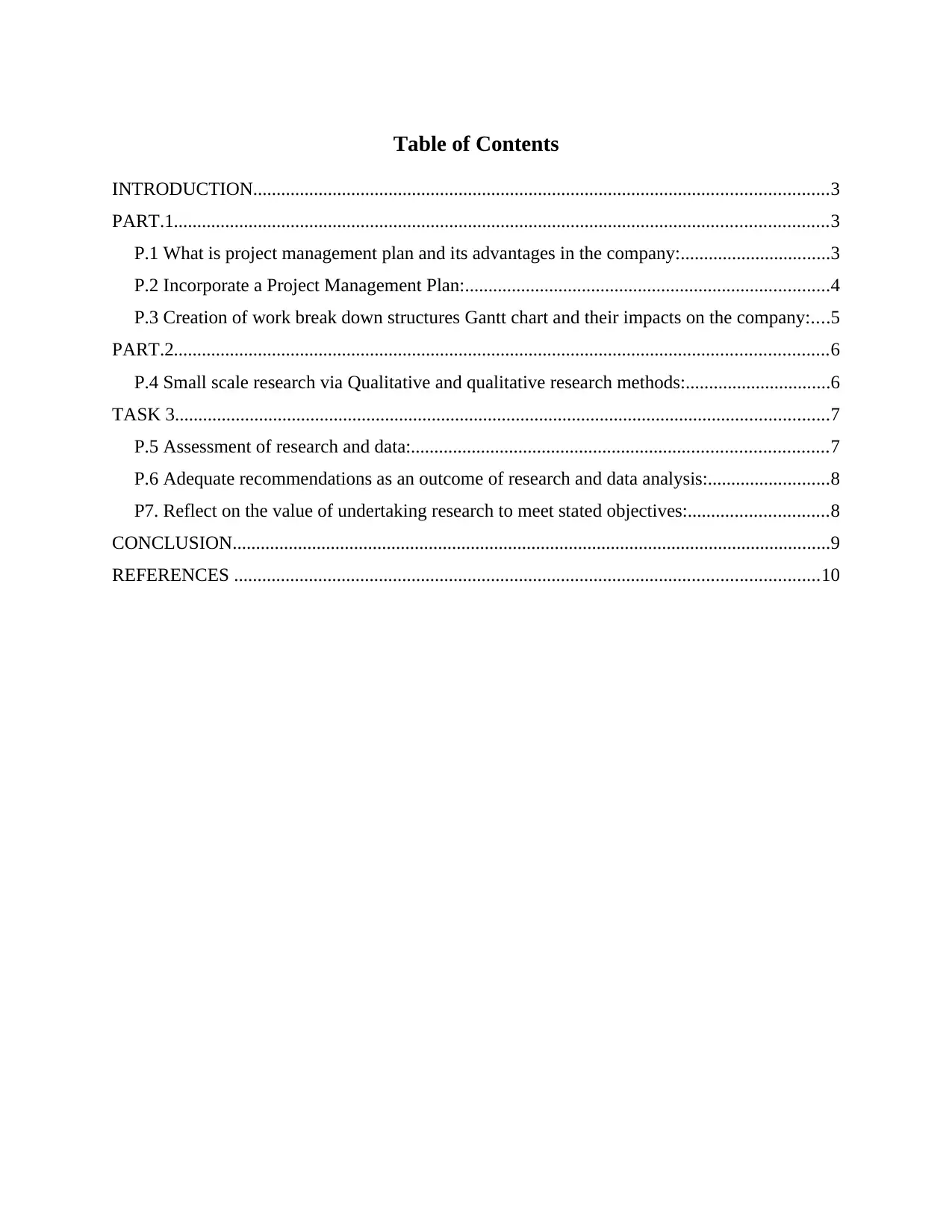
Table of Contents
INTRODUCTION...........................................................................................................................3
PART.1............................................................................................................................................3
P.1 What is project management plan and its advantages in the company:................................3
P.2 Incorporate a Project Management Plan:..............................................................................4
P.3 Creation of work break down structures Gantt chart and their impacts on the company:....5
PART.2............................................................................................................................................6
P.4 Small scale research via Qualitative and qualitative research methods:...............................6
TASK 3............................................................................................................................................7
P.5 Assessment of research and data:.........................................................................................7
P.6 Adequate recommendations as an outcome of research and data analysis:..........................8
P7. Reflect on the value of undertaking research to meet stated objectives:..............................8
CONCLUSION................................................................................................................................9
REFERENCES .............................................................................................................................10
INTRODUCTION...........................................................................................................................3
PART.1............................................................................................................................................3
P.1 What is project management plan and its advantages in the company:................................3
P.2 Incorporate a Project Management Plan:..............................................................................4
P.3 Creation of work break down structures Gantt chart and their impacts on the company:....5
PART.2............................................................................................................................................6
P.4 Small scale research via Qualitative and qualitative research methods:...............................6
TASK 3............................................................................................................................................7
P.5 Assessment of research and data:.........................................................................................7
P.6 Adequate recommendations as an outcome of research and data analysis:..........................8
P7. Reflect on the value of undertaking research to meet stated objectives:..............................8
CONCLUSION................................................................................................................................9
REFERENCES .............................................................................................................................10
INTRODUCTION
In the time of globalization, corporate world are applying their corporate social responsibility
practices in their businesses. Now, there has been some kind of changes which need to
implement by the corporate businesses. Different countries have adopted their CSR practices in
order to upgrade their society. Now the company's from different region, make their CSR
policies as per country's regulation(Kerzner, 2013). CSR practices in Unilever plc, assist in
improving their reputation and brand image which also help the company to get the competitive
advantages over the others. Although different-different countries have their CSR norms but all
of them main purpose are to upgrade the living standards of the society by way of charity or
donation, assist in providing free education to the needy students. Unilever need to manage its
strategy for getting its businesses successful one.
PART.1
P.1 What is project management plan and its advantages in the company:
Every company need to make an effective and efficient project management plan so that the
company can easily complete their projects. Project management plan in Unilever plc is the
foundation of the the project which is made before going to implement the project plan. With the
help of the project, projects managers would get to know about the persons or individuals who
are actively involved in a particular project. Every qualified professionals, on their part, would
give their suggestions or directions at the initial stage for implementing the plan in a better way.
The main cause of this direction is to know the entire purpose of the projects and how it can be
finished so that the company would able to achieve their set objectives and goals. The documents
which is used in the entire projects, are need to be used as a references for the whole projects. As
this is useful to manage all the routine activities and accountabilities by the entrepreneur and
mangers of the company. However, there is need to know the effective management teams who
can overlook the entire project and assist in completion of the project(Meredith and Mantel,
2011). Effectiveness of the projects can be done with the help of adequate planning,
implementation of project management techniques so that complex projects can be managed on
time. However there are so many projects which that covers large scale planning that influence
almost all of the departments of the company. While application of the project, Unilever faces so
many hurdles which may occurred in human resource, budgeting plan and supply. However,
In the time of globalization, corporate world are applying their corporate social responsibility
practices in their businesses. Now, there has been some kind of changes which need to
implement by the corporate businesses. Different countries have adopted their CSR practices in
order to upgrade their society. Now the company's from different region, make their CSR
policies as per country's regulation(Kerzner, 2013). CSR practices in Unilever plc, assist in
improving their reputation and brand image which also help the company to get the competitive
advantages over the others. Although different-different countries have their CSR norms but all
of them main purpose are to upgrade the living standards of the society by way of charity or
donation, assist in providing free education to the needy students. Unilever need to manage its
strategy for getting its businesses successful one.
PART.1
P.1 What is project management plan and its advantages in the company:
Every company need to make an effective and efficient project management plan so that the
company can easily complete their projects. Project management plan in Unilever plc is the
foundation of the the project which is made before going to implement the project plan. With the
help of the project, projects managers would get to know about the persons or individuals who
are actively involved in a particular project. Every qualified professionals, on their part, would
give their suggestions or directions at the initial stage for implementing the plan in a better way.
The main cause of this direction is to know the entire purpose of the projects and how it can be
finished so that the company would able to achieve their set objectives and goals. The documents
which is used in the entire projects, are need to be used as a references for the whole projects. As
this is useful to manage all the routine activities and accountabilities by the entrepreneur and
mangers of the company. However, there is need to know the effective management teams who
can overlook the entire project and assist in completion of the project(Meredith and Mantel,
2011). Effectiveness of the projects can be done with the help of adequate planning,
implementation of project management techniques so that complex projects can be managed on
time. However there are so many projects which that covers large scale planning that influence
almost all of the departments of the company. While application of the project, Unilever faces so
many hurdles which may occurred in human resource, budgeting plan and supply. However,
⊘ This is a preview!⊘
Do you want full access?
Subscribe today to unlock all pages.

Trusted by 1+ million students worldwide
project mangers and their qualified team expert in handling the various issues, they could make
the project plan to handle interdependence and meet resource issues. There are basically two
broad ways by which PMP can be exercised by the project management team and managers.
1). Explaining project plan to the Unilever shareholders: Project plans are the living
documents in the Unilever plc that can implement over the years in the company
through alteration. As this is a bigger concept that emerged after several planning
processes are done.
2). PMP contains baseline: Baseline is the tool of performance measurements
techniques that is applied to measure the ability of the company. In other words,
baseline is used to detect the variances which has been found during the operation
of the company and also used such baseline management technique to eradicate
such variances(Rosenau and Githens, 2011).
P.2 Incorporate a Project Management Plan:
Project management plan is provided by the project managers based on the guidelines
provided to them by their heads. Project plan is basically provide the guidelines for any project
as how the work will be carried out to achieve the goals or to complete the project. The project
management plan provide the various guideline as who all will be involved in the project what
will be the total budget for it, the time before which the project has to be completed and therefore
this document is used as a reference throughout the period in which project is completed. The
project management plan of Unilever plc. Contains various elements like how much total human
resource will be required ,what technology will be used,the budget for a particular project,what
all hurdles can be faced during the project is working and different ways to overcome those
hurdles,attachment are given of different business case and notes etc. The project plan is prepare
in the company by following a set of process which starts with explaining the project key
components of plan to stakeholder(Larson and Gray, 2011). Once the project is explained the
responsibilities and accountability is set of different individual so that there is no confusion
among the employees working on a particular project and in case of any check required everyone
is accountable for the work done by them which helps in maintaining control over the project.
After the project plan is made is held and all those who are associated with the project is called
and the project is discussed among all and all the required information is communicated to the
the project plan to handle interdependence and meet resource issues. There are basically two
broad ways by which PMP can be exercised by the project management team and managers.
1). Explaining project plan to the Unilever shareholders: Project plans are the living
documents in the Unilever plc that can implement over the years in the company
through alteration. As this is a bigger concept that emerged after several planning
processes are done.
2). PMP contains baseline: Baseline is the tool of performance measurements
techniques that is applied to measure the ability of the company. In other words,
baseline is used to detect the variances which has been found during the operation
of the company and also used such baseline management technique to eradicate
such variances(Rosenau and Githens, 2011).
P.2 Incorporate a Project Management Plan:
Project management plan is provided by the project managers based on the guidelines
provided to them by their heads. Project plan is basically provide the guidelines for any project
as how the work will be carried out to achieve the goals or to complete the project. The project
management plan provide the various guideline as who all will be involved in the project what
will be the total budget for it, the time before which the project has to be completed and therefore
this document is used as a reference throughout the period in which project is completed. The
project management plan of Unilever plc. Contains various elements like how much total human
resource will be required ,what technology will be used,the budget for a particular project,what
all hurdles can be faced during the project is working and different ways to overcome those
hurdles,attachment are given of different business case and notes etc. The project plan is prepare
in the company by following a set of process which starts with explaining the project key
components of plan to stakeholder(Larson and Gray, 2011). Once the project is explained the
responsibilities and accountability is set of different individual so that there is no confusion
among the employees working on a particular project and in case of any check required everyone
is accountable for the work done by them which helps in maintaining control over the project.
After the project plan is made is held and all those who are associated with the project is called
and the project is discussed among all and all the required information is communicated to the
Paraphrase This Document
Need a fresh take? Get an instant paraphrase of this document with our AI Paraphraser
involved parties. After the project details are discussed project cost base line and the schedule is
developed in which estimation of money required is done and also what all tasks in in the project
are interdependent and what are dependent are analysed. After the project cost base line is made
the project quality and risk is analysed. It involves study of the degree of risk involve in any
project as every plan has some chances of failure also and therefore it is important to have a
backup for those risk which can be forecasted before in order to minimise the risk and also
quality check of the project plan is important in which the expected quality of the project is
standards are set also what are the expectations from the project is made clear in the project
management plan(Doherty, Ashurst, and Peppard, 2012).
P.3 Creation of work break down structures Gantt chart and their impacts on the company:
In a complex or lengthy projects, company need to break such projects so that they could easy to
evaluate and complete by the project team. Project managers are the key person who implement
and complete the projects to make the company viable and successful. Work break down
structure is basically made in the organisation where there are so many big projects. Such
structure is made to cut the lengthy projects into sort parts so that such sort parts are easy to
evaluate by the project team. Unilever plc is operated into many countries and it has so many big
projects into their hands and that is why company applied work break down structure in their
firm so that their projects can easily finish on time(Putnam and Myers, 2013). In addition to this,
work break down structure also assist the company in making project organisation, displaying
the controlling points and projects, help in assigning the duty of the project managers, and this
will also help in ascertaining the cost of the company. Project managers and their team helps to
complete the project within a certain time and project allotted cost. When the project completes,
then it will able to satiate the outsiders or shareholders needs. Every project has a time deadline
within which project has to be completed and also have allotted funds for it. Basically the main
aim of WBS structure is to limits the complex practices to a gathering of task. The project
managers can covert the more complex task into the simpler one. Project mangers would allocate
the cost into their task and also make sure that the total task cost does not exceed the total project
cost. While on the other hand, Gantt chart is the graphical presentation of the projects.
developed in which estimation of money required is done and also what all tasks in in the project
are interdependent and what are dependent are analysed. After the project cost base line is made
the project quality and risk is analysed. It involves study of the degree of risk involve in any
project as every plan has some chances of failure also and therefore it is important to have a
backup for those risk which can be forecasted before in order to minimise the risk and also
quality check of the project plan is important in which the expected quality of the project is
standards are set also what are the expectations from the project is made clear in the project
management plan(Doherty, Ashurst, and Peppard, 2012).
P.3 Creation of work break down structures Gantt chart and their impacts on the company:
In a complex or lengthy projects, company need to break such projects so that they could easy to
evaluate and complete by the project team. Project managers are the key person who implement
and complete the projects to make the company viable and successful. Work break down
structure is basically made in the organisation where there are so many big projects. Such
structure is made to cut the lengthy projects into sort parts so that such sort parts are easy to
evaluate by the project team. Unilever plc is operated into many countries and it has so many big
projects into their hands and that is why company applied work break down structure in their
firm so that their projects can easily finish on time(Putnam and Myers, 2013). In addition to this,
work break down structure also assist the company in making project organisation, displaying
the controlling points and projects, help in assigning the duty of the project managers, and this
will also help in ascertaining the cost of the company. Project managers and their team helps to
complete the project within a certain time and project allotted cost. When the project completes,
then it will able to satiate the outsiders or shareholders needs. Every project has a time deadline
within which project has to be completed and also have allotted funds for it. Basically the main
aim of WBS structure is to limits the complex practices to a gathering of task. The project
managers can covert the more complex task into the simpler one. Project mangers would allocate
the cost into their task and also make sure that the total task cost does not exceed the total project
cost. While on the other hand, Gantt chart is the graphical presentation of the projects.
PART.2
P.4 Small scale research via Qualitative and qualitative research methods:
Research in Unilever plc. Is done to collect data from the market regarding the business.
It helps in taking the future decisions and reviewing the existing strategies if observed that
changes are required. Marketing research can b done by using the primary as well as the
secondary data the choice of which depends upon the urgency and nature of the data. Collection
of primary data takes more time and also bit expensive as much resources are needed to be
involved in it. And also less data is collected in more time though the data collected is more
reliable and correct and therefore it is consider when the data accuracy is demanded more.
Secondary data is collection of data from already available data from books internet newspaper
journals etc. Use of secondary data is done when the data is demanded in bulk and there is less
time to collect the data. It is an easy way of collecting the data and mostly prefer when data
accuracy can be compromised up to a limit(Rosemann and vom Brocke, 2015). Research can be
further done on qualitative and quantitative manner in which qualitative research gives quality
report which can be generated through interviews which may be a structure interview semi-
structured or non structured interview. Other ways to generate the qualitative research is by
observation,quality group discussion and other famous qualitative research methods are studying
the photograph personal documents etc. Once the research is done it is presented in the reports
and presented to the interested parties. Quantitative research on the other hand gives the data in
the numeric form to the Unilever company. The data provided by using quantitative method is
easy to understand and comparison can be done easily as the data is presented in tabular or
graphic form and is collected using the structured statistical instruments and before starting the
research all the aspects are carefully studied. It is important in the quantitative research that
while giving the end report the information regarding the techniques used in collection of data
should be given and also the assumptions if taken while preparing the research. Use of tables and
graphs is appreciated in the quantitative research as it makes the comparisons more easy and the
figures should be so small in size and always tell the reader what to look for in the figures and
tables and if in case the figures are taken from the already given data like from the government
P.4 Small scale research via Qualitative and qualitative research methods:
Research in Unilever plc. Is done to collect data from the market regarding the business.
It helps in taking the future decisions and reviewing the existing strategies if observed that
changes are required. Marketing research can b done by using the primary as well as the
secondary data the choice of which depends upon the urgency and nature of the data. Collection
of primary data takes more time and also bit expensive as much resources are needed to be
involved in it. And also less data is collected in more time though the data collected is more
reliable and correct and therefore it is consider when the data accuracy is demanded more.
Secondary data is collection of data from already available data from books internet newspaper
journals etc. Use of secondary data is done when the data is demanded in bulk and there is less
time to collect the data. It is an easy way of collecting the data and mostly prefer when data
accuracy can be compromised up to a limit(Rosemann and vom Brocke, 2015). Research can be
further done on qualitative and quantitative manner in which qualitative research gives quality
report which can be generated through interviews which may be a structure interview semi-
structured or non structured interview. Other ways to generate the qualitative research is by
observation,quality group discussion and other famous qualitative research methods are studying
the photograph personal documents etc. Once the research is done it is presented in the reports
and presented to the interested parties. Quantitative research on the other hand gives the data in
the numeric form to the Unilever company. The data provided by using quantitative method is
easy to understand and comparison can be done easily as the data is presented in tabular or
graphic form and is collected using the structured statistical instruments and before starting the
research all the aspects are carefully studied. It is important in the quantitative research that
while giving the end report the information regarding the techniques used in collection of data
should be given and also the assumptions if taken while preparing the research. Use of tables and
graphs is appreciated in the quantitative research as it makes the comparisons more easy and the
figures should be so small in size and always tell the reader what to look for in the figures and
tables and if in case the figures are taken from the already given data like from the government
⊘ This is a preview!⊘
Do you want full access?
Subscribe today to unlock all pages.
Trusted by 1+ million students worldwide
agency one should must give the method used to collect the figures initially and if in case any
data is missing than that should also be provided.
TASK 3
P.5 Assessment of research and data:
Assignment of any research is beneficial only if the provided data is accurate and correct.
As the data is collected using different techniques like qualitative and quantitative. Each
technique has its own merits and demerits. While doing the research, business use the the
primary data as well as the secondary data as per there need. Therefore it is important that the
sources used for the collection of data is correct as if it is not then the whole analytical process
on which the report based, will be give the wrong interpretation to the company that will also
lead to make the worthless strategies. So, proper attention is required for collecting appropriate
data, as this will also help the company to make useful strategy. Unilever plc uses the qualitative
approach while making analysis on the data(Mochal, 2017). Qualitative research technique is
applicable at the time of planning process where it can relevant for the subjective evaluation and
measurement of data. As, qualitative assessment helps to provide a clear views about the
challenges of the company that will lead to face in near future. Qualitative and quantitative
techniques will help Unilever plc to make PESTLE analysis, SWOT analysis, EVA analysis,
and so on. These analysis help the company to see their existing position and also show to the
company opportunities and strengths, and uncover the threats and weaknesses. Then, company
need to make their policies to grab the opportunities, strengths and avoid from threats and
weaknesses. The data collected from any of the sources can be used for doing company's SWOT
analysis and by doing SWOT analysis, company would know about the its strengths,
weaknesses. And also get to know the industry's opportunities and threats. Company would also
able to do PESTLE analysis, so that they would come to the conclusion that the company's
strategic policies are as per the external factors. These types of analysis, lead the company to
have the competitive advantages(Chang, Walters and Wills, 2013). However there are two ways
by which data can be assessed which are described hereunder:
1. Base stage or manifest stage: At this stage, data is described in detail. This is what
exactly said, but there is no explanation on theories.
data is missing than that should also be provided.
TASK 3
P.5 Assessment of research and data:
Assignment of any research is beneficial only if the provided data is accurate and correct.
As the data is collected using different techniques like qualitative and quantitative. Each
technique has its own merits and demerits. While doing the research, business use the the
primary data as well as the secondary data as per there need. Therefore it is important that the
sources used for the collection of data is correct as if it is not then the whole analytical process
on which the report based, will be give the wrong interpretation to the company that will also
lead to make the worthless strategies. So, proper attention is required for collecting appropriate
data, as this will also help the company to make useful strategy. Unilever plc uses the qualitative
approach while making analysis on the data(Mochal, 2017). Qualitative research technique is
applicable at the time of planning process where it can relevant for the subjective evaluation and
measurement of data. As, qualitative assessment helps to provide a clear views about the
challenges of the company that will lead to face in near future. Qualitative and quantitative
techniques will help Unilever plc to make PESTLE analysis, SWOT analysis, EVA analysis,
and so on. These analysis help the company to see their existing position and also show to the
company opportunities and strengths, and uncover the threats and weaknesses. Then, company
need to make their policies to grab the opportunities, strengths and avoid from threats and
weaknesses. The data collected from any of the sources can be used for doing company's SWOT
analysis and by doing SWOT analysis, company would know about the its strengths,
weaknesses. And also get to know the industry's opportunities and threats. Company would also
able to do PESTLE analysis, so that they would come to the conclusion that the company's
strategic policies are as per the external factors. These types of analysis, lead the company to
have the competitive advantages(Chang, Walters and Wills, 2013). However there are two ways
by which data can be assessed which are described hereunder:
1. Base stage or manifest stage: At this stage, data is described in detail. This is what
exactly said, but there is no explanation on theories.
Paraphrase This Document
Need a fresh take? Get an instant paraphrase of this document with our AI Paraphraser
2. Broader stage or potential stage for evaluation: in this stage, there is a need to
have detailed evaluation of data.
P.6 Adequate recommendations as an outcome of research and data analysis:
Data analysis is must for making the company's strategy. The outcome get after research and data
analysis, should be correct so that the company could use such data for making strategic policies
of the company that will also helps the company to get their certain objectives. Company is
required to work upon to gather the adequate data so that it can appropriately analysed. If the
company would pick the wrong or inappropriate data, then the analytical part would be senseless
and company would not able to make any strategic policies by which company could attain their
goals and objectives. Company is required to give the clear data analysis, so that it can able to
present the clear image before shareholders or general public. Through research analysis,
company would able to understand the consumers mind, and then react according to it so that the
company can make the plan as per consumers' desire. Data analysis assist in making the products
of the company. As data analysis is the results which come out after processing the raw data.
Data analysis assist the company to know the issues and challenges which company can face in
the near future. Analysis of data requires information and this can come through managers, board
of directors and other influential personal who have control on the management process. As a
results, data analysis would not give the information which can give adverse effects on the
company's operation(Baiden and Price, 2011). Company need to provide exact picture of the data
analysis so that the shareholders of the company would able to get the exact information about
the company. Unilever plc is a big organisation and have their operations in many of the
countries, for making their plans successful, company need to get the informations from the
reliable sources, and then apply such information for getting better analysis. Unilever plc need to
follow the better CSR practices in their businesses as per the country's norms that can attain the
set objectives and goals of the company.
P7. Reflect on the value of undertaking research to meet stated objectives:
Every company's main objectives is to increase the sales and revenues, and this can be attained
by fulfilling the needs or desires of the company. The wants of the consumers could be identified
with the helps of doing market research. There are few theories which are used to develop the
skills of the members of the organisation. One of them is training program, this will help the
have detailed evaluation of data.
P.6 Adequate recommendations as an outcome of research and data analysis:
Data analysis is must for making the company's strategy. The outcome get after research and data
analysis, should be correct so that the company could use such data for making strategic policies
of the company that will also helps the company to get their certain objectives. Company is
required to work upon to gather the adequate data so that it can appropriately analysed. If the
company would pick the wrong or inappropriate data, then the analytical part would be senseless
and company would not able to make any strategic policies by which company could attain their
goals and objectives. Company is required to give the clear data analysis, so that it can able to
present the clear image before shareholders or general public. Through research analysis,
company would able to understand the consumers mind, and then react according to it so that the
company can make the plan as per consumers' desire. Data analysis assist in making the products
of the company. As data analysis is the results which come out after processing the raw data.
Data analysis assist the company to know the issues and challenges which company can face in
the near future. Analysis of data requires information and this can come through managers, board
of directors and other influential personal who have control on the management process. As a
results, data analysis would not give the information which can give adverse effects on the
company's operation(Baiden and Price, 2011). Company need to provide exact picture of the data
analysis so that the shareholders of the company would able to get the exact information about
the company. Unilever plc is a big organisation and have their operations in many of the
countries, for making their plans successful, company need to get the informations from the
reliable sources, and then apply such information for getting better analysis. Unilever plc need to
follow the better CSR practices in their businesses as per the country's norms that can attain the
set objectives and goals of the company.
P7. Reflect on the value of undertaking research to meet stated objectives:
Every company's main objectives is to increase the sales and revenues, and this can be attained
by fulfilling the needs or desires of the company. The wants of the consumers could be identified
with the helps of doing market research. There are few theories which are used to develop the
skills of the members of the organisation. One of them is training program, this will help the
company to make employees productive and efficient so that they will further able to generate
add value in the company. With the help of training and development programme, company
would able to emerge good productive skill amongst employees and also able to reach to their
predetermined goals and objectives. Training is also divided into two parts: one is essential
training and the other one is for requirement based training. Essential training is provided at the
initial level when the new employee get recruited. This is required for get to knowing the
company's work cultures and how practically new employees do their works to get the
objectives. While on the other hands, requirement based training is provided to the existing
employees for familiar with the company's new technologies, and new policies. Training and
development programme explain company's development process for collecting and evaluating
informations that could help to make plans and giving and appropriate guidelines to the members
of the company(Rosenau and Githens, 2011). Company's HR department is the key department
which recruits the talented candidates and providing them adequate training and development
programme for improving their skills and further they would able to contributes to the company
for attaining their predetermined goals and objectives. In a company, main objectives of the
company is to attain it objectives, but how will set objectives are a is the key issue which
company need to face. Company's senior managers are the most eligible person who frame the
plans for getting its stated objectives.
CONCLUSION
It has been found from the above mentioned report that the company need to focus on their
efficient project completion. Project management plan assist the company to complete their
projects with full of accuracy. However, company need to follow their corporate social
responsibility practices that will help the company for sustainable development. It also pointed
out that the company is required to provide training to their employees for improving their skills.
Work break down strategy helps the company to effectively and efficiently complete their
projects by breaking their most complicated and lengthy projects into many small parts. Gantt
chart is also assist the company for completing their projects with the help of graphical
presentation.
add value in the company. With the help of training and development programme, company
would able to emerge good productive skill amongst employees and also able to reach to their
predetermined goals and objectives. Training is also divided into two parts: one is essential
training and the other one is for requirement based training. Essential training is provided at the
initial level when the new employee get recruited. This is required for get to knowing the
company's work cultures and how practically new employees do their works to get the
objectives. While on the other hands, requirement based training is provided to the existing
employees for familiar with the company's new technologies, and new policies. Training and
development programme explain company's development process for collecting and evaluating
informations that could help to make plans and giving and appropriate guidelines to the members
of the company(Rosenau and Githens, 2011). Company's HR department is the key department
which recruits the talented candidates and providing them adequate training and development
programme for improving their skills and further they would able to contributes to the company
for attaining their predetermined goals and objectives. In a company, main objectives of the
company is to attain it objectives, but how will set objectives are a is the key issue which
company need to face. Company's senior managers are the most eligible person who frame the
plans for getting its stated objectives.
CONCLUSION
It has been found from the above mentioned report that the company need to focus on their
efficient project completion. Project management plan assist the company to complete their
projects with full of accuracy. However, company need to follow their corporate social
responsibility practices that will help the company for sustainable development. It also pointed
out that the company is required to provide training to their employees for improving their skills.
Work break down strategy helps the company to effectively and efficiently complete their
projects by breaking their most complicated and lengthy projects into many small parts. Gantt
chart is also assist the company for completing their projects with the help of graphical
presentation.
⊘ This is a preview!⊘
Do you want full access?
Subscribe today to unlock all pages.
Trusted by 1+ million students worldwide
REFERENCES
Books and Journals:
Kerzner, H., 2013. Project management: a systems approach to planning, scheduling, and
controlling. John Wiley & Sons.
Meredith, J.R. and Mantel Jr, S.J., 2011. Project management: a managerial approach. John
Wiley & Sons.
Rosenau, M.D. and Githens, G.D., 2011. Successful project management: a step-by-step
approach with practical examples. John Wiley & Sons.
Larson, E.W. and Gray, C.F., 2011. Project management: The managerial process.
Doherty, N.F., Ashurst, C. and Peppard, J., 2012. Factors affecting the successful realisation of
benefits from systems development projects: findings from three case studies. Journal
of Information Technology. 27(1). pp.1-16.
Putnam, L.H. and Myers, W., 2013. Five core metrics: the intelligence behind successful
software management. Pearson Education.
Rosemann, M. and vom Brocke, J., 2015. The six core elements of business process
management. In Handbook on business process management 1(pp. 105-122). Springer
Berlin Heidelberg.
Meng, X., 2012. The effect of relationship management on project performance in construction.
International journal of project management. 30(2). pp.188-198.
Storbacka, K., 2011. A solution business model: Capabilities and management practices for
integrated solutions. Industrial Marketing Management. 40(5). pp.699-711.
vom Brocke, J. and Sinnl, T., 2011. Culture in business process management: a literature review.
Business Process Management Journal. 17(2). pp.357-378.
Baiden, B.K. and Price, A.D., 2011. The effect of integration on project delivery team
effectiveness. International Journal of Project Management. 29(2). pp.129-136.
Chang, V., Walters, R.J. and Wills, G., 2013. The development that leads to the Cloud
Computing Business Framework. International Journal of Information
Management.33(3). pp.524-538.
Online:
Mochal, T., 2017. 10 best practices for successful project management. [Online]. Available
through: <http://www.techrepublic.com/blog/10-things/10-best-practices-for-
successful-project-management/>. [accessed on 3rd April 2017].
Books and Journals:
Kerzner, H., 2013. Project management: a systems approach to planning, scheduling, and
controlling. John Wiley & Sons.
Meredith, J.R. and Mantel Jr, S.J., 2011. Project management: a managerial approach. John
Wiley & Sons.
Rosenau, M.D. and Githens, G.D., 2011. Successful project management: a step-by-step
approach with practical examples. John Wiley & Sons.
Larson, E.W. and Gray, C.F., 2011. Project management: The managerial process.
Doherty, N.F., Ashurst, C. and Peppard, J., 2012. Factors affecting the successful realisation of
benefits from systems development projects: findings from three case studies. Journal
of Information Technology. 27(1). pp.1-16.
Putnam, L.H. and Myers, W., 2013. Five core metrics: the intelligence behind successful
software management. Pearson Education.
Rosemann, M. and vom Brocke, J., 2015. The six core elements of business process
management. In Handbook on business process management 1(pp. 105-122). Springer
Berlin Heidelberg.
Meng, X., 2012. The effect of relationship management on project performance in construction.
International journal of project management. 30(2). pp.188-198.
Storbacka, K., 2011. A solution business model: Capabilities and management practices for
integrated solutions. Industrial Marketing Management. 40(5). pp.699-711.
vom Brocke, J. and Sinnl, T., 2011. Culture in business process management: a literature review.
Business Process Management Journal. 17(2). pp.357-378.
Baiden, B.K. and Price, A.D., 2011. The effect of integration on project delivery team
effectiveness. International Journal of Project Management. 29(2). pp.129-136.
Chang, V., Walters, R.J. and Wills, G., 2013. The development that leads to the Cloud
Computing Business Framework. International Journal of Information
Management.33(3). pp.524-538.
Online:
Mochal, T., 2017. 10 best practices for successful project management. [Online]. Available
through: <http://www.techrepublic.com/blog/10-things/10-best-practices-for-
successful-project-management/>. [accessed on 3rd April 2017].

1 out of 10


Related Documents


Your All-in-One AI-Powered Toolkit for Academic Success.
+13062052269
info@desklib.com
Available 24*7 on WhatsApp / Email
![[object Object]](/_next/static/media/star-bottom.7253800d.svg)
Unlock your academic potential
Copyright © 2020–2026 A2Z Services. All Rights Reserved. Developed and managed by ZUCOL.