Business IT Project Proposal
VerifiedAdded on 2020/02/24
|9
|3405
|71
Project
AI Summary
The Business IT Project Proposal outlines a comprehensive study on the use of Elm, a functional programming language, for developing web applications in business contexts. It includes an introduction to Elm, research questions, a literature review, methodology, and project timelines. The project aims to provide insights into when and how Elm should be utilized for business applications, ultimately leading to the design of a simple business application using Elm.
BUSINESS IT PROJECT PROPOSAL
Junaid Jamshaid Khan Niazi
S3575167
SUPERVISOR: Katherine Noall
TOPIC: Business Applications In Elm
Junaid Jamshaid Khan Niazi
S3575167
SUPERVISOR: Katherine Noall
TOPIC: Business Applications In Elm

Paraphrase This Document
Need a fresh take? Get an instant paraphrase of this document with our AI Paraphraser
1. Introduction
This project is focused on gaining an in-depth knowledge in Elm which is a functional
programming language. This study will further dive into determining when Elm should
be used or not used for software projects. In this project, the discussions will be
carried out to become professionals in in using Elm for business applications. Further,
this project will help to design and build an application by using Elm. The application
to be developed using Elm programming will be web based as web applications have
turned into a fundamental segment of business in this day and age. By utilizing the
web applications, organizations would now be able to create and turned out to be less
difficult, and accomplish its targets considerably quicker. These applications can help
focus on various demographic and clients at once. This project will investigate upon
the features of functional programming especially Elm and how viable it is context to
production (Chakravorty and Hales 2017). The architecture of Elm is simple and easy
to use for designing web applications also there is modularity and scope of reusing
codes as well as testing. The Elm architecture is easy however it is useful for front-end
projects only and has poor integration with the existing applications. The programming
industry have to be aware of the context in which Elm can be used or not used for
business applications. Hence, this project aims to deliver a guide for businesses to
determine the when m should and should not be used for business applications.
Finally, the research project will help to design and simple business application with
the help of Elm.
2. Research Question/s and intended outcomes
The aim of this project is determining the use of Elm for business applications and
hence the major research question is presented as below:
When and how Elm should be used for business applications?
When Elm should be selected or not selected for software projects?
How to program business applications in Elm?
The major aim of the research questions is to investigate Elm as a functional
programming language and role played by it for designing business applications. The
questions have been prepared for gaining in-depth knowledge in Elm and how it can
be associated with software projects.
The intended outcome of this project is a simple business application that will be
designed by using Elm. This project will help to assess when and how Elm should be
used for business applications (Bettinazzi and Zollo 2016). This project will also help
the professionals in their future research on utilizing Elm for designing of business
applications.
3. Literature Review
This section comprises of review on various available articles and journals existing on
the use of Elm programming for development of business applications that will mainly
comprise of web applications. The web applications are important for a number of
various reasons as organizations are rapidly embracing this aspect of the internet to
meet their business demands.
Web applications for business
This project is focused on gaining an in-depth knowledge in Elm which is a functional
programming language. This study will further dive into determining when Elm should
be used or not used for software projects. In this project, the discussions will be
carried out to become professionals in in using Elm for business applications. Further,
this project will help to design and build an application by using Elm. The application
to be developed using Elm programming will be web based as web applications have
turned into a fundamental segment of business in this day and age. By utilizing the
web applications, organizations would now be able to create and turned out to be less
difficult, and accomplish its targets considerably quicker. These applications can help
focus on various demographic and clients at once. This project will investigate upon
the features of functional programming especially Elm and how viable it is context to
production (Chakravorty and Hales 2017). The architecture of Elm is simple and easy
to use for designing web applications also there is modularity and scope of reusing
codes as well as testing. The Elm architecture is easy however it is useful for front-end
projects only and has poor integration with the existing applications. The programming
industry have to be aware of the context in which Elm can be used or not used for
business applications. Hence, this project aims to deliver a guide for businesses to
determine the when m should and should not be used for business applications.
Finally, the research project will help to design and simple business application with
the help of Elm.
2. Research Question/s and intended outcomes
The aim of this project is determining the use of Elm for business applications and
hence the major research question is presented as below:
When and how Elm should be used for business applications?
When Elm should be selected or not selected for software projects?
How to program business applications in Elm?
The major aim of the research questions is to investigate Elm as a functional
programming language and role played by it for designing business applications. The
questions have been prepared for gaining in-depth knowledge in Elm and how it can
be associated with software projects.
The intended outcome of this project is a simple business application that will be
designed by using Elm. This project will help to assess when and how Elm should be
used for business applications (Bettinazzi and Zollo 2016). This project will also help
the professionals in their future research on utilizing Elm for designing of business
applications.
3. Literature Review
This section comprises of review on various available articles and journals existing on
the use of Elm programming for development of business applications that will mainly
comprise of web applications. The web applications are important for a number of
various reasons as organizations are rapidly embracing this aspect of the internet to
meet their business demands.
Web applications for business
It is not any more feasible for the organizations to see a development in their piece of
the overall industry unless they have a legitimate web application. While greater
organizations might have the capacity to manage the cost of their own improvement
groups for such purposes, littler organizations outsource the work to web
advancement organizations to get a similar preferred standpoint at a decreased cost
(Bogel 2015). It enables associations to achieve new clients and let them think about
the association and the administrations gave by it. Web applications can assume a
vital part in the marking procedure. With their assistance, it is less demanding to keep
up a legitimate correspondence channel between potential clients and the business
association. Dispersion of the item learning can be expanded through this. Chances of
offering the administrations or items are expanded too. In the meantime, prevalence
of the association gets supported and lead era makes strides (Mayer 2014). With the
assistance of online business designers, the business can get a radical new market to
make deals, particularly by utilizing android applications.
Web applications additionally give alternatives to an upgraded client bolster. Great
applications can turn into the primary line of contact between potential clients and the
business. The excellence of such applications is that they can be gotten to whenever.
Indeed, even area is not any more a restriction with their assistance. Obviously, just
an amazing web advancement organization can guarantee such a facility in their
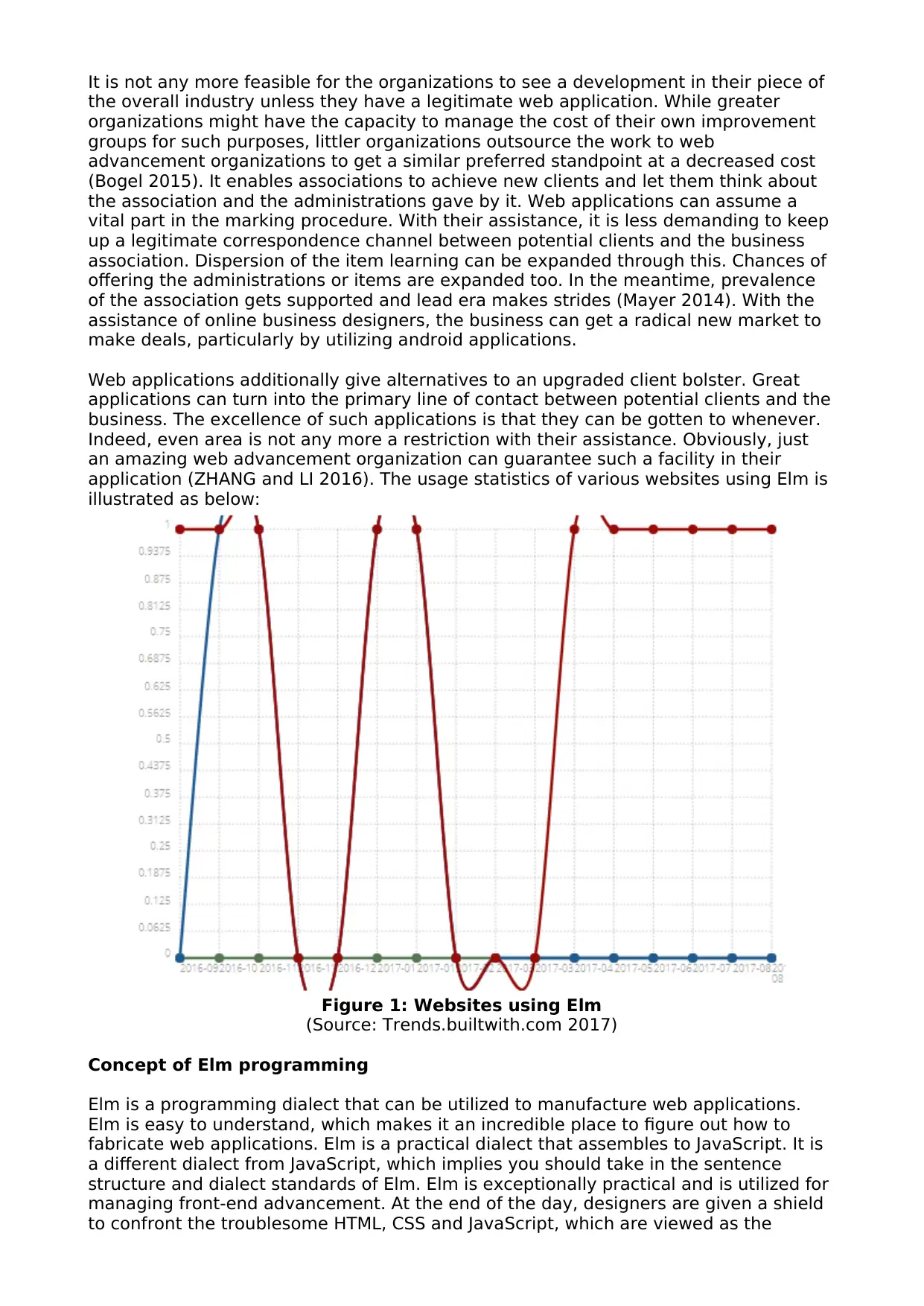
application (ZHANG and LI 2016). The usage statistics of various websites using Elm is
illustrated as below:
Figure 1: Websites using Elm
(Source: Trends.builtwith.com 2017)
Concept of Elm programming
Elm is a programming dialect that can be utilized to manufacture web applications.
Elm is easy to understand, which makes it an incredible place to figure out how to
fabricate web applications. Elm is a practical dialect that assembles to JavaScript. It is
a different dialect from JavaScript, which implies you should take in the sentence
structure and dialect standards of Elm. Elm is exceptionally practical and is utilized for
managing front-end advancement. At the end of the day, designers are given a shield
to confront the troublesome HTML, CSS and JavaScript, which are viewed as the
the overall industry unless they have a legitimate web application. While greater
organizations might have the capacity to manage the cost of their own improvement
groups for such purposes, littler organizations outsource the work to web
advancement organizations to get a similar preferred standpoint at a decreased cost
(Bogel 2015). It enables associations to achieve new clients and let them think about
the association and the administrations gave by it. Web applications can assume a
vital part in the marking procedure. With their assistance, it is less demanding to keep
up a legitimate correspondence channel between potential clients and the business
association. Dispersion of the item learning can be expanded through this. Chances of
offering the administrations or items are expanded too. In the meantime, prevalence
of the association gets supported and lead era makes strides (Mayer 2014). With the
assistance of online business designers, the business can get a radical new market to
make deals, particularly by utilizing android applications.
Web applications additionally give alternatives to an upgraded client bolster. Great
applications can turn into the primary line of contact between potential clients and the
business. The excellence of such applications is that they can be gotten to whenever.
Indeed, even area is not any more a restriction with their assistance. Obviously, just
an amazing web advancement organization can guarantee such a facility in their
application (ZHANG and LI 2016). The usage statistics of various websites using Elm is
illustrated as below:
Figure 1: Websites using Elm
(Source: Trends.builtwith.com 2017)
Concept of Elm programming
Elm is a programming dialect that can be utilized to manufacture web applications.
Elm is easy to understand, which makes it an incredible place to figure out how to
fabricate web applications. Elm is a practical dialect that assembles to JavaScript. It is
a different dialect from JavaScript, which implies you should take in the sentence
structure and dialect standards of Elm. Elm is exceptionally practical and is utilized for
managing front-end advancement. At the end of the day, designers are given a shield
to confront the troublesome HTML, CSS and JavaScript, which are viewed as the
⊘ This is a preview!⊘
Do you want full access?
Subscribe today to unlock all pages.

Trusted by 1+ million students worldwide
substance of front-end advancement (Elm et al. 2016). Dynamic web applications are
about the advancing multifaceted nature and not a different way.
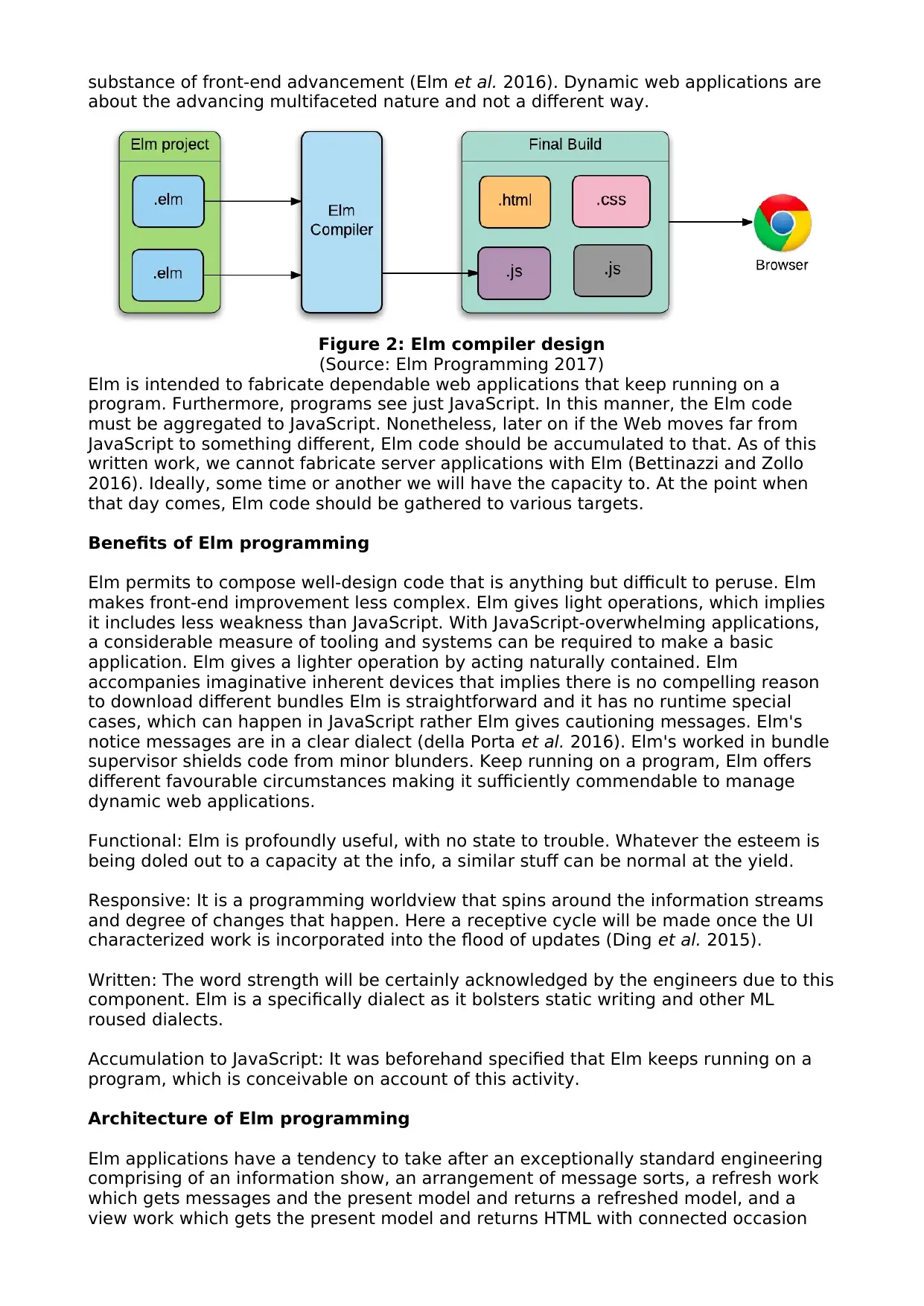
Figure 2: Elm compiler design
(Source: Elm Programming 2017)
Elm is intended to fabricate dependable web applications that keep running on a
program. Furthermore, programs see just JavaScript. In this manner, the Elm code
must be aggregated to JavaScript. Nonetheless, later on if the Web moves far from
JavaScript to something different, Elm code should be accumulated to that. As of this
written work, we cannot fabricate server applications with Elm (Bettinazzi and Zollo
2016). Ideally, some time or another we will have the capacity to. At the point when
that day comes, Elm code should be gathered to various targets.
Benefits of Elm programming
Elm permits to compose well-design code that is anything but difficult to peruse. Elm
makes front-end improvement less complex. Elm gives light operations, which implies
it includes less weakness than JavaScript. With JavaScript-overwhelming applications,
a considerable measure of tooling and systems can be required to make a basic
application. Elm gives a lighter operation by acting naturally contained. Elm
accompanies imaginative inherent devices that implies there is no compelling reason
to download different bundles Elm is straightforward and it has no runtime special
cases, which can happen in JavaScript rather Elm gives cautioning messages. Elm's
notice messages are in a clear dialect (della Porta et al. 2016). Elm's worked in bundle
supervisor shields code from minor blunders. Keep running on a program, Elm offers
different favourable circumstances making it sufficiently commendable to manage
dynamic web applications.
Functional: Elm is profoundly useful, with no state to trouble. Whatever the esteem is
being doled out to a capacity at the info, a similar stuff can be normal at the yield.
Responsive: It is a programming worldview that spins around the information streams
and degree of changes that happen. Here a receptive cycle will be made once the UI
characterized work is incorporated into the flood of updates (Ding et al. 2015).
Written: The word strength will be certainly acknowledged by the engineers due to this
component. Elm is a specifically dialect as it bolsters static writing and other ML
roused dialects.
Accumulation to JavaScript: It was beforehand specified that Elm keeps running on a
program, which is conceivable on account of this activity.
Architecture of Elm programming
Elm applications have a tendency to take after an exceptionally standard engineering
comprising of an information show, an arrangement of message sorts, a refresh work
which gets messages and the present model and returns a refreshed model, and a
view work which gets the present model and returns HTML with connected occasion
about the advancing multifaceted nature and not a different way.
Figure 2: Elm compiler design
(Source: Elm Programming 2017)
Elm is intended to fabricate dependable web applications that keep running on a
program. Furthermore, programs see just JavaScript. In this manner, the Elm code
must be aggregated to JavaScript. Nonetheless, later on if the Web moves far from
JavaScript to something different, Elm code should be accumulated to that. As of this
written work, we cannot fabricate server applications with Elm (Bettinazzi and Zollo
2016). Ideally, some time or another we will have the capacity to. At the point when
that day comes, Elm code should be gathered to various targets.
Benefits of Elm programming
Elm permits to compose well-design code that is anything but difficult to peruse. Elm
makes front-end improvement less complex. Elm gives light operations, which implies
it includes less weakness than JavaScript. With JavaScript-overwhelming applications,
a considerable measure of tooling and systems can be required to make a basic
application. Elm gives a lighter operation by acting naturally contained. Elm
accompanies imaginative inherent devices that implies there is no compelling reason
to download different bundles Elm is straightforward and it has no runtime special
cases, which can happen in JavaScript rather Elm gives cautioning messages. Elm's
notice messages are in a clear dialect (della Porta et al. 2016). Elm's worked in bundle
supervisor shields code from minor blunders. Keep running on a program, Elm offers
different favourable circumstances making it sufficiently commendable to manage
dynamic web applications.
Functional: Elm is profoundly useful, with no state to trouble. Whatever the esteem is
being doled out to a capacity at the info, a similar stuff can be normal at the yield.
Responsive: It is a programming worldview that spins around the information streams
and degree of changes that happen. Here a receptive cycle will be made once the UI
characterized work is incorporated into the flood of updates (Ding et al. 2015).
Written: The word strength will be certainly acknowledged by the engineers due to this
component. Elm is a specifically dialect as it bolsters static writing and other ML
roused dialects.
Accumulation to JavaScript: It was beforehand specified that Elm keeps running on a
program, which is conceivable on account of this activity.
Architecture of Elm programming
Elm applications have a tendency to take after an exceptionally standard engineering
comprising of an information show, an arrangement of message sorts, a refresh work
which gets messages and the present model and returns a refreshed model, and a
view work which gets the present model and returns HTML with connected occasion
Paraphrase This Document
Need a fresh take? Get an instant paraphrase of this document with our AI Paraphraser
audience members which send messages back to the refresh work (Khalid et al. 2016).
Further developed Elm applications likewise incorporate an instatement work for the
model, augmentations to the refresh capacity to return charges for performing non-
concurring operations (which themselves are guided once more into the code by
means of messages once more), and memberships which are utilized for getting
refreshes and reacting with messages.
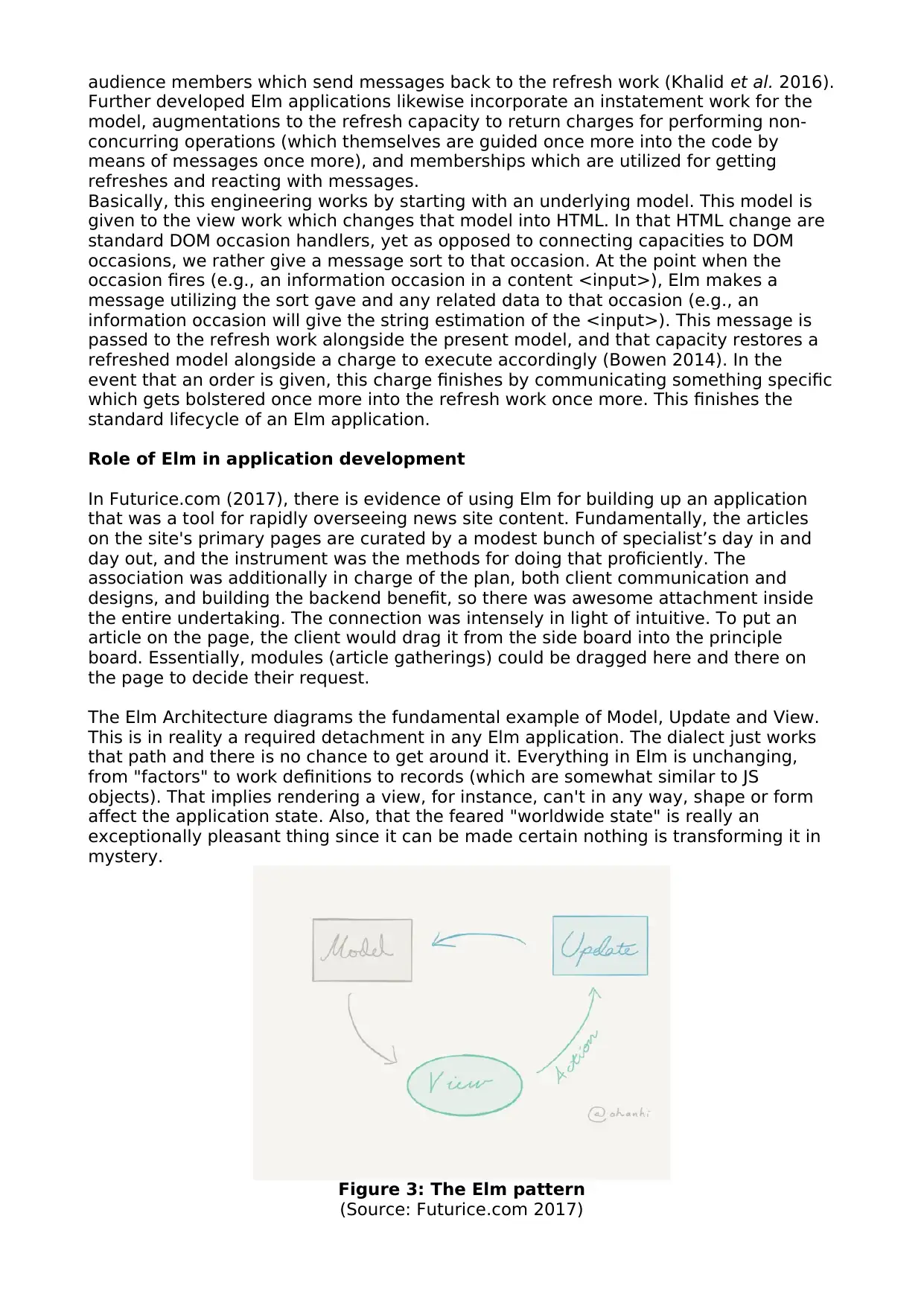
Basically, this engineering works by starting with an underlying model. This model is
given to the view work which changes that model into HTML. In that HTML change are
standard DOM occasion handlers, yet as opposed to connecting capacities to DOM
occasions, we rather give a message sort to that occasion. At the point when the
occasion fires (e.g., an information occasion in a content <input>), Elm makes a
message utilizing the sort gave and any related data to that occasion (e.g., an
information occasion will give the string estimation of the <input>). This message is
passed to the refresh work alongside the present model, and that capacity restores a
refreshed model alongside a charge to execute accordingly (Bowen 2014). In the
event that an order is given, this charge finishes by communicating something specific
which gets bolstered once more into the refresh work once more. This finishes the
standard lifecycle of an Elm application.
Role of Elm in application development
In Futurice.com (2017), there is evidence of using Elm for building up an application
that was a tool for rapidly overseeing news site content. Fundamentally, the articles
on the site's primary pages are curated by a modest bunch of specialist’s day in and
day out, and the instrument was the methods for doing that proficiently. The
association was additionally in charge of the plan, both client communication and
designs, and building the backend benefit, so there was awesome attachment inside
the entire undertaking. The connection was intensely in light of intuitive. To put an
article on the page, the client would drag it from the side board into the principle
board. Essentially, modules (article gatherings) could be dragged here and there on
the page to decide their request.
The Elm Architecture diagrams the fundamental example of Model, Update and View.
This is in reality a required detachment in any Elm application. The dialect just works
that path and there is no chance to get around it. Everything in Elm is unchanging,
from "factors" to work definitions to records (which are somewhat similar to JS
objects). That implies rendering a view, for instance, can't in any way, shape or form
affect the application state. Also, that the feared "worldwide state" is really an
exceptionally pleasant thing since it can be made certain nothing is transforming it in
mystery.
Figure 3: The Elm pattern
(Source: Futurice.com 2017)
Further developed Elm applications likewise incorporate an instatement work for the
model, augmentations to the refresh capacity to return charges for performing non-
concurring operations (which themselves are guided once more into the code by
means of messages once more), and memberships which are utilized for getting
refreshes and reacting with messages.
Basically, this engineering works by starting with an underlying model. This model is
given to the view work which changes that model into HTML. In that HTML change are
standard DOM occasion handlers, yet as opposed to connecting capacities to DOM
occasions, we rather give a message sort to that occasion. At the point when the
occasion fires (e.g., an information occasion in a content <input>), Elm makes a
message utilizing the sort gave and any related data to that occasion (e.g., an
information occasion will give the string estimation of the <input>). This message is
passed to the refresh work alongside the present model, and that capacity restores a
refreshed model alongside a charge to execute accordingly (Bowen 2014). In the
event that an order is given, this charge finishes by communicating something specific
which gets bolstered once more into the refresh work once more. This finishes the
standard lifecycle of an Elm application.
Role of Elm in application development
In Futurice.com (2017), there is evidence of using Elm for building up an application
that was a tool for rapidly overseeing news site content. Fundamentally, the articles
on the site's primary pages are curated by a modest bunch of specialist’s day in and
day out, and the instrument was the methods for doing that proficiently. The
association was additionally in charge of the plan, both client communication and
designs, and building the backend benefit, so there was awesome attachment inside
the entire undertaking. The connection was intensely in light of intuitive. To put an
article on the page, the client would drag it from the side board into the principle
board. Essentially, modules (article gatherings) could be dragged here and there on
the page to decide their request.
The Elm Architecture diagrams the fundamental example of Model, Update and View.
This is in reality a required detachment in any Elm application. The dialect just works
that path and there is no chance to get around it. Everything in Elm is unchanging,
from "factors" to work definitions to records (which are somewhat similar to JS
objects). That implies rendering a view, for instance, can't in any way, shape or form
affect the application state. Also, that the feared "worldwide state" is really an
exceptionally pleasant thing since it can be made certain nothing is transforming it in
mystery.
Figure 3: The Elm pattern
(Source: Futurice.com 2017)
4. Methodology
The primary and secondary sources of information together forms the base of data
collection tools in almost any research project. The primary sources of information for
this project will be collected from online survey questionnaires and direct face to face
interviews with professionals in the field of business application programming (Zhang
et al. 2016). Favorable position of using primary data is that experts are gathering
information for the specific inspirations driving their examination. Surveys routinely
contain diverse choice inquiries, manner scales, close request and open-completed
request. The online questionnaires will help to gather accurate information.
The secondary source of information will comprise of meetings that are generally
conducted very close however it can be controlled by telephone or using more
innovative technology, for instance, Skype (Mayer 2014). At times they are held in the
interviewee's home, as a rule at a more objective place. The secondary data will also
be collected from various case studies that relate to the subject topic.
5. Feasibility and Scope of the Study
This project is feasible in context to the scope of the study as it involves investigation
of functional programming and that has a significant role to play designing of business
applications. This project will help to achieve in-depth knowledge of Elm and how it
can be used for business applications. The research project will also eventually help to
design a simple business application with the help of Elm and produce a guide for
businesses on when Elm should and should not be used for business applications
(Komi et al. 2017). The professionals in programming industry will find this research
project to be beneficial as it will open doors for them to gain in-depth knowledge of
Elm.
6. Report Structure
The report structure being proposed for completion of the research project is
presented as below:
Introduction
Literature Review
Research Methodology
Findings and Analysis
Conclusion and Recommendations
7. Project Timelines
Activities for
the research
1st
Wee
k
2nd
Week
3rd
Wee
k
4th
Wee
k
5th
Week
6th
Wee
k
7th
Wee
k
Completio
n dates
The primary and secondary sources of information together forms the base of data
collection tools in almost any research project. The primary sources of information for
this project will be collected from online survey questionnaires and direct face to face
interviews with professionals in the field of business application programming (Zhang
et al. 2016). Favorable position of using primary data is that experts are gathering
information for the specific inspirations driving their examination. Surveys routinely
contain diverse choice inquiries, manner scales, close request and open-completed
request. The online questionnaires will help to gather accurate information.
The secondary source of information will comprise of meetings that are generally
conducted very close however it can be controlled by telephone or using more
innovative technology, for instance, Skype (Mayer 2014). At times they are held in the
interviewee's home, as a rule at a more objective place. The secondary data will also
be collected from various case studies that relate to the subject topic.
5. Feasibility and Scope of the Study
This project is feasible in context to the scope of the study as it involves investigation
of functional programming and that has a significant role to play designing of business
applications. This project will help to achieve in-depth knowledge of Elm and how it
can be used for business applications. The research project will also eventually help to
design a simple business application with the help of Elm and produce a guide for
businesses on when Elm should and should not be used for business applications
(Komi et al. 2017). The professionals in programming industry will find this research
project to be beneficial as it will open doors for them to gain in-depth knowledge of
Elm.
6. Report Structure
The report structure being proposed for completion of the research project is
presented as below:
Introduction
Literature Review
Research Methodology
Findings and Analysis
Conclusion and Recommendations
7. Project Timelines
Activities for
the research
1st
Wee
k
2nd
Week
3rd
Wee
k
4th
Wee
k
5th
Week
6th
Wee
k
7th
Wee
k
Completio
n dates
⊘ This is a preview!⊘
Do you want full access?
Subscribe today to unlock all pages.
Trusted by 1+ million students worldwide
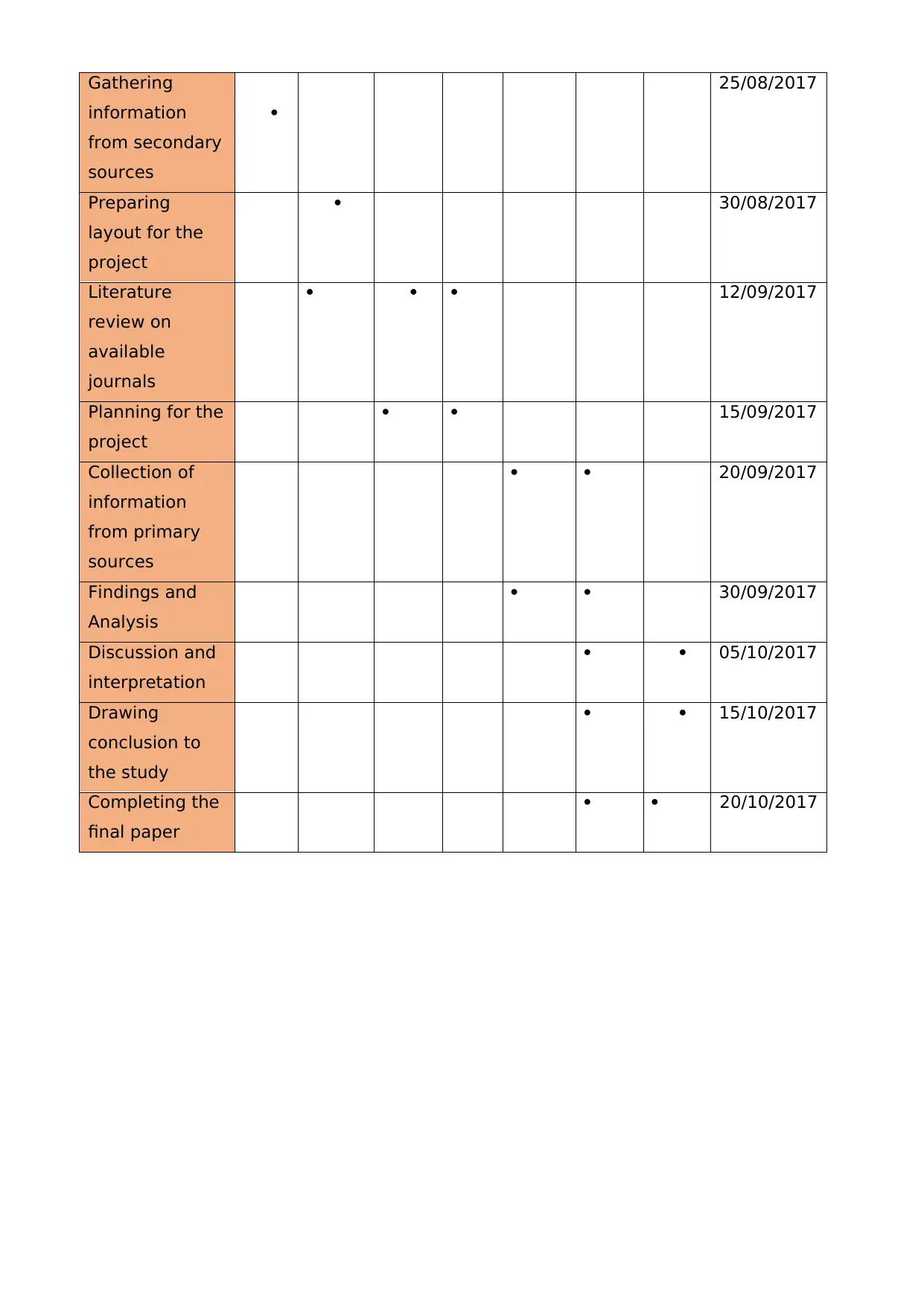
Gathering
information
from secondary
sources
25/08/2017
Preparing
layout for the
project
30/08/2017
Literature
review on
available
journals
12/09/2017
Planning for the
project
15/09/2017
Collection of
information
from primary
sources
20/09/2017
Findings and
Analysis
30/09/2017
Discussion and
interpretation
05/10/2017
Drawing
conclusion to
the study
15/10/2017
Completing the
final paper
20/10/2017
information
from secondary
sources
25/08/2017
Preparing
layout for the
project
30/08/2017
Literature
review on
available
journals
12/09/2017
Planning for the
project
15/09/2017
Collection of
information
from primary
sources
20/09/2017
Findings and
Analysis
30/09/2017
Discussion and
interpretation
05/10/2017
Drawing
conclusion to
the study
15/10/2017
Completing the
final paper
20/10/2017
Paraphrase This Document
Need a fresh take? Get an instant paraphrase of this document with our AI Paraphraser
8. References/Sources of evidence
Akusok, A., Veganzones, D., Björk, K.M., Séverin, E., du Jardin, P., Lendasse, A. and
Miche, Y., 2014. ELM Clustering–Application to Bankruptcy Prediction–. In International
work conference on TIme SEries (pp. 711-723).
Bettinazzi, E.L.M. and Zollo, M., 2016, January. Stakeholders and Organizational
Learning: Theory and Evidence from Corporate Acquisitions. In Academy of
Management Proceedings (Vol. 2016, No. 1, p. 13573). Academy of Management.
Bögel, P.M., 2015. Processing of CSR communication: insights from the ELM. Corporate
Communications: An International Journal, 20(2), pp.128-143.
Bowen, P.G., 2014. The Strategy Wagon Wheel and Its Application For Teaching
Strategy. Business Education Innovation Journal, 6(2).
Chakravorty, S.S. and Hales, D.N., 2017. Sustainability of process improvements: an
application of the experiential learning model (ELM). International Journal of
Production Research, pp.1-17.
della Porta, G., Principi, E., Ferroni, G., Squartini, S., Hussain, A. and Piazza, F., 2016.
ELM based algorithms for acoustic template matching in home automation scenarios:
advancements and performance analysis. In Recent Advances in Nonlinear Speech
Processing (pp. 159-168). Springer International Publishing.
Ding, S., Zhao, H., Zhang, Y., Xu, X. and Nie, R., 2015. Extreme learning machine:
algorithm, theory and applications. Artificial Intelligence Review, 44(1), pp.103-115.
Elm Programming. (2017). Beginning Elm. [online] Available at:
http://elmprogramming.com/elm-compiler.html [Accessed 24 Aug. 2017].
Elm, C., Knight, T., Martin, M.M., Michel, K.J., Boctor, M. and Loberg, S.J., Disney
Enterprises, Inc., 2016. Content orchestration for assembly of customized content
streams. U.S. Patent 9,503,770.
Elm, J.P. and Goldenson, D., 2014. The Business Case for Systems Engineering:
Comparison of Defense-Domain and Non-Defense Projects.
Futurice.com. (2017). How Elm made our work better — Futurice. [online] Available at:
http://futurice.com/blog/elm-in-the-real-world [Accessed 24 Aug. 2017].
Ismaeel, S., Miri, A., Sadeghian, A. and Chourishi, D., 2015, November. An Extreme
Learning Machine (ELM) Predictor for Electric Arc Furnaces' vi Characteristics. In Cyber
Security and Cloud Computing (CSCloud), 2015 IEEE 2nd International Conference on
(pp. 329-334). IEEE.
Khalid, H.M., Liew, W.S., Helander, M.G. and Loo, C.K., 2016, December. Prediction of
trust in scripted dialogs using neuro-fuzzy method. In Industrial Engineering and
Engineering Management (IEEM), 2016 IEEE International Conference on (pp. 1558-
1562). IEEE.
Komi, M., Li, J., Zhai, Y. and Zhang, X., 2017, June. Application of data mining methods
in diabetes prediction. In Image, Vision and Computing (ICIVC), 2017 2nd International
Conference on (pp. 1006-1010). IEEE.
Mayer, B., 2014. Designing the Business Strategy Game to Promote Strategic Thinking
and Student Engagement: An Application of the Four Disciplines of Execution. Business
Education Innovation Journal VOLUME 6 NUMBER 2 December 2014, p.86.
Milačić, L., Jović, S., Vujović, T. and Miljković, J., 2017. Application of artificial neural
network with extreme learning machine for economic growth estimation. Physica A:
Statistical Mechanics and its Applications, 465, pp.285-288.
Razzaghi, T., Otero, A. and Xanthopoulos, P., 2017. Imbalanced classification for
business analytics. In Artificial Intelligence: Concepts, Methodologies, Tools, and
Applications (pp. 660-670). IGI Global.
Teng, S., Khong, K.W. and Goh, W.W., 2014. Conceptualizing persuasive messages
using ELM in social media. Journal of Internet Commerce, 13(1), pp.65-87.
Wang, X.Z. and Wang, H., 2014. Guest editorial: learning from uncertainty and its
application to intelligent systems of web information. World Wide Web, 17(5), p.1027
Trends.builtwith.com. (2017). Elm Usage Statistics. [online] Available at:
https://trends.builtwith.com/framework/Elm [Accessed 24 Aug. 2017].
Akusok, A., Veganzones, D., Björk, K.M., Séverin, E., du Jardin, P., Lendasse, A. and
Miche, Y., 2014. ELM Clustering–Application to Bankruptcy Prediction–. In International
work conference on TIme SEries (pp. 711-723).
Bettinazzi, E.L.M. and Zollo, M., 2016, January. Stakeholders and Organizational
Learning: Theory and Evidence from Corporate Acquisitions. In Academy of
Management Proceedings (Vol. 2016, No. 1, p. 13573). Academy of Management.
Bögel, P.M., 2015. Processing of CSR communication: insights from the ELM. Corporate
Communications: An International Journal, 20(2), pp.128-143.
Bowen, P.G., 2014. The Strategy Wagon Wheel and Its Application For Teaching
Strategy. Business Education Innovation Journal, 6(2).
Chakravorty, S.S. and Hales, D.N., 2017. Sustainability of process improvements: an
application of the experiential learning model (ELM). International Journal of
Production Research, pp.1-17.
della Porta, G., Principi, E., Ferroni, G., Squartini, S., Hussain, A. and Piazza, F., 2016.
ELM based algorithms for acoustic template matching in home automation scenarios:
advancements and performance analysis. In Recent Advances in Nonlinear Speech
Processing (pp. 159-168). Springer International Publishing.
Ding, S., Zhao, H., Zhang, Y., Xu, X. and Nie, R., 2015. Extreme learning machine:
algorithm, theory and applications. Artificial Intelligence Review, 44(1), pp.103-115.
Elm Programming. (2017). Beginning Elm. [online] Available at:
http://elmprogramming.com/elm-compiler.html [Accessed 24 Aug. 2017].
Elm, C., Knight, T., Martin, M.M., Michel, K.J., Boctor, M. and Loberg, S.J., Disney
Enterprises, Inc., 2016. Content orchestration for assembly of customized content
streams. U.S. Patent 9,503,770.
Elm, J.P. and Goldenson, D., 2014. The Business Case for Systems Engineering:
Comparison of Defense-Domain and Non-Defense Projects.
Futurice.com. (2017). How Elm made our work better — Futurice. [online] Available at:
http://futurice.com/blog/elm-in-the-real-world [Accessed 24 Aug. 2017].
Ismaeel, S., Miri, A., Sadeghian, A. and Chourishi, D., 2015, November. An Extreme
Learning Machine (ELM) Predictor for Electric Arc Furnaces' vi Characteristics. In Cyber
Security and Cloud Computing (CSCloud), 2015 IEEE 2nd International Conference on
(pp. 329-334). IEEE.
Khalid, H.M., Liew, W.S., Helander, M.G. and Loo, C.K., 2016, December. Prediction of
trust in scripted dialogs using neuro-fuzzy method. In Industrial Engineering and
Engineering Management (IEEM), 2016 IEEE International Conference on (pp. 1558-
1562). IEEE.
Komi, M., Li, J., Zhai, Y. and Zhang, X., 2017, June. Application of data mining methods
in diabetes prediction. In Image, Vision and Computing (ICIVC), 2017 2nd International
Conference on (pp. 1006-1010). IEEE.
Mayer, B., 2014. Designing the Business Strategy Game to Promote Strategic Thinking
and Student Engagement: An Application of the Four Disciplines of Execution. Business
Education Innovation Journal VOLUME 6 NUMBER 2 December 2014, p.86.
Milačić, L., Jović, S., Vujović, T. and Miljković, J., 2017. Application of artificial neural
network with extreme learning machine for economic growth estimation. Physica A:
Statistical Mechanics and its Applications, 465, pp.285-288.
Razzaghi, T., Otero, A. and Xanthopoulos, P., 2017. Imbalanced classification for
business analytics. In Artificial Intelligence: Concepts, Methodologies, Tools, and
Applications (pp. 660-670). IGI Global.
Teng, S., Khong, K.W. and Goh, W.W., 2014. Conceptualizing persuasive messages
using ELM in social media. Journal of Internet Commerce, 13(1), pp.65-87.
Wang, X.Z. and Wang, H., 2014. Guest editorial: learning from uncertainty and its
application to intelligent systems of web information. World Wide Web, 17(5), p.1027
Trends.builtwith.com. (2017). Elm Usage Statistics. [online] Available at:
https://trends.builtwith.com/framework/Elm [Accessed 24 Aug. 2017].

Zhang, N., Chen, H., Chen, X. and Chen, J., 2016. ELM meets urban computing:
ensemble urban data for smart city application. In Proceedings of ELM-2015 Volume 1
(pp. 51-63). Springer, Cham.
Zhang, N., Chen, H., Chen, X. and Chen, J., 2016. ELM Meets Urban Big Data Analysis:
Case Studies. Computational intelligence and neuroscience, 2016.
ZHANG, Y. and LI, M., 2016. A Novel Evaluation Model of Water Quality Based on PSO-
ELM Method. Environmental Science & Technology, 5, p.026.
ZHENG, H.C., QI, Z.H., WU, J., WANG, T. and WAN, N., 2015. Antecedents of Award-
Based Crowdfunding Performance: From the ELM Perspective. Journal of University of
Electronic Science and Technology of China (Social Sciences Edition), 1, p.009.
ensemble urban data for smart city application. In Proceedings of ELM-2015 Volume 1
(pp. 51-63). Springer, Cham.
Zhang, N., Chen, H., Chen, X. and Chen, J., 2016. ELM Meets Urban Big Data Analysis:
Case Studies. Computational intelligence and neuroscience, 2016.
ZHANG, Y. and LI, M., 2016. A Novel Evaluation Model of Water Quality Based on PSO-
ELM Method. Environmental Science & Technology, 5, p.026.
ZHENG, H.C., QI, Z.H., WU, J., WANG, T. and WAN, N., 2015. Antecedents of Award-
Based Crowdfunding Performance: From the ELM Perspective. Journal of University of
Electronic Science and Technology of China (Social Sciences Edition), 1, p.009.
⊘ This is a preview!⊘
Do you want full access?
Subscribe today to unlock all pages.
Trusted by 1+ million students worldwide

1 out of 9


Related Documents


Your All-in-One AI-Powered Toolkit for Academic Success.
+13062052269
info@desklib.com
Available 24*7 on WhatsApp / Email
![[object Object]](/_next/static/media/star-bottom.7253800d.svg)
Unlock your academic potential
Copyright © 2020–2026 A2Z Services. All Rights Reserved. Developed and managed by ZUCOL.