Project & Relationship Management: Unilever's Market Analysis Report
VerifiedAdded on 2023/06/15
|10
|2518
|214
Report
AI Summary
This report provides a comprehensive analysis of project and relationship management within the context of traditional and modern markets, using Unilever as a case study. It begins by differentiating between traditional and modern market approaches, highlighting the shift from product-focused strategies to customer-centric models. The report then applies PESTEL analysis to evaluate the influence of external political, economic, social, technological, environmental, and legal factors on Unilever's operations, noting the increased political interference in modern markets and the impact of COVID-19 on economic factors. Furthermore, a SWOT analysis assesses Unilever's internal strengths, weaknesses, opportunities, and threats, emphasizing the challenges posed by increasing competition. The report also describes stakeholder analysis, explaining how organizations identify and prioritize stakeholders using tools like the power-interest grid, and appraises its application in business scenarios, detailing the steps for identifying, prioritizing, and understanding key stakeholders to align goals and ensure organizational success. The conclusion emphasizes the importance of understanding market dynamics and utilizing analytical tools for strategic decision-making in both traditional and modern business environments.
PROJECT &
RELATIONSHIP
MANAGEMENT
1
RELATIONSHIP
MANAGEMENT
1

Paraphrase This Document
Need a fresh take? Get an instant paraphrase of this document with our AI Paraphraser
Table of Contents
INTRODUCTION...........................................................................................................................3
MAIN BODY...................................................................................................................................3
Difference between modern and traditional market...............................................................3
Application of PESTEL analysis............................................................................................5
Application of SWOT analysis...............................................................................................6
Describe the stakeholder analysis...........................................................................................7
Appraise how stakeholder analysis apply in the business scenario........................................8
CONCLUSION................................................................................................................................9
REFERENCES:.............................................................................................................................10
2
INTRODUCTION...........................................................................................................................3
MAIN BODY...................................................................................................................................3
Difference between modern and traditional market...............................................................3
Application of PESTEL analysis............................................................................................5
Application of SWOT analysis...............................................................................................6
Describe the stakeholder analysis...........................................................................................7
Appraise how stakeholder analysis apply in the business scenario........................................8
CONCLUSION................................................................................................................................9
REFERENCES:.............................................................................................................................10
2
INTRODUCTION
In today's business environment, every day the competition and dynamic nature of
business environment is increasing (Rajhans, 2018). It is becoming very important for the
organisations to identify and analyse the nature of market so that they can take right actions at
right time. This report aims to analyse the external and internal environment with special
references to Unilever. Unilever is found to be the British multinational organisation that
operates in consumer goods. Headquartered of Unilever is situated in England. This report will
be discussing the difference between modern and traditional market. In addition to this, SWOT
and PESTEL analysis will be discussing in context of company. There is also a discussion of
stakeholder analysis in the context of business scenario.
MAIN BODY
Difference between modern and traditional market
In the new business world, it is found that now organisations are focusing on new or
modern market. They are running their business in new market (Aiyer, Panigrahi and Das, 2018).
In former times or traditional market, entrepreneurs are not as much innovative and creative as in
modern market. In the current business environment, it is identified that there are many
organisations which are running their business according to the traditional market approach. In
the same time, most of the organisation are running their business in modern market. This is the
reason that entrepreneur needs to understand the concept of traditional and modern market so
that they are able to achieve the goals and objective with the right selection of business
strategies. The diffidence between modern and traditional market is mentioned below:
Traditional market
Traditional market is refers to the marketing concept in which the marketers of
organisation is focusing on only products (Difference between Traditional Marketing Concept
and Modern Marketing Concept, 2020). Traditional marketers are aiming in production and
marketing of products so that they can gain more and more profits. It is found that traditional
market is only focusing on earning profits and that's why their activities are decided accordingly.
In the traditional market, it is identified by the organisation that they are not focusing on the
satisfaction of customers as they are just profit oriented in which they are selling their products
3
In today's business environment, every day the competition and dynamic nature of
business environment is increasing (Rajhans, 2018). It is becoming very important for the
organisations to identify and analyse the nature of market so that they can take right actions at
right time. This report aims to analyse the external and internal environment with special
references to Unilever. Unilever is found to be the British multinational organisation that
operates in consumer goods. Headquartered of Unilever is situated in England. This report will
be discussing the difference between modern and traditional market. In addition to this, SWOT
and PESTEL analysis will be discussing in context of company. There is also a discussion of
stakeholder analysis in the context of business scenario.
MAIN BODY
Difference between modern and traditional market
In the new business world, it is found that now organisations are focusing on new or
modern market. They are running their business in new market (Aiyer, Panigrahi and Das, 2018).
In former times or traditional market, entrepreneurs are not as much innovative and creative as in
modern market. In the current business environment, it is identified that there are many
organisations which are running their business according to the traditional market approach. In
the same time, most of the organisation are running their business in modern market. This is the
reason that entrepreneur needs to understand the concept of traditional and modern market so
that they are able to achieve the goals and objective with the right selection of business
strategies. The diffidence between modern and traditional market is mentioned below:
Traditional market
Traditional market is refers to the marketing concept in which the marketers of
organisation is focusing on only products (Difference between Traditional Marketing Concept
and Modern Marketing Concept, 2020). Traditional marketers are aiming in production and
marketing of products so that they can gain more and more profits. It is found that traditional
market is only focusing on earning profits and that's why their activities are decided accordingly.
In the traditional market, it is identified by the organisation that they are not focusing on the
satisfaction of customers as they are just profit oriented in which they are selling their products
3
⊘ This is a preview!⊘
Do you want full access?
Subscribe today to unlock all pages.

Trusted by 1+ million students worldwide
in order to earn revenues. This is the reason that sometimes customers are left those
organisations which are only profit oriented. It can be more clear with the discussion of
advantages and disadvantages.
Advantages:
It is identified that organisations have an opportunity to earn more profits and revenues.
In this market, companies are able to reach their customers easily as they are using old
marketing tools and techniques for the purpose of promoting goods and services in the
market. Old tools and techniques of marketing are including TV and Radio ads, Flyers
and brochures, etc.
These are very effective for attracting customers towards organisation.
Disadvantages:
This method is not working in modern business environment as it becomes very complex
as well as dynamic in nature.
In traditional market, the interaction with customers was very less and that's why
companies are not able to understand the behaviour of customers.
Modern market
It is the market which is concerned with customers' needs and wants rather than on profits
(Arbabi, Salehi-Taleshi and Ghods, 2020). The current scenario of business environment is
becoming necessary to understand as it is found that dynamics and complexities are continuously
increasing. Every day the customers' demands are changing and due to this companies are unable
to run a business according to the traditional market. This is the reason that now market is more
focused on customers. Due to this, the market concept becomes very wide and broader concept.
This market covers various aspects such as earning of profit, selling of goods or services,
customer satisfaction, after sales service, planning, etc.
Advantages:
It is the market in which company are able to increase the customer base as they are more
focused on customers.
There is a chances of higher return on investment.
Disadvantages:
4
organisations which are only profit oriented. It can be more clear with the discussion of
advantages and disadvantages.
Advantages:
It is identified that organisations have an opportunity to earn more profits and revenues.
In this market, companies are able to reach their customers easily as they are using old
marketing tools and techniques for the purpose of promoting goods and services in the
market. Old tools and techniques of marketing are including TV and Radio ads, Flyers
and brochures, etc.
These are very effective for attracting customers towards organisation.
Disadvantages:
This method is not working in modern business environment as it becomes very complex
as well as dynamic in nature.
In traditional market, the interaction with customers was very less and that's why
companies are not able to understand the behaviour of customers.
Modern market
It is the market which is concerned with customers' needs and wants rather than on profits
(Arbabi, Salehi-Taleshi and Ghods, 2020). The current scenario of business environment is
becoming necessary to understand as it is found that dynamics and complexities are continuously
increasing. Every day the customers' demands are changing and due to this companies are unable
to run a business according to the traditional market. This is the reason that now market is more
focused on customers. Due to this, the market concept becomes very wide and broader concept.
This market covers various aspects such as earning of profit, selling of goods or services,
customer satisfaction, after sales service, planning, etc.
Advantages:
It is the market in which company are able to increase the customer base as they are more
focused on customers.
There is a chances of higher return on investment.
Disadvantages:
4
Paraphrase This Document
Need a fresh take? Get an instant paraphrase of this document with our AI Paraphraser
It requires more technical skills as it involves business integration in which company
needs to align technology with their business strategy and goals.
Implementation cost is vert high.
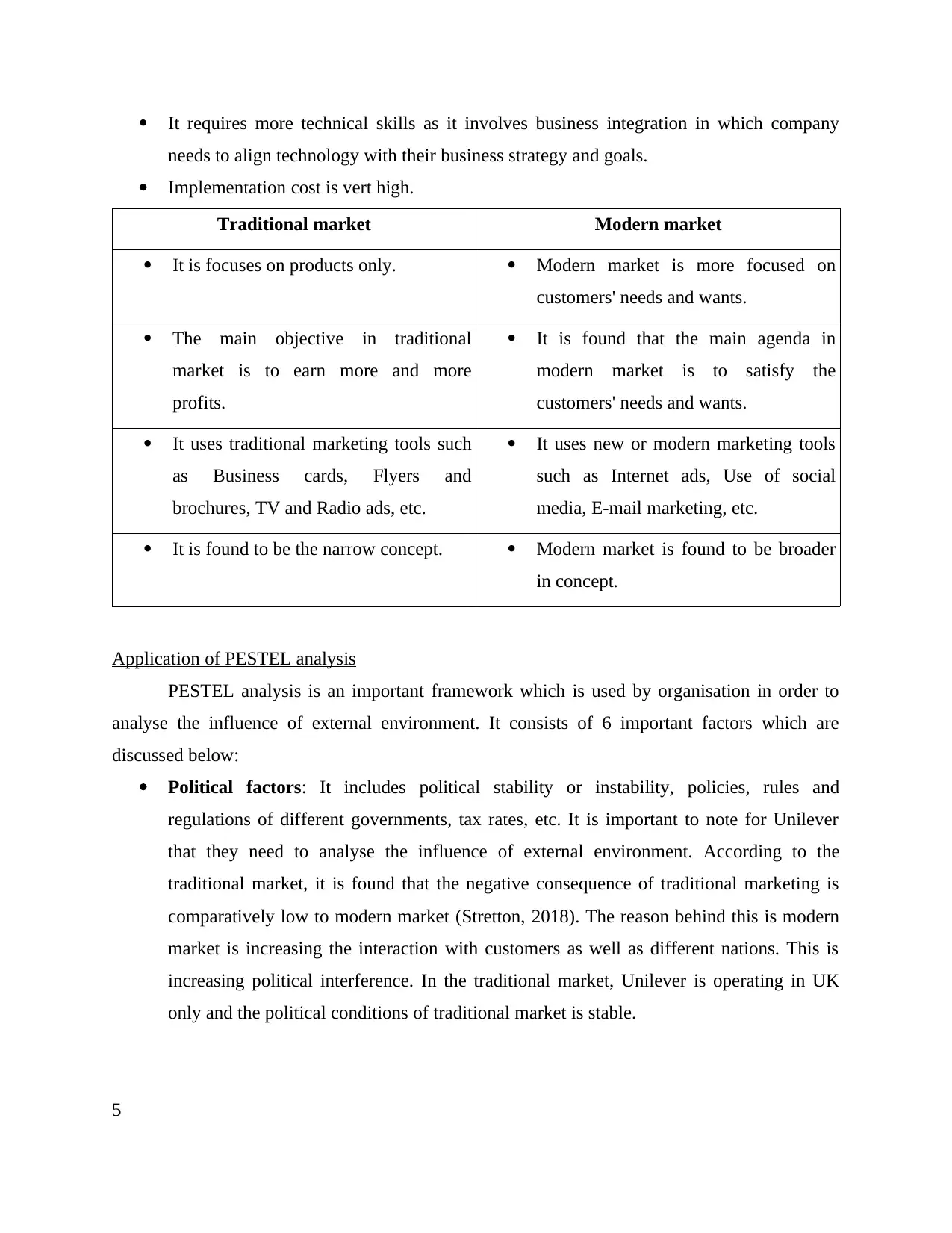
Traditional market Modern market
It is focuses on products only. Modern market is more focused on
customers' needs and wants.
The main objective in traditional
market is to earn more and more
profits.
It is found that the main agenda in
modern market is to satisfy the
customers' needs and wants.
It uses traditional marketing tools such
as Business cards, Flyers and
brochures, TV and Radio ads, etc.
It uses new or modern marketing tools
such as Internet ads, Use of social
media, E-mail marketing, etc.
It is found to be the narrow concept. Modern market is found to be broader
in concept.
Application of PESTEL analysis
PESTEL analysis is an important framework which is used by organisation in order to
analyse the influence of external environment. It consists of 6 important factors which are
discussed below:
Political factors: It includes political stability or instability, policies, rules and
regulations of different governments, tax rates, etc. It is important to note for Unilever
that they need to analyse the influence of external environment. According to the
traditional market, it is found that the negative consequence of traditional marketing is
comparatively low to modern market (Stretton, 2018). The reason behind this is modern
market is increasing the interaction with customers as well as different nations. This is
increasing political interference. In the traditional market, Unilever is operating in UK
only and the political conditions of traditional market is stable.
5
needs to align technology with their business strategy and goals.
Implementation cost is vert high.
Traditional market Modern market
It is focuses on products only. Modern market is more focused on
customers' needs and wants.
The main objective in traditional
market is to earn more and more
profits.
It is found that the main agenda in
modern market is to satisfy the
customers' needs and wants.
It uses traditional marketing tools such
as Business cards, Flyers and
brochures, TV and Radio ads, etc.
It uses new or modern marketing tools
such as Internet ads, Use of social
media, E-mail marketing, etc.
It is found to be the narrow concept. Modern market is found to be broader
in concept.
Application of PESTEL analysis
PESTEL analysis is an important framework which is used by organisation in order to
analyse the influence of external environment. It consists of 6 important factors which are
discussed below:
Political factors: It includes political stability or instability, policies, rules and
regulations of different governments, tax rates, etc. It is important to note for Unilever
that they need to analyse the influence of external environment. According to the
traditional market, it is found that the negative consequence of traditional marketing is
comparatively low to modern market (Stretton, 2018). The reason behind this is modern
market is increasing the interaction with customers as well as different nations. This is
increasing political interference. In the traditional market, Unilever is operating in UK
only and the political conditions of traditional market is stable.
5
Economical factors: This factor includes interest rates, economic growth rates,
unemployment rates, inflation rates, etc. The impact of COVID-19 is found to be very
negative as it declines the purchasing power of potential buyers of an organisation. Due
to this, now Unilever is found in difficult situations to cope up or overcome with the
consequences of economic slowdown.
Social factors: This is very important for company to understand the needs and wants of
customers but Unilever is running business in traditional as well as in modern market.
When company is in traditional market, then it becomes tough to understand the needs
and wants of customers as they are not as much engage with customers as modern market
does.
Technological factors: Traditional market is not accepting new updates in technologies
and that's why it becomes difficult for companies to accept changes as they are resistant
to change.
Legal factors: Every company should comply al the important laws whether they are
running their business in traditional market or in modern market.
It is analysed that companies needs to analyse the influence of external environment and
it is found that modern market is already running their business with the analysis. But in the case
of traditional market, it is found that they are not able to run according to the business
environment and that's why they may be get impacted by negative affects of external
environment.
Application of SWOT analysis
SWOT analysis is an important tool which is used by organisations for the purpose of
analysing internal environment of an organisation so that they can take necessary course of
actions according to their strengths and weaknesses (Jugdev, Müller and Hutchinson, 2025).
Strengths Weaknesses
It is found that Unilever has wide
variety of products and services so
that's why they are able to earn more
and more profits in traditional market.
They are running their major business
in traditional market and that's why
they are not experts in technical skills
which becomes weaknesses for their
6
unemployment rates, inflation rates, etc. The impact of COVID-19 is found to be very
negative as it declines the purchasing power of potential buyers of an organisation. Due
to this, now Unilever is found in difficult situations to cope up or overcome with the
consequences of economic slowdown.
Social factors: This is very important for company to understand the needs and wants of
customers but Unilever is running business in traditional as well as in modern market.
When company is in traditional market, then it becomes tough to understand the needs
and wants of customers as they are not as much engage with customers as modern market
does.
Technological factors: Traditional market is not accepting new updates in technologies
and that's why it becomes difficult for companies to accept changes as they are resistant
to change.
Legal factors: Every company should comply al the important laws whether they are
running their business in traditional market or in modern market.
It is analysed that companies needs to analyse the influence of external environment and
it is found that modern market is already running their business with the analysis. But in the case
of traditional market, it is found that they are not able to run according to the business
environment and that's why they may be get impacted by negative affects of external
environment.
Application of SWOT analysis
SWOT analysis is an important tool which is used by organisations for the purpose of
analysing internal environment of an organisation so that they can take necessary course of
actions according to their strengths and weaknesses (Jugdev, Müller and Hutchinson, 2025).
Strengths Weaknesses
It is found that Unilever has wide
variety of products and services so
that's why they are able to earn more
and more profits in traditional market.
They are running their major business
in traditional market and that's why
they are not experts in technical skills
which becomes weaknesses for their
6
⊘ This is a preview!⊘
Do you want full access?
Subscribe today to unlock all pages.
Trusted by 1+ million students worldwide
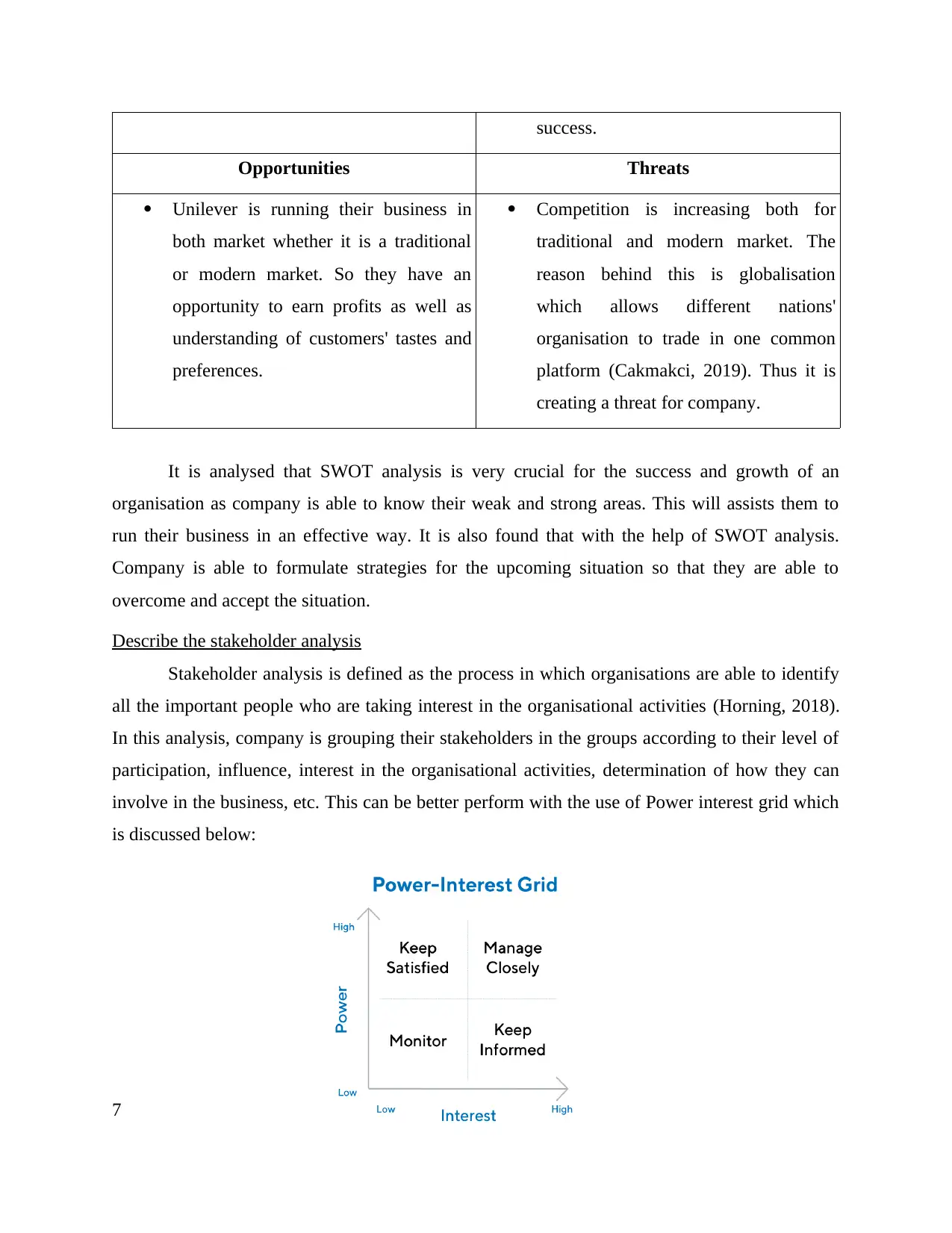
success.
Opportunities Threats
Unilever is running their business in
both market whether it is a traditional
or modern market. So they have an
opportunity to earn profits as well as
understanding of customers' tastes and
preferences.
Competition is increasing both for
traditional and modern market. The
reason behind this is globalisation
which allows different nations'
organisation to trade in one common
platform (Cakmakci, 2019). Thus it is
creating a threat for company.
It is analysed that SWOT analysis is very crucial for the success and growth of an
organisation as company is able to know their weak and strong areas. This will assists them to
run their business in an effective way. It is also found that with the help of SWOT analysis.
Company is able to formulate strategies for the upcoming situation so that they are able to
overcome and accept the situation.
Describe the stakeholder analysis
Stakeholder analysis is defined as the process in which organisations are able to identify
all the important people who are taking interest in the organisational activities (Horning, 2018).
In this analysis, company is grouping their stakeholders in the groups according to their level of
participation, influence, interest in the organisational activities, determination of how they can
involve in the business, etc. This can be better perform with the use of Power interest grid which
is discussed below:
7
Opportunities Threats
Unilever is running their business in
both market whether it is a traditional
or modern market. So they have an
opportunity to earn profits as well as
understanding of customers' tastes and
preferences.
Competition is increasing both for
traditional and modern market. The
reason behind this is globalisation
which allows different nations'
organisation to trade in one common
platform (Cakmakci, 2019). Thus it is
creating a threat for company.
It is analysed that SWOT analysis is very crucial for the success and growth of an
organisation as company is able to know their weak and strong areas. This will assists them to
run their business in an effective way. It is also found that with the help of SWOT analysis.
Company is able to formulate strategies for the upcoming situation so that they are able to
overcome and accept the situation.
Describe the stakeholder analysis
Stakeholder analysis is defined as the process in which organisations are able to identify
all the important people who are taking interest in the organisational activities (Horning, 2018).
In this analysis, company is grouping their stakeholders in the groups according to their level of
participation, influence, interest in the organisational activities, determination of how they can
involve in the business, etc. This can be better perform with the use of Power interest grid which
is discussed below:
7
Paraphrase This Document
Need a fresh take? Get an instant paraphrase of this document with our AI Paraphraser
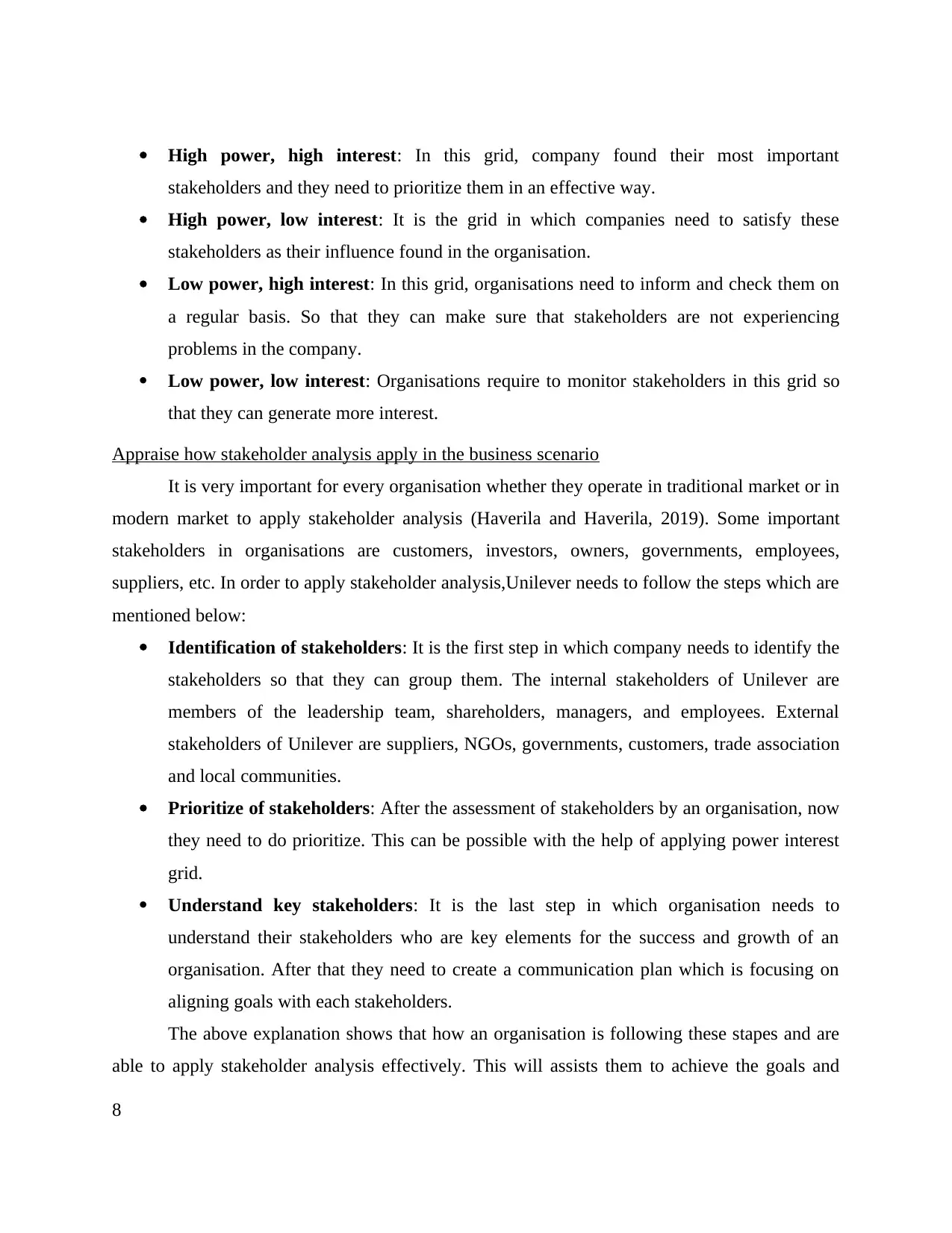
High power, high interest: In this grid, company found their most important
stakeholders and they need to prioritize them in an effective way.
High power, low interest: It is the grid in which companies need to satisfy these
stakeholders as their influence found in the organisation.
Low power, high interest: In this grid, organisations need to inform and check them on
a regular basis. So that they can make sure that stakeholders are not experiencing
problems in the company.
Low power, low interest: Organisations require to monitor stakeholders in this grid so
that they can generate more interest.
Appraise how stakeholder analysis apply in the business scenario
It is very important for every organisation whether they operate in traditional market or in
modern market to apply stakeholder analysis (Haverila and Haverila, 2019). Some important
stakeholders in organisations are customers, investors, owners, governments, employees,
suppliers, etc. In order to apply stakeholder analysis,Unilever needs to follow the steps which are
mentioned below:
Identification of stakeholders: It is the first step in which company needs to identify the
stakeholders so that they can group them. The internal stakeholders of Unilever are
members of the leadership team, shareholders, managers, and employees. External
stakeholders of Unilever are suppliers, NGOs, governments, customers, trade association
and local communities.
Prioritize of stakeholders: After the assessment of stakeholders by an organisation, now
they need to do prioritize. This can be possible with the help of applying power interest
grid.
Understand key stakeholders: It is the last step in which organisation needs to
understand their stakeholders who are key elements for the success and growth of an
organisation. After that they need to create a communication plan which is focusing on
aligning goals with each stakeholders.
The above explanation shows that how an organisation is following these stapes and are
able to apply stakeholder analysis effectively. This will assists them to achieve the goals and
8
stakeholders and they need to prioritize them in an effective way.
High power, low interest: It is the grid in which companies need to satisfy these
stakeholders as their influence found in the organisation.
Low power, high interest: In this grid, organisations need to inform and check them on
a regular basis. So that they can make sure that stakeholders are not experiencing
problems in the company.
Low power, low interest: Organisations require to monitor stakeholders in this grid so
that they can generate more interest.
Appraise how stakeholder analysis apply in the business scenario
It is very important for every organisation whether they operate in traditional market or in
modern market to apply stakeholder analysis (Haverila and Haverila, 2019). Some important
stakeholders in organisations are customers, investors, owners, governments, employees,
suppliers, etc. In order to apply stakeholder analysis,Unilever needs to follow the steps which are
mentioned below:
Identification of stakeholders: It is the first step in which company needs to identify the
stakeholders so that they can group them. The internal stakeholders of Unilever are
members of the leadership team, shareholders, managers, and employees. External
stakeholders of Unilever are suppliers, NGOs, governments, customers, trade association
and local communities.
Prioritize of stakeholders: After the assessment of stakeholders by an organisation, now
they need to do prioritize. This can be possible with the help of applying power interest
grid.
Understand key stakeholders: It is the last step in which organisation needs to
understand their stakeholders who are key elements for the success and growth of an
organisation. After that they need to create a communication plan which is focusing on
aligning goals with each stakeholders.
The above explanation shows that how an organisation is following these stapes and are
able to apply stakeholder analysis effectively. This will assists them to achieve the goals and
8
objectives. Proper stakeholder's analysis will provide a positive impact on the organisational
success and growth.
CONCLUSION
It can be concluded from the above discussion that it is necessary for an organisation to
analyse the difference between traditional and modern market. In addition to this, it is also
analysed that PESTEL analysis is very effective in order to analyse the external environment and
SWOT analysis is effective for internal analysis. This report also discussed stakeholder analysis
which is crucial for organisation as it helps them to formulate strategies for the success and
growth. It is also found from this report that modern market is full of complexities as compared
to traditional market. But still it is important for every organisation to run their business in
modern market.
9
success and growth.
CONCLUSION
It can be concluded from the above discussion that it is necessary for an organisation to
analyse the difference between traditional and modern market. In addition to this, it is also
analysed that PESTEL analysis is very effective in order to analyse the external environment and
SWOT analysis is effective for internal analysis. This report also discussed stakeholder analysis
which is crucial for organisation as it helps them to formulate strategies for the success and
growth. It is also found from this report that modern market is full of complexities as compared
to traditional market. But still it is important for every organisation to run their business in
modern market.
9
⊘ This is a preview!⊘
Do you want full access?
Subscribe today to unlock all pages.
Trusted by 1+ million students worldwide
REFERENCES:
Books and Journals
Aiyer, M., Panigrahi, J. K. and Das, B., 2018. Successful customer relationship management in
business process integration and development of applications for project
management. International Journal of Mechanical Engineering and Technology, 9(2),
pp.637-643.
Arbabi, H., Salehi-Taleshi, M. J. and Ghods, K., 2020. The role of project management office in
developing knowledge management infrastructure. Engineering, Construction and
Architectural Management.
Cakmakci, M., 2019, May. Interaction in project management approach within industry 4.0.
In International Scientific-Technical Conference MANUFACTURING (pp. 176-189).
Springer, Cham.
Haverila, M. J. and Haverila, K. C., 2019. Customer centric success measures in project
management. International Journal of Business Excellence, 19(2), pp.203-222.
Horning, T. M., 2018. Successful project management (Doctoral dissertation, Walden
University).
Jugdev, K., Müller, R. and Hutchinson, M., 2025. Future trends in project management: A
macro-environmental analysis. Project management circa, pp.229-240.
Rajhans, K., 2018. Effective communication management: A key to stakeholder relationship
management in project-based organizations. IUP Journal of Soft Skills, 12(4), pp.47-66.
Stretton, A., 2018. A commentary on program/project stakeholders. PM World Journal, 7.
Online
Difference between Traditional Marketing Concept and Modern Marketing Concept, 2020.
[Online] Available through: <https://www.geeksforgeeks.org/difference-between-traditional-
marketing-concept-and-modern-marketing-concept/>
10
Books and Journals
Aiyer, M., Panigrahi, J. K. and Das, B., 2018. Successful customer relationship management in
business process integration and development of applications for project
management. International Journal of Mechanical Engineering and Technology, 9(2),
pp.637-643.
Arbabi, H., Salehi-Taleshi, M. J. and Ghods, K., 2020. The role of project management office in
developing knowledge management infrastructure. Engineering, Construction and
Architectural Management.
Cakmakci, M., 2019, May. Interaction in project management approach within industry 4.0.
In International Scientific-Technical Conference MANUFACTURING (pp. 176-189).
Springer, Cham.
Haverila, M. J. and Haverila, K. C., 2019. Customer centric success measures in project
management. International Journal of Business Excellence, 19(2), pp.203-222.
Horning, T. M., 2018. Successful project management (Doctoral dissertation, Walden
University).
Jugdev, K., Müller, R. and Hutchinson, M., 2025. Future trends in project management: A
macro-environmental analysis. Project management circa, pp.229-240.
Rajhans, K., 2018. Effective communication management: A key to stakeholder relationship
management in project-based organizations. IUP Journal of Soft Skills, 12(4), pp.47-66.
Stretton, A., 2018. A commentary on program/project stakeholders. PM World Journal, 7.
Online
Difference between Traditional Marketing Concept and Modern Marketing Concept, 2020.
[Online] Available through: <https://www.geeksforgeeks.org/difference-between-traditional-
marketing-concept-and-modern-marketing-concept/>
10

1 out of 10


Related Documents


Your All-in-One AI-Powered Toolkit for Academic Success.
+13062052269
info@desklib.com
Available 24*7 on WhatsApp / Email
![[object Object]](/_next/static/media/star-bottom.7253800d.svg)
Unlock your academic potential
Copyright © 2020–2026 A2Z Services. All Rights Reserved. Developed and managed by ZUCOL.