A Critical Analysis of Dementia: Trends, Causes, and Interventions
VerifiedAdded on 2023/01/12
|12
|3067
|31
Report
AI Summary
This report provides a detailed investigation into the current trends and factors associated with dementia, exploring both its irreversible causes and potential intervention measures. The report begins with an overview of academic writing styles, emphasizing their importance in conveying clear understanding. It then delves into the topic of dementia, defining it as a loss of memory and mental disabilities, and highlighting the role of Alzheimer's disease. The core of the report analyzes research articles using both quantitative and qualitative methodologies. The quantitative section examines studies on motor function in different types of dementia and the correlation between gait and cognitive decline. The qualitative section explores the experiences of caregivers and the impact of interventions. A discussion section synthesizes the findings, emphasizing the importance of health and social care, effective interventions, and creating a supportive environment for individuals with dementia. The report concludes by summarizing key insights and implications for improving care and treatment outcomes.

Project

Paraphrase This Document
Need a fresh take? Get an instant paraphrase of this document with our AI Paraphraser
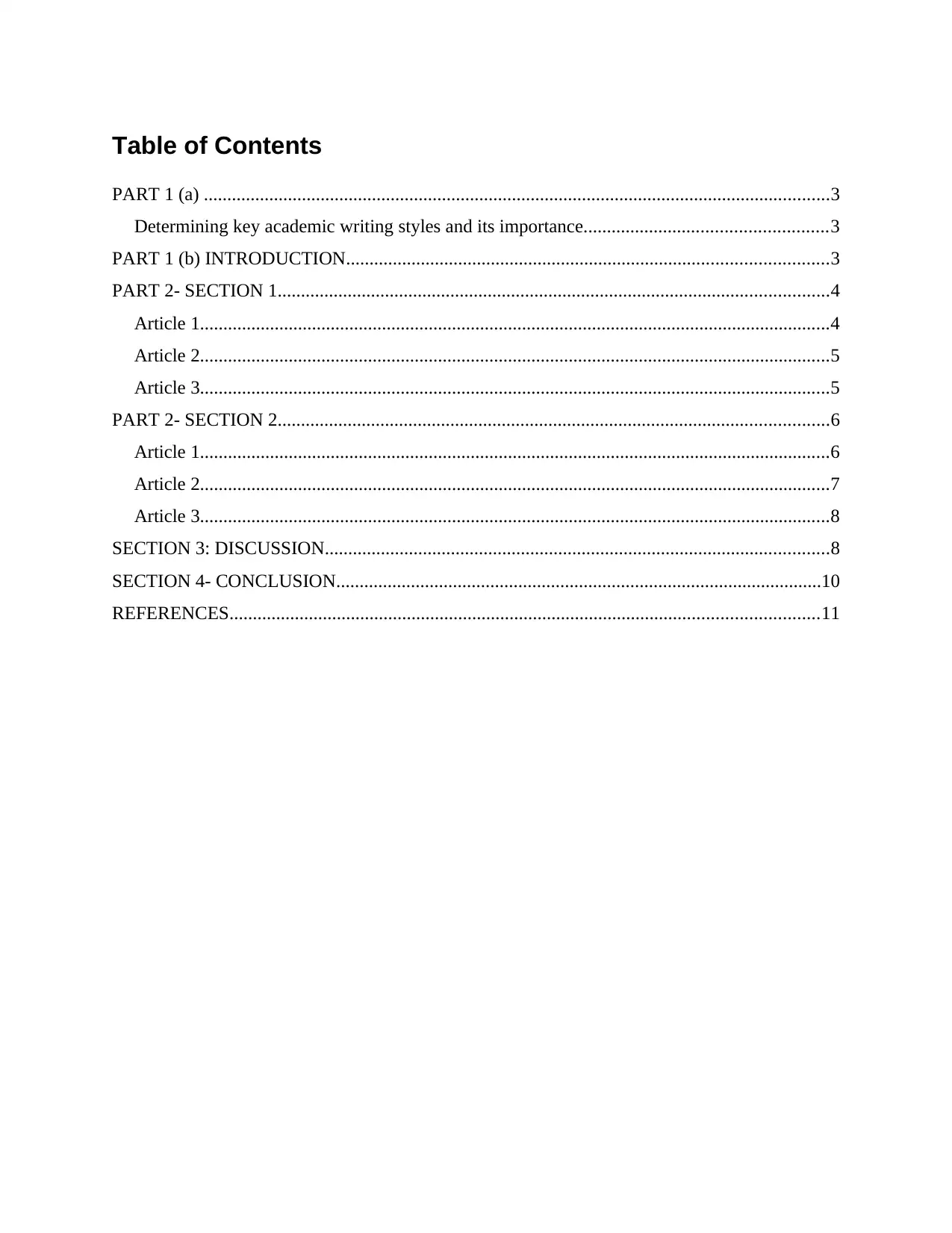
Table of Contents
PART 1 (a) ......................................................................................................................................3
Determining key academic writing styles and its importance....................................................3
PART 1 (b) INTRODUCTION.......................................................................................................3
PART 2- SECTION 1......................................................................................................................4
Article 1.......................................................................................................................................4
Article 2.......................................................................................................................................5
Article 3.......................................................................................................................................5
PART 2- SECTION 2......................................................................................................................6
Article 1.......................................................................................................................................6
Article 2.......................................................................................................................................7
Article 3.......................................................................................................................................8
SECTION 3: DISCUSSION............................................................................................................8
SECTION 4- CONCLUSION........................................................................................................10
REFERENCES..............................................................................................................................11
PART 1 (a) ......................................................................................................................................3
Determining key academic writing styles and its importance....................................................3
PART 1 (b) INTRODUCTION.......................................................................................................3
PART 2- SECTION 1......................................................................................................................4
Article 1.......................................................................................................................................4
Article 2.......................................................................................................................................5
Article 3.......................................................................................................................................5
PART 2- SECTION 2......................................................................................................................6
Article 1.......................................................................................................................................6
Article 2.......................................................................................................................................7
Article 3.......................................................................................................................................8
SECTION 3: DISCUSSION............................................................................................................8
SECTION 4- CONCLUSION........................................................................................................10
REFERENCES..............................................................................................................................11
PART 1 (a)
Determining key academic writing styles and its importance.
Academic writing is referred to as a style of expressing the intellectual boundaries of an
individual within college or university. It tends to display clear and proper understanding of the
specific project. I have demonstrated that, academic writing can be classified into descriptive,
reflective, evaluative and analytical academic writing styles (Strobl and et.al., 2019). Descriptive
style is considered to be one of the simplest form of academic writing. The key intention is to
provide necessary facts and information. They tend to give comprehensive snapshot related to
the subject matter. This academic style is considered to be prominent because it is useful in
creating connection with the set readers. Academic analytical writing tends to show relationship
between various set of piece of information. It is useful in comparing, contrasting, assessing and
critically evaluating the subject matter. On the other hand, I have also investigated that,
evaluative academic writing is intended to judge the relative topic in accordance to a particular
set criteria. The evaluative writing is useful in demonstrating the overall quality of the specific
products, services and program. I have also determined the fact that, reflective academic writing
is based on the reflective thinking of an individual person. This academic style helps in
reviewing the effectiveness of the skills. The key importance of the reflective academic writing
is to help individual to learn about its own practical experience (Bailey, 2017). This academic
writing helped me to appropriately develop high level of thinking and helps in taking action for
specific problem. This helps the writer to explore the specific experience and also helps in
reflecting negative and positive aspects. This helps in improving certain set of activity in the
future. Reflective academic writing style helps individual to develop their own set of skills and
helps in reviewing the effectiveness. I have also evaluated that, the academic writing is important
because it helps in communicating there knowledge to the marker (Hyland and Jiang, 2017). I
have also examined that, Florida obsessive compulsive student inventory (FOCSI) is considered
to be as the self reported measure in order to assess the various symptoms related with the
severity of the OCD.
PART 1 (b) INTRODUCTION
TOPIC: “To critically investigate the current trends and factors associated with
dementia. This study also demonstrates the irreversible causes associated with dementia with
proper intervention measures.”
Determining key academic writing styles and its importance.
Academic writing is referred to as a style of expressing the intellectual boundaries of an
individual within college or university. It tends to display clear and proper understanding of the
specific project. I have demonstrated that, academic writing can be classified into descriptive,
reflective, evaluative and analytical academic writing styles (Strobl and et.al., 2019). Descriptive
style is considered to be one of the simplest form of academic writing. The key intention is to
provide necessary facts and information. They tend to give comprehensive snapshot related to
the subject matter. This academic style is considered to be prominent because it is useful in
creating connection with the set readers. Academic analytical writing tends to show relationship
between various set of piece of information. It is useful in comparing, contrasting, assessing and
critically evaluating the subject matter. On the other hand, I have also investigated that,
evaluative academic writing is intended to judge the relative topic in accordance to a particular
set criteria. The evaluative writing is useful in demonstrating the overall quality of the specific
products, services and program. I have also determined the fact that, reflective academic writing
is based on the reflective thinking of an individual person. This academic style helps in
reviewing the effectiveness of the skills. The key importance of the reflective academic writing
is to help individual to learn about its own practical experience (Bailey, 2017). This academic
writing helped me to appropriately develop high level of thinking and helps in taking action for
specific problem. This helps the writer to explore the specific experience and also helps in
reflecting negative and positive aspects. This helps in improving certain set of activity in the
future. Reflective academic writing style helps individual to develop their own set of skills and
helps in reviewing the effectiveness. I have also evaluated that, the academic writing is important
because it helps in communicating there knowledge to the marker (Hyland and Jiang, 2017). I
have also examined that, Florida obsessive compulsive student inventory (FOCSI) is considered
to be as the self reported measure in order to assess the various symptoms related with the
severity of the OCD.
PART 1 (b) INTRODUCTION
TOPIC: “To critically investigate the current trends and factors associated with
dementia. This study also demonstrates the irreversible causes associated with dementia with
proper intervention measures.”
⊘ This is a preview!⊘
Do you want full access?
Subscribe today to unlock all pages.

Trusted by 1+ million students worldwide
Dementia is referred to as the loss of memory and various other set of mental disabilities
(Dementia, Symptoms, Warning Signs, Types, Causes, and Treatment Topic Guide, 2020). There
are various treatable cause of dementia which includes head injury, hormonal disorders,
infections, etc. there are various set of early symptoms of dementia which mainly includes
forgetting, losing things, difficulty in performing specific task, mood swings, change in
personality, etc. Alzheimer is considered to be one of the major cause of dementia which
negatively influence the memory and various other cognitive functions. This topic has been
narrowed down to analyse the various interventions associated with dementia. Motor dysfunction
in FTD, AD and DLB. Poor gait also results in potential prodromal feature associated with
dementia and cognitive decline. Providing home support to people who are at later stage of
dementia within England results in better care results and outcomes.
PART 2- SECTION 1
Positivist (Quantitative) research
Article 1
Carrying out research across the arts and humanities and social sciences: developing the
methodology for Dementia and Imagination
1. Type of research
The researcher has used quantitative method where positivist approach has been used.
2. Introduction
This study explores how social care communities can improve the quality of life of
people living with dementia. This study also tends to focus on challenging and changing the
perception of the public related with dementia.
3. Describing the method used
The quantitative scale were used in order to measure the quality of life, social
connectivity. This was carried out by the participatory artists in 4 waves, where each wave
constitutes of 12 people with dementia and 12 carers.
4. Results
It has been found out that it is very challenging to treat dementia and there various set of
interventions which helps in treating dementia (Vandrevala and et.al., 2017).
(Dementia, Symptoms, Warning Signs, Types, Causes, and Treatment Topic Guide, 2020). There
are various treatable cause of dementia which includes head injury, hormonal disorders,
infections, etc. there are various set of early symptoms of dementia which mainly includes
forgetting, losing things, difficulty in performing specific task, mood swings, change in
personality, etc. Alzheimer is considered to be one of the major cause of dementia which
negatively influence the memory and various other cognitive functions. This topic has been
narrowed down to analyse the various interventions associated with dementia. Motor dysfunction
in FTD, AD and DLB. Poor gait also results in potential prodromal feature associated with
dementia and cognitive decline. Providing home support to people who are at later stage of
dementia within England results in better care results and outcomes.
PART 2- SECTION 1
Positivist (Quantitative) research
Article 1
Carrying out research across the arts and humanities and social sciences: developing the
methodology for Dementia and Imagination
1. Type of research
The researcher has used quantitative method where positivist approach has been used.
2. Introduction
This study explores how social care communities can improve the quality of life of
people living with dementia. This study also tends to focus on challenging and changing the
perception of the public related with dementia.
3. Describing the method used
The quantitative scale were used in order to measure the quality of life, social
connectivity. This was carried out by the participatory artists in 4 waves, where each wave
constitutes of 12 people with dementia and 12 carers.
4. Results
It has been found out that it is very challenging to treat dementia and there various set of
interventions which helps in treating dementia (Vandrevala and et.al., 2017).
Paraphrase This Document
Need a fresh take? Get an instant paraphrase of this document with our AI Paraphraser
5. Conclusion
It has been concluded that, it helps in overcoming various set of challenges associated
with dementia by providing them with proper care results and treatment.
Article 2
Quantitative Measurements of Motor Function in Alzheimer’s Disease, Frontotemporal
Dementia, and Dementia with Lewy Bodies: A Proof-of-Concept Study.
1. Type of research
The researcher has used quantitative method where positivist approach has been used.
2. Introduction
This study demonstrates efficacy of using quantitative positivist measure associated with motor
dysfunction in frontotemporal dementia (FTD), Alzheimer’s disease (AD) and dementia with
Lewy bodies (DLB).
3. Describing the method used
The cross sectional method would be used, where 49 patients who has been diagnosed
with AD (n= 17), FTD (n= 19) and DLB (n= 13).
4. Results
The results stated higher Q- motor values. Q motor values has also detected difference
between AD and healthy controls.
5. Conclusion
This states that, qualitative approach tends to show more sensitive and objective
measurement associated with motor dysfunction related with dementia (Darweesh and et.al.,
2019).
Article 3
Quantitative gait, cognitive decline, and incident dementia: The Rotterdam Study.
1. Type of research
The researcher has used quantitative method where positivist approach has been used.
2. Introduction
It has been concluded that, it helps in overcoming various set of challenges associated
with dementia by providing them with proper care results and treatment.
Article 2
Quantitative Measurements of Motor Function in Alzheimer’s Disease, Frontotemporal
Dementia, and Dementia with Lewy Bodies: A Proof-of-Concept Study.
1. Type of research
The researcher has used quantitative method where positivist approach has been used.
2. Introduction
This study demonstrates efficacy of using quantitative positivist measure associated with motor
dysfunction in frontotemporal dementia (FTD), Alzheimer’s disease (AD) and dementia with
Lewy bodies (DLB).
3. Describing the method used
The cross sectional method would be used, where 49 patients who has been diagnosed
with AD (n= 17), FTD (n= 19) and DLB (n= 13).
4. Results
The results stated higher Q- motor values. Q motor values has also detected difference
between AD and healthy controls.
5. Conclusion
This states that, qualitative approach tends to show more sensitive and objective
measurement associated with motor dysfunction related with dementia (Darweesh and et.al.,
2019).
Article 3
Quantitative gait, cognitive decline, and incident dementia: The Rotterdam Study.
1. Type of research
The researcher has used quantitative method where positivist approach has been used.
2. Introduction
Poor gait results in potential prodromal feature associated with dementia and cognitive
decline.
3. Describing the method used
Quantitative gait and cognitive assessment method is used where 4258 dementia free
participants were included.
4. Results
3 independent gait domains were mainly linked with cognitive decline and 2 independent
gait domains were linked with dementia.
5. Conclusion
It has been concluded that, poor performance associated with independent gait tends to
result in dementia and cognitive decline (Darweesh and et.al., 2019).
PART 2- SECTION 2
Interpretative (Qualitative) research
Article 1
Applying a new concept of embedding qualitative research: an example from a quantitative
study of carers of people in later stage dementia.
1. Type of research
The researcher has used qualitative method where interpretative approach has been used.
2. Introduction
This study tends to explore potential of using qualitative method in order to gain
understanding on the effectiveness of providing home support to people who are at later stage of
dementia within England.
3. Describing the method used
The observational study is carried out where audio of 17 carers were recorded in order to
carry out structured interview.
4. Results
decline.
3. Describing the method used
Quantitative gait and cognitive assessment method is used where 4258 dementia free
participants were included.
4. Results
3 independent gait domains were mainly linked with cognitive decline and 2 independent
gait domains were linked with dementia.
5. Conclusion
It has been concluded that, poor performance associated with independent gait tends to
result in dementia and cognitive decline (Darweesh and et.al., 2019).
PART 2- SECTION 2
Interpretative (Qualitative) research
Article 1
Applying a new concept of embedding qualitative research: an example from a quantitative
study of carers of people in later stage dementia.
1. Type of research
The researcher has used qualitative method where interpretative approach has been used.
2. Introduction
This study tends to explore potential of using qualitative method in order to gain
understanding on the effectiveness of providing home support to people who are at later stage of
dementia within England.
3. Describing the method used
The observational study is carried out where audio of 17 carers were recorded in order to
carry out structured interview.
4. Results
⊘ This is a preview!⊘
Do you want full access?
Subscribe today to unlock all pages.
Trusted by 1+ million students worldwide
Analysis has demonstrated 3 key themes from carers which includes relevance of
maintaining normality in day to day life, conflicting carer emotions and tension between desired
and use of formal services.
5. Conclusion
This study emphasizes on various methodological challenges in order to carry research
related with dementia (van Gennip and et.al., 2016). It helped in understanding the people living
experience and also evaluated various people suffering from dementia.
Article 2
Relationship continuity and emotional well-being in spouses of people with dementia.
1. Type of research
The researcher has used qualitative method where interpretative approach has been used.
2. Introduction
This study states that, people with dementia contributes towards discontinuity within
their relationship which largely contributes towards entrapment, burden, isolation, intolerance of
behaviour, etc.
3. Describing the method used
A qualitative interpretative research method will be used where convenience sample of
71 spouses with dementia completed questionnaire.
4. Results
The experience of negative emotional reaction to care givers were correlated with the
greater relationship continuity which has resulted in optimistic emotional reactions (Abendstern
and et.al., 2019).
5. Conclusion
This concludes that, assisting couples in maintaining a sense of continuity results in
emotional adjustment related with dementia.
maintaining normality in day to day life, conflicting carer emotions and tension between desired
and use of formal services.
5. Conclusion
This study emphasizes on various methodological challenges in order to carry research
related with dementia (van Gennip and et.al., 2016). It helped in understanding the people living
experience and also evaluated various people suffering from dementia.
Article 2
Relationship continuity and emotional well-being in spouses of people with dementia.
1. Type of research
The researcher has used qualitative method where interpretative approach has been used.
2. Introduction
This study states that, people with dementia contributes towards discontinuity within
their relationship which largely contributes towards entrapment, burden, isolation, intolerance of
behaviour, etc.
3. Describing the method used
A qualitative interpretative research method will be used where convenience sample of
71 spouses with dementia completed questionnaire.
4. Results
The experience of negative emotional reaction to care givers were correlated with the
greater relationship continuity which has resulted in optimistic emotional reactions (Abendstern
and et.al., 2019).
5. Conclusion
This concludes that, assisting couples in maintaining a sense of continuity results in
emotional adjustment related with dementia.
Paraphrase This Document
Need a fresh take? Get an instant paraphrase of this document with our AI Paraphraser
Article 3
Family caregivers’ conceptualisation of quality end-of-life care for people with dementia: A
qualitative study.
1. Type of research
The researcher has used qualitative method where interpretative approach has been used.
2. Introduction
People who has been suffering from dementia are is referred to as disadvantaged dying
linked with poor end of life care. This study demonstrates psychological impact of care for
relative with dementia.
3. Describing the method used
Qualitative interpretative approach with the use of in- depth interviews with the help of
thematic analysis. They have recruited 47 care givers in England.
4. Results
This has resulted in providing 3 overarching themes which includes fostering dignity and
respect, show kindness and compassion.
5. Conclusion
This concludes that, psychological and sociological care helps in aligning with the
palliative and dementia care for better care results and outcomes.
SECTION 3: DISCUSSION
From the above carried out study on the topic dementia within the health and social care
helps in gaining wider knowledge related with subject matter. Quantitative approach helps in
gaining wider understanding on the subject matter through numerical analysis. On the other
hand, qualitative interpretative methodological approach has helped in gaining descriptive
understanding on the various articles associated with the topic dementia within the health and
social care. This study has helped me evaluate that, people with dementia tends to forget things
and has difficulty in carrying various set of regular day to day task with utmost accuracy and
efficiency. Health and social care is referred to as the specific treatment of the ill medical
conditions within health centres. Social care helps in providing proper care and support to the
Family caregivers’ conceptualisation of quality end-of-life care for people with dementia: A
qualitative study.
1. Type of research
The researcher has used qualitative method where interpretative approach has been used.
2. Introduction
People who has been suffering from dementia are is referred to as disadvantaged dying
linked with poor end of life care. This study demonstrates psychological impact of care for
relative with dementia.
3. Describing the method used
Qualitative interpretative approach with the use of in- depth interviews with the help of
thematic analysis. They have recruited 47 care givers in England.
4. Results
This has resulted in providing 3 overarching themes which includes fostering dignity and
respect, show kindness and compassion.
5. Conclusion
This concludes that, psychological and sociological care helps in aligning with the
palliative and dementia care for better care results and outcomes.
SECTION 3: DISCUSSION
From the above carried out study on the topic dementia within the health and social care
helps in gaining wider knowledge related with subject matter. Quantitative approach helps in
gaining wider understanding on the subject matter through numerical analysis. On the other
hand, qualitative interpretative methodological approach has helped in gaining descriptive
understanding on the various articles associated with the topic dementia within the health and
social care. This study has helped me evaluate that, people with dementia tends to forget things
and has difficulty in carrying various set of regular day to day task with utmost accuracy and
efficiency. Health and social care is referred to as the specific treatment of the ill medical
conditions within health centres. Social care helps in providing proper care and support to the
vulnerable people within the specific care community. Davies and et.al., (2017) sought to
establish the fact that, providing proper care and treatment with dementia helps in overcoming
various set of challenges associated with dementia. Using sensitive approach and accurate
intervention to treat dementia helps in improving various motor dysfunction which are linked
with dementia.
Bamford and et.al., (2018) investigated that, poor gait eventually leads to decline in the
cognitive behaviour and largely leads to dementia within individual. Critically understanding the
experience of the people helps in effectively evaluating people who has been suffering from
dementia.
Moreover, Poole and et.al., (2018) examined the fact that, Family caregivers and spouse
maintaining effective relationship and supporting people dementia helps in gaining better care
results and outcomes. Non- pharmacological intervention such as Cognitive Stimulation Therapy
(CST) is considered to be one of the effective intervention approach which helps in supporting
people with dementia. It includes sessions which mainly comprise of themed activities which
has been de signed to stimulate and engage. Kragh and et.al., (2018) sought to establish the fact
that, providing cognitive care and effective care session to the various other participants
eventually focuses on providing better care results and outcomes. Developing effective
psychological and sociological intervention tends to help in providing better care results and
outcomes. Dementia tends to largely result in diminished sense of personal dignity which is
mainly associated with diminished autonomy and also influence the former identity of an
individual. Creating a positive social environment eventually helps in sustaining people with
dementia. Creating an advanced positive social environment helps in confining with various
health related issues. This helps in taking various interpersonal decision in order to attain better
care results within the health and social care sector.
Additionally, Barrett and et.al., (2019) examined the fact that, organising care for the
family and health care practitioners engaging in better decision making leads to better care and
treatment to the people who has been suffering from dementia. Professionals within the health
and social care also focus on recognizing and exploring the individual perspective of the
individual who has been suffering from dementia. Evidence based intervention is considered to
be very relevant because it helps in providing the best possible care and treatment to the people
establish the fact that, providing proper care and treatment with dementia helps in overcoming
various set of challenges associated with dementia. Using sensitive approach and accurate
intervention to treat dementia helps in improving various motor dysfunction which are linked
with dementia.
Bamford and et.al., (2018) investigated that, poor gait eventually leads to decline in the
cognitive behaviour and largely leads to dementia within individual. Critically understanding the
experience of the people helps in effectively evaluating people who has been suffering from
dementia.
Moreover, Poole and et.al., (2018) examined the fact that, Family caregivers and spouse
maintaining effective relationship and supporting people dementia helps in gaining better care
results and outcomes. Non- pharmacological intervention such as Cognitive Stimulation Therapy
(CST) is considered to be one of the effective intervention approach which helps in supporting
people with dementia. It includes sessions which mainly comprise of themed activities which
has been de signed to stimulate and engage. Kragh and et.al., (2018) sought to establish the fact
that, providing cognitive care and effective care session to the various other participants
eventually focuses on providing better care results and outcomes. Developing effective
psychological and sociological intervention tends to help in providing better care results and
outcomes. Dementia tends to largely result in diminished sense of personal dignity which is
mainly associated with diminished autonomy and also influence the former identity of an
individual. Creating a positive social environment eventually helps in sustaining people with
dementia. Creating an advanced positive social environment helps in confining with various
health related issues. This helps in taking various interpersonal decision in order to attain better
care results within the health and social care sector.
Additionally, Barrett and et.al., (2019) examined the fact that, organising care for the
family and health care practitioners engaging in better decision making leads to better care and
treatment to the people who has been suffering from dementia. Professionals within the health
and social care also focus on recognizing and exploring the individual perspective of the
individual who has been suffering from dementia. Evidence based intervention is considered to
be very relevant because it helps in providing the best possible care and treatment to the people
⊘ This is a preview!⊘
Do you want full access?
Subscribe today to unlock all pages.
Trusted by 1+ million students worldwide
who has been suffering from dementia. This helps in providing quality care treatment which is
useful in treating people who has been suffering from dementia.
SECTION 4- CONCLUSION
From the above study, it has been summarized that, Dementia is considered to be as the
loss of memory and various other set of mental disabilities. Providing proper care and treatment
to the people with the best possible intervention helps in treating people with dementia. The
health care practitioners must focus on improving the various motor dysfunction associated with
the dementia. Engaging in cognitive behaviour therapy and improving skills helps in providing
better care and treatment associated with dementia. It has been concluded that, family care giving
is considered to be very prominent to the people who has been suffering from dementia.
Psychological and sociological care helps in aligning with the palliative and dementia care for
better care results and outcomes.
useful in treating people who has been suffering from dementia.
SECTION 4- CONCLUSION
From the above study, it has been summarized that, Dementia is considered to be as the
loss of memory and various other set of mental disabilities. Providing proper care and treatment
to the people with the best possible intervention helps in treating people with dementia. The
health care practitioners must focus on improving the various motor dysfunction associated with
the dementia. Engaging in cognitive behaviour therapy and improving skills helps in providing
better care and treatment associated with dementia. It has been concluded that, family care giving
is considered to be very prominent to the people who has been suffering from dementia.
Psychological and sociological care helps in aligning with the palliative and dementia care for
better care results and outcomes.
Paraphrase This Document
Need a fresh take? Get an instant paraphrase of this document with our AI Paraphraser
REFERENCES
Books and Journals
Abendstern, M and et.al., 2019. Applying a new concept of embedding qualitative research: an
example from a quantitative study of carers of people in later stage dementia. BMC
geriatrics.19(1). p.227.
Bailey, S., 2017. Academic writing: A handbook for international students. Routledge.
Bamford, C and et.al., 2018. What enables good end of life care for people with dementia? A
multi-method qualitative study with key stakeholders. BMC geriatrics.18(1). pp.1-15.
Barrett, E and et.al., 2019. Evaluation of a companion robot for individuals with dementia:
Quantitative findings of the MARIO project in an irish residential care setting. Journal of
Gerontological Nursing.45(7). pp.36-45.
Darweesh, S.K and et.al., 2019. Quantitative gait, cognitive decline, and incident dementia: The
Rotterdam Study. Alzheimer's & Dementia.15(10). pp.1264-1273.
Davies, N and et.al., 2017. Family caregivers’ conceptualisation of quality end-of-life care for
people with dementia: A qualitative study. Palliative Medicine. 31(8). pp.726-733.
Hyland, K. and Jiang, F.K., 2017. Is academic writing becoming more informal?. English for
Specific Purposes.45. pp.40-51.
Kragh, F.J and et.al., 2018. Quantitative measurements of motor function in Alzheimer’s disease,
frontotemporal dementia, and dementia with Lewy bodies: a proof-of-concept
study. Dementia and geriatric cognitive disorders.46(3-4). pp.168-179.
Poole, M and et.al., 2018. End-of-life care: a qualitative study comparing the views of people
with dementia and family carers. Palliative medicine.32(3). pp.631-642.
Strobl, C and et.al., 2019. Digital support for academic writing: A review of technologies and
pedagogies. Computers & Education. 131. pp.33-48.
van Gennip, I.E and et.al., 2016. How dementia affects personal dignity: a qualitative study on
the perspective of individuals with mild to moderate dementia. Journals of Gerontology
Series B: Psychological Sciences and Social Sciences.71(3). pp.491-501.
Books and Journals
Abendstern, M and et.al., 2019. Applying a new concept of embedding qualitative research: an
example from a quantitative study of carers of people in later stage dementia. BMC
geriatrics.19(1). p.227.
Bailey, S., 2017. Academic writing: A handbook for international students. Routledge.
Bamford, C and et.al., 2018. What enables good end of life care for people with dementia? A
multi-method qualitative study with key stakeholders. BMC geriatrics.18(1). pp.1-15.
Barrett, E and et.al., 2019. Evaluation of a companion robot for individuals with dementia:
Quantitative findings of the MARIO project in an irish residential care setting. Journal of
Gerontological Nursing.45(7). pp.36-45.
Darweesh, S.K and et.al., 2019. Quantitative gait, cognitive decline, and incident dementia: The
Rotterdam Study. Alzheimer's & Dementia.15(10). pp.1264-1273.
Davies, N and et.al., 2017. Family caregivers’ conceptualisation of quality end-of-life care for
people with dementia: A qualitative study. Palliative Medicine. 31(8). pp.726-733.
Hyland, K. and Jiang, F.K., 2017. Is academic writing becoming more informal?. English for
Specific Purposes.45. pp.40-51.
Kragh, F.J and et.al., 2018. Quantitative measurements of motor function in Alzheimer’s disease,
frontotemporal dementia, and dementia with Lewy bodies: a proof-of-concept
study. Dementia and geriatric cognitive disorders.46(3-4). pp.168-179.
Poole, M and et.al., 2018. End-of-life care: a qualitative study comparing the views of people
with dementia and family carers. Palliative medicine.32(3). pp.631-642.
Strobl, C and et.al., 2019. Digital support for academic writing: A review of technologies and
pedagogies. Computers & Education. 131. pp.33-48.
van Gennip, I.E and et.al., 2016. How dementia affects personal dignity: a qualitative study on
the perspective of individuals with mild to moderate dementia. Journals of Gerontology
Series B: Psychological Sciences and Social Sciences.71(3). pp.491-501.
Vandrevala, T and et.al., 2017. Perceived needs for support among care home staff providing end
of life care for people with dementia: a qualitative study. International Journal of
Geriatric Psychiatry.32(2). pp.155-163.
Online
Applying a new concept of embedding qualitative research: an example from a quantitative
study of carers of people in later stage dementia. 2019. [ONLINE]. Available
through:<https://link.springer.com/article/10.1186/s12877-019-1240-x>
Carrying out research across the arts and humanities and social sciences: developing the
methodology for Dementia and Imagination. 2020.[ONLINE]. Available through:<
https://www.tandfonline.com/doi/full/10.1080/09548963.2016.1241338>
Dementia, Symptoms, Warning Signs, Types, Causes, and Treatment Topic Guide. 2020.
[ONLINE]. Available
through:<https://www.emedicinehealth.com/dementia_overview/topic-guide.htm>
Family caregivers’ conceptualisation of quality end-of-life care for people with dementia: A
qualitative study. 2016. [ONLINE]. Available
through:<https://journals.sagepub.com/doi/full/10.1177/0269216316673552>
Quantitative gait, cognitive decline, and incident dementia: The Rotterdam Study. 2019.
[ONLINE]. Available
through:<https://www.sciencedirect.com/science/article/abs/pii/S1552526019300883>
Quantitative Measurements of Motor Function in Alzheimer’s Disease, Frontotemporal
Dementia, and Dementia with Lewy Bodies: A Proof-of-Concept Study. 2020. [ONLINE].
Available through:<https://www.karger.com/Article/Abstract/492860>
Relationship continuity and emotional well-being in spouses of people with dementia. 2016.
[ONLINE]. Available
through:<https://www.tandfonline.com/doi/abs/10.1080/13607863.2016.1248896>
of life care for people with dementia: a qualitative study. International Journal of
Geriatric Psychiatry.32(2). pp.155-163.
Online
Applying a new concept of embedding qualitative research: an example from a quantitative
study of carers of people in later stage dementia. 2019. [ONLINE]. Available
through:<https://link.springer.com/article/10.1186/s12877-019-1240-x>
Carrying out research across the arts and humanities and social sciences: developing the
methodology for Dementia and Imagination. 2020.[ONLINE]. Available through:<
https://www.tandfonline.com/doi/full/10.1080/09548963.2016.1241338>
Dementia, Symptoms, Warning Signs, Types, Causes, and Treatment Topic Guide. 2020.
[ONLINE]. Available
through:<https://www.emedicinehealth.com/dementia_overview/topic-guide.htm>
Family caregivers’ conceptualisation of quality end-of-life care for people with dementia: A
qualitative study. 2016. [ONLINE]. Available
through:<https://journals.sagepub.com/doi/full/10.1177/0269216316673552>
Quantitative gait, cognitive decline, and incident dementia: The Rotterdam Study. 2019.
[ONLINE]. Available
through:<https://www.sciencedirect.com/science/article/abs/pii/S1552526019300883>
Quantitative Measurements of Motor Function in Alzheimer’s Disease, Frontotemporal
Dementia, and Dementia with Lewy Bodies: A Proof-of-Concept Study. 2020. [ONLINE].
Available through:<https://www.karger.com/Article/Abstract/492860>
Relationship continuity and emotional well-being in spouses of people with dementia. 2016.
[ONLINE]. Available
through:<https://www.tandfonline.com/doi/abs/10.1080/13607863.2016.1248896>
⊘ This is a preview!⊘
Do you want full access?
Subscribe today to unlock all pages.
Trusted by 1+ million students worldwide

1 out of 12


Related Documents


Your All-in-One AI-Powered Toolkit for Academic Success.
+13062052269
info@desklib.com
Available 24*7 on WhatsApp / Email
![[object Object]](/_next/static/media/star-bottom.7253800d.svg)
Unlock your academic potential
Copyright © 2020–2026 A2Z Services. All Rights Reserved. Developed and managed by ZUCOL.