Effective Communication in Care Settings: A Comprehensive Report
VerifiedAdded on 2023/01/12
|10
|3249
|33
Report
AI Summary
This report delves into the critical role of communication within care settings, examining various aspects of effective interaction between healthcare professionals and patients. The report begins by identifying the reasons people communicate, highlighting the impact of communication on relationships in the workplace, and outlining strategies for managing challenging situations. It then explores factors crucial for promoting effective communication, such as environment, cultural differences, and disabilities, along with how different backgrounds may influence communication methods. Barriers to effective communication, including language, jargon, and physical impediments, are discussed, followed by strategies for handling complex, sensitive, and abusive situations. The report also covers accessing extra support, the purposes and principles of independent advocacy, and when to involve an advocate. Overall, the report provides a comprehensive overview of communication strategies essential for providing quality care and fostering positive patient outcomes.
PROMOTE
COMMUNICATION IN
CARE SETTING
COMMUNICATION IN
CARE SETTING

Paraphrase This Document
Need a fresh take? Get an instant paraphrase of this document with our AI Paraphraser

Table of Contents
INTRODUCTION...........................................................................................................................3
MAIN BODY...................................................................................................................................3
CONCLUSION................................................................................................................................9
REFERENECES............................................................................................................................10
INTRODUCTION...........................................................................................................................3
MAIN BODY...................................................................................................................................3
CONCLUSION................................................................................................................................9
REFERENECES............................................................................................................................10
INTRODUCTION
Communication is determined as the effective way through which individuals share
information and viewpoint with one another. This is acknowledged as the common medium by
which essential information can be shared two or more people. Communication can effectively
take place in any form that is writing, speaking or other forms. Promotion of communication in
care practice is highly important as it allows individuals to communicate with the doctors, nurses
and social workers. By acquiring effective communication practices it is easier healthcare
practitioners to serve its patients and other associated to serve them in more adequate manner.
This report includes various questions associated with communication and its contribution in
care settings along with their answers.
MAIN BODY
1.1 Question: Identify the different reasons people communicate
Answer: Individuals communicate with one another for several reasons. This can be
done for the personal or professional reason. Here, it can be said that the main reasons for which
individuals indulge into communication are to get socialise, to offer choices, to ask questions, to
express their viewpoints, for sharing experiences, to provide instruction and guidance to others,
to motivate and encourage people, to share ideas and express feelings and many others. From the
overall reasons, it can be said that even though the reasons are different but on an average the
overall motive from these activity is to share their point of information with others.
1.2 Question: Explain how communication affects relationships in the work setting
Answer: Communication places major influence over the work setting as well. This is so
because communication helps people to develop their relationship with one another. With
reference to the care setting, it can be said that by making use of effective care setting it is easier
for practitioners to develop their relationship with the other residents as well as patients. This can
be effectively performed by usage of soft communication that leads to establishment of trust
among the individuals who are communicating to one another. Along with this, it can be further
said that good working relationship also takes place because of effective communication as they
are able to convey their information with the colleagues and other related people. This simply
helps them out in executing their work in appropriate manner. In addition to development of
Communication is determined as the effective way through which individuals share
information and viewpoint with one another. This is acknowledged as the common medium by
which essential information can be shared two or more people. Communication can effectively
take place in any form that is writing, speaking or other forms. Promotion of communication in
care practice is highly important as it allows individuals to communicate with the doctors, nurses
and social workers. By acquiring effective communication practices it is easier healthcare
practitioners to serve its patients and other associated to serve them in more adequate manner.
This report includes various questions associated with communication and its contribution in
care settings along with their answers.
MAIN BODY
1.1 Question: Identify the different reasons people communicate
Answer: Individuals communicate with one another for several reasons. This can be
done for the personal or professional reason. Here, it can be said that the main reasons for which
individuals indulge into communication are to get socialise, to offer choices, to ask questions, to
express their viewpoints, for sharing experiences, to provide instruction and guidance to others,
to motivate and encourage people, to share ideas and express feelings and many others. From the
overall reasons, it can be said that even though the reasons are different but on an average the
overall motive from these activity is to share their point of information with others.
1.2 Question: Explain how communication affects relationships in the work setting
Answer: Communication places major influence over the work setting as well. This is so
because communication helps people to develop their relationship with one another. With
reference to the care setting, it can be said that by making use of effective care setting it is easier
for practitioners to develop their relationship with the other residents as well as patients. This can
be effectively performed by usage of soft communication that leads to establishment of trust
among the individuals who are communicating to one another. Along with this, it can be further
said that good working relationship also takes place because of effective communication as they
are able to convey their information with the colleagues and other related people. This simply
helps them out in executing their work in appropriate manner. In addition to development of
⊘ This is a preview!⊘
Do you want full access?
Subscribe today to unlock all pages.

Trusted by 1+ million students worldwide
positive relationship with one another at work setting helps in practitioners in completing their
work in adequate manner in lucrative form.
1.3 Question: Explain ways to manage challenging situations
Answer: This is highly important for professionals or individuals to manage challenging
situations at workplace as well as regular lifestyle. By handling these situations in adequate
manner individuals are able to survive effectively. Some of the common ways through which
these situations can be managed are specified as below:
Show respect and treat people with dignity: This is the first & foremost method by
which individuals can easily manage challenging situation. This is so because as respect
directly cools down the situation and helps an individual to tackle the challenging
problem in adequate manner.
Speak slowly and in a calm voice: It has been further analysed that soft speaking skill
especially calmness helps an individual in handling the challenging situation and
developing effective environment where there is no place for issues. In addition to this, it
can be said that calm voice directly develops effective bond among the individuals who
are communicating with one another. This simply provides adequate level of contribution
in developing their positive relationship with others that leads resolving of complicated
situations.
Listening: This is determined as the another influential way through which challenging
situation can be effectively managed at workplace. Here, it can be said that if an
individual’s listens to the others or the one with whom they are facing problem then it is
easier for them go through views and perception of others. This effectively leads to
effective management of challenging situation through effective communication.
2.2 Question: Describe the factors to consider when promoting effective communication
Answer: Individuals who are promoting effective communication are required to focus
of considering several factors so that they can easily convey their information to the individuals
with whom they wants to share. The main three factors among them are cultural differences,
environment and disabilities. These factors are explained one after another in detailed manner.
Environment: This is determined as one of the important that must be considered while
promoting effective communication. Here, it is essential to ensure that basic things like
work in adequate manner in lucrative form.
1.3 Question: Explain ways to manage challenging situations
Answer: This is highly important for professionals or individuals to manage challenging
situations at workplace as well as regular lifestyle. By handling these situations in adequate
manner individuals are able to survive effectively. Some of the common ways through which
these situations can be managed are specified as below:
Show respect and treat people with dignity: This is the first & foremost method by
which individuals can easily manage challenging situation. This is so because as respect
directly cools down the situation and helps an individual to tackle the challenging
problem in adequate manner.
Speak slowly and in a calm voice: It has been further analysed that soft speaking skill
especially calmness helps an individual in handling the challenging situation and
developing effective environment where there is no place for issues. In addition to this, it
can be said that calm voice directly develops effective bond among the individuals who
are communicating with one another. This simply provides adequate level of contribution
in developing their positive relationship with others that leads resolving of complicated
situations.
Listening: This is determined as the another influential way through which challenging
situation can be effectively managed at workplace. Here, it can be said that if an
individual’s listens to the others or the one with whom they are facing problem then it is
easier for them go through views and perception of others. This effectively leads to
effective management of challenging situation through effective communication.
2.2 Question: Describe the factors to consider when promoting effective communication
Answer: Individuals who are promoting effective communication are required to focus
of considering several factors so that they can easily convey their information to the individuals
with whom they wants to share. The main three factors among them are cultural differences,
environment and disabilities. These factors are explained one after another in detailed manner.
Environment: This is determined as one of the important that must be considered while
promoting effective communication. Here, it is essential to ensure that basic things like
Paraphrase This Document
Need a fresh take? Get an instant paraphrase of this document with our AI Paraphraser
temperature, comfortable level, crowd, safety, air, lights and other basic amenities must be
considered and acquired into rightful measure before establishing effective communication.
Disabilities: It is highly important for the individuals to firstly go through all the
disability in the surrounding and after that indulge into the activity of promoting effective
communication at workplace.
Cultural differences: Cultural differences also lead to ineffective communication. Thus,
it is mandatory for individuals to go through the core cultural background of the surrounding
area and after that indulge into communication activity or start promoting effective
communication at workplace.
3.1 Question: Explain how people from different backgrounds may use and/or interpret
communication methods in different ways
Answer: Communication is acknowledged as an effective practice used by every
individual but in different manner especially varies due to cultural or background difference.
Here, Interpretation of the communication is also practiced in the different manner as all the
people indulge into this does not have any common language that is being known by them at the
same time. This can also be seen as the major barrier to communication. Here, it can be said that
often individuals makes use of verbal communication while sharing their information with others
but at the same time there are probable chances that the one who is listening might not be
familiar with or could have perceive it in the wrong manner. Here, it is highly important for all
individuals to make use of common language as well as right body language so that they can
easily communicate with one another.
3.2 Question: Identify barriers to effective communication
Answer: Communication is determined as the two way process that results in sharing of
effective information to one another. There are several barriers of communication which are
often faced by individuals are specified as below in detailed manner:
Language: this is determined as the first and foremost barrier that is faced by the
individuals who indulges into effective communication. Here, it can be said that that if
individuals who indulge into communication do not makes use of common language or the
language which is easily understandable by both then it becomes main barrier for them as they
are not able to communicate to each other. This is so because, the language which is being used
by them are not clear.
considered and acquired into rightful measure before establishing effective communication.
Disabilities: It is highly important for the individuals to firstly go through all the
disability in the surrounding and after that indulge into the activity of promoting effective
communication at workplace.
Cultural differences: Cultural differences also lead to ineffective communication. Thus,
it is mandatory for individuals to go through the core cultural background of the surrounding
area and after that indulge into communication activity or start promoting effective
communication at workplace.
3.1 Question: Explain how people from different backgrounds may use and/or interpret
communication methods in different ways
Answer: Communication is acknowledged as an effective practice used by every
individual but in different manner especially varies due to cultural or background difference.
Here, Interpretation of the communication is also practiced in the different manner as all the
people indulge into this does not have any common language that is being known by them at the
same time. This can also be seen as the major barrier to communication. Here, it can be said that
often individuals makes use of verbal communication while sharing their information with others
but at the same time there are probable chances that the one who is listening might not be
familiar with or could have perceive it in the wrong manner. Here, it is highly important for all
individuals to make use of common language as well as right body language so that they can
easily communicate with one another.
3.2 Question: Identify barriers to effective communication
Answer: Communication is determined as the two way process that results in sharing of
effective information to one another. There are several barriers of communication which are
often faced by individuals are specified as below in detailed manner:
Language: this is determined as the first and foremost barrier that is faced by the
individuals who indulges into effective communication. Here, it can be said that that if
individuals who indulge into communication do not makes use of common language or the
language which is easily understandable by both then it becomes main barrier for them as they
are not able to communicate to each other. This is so because, the language which is being used
by them are not clear.
Slangs/ Jargons: Usage of Slang, jargon or other technical words can be seen as another
barrier of effective communication which places impact over the interaction. Here. It can be said
that if an individual’s make use of jargon or any other technical term then it makes the concept
unclear to individual. As a result, both the indulged individuals are not able to share information
with one another.
Cultural barriers: Culture is seen as another issue that can become another influential
barrier of communication. Here, it can be said that if individuals do not share the same cultural
background then it is difficult for them to communicate with one. The main reason behind this is
that they are not comfortable with one another.
Physical barriers: These are the barriers which develop in the form of sound and other
voice due to which sound or voice is not clear to the individuals who are indulged into
communication. This barrier can be developed due to any activity which produces non required
sound in surrounding. This ultimately places negative influence in the overall communication
process.
3.5 Question: Explain how to use communication skills to manage complex, sensitive,
abusive or challenging situations and behaviours
Answer: Effective communication skills are crucial at the time of dealing with any kind
of situation. Mainly, it is better to talk towards the complex situation as compare to avoiding
them. In case of difficult interaction is planned then individual have enough time to assess
information towards the same and at the same time also draw a rough conclusion. As they
should they show compassion and empathy but remain assertive and also communicate with
clarity. Sometime it may be important to negotiate to evaluate as well as find common ground on
the basis of specific solution. In addition of this, listening is also crucial to resolve complex
situations that are fuelled by emotion. Whenever individual face complex or sensitive situation
then they have to raise their voice to fixed the circumstances. In this, individual should listen
carefully, restate their concerns, empathise, offer a better solution to resolve the complex
situation. In addition of this, keeping sentences simple and concise that reduce the number of key
world as it may aid in understanding as well as comprehension the complex behaviour and
situation as well. Especially in cases where maltreatment is suspected, then it is necessary to
listen carefully rather than talk so that an individual’s can easily protect themselves towards
unexpected happened.
barrier of effective communication which places impact over the interaction. Here. It can be said
that if an individual’s make use of jargon or any other technical term then it makes the concept
unclear to individual. As a result, both the indulged individuals are not able to share information
with one another.
Cultural barriers: Culture is seen as another issue that can become another influential
barrier of communication. Here, it can be said that if individuals do not share the same cultural
background then it is difficult for them to communicate with one. The main reason behind this is
that they are not comfortable with one another.
Physical barriers: These are the barriers which develop in the form of sound and other
voice due to which sound or voice is not clear to the individuals who are indulged into
communication. This barrier can be developed due to any activity which produces non required
sound in surrounding. This ultimately places negative influence in the overall communication
process.
3.5 Question: Explain how to use communication skills to manage complex, sensitive,
abusive or challenging situations and behaviours
Answer: Effective communication skills are crucial at the time of dealing with any kind
of situation. Mainly, it is better to talk towards the complex situation as compare to avoiding
them. In case of difficult interaction is planned then individual have enough time to assess
information towards the same and at the same time also draw a rough conclusion. As they
should they show compassion and empathy but remain assertive and also communicate with
clarity. Sometime it may be important to negotiate to evaluate as well as find common ground on
the basis of specific solution. In addition of this, listening is also crucial to resolve complex
situations that are fuelled by emotion. Whenever individual face complex or sensitive situation
then they have to raise their voice to fixed the circumstances. In this, individual should listen
carefully, restate their concerns, empathise, offer a better solution to resolve the complex
situation. In addition of this, keeping sentences simple and concise that reduce the number of key
world as it may aid in understanding as well as comprehension the complex behaviour and
situation as well. Especially in cases where maltreatment is suspected, then it is necessary to
listen carefully rather than talk so that an individual’s can easily protect themselves towards
unexpected happened.
⊘ This is a preview!⊘
Do you want full access?
Subscribe today to unlock all pages.
Trusted by 1+ million students worldwide
3.6 Question: Explain how to access extra support or services to enable individuals to
communicate effectively
Answer: Care plan is recognised to be one of the most prominent source from which
information associated with an individual's communication can be obtained. In this regard, it is
identified that care plan tend to provide information such as the method of communication
adopted by a person along with the assistance required by an individuals for the purpose of
establishing strong and effective interaction. Further, it is recognised that the information related
to style and method of communication adopted by an individual can also be obtained from the
professionals such as manager, social worker, occupational therapist, general practitioner, nurse,
dementia specialist, family and friends, senior care worker, former care specialist and many
more. All of these together provide an overview of the different styles, media and methods of
communication adopted by an individual.
3.7 Question: Explain the purposes and principles of independent advocacy
Answer: Independent Advocacy is refers to the way that support people to have much
control over their ow lives. Mainly, it protect as well as safeguards people who are discriminated
against. It support to those people who actually need a stronger voice to take their own decisions.
With the assistance of this, individuals can make real choices towards their specific
circumstances. In this an advocate will determine as well as find out needs and desire of
individual by communicating with them and also support and speak up for them. One of the main
purpose of Independent advocacy is to assist people to attain their goals and at the same time
also access the services that they actually need. Furthermore, the main principle of independent
advocacy is that it is accountable and also accessible that can be support from conflict of interest.
It also promote equality and social justice by promoting social inclusion.
3.8 Question: Explain when to involve an advocate and how to access advocacy services
Answer: As independent advocate is helpful if there is any kind of disagreement between
two parties. In this advocate are the one who represent individual wishes without judging them
and giving a personal opinion. In context of this, advocacy duty will apply with the local
authority at any care review, safeguarding, assessment and planning stage. An independent
advocate is responsible for appointed to support the person who suffering from any kind of
disagreement. The main focus of advocate is to resolve issues and also assisting their
involvement at the time of taking any kind of decision in situation. As they are required to take
communicate effectively
Answer: Care plan is recognised to be one of the most prominent source from which
information associated with an individual's communication can be obtained. In this regard, it is
identified that care plan tend to provide information such as the method of communication
adopted by a person along with the assistance required by an individuals for the purpose of
establishing strong and effective interaction. Further, it is recognised that the information related
to style and method of communication adopted by an individual can also be obtained from the
professionals such as manager, social worker, occupational therapist, general practitioner, nurse,
dementia specialist, family and friends, senior care worker, former care specialist and many
more. All of these together provide an overview of the different styles, media and methods of
communication adopted by an individual.
3.7 Question: Explain the purposes and principles of independent advocacy
Answer: Independent Advocacy is refers to the way that support people to have much
control over their ow lives. Mainly, it protect as well as safeguards people who are discriminated
against. It support to those people who actually need a stronger voice to take their own decisions.
With the assistance of this, individuals can make real choices towards their specific
circumstances. In this an advocate will determine as well as find out needs and desire of
individual by communicating with them and also support and speak up for them. One of the main
purpose of Independent advocacy is to assist people to attain their goals and at the same time
also access the services that they actually need. Furthermore, the main principle of independent
advocacy is that it is accountable and also accessible that can be support from conflict of interest.
It also promote equality and social justice by promoting social inclusion.
3.8 Question: Explain when to involve an advocate and how to access advocacy services
Answer: As independent advocate is helpful if there is any kind of disagreement between
two parties. In this advocate are the one who represent individual wishes without judging them
and giving a personal opinion. In context of this, advocacy duty will apply with the local
authority at any care review, safeguarding, assessment and planning stage. An independent
advocate is responsible for appointed to support the person who suffering from any kind of
disagreement. The main focus of advocate is to resolve issues and also assisting their
involvement at the time of taking any kind of decision in situation. As they are required to take
Paraphrase This Document
Need a fresh take? Get an instant paraphrase of this document with our AI Paraphraser
part in various process that is related with the Care act like a safeguarding enquiry, adult review,
appeal against a local authority. Furthermore, independent advocate also support people in speak
out up and also protect their safeguarding rights. In this local authority must be consider each
person whether they have difficulty in engaging with the support process.
4.1 Question: Explain the meaning of the term confidentiality
Answer: Confidentiality can be defined as the process of keeping the information about
individuals stored and maintained in the organisational records and not disclosing it to any third
party without knowledge to the person whose information it is or without taking their
permission. In context of health and social care sector, it can be recognised as being the practice
of maintaining confidentiality of client's personal and medical data by making sure that such
information is stored in electronic as well as written format. Further, it is ensured that no outsider
gets access to such written or digital records by any means. The importance of confidentiality
arises as it is quite probable that a client might not place trust in a care worker who can not keep
his or her data stored in a private manner. The disclosure of client's personal information to third
party may lead to the client feeling undervalued. Further, there are even chance of posing risk to
the life of client in an instance whereby their personal details or medical records are shared with
someone without obtaining their consent. Thus, it is important for care workers to make sure that
the information procured by them during their sessions with clients are not disclosed to external
parties except in case of an emergency.
4.3 Question: Describe the potential tension between maintaining an individual’s
confidentiality and disclosing concerns
Answer: The conflict between maintenance of confidentiality of individuals as well as
disclosure of concerns can lead to emergence of ethical dilemmas for professionals. The
confidentiality of the client must be maintained at all times as this implies respect and integrity
towards the client. Duty of care of professionals need to be maintained by them at all times to
ensure the welfare and privacy concerns of the client. However, there are certain instances
whereby personal information of clients can be disclosed. In case of order by court, police or
government, it is the duty of professional to disclose the personal information of client to the
third party involved. There are certain other exceptional situations whereby an entity or a
professional may disclose private information of the clients. It is the trust of client which gets
appeal against a local authority. Furthermore, independent advocate also support people in speak
out up and also protect their safeguarding rights. In this local authority must be consider each
person whether they have difficulty in engaging with the support process.
4.1 Question: Explain the meaning of the term confidentiality
Answer: Confidentiality can be defined as the process of keeping the information about
individuals stored and maintained in the organisational records and not disclosing it to any third
party without knowledge to the person whose information it is or without taking their
permission. In context of health and social care sector, it can be recognised as being the practice
of maintaining confidentiality of client's personal and medical data by making sure that such
information is stored in electronic as well as written format. Further, it is ensured that no outsider
gets access to such written or digital records by any means. The importance of confidentiality
arises as it is quite probable that a client might not place trust in a care worker who can not keep
his or her data stored in a private manner. The disclosure of client's personal information to third
party may lead to the client feeling undervalued. Further, there are even chance of posing risk to
the life of client in an instance whereby their personal details or medical records are shared with
someone without obtaining their consent. Thus, it is important for care workers to make sure that
the information procured by them during their sessions with clients are not disclosed to external
parties except in case of an emergency.
4.3 Question: Describe the potential tension between maintaining an individual’s
confidentiality and disclosing concerns
Answer: The conflict between maintenance of confidentiality of individuals as well as
disclosure of concerns can lead to emergence of ethical dilemmas for professionals. The
confidentiality of the client must be maintained at all times as this implies respect and integrity
towards the client. Duty of care of professionals need to be maintained by them at all times to
ensure the welfare and privacy concerns of the client. However, there are certain instances
whereby personal information of clients can be disclosed. In case of order by court, police or
government, it is the duty of professional to disclose the personal information of client to the
third party involved. There are certain other exceptional situations whereby an entity or a
professional may disclose private information of the clients. It is the trust of client which gets
breached in case a professional communicates information about them in instances other than the
exceptional cases.
CONCLUSION
On the basis of overall information provided in the above section, it has been
acknowledged that effective communication helps every sector in executing their work
responsibility with minimal number of errors. It is highly important for all individuals to make
use of common language as well as right body language so that they can easily communicate
with one another.
exceptional cases.
CONCLUSION
On the basis of overall information provided in the above section, it has been
acknowledged that effective communication helps every sector in executing their work
responsibility with minimal number of errors. It is highly important for all individuals to make
use of common language as well as right body language so that they can easily communicate
with one another.
⊘ This is a preview!⊘
Do you want full access?
Subscribe today to unlock all pages.
Trusted by 1+ million students worldwide
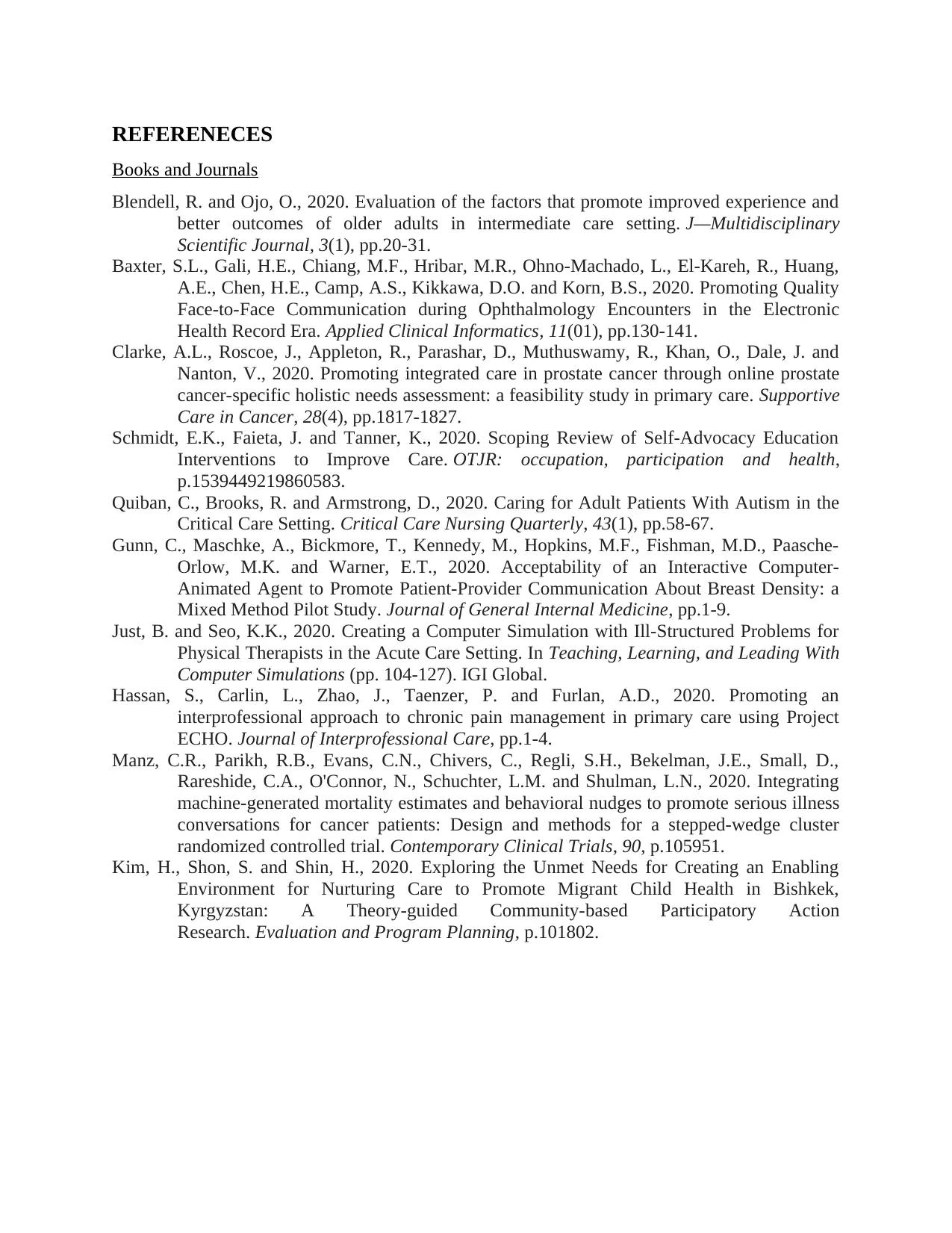
REFERENECES
Books and Journals
Blendell, R. and Ojo, O., 2020. Evaluation of the factors that promote improved experience and
better outcomes of older adults in intermediate care setting. J—Multidisciplinary
Scientific Journal, 3(1), pp.20-31.
Baxter, S.L., Gali, H.E., Chiang, M.F., Hribar, M.R., Ohno-Machado, L., El-Kareh, R., Huang,
A.E., Chen, H.E., Camp, A.S., Kikkawa, D.O. and Korn, B.S., 2020. Promoting Quality
Face-to-Face Communication during Ophthalmology Encounters in the Electronic
Health Record Era. Applied Clinical Informatics, 11(01), pp.130-141.
Clarke, A.L., Roscoe, J., Appleton, R., Parashar, D., Muthuswamy, R., Khan, O., Dale, J. and
Nanton, V., 2020. Promoting integrated care in prostate cancer through online prostate
cancer-specific holistic needs assessment: a feasibility study in primary care. Supportive
Care in Cancer, 28(4), pp.1817-1827.
Schmidt, E.K., Faieta, J. and Tanner, K., 2020. Scoping Review of Self-Advocacy Education
Interventions to Improve Care. OTJR: occupation, participation and health,
p.1539449219860583.
Quiban, C., Brooks, R. and Armstrong, D., 2020. Caring for Adult Patients With Autism in the
Critical Care Setting. Critical Care Nursing Quarterly, 43(1), pp.58-67.
Gunn, C., Maschke, A., Bickmore, T., Kennedy, M., Hopkins, M.F., Fishman, M.D., Paasche-
Orlow, M.K. and Warner, E.T., 2020. Acceptability of an Interactive Computer-
Animated Agent to Promote Patient-Provider Communication About Breast Density: a
Mixed Method Pilot Study. Journal of General Internal Medicine, pp.1-9.
Just, B. and Seo, K.K., 2020. Creating a Computer Simulation with Ill-Structured Problems for
Physical Therapists in the Acute Care Setting. In Teaching, Learning, and Leading With
Computer Simulations (pp. 104-127). IGI Global.
Hassan, S., Carlin, L., Zhao, J., Taenzer, P. and Furlan, A.D., 2020. Promoting an
interprofessional approach to chronic pain management in primary care using Project
ECHO. Journal of Interprofessional Care, pp.1-4.
Manz, C.R., Parikh, R.B., Evans, C.N., Chivers, C., Regli, S.H., Bekelman, J.E., Small, D.,
Rareshide, C.A., O'Connor, N., Schuchter, L.M. and Shulman, L.N., 2020. Integrating
machine-generated mortality estimates and behavioral nudges to promote serious illness
conversations for cancer patients: Design and methods for a stepped-wedge cluster
randomized controlled trial. Contemporary Clinical Trials, 90, p.105951.
Kim, H., Shon, S. and Shin, H., 2020. Exploring the Unmet Needs for Creating an Enabling
Environment for Nurturing Care to Promote Migrant Child Health in Bishkek,
Kyrgyzstan: A Theory-guided Community-based Participatory Action
Research. Evaluation and Program Planning, p.101802.
Books and Journals
Blendell, R. and Ojo, O., 2020. Evaluation of the factors that promote improved experience and
better outcomes of older adults in intermediate care setting. J—Multidisciplinary
Scientific Journal, 3(1), pp.20-31.
Baxter, S.L., Gali, H.E., Chiang, M.F., Hribar, M.R., Ohno-Machado, L., El-Kareh, R., Huang,
A.E., Chen, H.E., Camp, A.S., Kikkawa, D.O. and Korn, B.S., 2020. Promoting Quality
Face-to-Face Communication during Ophthalmology Encounters in the Electronic
Health Record Era. Applied Clinical Informatics, 11(01), pp.130-141.
Clarke, A.L., Roscoe, J., Appleton, R., Parashar, D., Muthuswamy, R., Khan, O., Dale, J. and
Nanton, V., 2020. Promoting integrated care in prostate cancer through online prostate
cancer-specific holistic needs assessment: a feasibility study in primary care. Supportive
Care in Cancer, 28(4), pp.1817-1827.
Schmidt, E.K., Faieta, J. and Tanner, K., 2020. Scoping Review of Self-Advocacy Education
Interventions to Improve Care. OTJR: occupation, participation and health,
p.1539449219860583.
Quiban, C., Brooks, R. and Armstrong, D., 2020. Caring for Adult Patients With Autism in the
Critical Care Setting. Critical Care Nursing Quarterly, 43(1), pp.58-67.
Gunn, C., Maschke, A., Bickmore, T., Kennedy, M., Hopkins, M.F., Fishman, M.D., Paasche-
Orlow, M.K. and Warner, E.T., 2020. Acceptability of an Interactive Computer-
Animated Agent to Promote Patient-Provider Communication About Breast Density: a
Mixed Method Pilot Study. Journal of General Internal Medicine, pp.1-9.
Just, B. and Seo, K.K., 2020. Creating a Computer Simulation with Ill-Structured Problems for
Physical Therapists in the Acute Care Setting. In Teaching, Learning, and Leading With
Computer Simulations (pp. 104-127). IGI Global.
Hassan, S., Carlin, L., Zhao, J., Taenzer, P. and Furlan, A.D., 2020. Promoting an
interprofessional approach to chronic pain management in primary care using Project
ECHO. Journal of Interprofessional Care, pp.1-4.
Manz, C.R., Parikh, R.B., Evans, C.N., Chivers, C., Regli, S.H., Bekelman, J.E., Small, D.,
Rareshide, C.A., O'Connor, N., Schuchter, L.M. and Shulman, L.N., 2020. Integrating
machine-generated mortality estimates and behavioral nudges to promote serious illness
conversations for cancer patients: Design and methods for a stepped-wedge cluster
randomized controlled trial. Contemporary Clinical Trials, 90, p.105951.
Kim, H., Shon, S. and Shin, H., 2020. Exploring the Unmet Needs for Creating an Enabling
Environment for Nurturing Care to Promote Migrant Child Health in Bishkek,
Kyrgyzstan: A Theory-guided Community-based Participatory Action
Research. Evaluation and Program Planning, p.101802.

1 out of 10


Related Documents


Your All-in-One AI-Powered Toolkit for Academic Success.
+13062052269
info@desklib.com
Available 24*7 on WhatsApp / Email
![[object Object]](/_next/static/media/star-bottom.7253800d.svg)
Unlock your academic potential
Copyright © 2020–2025 A2Z Services. All Rights Reserved. Developed and managed by ZUCOL.