Psychological Analysis Report: CBT Treatment for Depression and PTSD

Verified

Added on  2020/04/21

|9
|1524
|29
Report
AI Summary
This report presents a psychological analysis of a patient exhibiting symptoms of depression and Post Traumatic Stress Disorder (PTSD). The analysis delves into the patient's history, highlighting significant life events and their impact on the patient's psyche, including experiences of childhood trauma, failed relationships, and religious beliefs. Based on this analysis, the report suggests diagnoses of depression and PTSD. The core of the report focuses on treatment recommendations rooted in Cognitive Behavioral Therapy (CBT), including cognitive restructuring, automatic thought records, and pleasant activity scheduling. These CBT methods are presented as effective tools for managing the patient's emotional and behavioral issues. The report concludes by emphasizing the importance of these CBT treatments for the patient's psychological development and recovery.
Document Page
Running head: PSYCHOLOGICAL ANALYSIS
Psychological Analysis
Name of the Student
Name of the University
Author Note
tabler-icon-diamond-filled.svg

Paraphrase This Document

Need a fresh take? Get an instant paraphrase of this document with our AI Paraphraser
Document Page
1PSYCHOLOGICAL ANALYSIS
Executive Summary
This report studies the assessment, diagnosis and the treatment of a patient with
psychological issues. The patient has a history of traumatic past with lots of stress in adult
life. The different diagnosis includes depression and Post Traumatic Stress Disorder. The
different methods of treatment according to CBT are suggested.
Document Page
2PSYCHOLOGICAL ANALYSIS
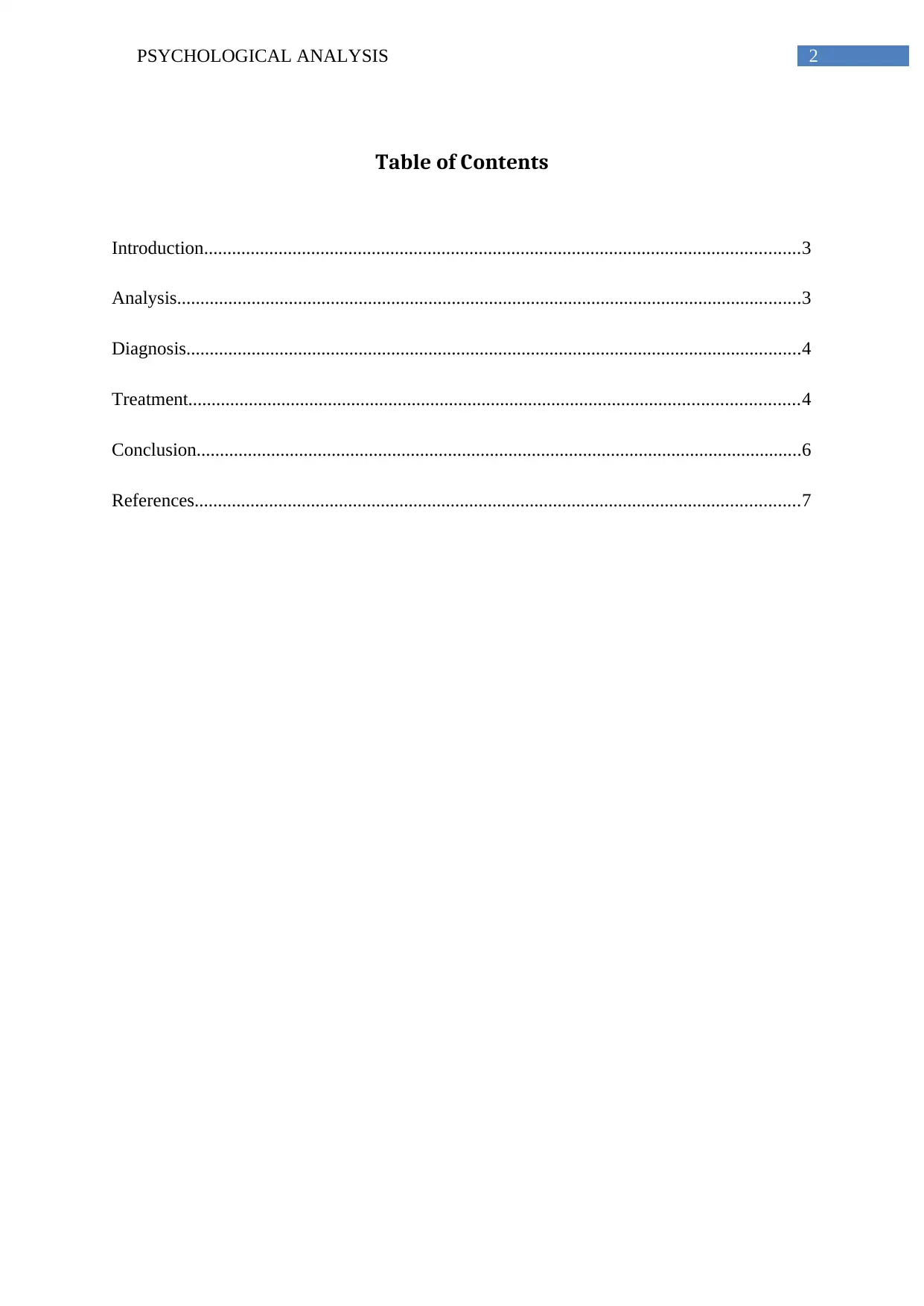
Table of Contents
Introduction................................................................................................................................3
Analysis......................................................................................................................................3
Diagnosis....................................................................................................................................4
Treatment...................................................................................................................................4
Conclusion..................................................................................................................................6
References..................................................................................................................................7
Document Page
3PSYCHOLOGICAL ANALYSIS
Introduction
The report focuses on the analysis, diagnosis and recommendation of treatment of a
patient. The report focuses on the use of the Cognitive Behavior Theory (CBT) for the case
study and recommendations of treatment of the given patient. The CBT is based on the
concept of working together of cognition (the thoughts), emotions (the feelings) and behavior
(the actions) (Kendall & Hollon, 2013). In the given case how these three determinants and
their study shows the mental health of the patient. In the study, the past of the subject along
with the social environment and the emotional balance help in the diagnosis. The resulting
treatment method helps in treating his issues using the therapies of CBT.
Analysis
The analysis of the patient’s history shows many impressionable events, which must
have a great impact on the psyche of the patient. The constant imagination of the death of his
father and the marriage of his mother to another man must have greatly affected him. The
imagination of beaten up by his stepfather, the inability of his mother to protect him affected
him negatively and affected his behavior of self-preservation and it further aggravates his
negative thoughts. The constant failing of his own marriage is because of the imaginary
troubles he has faced, he over dramatizes the situations he has faced. The effect of the
medicine on his sexual prowess has further aggravated his depression making him more upset
about his condition and harming his relation with his wife. The failure of his marriages he has
faced is affected by the constant fear ingrained in him. The subject has the habit of blaming
the situation he is facing as the divine wrath. This ideology makes him powerless to face
situations and find a solution to them. The idea of the divine wrath can be related to the
patient’s strict religious beliefs and a habit of self-blaming (Park & Slattery, 2013). .
tabler-icon-diamond-filled.svg

Paraphrase This Document

Need a fresh take? Get an instant paraphrase of this document with our AI Paraphraser
Document Page
4PSYCHOLOGICAL ANALYSIS
This habit can be related to his imagination of being powerless in the hands of his father and
therefore blaming himself for whatever issues he was facing.
Diagnosis
Based on the history and the current emotional status of the patient, there may be
different results of the analysis of the patient. The patient’s constant overflow of emotion and
imagining scenarios can be a result of depression (Alpert& Fava, 2014). Depression makes
him think he is incapable of taking actions and have conclusive decision-making capabilities.
The patient evidently also suffers from depression because of the traumatic and negative
impact of the life he imagines he has faced resulting in feeling unimportant (Gilbert, 2016).
The depression can be the reason of all the negative thoughts and his emotional reasoning of
feeling unimportant in the social circle stemming out of the failed relationships and the
emotional misbalance arising out of them. All the effects of human faults and his own
drawbacks are put on divine justice to avoid taking any action about them. The issues faced
by him are a complex of emotion and behavior which is a resultant of a number experiences
he has faced through his life.
Treatment
There are different types of treatments in the Cognitive Behavior Therapy (CBT) for
the various issues faced by the patient. Aaron T. Beck initially developed the CBT for
treatment of eating disorders (Boland, Tansey & Brooks, 2015). There should be mix of
individual and social approach to treat the issues of this patient.
Cognitive reconstructing can treat the depression faced by the patient. The cognitive
reconstructing of the emotions helps in the treatment of depression. The self-help technique is
used in this type of treatment (Cuijpers, et al., 2013). To treat the depression of this patient
Document Page
5PSYCHOLOGICAL ANALYSIS
the process of automatic thought record can be used (Neimeyer & Feixas, 2016). In this
technique, the patient has to write or record his taught along with the chain of reactions and
their results. The context of thought, the chain of the thought and the result of the thought is
recorded for the self-evaluation of importance and validity of the thought. This helps the
patient in constructing his behavior to focus on constructive thought processes thus helping in
depression. It also helps the psychiatrist in analyzing and understanding the thinking
mechanism of the patient. The constant record of the patients thought process would help in
counseling the patient for the various emotional fluctuations he is facing. A plan can be made
for the patient for doing his regular tasks so that he finds pleasure in them and it helps in his
depression. The process can be done in different parts by the patient
1. Cause: The patient records the cause of the unpleasant emotion felt by the patient, the
reason that initiated the thought process.
2. Automatic thoughts: The causal thoughts gave birth to which automatic thoughts and
how real the automatic thoughts seem.
3. Emotions: The emotions felt as the effect of the automatic thoughts are recorded. The
intensity of the emotions is also recorded so the patient can see it later.
4. Adaptive Response: this analyses the thought processes that led to the complex
behavior. A set of questions to be answered to reason the thought process and the
percentage of each response.
5. Outcome: This evaluates in percentage the belief of the patient on the adaptive
response he gave. It also records the present emotions and their intensities. It helps in
the evaluation of the success or failure of the process by the psychiatric help he is
taking.
The process of Pleasant Activity Scheduling can also be used, which a process to
schedule a series of activities which the patient can look forward to (Orgeta, Brede &
Document Page
6PSYCHOLOGICAL ANALYSIS
Livingston, 2017). These can include simple activities, which help the patient feel pleasure
like watching movies, or going on a trip. The pleasures felt by the patent will help them
neutralize depressing emotions.
Conclusion
Therefore, in this report the case of the patient has shown a number of psychological
issues arising out of his life experiences. The detailed analysis of his past and his present
symptoms show a number of different issues including depression. The traditional treatments
of the issues according to CBT have been recommended. The use of these methods will help
in the patient’s psychological development.
tabler-icon-diamond-filled.svg

Paraphrase This Document

Need a fresh take? Get an instant paraphrase of this document with our AI Paraphraser
Document Page
7PSYCHOLOGICAL ANALYSIS
References
Alpert, J. E., & Fava, M. (2014). Handbook of chronic depression: Diagnosis and therapeutic
management (Vol. 25). CRC Press.
Boland, E. A., Tansey, T. N., & Brooks, J. (2015). Cognitive behavioral therapy. Counseling
theories and techniques for rehabilitation and mental health professionals, 90.
Cuijpers, P., Berking, M., Andersson, G., Quigley, L., Kleiboer, A., & Dobson, K. S. (2013).
A meta-analysis of cognitive-behavioural therapy for adult depression, alone and in
comparison with other treatments. The Canadian Journal of Psychiatry, 58(7), 376-
385.
Gilbert, P. (2016). Depression: The evolution of powerlessness. Routledge.
Kendall, P. C., & Hollon, S. D. (Eds.). (2013). Cognitive-behavioral interventions: Theory,
research, and procedures (Vol. 21). Academic Press.
Neimeyer, R. A., & Feixas, G. (2016). The Role of Homework and Skill Acquisition in the
Outcome of Group Cognitive Therapy for Depression–Republished Article. Behavior
therapy, 47(5), 747-754.
Orgeta, V., Brede, J., & Livingston, G. (2017). Behavioural activation for depression in older
people: systematic review and meta-analysis. The British Journal of Psychiatry, bjp-
bp.
Park, C. L., & Slattery, J. M. (2013). Religion, spirituality, and mental health.
Document Page
8PSYCHOLOGICAL ANALYSIS
chevron_up_icon
1 out of 9
circle_padding
hide_on_mobile
zoom_out_icon
[object Object]