Research Report: Factors Influencing Bystander Effect in Psychology
VerifiedAdded on 2020/07/23
|13
|2884
|32
Report
AI Summary
This psychological research report investigates the bystander effect, exploring the factors that influence an individual's decision to help a victim in a specific situation. The study examines the impact of environmental factors (busy vs. quiet roads), gender, and age on helping behavior. The research employs an experimental design, collecting data through questionnaires administered to a sample of 116 participants. Statistical analyses, including descriptive statistics and t-tests, are used to identify significant relationships between the variables. The results indicate that age has a significant impact on the bystander effect, while environmental factors and gender do not appear to play a significant role. The report presents the methodology, results, and interpretations, concluding with a discussion of the findings and limitations of the study. This research contributes to understanding the complex dynamics of social psychology and the factors influencing helping behavior in emergency situations.
PSYCHOLOGICAL RESEARCH REPORT

Paraphrase This Document
Need a fresh take? Get an instant paraphrase of this document with our AI Paraphraser
ABSTRACT
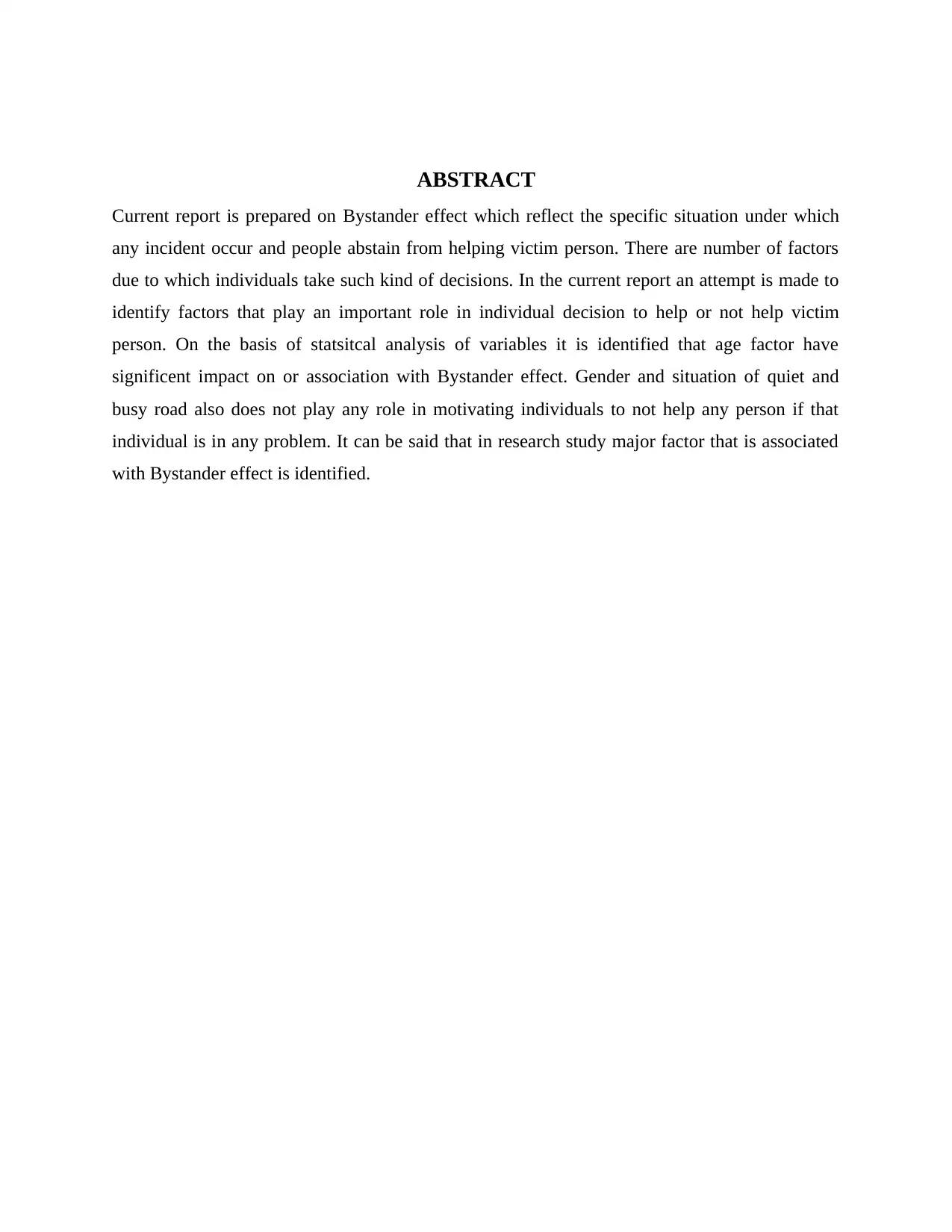
Current report is prepared on Bystander effect which reflect the specific situation under which
any incident occur and people abstain from helping victim person. There are number of factors
due to which individuals take such kind of decisions. In the current report an attempt is made to
identify factors that play an important role in individual decision to help or not help victim
person. On the basis of statsitcal analysis of variables it is identified that age factor have
significent impact on or association with Bystander effect. Gender and situation of quiet and
busy road also does not play any role in motivating individuals to not help any person if that
individual is in any problem. It can be said that in research study major factor that is associated
with Bystander effect is identified.
Current report is prepared on Bystander effect which reflect the specific situation under which
any incident occur and people abstain from helping victim person. There are number of factors
due to which individuals take such kind of decisions. In the current report an attempt is made to
identify factors that play an important role in individual decision to help or not help victim
person. On the basis of statsitcal analysis of variables it is identified that age factor have
significent impact on or association with Bystander effect. Gender and situation of quiet and
busy road also does not play any role in motivating individuals to not help any person if that
individual is in any problem. It can be said that in research study major factor that is associated
with Bystander effect is identified.
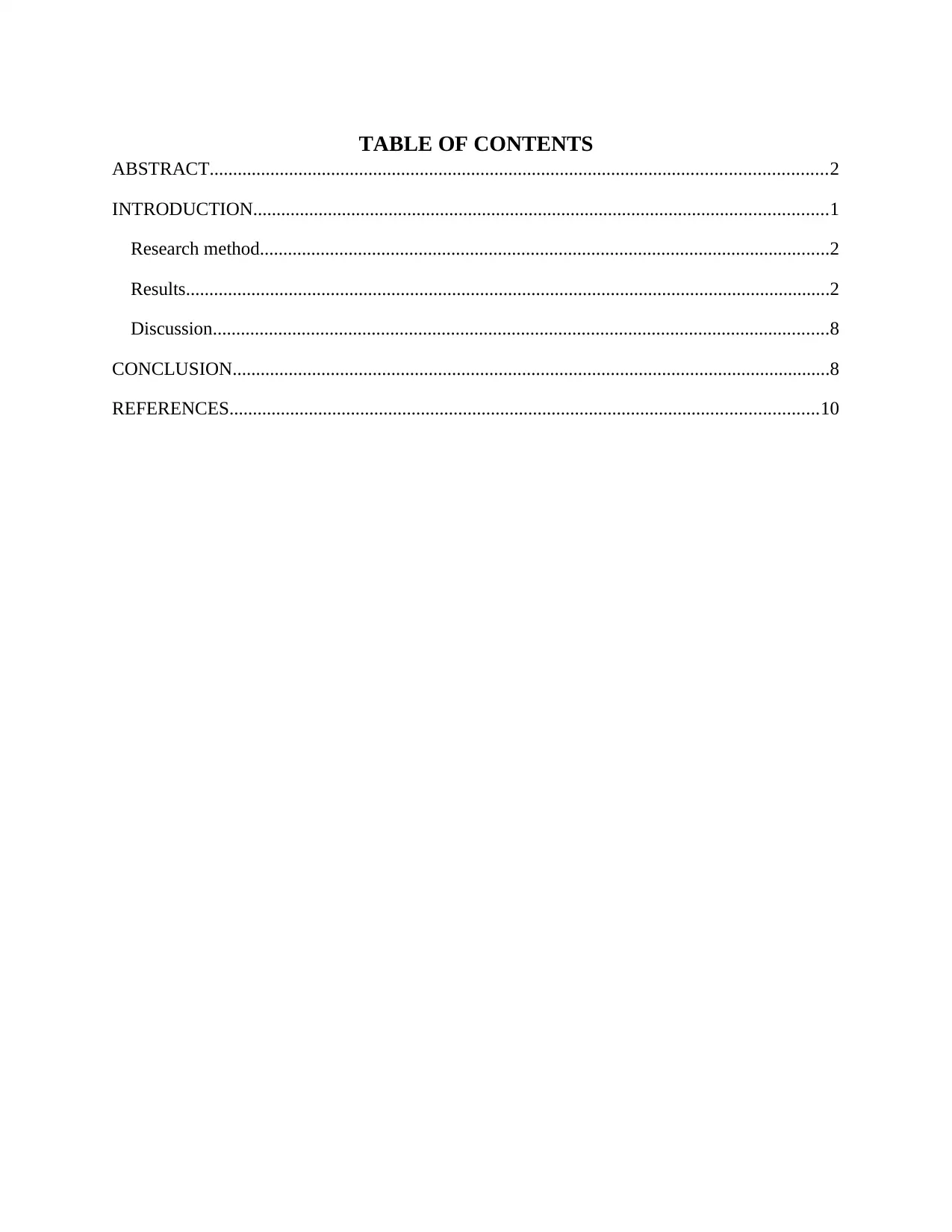
TABLE OF CONTENTS
ABSTRACT....................................................................................................................................2
INTRODUCTION...........................................................................................................................1
Research method..........................................................................................................................2
Results..........................................................................................................................................2
Discussion....................................................................................................................................8
CONCLUSION................................................................................................................................8
REFERENCES..............................................................................................................................10
ABSTRACT....................................................................................................................................2
INTRODUCTION...........................................................................................................................1
Research method..........................................................................................................................2
Results..........................................................................................................................................2
Discussion....................................................................................................................................8
CONCLUSION................................................................................................................................8
REFERENCES..............................................................................................................................10
⊘ This is a preview!⊘
Do you want full access?
Subscribe today to unlock all pages.

Trusted by 1+ million students worldwide
INTRODUCTION
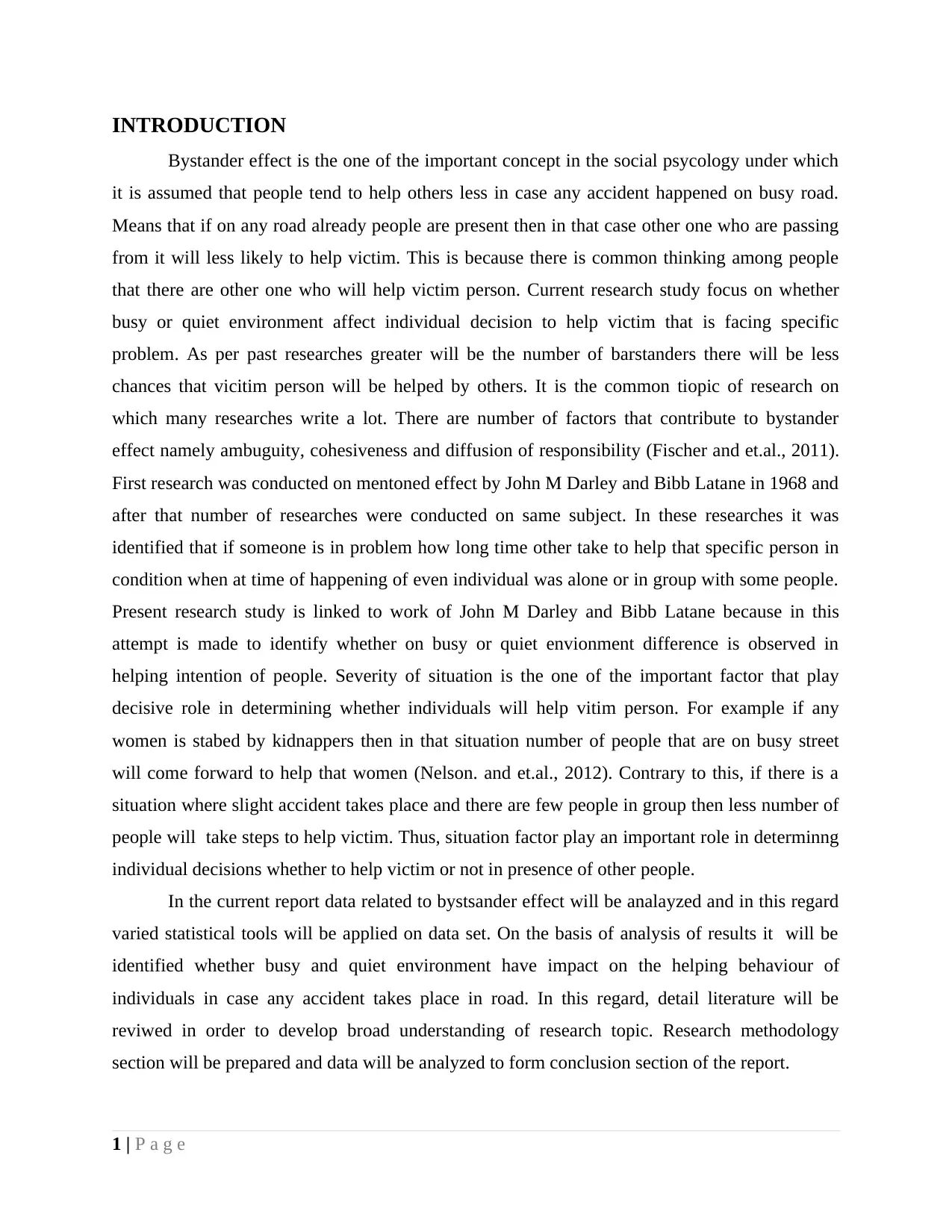
Bystander effect is the one of the important concept in the social psycology under which
it is assumed that people tend to help others less in case any accident happened on busy road.
Means that if on any road already people are present then in that case other one who are passing
from it will less likely to help victim. This is because there is common thinking among people
that there are other one who will help victim person. Current research study focus on whether
busy or quiet environment affect individual decision to help victim that is facing specific
problem. As per past researches greater will be the number of barstanders there will be less
chances that vicitim person will be helped by others. It is the common tiopic of research on
which many researches write a lot. There are number of factors that contribute to bystander
effect namely ambuguity, cohesiveness and diffusion of responsibility (Fischer and et.al., 2011).
First research was conducted on mentoned effect by John M Darley and Bibb Latane in 1968 and
after that number of researches were conducted on same subject. In these researches it was
identified that if someone is in problem how long time other take to help that specific person in
condition when at time of happening of even individual was alone or in group with some people.
Present research study is linked to work of John M Darley and Bibb Latane because in this
attempt is made to identify whether on busy or quiet envionment difference is observed in
helping intention of people. Severity of situation is the one of the important factor that play
decisive role in determining whether individuals will help vitim person. For example if any
women is stabed by kidnappers then in that situation number of people that are on busy street
will come forward to help that women (Nelson. and et.al., 2012). Contrary to this, if there is a
situation where slight accident takes place and there are few people in group then less number of
people will take steps to help victim. Thus, situation factor play an important role in determinng
individual decisions whether to help victim or not in presence of other people.
In the current report data related to bystsander effect will be analayzed and in this regard
varied statistical tools will be applied on data set. On the basis of analysis of results it will be
identified whether busy and quiet environment have impact on the helping behaviour of
individuals in case any accident takes place in road. In this regard, detail literature will be
reviwed in order to develop broad understanding of research topic. Research methodology
section will be prepared and data will be analyzed to form conclusion section of the report.
1 | P a g e
Bystander effect is the one of the important concept in the social psycology under which
it is assumed that people tend to help others less in case any accident happened on busy road.
Means that if on any road already people are present then in that case other one who are passing
from it will less likely to help victim. This is because there is common thinking among people
that there are other one who will help victim person. Current research study focus on whether
busy or quiet environment affect individual decision to help victim that is facing specific
problem. As per past researches greater will be the number of barstanders there will be less
chances that vicitim person will be helped by others. It is the common tiopic of research on
which many researches write a lot. There are number of factors that contribute to bystander
effect namely ambuguity, cohesiveness and diffusion of responsibility (Fischer and et.al., 2011).
First research was conducted on mentoned effect by John M Darley and Bibb Latane in 1968 and
after that number of researches were conducted on same subject. In these researches it was
identified that if someone is in problem how long time other take to help that specific person in
condition when at time of happening of even individual was alone or in group with some people.
Present research study is linked to work of John M Darley and Bibb Latane because in this
attempt is made to identify whether on busy or quiet envionment difference is observed in
helping intention of people. Severity of situation is the one of the important factor that play
decisive role in determining whether individuals will help vitim person. For example if any
women is stabed by kidnappers then in that situation number of people that are on busy street
will come forward to help that women (Nelson. and et.al., 2012). Contrary to this, if there is a
situation where slight accident takes place and there are few people in group then less number of
people will take steps to help victim. Thus, situation factor play an important role in determinng
individual decisions whether to help victim or not in presence of other people.
In the current report data related to bystsander effect will be analayzed and in this regard
varied statistical tools will be applied on data set. On the basis of analysis of results it will be
identified whether busy and quiet environment have impact on the helping behaviour of
individuals in case any accident takes place in road. In this regard, detail literature will be
reviwed in order to develop broad understanding of research topic. Research methodology
section will be prepared and data will be analyzed to form conclusion section of the report.
1 | P a g e
Paraphrase This Document
Need a fresh take? Get an instant paraphrase of this document with our AI Paraphraser
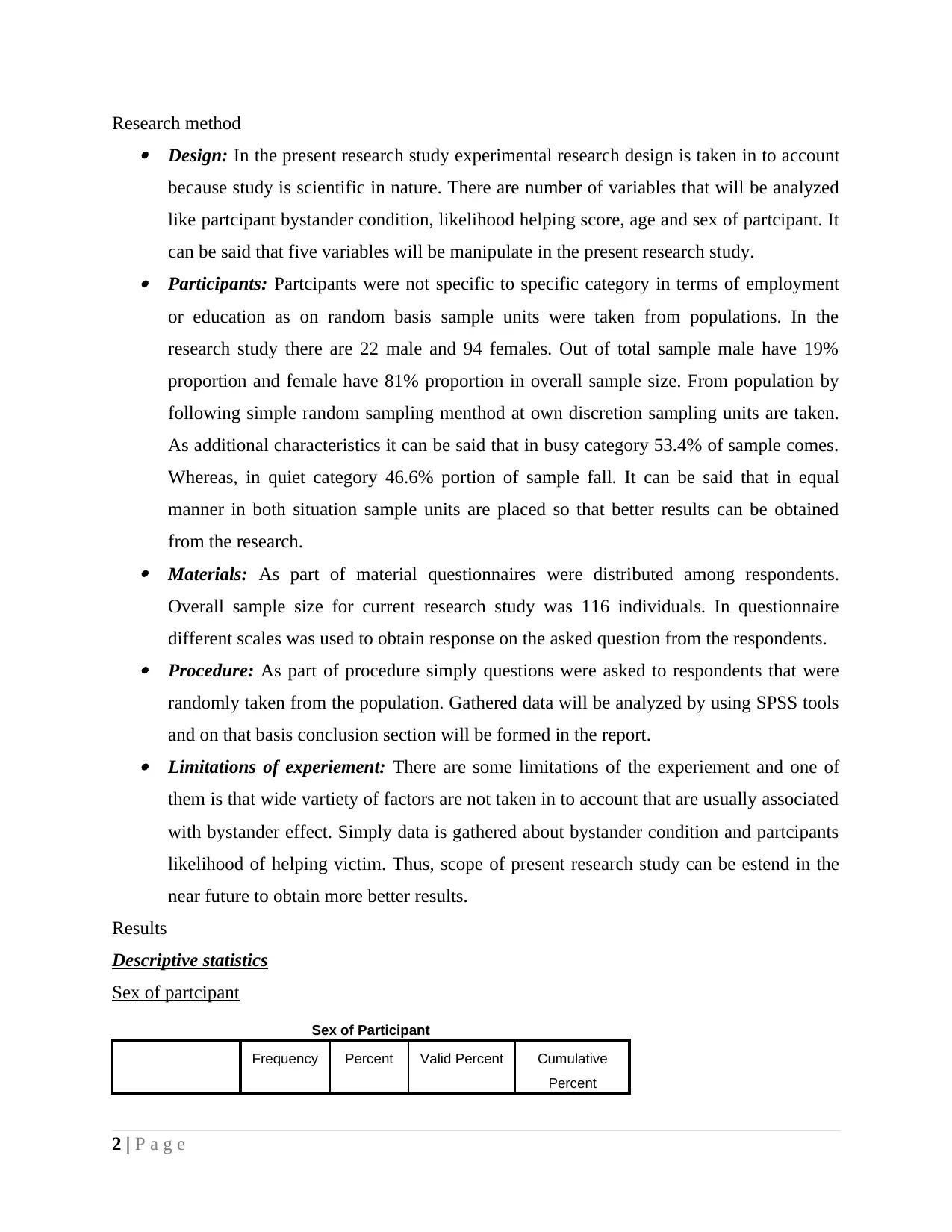
Research method Design: In the present research study experimental research design is taken in to account
because study is scientific in nature. There are number of variables that will be analyzed
like partcipant bystander condition, likelihood helping score, age and sex of partcipant. It
can be said that five variables will be manipulate in the present research study. Participants: Partcipants were not specific to specific category in terms of employment
or education as on random basis sample units were taken from populations. In the
research study there are 22 male and 94 females. Out of total sample male have 19%
proportion and female have 81% proportion in overall sample size. From population by
following simple random sampling menthod at own discretion sampling units are taken.
As additional characteristics it can be said that in busy category 53.4% of sample comes.
Whereas, in quiet category 46.6% portion of sample fall. It can be said that in equal
manner in both situation sample units are placed so that better results can be obtained
from the research. Materials: As part of material questionnaires were distributed among respondents.
Overall sample size for current research study was 116 individuals. In questionnaire
different scales was used to obtain response on the asked question from the respondents. Procedure: As part of procedure simply questions were asked to respondents that were
randomly taken from the population. Gathered data will be analyzed by using SPSS tools
and on that basis conclusion section will be formed in the report. Limitations of experiement: There are some limitations of the experiement and one of
them is that wide vartiety of factors are not taken in to account that are usually associated
with bystander effect. Simply data is gathered about bystander condition and partcipants
likelihood of helping victim. Thus, scope of present research study can be estend in the
near future to obtain more better results.
Results
Descriptive statistics
Sex of partcipant
Sex of Participant
Frequency Percent Valid Percent Cumulative
Percent
2 | P a g e
because study is scientific in nature. There are number of variables that will be analyzed
like partcipant bystander condition, likelihood helping score, age and sex of partcipant. It
can be said that five variables will be manipulate in the present research study. Participants: Partcipants were not specific to specific category in terms of employment
or education as on random basis sample units were taken from populations. In the
research study there are 22 male and 94 females. Out of total sample male have 19%
proportion and female have 81% proportion in overall sample size. From population by
following simple random sampling menthod at own discretion sampling units are taken.
As additional characteristics it can be said that in busy category 53.4% of sample comes.
Whereas, in quiet category 46.6% portion of sample fall. It can be said that in equal
manner in both situation sample units are placed so that better results can be obtained
from the research. Materials: As part of material questionnaires were distributed among respondents.
Overall sample size for current research study was 116 individuals. In questionnaire
different scales was used to obtain response on the asked question from the respondents. Procedure: As part of procedure simply questions were asked to respondents that were
randomly taken from the population. Gathered data will be analyzed by using SPSS tools
and on that basis conclusion section will be formed in the report. Limitations of experiement: There are some limitations of the experiement and one of
them is that wide vartiety of factors are not taken in to account that are usually associated
with bystander effect. Simply data is gathered about bystander condition and partcipants
likelihood of helping victim. Thus, scope of present research study can be estend in the
near future to obtain more better results.
Results
Descriptive statistics
Sex of partcipant
Sex of Participant
Frequency Percent Valid Percent Cumulative
Percent
2 | P a g e
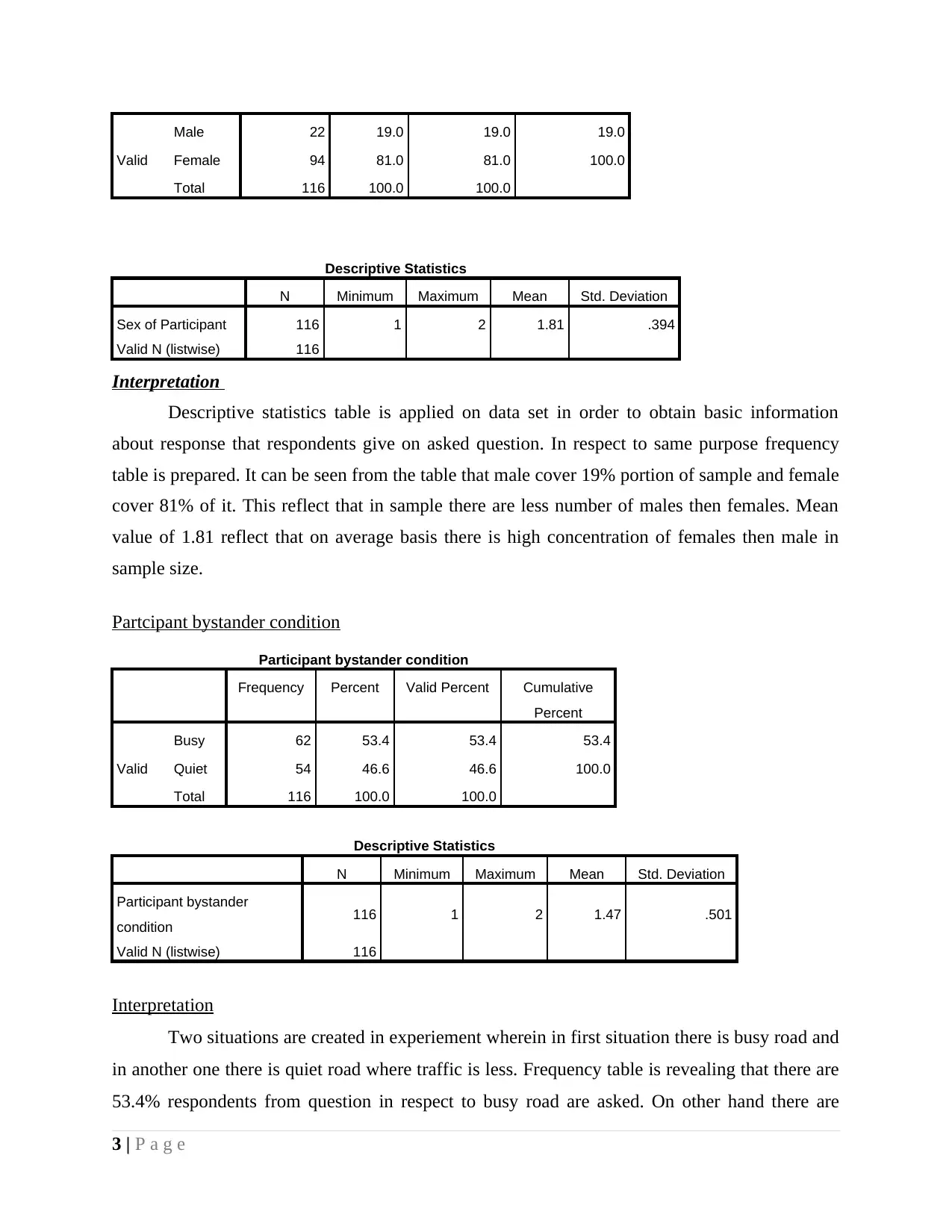
Valid
Male 22 19.0 19.0 19.0
Female 94 81.0 81.0 100.0
Total 116 100.0 100.0
Descriptive Statistics
N Minimum Maximum Mean Std. Deviation
Sex of Participant 116 1 2 1.81 .394
Valid N (listwise) 116
Interpretation
Descriptive statistics table is applied on data set in order to obtain basic information
about response that respondents give on asked question. In respect to same purpose frequency
table is prepared. It can be seen from the table that male cover 19% portion of sample and female
cover 81% of it. This reflect that in sample there are less number of males then females. Mean
value of 1.81 reflect that on average basis there is high concentration of females then male in
sample size.
Partcipant bystander condition
Participant bystander condition
Frequency Percent Valid Percent Cumulative
Percent
Valid
Busy 62 53.4 53.4 53.4
Quiet 54 46.6 46.6 100.0
Total 116 100.0 100.0
Descriptive Statistics
N Minimum Maximum Mean Std. Deviation
Participant bystander
condition 116 1 2 1.47 .501
Valid N (listwise) 116
Interpretation
Two situations are created in experiement wherein in first situation there is busy road and
in another one there is quiet road where traffic is less. Frequency table is revealing that there are
53.4% respondents from question in respect to busy road are asked. On other hand there are
3 | P a g e
Male 22 19.0 19.0 19.0
Female 94 81.0 81.0 100.0
Total 116 100.0 100.0
Descriptive Statistics
N Minimum Maximum Mean Std. Deviation
Sex of Participant 116 1 2 1.81 .394
Valid N (listwise) 116
Interpretation
Descriptive statistics table is applied on data set in order to obtain basic information
about response that respondents give on asked question. In respect to same purpose frequency
table is prepared. It can be seen from the table that male cover 19% portion of sample and female
cover 81% of it. This reflect that in sample there are less number of males then females. Mean
value of 1.81 reflect that on average basis there is high concentration of females then male in
sample size.
Partcipant bystander condition
Participant bystander condition
Frequency Percent Valid Percent Cumulative
Percent
Valid
Busy 62 53.4 53.4 53.4
Quiet 54 46.6 46.6 100.0
Total 116 100.0 100.0
Descriptive Statistics
N Minimum Maximum Mean Std. Deviation
Participant bystander
condition 116 1 2 1.47 .501
Valid N (listwise) 116
Interpretation
Two situations are created in experiement wherein in first situation there is busy road and
in another one there is quiet road where traffic is less. Frequency table is revealing that there are
53.4% respondents from question in respect to busy road are asked. On other hand there are
3 | P a g e
⊘ This is a preview!⊘
Do you want full access?
Subscribe today to unlock all pages.
Trusted by 1+ million students worldwide
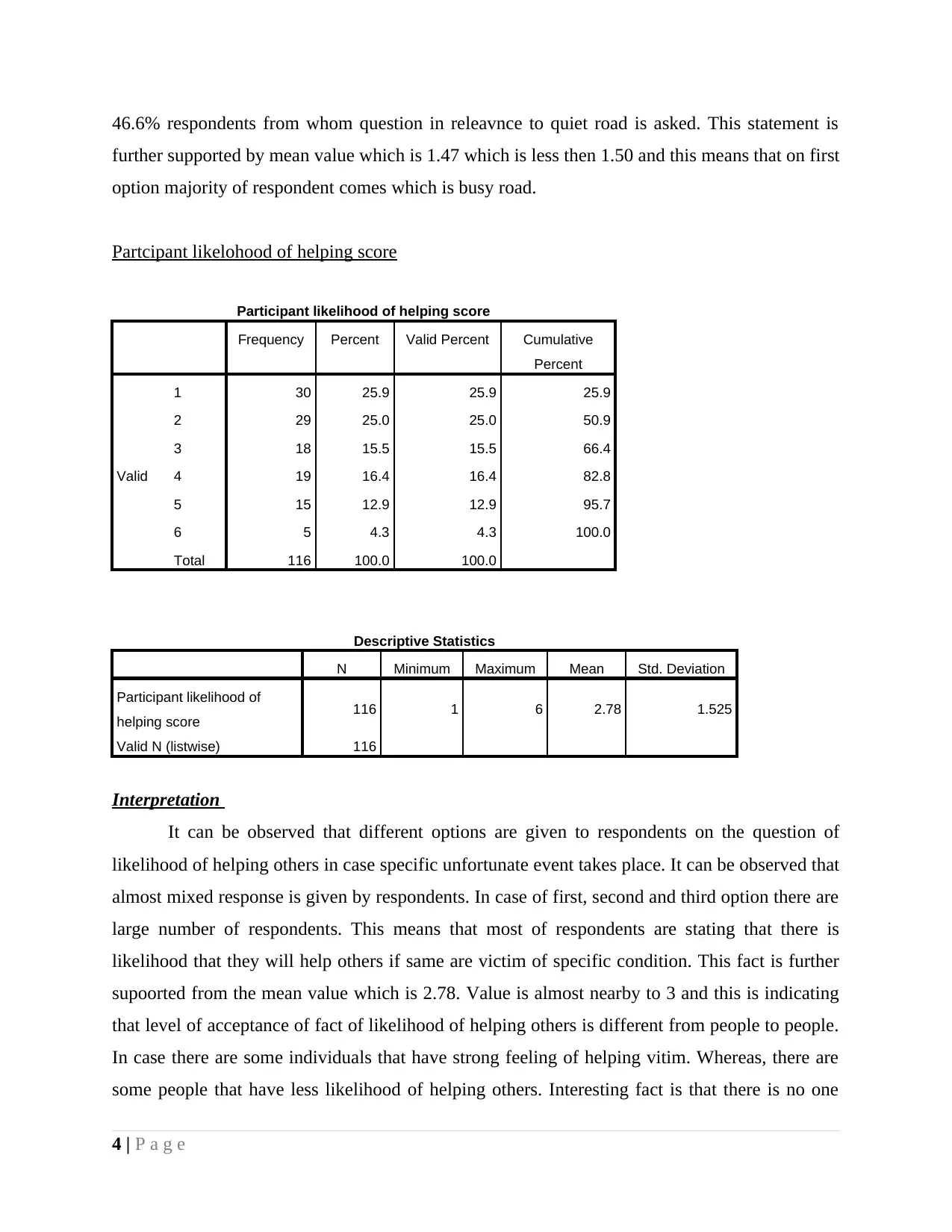
46.6% respondents from whom question in releavnce to quiet road is asked. This statement is
further supported by mean value which is 1.47 which is less then 1.50 and this means that on first
option majority of respondent comes which is busy road.
Partcipant likelohood of helping score
Participant likelihood of helping score
Frequency Percent Valid Percent Cumulative
Percent
Valid
1 30 25.9 25.9 25.9
2 29 25.0 25.0 50.9
3 18 15.5 15.5 66.4
4 19 16.4 16.4 82.8
5 15 12.9 12.9 95.7
6 5 4.3 4.3 100.0
Total 116 100.0 100.0
Descriptive Statistics
N Minimum Maximum Mean Std. Deviation
Participant likelihood of
helping score 116 1 6 2.78 1.525
Valid N (listwise) 116
Interpretation
It can be observed that different options are given to respondents on the question of
likelihood of helping others in case specific unfortunate event takes place. It can be observed that
almost mixed response is given by respondents. In case of first, second and third option there are
large number of respondents. This means that most of respondents are stating that there is
likelihood that they will help others if same are victim of specific condition. This fact is further
supoorted from the mean value which is 2.78. Value is almost nearby to 3 and this is indicating
that level of acceptance of fact of likelihood of helping others is different from people to people.
In case there are some individuals that have strong feeling of helping vitim. Whereas, there are
some people that have less likelihood of helping others. Interesting fact is that there is no one
4 | P a g e
further supported by mean value which is 1.47 which is less then 1.50 and this means that on first
option majority of respondent comes which is busy road.
Partcipant likelohood of helping score
Participant likelihood of helping score
Frequency Percent Valid Percent Cumulative
Percent
Valid
1 30 25.9 25.9 25.9
2 29 25.0 25.0 50.9
3 18 15.5 15.5 66.4
4 19 16.4 16.4 82.8
5 15 12.9 12.9 95.7
6 5 4.3 4.3 100.0
Total 116 100.0 100.0
Descriptive Statistics
N Minimum Maximum Mean Std. Deviation
Participant likelihood of
helping score 116 1 6 2.78 1.525
Valid N (listwise) 116
Interpretation
It can be observed that different options are given to respondents on the question of
likelihood of helping others in case specific unfortunate event takes place. It can be observed that
almost mixed response is given by respondents. In case of first, second and third option there are
large number of respondents. This means that most of respondents are stating that there is
likelihood that they will help others if same are victim of specific condition. This fact is further
supoorted from the mean value which is 2.78. Value is almost nearby to 3 and this is indicating
that level of acceptance of fact of likelihood of helping others is different from people to people.
In case there are some individuals that have strong feeling of helping vitim. Whereas, there are
some people that have less likelihood of helping others. Interesting fact is that there is no one
4 | P a g e
Paraphrase This Document
Need a fresh take? Get an instant paraphrase of this document with our AI Paraphraser
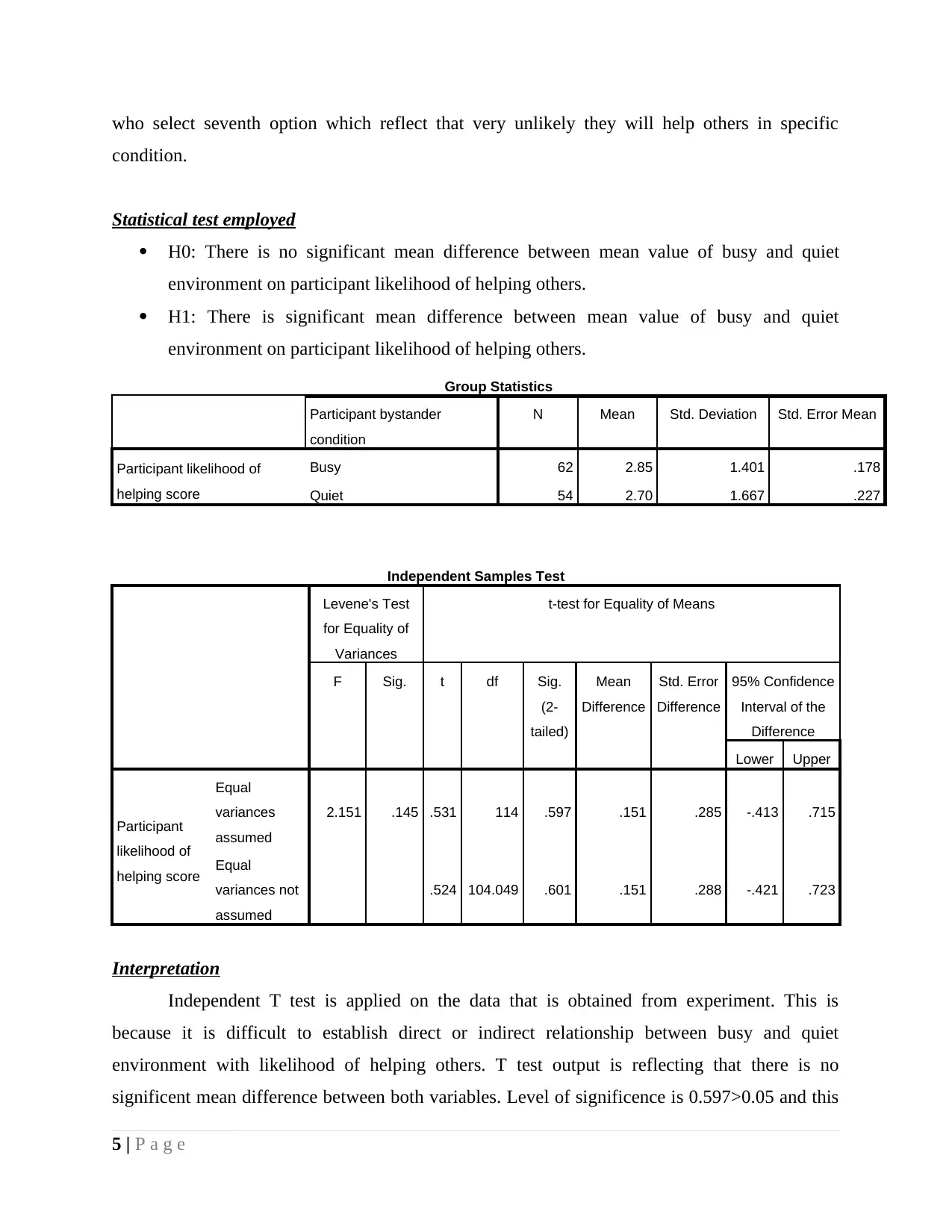
who select seventh option which reflect that very unlikely they will help others in specific
condition.
Statistical test employed
H0: There is no significant mean difference between mean value of busy and quiet
environment on participant likelihood of helping others.
H1: There is significant mean difference between mean value of busy and quiet
environment on participant likelihood of helping others.
Group Statistics
Participant bystander
condition
N Mean Std. Deviation Std. Error Mean
Participant likelihood of
helping score
Busy 62 2.85 1.401 .178
Quiet 54 2.70 1.667 .227
Independent Samples Test
Levene's Test
for Equality of
Variances
t-test for Equality of Means
F Sig. t df Sig.
(2-
tailed)
Mean
Difference
Std. Error
Difference
95% Confidence
Interval of the
Difference
Lower Upper
Participant
likelihood of
helping score
Equal
variances
assumed
2.151 .145 .531 114 .597 .151 .285 -.413 .715
Equal
variances not
assumed
.524 104.049 .601 .151 .288 -.421 .723
Interpretation
Independent T test is applied on the data that is obtained from experiment. This is
because it is difficult to establish direct or indirect relationship between busy and quiet
environment with likelihood of helping others. T test output is reflecting that there is no
significent mean difference between both variables. Level of significence is 0.597>0.05 and this
5 | P a g e
condition.
Statistical test employed
H0: There is no significant mean difference between mean value of busy and quiet
environment on participant likelihood of helping others.
H1: There is significant mean difference between mean value of busy and quiet
environment on participant likelihood of helping others.
Group Statistics
Participant bystander
condition
N Mean Std. Deviation Std. Error Mean
Participant likelihood of
helping score
Busy 62 2.85 1.401 .178
Quiet 54 2.70 1.667 .227
Independent Samples Test
Levene's Test
for Equality of
Variances
t-test for Equality of Means
F Sig. t df Sig.
(2-
tailed)
Mean
Difference
Std. Error
Difference
95% Confidence
Interval of the
Difference
Lower Upper
Participant
likelihood of
helping score
Equal
variances
assumed
2.151 .145 .531 114 .597 .151 .285 -.413 .715
Equal
variances not
assumed
.524 104.049 .601 .151 .288 -.421 .723
Interpretation
Independent T test is applied on the data that is obtained from experiment. This is
because it is difficult to establish direct or indirect relationship between busy and quiet
environment with likelihood of helping others. T test output is reflecting that there is no
significent mean difference between both variables. Level of significence is 0.597>0.05 and this
5 | P a g e
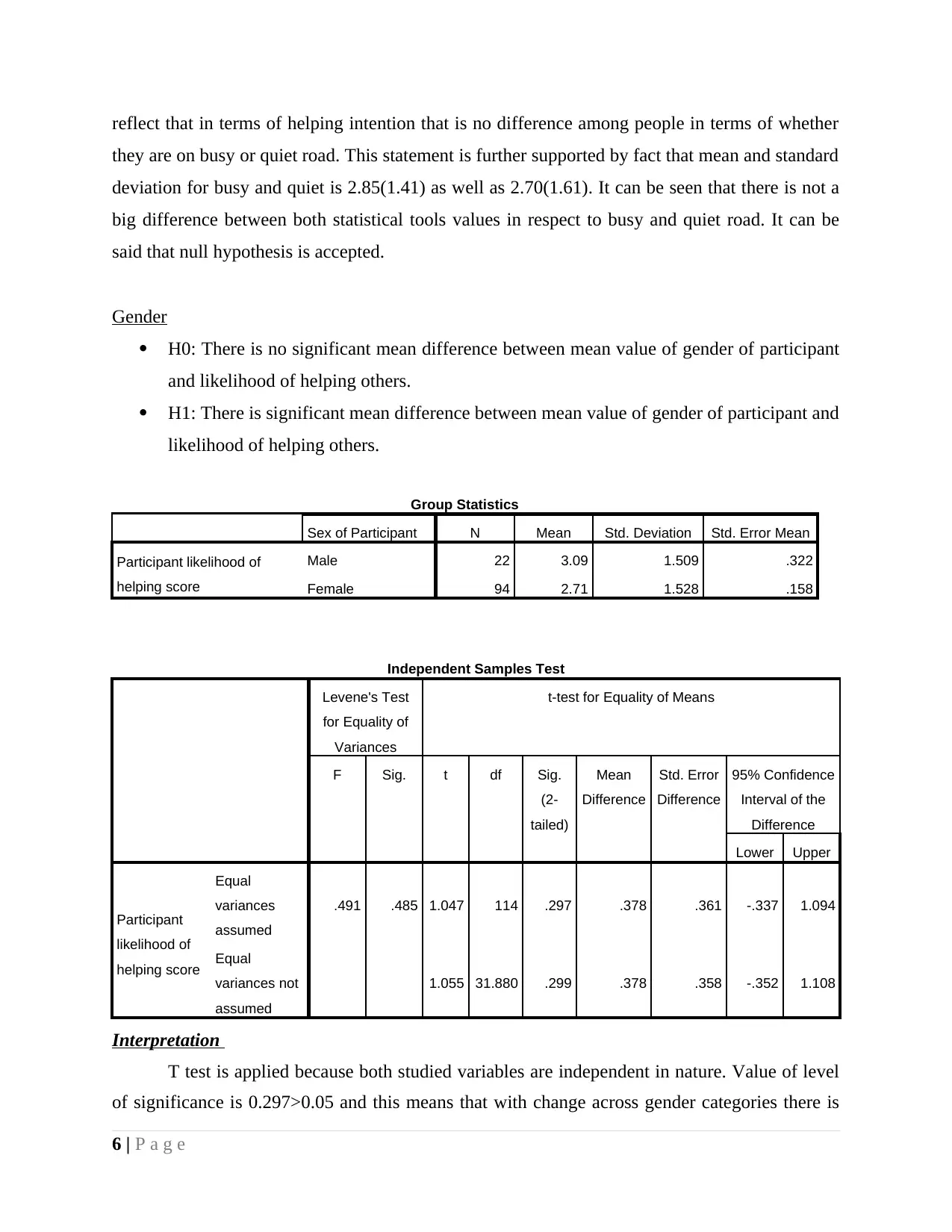
reflect that in terms of helping intention that is no difference among people in terms of whether
they are on busy or quiet road. This statement is further supported by fact that mean and standard
deviation for busy and quiet is 2.85(1.41) as well as 2.70(1.61). It can be seen that there is not a
big difference between both statistical tools values in respect to busy and quiet road. It can be
said that null hypothesis is accepted.
Gender
H0: There is no significant mean difference between mean value of gender of participant
and likelihood of helping others.
H1: There is significant mean difference between mean value of gender of participant and
likelihood of helping others.
Group Statistics
Sex of Participant N Mean Std. Deviation Std. Error Mean
Participant likelihood of
helping score
Male 22 3.09 1.509 .322
Female 94 2.71 1.528 .158
Independent Samples Test
Levene's Test
for Equality of
Variances
t-test for Equality of Means
F Sig. t df Sig.
(2-
tailed)
Mean
Difference
Std. Error
Difference
95% Confidence
Interval of the
Difference
Lower Upper
Participant
likelihood of
helping score
Equal
variances
assumed
.491 .485 1.047 114 .297 .378 .361 -.337 1.094
Equal
variances not
assumed
1.055 31.880 .299 .378 .358 -.352 1.108
Interpretation
T test is applied because both studied variables are independent in nature. Value of level
of significance is 0.297>0.05 and this means that with change across gender categories there is
6 | P a g e
they are on busy or quiet road. This statement is further supported by fact that mean and standard
deviation for busy and quiet is 2.85(1.41) as well as 2.70(1.61). It can be seen that there is not a
big difference between both statistical tools values in respect to busy and quiet road. It can be
said that null hypothesis is accepted.
Gender
H0: There is no significant mean difference between mean value of gender of participant
and likelihood of helping others.
H1: There is significant mean difference between mean value of gender of participant and
likelihood of helping others.
Group Statistics
Sex of Participant N Mean Std. Deviation Std. Error Mean
Participant likelihood of
helping score
Male 22 3.09 1.509 .322
Female 94 2.71 1.528 .158
Independent Samples Test
Levene's Test
for Equality of
Variances
t-test for Equality of Means
F Sig. t df Sig.
(2-
tailed)
Mean
Difference
Std. Error
Difference
95% Confidence
Interval of the
Difference
Lower Upper
Participant
likelihood of
helping score
Equal
variances
assumed
.491 .485 1.047 114 .297 .378 .361 -.337 1.094
Equal
variances not
assumed
1.055 31.880 .299 .378 .358 -.352 1.108
Interpretation
T test is applied because both studied variables are independent in nature. Value of level
of significance is 0.297>0.05 and this means that with change across gender categories there is
6 | P a g e
⊘ This is a preview!⊘
Do you want full access?
Subscribe today to unlock all pages.
Trusted by 1+ million students worldwide
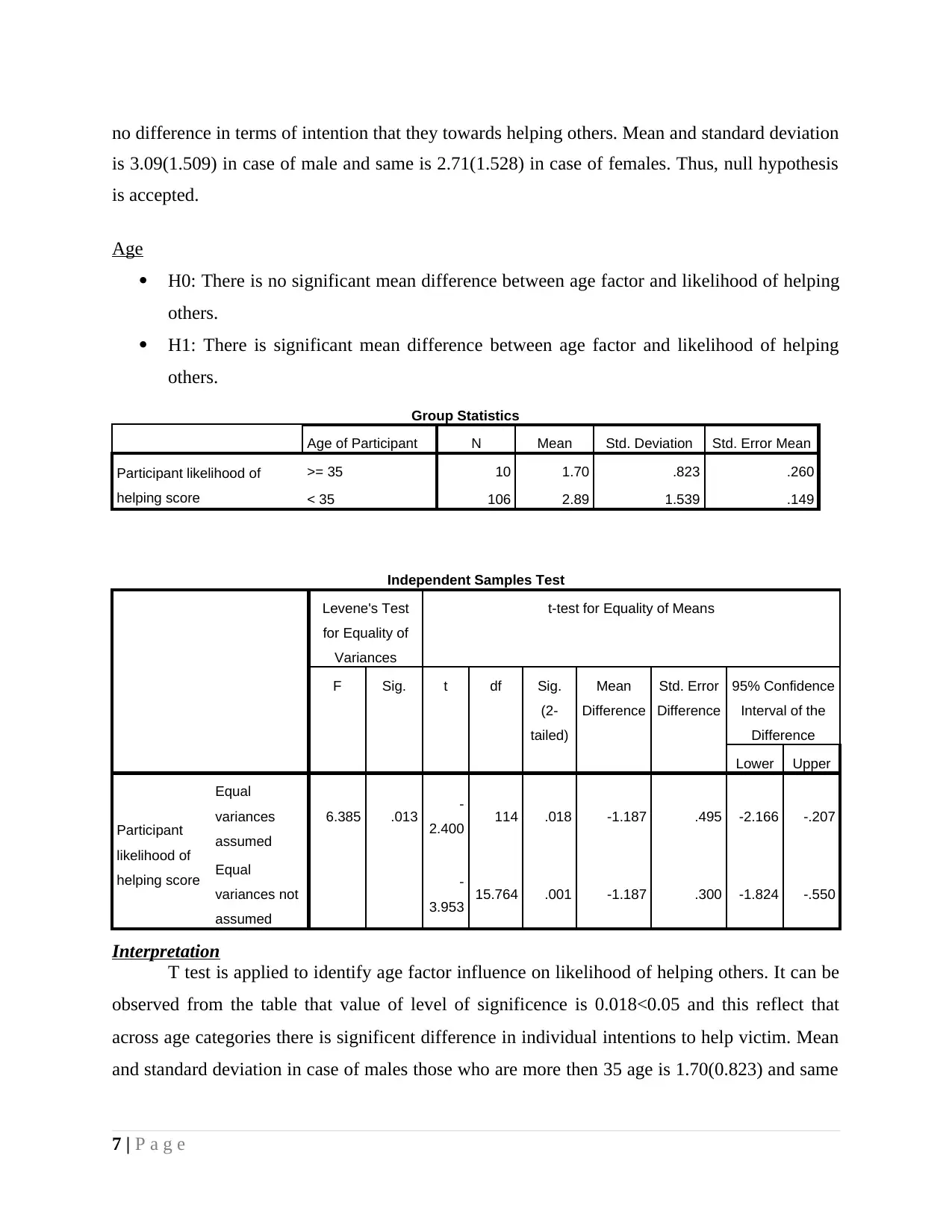
no difference in terms of intention that they towards helping others. Mean and standard deviation
is 3.09(1.509) in case of male and same is 2.71(1.528) in case of females. Thus, null hypothesis
is accepted.
Age
H0: There is no significant mean difference between age factor and likelihood of helping
others.
H1: There is significant mean difference between age factor and likelihood of helping
others.
Group Statistics
Age of Participant N Mean Std. Deviation Std. Error Mean
Participant likelihood of
helping score
>= 35 10 1.70 .823 .260
< 35 106 2.89 1.539 .149
Independent Samples Test
Levene's Test
for Equality of
Variances
t-test for Equality of Means
F Sig. t df Sig.
(2-
tailed)
Mean
Difference
Std. Error
Difference
95% Confidence
Interval of the
Difference
Lower Upper
Participant
likelihood of
helping score
Equal
variances
assumed
6.385 .013 -
2.400 114 .018 -1.187 .495 -2.166 -.207
Equal
variances not
assumed
-
3.953 15.764 .001 -1.187 .300 -1.824 -.550
Interpretation
T test is applied to identify age factor influence on likelihood of helping others. It can be
observed from the table that value of level of significence is 0.018<0.05 and this reflect that
across age categories there is significent difference in individual intentions to help victim. Mean
and standard deviation in case of males those who are more then 35 age is 1.70(0.823) and same
7 | P a g e
is 3.09(1.509) in case of male and same is 2.71(1.528) in case of females. Thus, null hypothesis
is accepted.
Age
H0: There is no significant mean difference between age factor and likelihood of helping
others.
H1: There is significant mean difference between age factor and likelihood of helping
others.
Group Statistics
Age of Participant N Mean Std. Deviation Std. Error Mean
Participant likelihood of
helping score
>= 35 10 1.70 .823 .260
< 35 106 2.89 1.539 .149
Independent Samples Test
Levene's Test
for Equality of
Variances
t-test for Equality of Means
F Sig. t df Sig.
(2-
tailed)
Mean
Difference
Std. Error
Difference
95% Confidence
Interval of the
Difference
Lower Upper
Participant
likelihood of
helping score
Equal
variances
assumed
6.385 .013 -
2.400 114 .018 -1.187 .495 -2.166 -.207
Equal
variances not
assumed
-
3.953 15.764 .001 -1.187 .300 -1.824 -.550
Interpretation
T test is applied to identify age factor influence on likelihood of helping others. It can be
observed from the table that value of level of significence is 0.018<0.05 and this reflect that
across age categories there is significent difference in individual intentions to help victim. Mean
and standard deviation in case of males those who are more then 35 age is 1.70(0.823) and same
7 | P a g e
Paraphrase This Document
Need a fresh take? Get an instant paraphrase of this document with our AI Paraphraser
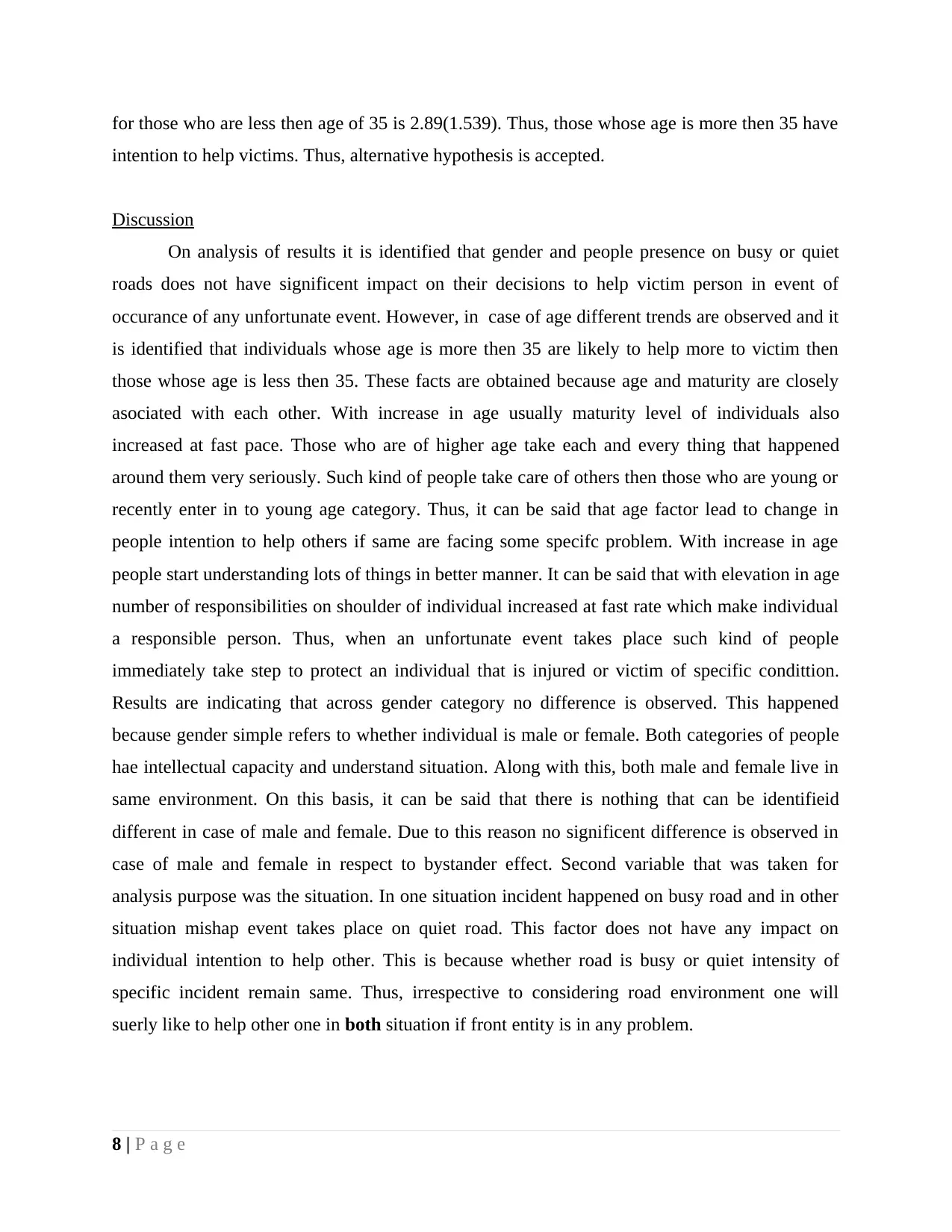
for those who are less then age of 35 is 2.89(1.539). Thus, those whose age is more then 35 have
intention to help victims. Thus, alternative hypothesis is accepted.
Discussion
On analysis of results it is identified that gender and people presence on busy or quiet
roads does not have significent impact on their decisions to help victim person in event of
occurance of any unfortunate event. However, in case of age different trends are observed and it
is identified that individuals whose age is more then 35 are likely to help more to victim then
those whose age is less then 35. These facts are obtained because age and maturity are closely
asociated with each other. With increase in age usually maturity level of individuals also
increased at fast pace. Those who are of higher age take each and every thing that happened
around them very seriously. Such kind of people take care of others then those who are young or
recently enter in to young age category. Thus, it can be said that age factor lead to change in
people intention to help others if same are facing some specifc problem. With increase in age
people start understanding lots of things in better manner. It can be said that with elevation in age
number of responsibilities on shoulder of individual increased at fast rate which make individual
a responsible person. Thus, when an unfortunate event takes place such kind of people
immediately take step to protect an individual that is injured or victim of specific condittion.
Results are indicating that across gender category no difference is observed. This happened
because gender simple refers to whether individual is male or female. Both categories of people
hae intellectual capacity and understand situation. Along with this, both male and female live in
same environment. On this basis, it can be said that there is nothing that can be identifieid
different in case of male and female. Due to this reason no significent difference is observed in
case of male and female in respect to bystander effect. Second variable that was taken for
analysis purpose was the situation. In one situation incident happened on busy road and in other
situation mishap event takes place on quiet road. This factor does not have any impact on
individual intention to help other. This is because whether road is busy or quiet intensity of
specific incident remain same. Thus, irrespective to considering road environment one will
suerly like to help other one in both situation if front entity is in any problem.
8 | P a g e
intention to help victims. Thus, alternative hypothesis is accepted.
Discussion
On analysis of results it is identified that gender and people presence on busy or quiet
roads does not have significent impact on their decisions to help victim person in event of
occurance of any unfortunate event. However, in case of age different trends are observed and it
is identified that individuals whose age is more then 35 are likely to help more to victim then
those whose age is less then 35. These facts are obtained because age and maturity are closely
asociated with each other. With increase in age usually maturity level of individuals also
increased at fast pace. Those who are of higher age take each and every thing that happened
around them very seriously. Such kind of people take care of others then those who are young or
recently enter in to young age category. Thus, it can be said that age factor lead to change in
people intention to help others if same are facing some specifc problem. With increase in age
people start understanding lots of things in better manner. It can be said that with elevation in age
number of responsibilities on shoulder of individual increased at fast rate which make individual
a responsible person. Thus, when an unfortunate event takes place such kind of people
immediately take step to protect an individual that is injured or victim of specific condittion.
Results are indicating that across gender category no difference is observed. This happened
because gender simple refers to whether individual is male or female. Both categories of people
hae intellectual capacity and understand situation. Along with this, both male and female live in
same environment. On this basis, it can be said that there is nothing that can be identifieid
different in case of male and female. Due to this reason no significent difference is observed in
case of male and female in respect to bystander effect. Second variable that was taken for
analysis purpose was the situation. In one situation incident happened on busy road and in other
situation mishap event takes place on quiet road. This factor does not have any impact on
individual intention to help other. This is because whether road is busy or quiet intensity of
specific incident remain same. Thus, irrespective to considering road environment one will
suerly like to help other one in both situation if front entity is in any problem.
8 | P a g e
CONCLUSION
On the basis of above discussion it is concluded that there is significent impact of age
factor on individual decisions to help aggrived entity. Apart from this, gender and other factors
like road environment in terms of busy or quiet does not lead to any difference among people in
terms of likelihood of helping others. It can be said that if awareness level will be increased
among those who comes in age group less then 35 likelihood of not helping victims can be
reduced to great extent.
9 | P a g e
On the basis of above discussion it is concluded that there is significent impact of age
factor on individual decisions to help aggrived entity. Apart from this, gender and other factors
like road environment in terms of busy or quiet does not lead to any difference among people in
terms of likelihood of helping others. It can be said that if awareness level will be increased
among those who comes in age group less then 35 likelihood of not helping victims can be
reduced to great extent.
9 | P a g e
⊘ This is a preview!⊘
Do you want full access?
Subscribe today to unlock all pages.
Trusted by 1+ million students worldwide

1 out of 13


Related Documents


Your All-in-One AI-Powered Toolkit for Academic Success.
+13062052269
info@desklib.com
Available 24*7 on WhatsApp / Email
![[object Object]](/_next/static/media/star-bottom.7253800d.svg)
Unlock your academic potential
Copyright © 2020–2025 A2Z Services. All Rights Reserved. Developed and managed by ZUCOL.