Comprehensive Report: Tax Cuts and Jobs Act of 2017 Analysis

Verified

Added on  2022/11/11

|6
|926
|165
Report
AI Summary
This report provides an analysis of the Tax Cuts and Jobs Act of 2017, examining its impact on various aspects of the US tax system. It begins with an introduction to the Act, highlighting changes to tax rates and the tax base. The report then delves into the effects of doubling the standard deduction, the changes to child tax credits, and the impact on the Affordable Care Act. It also explores the reasons for public frustration during tax filing, as well as the objectives of the Act, such as promoting economic efficiency and limiting profit shifting. The report references several sources to support its findings, providing a comprehensive overview of the Act's implications.
Document Page
Running head: PUBLIC AND NON PROFIT BUDGETING
1
Tax cuts and jobs Act
Name of the student
Name of the university
Author’s note
tabler-icon-diamond-filled.svg

Paraphrase This Document

Need a fresh take? Get an instant paraphrase of this document with our AI Paraphraser
Document Page
Public and nonprofit budgeting 2
Introduction
The tax cuts and jobs act is a new law that was introduced to change the tax rates and the
tax base of a person’s taxable income. The Tax Cuts and Jobs Act of 2017 is an amendment of
the Internal Revenue Code (IRC) of 1986. It introduced new changes and provisions such as the
standard deductions, child credit and personal exemption on the income taxes. This new law
introduced increases in the standard deductions from about $6,500 to $12,000 for the individual
tax return filers. The joint standards of $13,000also increased from those of the previous tax
policy which required about $24,000 and so many other changes exist in household tax expenses
(York and Muresianu, 2018).
Effects of doubling the standard
The 2017 changes in the tax law reflect ma significant change for over the last thirty
years. With a lot of alterations in the IRC law of 1986, the effects and consequences are highly
dynamic and assertive. For example the 2017 tax law eliminated exemptions from gross income
deductions, the retired individuals on the other hand had very little or minimal impacts felt from
the new tax policy. These retired people especially the tax payers did not feel significant change
as a result of the new policy. Child tax credits consequently increased to about $2,000 and yet
the refundable amount would not necessarily exceed $ 1,400. The business market tax liabilities
would reduce significantly through the changes coming from starting from the business tax rates
and the tax base as a general.
Tax policy effect on the affordable care act
The important point is that the new tax law of 2017 did not fully repeal the Affordable
Care Act. Since only individual mandate is what was scrapped, a person still had the liberty to
Document Page
Public and nonprofit budgeting 3
either obtain insurance or even choose not to. Besides this single change in the law, all the other
provisions of the Act still remained active and in operation. Among these Acts includes the duty
for all organizations employing more than 50 full time workers to pay and file for health care.
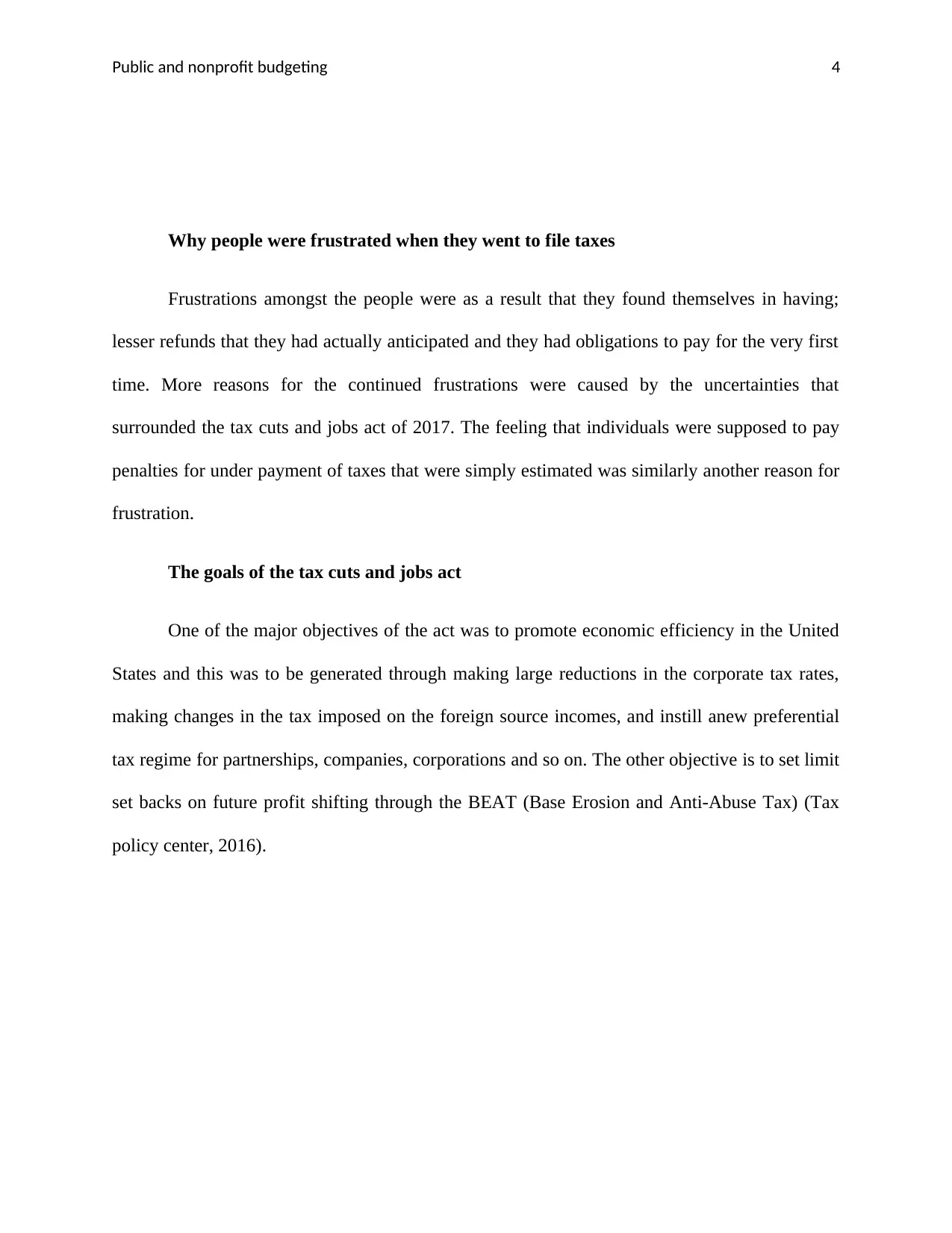
For example in the new tax policy a single filer earning an income that lies in a $0 to $9,525
would be subject to 10% tax liability (Elkins, 2019). This means that if a single person earns an
gross income of $ 6,000, the such a person would have to file back a tax amount equal to $600
obtained as ( 10
100* 6,000. According to (Pickering, 2017), in the new tax policy exemptions
were scrapped. This therefore removed the $4,050 deduction that all qualifying individuals were
entitled to on all taxable incomes. However, (Landes,2019) shows that a $12,000 for 2018 will
be available for single tax payers and this is much higher than the $6,350 which was given to the
dingle tax filers in 2017. Below is an illustration of the tax brackets for the single filers:
Fig.1 single filers’ tax brackets
Source: Elkins, 2019.
Document Page
Public and nonprofit budgeting 4
Why people were frustrated when they went to file taxes
Frustrations amongst the people were as a result that they found themselves in having;
lesser refunds that they had actually anticipated and they had obligations to pay for the very first
time. More reasons for the continued frustrations were caused by the uncertainties that
surrounded the tax cuts and jobs act of 2017. The feeling that individuals were supposed to pay
penalties for under payment of taxes that were simply estimated was similarly another reason for
frustration.
The goals of the tax cuts and jobs act
One of the major objectives of the act was to promote economic efficiency in the United
States and this was to be generated through making large reductions in the corporate tax rates,
making changes in the tax imposed on the foreign source incomes, and instill anew preferential
tax regime for partnerships, companies, corporations and so on. The other objective is to set limit
set backs on future profit shifting through the BEAT (Base Erosion and Anti-Abuse Tax) (Tax
policy center, 2016).
tabler-icon-diamond-filled.svg

Paraphrase This Document

Need a fresh take? Get an instant paraphrase of this document with our AI Paraphraser
Document Page
Public and nonprofit budgeting 5
References
Tax Policy Center, (2016). The Tax Policy Center’s Briefing Book: A Citizens Guide to the
Fascinating (Though Often Complex) Elements of the US Tax System. Retrieved from
https://www.taxpolicycenter.org/briefing-book/what-tcja-base-erosion-and-anti-abuse-
tax-and-how-does-it-work
York, E., Muresianu, A. (2018). The Tax Cuts And Jobs Act Simplified The Filing Process For
Millions Of Households. Retrieved from https://taxfoundation.org/the-tax-cuts-and-jobs-
act-simplified-the-tax-filing-process-for-millions-of-americans/
Elkins, K. (2019). About Half of AmericansDon’t Know What Tax Bracket They’re now In-
Here’s How to Find Out. Retrieved from https://www.cnbc.com/2019/02/07/how-to-find-
out-what-tax-bracket-youre-in-under-the-new-tax-law.html
Pickering, k. (2017). How the tax cuts and jobs Act impact U.S Tax Returns. Retrieved from
https://www.hrblock.com/tax-center/irs/tax-reform/tax-cuts-and-jobs-act/
Landes,L. 2019. 2018 IRS Standard Deductions and Exemptions. Retrieved from
https://www.consumerismcommentary.com/standard-deductions-exemptions-federal-
income-tax/
Document Page
Public and nonprofit budgeting 6
chevron_up_icon
1 out of 6
circle_padding
hide_on_mobile
zoom_out_icon
[object Object]