Marketing Research: Pulse Climbing Customer Analysis & Recommendations
VerifiedAdded on 2023/06/11
|39
|6491
|368
Report
AI Summary
This report presents a marketing research analysis of Pulse Climbing, focusing on customer demographics, psychographics, satisfaction levels, and preferred climbing styles. The analysis utilizes various statistical tests, including frequencies, t-tests, chi-square tests, Cronbach's alpha, Mann-Whitney U test, ANOVA, regression modeling, and correlational analysis, to address key research questions related to customer preferences, climbing experience, and the effectiveness of Pulse Climbing's positioning strategy. The findings indicate a need for improved customer satisfaction and a refined positioning strategy to maintain competitiveness. Recommendations are provided based on the data analysis, focusing on enhancing service quality, tailoring climbing experiences to customer preferences, and optimizing marketing efforts to attract and retain customers. Desklib offers similar solved assignments and past papers for students.
Marketing research

Paraphrase This Document
Need a fresh take? Get an instant paraphrase of this document with our AI Paraphraser
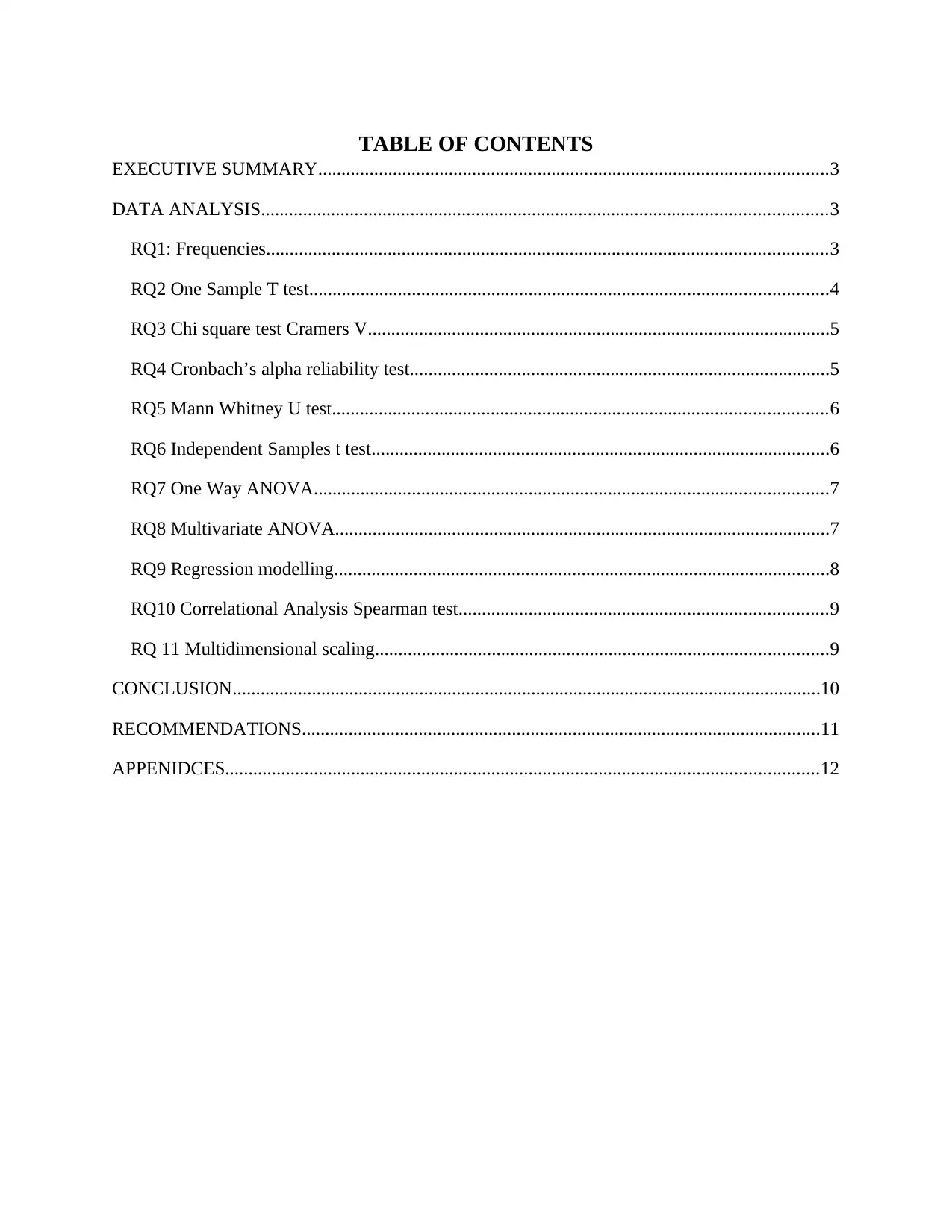
TABLE OF CONTENTS
EXECUTIVE SUMMARY.............................................................................................................3
DATA ANALYSIS.........................................................................................................................3
RQ1: Frequencies........................................................................................................................3
RQ2 One Sample T test...............................................................................................................4
RQ3 Chi square test Cramers V...................................................................................................5
RQ4 Cronbach’s alpha reliability test..........................................................................................5
RQ5 Mann Whitney U test..........................................................................................................6
RQ6 Independent Samples t test..................................................................................................6
RQ7 One Way ANOVA..............................................................................................................7
RQ8 Multivariate ANOVA..........................................................................................................7
RQ9 Regression modelling..........................................................................................................8
RQ10 Correlational Analysis Spearman test...............................................................................9
RQ 11 Multidimensional scaling.................................................................................................9
CONCLUSION..............................................................................................................................10
RECOMMENDATIONS...............................................................................................................11
APPENIDCES...............................................................................................................................12
EXECUTIVE SUMMARY.............................................................................................................3
DATA ANALYSIS.........................................................................................................................3
RQ1: Frequencies........................................................................................................................3
RQ2 One Sample T test...............................................................................................................4
RQ3 Chi square test Cramers V...................................................................................................5
RQ4 Cronbach’s alpha reliability test..........................................................................................5
RQ5 Mann Whitney U test..........................................................................................................6
RQ6 Independent Samples t test..................................................................................................6
RQ7 One Way ANOVA..............................................................................................................7
RQ8 Multivariate ANOVA..........................................................................................................7
RQ9 Regression modelling..........................................................................................................8
RQ10 Correlational Analysis Spearman test...............................................................................9
RQ 11 Multidimensional scaling.................................................................................................9
CONCLUSION..............................................................................................................................10
RECOMMENDATIONS...............................................................................................................11
APPENIDCES...............................................................................................................................12
EXECUTIVE SUMMARY
The study is based upon the Pulse Climbing that provide all levels of climbing, from
beginners starting out to high class training facility. The company faces a management decision
problem related to adapt the positioning strategy for remaining competitive adventure and rock
climbing facility. The results reveals that the customer satisfaction level is neutral and that is
why, company has to hire quality team in order to remain competitive. Whereas there is a need to
provide an alternative positioning strategy that helps the company to improve the overall
performance. The demographic profile of Pulse Climbing customers reflected that they have
average number of years and that is why, there is a need to provide proper trained staff that helps
to improve the performance of the company.
DATA ANALYSIS
RQ1: Frequencies
In order to collect the information pertaining to demographic and psychographic profile
of Pulse Climbing Customer, frequency as a statistical data is used that helps to understand
which option occur more and less often in a dataset.
As per the appendix 1.1, it has been identified that majority of the selected respondents
are moderately satisfied with the Pulse Climbing facility such that out of 402, 68 respondents are
moderate satisfied whereas 64 of them do not state anything (nil). However, 43 of them are
satisfied with the facility and 53 of them are not satisfied. Further, according to appendix 1.2, it
has been analysed that 27% of the selected respondents are stated that 15 meters is the preferred
height for climbing whereas 15% of them stated that 20 meter is the preferred height. On the
other side, 10% of them stated that 10 meter is the preferred climbing height for the respondents.
Through appendix 1.3, it has been analysed that 42.3% of the respondents prefer lead climbing
style and 29.1% of them stated that Top roping style is preferred style by them. In accordance
with the appendix 1.4, it is to be interpreted that out of 402, 259 prefer indoor rock climb and
143 of them preferred outdoor rock climb.
The study is based upon the Pulse Climbing that provide all levels of climbing, from
beginners starting out to high class training facility. The company faces a management decision
problem related to adapt the positioning strategy for remaining competitive adventure and rock
climbing facility. The results reveals that the customer satisfaction level is neutral and that is
why, company has to hire quality team in order to remain competitive. Whereas there is a need to
provide an alternative positioning strategy that helps the company to improve the overall
performance. The demographic profile of Pulse Climbing customers reflected that they have
average number of years and that is why, there is a need to provide proper trained staff that helps
to improve the performance of the company.
DATA ANALYSIS
RQ1: Frequencies
In order to collect the information pertaining to demographic and psychographic profile
of Pulse Climbing Customer, frequency as a statistical data is used that helps to understand
which option occur more and less often in a dataset.
As per the appendix 1.1, it has been identified that majority of the selected respondents
are moderately satisfied with the Pulse Climbing facility such that out of 402, 68 respondents are
moderate satisfied whereas 64 of them do not state anything (nil). However, 43 of them are
satisfied with the facility and 53 of them are not satisfied. Further, according to appendix 1.2, it
has been analysed that 27% of the selected respondents are stated that 15 meters is the preferred
height for climbing whereas 15% of them stated that 20 meter is the preferred height. On the
other side, 10% of them stated that 10 meter is the preferred climbing height for the respondents.
Through appendix 1.3, it has been analysed that 42.3% of the respondents prefer lead climbing
style and 29.1% of them stated that Top roping style is preferred style by them. In accordance
with the appendix 1.4, it is to be interpreted that out of 402, 259 prefer indoor rock climb and
143 of them preferred outdoor rock climb.
⊘ This is a preview!⊘
Do you want full access?
Subscribe today to unlock all pages.

Trusted by 1+ million students worldwide
Further, in accordance with the appendix 1.5, it is has been identified that 37.1% of the
selected participants have 2 to 3 year experience and 25% of the selected respondents have more
than 3 year experience. Moreover, appendix 1.6 stated that 45.8% participants attend 2 to 3 times
gym a week and 32.3% of them attend 3-5 times in a week. With the frequency table of 1.6, it
has been interpreted that 42.5% of the selected participants are very fit and only 3.5% of them
stated that they are not fit at all. From the appendix 1.7, it has been identified majority of the
selected respondents are 26 years old and 35 respondents stated that they are 22 year old. In
addition to this, 51% of the selected participants are female (appendix 1.8) and 43.3% of them
are male whereas 5% of them do not prefer to state anything. Appendix 1.9 stated that most of
the selected respondents earn $1000 to $1499 per week and 28% of them earn $1500 to $1999
per week.
Through the information collected through survey, it has been analysed that management
of Pulse Climbing get accurate information because the selected respondents provide valid
answer as they are experienced and good earner that helps to provide solution regarding the
stated problem.
RQ2 One Sample T test
H0: There is no significant difference between customer’s average preferred climbing height to
maximum vertical height.
H1: There is a significant difference between customer’s average preferred climbing height to
maximum vertical height.
In order to determine whether an unknown population mean is differ from a specific value i.e. 15
meter, one sample T test is used.
As per the appendix 2, the test reflected that alternative hypothesis is accepted because
the value of p=0.00 which is lower than 0.05 and that is why, customers’ average preferred
climbing height is differ from Pulse Climbing maximum height.
Thus, for management of Pulse Climbing, it is to be interpreted from the analysis
revealed that customer prefer climbing height is 15 meter and that is why, the company should
not design any rope beyond the defined meter.
selected participants have 2 to 3 year experience and 25% of the selected respondents have more
than 3 year experience. Moreover, appendix 1.6 stated that 45.8% participants attend 2 to 3 times
gym a week and 32.3% of them attend 3-5 times in a week. With the frequency table of 1.6, it
has been interpreted that 42.5% of the selected participants are very fit and only 3.5% of them
stated that they are not fit at all. From the appendix 1.7, it has been identified majority of the
selected respondents are 26 years old and 35 respondents stated that they are 22 year old. In
addition to this, 51% of the selected participants are female (appendix 1.8) and 43.3% of them
are male whereas 5% of them do not prefer to state anything. Appendix 1.9 stated that most of
the selected respondents earn $1000 to $1499 per week and 28% of them earn $1500 to $1999
per week.
Through the information collected through survey, it has been analysed that management
of Pulse Climbing get accurate information because the selected respondents provide valid
answer as they are experienced and good earner that helps to provide solution regarding the
stated problem.
RQ2 One Sample T test
H0: There is no significant difference between customer’s average preferred climbing height to
maximum vertical height.
H1: There is a significant difference between customer’s average preferred climbing height to
maximum vertical height.
In order to determine whether an unknown population mean is differ from a specific value i.e. 15
meter, one sample T test is used.
As per the appendix 2, the test reflected that alternative hypothesis is accepted because
the value of p=0.00 which is lower than 0.05 and that is why, customers’ average preferred
climbing height is differ from Pulse Climbing maximum height.
Thus, for management of Pulse Climbing, it is to be interpreted from the analysis
revealed that customer prefer climbing height is 15 meter and that is why, the company should
not design any rope beyond the defined meter.
Paraphrase This Document
Need a fresh take? Get an instant paraphrase of this document with our AI Paraphraser
RQ3 Chi square test Cramers V
In order to determine relationship between different climbing style and year of experience
in climbing, chi-square test is used because of having categorical data that determine the
relationship between variable.
In accordance with the appendix 3 under crosstabulation, it has been identified that 33
respondents have less than 1-year top roping and 47 of them have between 1 to 2 years whereas
31 of them have only 2 to 3 years. On the other side, under lead climbing, 18 respondents out of
170 have less than 1-year experience whereas 29 of them have between 1 to 2 year, but majority
(70) of them have 2 to 3 years while 53 of them more than 3 years. Under Bouldering, 71 out of
6 of them have less than 1 year experience, 41 of them have 2 to 3 years and only 6 of them
greater than 3 years. In the case of rapelling only 37 of them have more than 3 year experience
and 7 of them have between 2 to 3 years. Through Chi-square test, it has been identified that
there is a strong association between preferred climbing style and years of climbing experience
due to value of P = 0.00 < 0.05 which in turn shows acceptance of alternative hypothesis.
The analysis is helpful for management of Pulse Climbing because having a good
experience customer who getting enough training from the company in order to increase their
experience of climbing. That is why, it will be beneficial for the company to provide safety tips
to the customers, as they have enough experience of different types of climbing.
RQ4 Cronbach’s alpha reliability test
To provide the reliability, Cronnbach’s Alpha reliability test is to be used which help to
reflect how closely related a set of items are as a group. That is why, it is considered to be a
measure of scale reliability.
Through the Appendix 4, it has been analysed that the selected data is 82% closely
associated and that is why, it provide appropriate answer.
This is beneficial for the management of Pulse Climbing because the internal consistency
of data set is closely associated and it will tell the experience of selected respondents so that the
market research problem can be solved by implementing effective steps.
In order to determine relationship between different climbing style and year of experience
in climbing, chi-square test is used because of having categorical data that determine the
relationship between variable.
In accordance with the appendix 3 under crosstabulation, it has been identified that 33
respondents have less than 1-year top roping and 47 of them have between 1 to 2 years whereas
31 of them have only 2 to 3 years. On the other side, under lead climbing, 18 respondents out of
170 have less than 1-year experience whereas 29 of them have between 1 to 2 year, but majority
(70) of them have 2 to 3 years while 53 of them more than 3 years. Under Bouldering, 71 out of
6 of them have less than 1 year experience, 41 of them have 2 to 3 years and only 6 of them
greater than 3 years. In the case of rapelling only 37 of them have more than 3 year experience
and 7 of them have between 2 to 3 years. Through Chi-square test, it has been identified that
there is a strong association between preferred climbing style and years of climbing experience
due to value of P = 0.00 < 0.05 which in turn shows acceptance of alternative hypothesis.
The analysis is helpful for management of Pulse Climbing because having a good
experience customer who getting enough training from the company in order to increase their
experience of climbing. That is why, it will be beneficial for the company to provide safety tips
to the customers, as they have enough experience of different types of climbing.
RQ4 Cronbach’s alpha reliability test
To provide the reliability, Cronnbach’s Alpha reliability test is to be used which help to
reflect how closely related a set of items are as a group. That is why, it is considered to be a
measure of scale reliability.
Through the Appendix 4, it has been analysed that the selected data is 82% closely
associated and that is why, it provide appropriate answer.
This is beneficial for the management of Pulse Climbing because the internal consistency
of data set is closely associated and it will tell the experience of selected respondents so that the
market research problem can be solved by implementing effective steps.
RQ5 Mann Whitney U test
Mann Whitney U test is used in order to compare that there is a difference within a dependent
variable for two independent groups. That is why, in order to determine the customer views, it is
suitable because it help to determine the dependency.
As per the appendix 5, it has been identified that only facility has a days trip to outdoor
climbing areas is significantly true because the value is also lower than 0.05. However, in all the
other case, there is no significant difference proved. Thus, there is a need to make effective steps
in order to determine the criteria of customers.
This results are beneficial for the management of Pulse Climbing because this assist to
determine that in order to remain competitive there is a need to improve the results and consider
the criteria of customers. This in turn assist to make decision effectively and answer the
marketing question as well.
RQ6 Independent Samples t test
H0: There is no mean difference between the likelihood of revisiting Pulse Climbing and
customer preference.
H1: There is a mean difference between the likelihood of revisiting Pulse Climbing and customer
preference.
Independent Sample T Test is used in order to compare the means of two independent group i.e.
likelihood of revisiting Pulse Climbing and customer preference that assist to determine the
association between the groups.
From the table (Appendix 6), it has been analysed that null hypothesis is rejected because
the significant difference is 0.00 which is lower than standard criteria. This in turn reflected that
there is a means difference between both independent groups and that is why, the customer
preference to rock climb is changes by the likelihood of revisiting Pulse climbing.
The data generated is beneficial for management of quoted company because this will
help to supply the equipment because customer preference is identified. This in turn help to
determine the steps taken so that company can answer the market question.
Mann Whitney U test is used in order to compare that there is a difference within a dependent
variable for two independent groups. That is why, in order to determine the customer views, it is
suitable because it help to determine the dependency.
As per the appendix 5, it has been identified that only facility has a days trip to outdoor
climbing areas is significantly true because the value is also lower than 0.05. However, in all the
other case, there is no significant difference proved. Thus, there is a need to make effective steps
in order to determine the criteria of customers.
This results are beneficial for the management of Pulse Climbing because this assist to
determine that in order to remain competitive there is a need to improve the results and consider
the criteria of customers. This in turn assist to make decision effectively and answer the
marketing question as well.
RQ6 Independent Samples t test
H0: There is no mean difference between the likelihood of revisiting Pulse Climbing and
customer preference.
H1: There is a mean difference between the likelihood of revisiting Pulse Climbing and customer
preference.
Independent Sample T Test is used in order to compare the means of two independent group i.e.
likelihood of revisiting Pulse Climbing and customer preference that assist to determine the
association between the groups.
From the table (Appendix 6), it has been analysed that null hypothesis is rejected because
the significant difference is 0.00 which is lower than standard criteria. This in turn reflected that
there is a means difference between both independent groups and that is why, the customer
preference to rock climb is changes by the likelihood of revisiting Pulse climbing.
The data generated is beneficial for management of quoted company because this will
help to supply the equipment because customer preference is identified. This in turn help to
determine the steps taken so that company can answer the market question.
⊘ This is a preview!⊘
Do you want full access?
Subscribe today to unlock all pages.
Trusted by 1+ million students worldwide
RQ7 One Way ANOVA
The rationale for using One Way Anova is to determine the statistical difference between
the mean of two groups i.e. years of experience and satisfaction level of Pulse Climbing.
Null hypothesis: There is no statistical difference between the mean group of satisfaction level
and years of climbing experience.
Alternative hypothesis: There is a statistical difference between the mean group of satisfaction
level and years of climbing experience.
From the results generated under one way Anova (attached in appendix 7), it has been
interpreted that there is no difference between the group because (0.266 > 0.05). This in turn
shows that null hypothesis is accepted over other.
With the help of test, management of Pulse Climbing determine that if the customer have
years of climbing experience, then it does not have any relationship between satisfaction level of
Climbing experience. This in turn reflected that company need to offer the facility that helps to
lead satisfaction level.
RQ8 Multivariate ANOVA
Multivariate ANOVA is used in this because it helps to determine the dependency of
different independent variable over dependent. In this case, there are different independent
variable and that is why, this statistical tool is preferred over other.
H0: There is no difference identified between the customer preference and climbing experience
as well as preferred vertical height.
H1: There is a difference identified between the customer preference and climbing experience as
well as preferred vertical height.
As per the Box’s Test of Equality of Covariance Matrices (appendix 8), it has been
interpreted that alternative hypothesis is accepted because the value of significance difference is
The rationale for using One Way Anova is to determine the statistical difference between
the mean of two groups i.e. years of experience and satisfaction level of Pulse Climbing.
Null hypothesis: There is no statistical difference between the mean group of satisfaction level
and years of climbing experience.
Alternative hypothesis: There is a statistical difference between the mean group of satisfaction
level and years of climbing experience.
From the results generated under one way Anova (attached in appendix 7), it has been
interpreted that there is no difference between the group because (0.266 > 0.05). This in turn
shows that null hypothesis is accepted over other.
With the help of test, management of Pulse Climbing determine that if the customer have
years of climbing experience, then it does not have any relationship between satisfaction level of
Climbing experience. This in turn reflected that company need to offer the facility that helps to
lead satisfaction level.
RQ8 Multivariate ANOVA
Multivariate ANOVA is used in this because it helps to determine the dependency of
different independent variable over dependent. In this case, there are different independent
variable and that is why, this statistical tool is preferred over other.
H0: There is no difference identified between the customer preference and climbing experience
as well as preferred vertical height.
H1: There is a difference identified between the customer preference and climbing experience as
well as preferred vertical height.
As per the Box’s Test of Equality of Covariance Matrices (appendix 8), it has been
interpreted that alternative hypothesis is accepted because the value of significance difference is
Paraphrase This Document
Need a fresh take? Get an instant paraphrase of this document with our AI Paraphraser
0.00 < 0.05. Also, it can be stated that respondents experience and preferred vertical height is
varying from the climbing preference and that is why, there is a difference identified.
This information is beneficial for management of cited firm because it assists to
determine whether there is an interaction between the years of climbing experience and
preference for climbs so that company would design the equipment accordingly and supply the
same in order to increase the customer satisfaction level.
RQ9 Regression modelling
The regression analysis is used that helps to predict the value of dependent variable for
independent. This in turn assist to determine or estimate the effect of some explanatory variable
on dependent variable. That is why, to determine relationship between variable, regression is
used.
H0: There is no statistically relationship between the participant’s satisfaction with Pulse
Climbing and participants’ evaluation of their experience
H1: There is a statistically relationship between the participant’s satisfaction with Pulse Climbing
and participants’ evaluation of their experience
In accordance with the model summary (attached in appendix 9) it has been interpreted
that there is moderate association between the variable and only 24% change is identified when
the independent variable changes over dependent. Whereas, the Anova table clearly reflected that
there is a statistical relationship identified between the variable such that the value of p is 0.00
which I lower than 0.05 and that is why, alternative hypothesis is accepted over null.
The chosen information is beneficial for the management of Pulse Climbing such that
management can determine whether experience is beneficial for the company to determine the
satisfaction level. This help to make decision effectually and then improve the level of customer
satisfaction.
varying from the climbing preference and that is why, there is a difference identified.
This information is beneficial for management of cited firm because it assists to
determine whether there is an interaction between the years of climbing experience and
preference for climbs so that company would design the equipment accordingly and supply the
same in order to increase the customer satisfaction level.
RQ9 Regression modelling
The regression analysis is used that helps to predict the value of dependent variable for
independent. This in turn assist to determine or estimate the effect of some explanatory variable
on dependent variable. That is why, to determine relationship between variable, regression is
used.
H0: There is no statistically relationship between the participant’s satisfaction with Pulse
Climbing and participants’ evaluation of their experience
H1: There is a statistically relationship between the participant’s satisfaction with Pulse Climbing
and participants’ evaluation of their experience
In accordance with the model summary (attached in appendix 9) it has been interpreted
that there is moderate association between the variable and only 24% change is identified when
the independent variable changes over dependent. Whereas, the Anova table clearly reflected that
there is a statistical relationship identified between the variable such that the value of p is 0.00
which I lower than 0.05 and that is why, alternative hypothesis is accepted over null.
The chosen information is beneficial for the management of Pulse Climbing such that
management can determine whether experience is beneficial for the company to determine the
satisfaction level. This help to make decision effectually and then improve the level of customer
satisfaction.
RQ10 Correlational Analysis Spearman test
Correlation is used in order to determine the association between variables. With the help
of this, scholar is able to determine the strength of their association and this in turn assist to
determine the level of change in one variable due to other.
H0: There is no relationship between criteria used to choose an adventure and rock climbing
facility.
H1: There is a relationship between criteria used to choose an adventure and rock climbing
facility
With the help of the Appendix 10, it has been interpreted that there is negative lower
correlation between facility has all styles of climbing available with booking climbing time,
facility cater for all level of climbers, facility provides high quality of customer service and
experienced staff. On the other side, there is a lower negative relationship identified within easily
climbing booking with facility caters for all level of climbers and facility provide high quality of
customer service. Further, there is lower association between climbing book times and
experience staff because 0.024 is fall under the category of below 0.025. Moreover, facility
caters for all level of climber is also lower associated with high quality customer service whereas
facility supply is negatively associated with experienced staff. Moreover, it has been identified
that there is almost negative and lower association between the variables and that is why, it can
be stated that there is no changes identified between the variable when one of the independent
variable changes.
The results drawn from the correlation will be beneficial for the management of Pulse
Climbing because there is no association between the variable and that is why, company should
focused individually upon their facility so that effective outcome can be generated for the
welfare of the customers.
RQ 11 Multidimensional scaling
In order to determine the attribute of the company, Multidimensional scaling is used that
helps market researchers to produce invaluable perceptual map in order to make it useful in
Correlation is used in order to determine the association between variables. With the help
of this, scholar is able to determine the strength of their association and this in turn assist to
determine the level of change in one variable due to other.
H0: There is no relationship between criteria used to choose an adventure and rock climbing
facility.
H1: There is a relationship between criteria used to choose an adventure and rock climbing
facility
With the help of the Appendix 10, it has been interpreted that there is negative lower
correlation between facility has all styles of climbing available with booking climbing time,
facility cater for all level of climbers, facility provides high quality of customer service and
experienced staff. On the other side, there is a lower negative relationship identified within easily
climbing booking with facility caters for all level of climbers and facility provide high quality of
customer service. Further, there is lower association between climbing book times and
experience staff because 0.024 is fall under the category of below 0.025. Moreover, facility
caters for all level of climber is also lower associated with high quality customer service whereas
facility supply is negatively associated with experienced staff. Moreover, it has been identified
that there is almost negative and lower association between the variables and that is why, it can
be stated that there is no changes identified between the variable when one of the independent
variable changes.
The results drawn from the correlation will be beneficial for the management of Pulse
Climbing because there is no association between the variable and that is why, company should
focused individually upon their facility so that effective outcome can be generated for the
welfare of the customers.
RQ 11 Multidimensional scaling
In order to determine the attribute of the company, Multidimensional scaling is used that
helps market researchers to produce invaluable perceptual map in order to make it useful in
⊘ This is a preview!⊘
Do you want full access?
Subscribe today to unlock all pages.
Trusted by 1+ million students worldwide
brand similarity study and product positioning as well as market segmentation. This in turn assist
to provide a visual representation of a different set of relationship.
As per the appendix 11, it has been interpreted that there is a level of similarity of
individual cases of a dataset in which it can be stated that with each variable is closely linked.
Through the goodness of fit, it has been identified that staff friendliness, staff helpfulness, and
staff welcoming nature are closely linked with the Pulse climbing and that is why, it helps to
improve the results and make management aware with the same.
Through the data, it has been identified that management should focus upon the different
aspect of the company that helps to create a better outcome and reach the business at further
level of success. There is a strong association between the staff helpfulness and that is why,
company should focus upon the skills that need to be improved and let the customers be
satisfied.
CONCLUSION
By summing up above it has been concluded that Pulse Climbing should focused upon its
services because in order to remain competitive, there is a need to analyse which position
strategy is useful for the company with regard to adventure and rock climb.
criteria while selecting facility
Customer prefer trendy facilities by Pulse Climbing in order to remain engaged with the
long term, but due to low level of satisfaction, management might not offering the same.
choice criteria of customers
Rock climbing facility selection and evaluation criteria is quite challenging and lack of
positioning strategy adapted by Pulse Climbing. The customers preferred only 15-meter height
vertical climbing and that is why, company should increase the same to remain competitive.
nature of Pulse Climbing’s appeal
to provide a visual representation of a different set of relationship.
As per the appendix 11, it has been interpreted that there is a level of similarity of
individual cases of a dataset in which it can be stated that with each variable is closely linked.
Through the goodness of fit, it has been identified that staff friendliness, staff helpfulness, and
staff welcoming nature are closely linked with the Pulse climbing and that is why, it helps to
improve the results and make management aware with the same.
Through the data, it has been identified that management should focus upon the different
aspect of the company that helps to create a better outcome and reach the business at further
level of success. There is a strong association between the staff helpfulness and that is why,
company should focus upon the skills that need to be improved and let the customers be
satisfied.
CONCLUSION
By summing up above it has been concluded that Pulse Climbing should focused upon its
services because in order to remain competitive, there is a need to analyse which position
strategy is useful for the company with regard to adventure and rock climb.
criteria while selecting facility
Customer prefer trendy facilities by Pulse Climbing in order to remain engaged with the
long term, but due to low level of satisfaction, management might not offering the same.
choice criteria of customers
Rock climbing facility selection and evaluation criteria is quite challenging and lack of
positioning strategy adapted by Pulse Climbing. The customers preferred only 15-meter height
vertical climbing and that is why, company should increase the same to remain competitive.
nature of Pulse Climbing’s appeal
Paraphrase This Document
Need a fresh take? Get an instant paraphrase of this document with our AI Paraphraser
Through frequency, it has been concluded that company has moderate or neutral level of
customer satisfaction and that is why, the quality need to be focused that help to improve the
performance and attracted the customers.
alternative positioning strategies
Through chi-square test, it has been concluded that there is a relationship between
climbing style and the level of experience. That is why, there is a need to consider the important
determinants of customers that helps to improve the climbing facility and target the customers so
that they make effective decision.
demographic and psychological profiles
Through the frequency, it has been concluded that demographic profile of the customer
includes average age 22 to 26, majority of them are female, preferred height is 15 meter and
average experience of climbing is between 2 to 3 years
RECOMMENDATIONS
With the help of demographic information, most of the customers are of 22 to 26 and also
have around 2-3 years of experience. That is why, it is to be suggested to the company
that it should re-focus upon the experienced staff so that they develop new ideas that
helps to attract the customers who have at least more than 3-year experience so that they
can enjoy the services offered by company.
Majority of the customers preferred to have 15-meter vertical height during climbing but
to remain competitive, it is essential to study the rival firms offered height and then
change the same as per that in order to grab attention of new customers towards it.
It is also suggested to the company to focus upon the offered service so that effective
outcome can be generated, as per the demographic information, customer preferred lead
climbing only. That is why, now management should focus upon those items that helps to
grab attention of customer to increase the sale of rapelling because the customers do not
preferred this style due to shortage of trained staff. That is why, company need to focus
upon this aspect in order to remain competitive and attract the customers towards it.
customer satisfaction and that is why, the quality need to be focused that help to improve the
performance and attracted the customers.
alternative positioning strategies
Through chi-square test, it has been concluded that there is a relationship between
climbing style and the level of experience. That is why, there is a need to consider the important
determinants of customers that helps to improve the climbing facility and target the customers so
that they make effective decision.
demographic and psychological profiles
Through the frequency, it has been concluded that demographic profile of the customer
includes average age 22 to 26, majority of them are female, preferred height is 15 meter and
average experience of climbing is between 2 to 3 years
RECOMMENDATIONS
With the help of demographic information, most of the customers are of 22 to 26 and also
have around 2-3 years of experience. That is why, it is to be suggested to the company
that it should re-focus upon the experienced staff so that they develop new ideas that
helps to attract the customers who have at least more than 3-year experience so that they
can enjoy the services offered by company.
Majority of the customers preferred to have 15-meter vertical height during climbing but
to remain competitive, it is essential to study the rival firms offered height and then
change the same as per that in order to grab attention of new customers towards it.
It is also suggested to the company to focus upon the offered service so that effective
outcome can be generated, as per the demographic information, customer preferred lead
climbing only. That is why, now management should focus upon those items that helps to
grab attention of customer to increase the sale of rapelling because the customers do not
preferred this style due to shortage of trained staff. That is why, company need to focus
upon this aspect in order to remain competitive and attract the customers towards it.
Along with this, experienced staff of Pulse Climbing should also provide effective
training so that they can provide tips and training to customers more than 15 meter
vertical height. This in turn help to attract the customers and increase the financial
performance that contribute to raise the sales.
Due to lack of customer satisfaction, it is to be suggested to focus upon the offered
products and services and by hiring quality team, company can increase the satisfaction
level of the customers and solve the problem that assist to remain competitive in a
market.
training so that they can provide tips and training to customers more than 15 meter
vertical height. This in turn help to attract the customers and increase the financial
performance that contribute to raise the sales.
Due to lack of customer satisfaction, it is to be suggested to focus upon the offered
products and services and by hiring quality team, company can increase the satisfaction
level of the customers and solve the problem that assist to remain competitive in a
market.
⊘ This is a preview!⊘
Do you want full access?
Subscribe today to unlock all pages.
Trusted by 1+ million students worldwide

1 out of 39


Your All-in-One AI-Powered Toolkit for Academic Success.
+13062052269
info@desklib.com
Available 24*7 on WhatsApp / Email
![[object Object]](/_next/static/media/star-bottom.7253800d.svg)
Unlock your academic potential
Copyright © 2020–2025 A2Z Services. All Rights Reserved. Developed and managed by ZUCOL.