Economics Report: Currency Exchange, Wheat Prices, and PPP Analysis

Verified

Added on  2023/05/31

|11
|1647
|57
Report
AI Summary
This economics report delves into the theory of Purchasing Power Parity (PPP) by analyzing the exchange rates between two fictional currencies: the Blue currency of Bluelandia and the Red currency of Redistan, with a focus on wheat prices. The report examines how fluctuations in currency values, influenced by inflation and wheat prices, affect the purchasing power of each currency. It presents data on currency movements over 12 rounds, illustrating the weakening of the Blue currency due to increased wheat prices in Bluelandia and the relative strength of the Red currency. The analysis explores the relationship between price levels, exchange rates, and their impact on decisions such as foreign travel and investment. The report also discusses the Law of One Price, the effects of fixed exchange rates, and the implications of inflation on currency value and purchasing power, concluding that inflation in Bluelandia has weakened the Blue currency compared to the Red currency.
Document Page
Running head: ECONOMICS
Economics
Name of the Student:
Name of the University:
Authors Note:
tabler-icon-diamond-filled.svg

Paraphrase This Document

Need a fresh take? Get an instant paraphrase of this document with our AI Paraphraser
Document Page
1
ECONOMICS
Contents
Introduction:....................................................................................................................................2
Part 1:...............................................................................................................................................2
Part 2:...............................................................................................................................................2
Part 3:...............................................................................................................................................6
Part 4:...............................................................................................................................................7
Part 5:...............................................................................................................................................8
Part 6:...............................................................................................................................................8
Conclusion:......................................................................................................................................9
References:....................................................................................................................................10
Document Page
2
ECONOMICS
Introduction:
The purchasing power parity theory explains that the exchange rate between two
currencies is nothing but the ratio of purchasing power of the respective currencies. Thus, as per
the theory the exchange rate moves in tandem with the purchasing power of different currencies.
In this document a detailed discussion on the two fictional currencies, Blue currency for
Bluelandia and Red currency for Redistan and the movement in exchange rate in terms of wheat
price in the two countries shall be discussed.
Part 1:
In case the currency of Bluelandia gets weaker that means one with the currency of
Redistan should use to brought as many Bluelandia as feasible to improve the ability to purchase
maximum amount of wheat by using Bluelandia currency when it will recover and become
stronger. Also if the currency of Bluelandia gets weaker and the prices of wheat in Bluelandia is
also cheaper, then the currency of Bluelandia could be used to buy maximum wheat in
Bluelandia (McKinnon & Ohno, 2016).
Part 2:
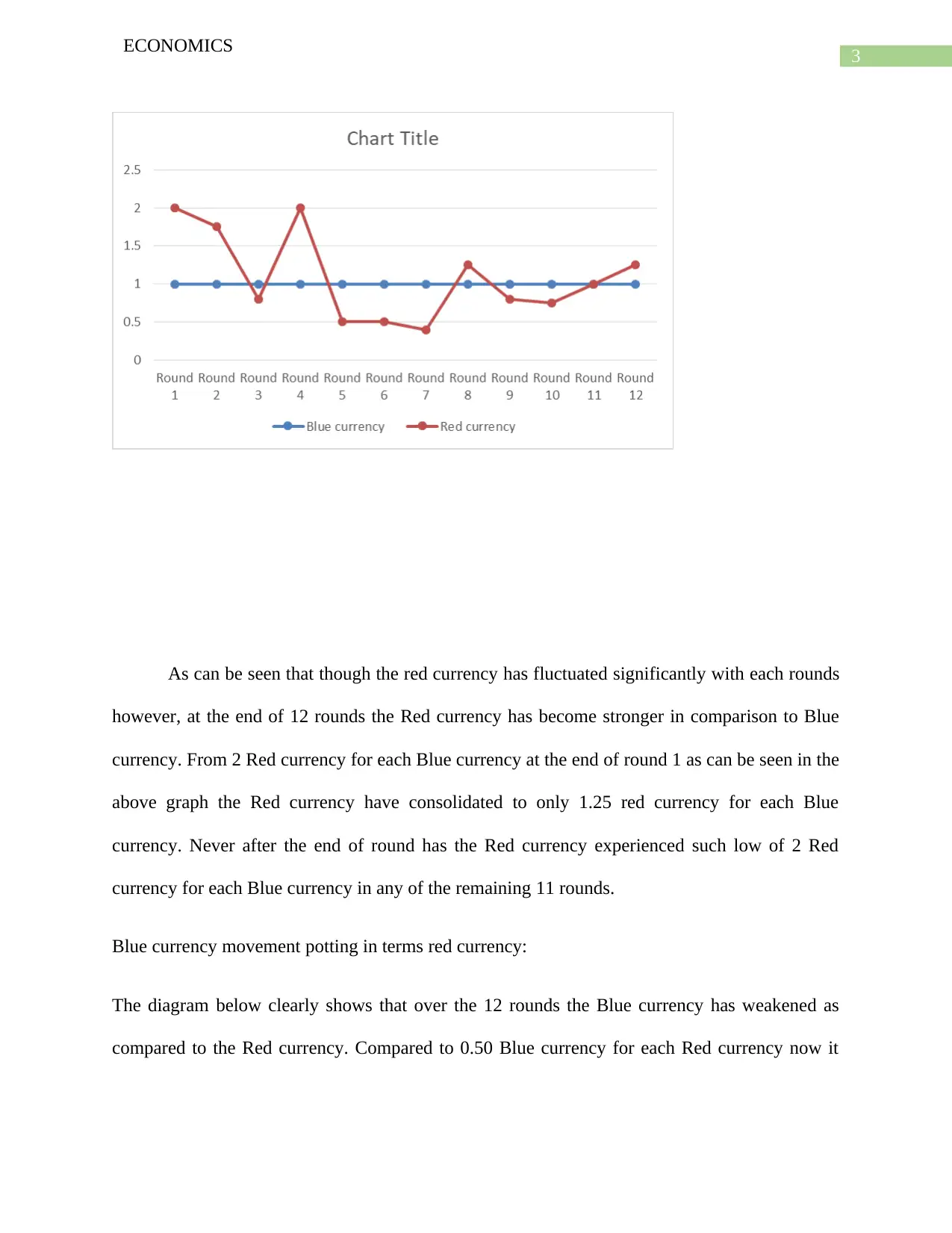
The movement of red currency in terms of blue currency is plotted in the following
diagram.
Document Page
3
ECONOMICS
As can be seen that though the red currency has fluctuated significantly with each rounds
however, at the end of 12 rounds the Red currency has become stronger in comparison to Blue
currency. From 2 Red currency for each Blue currency at the end of round 1 as can be seen in the
above graph the Red currency have consolidated to only 1.25 red currency for each Blue
currency. Never after the end of round has the Red currency experienced such low of 2 Red
currency for each Blue currency in any of the remaining 11 rounds.
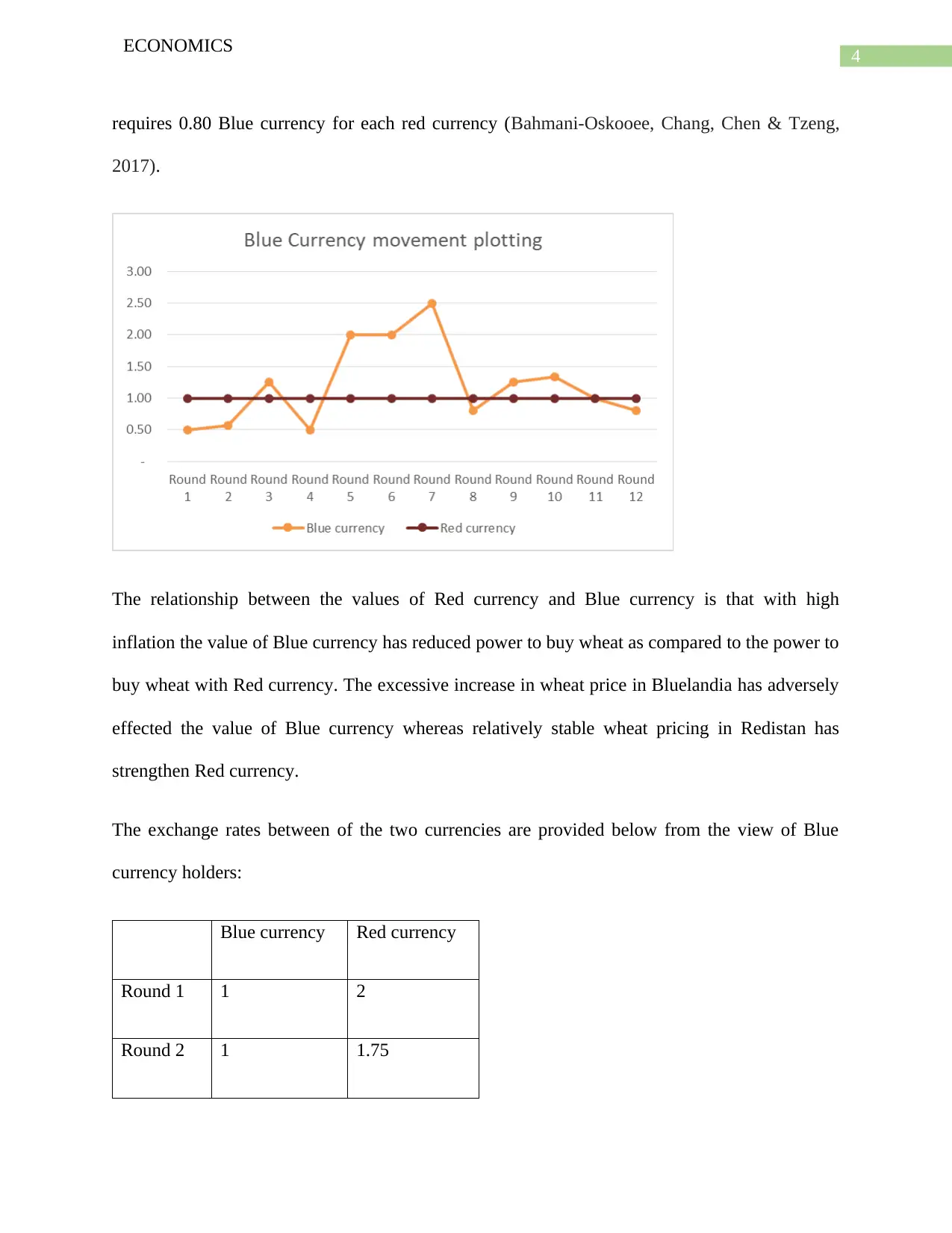
Blue currency movement potting in terms red currency:
The diagram below clearly shows that over the 12 rounds the Blue currency has weakened as
compared to the Red currency. Compared to 0.50 Blue currency for each Red currency now it
tabler-icon-diamond-filled.svg

Paraphrase This Document

Need a fresh take? Get an instant paraphrase of this document with our AI Paraphraser
Document Page
4
ECONOMICS
requires 0.80 Blue currency for each red currency (Bahmani-Oskooee, Chang, Chen & Tzeng,
2017).
The relationship between the values of Red currency and Blue currency is that with high
inflation the value of Blue currency has reduced power to buy wheat as compared to the power to
buy wheat with Red currency. The excessive increase in wheat price in Bluelandia has adversely
effected the value of Blue currency whereas relatively stable wheat pricing in Redistan has
strengthen Red currency.
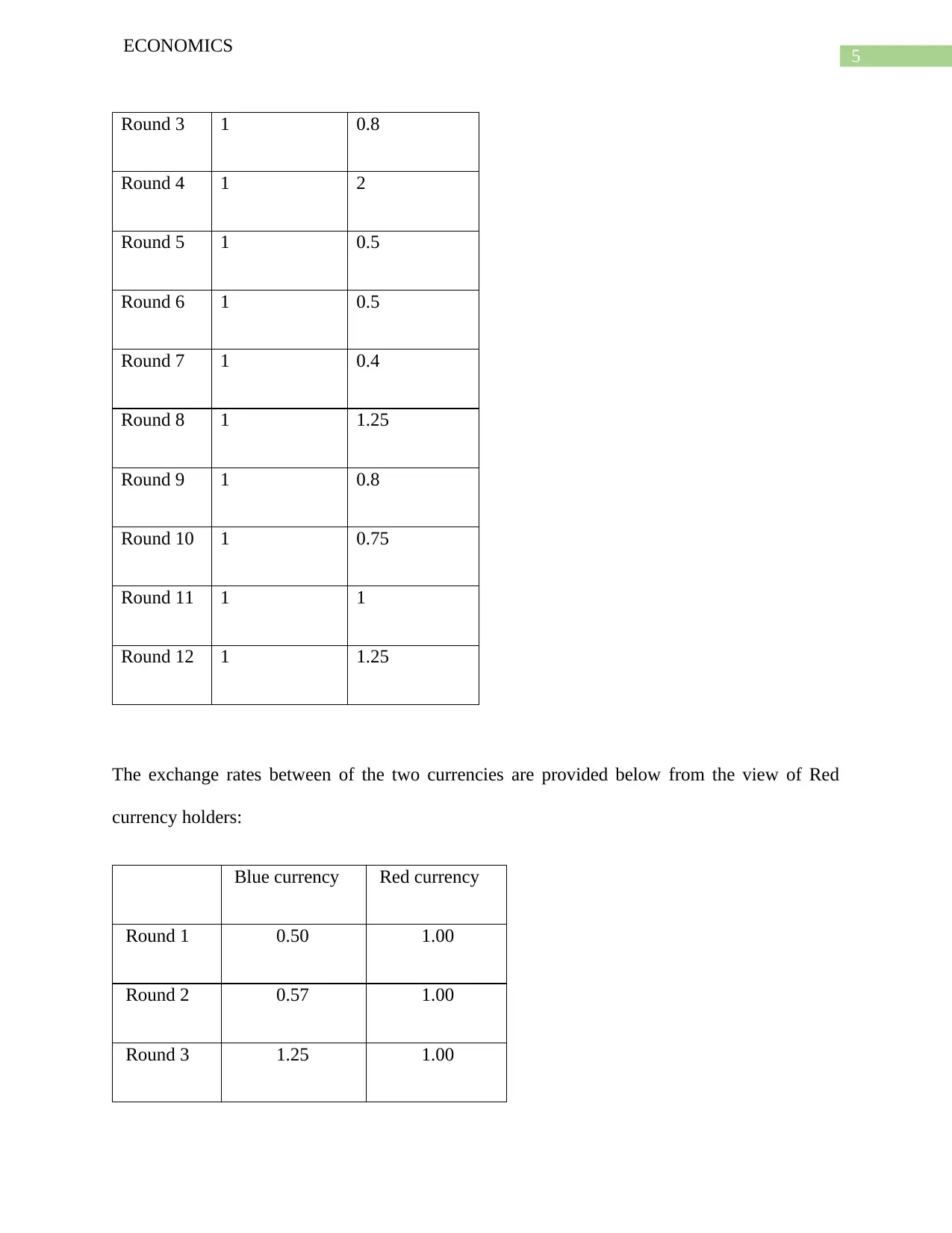
The exchange rates between of the two currencies are provided below from the view of Blue
currency holders:
Blue currency Red currency
Round 1 1 2
Round 2 1 1.75
Document Page
5
ECONOMICS
Round 3 1 0.8
Round 4 1 2
Round 5 1 0.5
Round 6 1 0.5
Round 7 1 0.4
Round 8 1 1.25
Round 9 1 0.8
Round 10 1 0.75
Round 11 1 1
Round 12 1 1.25
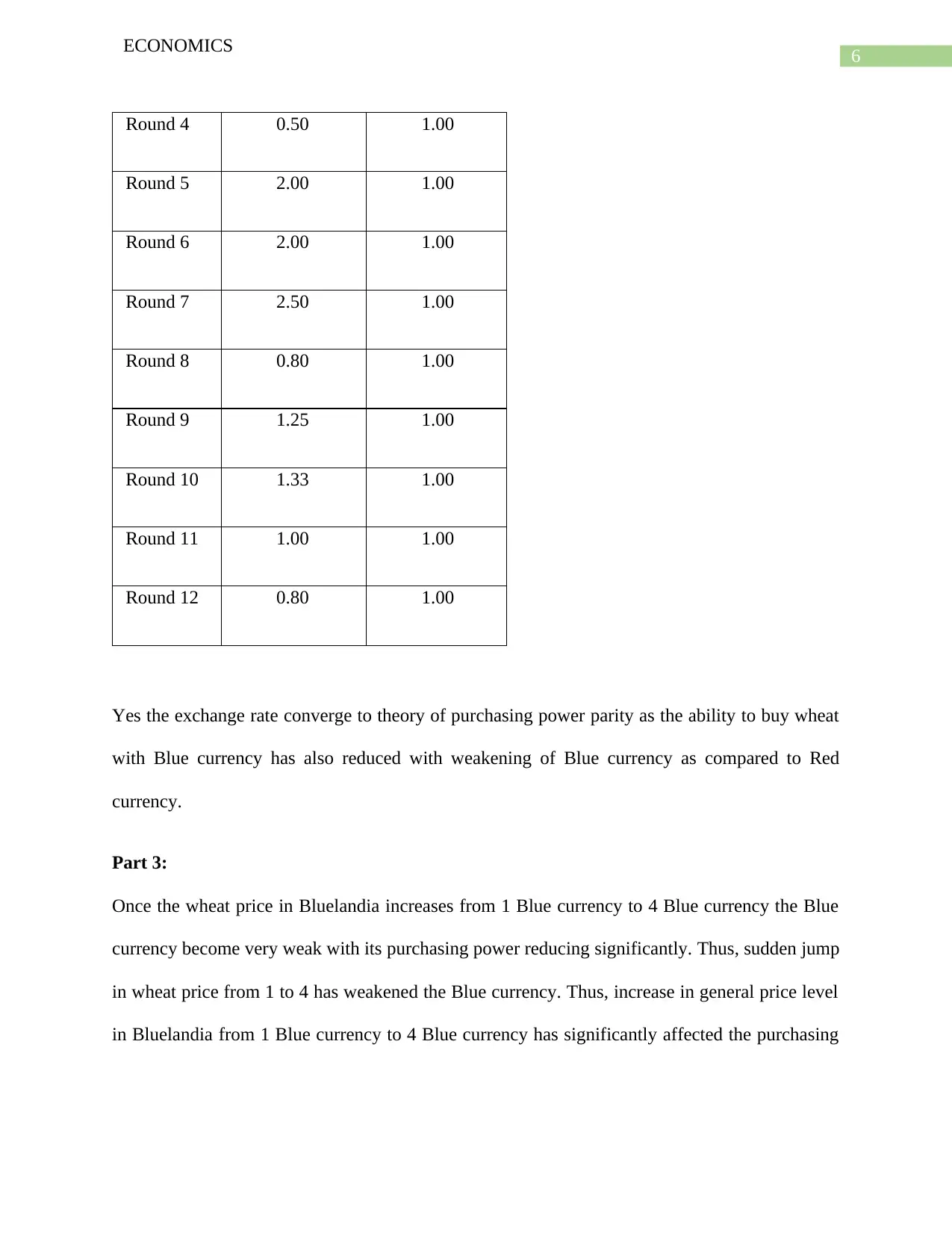
The exchange rates between of the two currencies are provided below from the view of Red
currency holders:
Blue currency Red currency
Round 1 0.50 1.00
Round 2 0.57 1.00
Round 3 1.25 1.00
Document Page
6
ECONOMICS
Round 4 0.50 1.00
Round 5 2.00 1.00
Round 6 2.00 1.00
Round 7 2.50 1.00
Round 8 0.80 1.00
Round 9 1.25 1.00
Round 10 1.33 1.00
Round 11 1.00 1.00
Round 12 0.80 1.00
Yes the exchange rate converge to theory of purchasing power parity as the ability to buy wheat
with Blue currency has also reduced with weakening of Blue currency as compared to Red
currency.
Part 3:
Once the wheat price in Bluelandia increases from 1 Blue currency to 4 Blue currency the Blue
currency become very weak with its purchasing power reducing significantly. Thus, sudden jump
in wheat price from 1 to 4 has weakened the Blue currency. Thus, increase in general price level
in Bluelandia from 1 Blue currency to 4 Blue currency has significantly affected the purchasing
tabler-icon-diamond-filled.svg

Paraphrase This Document

Need a fresh take? Get an instant paraphrase of this document with our AI Paraphraser
Document Page
7
ECONOMICS
power of the currency as a result the currency has weakened significantly compared to Red
currency (Huang, & Yang, 2015).
Theoretical relationship between prices and exchange rate is that the more the prices increases in
a country the value of its currency reduces its value in the world market. Thus, exchange rate is
adversely effected with increase in general price level in the country. Thus, the price and
exchange rate share an opposite relationship with each other. With increase in price level the
exchange rate decrease and with decrease in prices exchange rate increases.
Part 4:
The exchange rate has significant influence on the decisions such as the decision of travelling
abroad, investments in foreign companies. It is because the exchange rates determine the
purchasing power of home currency in the foreign country. Thus, as the home currency of a
country strengthen against any foreign currency the people of home currency will have increase
purchasing power in the foreign country. Thus, the ability to travel as well as to invest in foreign
companies would increase in proportion with the exchange rate.
Hence, the decisions are significantly influenced with the changes in exchange rates. It is
generally beneficial for the stronger currency as the stronger currency generally have high
exchange rates as compared to relatively weak currencies. The purchasing power parity theory is
effective and relevant even with exchange rates thus. The decisions of travelling in foreign as
well investment in foreign companies are influenced by the exchange rates.
Document Page
8
ECONOMICS
Part 5:
The Law of one price states that without any conflict, trade barriers, fictions in trade and under
perfect and free market condition the price of identical goods in sold in two different countries
shall be same if expressed in a common currency.
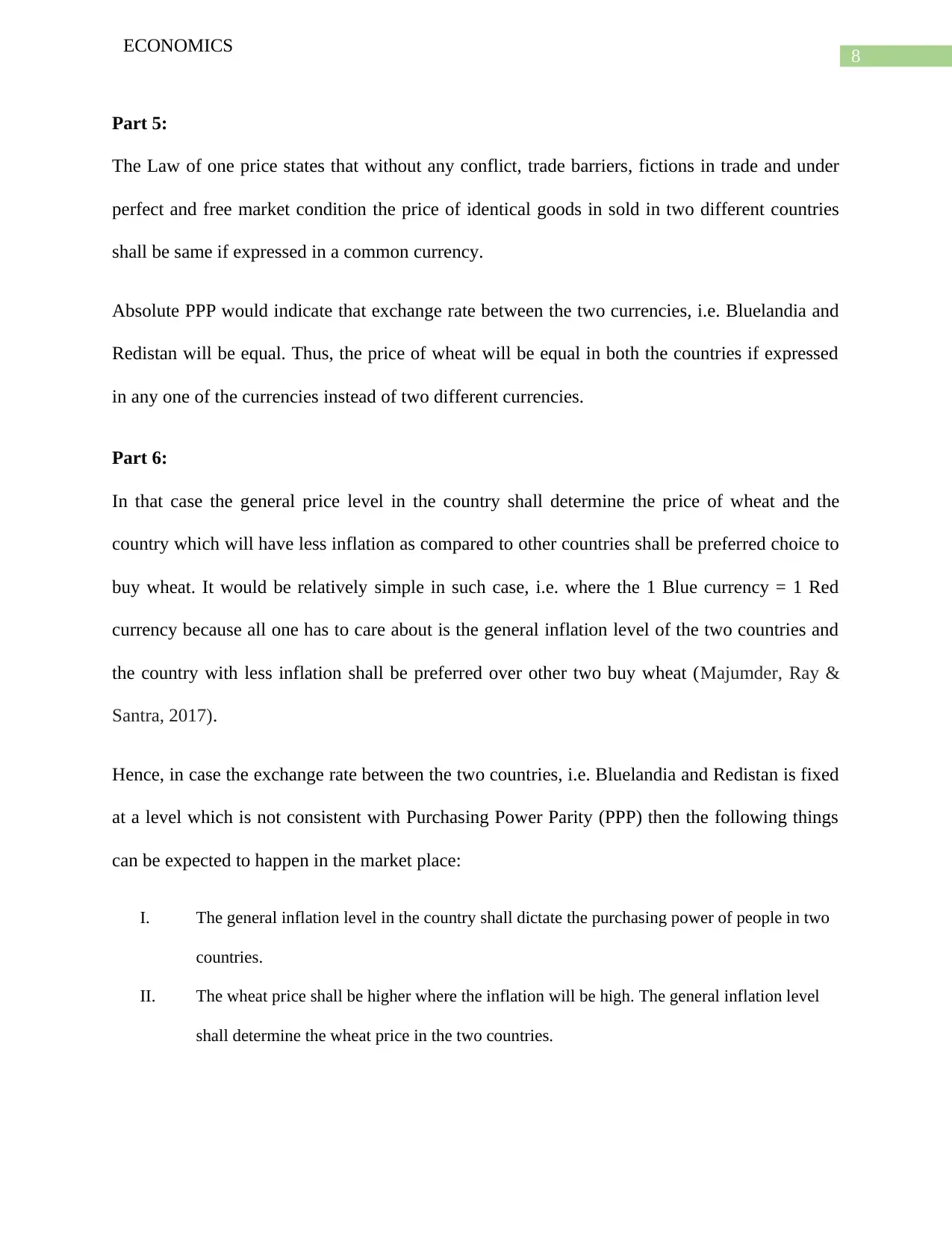
Absolute PPP would indicate that exchange rate between the two currencies, i.e. Bluelandia and
Redistan will be equal. Thus, the price of wheat will be equal in both the countries if expressed
in any one of the currencies instead of two different currencies.
Part 6:
In that case the general price level in the country shall determine the price of wheat and the
country which will have less inflation as compared to other countries shall be preferred choice to
buy wheat. It would be relatively simple in such case, i.e. where the 1 Blue currency = 1 Red
currency because all one has to care about is the general inflation level of the two countries and
the country with less inflation shall be preferred over other two buy wheat (Majumder, Ray &
Santra, 2017).
Hence, in case the exchange rate between the two countries, i.e. Bluelandia and Redistan is fixed
at a level which is not consistent with Purchasing Power Parity (PPP) then the following things
can be expected to happen in the market place:
I. The general inflation level in the country shall dictate the purchasing power of people in two
countries.
II. The wheat price shall be higher where the inflation will be high. The general inflation level
shall determine the wheat price in the two countries.
Document Page
9
ECONOMICS
III. It would be relatively easier to calculate exchange rate between two currencies and
accordingly taking important economic decisions would be easier.
IV. The economists will not consider the impact of PPP to determine the exchange rate between
two countries.
Conclusion:
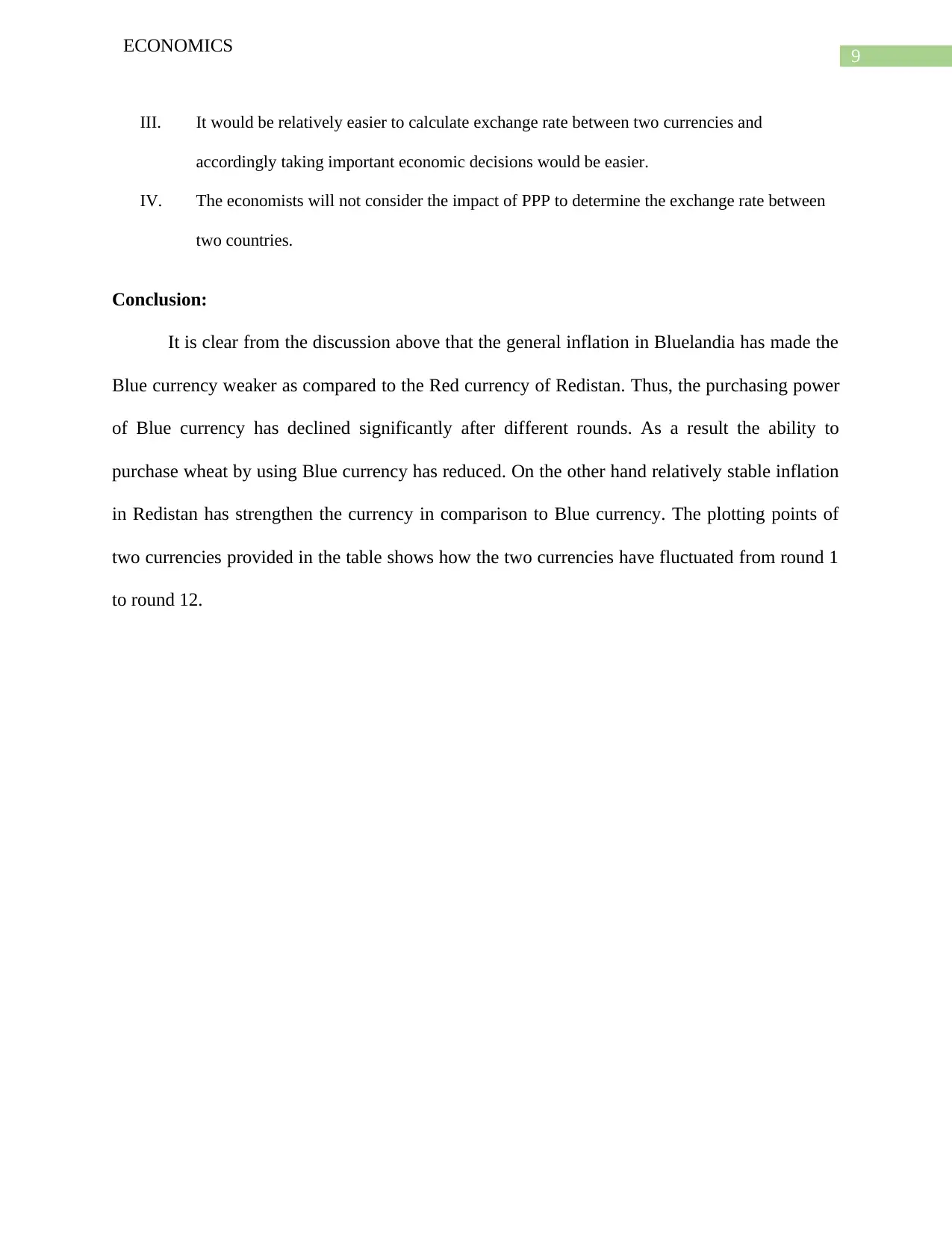
It is clear from the discussion above that the general inflation in Bluelandia has made the
Blue currency weaker as compared to the Red currency of Redistan. Thus, the purchasing power
of Blue currency has declined significantly after different rounds. As a result the ability to
purchase wheat by using Blue currency has reduced. On the other hand relatively stable inflation
in Redistan has strengthen the currency in comparison to Blue currency. The plotting points of
two currencies provided in the table shows how the two currencies have fluctuated from round 1
to round 12.
tabler-icon-diamond-filled.svg

Paraphrase This Document

Need a fresh take? Get an instant paraphrase of this document with our AI Paraphraser
Document Page
10
ECONOMICS
References:
Bahmani-Oskooee, M., Chang, T., Chen, T. H., & Tzeng, H. W. (2017). Revisiting purchasing
power parity in Eastern European countries: quantile unit root tests. Empirical
Economics, 52(2), 463-483.
Huang, C. H., & Yang, C. Y. (2015). European exchange rate regimes and purchasing power
parity: An empirical study on eleven eurozone countries. International Review of
Economics & Finance, 35, 100-109.
Majumder, A., Ray, R., & Santra, S. (2017). Sensitivity of Purchasing Power Parity Estimates to
Estimation Procedures and their Effect on Living Standards Comparisons. Journal of
Globalization and Development, 8(1).
McKinnon, R. I., & Ohno, K. (2016). 7 Purchasing power parity as a monetary. The Future of
the International Monetary System: Change, Coordination of Instability?: Change,
Coordination of Instability?, 42.
chevron_up_icon
1 out of 11
circle_padding
hide_on_mobile
zoom_out_icon
[object Object]