Business Entity Analysis: Case Studies on Liability and Taxation

Verified

Added on  2023/01/13

|2
|664
|69
Homework Assignment
AI Summary
This assignment delves into the analysis of different business entities, exploring their implications on liability and taxation through case studies. The first question examines the most suitable business structure (limited partnership) for a scenario involving capital investment and limited liability. The second question analyzes the ownership of property in a dissolved partnership. Question three addresses the liability of managing members in a limited liability company (LLC) and whether they can be personally sued. Question four explores the optimal business structure (LLC) for a real estate venture seeking pass-through taxation and asset protection. Finally, question five examines the liability of a promoter who signs a lease before the business is formed and the legal implications of a breach of contract. The assignment provides a comprehensive understanding of business structures, their legal ramifications, and their tax implications.
Document Page
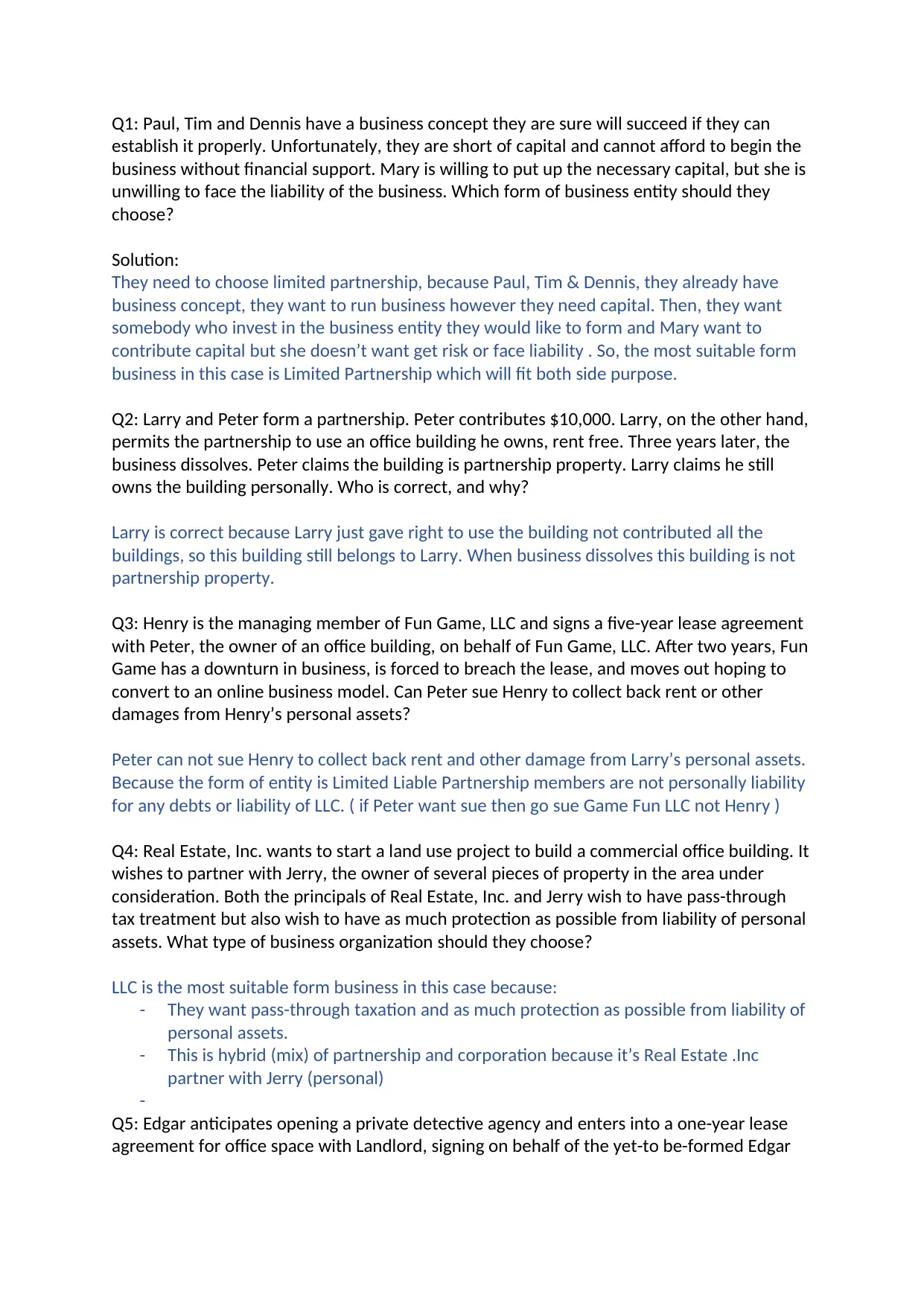
Q1: Paul, Tim and Dennis have a business concept they are sure will succeed if they can
establish it properly. Unfortunately, they are short of capital and cannot afford to begin the
business without financial support. Mary is willing to put up the necessary capital, but she is
unwilling to face the liability of the business. Which form of business entity should they
choose?
Solution:
They need to choose limited partnership, because Paul, Tim & Dennis, they already have
business concept, they want to run business however they need capital. Then, they want
somebody who invest in the business entity they would like to form and Mary want to
contribute capital but she doesn’t want get risk or face liability . So, the most suitable form
business in this case is Limited Partnership which will fit both side purpose.
Q2: Larry and Peter form a partnership. Peter contributes $10,000. Larry, on the other hand,
permits the partnership to use an office building he owns, rent free. Three years later, the
business dissolves. Peter claims the building is partnership property. Larry claims he still
owns the building personally. Who is correct, and why?
Larry is correct because Larry just gave right to use the building not contributed all the
buildings, so this building still belongs to Larry. When business dissolves this building is not
partnership property.
Q3: Henry is the managing member of Fun Game, LLC and signs a five-year lease agreement
with Peter, the owner of an office building, on behalf of Fun Game, LLC. After two years, Fun
Game has a downturn in business, is forced to breach the lease, and moves out hoping to
convert to an online business model. Can Peter sue Henry to collect back rent or other
damages from Henry’s personal assets?
Peter can not sue Henry to collect back rent and other damage from Larry’s personal assets.
Because the form of entity is Limited Liable Partnership members are not personally liability
for any debts or liability of LLC. ( if Peter want sue then go sue Game Fun LLC not Henry )
Q4: Real Estate, Inc. wants to start a land use project to build a commercial office building. It
wishes to partner with Jerry, the owner of several pieces of property in the area under
consideration. Both the principals of Real Estate, Inc. and Jerry wish to have pass-through
tax treatment but also wish to have as much protection as possible from liability of personal
assets. What type of business organization should they choose?
LLC is the most suitable form business in this case because:
- They want pass-through taxation and as much protection as possible from liability of
personal assets.
- This is hybrid (mix) of partnership and corporation because it’s Real Estate .Inc
partner with Jerry (personal)
-
Q5: Edgar anticipates opening a private detective agency and enters into a one-year lease
agreement for office space with Landlord, signing on behalf of the yet-to be-formed Edgar
tabler-icon-diamond-filled.svg

Paraphrase This Document

Need a fresh take? Get an instant paraphrase of this document with our AI Paraphraser
Document Page
Detective Agency Inc. One month later, Edgar’s financing falls through, and he abandons the
idea. Can Landlord sue Edgar for breach of contract?
Facts: Edgar enters into 1 year lease agreement for office space with Landlord and 1 month
later they didn’t have enough money so company was not formed but Edgar already signed
contract.
Due to Promoter is personally liable for any pre-formation debts or activities on behalf of
the future corporation.
So Edgar has liability for the contract and Landlord can sue him breach of contract.
chevron_up_icon
1 out of 2
circle_padding
hide_on_mobile
zoom_out_icon
[object Object]