Comparative Analysis of AM and FM - NIE2226 Communications Lab Report

Verified

Added on  2023/04/19

|5
|792
|116
Report
AI Summary
This report provides a comparative analysis of Amplitude Modulation (AM) and Frequency Modulation (FM), focusing on their characteristics in both the time and frequency domains. It discusses the principles of AM, where the amplitude of the carrier signal is varied according to the modulating signal, and FM, where the frequency is varied. The report includes an analysis of Bessel functions and their impact on the bandwidth of FM signals, along with figures illustrating different modulation indices. Furthermore, it contrasts the signal quality, broadcasting frequencies, and power efficiency of AM and FM, highlighting FM's superior noise immunity and AM's ability to travel longer distances. The document concludes by outlining the advantages of FM over AM, such as improved signal-to-noise ratio and reduced geographical interference, while also noting the bandwidth differences between the two modulation techniques.
Document Page
Q4)
( J 1 (m)
J 0 (m) )
2
( J 2 (m)
J 0 (m) )
2
( J 3 (m)
J 0 (m) )
2
( J 4 (m)
J 0 (m))
2
m=.1 .0025 dB = 1
W
1.446106 dB=
1 W
0 dB=1W 0 dB= 1W
m=.5 .066 dB=
1.015 W
.001063 dB=
1 W
7.675106 dB
= 1W
4.541108 dB=1W
m=1 .33 dB=
1.079 W
.02255 dB=
1.005 W
6.561104dB
= 1W
1.067107 dB=
1W
m=2 6.634 dB=
4.607 W
2.483 dB=
1.771 W
.3314 dB=
1.079 W
.0236 dB=
1.005 W
m=2.4 4.33104 dB 2.972104 dB 6.279103 dB 661.5 dB
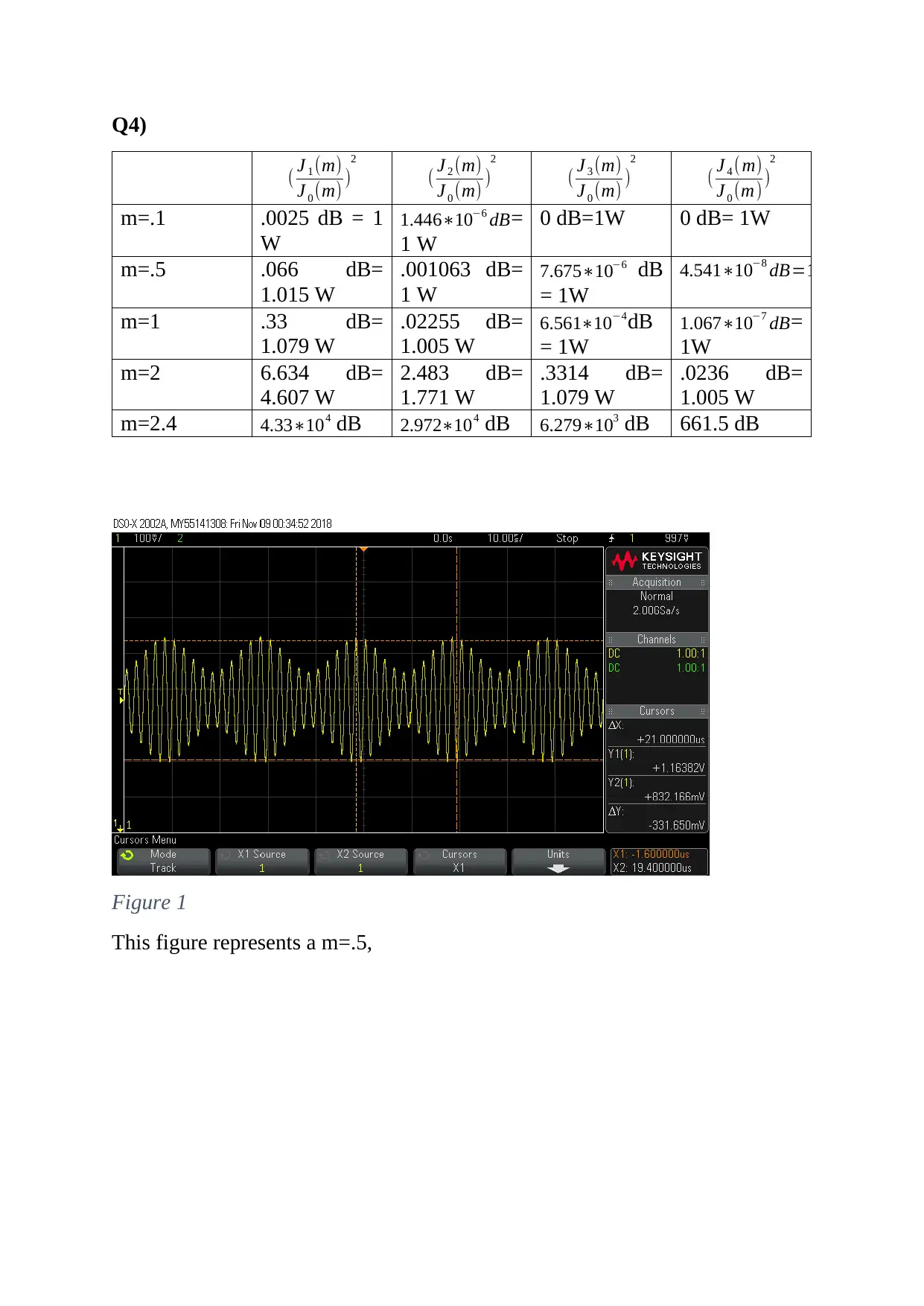
Figure 1
This figure represents a m=.5,
tabler-icon-diamond-filled.svg

Paraphrase This Document

Need a fresh take? Get an instant paraphrase of this document with our AI Paraphraser
Document Page
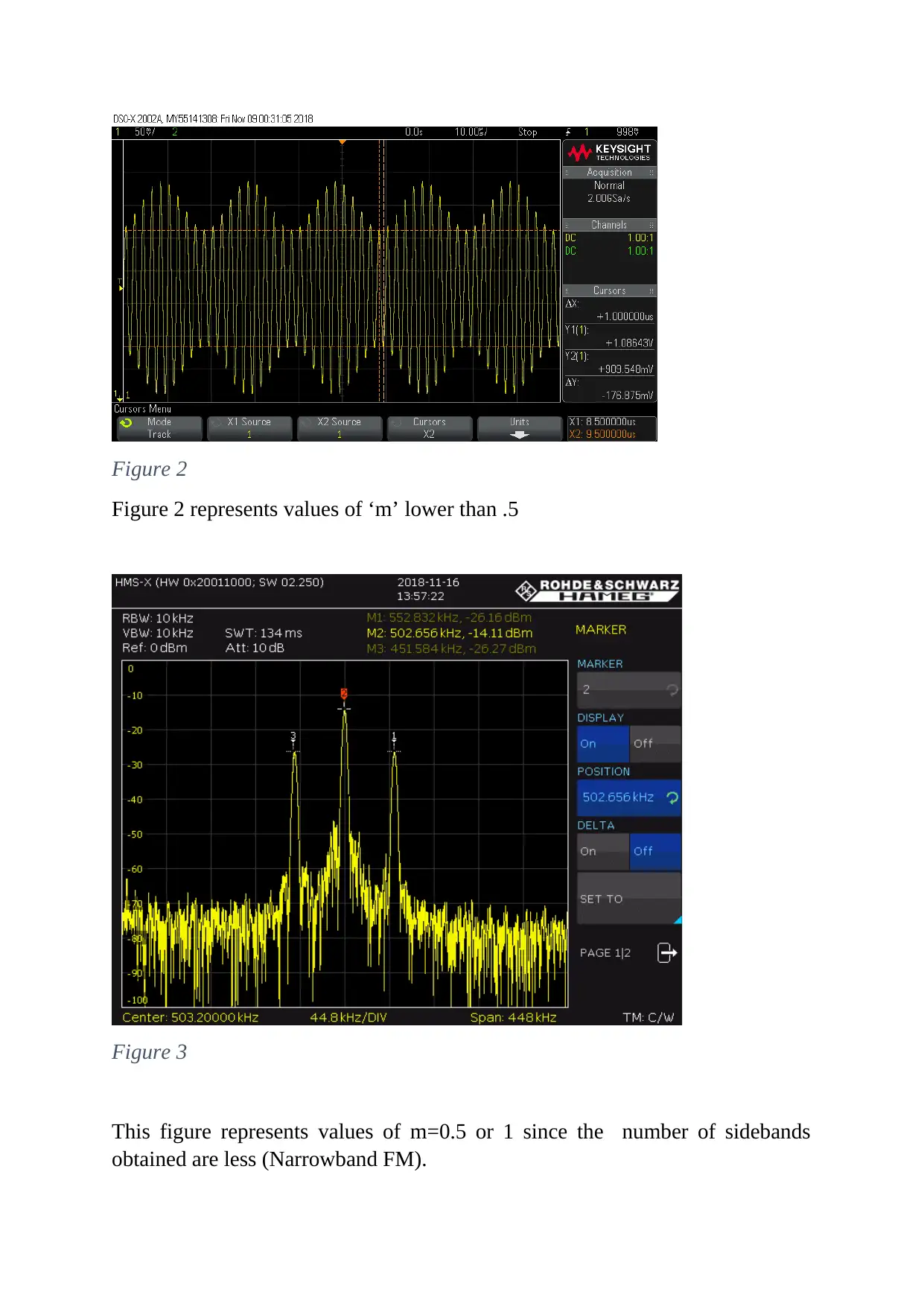
Figure 2
Figure 2 represents values of ‘m’ lower than .5
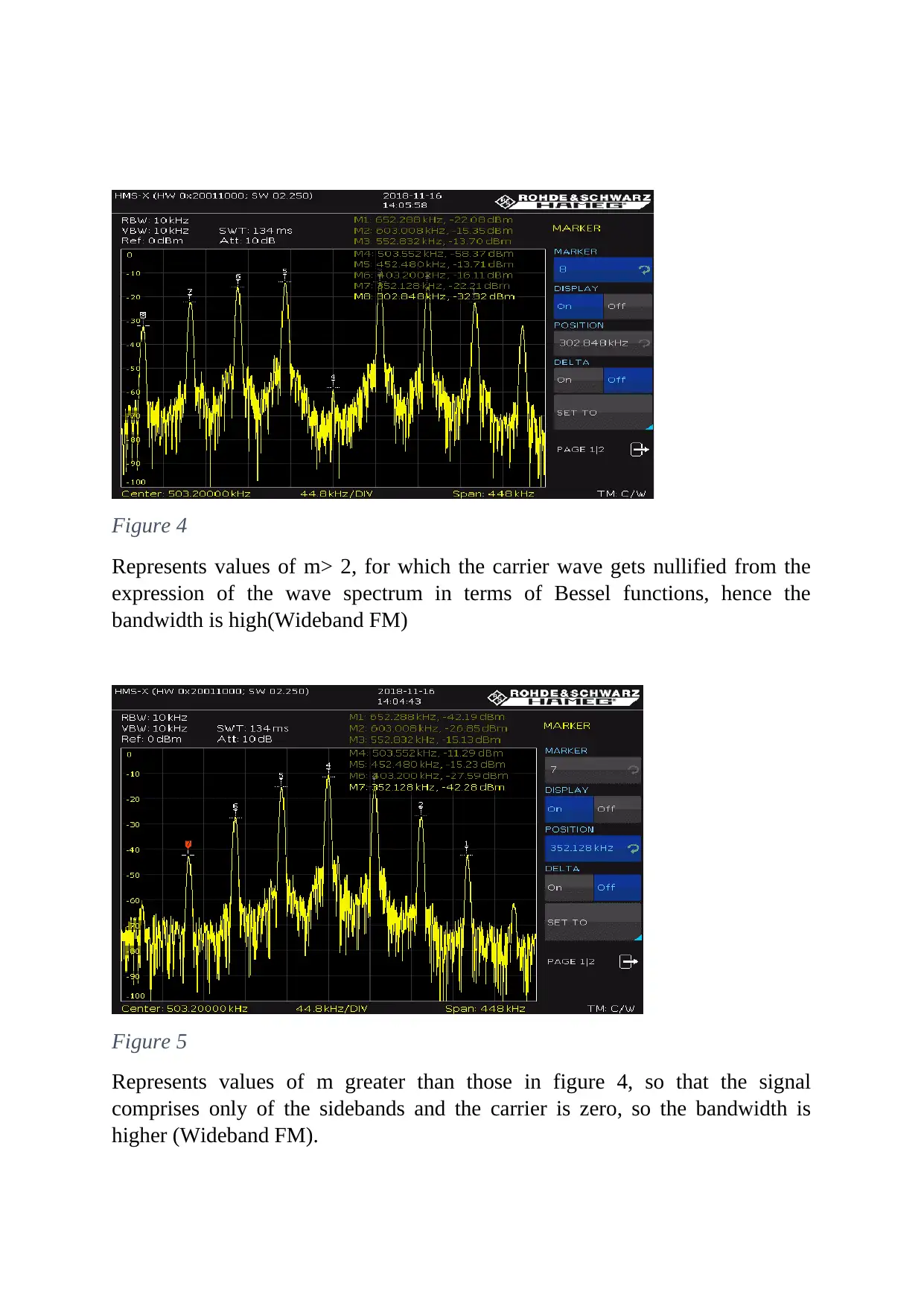
Figure 3
This figure represents values of m=0.5 or 1 since the number of sidebands
obtained are less (Narrowband FM).
Document Page
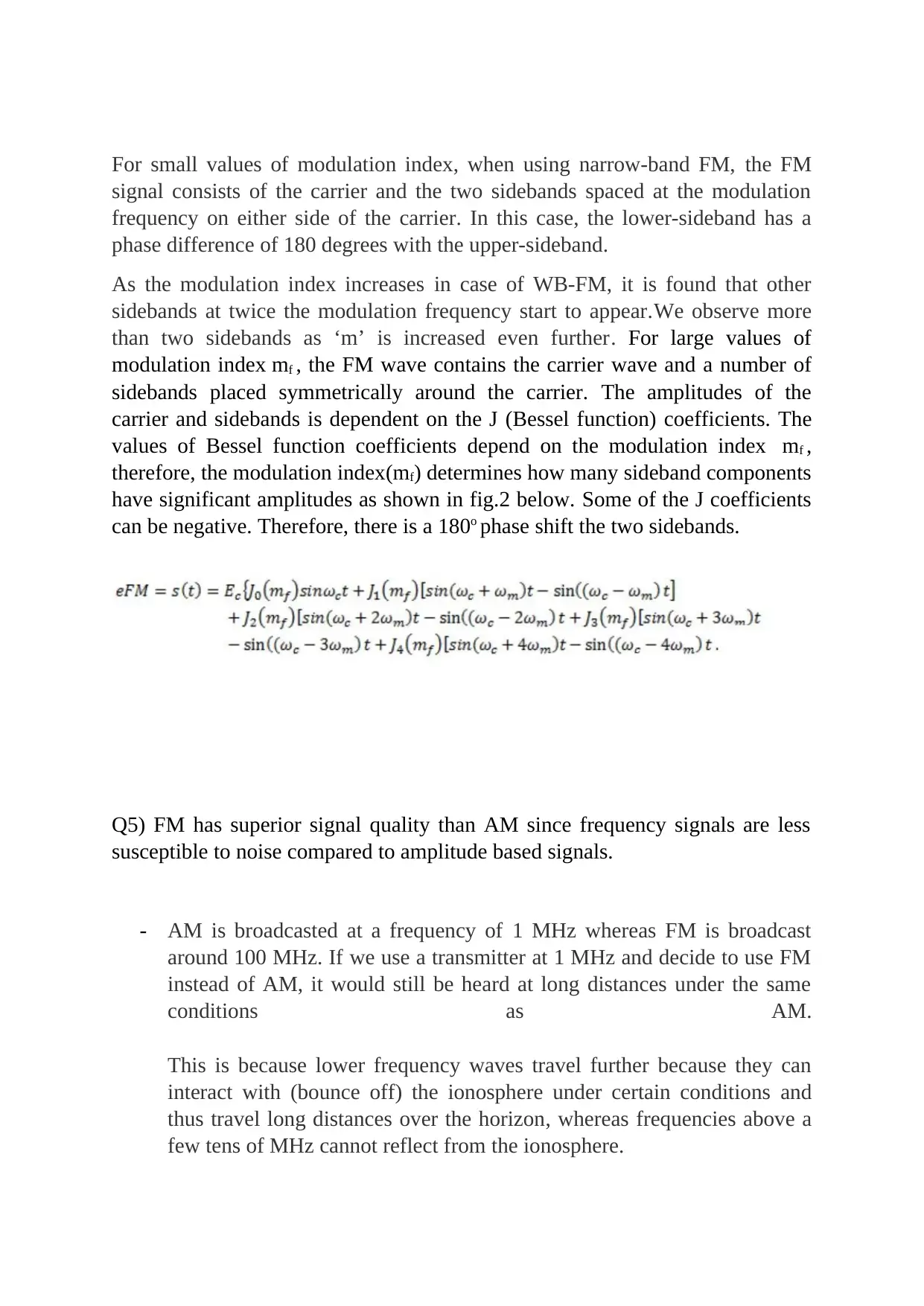
Figure 4
Represents values of m> 2, for which the carrier wave gets nullified from the
expression of the wave spectrum in terms of Bessel functions, hence the
bandwidth is high(Wideband FM)
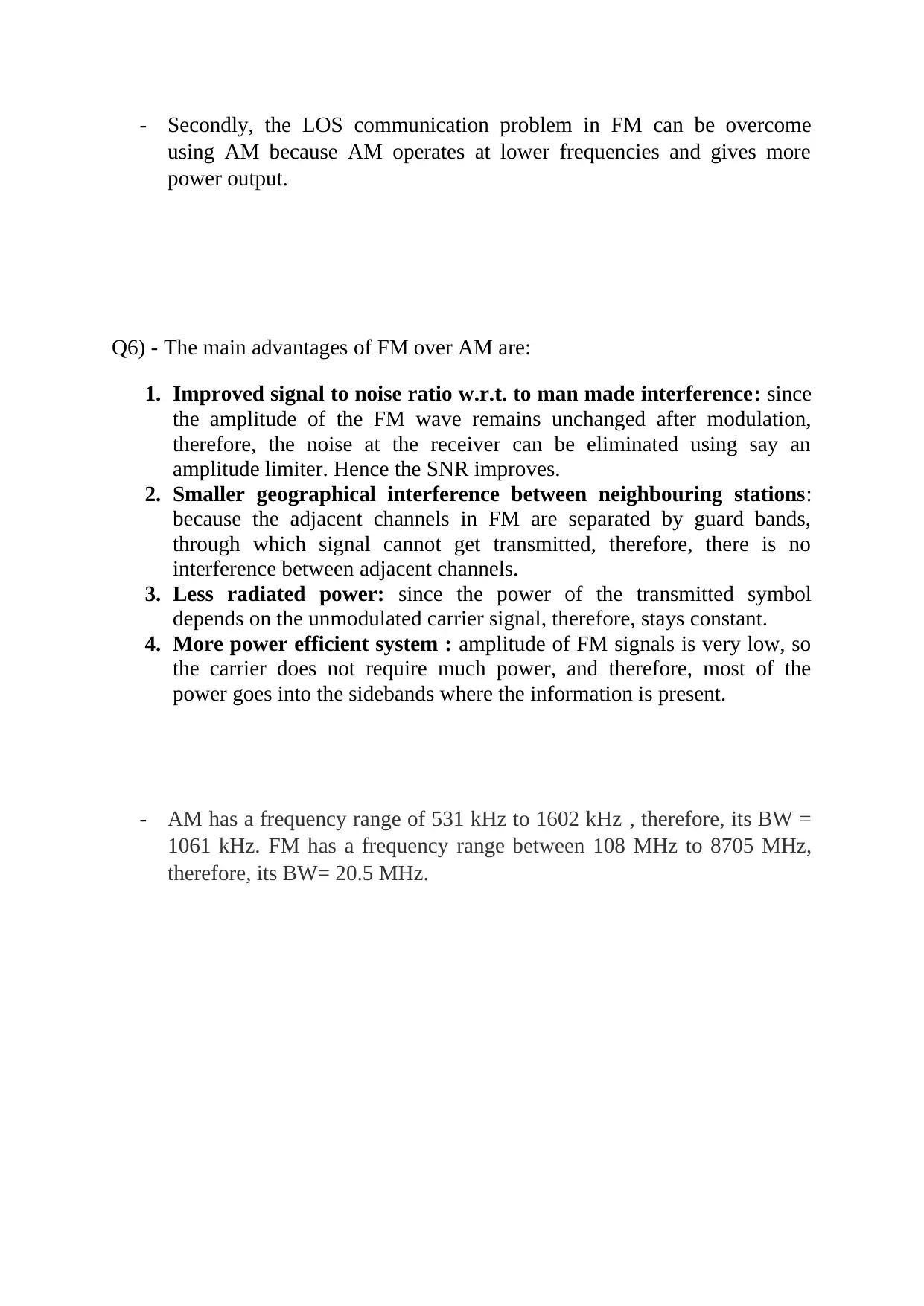
Figure 5
Represents values of m greater than those in figure 4, so that the signal
comprises only of the sidebands and the carrier is zero, so the bandwidth is
higher (Wideband FM).
Document Page
For small values of modulation index, when using narrow-band FM, the FM
signal consists of the carrier and the two sidebands spaced at the modulation
frequency on either side of the carrier. In this case, the lower-sideband has a
phase difference of 180 degrees with the upper-sideband.
As the modulation index increases in case of WB-FM, it is found that other
sidebands at twice the modulation frequency start to appear.We observe more
than two sidebands as ‘m’ is increased even further. For large values of
modulation index mf , the FM wave contains the carrier wave and a number of
sidebands placed symmetrically around the carrier. The amplitudes of the
carrier and sidebands is dependent on the J (Bessel function) coefficients. The
values of Bessel function coefficients depend on the modulation index mf ,
therefore, the modulation index(mf) determines how many sideband components
have significant amplitudes as shown in fig.2 below. Some of the J coefficients
can be negative. Therefore, there is a 180o phase shift the two sidebands.
Q5) FM has superior signal quality than AM since frequency signals are less
susceptible to noise compared to amplitude based signals.
- AM is broadcasted at a frequency of 1 MHz whereas FM is broadcast
around 100 MHz. If we use a transmitter at 1 MHz and decide to use FM
instead of AM, it would still be heard at long distances under the same
conditions as AM.
This is because lower frequency waves travel further because they can
interact with (bounce off) the ionosphere under certain conditions and
thus travel long distances over the horizon, whereas frequencies above a
few tens of MHz cannot reflect from the ionosphere.
tabler-icon-diamond-filled.svg

Paraphrase This Document

Need a fresh take? Get an instant paraphrase of this document with our AI Paraphraser
Document Page
- Secondly, the LOS communication problem in FM can be overcome
using AM because AM operates at lower frequencies and gives more
power output.
Q6) - The main advantages of FM over AM are:
1. Improved signal to noise ratio w.r.t. to man made interference: since
the amplitude of the FM wave remains unchanged after modulation,
therefore, the noise at the receiver can be eliminated using say an
amplitude limiter. Hence the SNR improves.
2. Smaller geographical interference between neighbouring stations:
because the adjacent channels in FM are separated by guard bands,
through which signal cannot get transmitted, therefore, there is no
interference between adjacent channels.
3. Less radiated power: since the power of the transmitted symbol
depends on the unmodulated carrier signal, therefore, stays constant.
4. More power efficient system : amplitude of FM signals is very low, so
the carrier does not require much power, and therefore, most of the
power goes into the sidebands where the information is present.
- AM has a frequency range of 531 kHz to 1602 kHz , therefore, its BW =
1061 kHz. FM has a frequency range between 108 MHz to 8705 MHz,
therefore, its BW= 20.5 MHz.
chevron_up_icon
1 out of 5
circle_padding
hide_on_mobile
zoom_out_icon
[object Object]