Sports Technique Analysis: Fast Bowling Technique Analysis Report

Verified

Added on  2022/09/17

|4
|810
|22
Report
AI Summary
This report provides a biomechanical analysis of the fast bowling technique in cricket. It examines the three key phases: running, ball release, and follow-through. The analysis involves a three-dimensional kinetics and ground reaction force examination using a system of 18 rigid segments linked by pin joints. Kinetic, kinematic, and anthropometric data are collected to analyze correlations between bowling technique, ball speed, and ground reaction forces. The report emphasizes the importance of ball release speed, the bowler's run-up, shoulder relaxation, and maintaining straight legs during ball release. It also highlights the significance of proper follow-through and the use of video analysis for detecting flaws and improving performance. The report references several studies that support the biomechanical principles discussed.

Document Page
Running head: SPORTS TECHNIQUE
Sports Technique
Name of the Student
Name of the University
Author Note
tabler-icon-diamond-filled.svg

Paraphrase This Document

Need a fresh take? Get an instant paraphrase of this document with our AI Paraphraser
Document Page
1
SPORTS TECHNIQUE
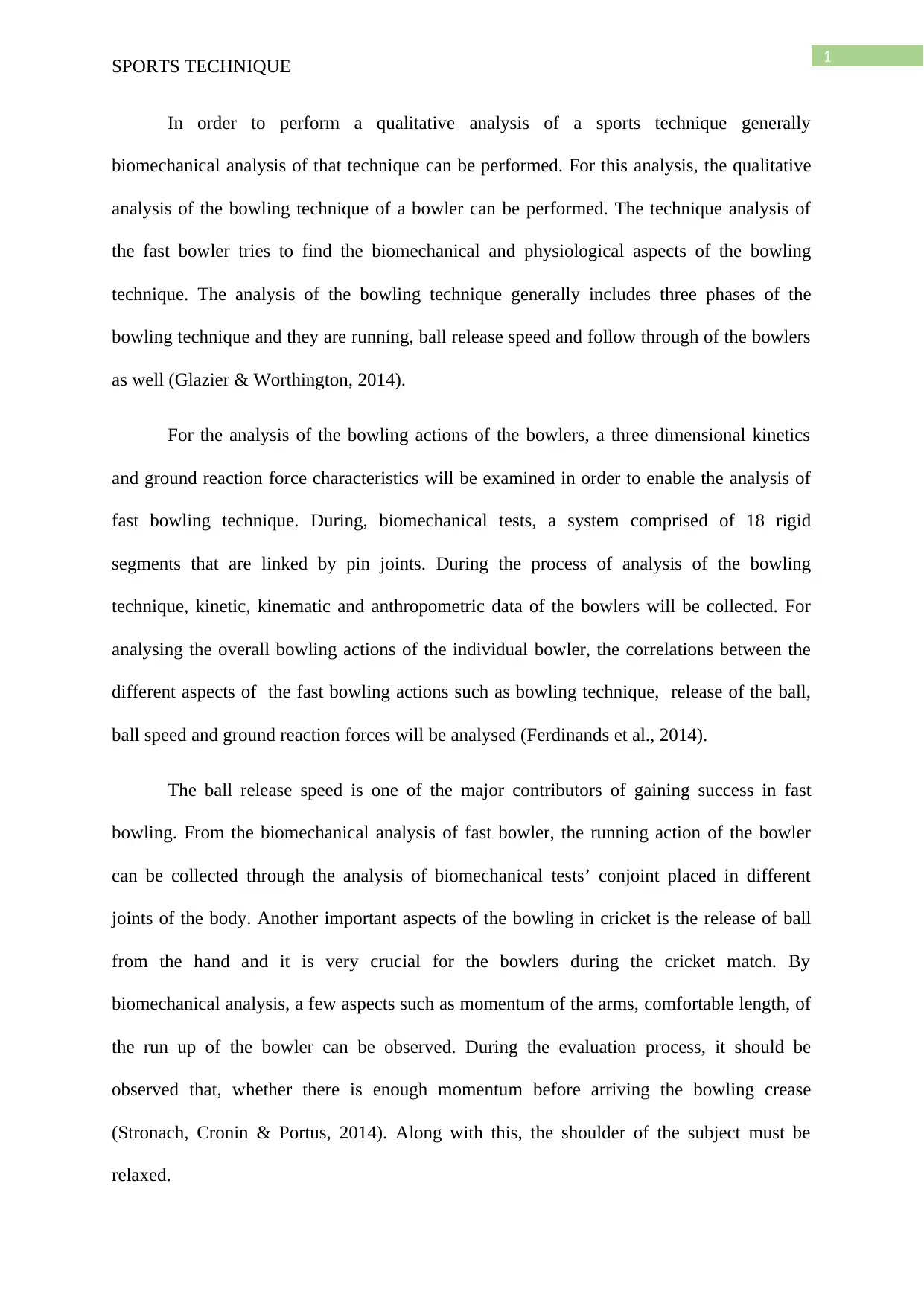
In order to perform a qualitative analysis of a sports technique generally
biomechanical analysis of that technique can be performed. For this analysis, the qualitative
analysis of the bowling technique of a bowler can be performed. The technique analysis of
the fast bowler tries to find the biomechanical and physiological aspects of the bowling
technique. The analysis of the bowling technique generally includes three phases of the
bowling technique and they are running, ball release speed and follow through of the bowlers
as well (Glazier & Worthington, 2014).
For the analysis of the bowling actions of the bowlers, a three dimensional kinetics
and ground reaction force characteristics will be examined in order to enable the analysis of
fast bowling technique. During, biomechanical tests, a system comprised of 18 rigid
segments that are linked by pin joints. During the process of analysis of the bowling
technique, kinetic, kinematic and anthropometric data of the bowlers will be collected. For
analysing the overall bowling actions of the individual bowler, the correlations between the
different aspects of the fast bowling actions such as bowling technique, release of the ball,
ball speed and ground reaction forces will be analysed (Ferdinands et al., 2014).
The ball release speed is one of the major contributors of gaining success in fast
bowling. From the biomechanical analysis of fast bowler, the running action of the bowler
can be collected through the analysis of biomechanical tests’ conjoint placed in different
joints of the body. Another important aspects of the bowling in cricket is the release of ball
from the hand and it is very crucial for the bowlers during the cricket match. By
biomechanical analysis, a few aspects such as momentum of the arms, comfortable length, of
the run up of the bowler can be observed. During the evaluation process, it should be
observed that, whether there is enough momentum before arriving the bowling crease
(Stronach, Cronin & Portus, 2014). Along with this, the shoulder of the subject must be
relaxed.
Document Page
2
SPORTS TECHNIQUE
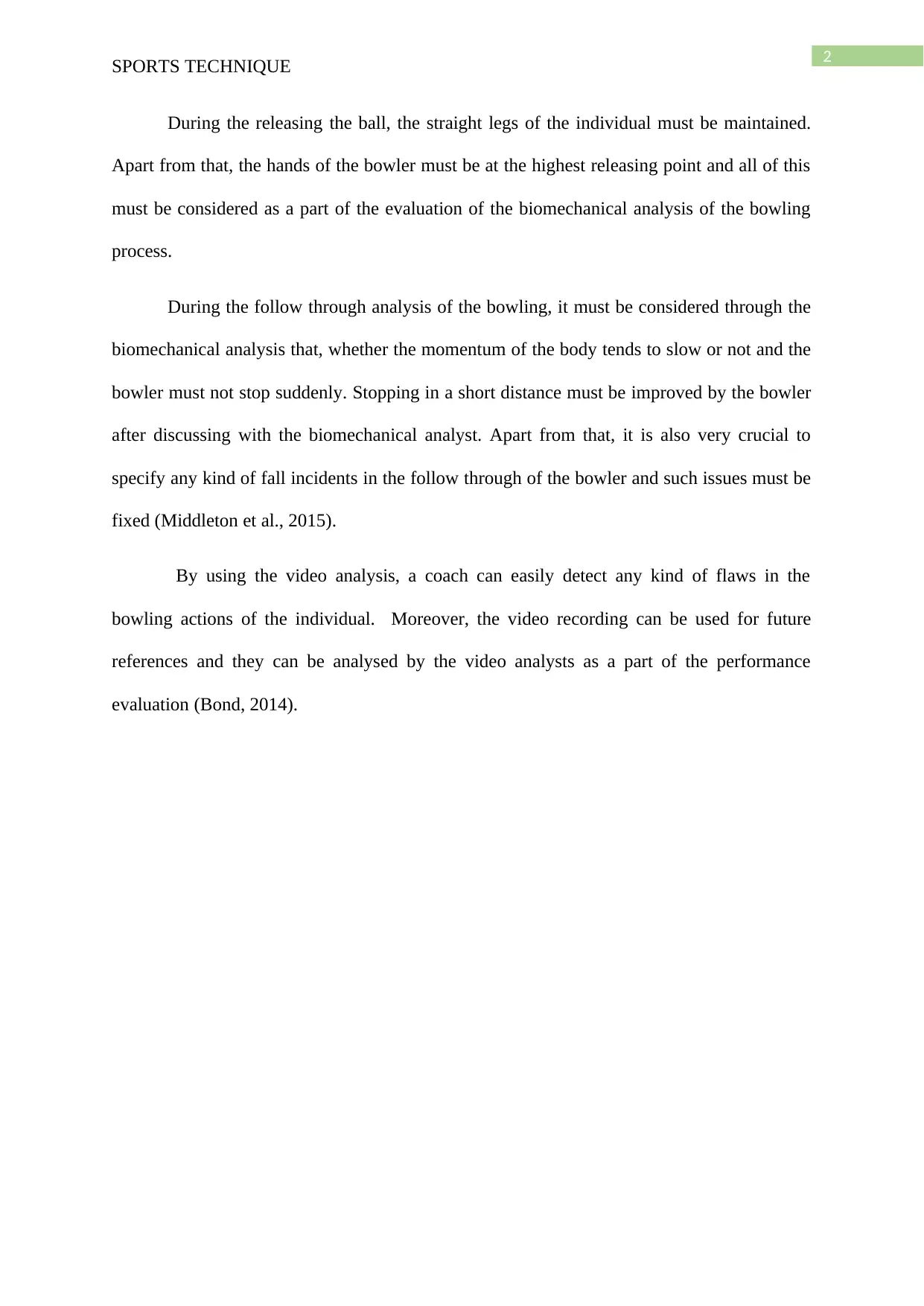
During the releasing the ball, the straight legs of the individual must be maintained.
Apart from that, the hands of the bowler must be at the highest releasing point and all of this
must be considered as a part of the evaluation of the biomechanical analysis of the bowling
process.
During the follow through analysis of the bowling, it must be considered through the
biomechanical analysis that, whether the momentum of the body tends to slow or not and the
bowler must not stop suddenly. Stopping in a short distance must be improved by the bowler
after discussing with the biomechanical analyst. Apart from that, it is also very crucial to
specify any kind of fall incidents in the follow through of the bowler and such issues must be
fixed (Middleton et al., 2015).
By using the video analysis, a coach can easily detect any kind of flaws in the
bowling actions of the individual. Moreover, the video recording can be used for future
references and they can be analysed by the video analysts as a part of the performance
evaluation (Bond, 2014).
Document Page
3
SPORTS TECHNIQUE
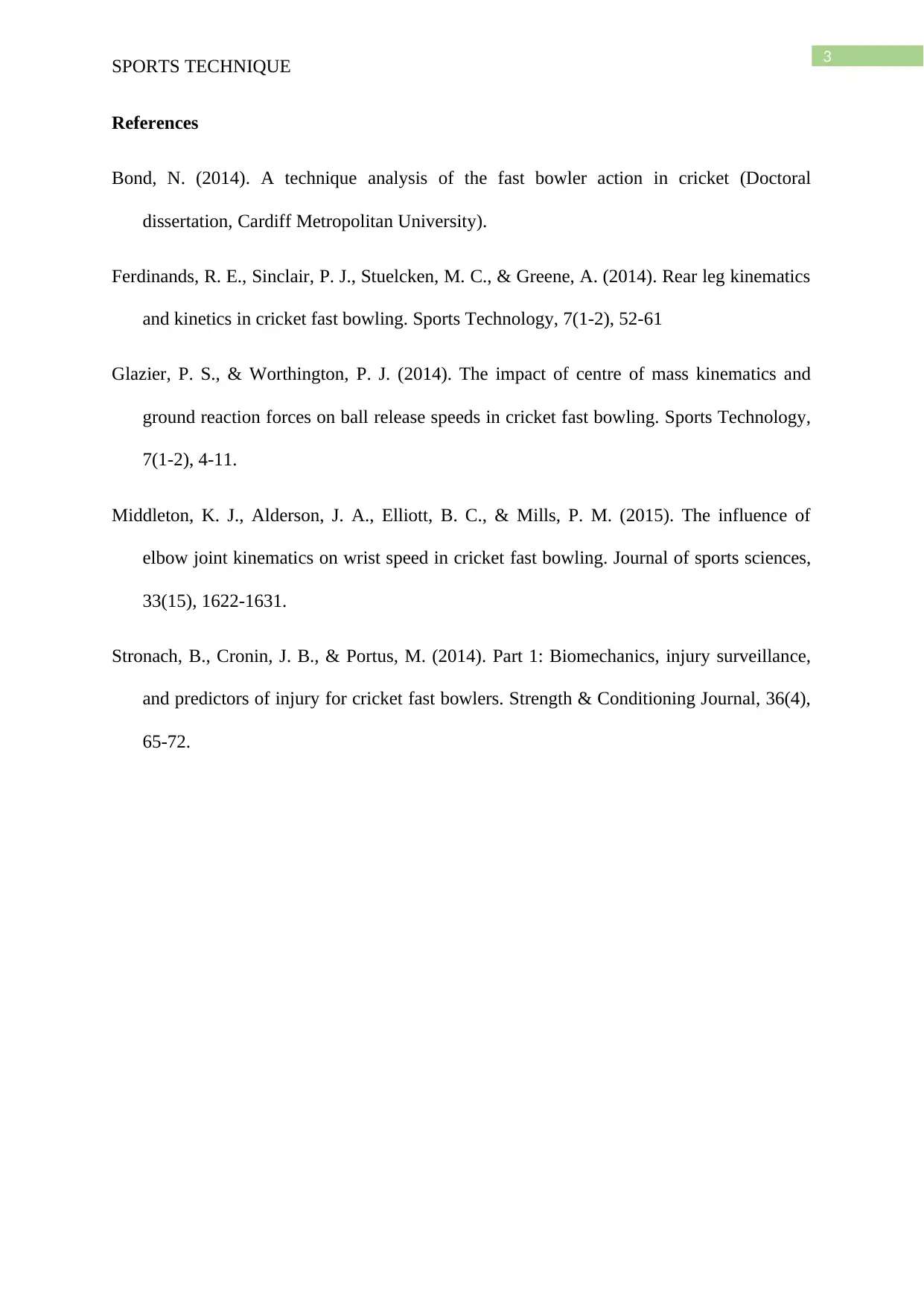
References
Bond, N. (2014). A technique analysis of the fast bowler action in cricket (Doctoral
dissertation, Cardiff Metropolitan University).
Ferdinands, R. E., Sinclair, P. J., Stuelcken, M. C., & Greene, A. (2014). Rear leg kinematics
and kinetics in cricket fast bowling. Sports Technology, 7(1-2), 52-61
Glazier, P. S., & Worthington, P. J. (2014). The impact of centre of mass kinematics and
ground reaction forces on ball release speeds in cricket fast bowling. Sports Technology,
7(1-2), 4-11.
Middleton, K. J., Alderson, J. A., Elliott, B. C., & Mills, P. M. (2015). The influence of
elbow joint kinematics on wrist speed in cricket fast bowling. Journal of sports sciences,
33(15), 1622-1631.
Stronach, B., Cronin, J. B., & Portus, M. (2014). Part 1: Biomechanics, injury surveillance,
and predictors of injury for cricket fast bowlers. Strength & Conditioning Journal, 36(4),
65-72.
chevron_up_icon
1 out of 4
circle_padding
hide_on_mobile
zoom_out_icon
[object Object]