Financial Accounting Report: Infosys and Financial Reporting Analysis
VerifiedAdded on 2023/06/09
|13
|2324
|320
Report
AI Summary
This report provides a comprehensive analysis of Infosys' financial reporting practices, focusing on the qualitative characteristics of useful financial information as defined by the IASB framework. The report identifies relevance as a key fundamental characteristic evident in Infosys' General Purpose Financial Statements (GPFS), supported by references to the company's annual reports and adherence to accounting standards. It then critically evaluates the absence of timeliness and verifiability as enhancing characteristics within the GPFS, citing specific examples like the delayed filing of Form 20F and discrepancies in the valuation of acquisitions. The study explores how the lack of these characteristics impacts decision-making processes, potentially leading to delayed or inaccurate judgments by stakeholders. Finally, the report offers actionable recommendations for decision-makers to mitigate the adverse effects of these absences, emphasizing the importance of objectivity, reliable information sources, and verification techniques to ensure the integrity and usefulness of financial reporting. The report includes a detailed analysis of the IASB framework and provides references to relevant academic literature and Infosys' annual reports.

Running head: FINANCIAL ACCOUNTING
Financial Accounting
Name of the Student:
Name of the University:
Author’s Note:
Course ID:
Financial Accounting
Name of the Student:
Name of the University:
Author’s Note:
Course ID:
Paraphrase This Document
Need a fresh take? Get an instant paraphrase of this document with our AI Paraphraser

1FINANCIAL ACCOUNTING
Table of Contents
Introduction:....................................................................................................................................2
1. One fundamental characteristic evident in the GPFS of Infosys:................................................2
2. Two enhancing characteristics not evident in the GPFS of Infosys:...........................................6
3. Effect of the absence of two qualitative characteristics on the decision-making process:..........7
4. Techniques to overcome the absence of the characteristics:.......................................................8
Conclusion:......................................................................................................................................9
References:....................................................................................................................................11
Table of Contents
Introduction:....................................................................................................................................2
1. One fundamental characteristic evident in the GPFS of Infosys:................................................2
2. Two enhancing characteristics not evident in the GPFS of Infosys:...........................................6
3. Effect of the absence of two qualitative characteristics on the decision-making process:..........7
4. Techniques to overcome the absence of the characteristics:.......................................................8
Conclusion:......................................................................................................................................9
References:....................................................................................................................................11

2FINANCIAL ACCOUNTING
Introduction:
The conceptual framework for financial reporting is formulated with the intent to assist
“International Accounting Standards Board (IASB)” in developing effective accounting policies
for areas, which are not covered on the part of standards or in which there is accounting policy
choice for better interpretation of information (Zhang & Andrew, 2014). The current assignment
would focus on selecting a stock functioning in a recognised Stock Exchange to assess its
conformance to the qualitative characteristics as laid down in the conceptual framework. Hence,
Infosys has been selected, which is an IT company, operating in the Indian Stock Exchange.
More precisely, it would intend to determine one fundamental characteristic that is evident in the
financial statements of GPFS and two qualitative characteristics not evident in the financial
statements of the organisation. Finally, the assignment would shed light on the effects of the
absence of those characteristics on the decision-making process and the ways through which
such adverse effects could be mitigated.
1. One fundamental characteristic evident in the GPFS of Infosys:
The fundamental qualitative characteristic, which is evident in the GPFS of Infosys, is
relevance. According to Gordon et al., (2015, p. 96), ‘the implied purpose of disaggregation to
help in estimation is to assure that the financial statements and their related footnotes signify the
qualitative characteristic of relevance’. Infosys has conformed to all the principles of the
Companies Act 2013 and International Financial Reporting Standards (IFRS)’. Moreover, it has
taken into consideration the current rates associated with depreciation, tax and others
(Infosys.com, 2018). Relevant information could be found about the treatment of impairment
from the annual report of the organisation. In case of revenues, the management of Infosys
Introduction:
The conceptual framework for financial reporting is formulated with the intent to assist
“International Accounting Standards Board (IASB)” in developing effective accounting policies
for areas, which are not covered on the part of standards or in which there is accounting policy
choice for better interpretation of information (Zhang & Andrew, 2014). The current assignment
would focus on selecting a stock functioning in a recognised Stock Exchange to assess its
conformance to the qualitative characteristics as laid down in the conceptual framework. Hence,
Infosys has been selected, which is an IT company, operating in the Indian Stock Exchange.
More precisely, it would intend to determine one fundamental characteristic that is evident in the
financial statements of GPFS and two qualitative characteristics not evident in the financial
statements of the organisation. Finally, the assignment would shed light on the effects of the
absence of those characteristics on the decision-making process and the ways through which
such adverse effects could be mitigated.
1. One fundamental characteristic evident in the GPFS of Infosys:
The fundamental qualitative characteristic, which is evident in the GPFS of Infosys, is
relevance. According to Gordon et al., (2015, p. 96), ‘the implied purpose of disaggregation to
help in estimation is to assure that the financial statements and their related footnotes signify the
qualitative characteristic of relevance’. Infosys has conformed to all the principles of the
Companies Act 2013 and International Financial Reporting Standards (IFRS)’. Moreover, it has
taken into consideration the current rates associated with depreciation, tax and others
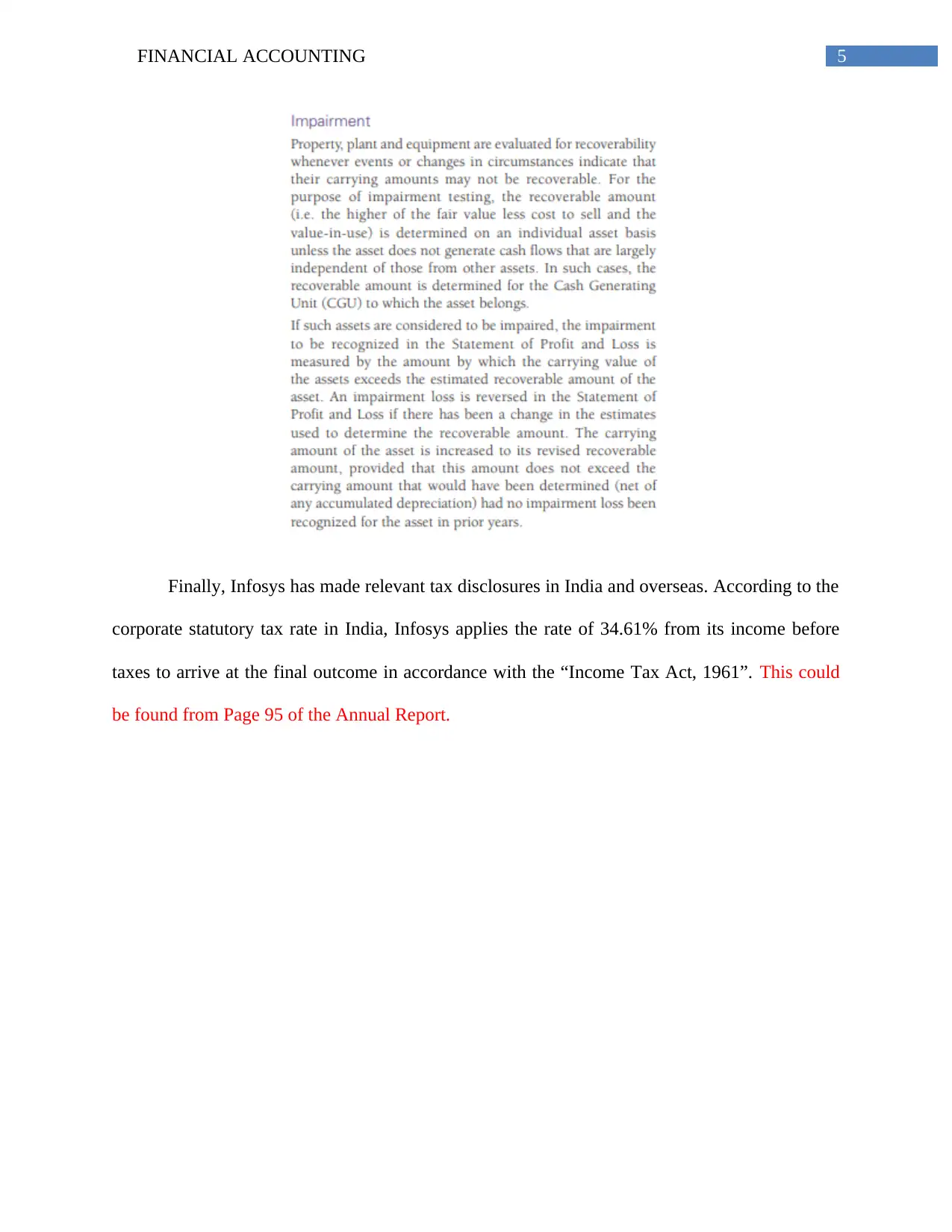
(Infosys.com, 2018). Relevant information could be found about the treatment of impairment
from the annual report of the organisation. In case of revenues, the management of Infosys
⊘ This is a preview!⊘
Do you want full access?
Subscribe today to unlock all pages.

Trusted by 1+ million students worldwide

3FINANCIAL ACCOUNTING
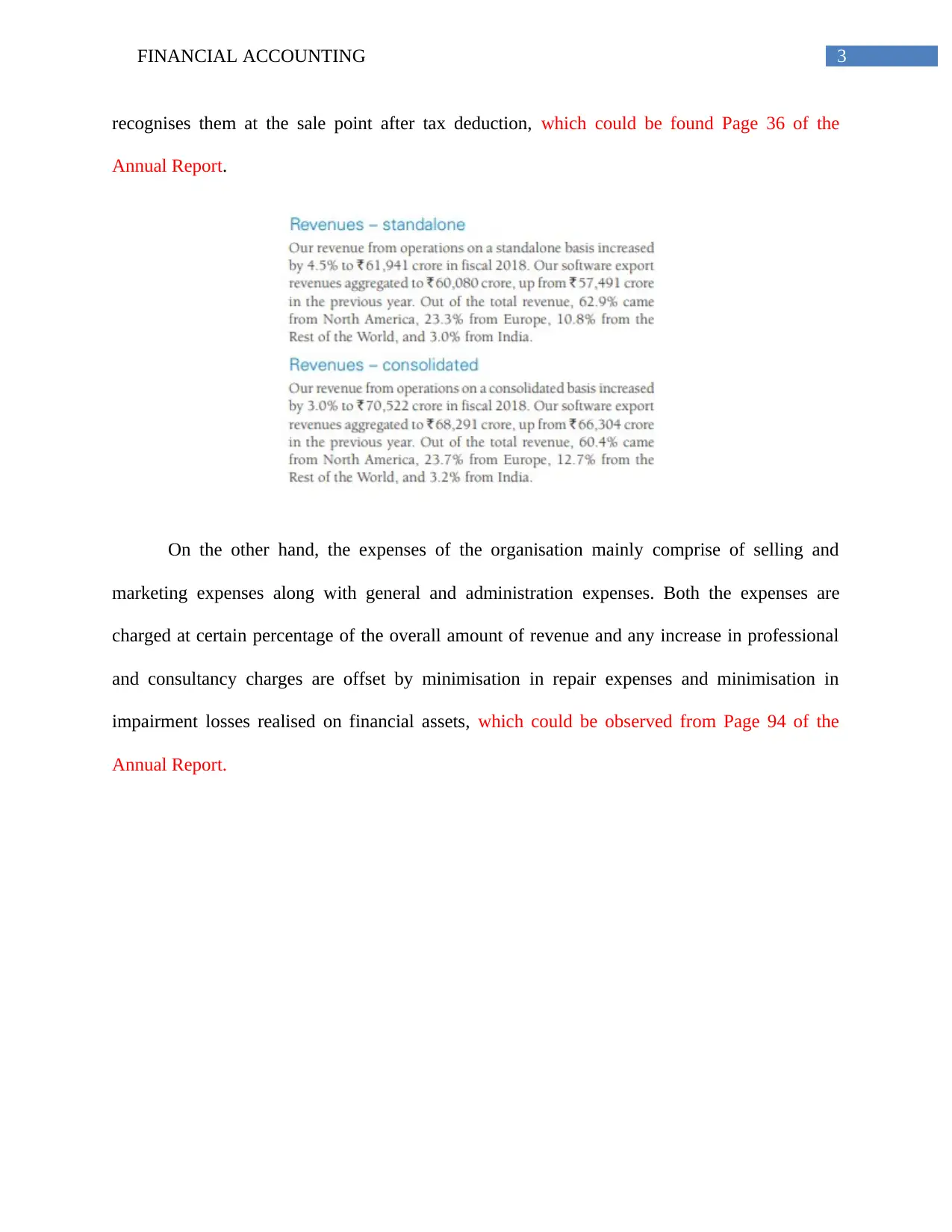
recognises them at the sale point after tax deduction, which could be found Page 36 of the
Annual Report.
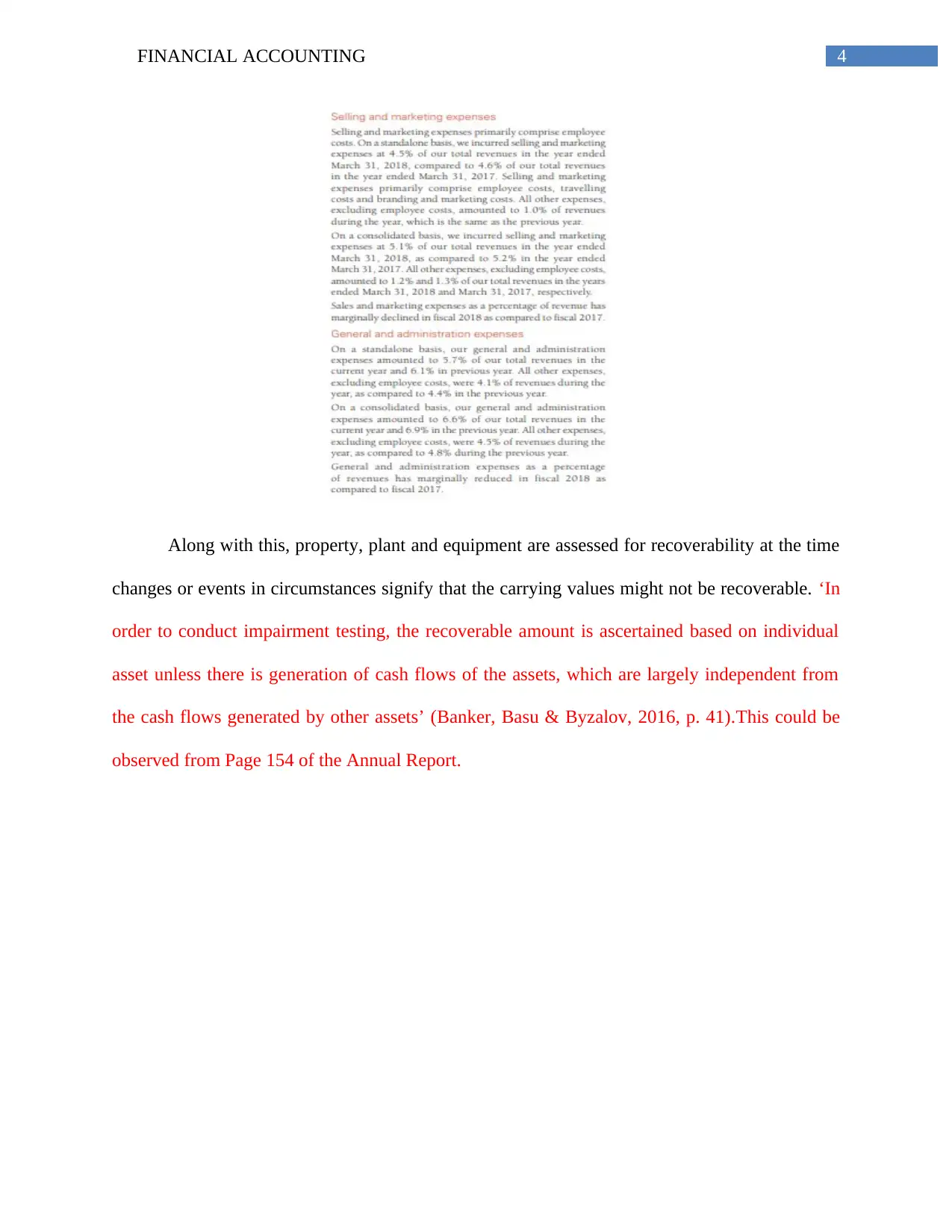
On the other hand, the expenses of the organisation mainly comprise of selling and
marketing expenses along with general and administration expenses. Both the expenses are
charged at certain percentage of the overall amount of revenue and any increase in professional
and consultancy charges are offset by minimisation in repair expenses and minimisation in
impairment losses realised on financial assets, which could be observed from Page 94 of the
Annual Report.
recognises them at the sale point after tax deduction, which could be found Page 36 of the
Annual Report.
On the other hand, the expenses of the organisation mainly comprise of selling and
marketing expenses along with general and administration expenses. Both the expenses are
charged at certain percentage of the overall amount of revenue and any increase in professional
and consultancy charges are offset by minimisation in repair expenses and minimisation in
impairment losses realised on financial assets, which could be observed from Page 94 of the
Annual Report.
Paraphrase This Document
Need a fresh take? Get an instant paraphrase of this document with our AI Paraphraser

4FINANCIAL ACCOUNTING
Along with this, property, plant and equipment are assessed for recoverability at the time
changes or events in circumstances signify that the carrying values might not be recoverable. ‘In
order to conduct impairment testing, the recoverable amount is ascertained based on individual
asset unless there is generation of cash flows of the assets, which are largely independent from
the cash flows generated by other assets’ (Banker, Basu & Byzalov, 2016, p. 41).This could be
observed from Page 154 of the Annual Report.
Along with this, property, plant and equipment are assessed for recoverability at the time
changes or events in circumstances signify that the carrying values might not be recoverable. ‘In
order to conduct impairment testing, the recoverable amount is ascertained based on individual
asset unless there is generation of cash flows of the assets, which are largely independent from
the cash flows generated by other assets’ (Banker, Basu & Byzalov, 2016, p. 41).This could be
observed from Page 154 of the Annual Report.

5FINANCIAL ACCOUNTING
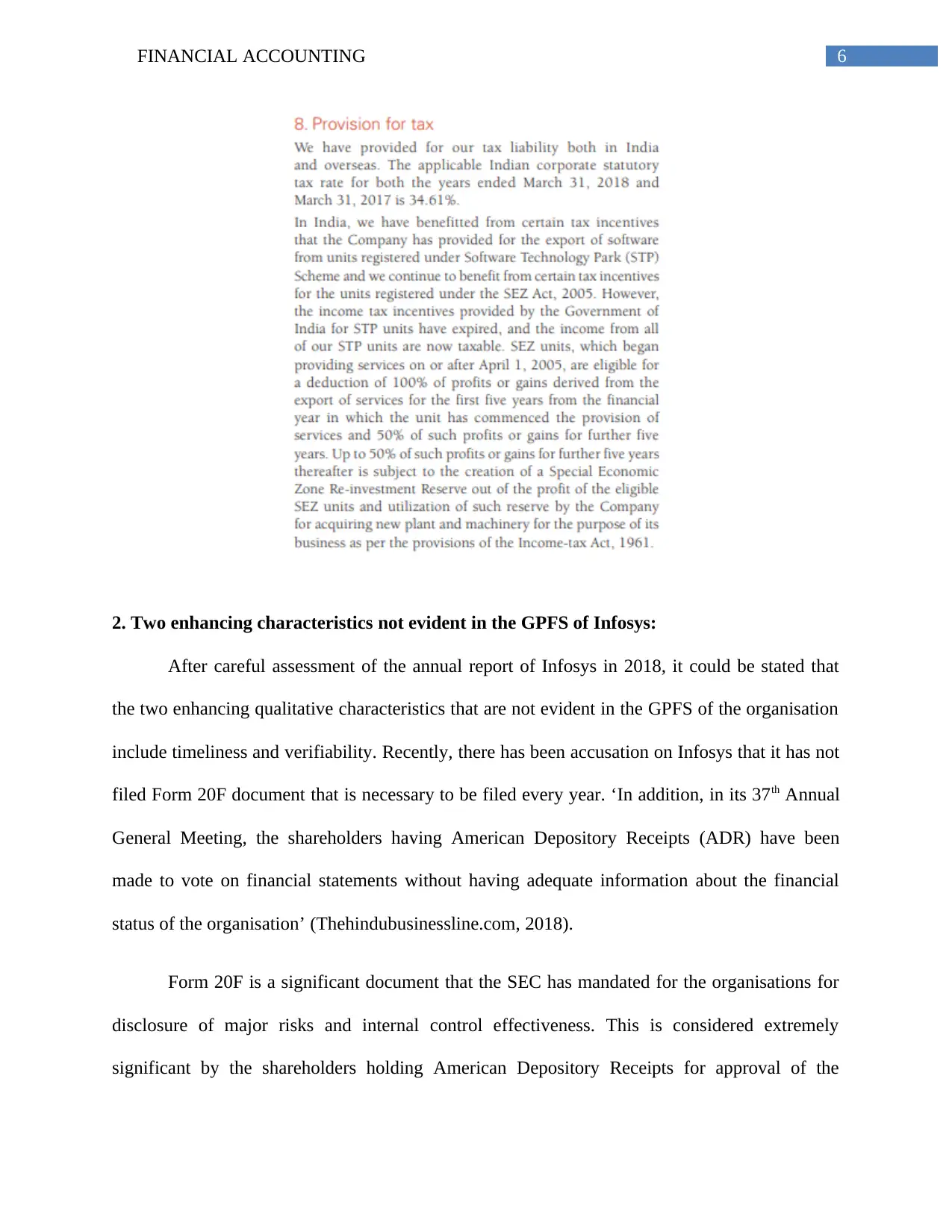
Finally, Infosys has made relevant tax disclosures in India and overseas. According to the
corporate statutory tax rate in India, Infosys applies the rate of 34.61% from its income before
taxes to arrive at the final outcome in accordance with the “Income Tax Act, 1961”. This could
be found from Page 95 of the Annual Report.
Finally, Infosys has made relevant tax disclosures in India and overseas. According to the
corporate statutory tax rate in India, Infosys applies the rate of 34.61% from its income before
taxes to arrive at the final outcome in accordance with the “Income Tax Act, 1961”. This could
be found from Page 95 of the Annual Report.
⊘ This is a preview!⊘
Do you want full access?
Subscribe today to unlock all pages.

Trusted by 1+ million students worldwide

6FINANCIAL ACCOUNTING
2. Two enhancing characteristics not evident in the GPFS of Infosys:
After careful assessment of the annual report of Infosys in 2018, it could be stated that
the two enhancing qualitative characteristics that are not evident in the GPFS of the organisation
include timeliness and verifiability. Recently, there has been accusation on Infosys that it has not
filed Form 20F document that is necessary to be filed every year. ‘In addition, in its 37th Annual
General Meeting, the shareholders having American Depository Receipts (ADR) have been
made to vote on financial statements without having adequate information about the financial
status of the organisation’ (Thehindubusinessline.com, 2018).
Form 20F is a significant document that the SEC has mandated for the organisations for
disclosure of major risks and internal control effectiveness. This is considered extremely
significant by the shareholders holding American Depository Receipts for approval of the
2. Two enhancing characteristics not evident in the GPFS of Infosys:
After careful assessment of the annual report of Infosys in 2018, it could be stated that
the two enhancing qualitative characteristics that are not evident in the GPFS of the organisation
include timeliness and verifiability. Recently, there has been accusation on Infosys that it has not
filed Form 20F document that is necessary to be filed every year. ‘In addition, in its 37th Annual
General Meeting, the shareholders having American Depository Receipts (ADR) have been
made to vote on financial statements without having adequate information about the financial
status of the organisation’ (Thehindubusinessline.com, 2018).
Form 20F is a significant document that the SEC has mandated for the organisations for
disclosure of major risks and internal control effectiveness. This is considered extremely
significant by the shareholders holding American Depository Receipts for approval of the
Paraphrase This Document
Need a fresh take? Get an instant paraphrase of this document with our AI Paraphraser

7FINANCIAL ACCOUNTING
financial information. It is necessary to document this file within six months of the fiscal year
end of the organisation. ‘The sensitivity of earnings to returns of an organisation helps in
measuring the aspect of timeliness’ (Nobes & Stadler, 2015, p. 11). In case of Infosys, no
disclosure has been made regarding the filing of Form 20F document and hence, timeliness
aspect is not present in its annual report.
Recently Infosys has acquired Panaya, an Israeli firm, in which dispute could be observed
between propriety and valuation of the deal. The organisation has recognised an impairment loss
of $18 million for Panaya and Skava and the assets and liabilities of the organisation have been
re-categorised and presented as held for sale. This information was not disclosed in the annual
report of the organisation in 2018 and hence, the shareholders could not verify the actual
financial condition of the organisation. Thus, Infosys has not conformed to the verifiability
characteristic of GPFS.
3. Effect of the absence of two qualitative characteristics on the decision-making process:
As stated by Hussey (2014, p. 76), ‘the timeliness of the accounting information is
referred as the provision of the information provided to the users which allow them to take quick
action’. It is regarded as one of the crucial five elements of the decision-making process. ‘It
needs to be further observed that if there is unavailability of information when required or
information is accessible after reporting events, there would be lack of relevance as well’
(Isiavwe, Adetiloye & Eriabie, 2017, pp. 5-6). In case, a person is unable to make a decision in a
timely manner it may lead to loss of customer as well as the overall business of Infosys. In case
the information is not reported within time in a company like Infosys, it becomes useless and
obsolete. The timeliness factor is usually responsible to specify the important aspect of the
financial information. It is necessary to document this file within six months of the fiscal year
end of the organisation. ‘The sensitivity of earnings to returns of an organisation helps in
measuring the aspect of timeliness’ (Nobes & Stadler, 2015, p. 11). In case of Infosys, no
disclosure has been made regarding the filing of Form 20F document and hence, timeliness
aspect is not present in its annual report.
Recently Infosys has acquired Panaya, an Israeli firm, in which dispute could be observed
between propriety and valuation of the deal. The organisation has recognised an impairment loss
of $18 million for Panaya and Skava and the assets and liabilities of the organisation have been
re-categorised and presented as held for sale. This information was not disclosed in the annual
report of the organisation in 2018 and hence, the shareholders could not verify the actual
financial condition of the organisation. Thus, Infosys has not conformed to the verifiability
characteristic of GPFS.
3. Effect of the absence of two qualitative characteristics on the decision-making process:
As stated by Hussey (2014, p. 76), ‘the timeliness of the accounting information is
referred as the provision of the information provided to the users which allow them to take quick
action’. It is regarded as one of the crucial five elements of the decision-making process. ‘It
needs to be further observed that if there is unavailability of information when required or
information is accessible after reporting events, there would be lack of relevance as well’
(Isiavwe, Adetiloye & Eriabie, 2017, pp. 5-6). In case, a person is unable to make a decision in a
timely manner it may lead to loss of customer as well as the overall business of Infosys. In case
the information is not reported within time in a company like Infosys, it becomes useless and
obsolete. The timeliness factor is usually responsible to specify the important aspect of the

8FINANCIAL ACCOUNTING
statute for preparation and presentation of the financial reports. ‘In case there is any delay in the
retrieval of financial data, it may even lead to incorrect presentation of information, as timeliness
is associated with cost of equity capital’ (Persakis & Iatridis, 2017, p. 13).
Secondly, the verifiability aspect ensures that the information is represented faithfully in
economic phenomena, which states the purpose of the report. In case, verifiability aspect is
absent, the decision-making process by the independent accountants could not ensure that a
specific depiction is a faithful representation (Scott, 2018). Similar to the timeliness aspect the
verifiability aspect is seen to be having a significant impact on the financial statement of a
company like Infosys. The absence of verifiability aspect further affects the reliability and
accuracy of the information. The main decision which may get affected in the absence of these
characteristics is also depicted with incorrect evaluation of informal data.
4. Techniques to overcome the absence of the characteristics:
The verifiability aspect in an organization such as Infosys can be maintained with the
adherence to the various types of the policies pertaining to the practice of objectivity. This will
allow the company to evaluate the financial statements in terms of the various types of the
measures which are seen to be associated with the uniformity and reliability aspects. In addition
to this, the management accountant needs to ensure that the information with the top-level
management. The management accountants need to be ensured that the facilitated information
does not contain alterations and it is relevant to the accurate decision making. ‘For such
assurance, it is necessary to carry out direct verification like direct observations and indirect
verifications like checking inputs to any model along with recomputing the outputs with similar
methodology’ (Aasb.gov.au, 2018).
statute for preparation and presentation of the financial reports. ‘In case there is any delay in the
retrieval of financial data, it may even lead to incorrect presentation of information, as timeliness
is associated with cost of equity capital’ (Persakis & Iatridis, 2017, p. 13).
Secondly, the verifiability aspect ensures that the information is represented faithfully in
economic phenomena, which states the purpose of the report. In case, verifiability aspect is
absent, the decision-making process by the independent accountants could not ensure that a
specific depiction is a faithful representation (Scott, 2018). Similar to the timeliness aspect the
verifiability aspect is seen to be having a significant impact on the financial statement of a
company like Infosys. The absence of verifiability aspect further affects the reliability and
accuracy of the information. The main decision which may get affected in the absence of these
characteristics is also depicted with incorrect evaluation of informal data.
4. Techniques to overcome the absence of the characteristics:
The verifiability aspect in an organization such as Infosys can be maintained with the
adherence to the various types of the policies pertaining to the practice of objectivity. This will
allow the company to evaluate the financial statements in terms of the various types of the
measures which are seen to be associated with the uniformity and reliability aspects. In addition
to this, the management accountant needs to ensure that the information with the top-level
management. The management accountants need to be ensured that the facilitated information
does not contain alterations and it is relevant to the accurate decision making. ‘For such
assurance, it is necessary to carry out direct verification like direct observations and indirect
verifications like checking inputs to any model along with recomputing the outputs with similar
methodology’ (Aasb.gov.au, 2018).
⊘ This is a preview!⊘
Do you want full access?
Subscribe today to unlock all pages.

Trusted by 1+ million students worldwide

9FINANCIAL ACCOUNTING
In order to avoid the problem of verifiability the decision maker needs to ensure that the
facilitated information is coming from a reliable source. The verifiability of the accounting
information in a company like Infosys may be implemented both the direct and the indirect
methodology. In case the company is seen to be following the direct method of the verifiability
of the information, the cash is counted on the end of each year. In addition to this, if the company
is depicted to follow the direct verification, the cash in hand will be counted at the end of each
year. In case the company is depicted to be following the method of the direct verification the
main process of the verifiability aspect needs to be ensured with the following of a trend of
recalculation of the value of the of the inventory has been able to confirm the various types of the
factors to confirm the implication of the various types of the valuation methods. The disclosure
pertaining to the pending cases also needs to be verified as per the different types of tenure of
thee cases. Some of the important considerations which the management needs to be take are
also seen to be related to the verifying the information from beforehand. ‘It is the duty of the top
management in ensuring the reliability of accumulated information’ (Bellandi, 2017, p.29).
Conclusion:
It can be concluded verifiability and the timeliness are seen as the main aspects which the
company does not follow. Secondly, the relevance aspect of the company is maintained by
Infosys. The important effect on the decision making related to the verifiability aspect is seen to
be based on the various types of the factors which are seen with the delay in the processing of the
financial information. In addition to this, if verifiability aspect is not maintained by the company
this may lead to several inconsistencies in the accounting information. The decision making as
per the verifiability can be ensured with the policies pertaining to the practice of objectivity. This
will be able to ensure that the main implication on the evaluating the financial statements in
In order to avoid the problem of verifiability the decision maker needs to ensure that the
facilitated information is coming from a reliable source. The verifiability of the accounting
information in a company like Infosys may be implemented both the direct and the indirect
methodology. In case the company is seen to be following the direct method of the verifiability
of the information, the cash is counted on the end of each year. In addition to this, if the company
is depicted to follow the direct verification, the cash in hand will be counted at the end of each
year. In case the company is depicted to be following the method of the direct verification the
main process of the verifiability aspect needs to be ensured with the following of a trend of
recalculation of the value of the of the inventory has been able to confirm the various types of the
factors to confirm the implication of the various types of the valuation methods. The disclosure
pertaining to the pending cases also needs to be verified as per the different types of tenure of
thee cases. Some of the important considerations which the management needs to be take are
also seen to be related to the verifying the information from beforehand. ‘It is the duty of the top
management in ensuring the reliability of accumulated information’ (Bellandi, 2017, p.29).
Conclusion:
It can be concluded verifiability and the timeliness are seen as the main aspects which the
company does not follow. Secondly, the relevance aspect of the company is maintained by
Infosys. The important effect on the decision making related to the verifiability aspect is seen to
be based on the various types of the factors which are seen with the delay in the processing of the
financial information. In addition to this, if verifiability aspect is not maintained by the company
this may lead to several inconsistencies in the accounting information. The decision making as
per the verifiability can be ensured with the policies pertaining to the practice of objectivity. This
will be able to ensure that the main implication on the evaluating the financial statements in
Paraphrase This Document
Need a fresh take? Get an instant paraphrase of this document with our AI Paraphraser

10FINANCIAL ACCOUNTING
terms of the various types of the measures which are seen to associated with the uniformity and
reliability aspects.
terms of the various types of the measures which are seen to associated with the uniformity and
reliability aspects.

11FINANCIAL ACCOUNTING
References:
Books:
Bellandi, F. (2017). Materiality in Financial Reporting: An Integrative Perspective. Emerald
Group Publishing.
Hussey, R. (2014). MBA Accounting. Macmillan International Higher Education.
Scott, P. (2018). Introduction to Accounting. Oxford University Press.
Journals:
Banker, R. D., Basu, S., & Byzalov, D. (2016). Implications of Impairment Decisions and
Assets' Cash-Flow Horizons for Conservatism Research. The Accounting Review, 92(2),
41-67.
Gordon, E. A., Bischof, J., Daske, H., Munter, P., Saka, C., Smith, K. J., & Venter, E. R. (2015).
The IASB's discussion paper on the Conceptual framework for financial reporting: a
commentary and research review. Journal of International Financial Management &
Accounting, 26(1), 72-110.
Isiavwe, D. T., Adetiloye, K. A., & Eriabie, S. O. (2017). FINANCIAL REPORTS AND
SHAREHOLDERS’DECISION MAKING IN NIGERIA: ANY
CONNECTEDNESS?. Journal of Internet Banking and Commerce, 22(8), 1-14.
Nobes, C. W., & Stadler, C. (2015). The qualitative characteristics of financial information, and
managers’ accounting decisions: evidence from IFRS policy changes. Accounting and
Business Research, 45(5), 1-51.
References:
Books:
Bellandi, F. (2017). Materiality in Financial Reporting: An Integrative Perspective. Emerald
Group Publishing.
Hussey, R. (2014). MBA Accounting. Macmillan International Higher Education.
Scott, P. (2018). Introduction to Accounting. Oxford University Press.
Journals:
Banker, R. D., Basu, S., & Byzalov, D. (2016). Implications of Impairment Decisions and
Assets' Cash-Flow Horizons for Conservatism Research. The Accounting Review, 92(2),
41-67.
Gordon, E. A., Bischof, J., Daske, H., Munter, P., Saka, C., Smith, K. J., & Venter, E. R. (2015).
The IASB's discussion paper on the Conceptual framework for financial reporting: a
commentary and research review. Journal of International Financial Management &
Accounting, 26(1), 72-110.
Isiavwe, D. T., Adetiloye, K. A., & Eriabie, S. O. (2017). FINANCIAL REPORTS AND
SHAREHOLDERS’DECISION MAKING IN NIGERIA: ANY
CONNECTEDNESS?. Journal of Internet Banking and Commerce, 22(8), 1-14.
Nobes, C. W., & Stadler, C. (2015). The qualitative characteristics of financial information, and
managers’ accounting decisions: evidence from IFRS policy changes. Accounting and
Business Research, 45(5), 1-51.
⊘ This is a preview!⊘
Do you want full access?
Subscribe today to unlock all pages.

Trusted by 1+ million students worldwide
1 out of 13
Related Documents
Your All-in-One AI-Powered Toolkit for Academic Success.
+13062052269
info@desklib.com
Available 24*7 on WhatsApp / Email
Unlock your academic potential
Copyright © 2020–2025 A2Z Services. All Rights Reserved. Developed and managed by ZUCOL.