Research Proposal: Project Management and Quality Control
VerifiedAdded on 2022/08/25
|22
|6218
|16
Project
AI Summary
This research proposal investigates the relationship between project management practices and quality control within the construction industry. It begins with an introduction highlighting the importance of quality management in construction projects and the need for this research. A thorough literature review examines existing research on project management principles, quality management phases, and their impact on project outcomes, referencing various authors and studies. The proposal outlines the methodologies to be employed, including the research question, hypothesis, and data collection methods. It also covers ethical considerations, sampling strategies, and a detailed time plan for the research. The study aims to clarify the effects of effective project management on quality control, emphasizing the importance of maintaining consistent quality throughout all project stages to minimize defects, reduce costs, and enhance client satisfaction.
Running head: RESEARCH PROPOSAL
Research Proposal
Topic: Project Management and its effect on Quality Control in the Construction Industry
Name of the Student
Name of the University
Author Note
Research Proposal
Topic: Project Management and its effect on Quality Control in the Construction Industry
Name of the Student
Name of the University
Author Note

Paraphrase This Document
Need a fresh take? Get an instant paraphrase of this document with our AI Paraphraser
1RESEARCH PROPOSAL
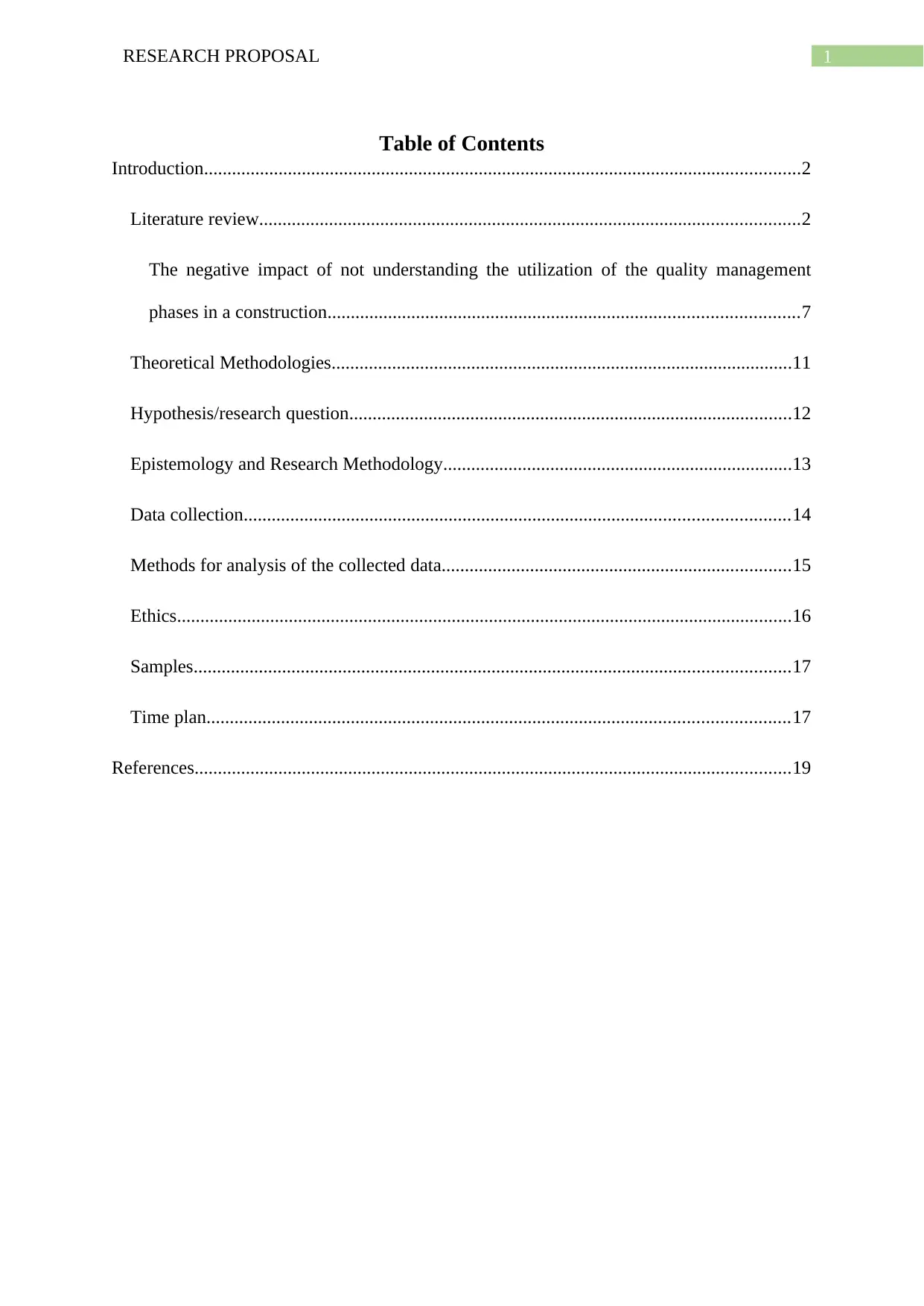
Table of Contents
Introduction................................................................................................................................2
Literature review....................................................................................................................2
The negative impact of not understanding the utilization of the quality management
phases in a construction.....................................................................................................7
Theoretical Methodologies...................................................................................................11
Hypothesis/research question...............................................................................................12
Epistemology and Research Methodology...........................................................................13
Data collection.....................................................................................................................14
Methods for analysis of the collected data...........................................................................15
Ethics....................................................................................................................................16
Samples................................................................................................................................17
Time plan.............................................................................................................................17
References................................................................................................................................19
Table of Contents
Introduction................................................................................................................................2
Literature review....................................................................................................................2
The negative impact of not understanding the utilization of the quality management
phases in a construction.....................................................................................................7
Theoretical Methodologies...................................................................................................11
Hypothesis/research question...............................................................................................12
Epistemology and Research Methodology...........................................................................13
Data collection.....................................................................................................................14
Methods for analysis of the collected data...........................................................................15
Ethics....................................................................................................................................16
Samples................................................................................................................................17
Time plan.............................................................................................................................17
References................................................................................................................................19
2RESEARCH PROPOSAL
Introduction
Every organisation foresees a project taken by them as an act of adding benefits to the
organisation. Before delivering the end products, which might be a product or service, to the
customers of the organisation, it needs to be kept in mind that quality of the product of the
service is consistent. The end product deliver to the customers all the consumers need to have
a proper quality maintained not just during the product delivery but also throughout all the
stages and phases of proper project management. Construction industry as well the act of
overseeing all this activity to maintain the desired level of excellence through quality
management is required. It would have several features to focus on maintaining the proper
quality of the construction project. The delivery of the project in construction industry
depends upon the quality of the product and service (Rumane 2016). Its pants several policies
and procedures put into place that is developed by the management body. It is the
responsibility of the executive to develop policies, procedures and processes through the
management of a project for maintaining quality at every project please resulting into
excellent product or service delivered to the clients. Every construction project needs to
maintain quality through principles and guidelines followed by every team member within
the project so that the resulting quality add to the benefit of the organisation and success of
the project. Minimising the defects on asset delivery or maintaining the defects on the
resources providing the end product is much reduced due to the quality management
protocols followed through the management of an ongoing project. This is why this particular
research is going to be conducted so that project management and its effect on quality control
in the construction industry can be clearly pointed out.
Introduction
Every organisation foresees a project taken by them as an act of adding benefits to the
organisation. Before delivering the end products, which might be a product or service, to the
customers of the organisation, it needs to be kept in mind that quality of the product of the
service is consistent. The end product deliver to the customers all the consumers need to have
a proper quality maintained not just during the product delivery but also throughout all the
stages and phases of proper project management. Construction industry as well the act of
overseeing all this activity to maintain the desired level of excellence through quality
management is required. It would have several features to focus on maintaining the proper
quality of the construction project. The delivery of the project in construction industry
depends upon the quality of the product and service (Rumane 2016). Its pants several policies
and procedures put into place that is developed by the management body. It is the
responsibility of the executive to develop policies, procedures and processes through the
management of a project for maintaining quality at every project please resulting into
excellent product or service delivered to the clients. Every construction project needs to
maintain quality through principles and guidelines followed by every team member within
the project so that the resulting quality add to the benefit of the organisation and success of
the project. Minimising the defects on asset delivery or maintaining the defects on the
resources providing the end product is much reduced due to the quality management
protocols followed through the management of an ongoing project. This is why this particular
research is going to be conducted so that project management and its effect on quality control
in the construction industry can be clearly pointed out.
⊘ This is a preview!⊘
Do you want full access?
Subscribe today to unlock all pages.

Trusted by 1+ million students worldwide
3RESEARCH PROPOSAL
Literature review
According to several researches conducted by different authors, this section would
provide a thorough idea about how the variations of quality is maintained in the project for
construction industry. There are several authors that have pointed out the key factor of quality
that construction industry understand and implement within an organisation. This section
would short list the project management principles that construction industry based
organisations normally take up and the ways that they are conducted. The association of each
of these project would be separated by their subjects depending on how each of the research
paper focuses more on quality management factors. Then the impact of applying quality
management factors resulting into to the end product would be selected as the papers that
would be ideal for the conduction of this literature review.
Based on the collection of research papers, the findings of the studies are conducted
aligning to the Research question and objectives.
According to the author Sertyesilisik and Kivircik (2017), Construction Company is
mostly focused on wanting to deliver a quality of product or service not just at the end
product but also for delivering quality throughout every phase of the project. Usually the
construction business is set on the quality of the end products and this is why every
construction industry organisation carefully focuses on the principle guidelines that the
employees within the organisation need to follow to maintain proper quality at every stage of
the project. For this is primary idea of maintaining quality which reflects at the end product to
the clients, as per the author and finding suggest. Mostly there are two mentalities working
behind the quality maintenance in the construction project that also become the major
objectives of making a project maintain its quality. Firstly, maintaining quality would
minimise the defects that normally occurs on the assets delivery during handover of the
project. Simply putting it forward, this means that the construction industry is of the belief
Literature review
According to several researches conducted by different authors, this section would
provide a thorough idea about how the variations of quality is maintained in the project for
construction industry. There are several authors that have pointed out the key factor of quality
that construction industry understand and implement within an organisation. This section
would short list the project management principles that construction industry based
organisations normally take up and the ways that they are conducted. The association of each
of these project would be separated by their subjects depending on how each of the research
paper focuses more on quality management factors. Then the impact of applying quality
management factors resulting into to the end product would be selected as the papers that
would be ideal for the conduction of this literature review.
Based on the collection of research papers, the findings of the studies are conducted
aligning to the Research question and objectives.
According to the author Sertyesilisik and Kivircik (2017), Construction Company is
mostly focused on wanting to deliver a quality of product or service not just at the end
product but also for delivering quality throughout every phase of the project. Usually the
construction business is set on the quality of the end products and this is why every
construction industry organisation carefully focuses on the principle guidelines that the
employees within the organisation need to follow to maintain proper quality at every stage of
the project. For this is primary idea of maintaining quality which reflects at the end product to
the clients, as per the author and finding suggest. Mostly there are two mentalities working
behind the quality maintenance in the construction project that also become the major
objectives of making a project maintain its quality. Firstly, maintaining quality would
minimise the defects that normally occurs on the assets delivery during handover of the
project. Simply putting it forward, this means that the construction industry is of the belief
Paraphrase This Document
Need a fresh take? Get an instant paraphrase of this document with our AI Paraphraser
4RESEARCH PROPOSAL
that maintaining quality throughout the entire project would reduce the misuse of assets that
are being included in the project currently and during the handover of the project the
minimization of the defects would make sure that the resources have not been wasted.
Moreover comma during maintenance of proper principles and guidelines for maintaining
quality of the end products in the construction project, it is easier to identify the facts and
issues in a project before the clients can point them out. Identifying the defects in the
products or services before handing them over to the client would provide mechanism to
solve it as well, maintaining the reputation of the organisation. Therefore as per the author,
there are several benefits that any organisation can input throughout the conduction of the
ongoing process in a project by maintaining proper quality at every project phase. The
benefits of such manifold that the organisation can provide an excellent quality product or
service to the client adding to their reputation and continuing for getting more work and
building a strong and positive reputation in the market.
As per the research conducted by the author Banihashemi et al. (2017), construction
industry is based upon several policies and prove that the people within the organisation need
to follow while they take up new project. This ensures that any kind of mistake are prevented
so that the conducts of the employees within the organisation during a project is cost
effective. The upfront investment that is made in construction industry is comparatively much
bigger than the investments made in The Other industries. One of the major factors that
organisations in the construction industry are found to be taking up every now and then is the
establishment of policies and procedures to maintain quality. The construction industries are
mostly found to be establishing a quality management plan before the project begins. This
quality management plan mostly has four phases that would be offering a huge cost effective
measure for maintaining the quality throughout the project life cycle. Following would be the
that maintaining quality throughout the entire project would reduce the misuse of assets that
are being included in the project currently and during the handover of the project the
minimization of the defects would make sure that the resources have not been wasted.
Moreover comma during maintenance of proper principles and guidelines for maintaining
quality of the end products in the construction project, it is easier to identify the facts and
issues in a project before the clients can point them out. Identifying the defects in the
products or services before handing them over to the client would provide mechanism to
solve it as well, maintaining the reputation of the organisation. Therefore as per the author,
there are several benefits that any organisation can input throughout the conduction of the
ongoing process in a project by maintaining proper quality at every project phase. The
benefits of such manifold that the organisation can provide an excellent quality product or
service to the client adding to their reputation and continuing for getting more work and
building a strong and positive reputation in the market.
As per the research conducted by the author Banihashemi et al. (2017), construction
industry is based upon several policies and prove that the people within the organisation need
to follow while they take up new project. This ensures that any kind of mistake are prevented
so that the conducts of the employees within the organisation during a project is cost
effective. The upfront investment that is made in construction industry is comparatively much
bigger than the investments made in The Other industries. One of the major factors that
organisations in the construction industry are found to be taking up every now and then is the
establishment of policies and procedures to maintain quality. The construction industries are
mostly found to be establishing a quality management plan before the project begins. This
quality management plan mostly has four phases that would be offering a huge cost effective
measure for maintaining the quality throughout the project life cycle. Following would be the
5RESEARCH PROPOSAL
quality plan that construction industry generally outline before beginning a project consisting
of four main sections:
Establishing the quality procedures: The establishment of quality procedure is
derived by the goals that the organisation is currently focusing at. This is enabled by the
setting of the goals before the progress of the project begins. This particular phase before the
initiation of a project is extremely difficult for different organisations in the construction
industry as creation of the plan is difficult with involvement of procedures consisting of
several employees within the team to be trained and monitor the same time then sitting down
and planning the courses of action. There are four key areas that mostly the construction
industry follows for a comprehensive quality procedure establishment aligning with the
critical procedures of the project. These areas are the control documents, the quality audit, the
non-conformance control and the corrective and preventive actions.
Quality Management documentation: As per the project management faces initiation
of a plan would be put into action by proper documentation. Therefore during the initial
phase of the project, when quality management procedures are planned the documentation
would typically start along with the procedures. These are mostly oriented by plants and are
comprehensive in nature and outlines the summary of the quality management required
during the project progression. The procedure documentation reflects on how the quality
would be captured and how the organisation is planning to track the point from where quality
would start to enhance and impact the outcome of the project (Banihashemi et al. 2017). This
is the same area where the quality management form would generate to be presented to the
engineers, and the project managers and other employees within the organisation that has the
responsibility of working together as a team for the project. The forms would be deployed to
them so that they approve of the quality management phases and also understand their
individual responsibilities to make sure that the quality of the project is maintained. It is also
quality plan that construction industry generally outline before beginning a project consisting
of four main sections:
Establishing the quality procedures: The establishment of quality procedure is
derived by the goals that the organisation is currently focusing at. This is enabled by the
setting of the goals before the progress of the project begins. This particular phase before the
initiation of a project is extremely difficult for different organisations in the construction
industry as creation of the plan is difficult with involvement of procedures consisting of
several employees within the team to be trained and monitor the same time then sitting down
and planning the courses of action. There are four key areas that mostly the construction
industry follows for a comprehensive quality procedure establishment aligning with the
critical procedures of the project. These areas are the control documents, the quality audit, the
non-conformance control and the corrective and preventive actions.
Quality Management documentation: As per the project management faces initiation
of a plan would be put into action by proper documentation. Therefore during the initial
phase of the project, when quality management procedures are planned the documentation
would typically start along with the procedures. These are mostly oriented by plants and are
comprehensive in nature and outlines the summary of the quality management required
during the project progression. The procedure documentation reflects on how the quality
would be captured and how the organisation is planning to track the point from where quality
would start to enhance and impact the outcome of the project (Banihashemi et al. 2017). This
is the same area where the quality management form would generate to be presented to the
engineers, and the project managers and other employees within the organisation that has the
responsibility of working together as a team for the project. The forms would be deployed to
them so that they approve of the quality management phases and also understand their
individual responsibilities to make sure that the quality of the project is maintained. It is also
⊘ This is a preview!⊘
Do you want full access?
Subscribe today to unlock all pages.
Trusted by 1+ million students worldwide
6RESEARCH PROPOSAL
the responsibility to inform the management about the quality control responsibility of the
other people within the organisation so that necessary actions could be taken if the procedures
mentioned as per the documentation are not followed. This can be considered as declaration
forms for the people within the organisation working for the project so that they agree in
maintaining the quality of the project through every face of the project into an excellent
quality and product for the clients.
Management decision following Quality Assurance and quality control: According
to the author , the quality assurance and quality control factors are two different aspects of
project management that Construction companies do not usually differentiate amongst. Both
of these are broader categories of quality management in a construction project but the roles
and outputs of both these factors are different from one another. Quality Assurance and
quality control are both quality management factors which form the critical element of
maintaining quality in construction project. The author point out that in absence of quality
assurance, it would be extremely difficult for the concerned parties in the organisation or
related to the project to have a confident working relationship built between each other as
they would rely on Quality Assurance and quality plans. This quality assurance and quality
plans would deciphered the proper way by which the different stakeholders associated with
the project would be providing the interest for working with an organisation. However
without quality control there would be no maintenance of terms of quality making it for the
impossible to take any decision about the progressing phases of the project. The decisions
would most probably be associated with the aligned data.
Final phases of quality management: The different phases of quality management
need to be deciphered by the project management executive, mostly the project manager
before implementing a quality management plan. The author points out that the management
decisions taken by the project managers are usually dependent upon the phases of quality
the responsibility to inform the management about the quality control responsibility of the
other people within the organisation so that necessary actions could be taken if the procedures
mentioned as per the documentation are not followed. This can be considered as declaration
forms for the people within the organisation working for the project so that they agree in
maintaining the quality of the project through every face of the project into an excellent
quality and product for the clients.
Management decision following Quality Assurance and quality control: According
to the author , the quality assurance and quality control factors are two different aspects of
project management that Construction companies do not usually differentiate amongst. Both
of these are broader categories of quality management in a construction project but the roles
and outputs of both these factors are different from one another. Quality Assurance and
quality control are both quality management factors which form the critical element of
maintaining quality in construction project. The author point out that in absence of quality
assurance, it would be extremely difficult for the concerned parties in the organisation or
related to the project to have a confident working relationship built between each other as
they would rely on Quality Assurance and quality plans. This quality assurance and quality
plans would deciphered the proper way by which the different stakeholders associated with
the project would be providing the interest for working with an organisation. However
without quality control there would be no maintenance of terms of quality making it for the
impossible to take any decision about the progressing phases of the project. The decisions
would most probably be associated with the aligned data.
Final phases of quality management: The different phases of quality management
need to be deciphered by the project management executive, mostly the project manager
before implementing a quality management plan. The author points out that the management
decisions taken by the project managers are usually dependent upon the phases of quality
Paraphrase This Document
Need a fresh take? Get an instant paraphrase of this document with our AI Paraphraser
7RESEARCH PROPOSAL
management. The first stage is provided by the understanding of the level of quality
management that needs to be implemented within the organisation. This is provided by the
organisational level quality control. They understand the level that the organisation is based
on the process and procedures and also according to the resources of the organisation. Every
plan needs to ensure that the business is capable of making probable adjustments according to
the changes required or the ongoing phases based upon the availability of resources within
the organisation. Quality Management plan needs to oversee the systematic implementation
of the different tools and systems that would be required to utilise appropriate resources
within the organisation ensuring that the human and capital assets are utilised well to provide
an excellent quality product or service to the clients (Cerezo et al. 2019). Right after the
organisational level quality control, the next level begins with project level Quality
Management which combines the project management methodologies as well as the
understanding of the project manager to maintain quality to be delivered at every project
phase. The quality assurance concern tools that are derived from the resources at the
organisation has are utilised in this his to maintain quality of the end product. The final layer
of total quality management is provided by the technical and team layer of quality
management where the human resources and the companies would be coming together to
concern the actual work and output of the people, tools and equipment. They would ensure
that the organisation and the people associated are ensuring acceptable limits of jobs been
performed at every face and conducting a thorough analysis of quality for the product and
services at every phase of the project.
The negative impact of not understanding the utilization of the quality management
phases in a construction
According to the author Meng and Boyd (2017), quality is the key factor that
construction industry cannot ignore if it wants to stay in the market as a competitive
management. The first stage is provided by the understanding of the level of quality
management that needs to be implemented within the organisation. This is provided by the
organisational level quality control. They understand the level that the organisation is based
on the process and procedures and also according to the resources of the organisation. Every
plan needs to ensure that the business is capable of making probable adjustments according to
the changes required or the ongoing phases based upon the availability of resources within
the organisation. Quality Management plan needs to oversee the systematic implementation
of the different tools and systems that would be required to utilise appropriate resources
within the organisation ensuring that the human and capital assets are utilised well to provide
an excellent quality product or service to the clients (Cerezo et al. 2019). Right after the
organisational level quality control, the next level begins with project level Quality
Management which combines the project management methodologies as well as the
understanding of the project manager to maintain quality to be delivered at every project
phase. The quality assurance concern tools that are derived from the resources at the
organisation has are utilised in this his to maintain quality of the end product. The final layer
of total quality management is provided by the technical and team layer of quality
management where the human resources and the companies would be coming together to
concern the actual work and output of the people, tools and equipment. They would ensure
that the organisation and the people associated are ensuring acceptable limits of jobs been
performed at every face and conducting a thorough analysis of quality for the product and
services at every phase of the project.
The negative impact of not understanding the utilization of the quality management
phases in a construction
According to the author Meng and Boyd (2017), quality is the key factor that
construction industry cannot ignore if it wants to stay in the market as a competitive
8RESEARCH PROPOSAL
organisation. It also acts as one of the most important key success factors for all
organizations, especially the construction industry. Quality Management procedures are
found to be not implemented or there are also found to be limited participation that affects the
negative project management competitiveness in the firms.
The survival of the construction firms in the market becomes reduced in potential if
they do not understand the requirement of quality management during the progress of a
project. The participation of every employee within the organisation needs to be suggestively
activated during the progression of a project. For a proper quality management procedure, the
involvement of every person within the organisation is required who are actively and
figuratively associated with the project (Nguyen et al. 2018). The implementation of
integrated quality management needs to be supported at every organisation, especially for the
construction industry. The development of industry is dependent on Quality Management
which was first initialised in the 1980s. Understanding of the principles to maintain within an
organisation for having a thorough and integrated quality management is exceptionally
required for every organisation. Especially for the construction industry it is even more
important as a large number of factors are always at the ready for effectively degrading the
quality of the end products in construction industry. Hewitt number of factors influence the
effectiveness of project quality management within the construction industry and there are
several barriers to successful project management implementing their success on the quality
control of the construction organisation. The natural procedures that are usually followed in
the construction organisation form barriers to a successful project quality implementation.
The project might be unique, the site of the project might vary from one another and even the
staff members and work labour changes, but the primary factor that does not need to be
changed in the project progression within a construction industry is the development of a
quality management plan. The barriers to success within project in construction industry can
organisation. It also acts as one of the most important key success factors for all
organizations, especially the construction industry. Quality Management procedures are
found to be not implemented or there are also found to be limited participation that affects the
negative project management competitiveness in the firms.
The survival of the construction firms in the market becomes reduced in potential if
they do not understand the requirement of quality management during the progress of a
project. The participation of every employee within the organisation needs to be suggestively
activated during the progression of a project. For a proper quality management procedure, the
involvement of every person within the organisation is required who are actively and
figuratively associated with the project (Nguyen et al. 2018). The implementation of
integrated quality management needs to be supported at every organisation, especially for the
construction industry. The development of industry is dependent on Quality Management
which was first initialised in the 1980s. Understanding of the principles to maintain within an
organisation for having a thorough and integrated quality management is exceptionally
required for every organisation. Especially for the construction industry it is even more
important as a large number of factors are always at the ready for effectively degrading the
quality of the end products in construction industry. Hewitt number of factors influence the
effectiveness of project quality management within the construction industry and there are
several barriers to successful project management implementing their success on the quality
control of the construction organisation. The natural procedures that are usually followed in
the construction organisation form barriers to a successful project quality implementation.
The project might be unique, the site of the project might vary from one another and even the
staff members and work labour changes, but the primary factor that does not need to be
changed in the project progression within a construction industry is the development of a
quality management plan. The barriers to success within project in construction industry can
⊘ This is a preview!⊘
Do you want full access?
Subscribe today to unlock all pages.
Trusted by 1+ million students worldwide
9RESEARCH PROPOSAL
be failure of a proper quality management plan. This ensures that every Organisation in the
construction industry must follow the project quality management so that the construction
industry can embrace the total quality management resulting into an excellent quality product
provided to the end users.
As per the findings of another author Al-Tmeemy and Al Bassam (2018), quality
control is another basic principles that a construction industry should initiate within the
organisation for exercising human capability to the fullest and also for enhancing the skill
level of the employees by making them contribute for the improvement of the project
procedures as well. As the quality management principles are regarded as a way for retaining
workforce and enhancing employee motivation by the author, it is also describe the way by
which employees can initiate the satisfaction level of their working and also the organisation
against the trust of the employees (Irhamna and Nurcahyo 2018). There are several cases that
the authors pointed out from different construction industry in various countries where
implementing of a quality control management procedure within the project management of
an ongoing project made the industrial companies to improve the quality, productivity and
also the competitiveness of the organisation in the market. However the first and foremost
initialisation begins from the understanding of the awareness about maintaining quality for
improvement and productivity of the ongoing projects in the organisation. Maintaining
quality is a set of coordinated activities that construction industry needs to implement. This is
also necessary because this particular industry are exposed to various conditions that might
not be favourable for the implementation of a quality control management system. There are
several factors working in favour and as a demotivating factor for construction. The project
within the construction industry mostly focuses on several objectives to be fulfilled that can
be listed as below:
Encouraging the team work
be failure of a proper quality management plan. This ensures that every Organisation in the
construction industry must follow the project quality management so that the construction
industry can embrace the total quality management resulting into an excellent quality product
provided to the end users.
As per the findings of another author Al-Tmeemy and Al Bassam (2018), quality
control is another basic principles that a construction industry should initiate within the
organisation for exercising human capability to the fullest and also for enhancing the skill
level of the employees by making them contribute for the improvement of the project
procedures as well. As the quality management principles are regarded as a way for retaining
workforce and enhancing employee motivation by the author, it is also describe the way by
which employees can initiate the satisfaction level of their working and also the organisation
against the trust of the employees (Irhamna and Nurcahyo 2018). There are several cases that
the authors pointed out from different construction industry in various countries where
implementing of a quality control management procedure within the project management of
an ongoing project made the industrial companies to improve the quality, productivity and
also the competitiveness of the organisation in the market. However the first and foremost
initialisation begins from the understanding of the awareness about maintaining quality for
improvement and productivity of the ongoing projects in the organisation. Maintaining
quality is a set of coordinated activities that construction industry needs to implement. This is
also necessary because this particular industry are exposed to various conditions that might
not be favourable for the implementation of a quality control management system. There are
several factors working in favour and as a demotivating factor for construction. The project
within the construction industry mostly focuses on several objectives to be fulfilled that can
be listed as below:
Encouraging the team work
Paraphrase This Document
Need a fresh take? Get an instant paraphrase of this document with our AI Paraphraser
10RESEARCH PROPOSAL
Motivating employees
Enhancing productivity within the organisation making sure that the quality
product and services are maintained
For making a happy environment within the organisation for every people to
work unanimously for the represented goals or objectives of the organisation
For establishing proper communication between the employees
For developing a positive attitude and proper decision making procedure
For satisfying the needs of the clients with an excellent product or service
manufactured or provided
The author Al-Qassab et al. (2019), stated that there are several activities in a project
that helps a construction industry to maintain or ensure proper product and service quality.
When these are not maintained, the quality of construction management aided by Project
Management principles halted or provided with a negative impact. There are several factors
that project management principles and failing to implement them for Quality Management
purposes in construction industry induces failing of a project.
The first and foremost factor is the damaged and low quality materials that are used
for that are not followed for having a proper maintenance of quality materials used in the
beginning of the construction project. Ideally project management principle infrastructure
should begin with an initial scrutinization of the products to be used for the project. This is
where quality is affected negatively during the quality management phase. This is because,
these factors of failing to maintain quality of the utilised materials often causes safety hazard
for the workers during the construction project (Krajangsri and Pongpeng 2017). Therefore
before implementing the materials to work at the ongoing construction project, it is to be
ensured that the products that are being used are coming from trusted people all around the
world are the trusted suppliers. All the shipment must be checked at every face after the
Motivating employees
Enhancing productivity within the organisation making sure that the quality
product and services are maintained
For making a happy environment within the organisation for every people to
work unanimously for the represented goals or objectives of the organisation
For establishing proper communication between the employees
For developing a positive attitude and proper decision making procedure
For satisfying the needs of the clients with an excellent product or service
manufactured or provided
The author Al-Qassab et al. (2019), stated that there are several activities in a project
that helps a construction industry to maintain or ensure proper product and service quality.
When these are not maintained, the quality of construction management aided by Project
Management principles halted or provided with a negative impact. There are several factors
that project management principles and failing to implement them for Quality Management
purposes in construction industry induces failing of a project.
The first and foremost factor is the damaged and low quality materials that are used
for that are not followed for having a proper maintenance of quality materials used in the
beginning of the construction project. Ideally project management principle infrastructure
should begin with an initial scrutinization of the products to be used for the project. This is
where quality is affected negatively during the quality management phase. This is because,
these factors of failing to maintain quality of the utilised materials often causes safety hazard
for the workers during the construction project (Krajangsri and Pongpeng 2017). Therefore
before implementing the materials to work at the ongoing construction project, it is to be
ensured that the products that are being used are coming from trusted people all around the
world are the trusted suppliers. All the shipment must be checked at every face after the
11RESEARCH PROPOSAL
materials arrived and this is the only way to verify a project material before the construction
work begins. Otherwise the entire project might crumble and miserably fail.
There are other factors that are included in a project management procedures that
affect the quality management for a construction industry. The author finds out that without a
proper maintenance of all these factors, the identification of a successful project is not
established. There might be agitation for interpersonal conflicts between suppliers and
vendors which might be resulting into quality issue. Problems with the suppliers and vendors
can result into height and cost and low quality level of the materials. This is time consuming
and often reflects in the end product and its quality (Shah et al. 2016). There might also be
missed handling of subcontractors which can be e easily maintained during the screening
procedures of the labour and subcontractors. This is the better way to make them understand
their own mistakes so that they can take it as a constructive criticism and reform their
activities. Construction firms are open found to be not following up with the independent
auditing of subcontractor performances and therefore this is often affect negatively e in the
resulting project outcome.
The documentation failure, last minute changes causing deadly collapses, scope creep,
miscommunication between the team members, design complexity, lacking a proper project
management system and ignored auditing and testing might also result into poor quality
management in construction organisations. What affects the most to this organisation is a lack
of proper project management system for Quality Control and assurance (Barnes 2017). This
would help in determining the testing of the work completed so far so that if any error is
occurred at any stage, they can be eliminated and mitigated so that further the problems
cannot arise. A management system or a plan is extremely required for Quality Control and
assurance in the construction forms but it is always found that the construction forms are tend
to wait a long period of time for performing essential auditing on their work and testing of the
materials arrived and this is the only way to verify a project material before the construction
work begins. Otherwise the entire project might crumble and miserably fail.
There are other factors that are included in a project management procedures that
affect the quality management for a construction industry. The author finds out that without a
proper maintenance of all these factors, the identification of a successful project is not
established. There might be agitation for interpersonal conflicts between suppliers and
vendors which might be resulting into quality issue. Problems with the suppliers and vendors
can result into height and cost and low quality level of the materials. This is time consuming
and often reflects in the end product and its quality (Shah et al. 2016). There might also be
missed handling of subcontractors which can be e easily maintained during the screening
procedures of the labour and subcontractors. This is the better way to make them understand
their own mistakes so that they can take it as a constructive criticism and reform their
activities. Construction firms are open found to be not following up with the independent
auditing of subcontractor performances and therefore this is often affect negatively e in the
resulting project outcome.
The documentation failure, last minute changes causing deadly collapses, scope creep,
miscommunication between the team members, design complexity, lacking a proper project
management system and ignored auditing and testing might also result into poor quality
management in construction organisations. What affects the most to this organisation is a lack
of proper project management system for Quality Control and assurance (Barnes 2017). This
would help in determining the testing of the work completed so far so that if any error is
occurred at any stage, they can be eliminated and mitigated so that further the problems
cannot arise. A management system or a plan is extremely required for Quality Control and
assurance in the construction forms but it is always found that the construction forms are tend
to wait a long period of time for performing essential auditing on their work and testing of the
⊘ This is a preview!⊘
Do you want full access?
Subscribe today to unlock all pages.
Trusted by 1+ million students worldwide

1 out of 22


Related Documents


Your All-in-One AI-Powered Toolkit for Academic Success.
+13062052269
info@desklib.com
Available 24*7 on WhatsApp / Email
![[object Object]](/_next/static/media/star-bottom.7253800d.svg)
Unlock your academic potential
Copyright © 2020–2025 A2Z Services. All Rights Reserved. Developed and managed by ZUCOL.