Quality Management Plan: RTA Road Maintenance Council Contract Review
VerifiedAdded on 2023/06/12
|28
|8486
|85
Report
AI Summary
This document presents a comprehensive Quality Management Plan (QMP) for road maintenance services under a Road Maintenance Council Contract (RMCC) with the RTA. It defines the quality management practices and processes employed to meet the needs of residents, road users, the public, and the RTA, aligning with Council's Contract Management System. The QMP outlines the scope, objectives, and responsibilities for quality management, emphasizing a continuous improvement cycle. Key aspects covered include determining customer requirements through joint inspections and asset inspection systems, implementing a Defect Management process, managing survey control, ensuring calibration of measuring equipment, and providing induction and training for personnel. The plan also details purchasing and supply procedures, materials management (including schedules and traceability), and controlling services through work guidelines and inspections, with a focus on RTA specifications and hold points. The Engineering Director holds final responsibility for review and sign-off of inspection and testing.
1 | P a g e
Task 1 – Quality management plan
Task 1 – Quality management plan

Paraphrase This Document
Need a fresh take? Get an instant paraphrase of this document with our AI Paraphraser
2 | P a g e
Quality Management Plan
for Services for the RTA under the RMCC
Printed copies of this document are uncontrolled
Quality Management Plan
for Services for the RTA under the RMCC
Printed copies of this document are uncontrolled

3 | P a g e
⊘ This is a preview!⊘
Do you want full access?
Subscribe today to unlock all pages.

Trusted by 1+ million students worldwide
4 | P a g e
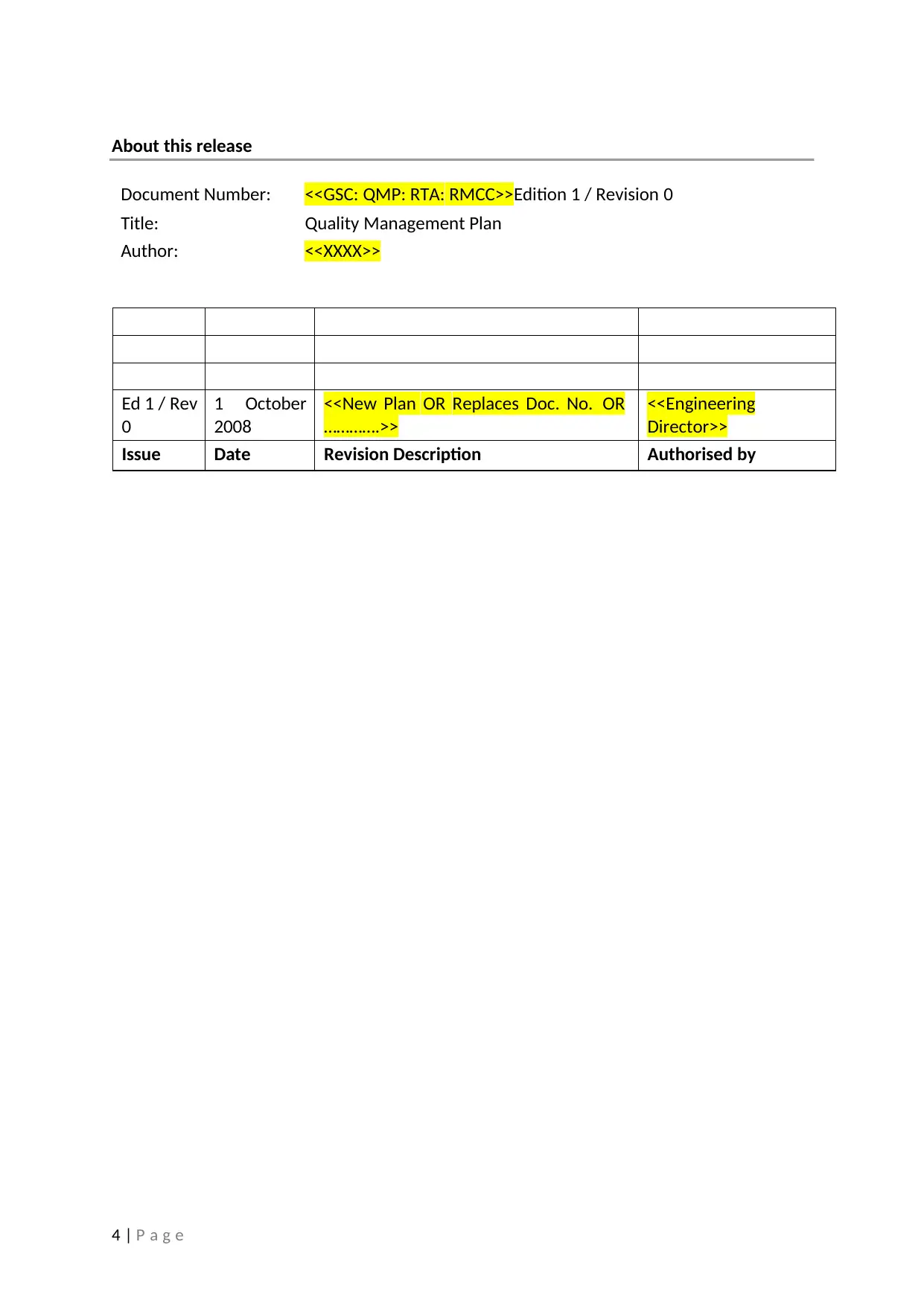
About this release
Document Number: <<GSC: QMP: RTA: RMCC>>Edition 1 / Revision 0
Title: Quality Management Plan
Author: <<XXXX>>
Ed 1 / Rev
0
1 October
2008
<<New Plan OR Replaces Doc. No. OR
………….>>
<<Engineering
Director>>
Issue Date Revision Description Authorised by
About this release
Document Number: <<GSC: QMP: RTA: RMCC>>Edition 1 / Revision 0
Title: Quality Management Plan
Author: <<XXXX>>
Ed 1 / Rev
0
1 October
2008
<<New Plan OR Replaces Doc. No. OR
………….>>
<<Engineering
Director>>
Issue Date Revision Description Authorised by
Paraphrase This Document
Need a fresh take? Get an instant paraphrase of this document with our AI Paraphraser
5 | P a g e
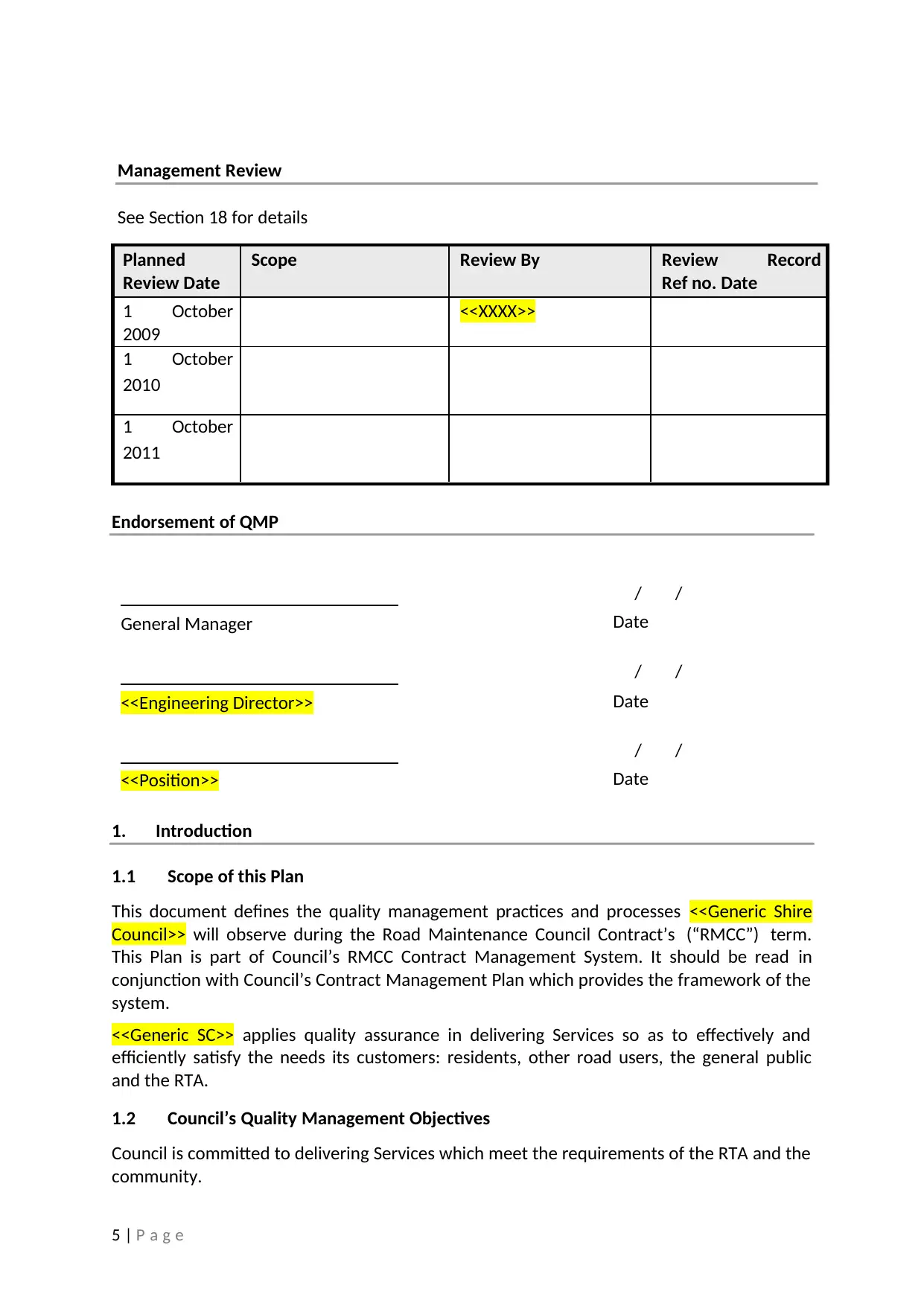
Management Review
See Section 18 for details
Planned
Review Date
Scope Review By Review Record
Ref no. Date
1 October
2009
<<XXXX>>
1 October
2010
1 October
2011
Endorsement of QMP
/ /
General Manager Date
/ /
<<Engineering Director>> Date
/ /
<<Position>> Date
1. Introduction
1.1 Scope of this Plan
This document defines the quality management practices and processes <<Generic Shire
Council>> will observe during the Road Maintenance Council Contract’s (“RMCC”) term.
This Plan is part of Council’s RMCC Contract Management System. It should be read in
conjunction with Council’s Contract Management Plan which provides the framework of the
system.
<<Generic SC>> applies quality assurance in delivering Services so as to effectively and
efficiently satisfy the needs its customers: residents, other road users, the general public
and the RTA.
1.2 Council’s Quality Management Objectives
Council is committed to delivering Services which meet the requirements of the RTA and the
community.
Management Review
See Section 18 for details
Planned
Review Date
Scope Review By Review Record
Ref no. Date
1 October
2009
<<XXXX>>
1 October
2010
1 October
2011
Endorsement of QMP
/ /
General Manager Date
/ /
<<Engineering Director>> Date
/ /
<<Position>> Date
1. Introduction
1.1 Scope of this Plan
This document defines the quality management practices and processes <<Generic Shire
Council>> will observe during the Road Maintenance Council Contract’s (“RMCC”) term.
This Plan is part of Council’s RMCC Contract Management System. It should be read in
conjunction with Council’s Contract Management Plan which provides the framework of the
system.
<<Generic SC>> applies quality assurance in delivering Services so as to effectively and
efficiently satisfy the needs its customers: residents, other road users, the general public
and the RTA.
1.2 Council’s Quality Management Objectives
Council is committed to delivering Services which meet the requirements of the RTA and the
community.
6 | P a g e
We contribute to this by planning, organising, resourcing, directing, monitoring and
measuring the processes and products relative to Council’s policies, objectives and the
requirements of the RTA as expressed in the RMCC.
We record and report the results and use this as a basis for continual improvement.
1.3 Purposes of Council’s Quality Management Plan
The purposes of Council’s Quality Management Plan (“QMP”) are to:
Define Council’s management of Quality processes when delivering the RMCC
Services,
Provide guidance to Council staff on Council’s obligations under the RMCC,
Assure the RTA that Council is fulfilling its obligations regarding the RMCC,
Define the responsibilities of the Quality Management Representative under the
RMCC (the responsibilities and authorities of other positions are set down in the
Contract Management Plan and other functional plans) and
Set down the frequency and responsibilities for management review of this Plan,
1.4 Practice of Quality Management
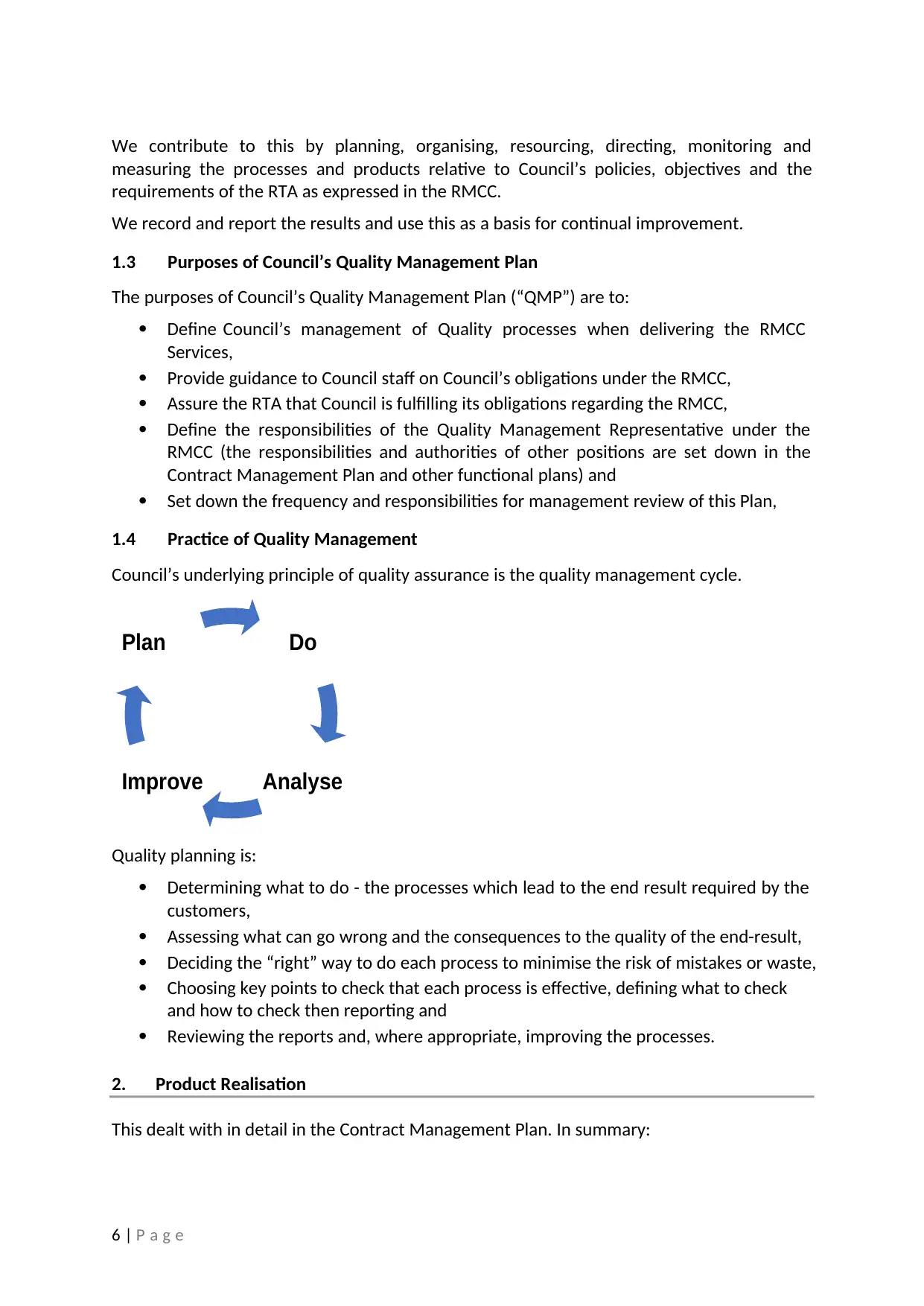
Council’s underlying principle of quality assurance is the quality management cycle.
Plan Do
Improve Analyse
Quality planning is:
Determining what to do - the processes which lead to the end result required by the
customers,
Assessing what can go wrong and the consequences to the quality of the end-result,
Deciding the “right” way to do each process to minimise the risk of mistakes or waste,
Choosing key points to check that each process is effective, defining what to check
and how to check then reporting and
Reviewing the reports and, where appropriate, improving the processes.
2. Product Realisation
This dealt with in detail in the Contract Management Plan. In summary:
We contribute to this by planning, organising, resourcing, directing, monitoring and
measuring the processes and products relative to Council’s policies, objectives and the
requirements of the RTA as expressed in the RMCC.
We record and report the results and use this as a basis for continual improvement.
1.3 Purposes of Council’s Quality Management Plan
The purposes of Council’s Quality Management Plan (“QMP”) are to:
Define Council’s management of Quality processes when delivering the RMCC
Services,
Provide guidance to Council staff on Council’s obligations under the RMCC,
Assure the RTA that Council is fulfilling its obligations regarding the RMCC,
Define the responsibilities of the Quality Management Representative under the
RMCC (the responsibilities and authorities of other positions are set down in the
Contract Management Plan and other functional plans) and
Set down the frequency and responsibilities for management review of this Plan,
1.4 Practice of Quality Management
Council’s underlying principle of quality assurance is the quality management cycle.
Plan Do
Improve Analyse
Quality planning is:
Determining what to do - the processes which lead to the end result required by the
customers,
Assessing what can go wrong and the consequences to the quality of the end-result,
Deciding the “right” way to do each process to minimise the risk of mistakes or waste,
Choosing key points to check that each process is effective, defining what to check
and how to check then reporting and
Reviewing the reports and, where appropriate, improving the processes.
2. Product Realisation
This dealt with in detail in the Contract Management Plan. In summary:
⊘ This is a preview!⊘
Do you want full access?
Subscribe today to unlock all pages.
Trusted by 1+ million students worldwide
7 | P a g e
2.1 Determining the Requirements
In the RMCC, the customers’ requirements are determined by:
Joint inspections and Joint Planning Assessments - to develop a programme of
Services to be carried out during the current financial year,
Developing an Asset Inspection System – which ensures each road is regularly and
systematically inspected to identify defects and subsequently to confirm that repairs
have been done,
Carrying out inspections in accordance with the Asset Inspection System (see
Council’s Contract Management Plan Appendix E) to identify any defects which have
reached the Intervention Requirements nominated in RTA specifications.
2.2 Production and service provision
Council will implement a Defect Management process which encompasses:
Defect Identification,
Repair of those defects according to their urgency and
Recording and reporting.
2.3 Purchasing
See 6 below.
2.4 Design
Any design work associated with the contract will be arranged by the <<Project
manager>> in accordance with RTA’s requirements.
3. Survey Control
Surveying for set-out or construction is arranged by the <<Manager>>.
4. Measuring and Test Equipment
All equipment used for inspection, measuring and testing is regularly calibrated and
maintained in good working order to ensure reliable performance and accurate results.
The <<Quality manager>> will select measuring equipment to suit the accuracy of the
proposed application and only be used within its range of accuracy. When issuing measuring
equipment for use on road maintenance Services, the <<Construction manager>> will
confirm that the equipment is in current calibration.
If an item of equipment is knocked or dropped or if out-of-calibration is suspected, the user
will immediately check its calibration, where possible, by comparing measurement against a
similar item. Alternatively, the user will promptly tag the item "NOT TO BE USED" and
arrange for it to be recalibrated.
If equipment is damaged, the user will immediately tag it "NOT TO BE USED" and notify the
<<Civil engineer>> who will promptly arrange repairs.
2.1 Determining the Requirements
In the RMCC, the customers’ requirements are determined by:
Joint inspections and Joint Planning Assessments - to develop a programme of
Services to be carried out during the current financial year,
Developing an Asset Inspection System – which ensures each road is regularly and
systematically inspected to identify defects and subsequently to confirm that repairs
have been done,
Carrying out inspections in accordance with the Asset Inspection System (see
Council’s Contract Management Plan Appendix E) to identify any defects which have
reached the Intervention Requirements nominated in RTA specifications.
2.2 Production and service provision
Council will implement a Defect Management process which encompasses:
Defect Identification,
Repair of those defects according to their urgency and
Recording and reporting.
2.3 Purchasing
See 6 below.
2.4 Design
Any design work associated with the contract will be arranged by the <<Project
manager>> in accordance with RTA’s requirements.
3. Survey Control
Surveying for set-out or construction is arranged by the <<Manager>>.
4. Measuring and Test Equipment
All equipment used for inspection, measuring and testing is regularly calibrated and
maintained in good working order to ensure reliable performance and accurate results.
The <<Quality manager>> will select measuring equipment to suit the accuracy of the
proposed application and only be used within its range of accuracy. When issuing measuring
equipment for use on road maintenance Services, the <<Construction manager>> will
confirm that the equipment is in current calibration.
If an item of equipment is knocked or dropped or if out-of-calibration is suspected, the user
will immediately check its calibration, where possible, by comparing measurement against a
similar item. Alternatively, the user will promptly tag the item "NOT TO BE USED" and
arrange for it to be recalibrated.
If equipment is damaged, the user will immediately tag it "NOT TO BE USED" and notify the
<<Civil engineer>> who will promptly arrange repairs.
Paraphrase This Document
Need a fresh take? Get an instant paraphrase of this document with our AI Paraphraser
8 | P a g e
The <<Validity manager>> will arrange for the validity of measurements or tests that
utilised defective equipment to be re-assessed.
5. Induction and Training
Council’s <<Head>> will prepare a network-specific induction and training plan. See RTA
Q4M Clause 6.2.2.
Council employees will not perform inspections or maintenance tasks unless competent to
do so. Inspection competency includes being conversant with RTA’s intervention levels,
inspection procedures, safety, traffic control, environmental protection and incident
management requirements.
The<< Council HR >> will ensure that all on site personnel engaged on the project (including
subcontractor's personnel working under Council’s quality system) have undergone an
appropriate induction programme which ensures they are aware of how the quality system
is to be implemented on the project. The programme will focus on their specific roles and
responsibilities, the Council’s Quality Plan, Project Quality Plans, the RTA’s Intervention and
Rectification Requirements, other RTA Specifications, Inspection and Test requirements, on
checking that the completed Services meet RTA requirements. This programme is available
to RTA staff.
Council will keep records of who has been trained.
OH&S and Environmental training is dealt with fully in Council’s Safety Management Plan and
Environmental Management Plan respectively.
6. Purchasing or supply by the RTA
Council will ensure anything purchased or supplied by the RTA, including subcontract
Services, conforms to the contract and RTA specifications before incorporating it in any
Service.
Materials and products supplied will be conforming and traceable.
The <<Council manufacturing manager>> is responsible for receipt of incoming goods used
for the Services. This comprises checking that orders are complete, identified and
undamaged, and also that any required documentation such as certificates of compliance
and test results are submitted by the supplier.
The <<Council Inspection manager>>is responsible for reviewing all inspection and test
documents submitted by the supplier for the incoming goods to verify that all quality
requirements have been met. A record of this verification will be kept.
Any nonconforming products will be clearly labelled by <<Council product manager>> and
kept separate from conforming products pending a decision on their disposal. The <<Council
manager>> will keep records of such actions.
The <<Validity manager>> will arrange for the validity of measurements or tests that
utilised defective equipment to be re-assessed.
5. Induction and Training
Council’s <<Head>> will prepare a network-specific induction and training plan. See RTA
Q4M Clause 6.2.2.
Council employees will not perform inspections or maintenance tasks unless competent to
do so. Inspection competency includes being conversant with RTA’s intervention levels,
inspection procedures, safety, traffic control, environmental protection and incident
management requirements.
The<< Council HR >> will ensure that all on site personnel engaged on the project (including
subcontractor's personnel working under Council’s quality system) have undergone an
appropriate induction programme which ensures they are aware of how the quality system
is to be implemented on the project. The programme will focus on their specific roles and
responsibilities, the Council’s Quality Plan, Project Quality Plans, the RTA’s Intervention and
Rectification Requirements, other RTA Specifications, Inspection and Test requirements, on
checking that the completed Services meet RTA requirements. This programme is available
to RTA staff.
Council will keep records of who has been trained.
OH&S and Environmental training is dealt with fully in Council’s Safety Management Plan and
Environmental Management Plan respectively.
6. Purchasing or supply by the RTA
Council will ensure anything purchased or supplied by the RTA, including subcontract
Services, conforms to the contract and RTA specifications before incorporating it in any
Service.
Materials and products supplied will be conforming and traceable.
The <<Council manufacturing manager>> is responsible for receipt of incoming goods used
for the Services. This comprises checking that orders are complete, identified and
undamaged, and also that any required documentation such as certificates of compliance
and test results are submitted by the supplier.
The <<Council Inspection manager>>is responsible for reviewing all inspection and test
documents submitted by the supplier for the incoming goods to verify that all quality
requirements have been met. A record of this verification will be kept.
Any nonconforming products will be clearly labelled by <<Council product manager>> and
kept separate from conforming products pending a decision on their disposal. The <<Council
manager>> will keep records of such actions.
9 | P a g e
7. Supply of Materials
7.1 Materials Schedule
The <<supply manager>> is responsible for preparing a Materials Schedule for all materials
needed to carry out the Services. The Materials Schedule will show:
Source(s) of supply (e.g. gravel pits, quarry masters, pre-mix concrete supplier),
Anticipated quantities and dates for use,
Applicable RTA specifications to be used for purchase e.g. RTA 3061, RTA 3201,
RTA R111,
If supplier is to carry out tests, frequency of testing and
If Council is to carry out tests, applicable Test Plan.
7.2 Materials Supplied by Council
The <<Council inspection manager>> will arrange any source testing and production testing
of any materials to be supplied by Council (e.g. from Council gravel pits) in accordance with
the Inspection Test Plan.
7.3 Materials Supplied by the RTA
The <<Council Insert Position>> will take delivery and inspect the materials supplied by the
RTA.
Council will carry out checks on any certificates to ensure the materials comply with the RTA
specified quality requirements. Council will keep records of deliveries.
<<Council manager>> will immediately advise the <<material manager>> of any shortages,
deficiencies or materials unsuitable for use. The <<personnel manager>> will promptly
notify the RTA in writing.
Council staff will handle and store materials so that no damage or deterioration will occur
and ensure they are under adequate security. Periodically check the condition of materials
in storage. Keep records of these checks as necessary.
8. Identification and Traceability
As required by RTA Q4M Clause 7.5.3, Council will provide written evidence that each lot,
area or part of completed Services has passed all inspections and tests.
For Services which are of a routine nature Council will record each discrete work area on the
Daily Work Record (see Contract Management Plan Appendix E). This will allow records to
be re-examined if any problems are observed in the future.
For Services which require new construction Council will divide the project into discrete
work areas or lots. The work area or lot number will be written on each ITP Checklist and
Test Report so that any problems can be identified back to their physical location.
Council’s Lot numbering is standardised –see Appendix A.
7. Supply of Materials
7.1 Materials Schedule
The <<supply manager>> is responsible for preparing a Materials Schedule for all materials
needed to carry out the Services. The Materials Schedule will show:
Source(s) of supply (e.g. gravel pits, quarry masters, pre-mix concrete supplier),
Anticipated quantities and dates for use,
Applicable RTA specifications to be used for purchase e.g. RTA 3061, RTA 3201,
RTA R111,
If supplier is to carry out tests, frequency of testing and
If Council is to carry out tests, applicable Test Plan.
7.2 Materials Supplied by Council
The <<Council inspection manager>> will arrange any source testing and production testing
of any materials to be supplied by Council (e.g. from Council gravel pits) in accordance with
the Inspection Test Plan.
7.3 Materials Supplied by the RTA
The <<Council Insert Position>> will take delivery and inspect the materials supplied by the
RTA.
Council will carry out checks on any certificates to ensure the materials comply with the RTA
specified quality requirements. Council will keep records of deliveries.
<<Council manager>> will immediately advise the <<material manager>> of any shortages,
deficiencies or materials unsuitable for use. The <<personnel manager>> will promptly
notify the RTA in writing.
Council staff will handle and store materials so that no damage or deterioration will occur
and ensure they are under adequate security. Periodically check the condition of materials
in storage. Keep records of these checks as necessary.
8. Identification and Traceability
As required by RTA Q4M Clause 7.5.3, Council will provide written evidence that each lot,
area or part of completed Services has passed all inspections and tests.
For Services which are of a routine nature Council will record each discrete work area on the
Daily Work Record (see Contract Management Plan Appendix E). This will allow records to
be re-examined if any problems are observed in the future.
For Services which require new construction Council will divide the project into discrete
work areas or lots. The work area or lot number will be written on each ITP Checklist and
Test Report so that any problems can be identified back to their physical location.
Council’s Lot numbering is standardised –see Appendix A.
⊘ This is a preview!⊘
Do you want full access?
Subscribe today to unlock all pages.
Trusted by 1+ million students worldwide
10 | P a g e
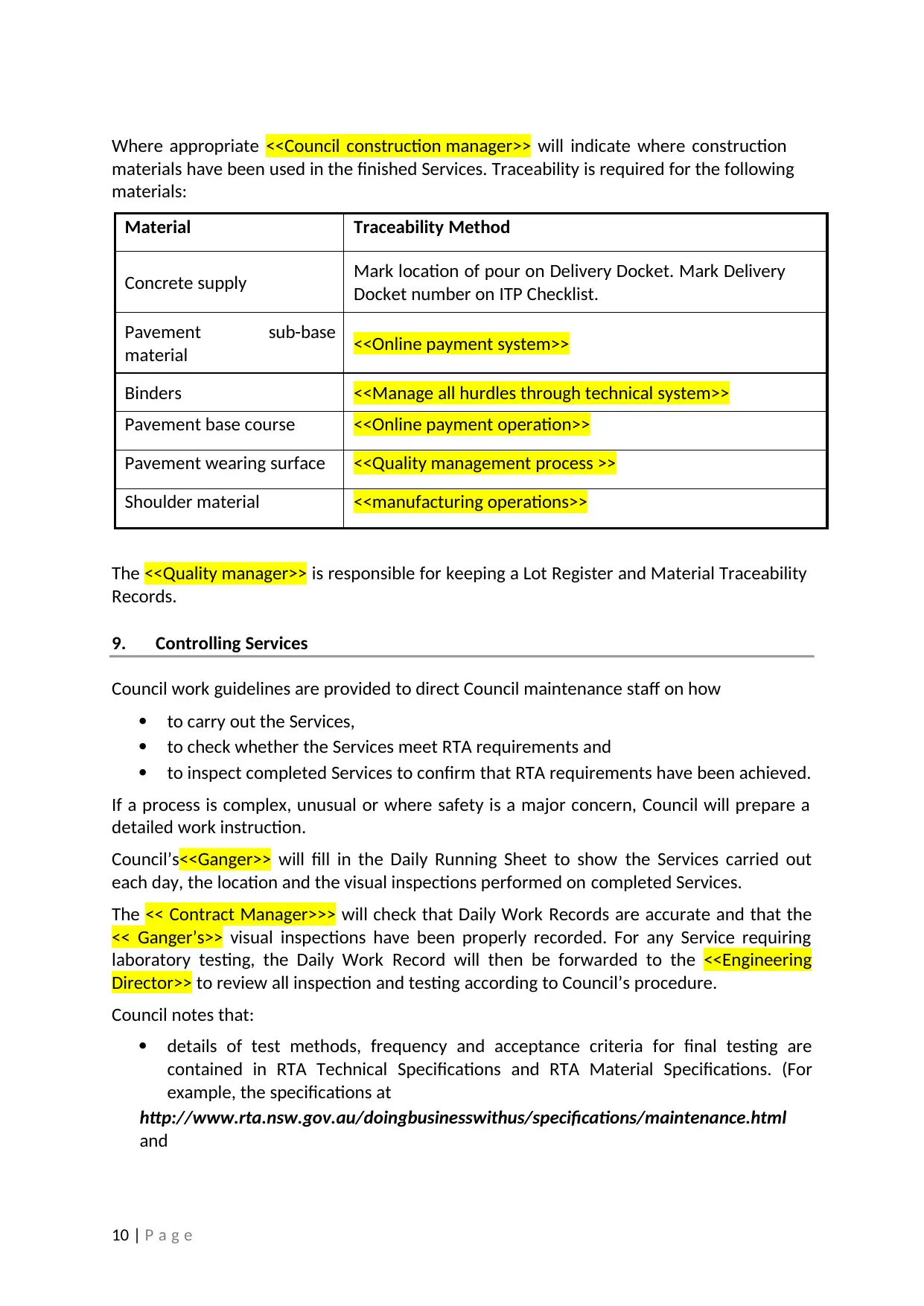
Where appropriate <<Council construction manager>> will indicate where construction
materials have been used in the finished Services. Traceability is required for the following
materials:
Material Traceability Method
Concrete supply Mark location of pour on Delivery Docket. Mark Delivery
Docket number on ITP Checklist.
Pavement sub-base
material <<Online payment system>>
Binders <<Manage all hurdles through technical system>>
Pavement base course <<Online payment operation>>
Pavement wearing surface <<Quality management process >>
Shoulder material <<manufacturing operations>>
The <<Quality manager>> is responsible for keeping a Lot Register and Material Traceability
Records.
9. Controlling Services
Council work guidelines are provided to direct Council maintenance staff on how
to carry out the Services,
to check whether the Services meet RTA requirements and
to inspect completed Services to confirm that RTA requirements have been achieved.
If a process is complex, unusual or where safety is a major concern, Council will prepare a
detailed work instruction.
Council’s<<Ganger>> will fill in the Daily Running Sheet to show the Services carried out
each day, the location and the visual inspections performed on completed Services.
The << Contract Manager>>> will check that Daily Work Records are accurate and that the
<< Ganger’s>> visual inspections have been properly recorded. For any Service requiring
laboratory testing, the Daily Work Record will then be forwarded to the <<Engineering
Director>> to review all inspection and testing according to Council’s procedure.
Council notes that:
details of test methods, frequency and acceptance criteria for final testing are
contained in RTA Technical Specifications and RTA Material Specifications. (For
example, the specifications at
http://www.rta.nsw.gov.au/doingbusinesswithus/specifications/maintenance.html
and
Where appropriate <<Council construction manager>> will indicate where construction
materials have been used in the finished Services. Traceability is required for the following
materials:
Material Traceability Method
Concrete supply Mark location of pour on Delivery Docket. Mark Delivery
Docket number on ITP Checklist.
Pavement sub-base
material <<Online payment system>>
Binders <<Manage all hurdles through technical system>>
Pavement base course <<Online payment operation>>
Pavement wearing surface <<Quality management process >>
Shoulder material <<manufacturing operations>>
The <<Quality manager>> is responsible for keeping a Lot Register and Material Traceability
Records.
9. Controlling Services
Council work guidelines are provided to direct Council maintenance staff on how
to carry out the Services,
to check whether the Services meet RTA requirements and
to inspect completed Services to confirm that RTA requirements have been achieved.
If a process is complex, unusual or where safety is a major concern, Council will prepare a
detailed work instruction.
Council’s<<Ganger>> will fill in the Daily Running Sheet to show the Services carried out
each day, the location and the visual inspections performed on completed Services.
The << Contract Manager>>> will check that Daily Work Records are accurate and that the
<< Ganger’s>> visual inspections have been properly recorded. For any Service requiring
laboratory testing, the Daily Work Record will then be forwarded to the <<Engineering
Director>> to review all inspection and testing according to Council’s procedure.
Council notes that:
details of test methods, frequency and acceptance criteria for final testing are
contained in RTA Technical Specifications and RTA Material Specifications. (For
example, the specifications at
http://www.rta.nsw.gov.au/doingbusinesswithus/specifications/maintenance.html
and
Paraphrase This Document
Need a fresh take? Get an instant paraphrase of this document with our AI Paraphraser
11 | P a g e
http://wwww.rta.nsw.gov.au/doingbusinesswithus/specifications/materials.html)
and
some RTA specifications require that statistical evaluation be carried out. In these
cases, Council’s tester will randomly choose a number of sampling locations within
each lot and calculate a “characteristic” test result for the entire lot. If the lot fails, it
will be fully re-sampled and re-tested.
Where RTA Specifications show HOLD POINTS, the <<Council Contract Manager>> will have
these released by the RTA’s representative before Council continues with the work process
except in the following circumstances:
Final compliance test results have not been received (e.g. 28-day concrete strength)
but test results from earlier similar work, or earlier test results, give confidence that
the final test results will show compliance or
All survey verification to demonstrate conformity for position, level, dimensions
and/or tolerances have been completed and work has been passed or
Council has submitted a written request for a HOLD POINT release within the
required notice period, but the notice has expired and advice of the HOLD POINT
release/with- hold has not been received. Council can then release the HOLD POINT
on behalf of the RTA after notifying the RTA’s Senior Project Manager to that effect
The <<Engineering Director>> is responsible for a final review and sign-off of all inspection
and testing for each lot. Sign-off will not take place until any outstanding test reports or
survey conformance reports for the lot has been received and any non-conformances for
that lot have been closed out.
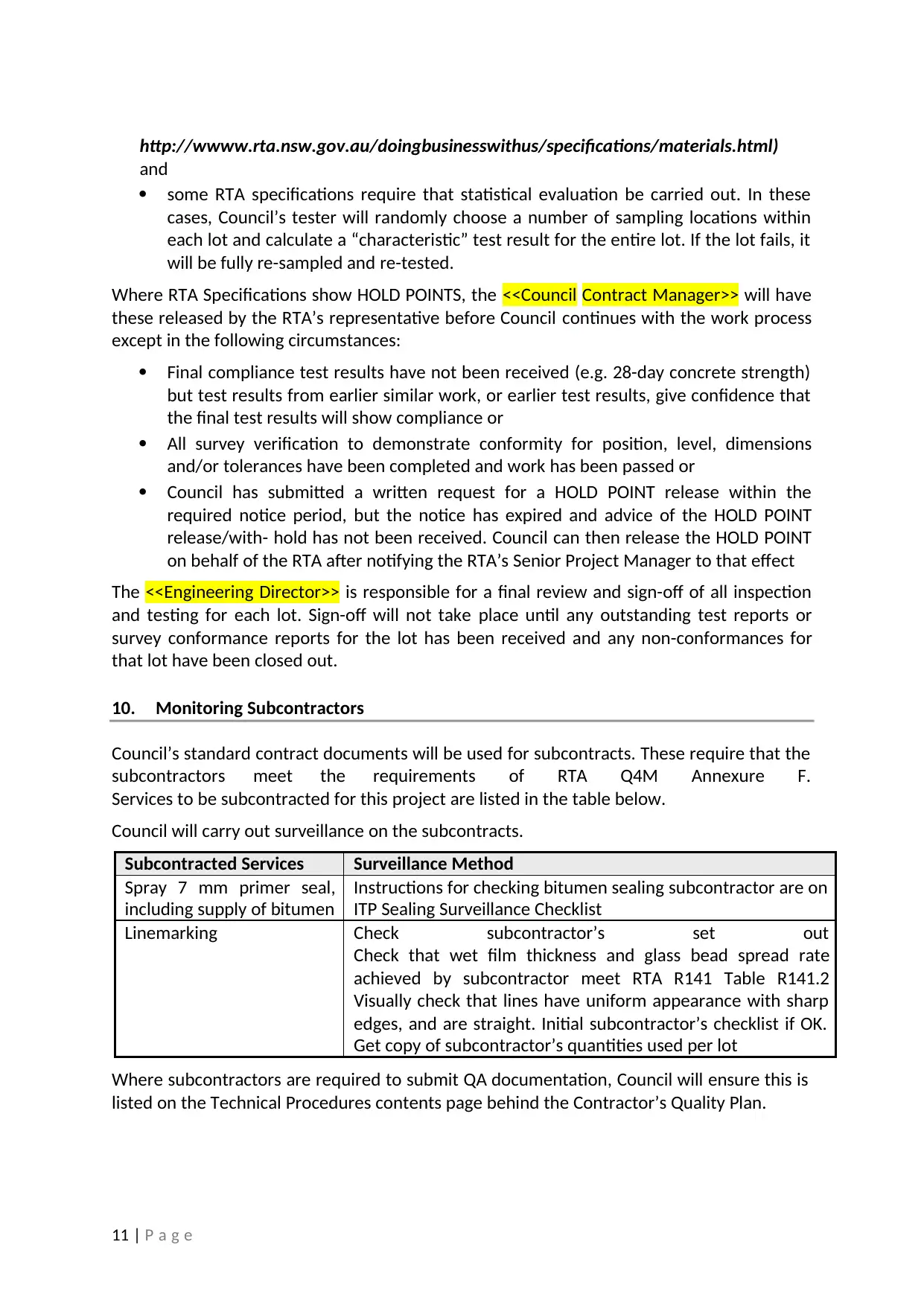
10. Monitoring Subcontractors
Council’s standard contract documents will be used for subcontracts. These require that the
subcontractors meet the requirements of RTA Q4M Annexure F.
Services to be subcontracted for this project are listed in the table below.
Council will carry out surveillance on the subcontracts.
Subcontracted Services Surveillance Method
Spray 7 mm primer seal,
including supply of bitumen
Instructions for checking bitumen sealing subcontractor are on
ITP Sealing Surveillance Checklist
Linemarking Check subcontractor’s set out
Check that wet film thickness and glass bead spread rate
achieved by subcontractor meet RTA R141 Table R141.2
Visually check that lines have uniform appearance with sharp
edges, and are straight. Initial subcontractor’s checklist if OK.
Get copy of subcontractor’s quantities used per lot
Where subcontractors are required to submit QA documentation, Council will ensure this is
listed on the Technical Procedures contents page behind the Contractor’s Quality Plan.
http://wwww.rta.nsw.gov.au/doingbusinesswithus/specifications/materials.html)
and
some RTA specifications require that statistical evaluation be carried out. In these
cases, Council’s tester will randomly choose a number of sampling locations within
each lot and calculate a “characteristic” test result for the entire lot. If the lot fails, it
will be fully re-sampled and re-tested.
Where RTA Specifications show HOLD POINTS, the <<Council Contract Manager>> will have
these released by the RTA’s representative before Council continues with the work process
except in the following circumstances:
Final compliance test results have not been received (e.g. 28-day concrete strength)
but test results from earlier similar work, or earlier test results, give confidence that
the final test results will show compliance or
All survey verification to demonstrate conformity for position, level, dimensions
and/or tolerances have been completed and work has been passed or
Council has submitted a written request for a HOLD POINT release within the
required notice period, but the notice has expired and advice of the HOLD POINT
release/with- hold has not been received. Council can then release the HOLD POINT
on behalf of the RTA after notifying the RTA’s Senior Project Manager to that effect
The <<Engineering Director>> is responsible for a final review and sign-off of all inspection
and testing for each lot. Sign-off will not take place until any outstanding test reports or
survey conformance reports for the lot has been received and any non-conformances for
that lot have been closed out.
10. Monitoring Subcontractors
Council’s standard contract documents will be used for subcontracts. These require that the
subcontractors meet the requirements of RTA Q4M Annexure F.
Services to be subcontracted for this project are listed in the table below.
Council will carry out surveillance on the subcontracts.
Subcontracted Services Surveillance Method
Spray 7 mm primer seal,
including supply of bitumen
Instructions for checking bitumen sealing subcontractor are on
ITP Sealing Surveillance Checklist
Linemarking Check subcontractor’s set out
Check that wet film thickness and glass bead spread rate
achieved by subcontractor meet RTA R141 Table R141.2
Visually check that lines have uniform appearance with sharp
edges, and are straight. Initial subcontractor’s checklist if OK.
Get copy of subcontractor’s quantities used per lot
Where subcontractors are required to submit QA documentation, Council will ensure this is
listed on the Technical Procedures contents page behind the Contractor’s Quality Plan.
12 | P a g e
11. Control of Substandard Services
11.1 Evaluation
Council employees are required to minimise substandard Services. However, Council
recognises they may occur from time to time within its own Services and those of its
subcontractors.
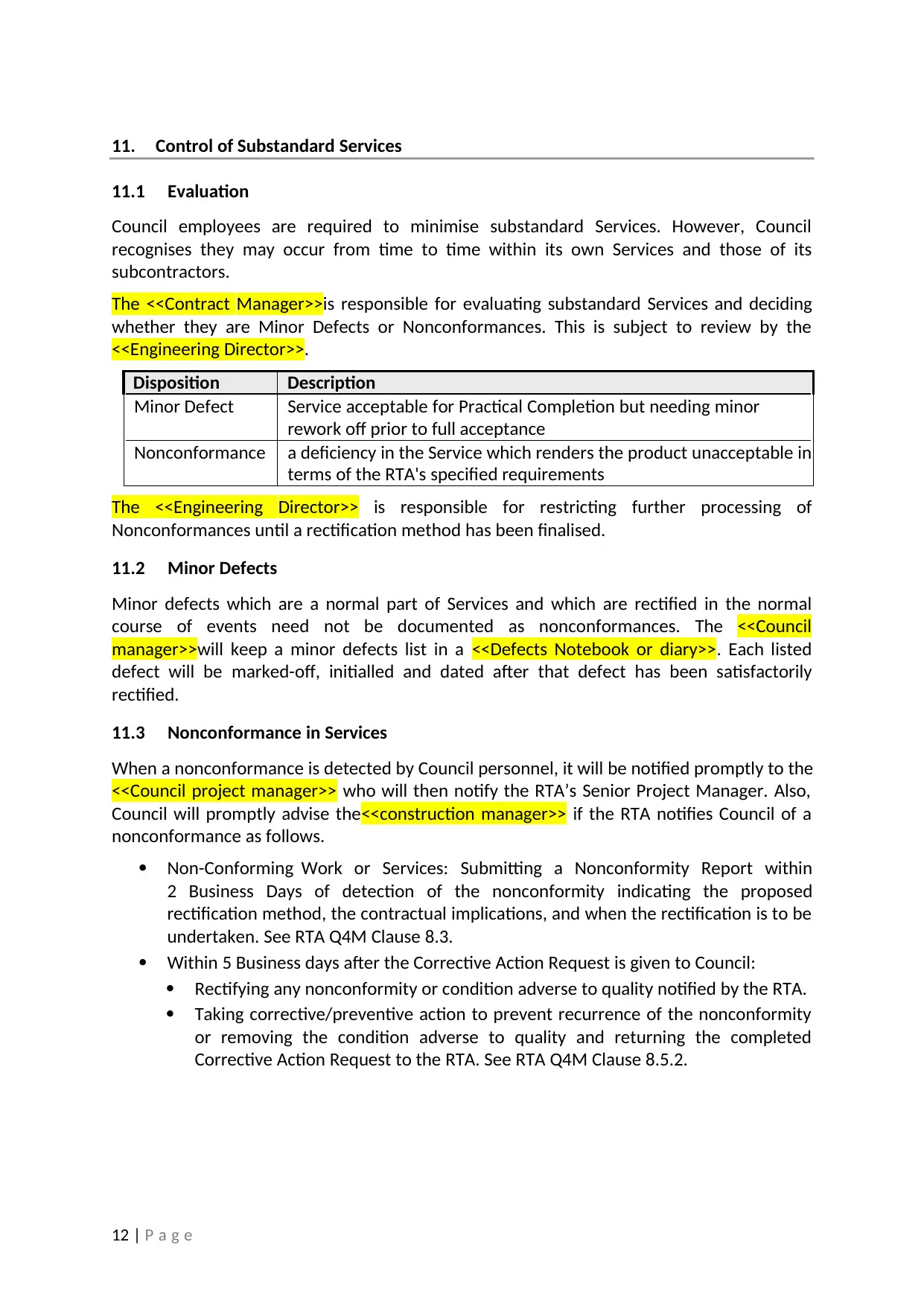
The <<Contract Manager>>is responsible for evaluating substandard Services and deciding
whether they are Minor Defects or Nonconformances. This is subject to review by the
<<Engineering Director>>.
Disposition Description
Minor Defect Service acceptable for Practical Completion but needing minor
rework off prior to full acceptance
Nonconformance a deficiency in the Service which renders the product unacceptable in
terms of the RTA's specified requirements
The <<Engineering Director>> is responsible for restricting further processing of
Nonconformances until a rectification method has been finalised.
11.2 Minor Defects
Minor defects which are a normal part of Services and which are rectified in the normal
course of events need not be documented as nonconformances. The <<Council
manager>>will keep a minor defects list in a <<Defects Notebook or diary>>. Each listed
defect will be marked-off, initialled and dated after that defect has been satisfactorily
rectified.
11.3 Nonconformance in Services
When a nonconformance is detected by Council personnel, it will be notified promptly to the
<<Council project manager>> who will then notify the RTA’s Senior Project Manager. Also,
Council will promptly advise the<<construction manager>> if the RTA notifies Council of a
nonconformance as follows.
Non-Conforming Work or Services: Submitting a Nonconformity Report within
2 Business Days of detection of the nonconformity indicating the proposed
rectification method, the contractual implications, and when the rectification is to be
undertaken. See RTA Q4M Clause 8.3.
Within 5 Business days after the Corrective Action Request is given to Council:
Rectifying any nonconformity or condition adverse to quality notified by the RTA.
Taking corrective/preventive action to prevent recurrence of the nonconformity
or removing the condition adverse to quality and returning the completed
Corrective Action Request to the RTA. See RTA Q4M Clause 8.5.2.
11. Control of Substandard Services
11.1 Evaluation
Council employees are required to minimise substandard Services. However, Council
recognises they may occur from time to time within its own Services and those of its
subcontractors.
The <<Contract Manager>>is responsible for evaluating substandard Services and deciding
whether they are Minor Defects or Nonconformances. This is subject to review by the
<<Engineering Director>>.
Disposition Description
Minor Defect Service acceptable for Practical Completion but needing minor
rework off prior to full acceptance
Nonconformance a deficiency in the Service which renders the product unacceptable in
terms of the RTA's specified requirements
The <<Engineering Director>> is responsible for restricting further processing of
Nonconformances until a rectification method has been finalised.
11.2 Minor Defects
Minor defects which are a normal part of Services and which are rectified in the normal
course of events need not be documented as nonconformances. The <<Council
manager>>will keep a minor defects list in a <<Defects Notebook or diary>>. Each listed
defect will be marked-off, initialled and dated after that defect has been satisfactorily
rectified.
11.3 Nonconformance in Services
When a nonconformance is detected by Council personnel, it will be notified promptly to the
<<Council project manager>> who will then notify the RTA’s Senior Project Manager. Also,
Council will promptly advise the<<construction manager>> if the RTA notifies Council of a
nonconformance as follows.
Non-Conforming Work or Services: Submitting a Nonconformity Report within
2 Business Days of detection of the nonconformity indicating the proposed
rectification method, the contractual implications, and when the rectification is to be
undertaken. See RTA Q4M Clause 8.3.
Within 5 Business days after the Corrective Action Request is given to Council:
Rectifying any nonconformity or condition adverse to quality notified by the RTA.
Taking corrective/preventive action to prevent recurrence of the nonconformity
or removing the condition adverse to quality and returning the completed
Corrective Action Request to the RTA. See RTA Q4M Clause 8.5.2.
⊘ This is a preview!⊘
Do you want full access?
Subscribe today to unlock all pages.
Trusted by 1+ million students worldwide

1 out of 28


Related Documents


Your All-in-One AI-Powered Toolkit for Academic Success.
+13062052269
info@desklib.com
Available 24*7 on WhatsApp / Email
![[object Object]](/_next/static/media/star-bottom.7253800d.svg)
Unlock your academic potential
Copyright © 2020–2025 A2Z Services. All Rights Reserved. Developed and managed by ZUCOL.