Quality Management Report: Sydney Enterprise Event Analysis
VerifiedAdded on 2023/01/17
|10
|2843
|50
Report
AI Summary
This report provides a comprehensive analysis of a quality management plan implemented by Vertias Events for a branding event organized for a new enterprise from Sydney. The report delves into the background of Vertias Events, highlighting its innovative approach to event services. It outlines the key components of a quality management plan, including schedule, cost, resource management, product performance, and customer satisfaction, emphasizing their role in ensuring event success. The report also details a stakeholder management plan, identifying various stakeholders such as suppliers, the client company, investors, visitors, and human resources, and analyzes their power and impact. Furthermore, it discusses strategies for managing stakeholder engagement and includes a conflict management plan to mitigate potential issues. The report aims to demonstrate how Vertias Events ensures the quality of its services through meticulous planning, stakeholder management, and conflict resolution, ultimately contributing to the successful branding of the Sydney enterprise.
Quality Management

Paraphrase This Document
Need a fresh take? Get an instant paraphrase of this document with our AI Paraphraser
Contents
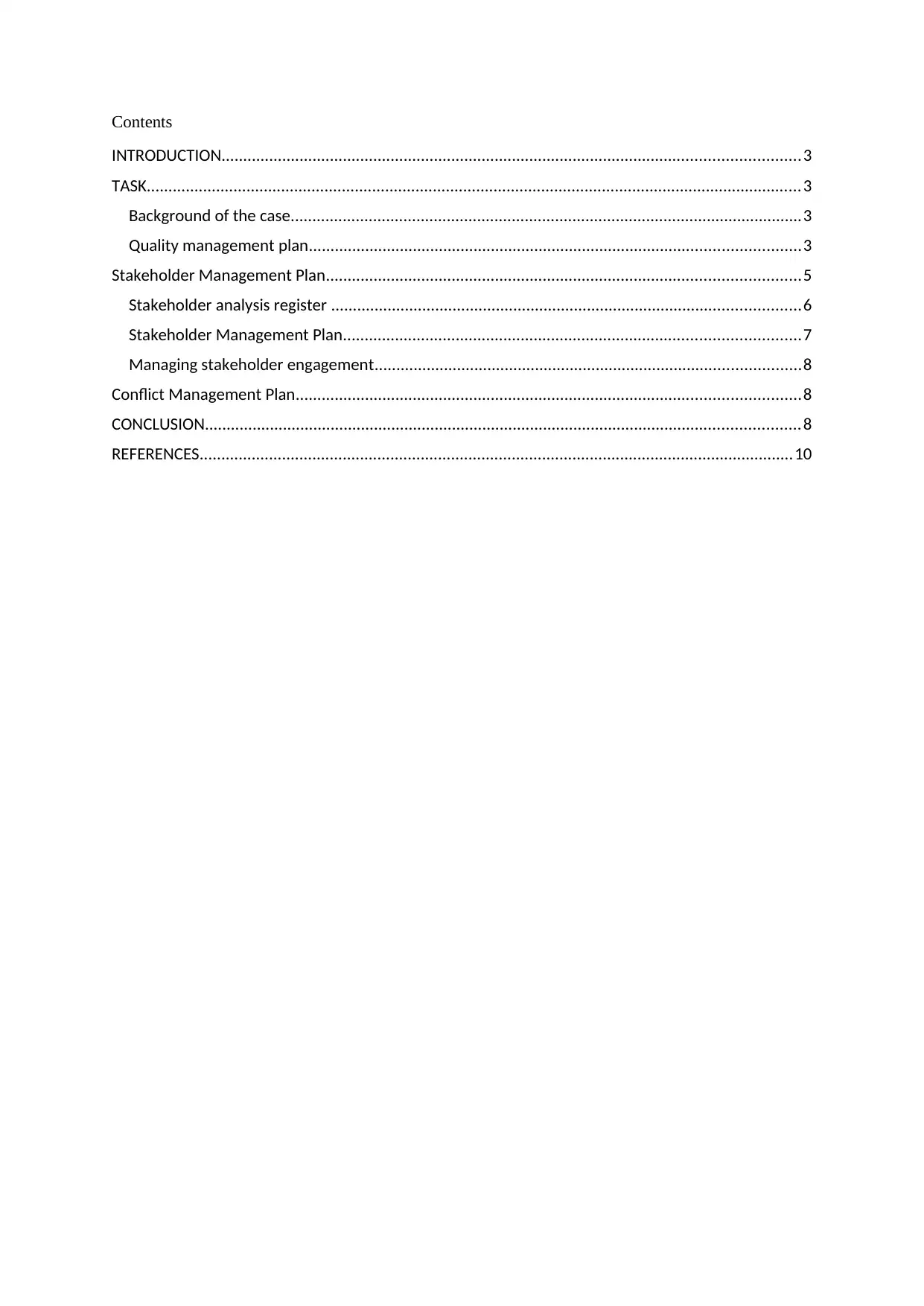
INTRODUCTION.....................................................................................................................................3
TASK.......................................................................................................................................................3
Background of the case......................................................................................................................3
Quality management plan.................................................................................................................3
Stakeholder Management Plan.............................................................................................................5
Stakeholder analysis register ............................................................................................................6
Stakeholder Management Plan.........................................................................................................7
Managing stakeholder engagement..................................................................................................8
Conflict Management Plan....................................................................................................................8
CONCLUSION.........................................................................................................................................8
REFERENCES.........................................................................................................................................10
INTRODUCTION.....................................................................................................................................3
TASK.......................................................................................................................................................3
Background of the case......................................................................................................................3
Quality management plan.................................................................................................................3
Stakeholder Management Plan.............................................................................................................5
Stakeholder analysis register ............................................................................................................6
Stakeholder Management Plan.........................................................................................................7
Managing stakeholder engagement..................................................................................................8
Conflict Management Plan....................................................................................................................8
CONCLUSION.........................................................................................................................................8
REFERENCES.........................................................................................................................................10
INTRODUCTION
Quality management is a continuous process of overseeing the different operations
and projects in order to ensure good quality of work. There are distinct elements through
which the standards are evaluated. in order to assure the quality of a work done it is compared
with the standards which were set against same. This way it is an important process as it leads
to high customer loyalty and improves the overall business (Bergman and Klefsjö, 2010).
Vertias events is an event organisation that is known for delivering the new, unique services
to its clients. It helps specially the corporates to organise programmes and do all the
arrangements to deliver an excellent experience. The following report will discuss how
Vertias events will help a new enterprise from Sydney to do its positioning in the market by
organising an event at huge scale. It would be discussed that how the total quality standards
are going to be maintained and in context of same there would be discussion on quality
stakeholder management plan. Thereafter it will be elaborated that how while planning for
the event the chances of conflicts will be avoided using a plan for it.
TASK
Background of the case
Vertias events was established in the year 1992 and since then instead of recycling
the ideas it is creating its own innovative services which attracts clients from all over. In
order to be different in the event industry this organisation every time create something which
is better than before and take full control over the quality of the final service that is delivered
to the client. A new company from Sydney wish to establish its brand in the market and has
approached to the event company to do all the arrangements. In order to ensure that the event
is successful use of quality management plan is done (Boyd and Tucker, 2012).
Quality management plan
It is a document that contains all the information that is required on order to ensure
the good quality of work. It expresses all the relevant areas of the project where standards
need to be managed and also discuss how. It is inclusive of guidelines for the implementation
of roles, criteria’s that need to be met in context of the duties of different stakeholders
involve in the project and many more. There are different objectives of this plan and in
context of this event the goals are as follows:
To ensure that the event is organised effectively
To maximise the brand image through branding in the event
Quality management is a continuous process of overseeing the different operations
and projects in order to ensure good quality of work. There are distinct elements through
which the standards are evaluated. in order to assure the quality of a work done it is compared
with the standards which were set against same. This way it is an important process as it leads
to high customer loyalty and improves the overall business (Bergman and Klefsjö, 2010).
Vertias events is an event organisation that is known for delivering the new, unique services
to its clients. It helps specially the corporates to organise programmes and do all the
arrangements to deliver an excellent experience. The following report will discuss how
Vertias events will help a new enterprise from Sydney to do its positioning in the market by
organising an event at huge scale. It would be discussed that how the total quality standards
are going to be maintained and in context of same there would be discussion on quality
stakeholder management plan. Thereafter it will be elaborated that how while planning for
the event the chances of conflicts will be avoided using a plan for it.
TASK
Background of the case
Vertias events was established in the year 1992 and since then instead of recycling
the ideas it is creating its own innovative services which attracts clients from all over. In
order to be different in the event industry this organisation every time create something which
is better than before and take full control over the quality of the final service that is delivered
to the client. A new company from Sydney wish to establish its brand in the market and has
approached to the event company to do all the arrangements. In order to ensure that the event
is successful use of quality management plan is done (Boyd and Tucker, 2012).
Quality management plan
It is a document that contains all the information that is required on order to ensure
the good quality of work. It expresses all the relevant areas of the project where standards
need to be managed and also discuss how. It is inclusive of guidelines for the implementation
of roles, criteria’s that need to be met in context of the duties of different stakeholders
involve in the project and many more. There are different objectives of this plan and in
context of this event the goals are as follows:
To ensure that the event is organised effectively
To maximise the brand image through branding in the event
⊘ This is a preview!⊘
Do you want full access?
Subscribe today to unlock all pages.

Trusted by 1+ million students worldwide
To give maximum satisfaction to all the stakeholders involved in the
The following points will discuss how the quality is maintained in the process of event
that will be organised for the branding process.
Schedule: This is one of the most important metrics in the quality management process. it
helps in carrying out the work which is supported with discipline and hence assures that
timely completion of the work. A written record of all those who are involve in the event
origination process was maintained which helps in facilitating the communication process.
The different departments are given the time limits in which they have to complete their tasks
and report and this further helped in meeting the targets (Ebrahimi and Sadeghi, 2013). Every
distinct section is facilitated with the resistors so that corrections can be made on the same
time and it could be ensured that whatever work has been done till date is cross checked and
is free from any possible errors.
Cost: This is the total expenditure which is allowed for the organisation of event by the
client and it is very important to finish the work with nut. Exceeding same has direct impact
on the quality of work and may affect the brand image of Vertias events. Therefore, the other
quality management tool is to control the cost. It is done by allotting fix amount to distinct
sections so that the overall expenditure does not exceeds. The total amount budget given by
the new enterprise is of ten thousand dollars and therefore it is divided into various
departments. The fluctuations that take place in the market may effect to the budget but it was
given care that the total amount do not vary from more than ten percent as it can be adjusted
with the clients easily (Goetsch and Davis, 2014).
Resource: The branding event is going to be organised at big level and therefore there are
lots of resources which are required to carry out same. These can be considered as the pillars
of the work as without it nothing can be completed. Also to make the full capacity utilisations
of these quality management is important. Firstly, a checklist of all the required resources for
the event need to be maintained so that no important material is missed out for the last
moment. Therfter all the required material is made available at the desired places to make the
use more convenient. Responsibilities are given to the authorised persons for the sources so
that they are not wasted and also when limited resources are made available then they are
effectively utilised.
Product Performance – Here in context of the event the product performance referred to
the success of the branding event. To do so close monitoring on every step of the project is
The following points will discuss how the quality is maintained in the process of event
that will be organised for the branding process.
Schedule: This is one of the most important metrics in the quality management process. it
helps in carrying out the work which is supported with discipline and hence assures that
timely completion of the work. A written record of all those who are involve in the event
origination process was maintained which helps in facilitating the communication process.
The different departments are given the time limits in which they have to complete their tasks
and report and this further helped in meeting the targets (Ebrahimi and Sadeghi, 2013). Every
distinct section is facilitated with the resistors so that corrections can be made on the same
time and it could be ensured that whatever work has been done till date is cross checked and
is free from any possible errors.
Cost: This is the total expenditure which is allowed for the organisation of event by the
client and it is very important to finish the work with nut. Exceeding same has direct impact
on the quality of work and may affect the brand image of Vertias events. Therefore, the other
quality management tool is to control the cost. It is done by allotting fix amount to distinct
sections so that the overall expenditure does not exceeds. The total amount budget given by
the new enterprise is of ten thousand dollars and therefore it is divided into various
departments. The fluctuations that take place in the market may effect to the budget but it was
given care that the total amount do not vary from more than ten percent as it can be adjusted
with the clients easily (Goetsch and Davis, 2014).
Resource: The branding event is going to be organised at big level and therefore there are
lots of resources which are required to carry out same. These can be considered as the pillars
of the work as without it nothing can be completed. Also to make the full capacity utilisations
of these quality management is important. Firstly, a checklist of all the required resources for
the event need to be maintained so that no important material is missed out for the last
moment. Therfter all the required material is made available at the desired places to make the
use more convenient. Responsibilities are given to the authorised persons for the sources so
that they are not wasted and also when limited resources are made available then they are
effectively utilised.
Product Performance – Here in context of the event the product performance referred to
the success of the branding event. To do so close monitoring on every step of the project is
Paraphrase This Document
Need a fresh take? Get an instant paraphrase of this document with our AI Paraphraser
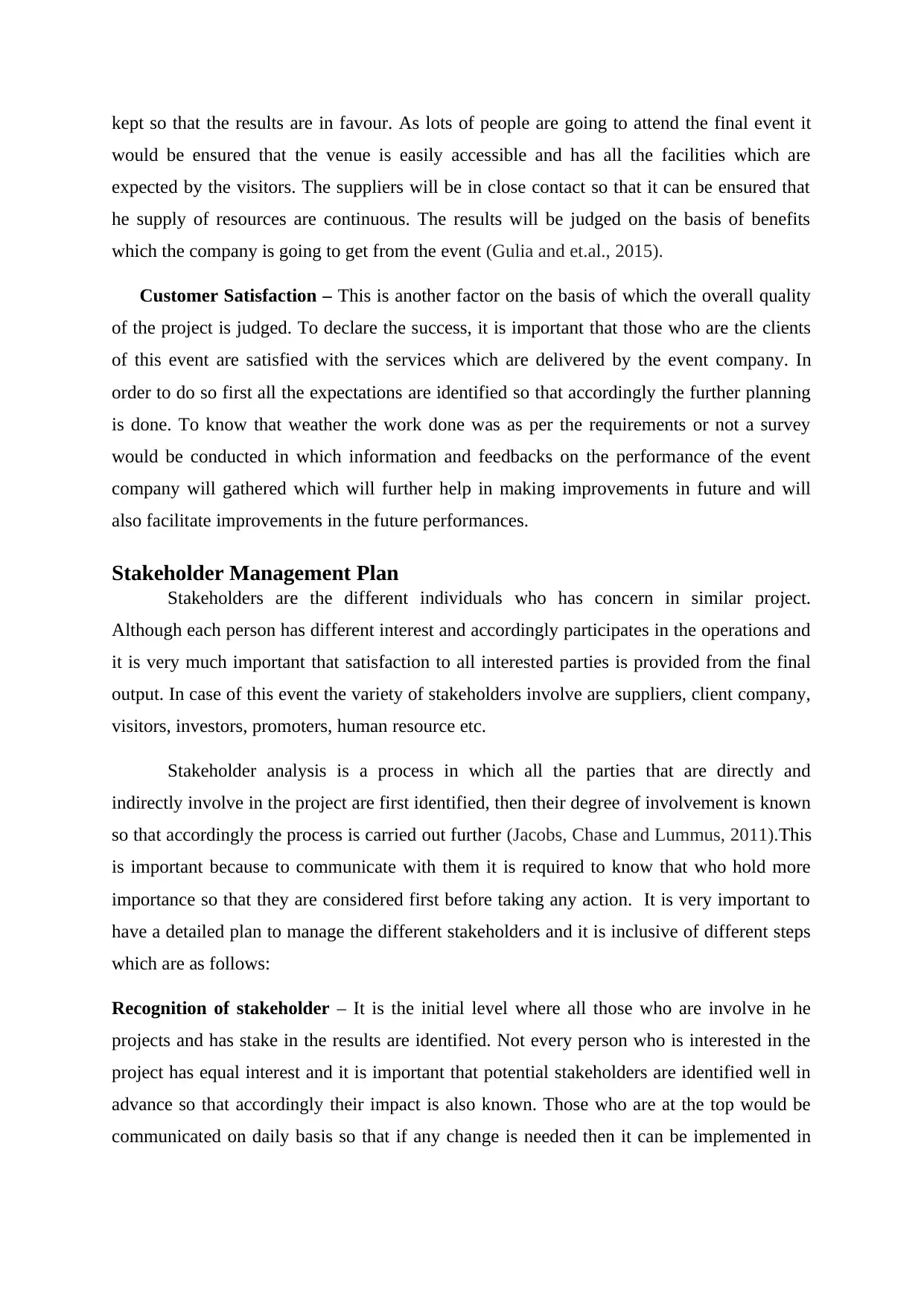
kept so that the results are in favour. As lots of people are going to attend the final event it
would be ensured that the venue is easily accessible and has all the facilities which are
expected by the visitors. The suppliers will be in close contact so that it can be ensured that
he supply of resources are continuous. The results will be judged on the basis of benefits
which the company is going to get from the event (Gulia and et.al., 2015).
Customer Satisfaction – This is another factor on the basis of which the overall quality
of the project is judged. To declare the success, it is important that those who are the clients
of this event are satisfied with the services which are delivered by the event company. In
order to do so first all the expectations are identified so that accordingly the further planning
is done. To know that weather the work done was as per the requirements or not a survey
would be conducted in which information and feedbacks on the performance of the event
company will gathered which will further help in making improvements in future and will
also facilitate improvements in the future performances.
Stakeholder Management Plan
Stakeholders are the different individuals who has concern in similar project.
Although each person has different interest and accordingly participates in the operations and
it is very much important that satisfaction to all interested parties is provided from the final
output. In case of this event the variety of stakeholders involve are suppliers, client company,
visitors, investors, promoters, human resource etc.
Stakeholder analysis is a process in which all the parties that are directly and
indirectly involve in the project are first identified, then their degree of involvement is known
so that accordingly the process is carried out further (Jacobs, Chase and Lummus, 2011).This
is important because to communicate with them it is required to know that who hold more
importance so that they are considered first before taking any action. It is very important to
have a detailed plan to manage the different stakeholders and it is inclusive of different steps
which are as follows:
Recognition of stakeholder – It is the initial level where all those who are involve in he
projects and has stake in the results are identified. Not every person who is interested in the
project has equal interest and it is important that potential stakeholders are identified well in
advance so that accordingly their impact is also known. Those who are at the top would be
communicated on daily basis so that if any change is needed then it can be implemented in
would be ensured that the venue is easily accessible and has all the facilities which are
expected by the visitors. The suppliers will be in close contact so that it can be ensured that
he supply of resources are continuous. The results will be judged on the basis of benefits
which the company is going to get from the event (Gulia and et.al., 2015).
Customer Satisfaction – This is another factor on the basis of which the overall quality
of the project is judged. To declare the success, it is important that those who are the clients
of this event are satisfied with the services which are delivered by the event company. In
order to do so first all the expectations are identified so that accordingly the further planning
is done. To know that weather the work done was as per the requirements or not a survey
would be conducted in which information and feedbacks on the performance of the event
company will gathered which will further help in making improvements in future and will
also facilitate improvements in the future performances.
Stakeholder Management Plan
Stakeholders are the different individuals who has concern in similar project.
Although each person has different interest and accordingly participates in the operations and
it is very much important that satisfaction to all interested parties is provided from the final
output. In case of this event the variety of stakeholders involve are suppliers, client company,
visitors, investors, promoters, human resource etc.
Stakeholder analysis is a process in which all the parties that are directly and
indirectly involve in the project are first identified, then their degree of involvement is known
so that accordingly the process is carried out further (Jacobs, Chase and Lummus, 2011).This
is important because to communicate with them it is required to know that who hold more
importance so that they are considered first before taking any action. It is very important to
have a detailed plan to manage the different stakeholders and it is inclusive of different steps
which are as follows:
Recognition of stakeholder – It is the initial level where all those who are involve in he
projects and has stake in the results are identified. Not every person who is interested in the
project has equal interest and it is important that potential stakeholders are identified well in
advance so that accordingly their impact is also known. Those who are at the top would be
communicated on daily basis so that if any change is needed then it can be implemented in
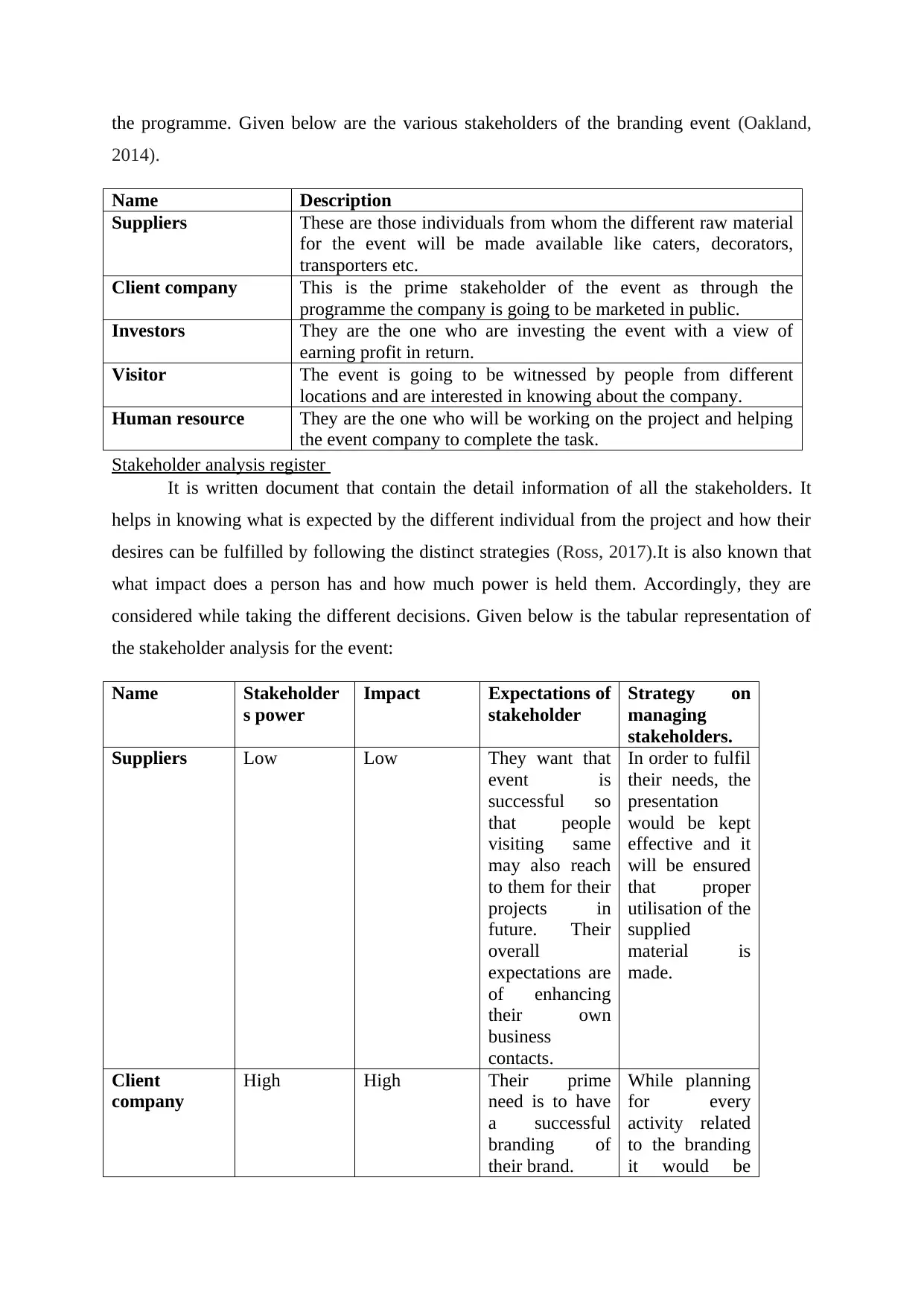
the programme. Given below are the various stakeholders of the branding event (Oakland,
2014).
Name Description
Suppliers These are those individuals from whom the different raw material
for the event will be made available like caters, decorators,
transporters etc.
Client company This is the prime stakeholder of the event as through the
programme the company is going to be marketed in public.
Investors They are the one who are investing the event with a view of
earning profit in return.
Visitor The event is going to be witnessed by people from different
locations and are interested in knowing about the company.
Human resource They are the one who will be working on the project and helping
the event company to complete the task.
Stakeholder analysis register
It is written document that contain the detail information of all the stakeholders. It
helps in knowing what is expected by the different individual from the project and how their
desires can be fulfilled by following the distinct strategies (Ross, 2017).It is also known that
what impact does a person has and how much power is held them. Accordingly, they are
considered while taking the different decisions. Given below is the tabular representation of
the stakeholder analysis for the event:
Name Stakeholder
s power
Impact Expectations of
stakeholder
Strategy on
managing
stakeholders.
Suppliers Low Low They want that
event is
successful so
that people
visiting same
may also reach
to them for their
projects in
future. Their
overall
expectations are
of enhancing
their own
business
contacts.
In order to fulfil
their needs, the
presentation
would be kept
effective and it
will be ensured
that proper
utilisation of the
supplied
material is
made.
Client
company
High High Their prime
need is to have
a successful
branding of
their brand.
While planning
for every
activity related
to the branding
it would be
2014).
Name Description
Suppliers These are those individuals from whom the different raw material
for the event will be made available like caters, decorators,
transporters etc.
Client company This is the prime stakeholder of the event as through the
programme the company is going to be marketed in public.
Investors They are the one who are investing the event with a view of
earning profit in return.
Visitor The event is going to be witnessed by people from different
locations and are interested in knowing about the company.
Human resource They are the one who will be working on the project and helping
the event company to complete the task.
Stakeholder analysis register
It is written document that contain the detail information of all the stakeholders. It
helps in knowing what is expected by the different individual from the project and how their
desires can be fulfilled by following the distinct strategies (Ross, 2017).It is also known that
what impact does a person has and how much power is held them. Accordingly, they are
considered while taking the different decisions. Given below is the tabular representation of
the stakeholder analysis for the event:
Name Stakeholder
s power
Impact Expectations of
stakeholder
Strategy on
managing
stakeholders.
Suppliers Low Low They want that
event is
successful so
that people
visiting same
may also reach
to them for their
projects in
future. Their
overall
expectations are
of enhancing
their own
business
contacts.
In order to fulfil
their needs, the
presentation
would be kept
effective and it
will be ensured
that proper
utilisation of the
supplied
material is
made.
Client
company
High High Their prime
need is to have
a successful
branding of
their brand.
While planning
for every
activity related
to the branding
it would be
⊘ This is a preview!⊘
Do you want full access?
Subscribe today to unlock all pages.
Trusted by 1+ million students worldwide
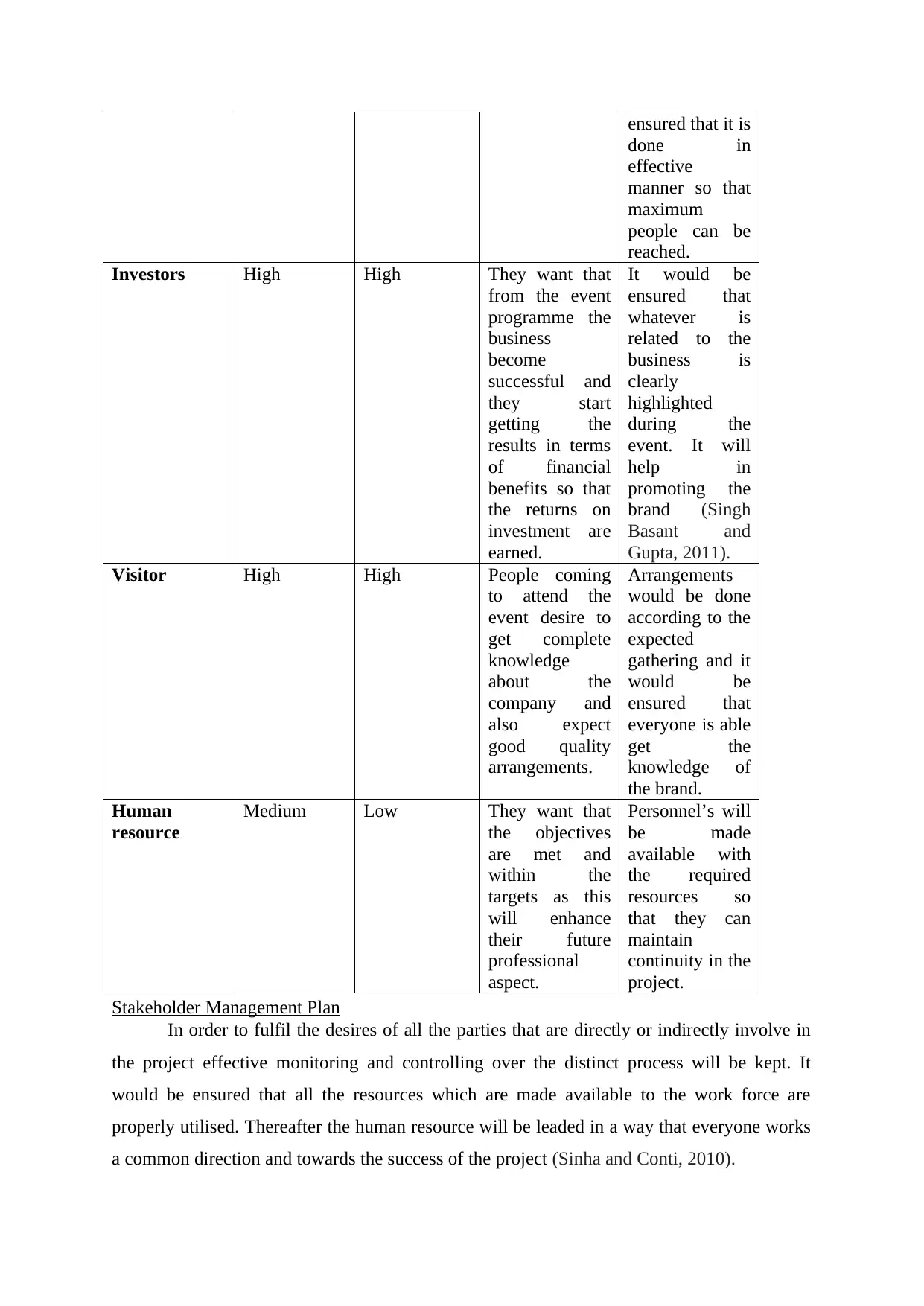
ensured that it is
done in
effective
manner so that
maximum
people can be
reached.
Investors High High They want that
from the event
programme the
business
become
successful and
they start
getting the
results in terms
of financial
benefits so that
the returns on
investment are
earned.
It would be
ensured that
whatever is
related to the
business is
clearly
highlighted
during the
event. It will
help in
promoting the
brand (Singh
Basant and
Gupta, 2011).
Visitor High High People coming
to attend the
event desire to
get complete
knowledge
about the
company and
also expect
good quality
arrangements.
Arrangements
would be done
according to the
expected
gathering and it
would be
ensured that
everyone is able
get the
knowledge of
the brand.
Human
resource
Medium Low They want that
the objectives
are met and
within the
targets as this
will enhance
their future
professional
aspect.
Personnel’s will
be made
available with
the required
resources so
that they can
maintain
continuity in the
project.
Stakeholder Management Plan
In order to fulfil the desires of all the parties that are directly or indirectly involve in
the project effective monitoring and controlling over the distinct process will be kept. It
would be ensured that all the resources which are made available to the work force are
properly utilised. Thereafter the human resource will be leaded in a way that everyone works
a common direction and towards the success of the project (Sinha and Conti, 2010).
done in
effective
manner so that
maximum
people can be
reached.
Investors High High They want that
from the event
programme the
business
become
successful and
they start
getting the
results in terms
of financial
benefits so that
the returns on
investment are
earned.
It would be
ensured that
whatever is
related to the
business is
clearly
highlighted
during the
event. It will
help in
promoting the
brand (Singh
Basant and
Gupta, 2011).
Visitor High High People coming
to attend the
event desire to
get complete
knowledge
about the
company and
also expect
good quality
arrangements.
Arrangements
would be done
according to the
expected
gathering and it
would be
ensured that
everyone is able
get the
knowledge of
the brand.
Human
resource
Medium Low They want that
the objectives
are met and
within the
targets as this
will enhance
their future
professional
aspect.
Personnel’s will
be made
available with
the required
resources so
that they can
maintain
continuity in the
project.
Stakeholder Management Plan
In order to fulfil the desires of all the parties that are directly or indirectly involve in
the project effective monitoring and controlling over the distinct process will be kept. It
would be ensured that all the resources which are made available to the work force are
properly utilised. Thereafter the human resource will be leaded in a way that everyone works
a common direction and towards the success of the project (Sinha and Conti, 2010).
Paraphrase This Document
Need a fresh take? Get an instant paraphrase of this document with our AI Paraphraser
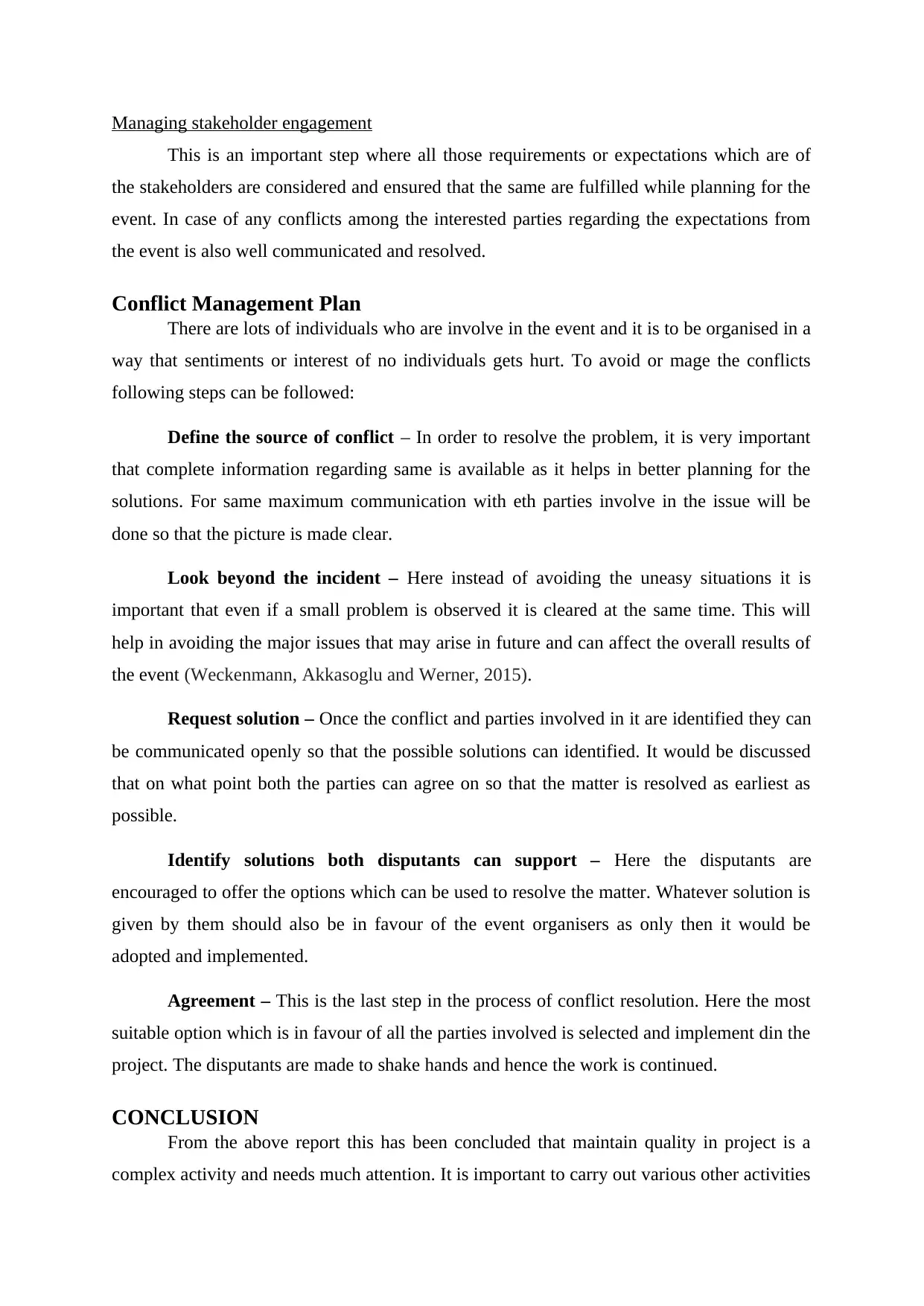
Managing stakeholder engagement
This is an important step where all those requirements or expectations which are of
the stakeholders are considered and ensured that the same are fulfilled while planning for the
event. In case of any conflicts among the interested parties regarding the expectations from
the event is also well communicated and resolved.
Conflict Management Plan
There are lots of individuals who are involve in the event and it is to be organised in a
way that sentiments or interest of no individuals gets hurt. To avoid or mage the conflicts
following steps can be followed:
Define the source of conflict – In order to resolve the problem, it is very important
that complete information regarding same is available as it helps in better planning for the
solutions. For same maximum communication with eth parties involve in the issue will be
done so that the picture is made clear.
Look beyond the incident – Here instead of avoiding the uneasy situations it is
important that even if a small problem is observed it is cleared at the same time. This will
help in avoiding the major issues that may arise in future and can affect the overall results of
the event (Weckenmann, Akkasoglu and Werner, 2015).
Request solution – Once the conflict and parties involved in it are identified they can
be communicated openly so that the possible solutions can identified. It would be discussed
that on what point both the parties can agree on so that the matter is resolved as earliest as
possible.
Identify solutions both disputants can support – Here the disputants are
encouraged to offer the options which can be used to resolve the matter. Whatever solution is
given by them should also be in favour of the event organisers as only then it would be
adopted and implemented.
Agreement – This is the last step in the process of conflict resolution. Here the most
suitable option which is in favour of all the parties involved is selected and implement din the
project. The disputants are made to shake hands and hence the work is continued.
CONCLUSION
From the above report this has been concluded that maintain quality in project is a
complex activity and needs much attention. It is important to carry out various other activities
This is an important step where all those requirements or expectations which are of
the stakeholders are considered and ensured that the same are fulfilled while planning for the
event. In case of any conflicts among the interested parties regarding the expectations from
the event is also well communicated and resolved.
Conflict Management Plan
There are lots of individuals who are involve in the event and it is to be organised in a
way that sentiments or interest of no individuals gets hurt. To avoid or mage the conflicts
following steps can be followed:
Define the source of conflict – In order to resolve the problem, it is very important
that complete information regarding same is available as it helps in better planning for the
solutions. For same maximum communication with eth parties involve in the issue will be
done so that the picture is made clear.
Look beyond the incident – Here instead of avoiding the uneasy situations it is
important that even if a small problem is observed it is cleared at the same time. This will
help in avoiding the major issues that may arise in future and can affect the overall results of
the event (Weckenmann, Akkasoglu and Werner, 2015).
Request solution – Once the conflict and parties involved in it are identified they can
be communicated openly so that the possible solutions can identified. It would be discussed
that on what point both the parties can agree on so that the matter is resolved as earliest as
possible.
Identify solutions both disputants can support – Here the disputants are
encouraged to offer the options which can be used to resolve the matter. Whatever solution is
given by them should also be in favour of the event organisers as only then it would be
adopted and implemented.
Agreement – This is the last step in the process of conflict resolution. Here the most
suitable option which is in favour of all the parties involved is selected and implement din the
project. The disputants are made to shake hands and hence the work is continued.
CONCLUSION
From the above report this has been concluded that maintain quality in project is a
complex activity and needs much attention. It is important to carry out various other activities

so that the overall standards of the work are maintained. It is required that every step while
performing the group task is take with care and after evaluating that it will give the desired
results. Stakeholders are important parties of the and needs to be managed effectively so that
they are provided with maximum satisfaction. Apart from this conflict resolution process was
discussed which shows that how by following few steps the problem that may arise can be
avoided or impact of same can be reduced to maximum limit.
performing the group task is take with care and after evaluating that it will give the desired
results. Stakeholders are important parties of the and needs to be managed effectively so that
they are provided with maximum satisfaction. Apart from this conflict resolution process was
discussed which shows that how by following few steps the problem that may arise can be
avoided or impact of same can be reduced to maximum limit.
⊘ This is a preview!⊘
Do you want full access?
Subscribe today to unlock all pages.
Trusted by 1+ million students worldwide
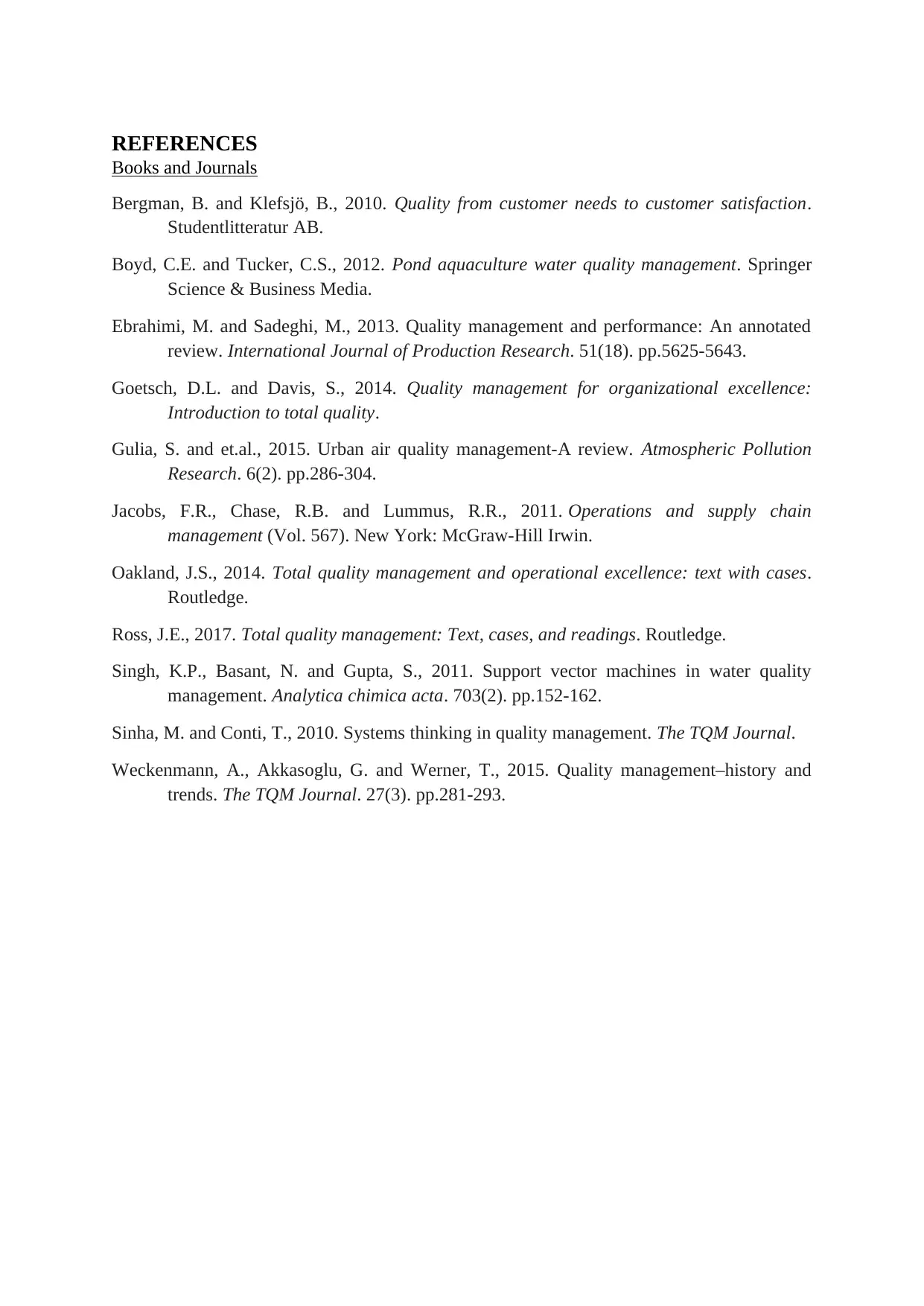
REFERENCES
Books and Journals
Bergman, B. and Klefsjö, B., 2010. Quality from customer needs to customer satisfaction.
Studentlitteratur AB.
Boyd, C.E. and Tucker, C.S., 2012. Pond aquaculture water quality management. Springer
Science & Business Media.
Ebrahimi, M. and Sadeghi, M., 2013. Quality management and performance: An annotated
review. International Journal of Production Research. 51(18). pp.5625-5643.
Goetsch, D.L. and Davis, S., 2014. Quality management for organizational excellence:
Introduction to total quality.
Gulia, S. and et.al., 2015. Urban air quality management-A review. Atmospheric Pollution
Research. 6(2). pp.286-304.
Jacobs, F.R., Chase, R.B. and Lummus, R.R., 2011. Operations and supply chain
management (Vol. 567). New York: McGraw-Hill Irwin.
Oakland, J.S., 2014. Total quality management and operational excellence: text with cases.
Routledge.
Ross, J.E., 2017. Total quality management: Text, cases, and readings. Routledge.
Singh, K.P., Basant, N. and Gupta, S., 2011. Support vector machines in water quality
management. Analytica chimica acta. 703(2). pp.152-162.
Sinha, M. and Conti, T., 2010. Systems thinking in quality management. The TQM Journal.
Weckenmann, A., Akkasoglu, G. and Werner, T., 2015. Quality management–history and
trends. The TQM Journal. 27(3). pp.281-293.
Books and Journals
Bergman, B. and Klefsjö, B., 2010. Quality from customer needs to customer satisfaction.
Studentlitteratur AB.
Boyd, C.E. and Tucker, C.S., 2012. Pond aquaculture water quality management. Springer
Science & Business Media.
Ebrahimi, M. and Sadeghi, M., 2013. Quality management and performance: An annotated
review. International Journal of Production Research. 51(18). pp.5625-5643.
Goetsch, D.L. and Davis, S., 2014. Quality management for organizational excellence:
Introduction to total quality.
Gulia, S. and et.al., 2015. Urban air quality management-A review. Atmospheric Pollution
Research. 6(2). pp.286-304.
Jacobs, F.R., Chase, R.B. and Lummus, R.R., 2011. Operations and supply chain
management (Vol. 567). New York: McGraw-Hill Irwin.
Oakland, J.S., 2014. Total quality management and operational excellence: text with cases.
Routledge.
Ross, J.E., 2017. Total quality management: Text, cases, and readings. Routledge.
Singh, K.P., Basant, N. and Gupta, S., 2011. Support vector machines in water quality
management. Analytica chimica acta. 703(2). pp.152-162.
Sinha, M. and Conti, T., 2010. Systems thinking in quality management. The TQM Journal.
Weckenmann, A., Akkasoglu, G. and Werner, T., 2015. Quality management–history and
trends. The TQM Journal. 27(3). pp.281-293.

1 out of 10


Related Documents


Your All-in-One AI-Powered Toolkit for Academic Success.
+13062052269
info@desklib.com
Available 24*7 on WhatsApp / Email
![[object Object]](/_next/static/media/star-bottom.7253800d.svg)
Unlock your academic potential
Copyright © 2020–2026 A2Z Services. All Rights Reserved. Developed and managed by ZUCOL.