Inquest Analysis: Systems of Quality and Safety in Ann Parsons' Death
VerifiedAdded on 2023/06/11
|17
|4416
|392
Case Study
AI Summary
This case study meticulously examines the circumstances surrounding the death of Mrs. Ann Parsons within the healthcare system, utilizing the London Protocol framework by Vincent et al. to categorize and explain the factors contributing to her death as identified by the Coroner's report. The analysis covers patient factors, testing procedures, individual staff contributions, team dynamics, and work environment influences. It assesses the actions taken in the aftermath of the event against established good practices and evaluates whether The Royal Brisbane and Women’s Hospital adhered to these standards. Furthermore, the study identifies specific issues related to providing high-quality, safe health services highlighted by the case and proposes an action plan, employing a recognized risk management and quality improvement approach, to address the strategic issues, supported by evidence from relevant literature. The assignment emphasizes the interconnectedness of quality and safety in healthcare, aiming to prevent future adverse events through comprehensive system analysis and improvement strategies.

Running head: SYSTEMS OF QUALITY AND SAFETY IN HEALTH
Systems of Quality and Safety in Health
Name of the Student:
Name of the University:
Author Note:
Systems of Quality and Safety in Health
Name of the Student:
Name of the University:
Author Note:

Paraphrase This Document
Need a fresh take? Get an instant paraphrase of this document with our AI Paraphraser
1SYSTEMS OF QUALITY AND SAFETY IN HEALTH
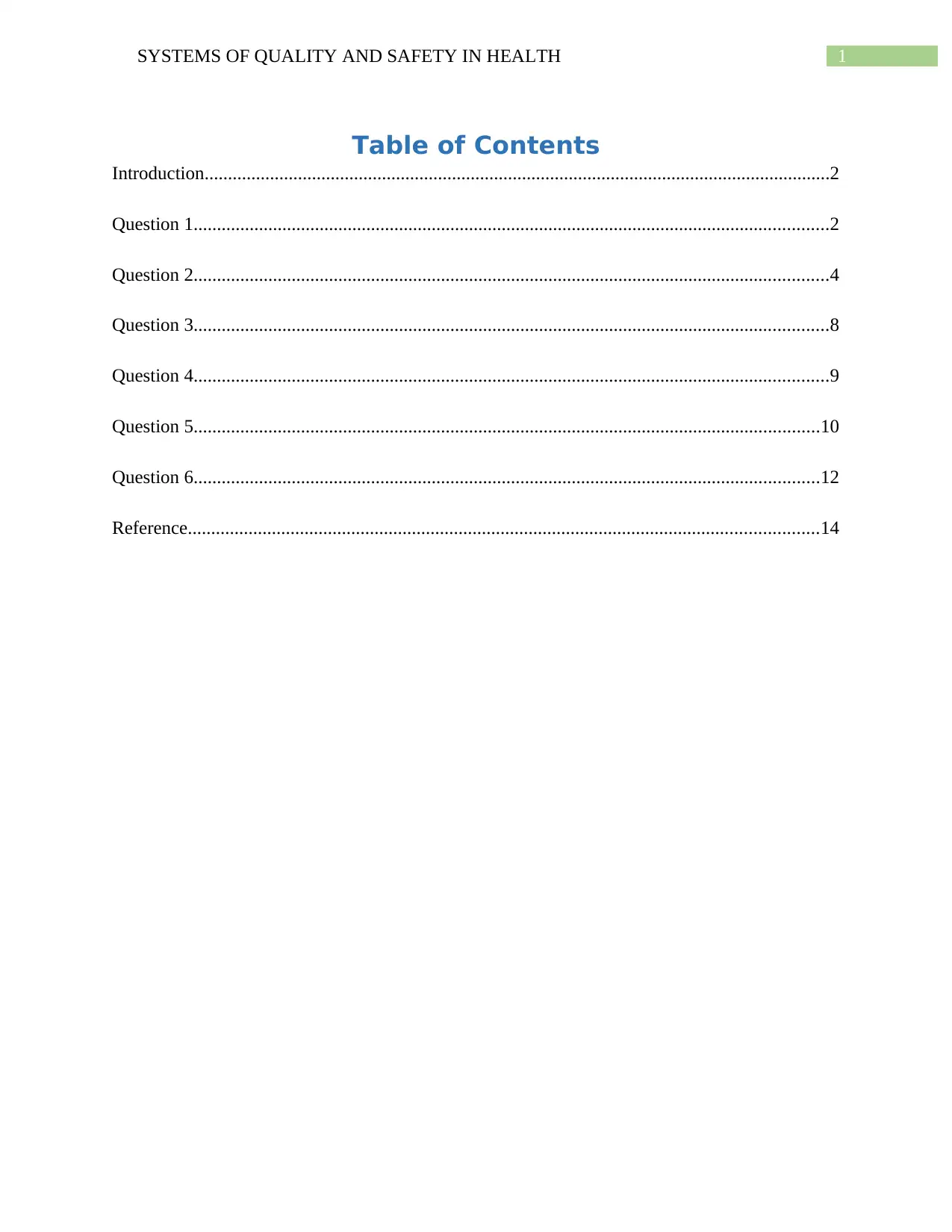
Table of Contents
Introduction......................................................................................................................................2
Question 1........................................................................................................................................2
Question 2........................................................................................................................................4
Question 3........................................................................................................................................8
Question 4........................................................................................................................................9
Question 5......................................................................................................................................10
Question 6......................................................................................................................................12
Reference.......................................................................................................................................14
Table of Contents
Introduction......................................................................................................................................2
Question 1........................................................................................................................................2
Question 2........................................................................................................................................4
Question 3........................................................................................................................................8
Question 4........................................................................................................................................9
Question 5......................................................................................................................................10
Question 6......................................................................................................................................12
Reference.......................................................................................................................................14
2SYSTEMS OF QUALITY AND SAFETY IN HEALTH
Introduction
Quality and safety are closely intertwined and it is established to provide the optimal safety to
the patients. This is achieved through the high quality of care throughout the journey of the
patient. when the quality of the all the vital processes engaged in the healthcare of the patient
helps in preventing the threat turn into accidents. While the system approach designates that the
care consists of the several processes that work to influence each other and result in patient
outcome (World Health Organization, 2018). This study deals with the inquest of the death of a
patient named Ann Parsons.
Question 1
The events that led to the death of Mrs Parsons are discussed as follows:
Dr Cunneen noted that the daughter of Ann Parsons reported that her mother is
having difficulties with concentration, attention and ha difficulties in the last
month. Mrs Parsons. It was also found that Mrs Parsons had a history of a
migraine when she was a child and had a history of malignancy or cancer.
Dr Bernardi reviewed the brain scan report and made a comparison with the prior
perioperative CT scan. Dr Bernardi observed that the CT scan which had been
done recently reveals that a resection cavity is filled with the air. The region also
showcased peri-lesional oedema. This was previously found on the perioperative
scan (Courts.qld.gov.au, 2018).
There are several issues that were found during the stay in the ICU and they are as
follows: prior to the surgery, Mrs Parsons speech capacity was not monitored and
this left both the nursing and the medical team without a base level data for
Introduction
Quality and safety are closely intertwined and it is established to provide the optimal safety to
the patients. This is achieved through the high quality of care throughout the journey of the
patient. when the quality of the all the vital processes engaged in the healthcare of the patient
helps in preventing the threat turn into accidents. While the system approach designates that the
care consists of the several processes that work to influence each other and result in patient
outcome (World Health Organization, 2018). This study deals with the inquest of the death of a
patient named Ann Parsons.
Question 1
The events that led to the death of Mrs Parsons are discussed as follows:
Dr Cunneen noted that the daughter of Ann Parsons reported that her mother is
having difficulties with concentration, attention and ha difficulties in the last
month. Mrs Parsons. It was also found that Mrs Parsons had a history of a
migraine when she was a child and had a history of malignancy or cancer.
Dr Bernardi reviewed the brain scan report and made a comparison with the prior
perioperative CT scan. Dr Bernardi observed that the CT scan which had been
done recently reveals that a resection cavity is filled with the air. The region also
showcased peri-lesional oedema. This was previously found on the perioperative
scan (Courts.qld.gov.au, 2018).
There are several issues that were found during the stay in the ICU and they are as
follows: prior to the surgery, Mrs Parsons speech capacity was not monitored and
this left both the nursing and the medical team without a base level data for
⊘ This is a preview!⊘
Do you want full access?
Subscribe today to unlock all pages.

Trusted by 1+ million students worldwide
3SYSTEMS OF QUALITY AND SAFETY IN HEALTH
comparison that is conducted later on; For the purpose of assessing the
consciousness through the motor responses, verbal responses, eye responses and
GSC has all the specific components. When this was analysed that the due to the
variability of data that are collected by the different individuals over a short
period of time. This has resulted in a verbal handover of information from the
ICU nursing to the neurological ward and the score that was provided was 13.
While it is important to note that a recent GCS score had been 11; The verbal
communication between the ICU registrar and the Radiology registrar at around 7
am was not recorded in the ICU notes; The medical discharge summary that was
made at the 10:20 am revealed that the GCS recorded at that moment was 14.
However, this was not updated at the summary with the GCS data that included
the assessment of 11; The verbal handover that was made by the ICU nurse to the
neurosurgical ward nurse wrongly stated the CT scan conducted at 5:00 am
showed no concerns. However, there had been oedema and a new ischaemic
infarct and a shift is noticed in the midline when a comparison is made to the
previous available CT; The nursing handover documented was commenced by
different nurse that was present in the earlier shift and not updated later and it
included no information about the CT that was performed on during the 5:00 am;
The neurosurgical discharge notation that recorded the plan contained that
information which stated that the MR in the next few days will clarify the
hypodensity after a scan. The plan gave neither any direction nor any guidance to
look upon for any particular change in the status of the patient to report upon
(Courts.qld.gov.au, 2018).
comparison that is conducted later on; For the purpose of assessing the
consciousness through the motor responses, verbal responses, eye responses and
GSC has all the specific components. When this was analysed that the due to the
variability of data that are collected by the different individuals over a short
period of time. This has resulted in a verbal handover of information from the
ICU nursing to the neurological ward and the score that was provided was 13.
While it is important to note that a recent GCS score had been 11; The verbal
communication between the ICU registrar and the Radiology registrar at around 7
am was not recorded in the ICU notes; The medical discharge summary that was
made at the 10:20 am revealed that the GCS recorded at that moment was 14.
However, this was not updated at the summary with the GCS data that included
the assessment of 11; The verbal handover that was made by the ICU nurse to the
neurosurgical ward nurse wrongly stated the CT scan conducted at 5:00 am
showed no concerns. However, there had been oedema and a new ischaemic
infarct and a shift is noticed in the midline when a comparison is made to the
previous available CT; The nursing handover documented was commenced by
different nurse that was present in the earlier shift and not updated later and it
included no information about the CT that was performed on during the 5:00 am;
The neurosurgical discharge notation that recorded the plan contained that
information which stated that the MR in the next few days will clarify the
hypodensity after a scan. The plan gave neither any direction nor any guidance to
look upon for any particular change in the status of the patient to report upon
(Courts.qld.gov.au, 2018).
Paraphrase This Document
Need a fresh take? Get an instant paraphrase of this document with our AI Paraphraser
4SYSTEMS OF QUALITY AND SAFETY IN HEALTH
Mr Pickham spoke with CN Stanford and then attempted to communicate with the
concerns. It was later concluded that the nurse failed to appreciate and share the
information with Mrs Parsons. CN Stanford was thus at that time was not aware
of the fact that Mrs Parsons suffered from a post-surgical ischaemic infarct. The
nurse, however, failed to hand over the information to CN Stanford because she
thought that there is nothing concerning in the CT (Courts.qld.gov.au, 2018).
There was no direction either in the nursing discharge nor in the medical
regarding the frequency of the observations.
Question 2
The framework selected for the studying the factors that are mentioned and pointed out
by the Coroner is done according to the framework suggested by Vincent et al. This framework
is a part of the London Protocol that was framed as a tool to analyse and investigate both outside
and inside the health care. An update version, The London protocol of the old form of "Protocol
for the Investigation and Analysis of Clinical Incidents" has been developed. The protocol
provides a process for the investigation of the incident and its analysis of the how the incident
developed. The approach is developed and refined and it is based on the experience of the
research into the incident investigation both inside and outside the healthcare (Imperial College
London, 2018b). The main purpose of the London Protocol is to gain a thoughtful and a
comprehensive investigation of the incident analysis. This even goes beyond the blame or the
fault identification. It is important to note that a structured reflection process is far more useful
and successful and is better than the quick assessments by the experts or casual brainstorming.
The approach utilizes the full potential of the clinical expertise and the clinical experiences to the
fullest (Imperial College London, 2018a).
Mr Pickham spoke with CN Stanford and then attempted to communicate with the
concerns. It was later concluded that the nurse failed to appreciate and share the
information with Mrs Parsons. CN Stanford was thus at that time was not aware
of the fact that Mrs Parsons suffered from a post-surgical ischaemic infarct. The
nurse, however, failed to hand over the information to CN Stanford because she
thought that there is nothing concerning in the CT (Courts.qld.gov.au, 2018).
There was no direction either in the nursing discharge nor in the medical
regarding the frequency of the observations.
Question 2
The framework selected for the studying the factors that are mentioned and pointed out
by the Coroner is done according to the framework suggested by Vincent et al. This framework
is a part of the London Protocol that was framed as a tool to analyse and investigate both outside
and inside the health care. An update version, The London protocol of the old form of "Protocol
for the Investigation and Analysis of Clinical Incidents" has been developed. The protocol
provides a process for the investigation of the incident and its analysis of the how the incident
developed. The approach is developed and refined and it is based on the experience of the
research into the incident investigation both inside and outside the healthcare (Imperial College
London, 2018b). The main purpose of the London Protocol is to gain a thoughtful and a
comprehensive investigation of the incident analysis. This even goes beyond the blame or the
fault identification. It is important to note that a structured reflection process is far more useful
and successful and is better than the quick assessments by the experts or casual brainstorming.
The approach utilizes the full potential of the clinical expertise and the clinical experiences to the
fullest (Imperial College London, 2018a).
5SYSTEMS OF QUALITY AND SAFETY IN HEALTH
The main theory underneath which the protocol is based exists within the settings outside the
healthcare. The London Protocol is adapted from the Organizational Accident Causation Model.
The London Framework as devised by Vincent et al. consists of different types of the
frameworks and it includes institutional, management and organizational, team, work
environment, task and patient and individual staff member (Imperial College London, 2018a).
At the beginning of the framework lies the patient factors. In a clinical setup, it is
important to note that the clinical condition of the patient has a larger impact on both the
outcome and practice. There are several factors like the psychological problems, language and
personality and it may be important because it influences the staff communication. The utility
and the availability of the protocols, design of the task, the test results affect the process of care,
and it affects the quality of the care. The individual factors include the experiences and skills of
the staffs and the knowledge all together affects the clinical practice. It is important to mention
that the each of the staff members are a part of a wider organization, mental health service or
hospital. The healthcare delivered depend a lot on the individual practises and the way it impacts
a team of healthcare professionals perform, supervise, support and communicate. All the
members are influenced by the working environments (Imperial College London, 2018b). The
physical environment, working environment and the several factors that affect the ability and the
morale of a staff to work effectively. The team of the professionals on the other hand is affected
by the management decisions and the management actions at the higher level of the organization.
These include the policies that will be used by the agency staff or a locum, supervisions, training,
education and along with it the availability of the supplies and the equipment. It is however
important to note that the organization is itself being affected by the institutional context,
political climate, broader economy, external regulatory bodies, financial constraints, financial
The main theory underneath which the protocol is based exists within the settings outside the
healthcare. The London Protocol is adapted from the Organizational Accident Causation Model.
The London Framework as devised by Vincent et al. consists of different types of the
frameworks and it includes institutional, management and organizational, team, work
environment, task and patient and individual staff member (Imperial College London, 2018a).
At the beginning of the framework lies the patient factors. In a clinical setup, it is
important to note that the clinical condition of the patient has a larger impact on both the
outcome and practice. There are several factors like the psychological problems, language and
personality and it may be important because it influences the staff communication. The utility
and the availability of the protocols, design of the task, the test results affect the process of care,
and it affects the quality of the care. The individual factors include the experiences and skills of
the staffs and the knowledge all together affects the clinical practice. It is important to mention
that the each of the staff members are a part of a wider organization, mental health service or
hospital. The healthcare delivered depend a lot on the individual practises and the way it impacts
a team of healthcare professionals perform, supervise, support and communicate. All the
members are influenced by the working environments (Imperial College London, 2018b). The
physical environment, working environment and the several factors that affect the ability and the
morale of a staff to work effectively. The team of the professionals on the other hand is affected
by the management decisions and the management actions at the higher level of the organization.
These include the policies that will be used by the agency staff or a locum, supervisions, training,
education and along with it the availability of the supplies and the equipment. It is however
important to note that the organization is itself being affected by the institutional context,
political climate, broader economy, external regulatory bodies, financial constraints, financial
⊘ This is a preview!⊘
Do you want full access?
Subscribe today to unlock all pages.
Trusted by 1+ million students worldwide
6SYSTEMS OF QUALITY AND SAFETY IN HEALTH
stability. The analysis at each level has the provision of expansion and it provides a detailed
specification of the major elements as it has major factors (Imperial College London, 2018b).
The framework also provides a conceptual basis for the adverse incidents analysis. This includes
both the higher level organizational factors and the clinical factors that can be influential. By
following the framework, a whole range of the possible influences can be considered and also
can be used for the purpose of an incident analysis and investigation (Imperial College London,
2018a).
The various factor types and the contributory factors are mentioned below:
The patient factors- it is important to note that Mrs Parsons is a registered nurse
and her other family members also work in the medical field. Her son is also a
registered nurse and a professor of nursing in the US. Mrs Parsons daughter is an
emergency and intensive care nurse. The daughter in law of Mrs Parsons is a
surgeon in the US. It is shocking to note that on the first day of Mrs Parson's job,
she had been experiencing the symptoms of an unknown brain tumour. It was
being mentioned by the daughter of Mrs Parsons that her mother is having a
decreased concentration/attention span and concentration. Mrs Parsons had been
known to have a history of a migraine but with no history of malignancy or
cancer. This is, however, important to note that Mrs Parsons even after having so
many health issues were reluctant to consult a doctor. It is only on 26th
September that Mrs Parsons was admitted to the Rockhampton Base Hospital
Emergency because Mrs Parsons was experiencing a 6-day history of an occipital
headache with nausea.
stability. The analysis at each level has the provision of expansion and it provides a detailed
specification of the major elements as it has major factors (Imperial College London, 2018b).
The framework also provides a conceptual basis for the adverse incidents analysis. This includes
both the higher level organizational factors and the clinical factors that can be influential. By
following the framework, a whole range of the possible influences can be considered and also
can be used for the purpose of an incident analysis and investigation (Imperial College London,
2018a).
The various factor types and the contributory factors are mentioned below:
The patient factors- it is important to note that Mrs Parsons is a registered nurse
and her other family members also work in the medical field. Her son is also a
registered nurse and a professor of nursing in the US. Mrs Parsons daughter is an
emergency and intensive care nurse. The daughter in law of Mrs Parsons is a
surgeon in the US. It is shocking to note that on the first day of Mrs Parson's job,
she had been experiencing the symptoms of an unknown brain tumour. It was
being mentioned by the daughter of Mrs Parsons that her mother is having a
decreased concentration/attention span and concentration. Mrs Parsons had been
known to have a history of a migraine but with no history of malignancy or
cancer. This is, however, important to note that Mrs Parsons even after having so
many health issues were reluctant to consult a doctor. It is only on 26th
September that Mrs Parsons was admitted to the Rockhampton Base Hospital
Emergency because Mrs Parsons was experiencing a 6-day history of an occipital
headache with nausea.
Paraphrase This Document
Need a fresh take? Get an instant paraphrase of this document with our AI Paraphraser
7SYSTEMS OF QUALITY AND SAFETY IN HEALTH
Tests- Dr Papacostas revealed that the outcomes of the investigation (blood test,
CT brain) were pending and the decline of the GCS was sufficient at the time of
the emergency surgical intervention. Prior to the surgery, the CT and the MRI
imaging are the only documented neurological assessment. prior to the surgery,
Mrs Parsons speech capacity was not monitored and this left both the nursing and
the medical team without a base level data for comparison that is conducted later
on. For the purpose of assessing the consciousness through the motor responses,
verbal responses, eye responses and GSC have all the specific components. When
this was analysed that the due to the variability of data that are collected by the
different individuals over a short period of time. This has resulted in a verbal
handover of information from the ICU nursing to the neurological ward and the
score that was provided was 13. While it is important to note that a recent GCS
score had been 11
Individual (staff) factors- initially, the Dr Tollesson was on leave and was
unwilling to hand over Mrs Parsons to another surgeon. However, he later on
handed over Mrs Parosons to a consultant neurosurgeon. The main issue is that
the consultant neurosurgeon did not see her prior to the surgery.
Team factors- The verbal communication between the ICU registrar and the
Radiology registrar at around 7 am was not recorded in the ICU notes. The verbal
handover that was made by the ICU nurse to the neurosurgical ward nurse
wrongly stated the CT scan conducted at 5:00 am showed no concerns. However,
there had been oedema and a new ischaemic infarct and a shift are noticed in the
midline when a comparison is made to the previous available CT.
Tests- Dr Papacostas revealed that the outcomes of the investigation (blood test,
CT brain) were pending and the decline of the GCS was sufficient at the time of
the emergency surgical intervention. Prior to the surgery, the CT and the MRI
imaging are the only documented neurological assessment. prior to the surgery,
Mrs Parsons speech capacity was not monitored and this left both the nursing and
the medical team without a base level data for comparison that is conducted later
on. For the purpose of assessing the consciousness through the motor responses,
verbal responses, eye responses and GSC have all the specific components. When
this was analysed that the due to the variability of data that are collected by the
different individuals over a short period of time. This has resulted in a verbal
handover of information from the ICU nursing to the neurological ward and the
score that was provided was 13. While it is important to note that a recent GCS
score had been 11
Individual (staff) factors- initially, the Dr Tollesson was on leave and was
unwilling to hand over Mrs Parsons to another surgeon. However, he later on
handed over Mrs Parosons to a consultant neurosurgeon. The main issue is that
the consultant neurosurgeon did not see her prior to the surgery.
Team factors- The verbal communication between the ICU registrar and the
Radiology registrar at around 7 am was not recorded in the ICU notes. The verbal
handover that was made by the ICU nurse to the neurosurgical ward nurse
wrongly stated the CT scan conducted at 5:00 am showed no concerns. However,
there had been oedema and a new ischaemic infarct and a shift are noticed in the
midline when a comparison is made to the previous available CT.
8SYSTEMS OF QUALITY AND SAFETY IN HEALTH
Work environmental factors- CN Stanford mentioned that the nurses generally
work as three teams and the 3 teams cover 30 bed of the neurosurgical ward. In
the team of CN Stanford, there were 3 nurses on one team and each team have a
total of 11 patients. All the nurses before the start of the shift start ensure that they
are able to cover each other during the breaks. Thus, it can be inferred that the
nurses might have encountered heavy workloads during their shift time that in the
majority of the cases leads to fatigue. It has been found that the CN Stanford was
not advised of the fact that there is any concerning issue with respect to Mrs
Parsons. However, by the time of inquest, CN Stanford was unable to recall that
the, whether Mrs Parsons had an ischaemic heart attack or Mrs Parsons, had a CT
scan. Thus, it can be seen that the due to workloads the staffs were unable to
remember the vital information. Even it can be said that the doctors failed to
convey the same information to the CN Stanford.
Question 3
The best practices for the in-hospital cardiac arrest include the high-quality
Cardiopulmonary Resuscitation (CPR), with the optimal chest ventilations and compressions and
the early defibrillations (Maekawa et al., 2013). All these procedures have been found to be
playing a successful role in the increases survival rate in the out of hospital cardiac arrest.
Mechanical chest compression devices that are present in the in-hospital setting are especially
used when the manual usage of the CPR cannot be used (Rubertsson et al., 2014). There is
evidence that the mechanical compression devices are beneficial in improving the coronary
perfusion pressures during the in-hospital cardiac arrest in comparison to the manual chest
compressions. The automated external defibrillators play a major role in the early defibrillation
Work environmental factors- CN Stanford mentioned that the nurses generally
work as three teams and the 3 teams cover 30 bed of the neurosurgical ward. In
the team of CN Stanford, there were 3 nurses on one team and each team have a
total of 11 patients. All the nurses before the start of the shift start ensure that they
are able to cover each other during the breaks. Thus, it can be inferred that the
nurses might have encountered heavy workloads during their shift time that in the
majority of the cases leads to fatigue. It has been found that the CN Stanford was
not advised of the fact that there is any concerning issue with respect to Mrs
Parsons. However, by the time of inquest, CN Stanford was unable to recall that
the, whether Mrs Parsons had an ischaemic heart attack or Mrs Parsons, had a CT
scan. Thus, it can be seen that the due to workloads the staffs were unable to
remember the vital information. Even it can be said that the doctors failed to
convey the same information to the CN Stanford.
Question 3
The best practices for the in-hospital cardiac arrest include the high-quality
Cardiopulmonary Resuscitation (CPR), with the optimal chest ventilations and compressions and
the early defibrillations (Maekawa et al., 2013). All these procedures have been found to be
playing a successful role in the increases survival rate in the out of hospital cardiac arrest.
Mechanical chest compression devices that are present in the in-hospital setting are especially
used when the manual usage of the CPR cannot be used (Rubertsson et al., 2014). There is
evidence that the mechanical compression devices are beneficial in improving the coronary
perfusion pressures during the in-hospital cardiac arrest in comparison to the manual chest
compressions. The automated external defibrillators play a major role in the early defibrillation
⊘ This is a preview!⊘
Do you want full access?
Subscribe today to unlock all pages.
Trusted by 1+ million students worldwide
9SYSTEMS OF QUALITY AND SAFETY IN HEALTH
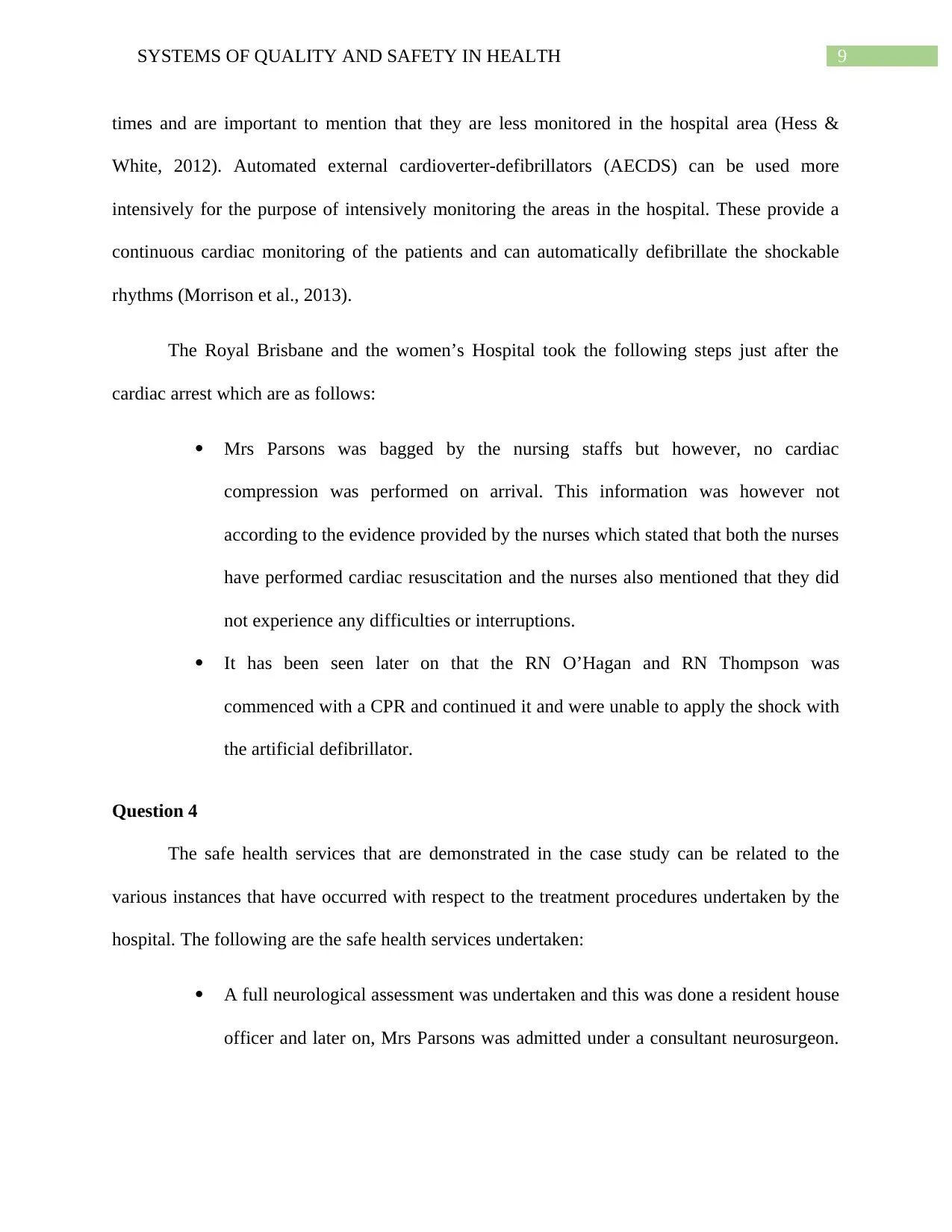
times and are important to mention that they are less monitored in the hospital area (Hess &
White, 2012). Automated external cardioverter-defibrillators (AECDS) can be used more
intensively for the purpose of intensively monitoring the areas in the hospital. These provide a
continuous cardiac monitoring of the patients and can automatically defibrillate the shockable
rhythms (Morrison et al., 2013).
The Royal Brisbane and the women’s Hospital took the following steps just after the
cardiac arrest which are as follows:
Mrs Parsons was bagged by the nursing staffs but however, no cardiac
compression was performed on arrival. This information was however not
according to the evidence provided by the nurses which stated that both the nurses
have performed cardiac resuscitation and the nurses also mentioned that they did
not experience any difficulties or interruptions.
It has been seen later on that the RN O’Hagan and RN Thompson was
commenced with a CPR and continued it and were unable to apply the shock with
the artificial defibrillator.
Question 4
The safe health services that are demonstrated in the case study can be related to the
various instances that have occurred with respect to the treatment procedures undertaken by the
hospital. The following are the safe health services undertaken:
A full neurological assessment was undertaken and this was done a resident house
officer and later on, Mrs Parsons was admitted under a consultant neurosurgeon.
times and are important to mention that they are less monitored in the hospital area (Hess &
White, 2012). Automated external cardioverter-defibrillators (AECDS) can be used more
intensively for the purpose of intensively monitoring the areas in the hospital. These provide a
continuous cardiac monitoring of the patients and can automatically defibrillate the shockable
rhythms (Morrison et al., 2013).
The Royal Brisbane and the women’s Hospital took the following steps just after the
cardiac arrest which are as follows:
Mrs Parsons was bagged by the nursing staffs but however, no cardiac
compression was performed on arrival. This information was however not
according to the evidence provided by the nurses which stated that both the nurses
have performed cardiac resuscitation and the nurses also mentioned that they did
not experience any difficulties or interruptions.
It has been seen later on that the RN O’Hagan and RN Thompson was
commenced with a CPR and continued it and were unable to apply the shock with
the artificial defibrillator.
Question 4
The safe health services that are demonstrated in the case study can be related to the
various instances that have occurred with respect to the treatment procedures undertaken by the
hospital. The following are the safe health services undertaken:
A full neurological assessment was undertaken and this was done a resident house
officer and later on, Mrs Parsons was admitted under a consultant neurosurgeon.
Paraphrase This Document
Need a fresh take? Get an instant paraphrase of this document with our AI Paraphraser
10SYSTEMS OF QUALITY AND SAFETY IN HEALTH
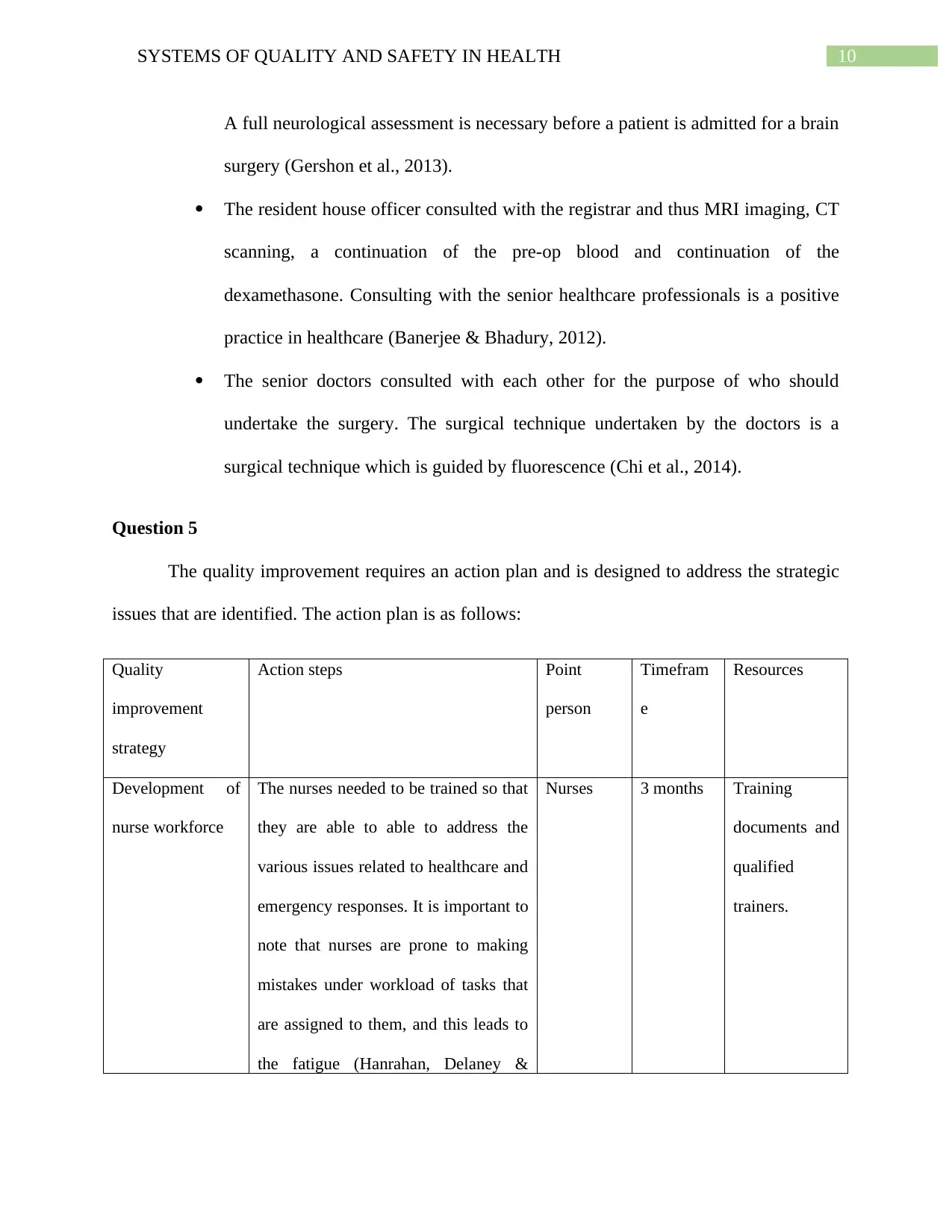
A full neurological assessment is necessary before a patient is admitted for a brain
surgery (Gershon et al., 2013).
The resident house officer consulted with the registrar and thus MRI imaging, CT
scanning, a continuation of the pre-op blood and continuation of the
dexamethasone. Consulting with the senior healthcare professionals is a positive
practice in healthcare (Banerjee & Bhadury, 2012).
The senior doctors consulted with each other for the purpose of who should
undertake the surgery. The surgical technique undertaken by the doctors is a
surgical technique which is guided by fluorescence (Chi et al., 2014).
Question 5
The quality improvement requires an action plan and is designed to address the strategic
issues that are identified. The action plan is as follows:
Quality
improvement
strategy
Action steps Point
person
Timefram
e
Resources
Development of
nurse workforce
The nurses needed to be trained so that
they are able to able to address the
various issues related to healthcare and
emergency responses. It is important to
note that nurses are prone to making
mistakes under workload of tasks that
are assigned to them, and this leads to
the fatigue (Hanrahan, Delaney &
Nurses 3 months Training
documents and
qualified
trainers.
A full neurological assessment is necessary before a patient is admitted for a brain
surgery (Gershon et al., 2013).
The resident house officer consulted with the registrar and thus MRI imaging, CT
scanning, a continuation of the pre-op blood and continuation of the
dexamethasone. Consulting with the senior healthcare professionals is a positive
practice in healthcare (Banerjee & Bhadury, 2012).
The senior doctors consulted with each other for the purpose of who should
undertake the surgery. The surgical technique undertaken by the doctors is a
surgical technique which is guided by fluorescence (Chi et al., 2014).
Question 5
The quality improvement requires an action plan and is designed to address the strategic
issues that are identified. The action plan is as follows:
Quality
improvement
strategy
Action steps Point
person
Timefram
e
Resources
Development of
nurse workforce
The nurses needed to be trained so that
they are able to able to address the
various issues related to healthcare and
emergency responses. It is important to
note that nurses are prone to making
mistakes under workload of tasks that
are assigned to them, and this leads to
the fatigue (Hanrahan, Delaney &
Nurses 3 months Training
documents and
qualified
trainers.
11SYSTEMS OF QUALITY AND SAFETY IN HEALTH
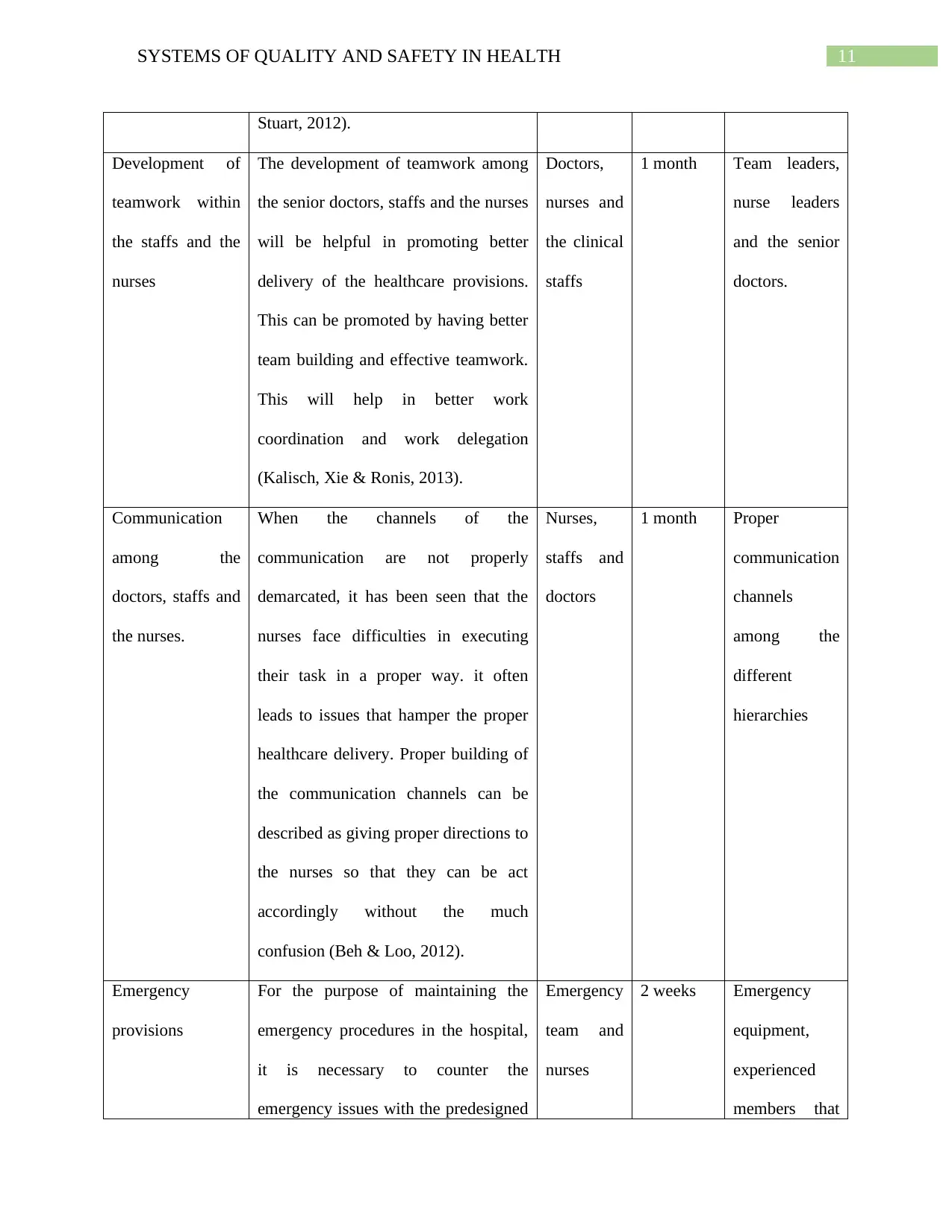
Stuart, 2012).
Development of
teamwork within
the staffs and the
nurses
The development of teamwork among
the senior doctors, staffs and the nurses
will be helpful in promoting better
delivery of the healthcare provisions.
This can be promoted by having better
team building and effective teamwork.
This will help in better work
coordination and work delegation
(Kalisch, Xie & Ronis, 2013).
Doctors,
nurses and
the clinical
staffs
1 month Team leaders,
nurse leaders
and the senior
doctors.
Communication
among the
doctors, staffs and
the nurses.
When the channels of the
communication are not properly
demarcated, it has been seen that the
nurses face difficulties in executing
their task in a proper way. it often
leads to issues that hamper the proper
healthcare delivery. Proper building of
the communication channels can be
described as giving proper directions to
the nurses so that they can be act
accordingly without the much
confusion (Beh & Loo, 2012).
Nurses,
staffs and
doctors
1 month Proper
communication
channels
among the
different
hierarchies
Emergency
provisions
For the purpose of maintaining the
emergency procedures in the hospital,
it is necessary to counter the
emergency issues with the predesigned
Emergency
team and
nurses
2 weeks Emergency
equipment,
experienced
members that
Stuart, 2012).
Development of
teamwork within
the staffs and the
nurses
The development of teamwork among
the senior doctors, staffs and the nurses
will be helpful in promoting better
delivery of the healthcare provisions.
This can be promoted by having better
team building and effective teamwork.
This will help in better work
coordination and work delegation
(Kalisch, Xie & Ronis, 2013).
Doctors,
nurses and
the clinical
staffs
1 month Team leaders,
nurse leaders
and the senior
doctors.
Communication
among the
doctors, staffs and
the nurses.
When the channels of the
communication are not properly
demarcated, it has been seen that the
nurses face difficulties in executing
their task in a proper way. it often
leads to issues that hamper the proper
healthcare delivery. Proper building of
the communication channels can be
described as giving proper directions to
the nurses so that they can be act
accordingly without the much
confusion (Beh & Loo, 2012).
Nurses,
staffs and
doctors
1 month Proper
communication
channels
among the
different
hierarchies
Emergency
provisions
For the purpose of maintaining the
emergency procedures in the hospital,
it is necessary to counter the
emergency issues with the predesigned
Emergency
team and
nurses
2 weeks Emergency
equipment,
experienced
members that
⊘ This is a preview!⊘
Do you want full access?
Subscribe today to unlock all pages.
Trusted by 1+ million students worldwide

1 out of 17


Your All-in-One AI-Powered Toolkit for Academic Success.
+13062052269
info@desklib.com
Available 24*7 on WhatsApp / Email
![[object Object]](/_next/static/media/star-bottom.7253800d.svg)
Unlock your academic potential
Copyright © 2020–2026 A2Z Services. All Rights Reserved. Developed and managed by ZUCOL.