The Impact of Fossil Fuels on Climate Change: A Study

Verified

Added on  2020/03/28

|2
|313
|156
Homework Assignment
AI Summary
This assignment delves into the critical relationship between fossil fuels and climate change. It begins by highlighting the vast reserves of fossil fuels and their potential to release significantly more carbon dioxide than the safe limit, emphasizing the urgency of addressing the issue. The assignment then proposes a solution: the implementation of a carbon tax to discourage fossil fuel consumption. This tax would increase the cost of fossil fuels, making them less economically viable and encouraging consumers to use them more efficiently, thereby reducing carbon emissions. The assignment references McKibben's (2012) work on the topic to support its arguments and provide context to the issues discussed.
Document Page
Question 1
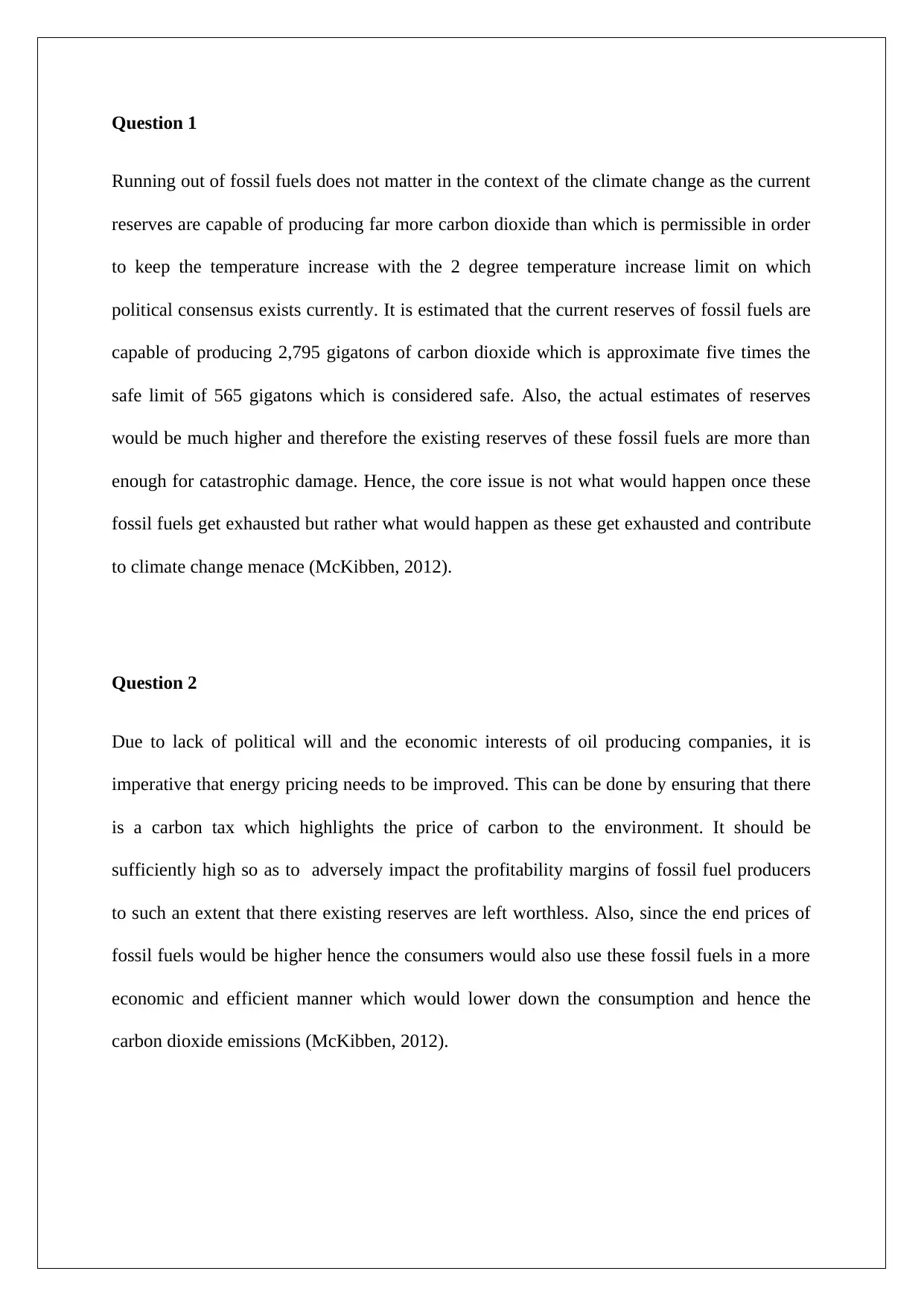
Running out of fossil fuels does not matter in the context of the climate change as the current
reserves are capable of producing far more carbon dioxide than which is permissible in order
to keep the temperature increase with the 2 degree temperature increase limit on which
political consensus exists currently. It is estimated that the current reserves of fossil fuels are
capable of producing 2,795 gigatons of carbon dioxide which is approximate five times the
safe limit of 565 gigatons which is considered safe. Also, the actual estimates of reserves
would be much higher and therefore the existing reserves of these fossil fuels are more than
enough for catastrophic damage. Hence, the core issue is not what would happen once these
fossil fuels get exhausted but rather what would happen as these get exhausted and contribute
to climate change menace (McKibben, 2012).
Question 2
Due to lack of political will and the economic interests of oil producing companies, it is
imperative that energy pricing needs to be improved. This can be done by ensuring that there
is a carbon tax which highlights the price of carbon to the environment. It should be
sufficiently high so as to adversely impact the profitability margins of fossil fuel producers
to such an extent that there existing reserves are left worthless. Also, since the end prices of
fossil fuels would be higher hence the consumers would also use these fossil fuels in a more
economic and efficient manner which would lower down the consumption and hence the
carbon dioxide emissions (McKibben, 2012).
tabler-icon-diamond-filled.svg

Paraphrase This Document

Need a fresh take? Get an instant paraphrase of this document with our AI Paraphraser
Document Page
Reference
McKibben, B. (2012, July 19), Global Warming’s Terrifying New Math, Rolling Stone
Website. Retrieved on September 19, 2017 from
http://www.rollingstone.com/politics/news/global-warmings-terrifying-new-math-
20120719
chevron_up_icon
1 out of 2
circle_padding
hide_on_mobile
zoom_out_icon
[object Object]