Racial Discrimination in the Workplace
VerifiedAdded on 2020/02/24
|21
|5337
|267
Report
AI Summary
This report analyzes racial discrimination in the workplace, discussing its background, impacts, and the importance of understanding the issue. It outlines federal and state laws, the effects on organizations, and proposes an action plan to combat discrimination. The report emphasizes the need for awareness and training to create a diverse and inclusive work environment.

Racial Discrimination 1
RACIAL DISCRIMINATION IN THE WORKPLACE
Name
Institution
Course
Course
Tutor
City/State
Date
RACIAL DISCRIMINATION IN THE WORKPLACE
Name
Institution
Course
Course
Tutor
City/State
Date

Paraphrase This Document
Need a fresh take? Get an instant paraphrase of this document with our AI Paraphraser
Racial Discrimination 2
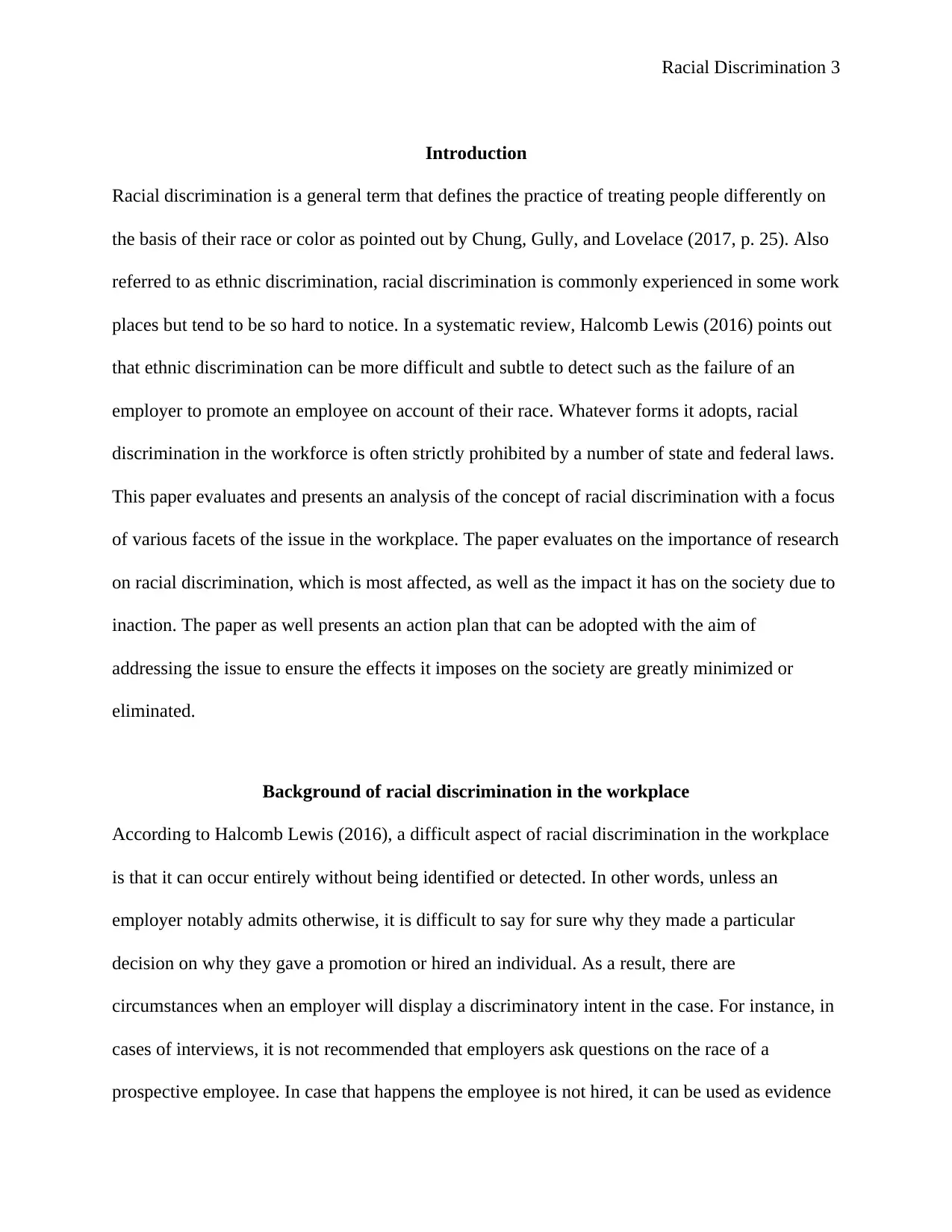
Table of Contents
Introduction......................................................................................................................................2
Background of racial discrimination in the workplace....................................................................2
Importance of understanding the concept of racial discrimination.................................................3
The most affected groups and effects of racial discrimination in the society.................................5
Federal and State Laws on racial discrimination.............................................................................6
Impacts of racial discrimination in the workplace on the company or organization.......................8
Objectives of the action plan...........................................................................................................9
Proposed actions in adopting the strategy.....................................................................................10
Anticipated Outcomes...................................................................................................................11
Timelines and resources required..................................................................................................12
Key Risks.......................................................................................................................................13
Evaluation Method.........................................................................................................................14
Conclusion.....................................................................................................................................15
Appendix........................................................................................................................................16
List of References..........................................................................................................................16
Table of Contents
Introduction......................................................................................................................................2
Background of racial discrimination in the workplace....................................................................2
Importance of understanding the concept of racial discrimination.................................................3
The most affected groups and effects of racial discrimination in the society.................................5
Federal and State Laws on racial discrimination.............................................................................6
Impacts of racial discrimination in the workplace on the company or organization.......................8
Objectives of the action plan...........................................................................................................9
Proposed actions in adopting the strategy.....................................................................................10
Anticipated Outcomes...................................................................................................................11
Timelines and resources required..................................................................................................12
Key Risks.......................................................................................................................................13
Evaluation Method.........................................................................................................................14
Conclusion.....................................................................................................................................15
Appendix........................................................................................................................................16
List of References..........................................................................................................................16
Racial Discrimination 3
Introduction
Racial discrimination is a general term that defines the practice of treating people differently on
the basis of their race or color as pointed out by Chung, Gully, and Lovelace (2017, p. 25). Also
referred to as ethnic discrimination, racial discrimination is commonly experienced in some work
places but tend to be so hard to notice. In a systematic review, Halcomb Lewis (2016) points out
that ethnic discrimination can be more difficult and subtle to detect such as the failure of an
employer to promote an employee on account of their race. Whatever forms it adopts, racial
discrimination in the workforce is often strictly prohibited by a number of state and federal laws.
This paper evaluates and presents an analysis of the concept of racial discrimination with a focus
of various facets of the issue in the workplace. The paper evaluates on the importance of research
on racial discrimination, which is most affected, as well as the impact it has on the society due to
inaction. The paper as well presents an action plan that can be adopted with the aim of
addressing the issue to ensure the effects it imposes on the society are greatly minimized or
eliminated.
Background of racial discrimination in the workplace
According to Halcomb Lewis (2016), a difficult aspect of racial discrimination in the workplace
is that it can occur entirely without being identified or detected. In other words, unless an
employer notably admits otherwise, it is difficult to say for sure why they made a particular
decision on why they gave a promotion or hired an individual. As a result, there are
circumstances when an employer will display a discriminatory intent in the case. For instance, in
cases of interviews, it is not recommended that employers ask questions on the race of a
prospective employee. In case that happens the employee is not hired, it can be used as evidence
Introduction
Racial discrimination is a general term that defines the practice of treating people differently on
the basis of their race or color as pointed out by Chung, Gully, and Lovelace (2017, p. 25). Also
referred to as ethnic discrimination, racial discrimination is commonly experienced in some work
places but tend to be so hard to notice. In a systematic review, Halcomb Lewis (2016) points out
that ethnic discrimination can be more difficult and subtle to detect such as the failure of an
employer to promote an employee on account of their race. Whatever forms it adopts, racial
discrimination in the workforce is often strictly prohibited by a number of state and federal laws.
This paper evaluates and presents an analysis of the concept of racial discrimination with a focus
of various facets of the issue in the workplace. The paper evaluates on the importance of research
on racial discrimination, which is most affected, as well as the impact it has on the society due to
inaction. The paper as well presents an action plan that can be adopted with the aim of
addressing the issue to ensure the effects it imposes on the society are greatly minimized or
eliminated.
Background of racial discrimination in the workplace
According to Halcomb Lewis (2016), a difficult aspect of racial discrimination in the workplace
is that it can occur entirely without being identified or detected. In other words, unless an
employer notably admits otherwise, it is difficult to say for sure why they made a particular
decision on why they gave a promotion or hired an individual. As a result, there are
circumstances when an employer will display a discriminatory intent in the case. For instance, in
cases of interviews, it is not recommended that employers ask questions on the race of a
prospective employee. In case that happens the employee is not hired, it can be used as evidence
⊘ This is a preview!⊘
Do you want full access?
Subscribe today to unlock all pages.

Trusted by 1+ million students worldwide
Racial Discrimination 4
that race played a certain role in the decision-making process of who is to be selected and who is
to be left out. However, Chung, Gully, and Lovelace (2017) denote that such circumstances tend
to be rare and it should as well be noted that employers need to permissibly discuss or ask on the
race in the affirmative action forms and programs as long as they do not play any part in the
decision-making.
In most cases, discrimination is relative, and a person will have no certainty on why they have
not been hired, unlike the above example. An opinion can be asking the employer about the case
who can as well offer any viable reason that is understandable and not on the basis of the race of
the individual. Alternatively, Doohee, Muslin, and Mcinerney (2016) point out that in case a
lesser-qualified person is promoted or hired than an applicant of another race, it can as well are
used as the evidence of racial discrimination in that working environment. On the other hand, the
same study denotes that there are cases when an employer is discriminating without their
knowledge. This is possible through the institution of hiring practices, workplace policies, and
tests that single out or greatly affects some ethnic communities. However, if it is not validated or
not done for legitimate business reasons, the practice could be considered as racial discrimination
in case a claim arises.
Importance of understanding the concept of racial discrimination
Understanding the concept of racial discrimination is an essential aspect of both the
organizational management and the society. For instance, gaining the required knowledge and
skills on racial discrimination enables the organizations charged with the responsibility of
dealing with the issue to understand some general exceptions as stipulated in the Equal
Opportunity Act 2010 of the international human rights policies Offermann et al. (2014, p. 500).
that race played a certain role in the decision-making process of who is to be selected and who is
to be left out. However, Chung, Gully, and Lovelace (2017) denote that such circumstances tend
to be rare and it should as well be noted that employers need to permissibly discuss or ask on the
race in the affirmative action forms and programs as long as they do not play any part in the
decision-making.
In most cases, discrimination is relative, and a person will have no certainty on why they have
not been hired, unlike the above example. An opinion can be asking the employer about the case
who can as well offer any viable reason that is understandable and not on the basis of the race of
the individual. Alternatively, Doohee, Muslin, and Mcinerney (2016) point out that in case a
lesser-qualified person is promoted or hired than an applicant of another race, it can as well are
used as the evidence of racial discrimination in that working environment. On the other hand, the
same study denotes that there are cases when an employer is discriminating without their
knowledge. This is possible through the institution of hiring practices, workplace policies, and
tests that single out or greatly affects some ethnic communities. However, if it is not validated or
not done for legitimate business reasons, the practice could be considered as racial discrimination
in case a claim arises.
Importance of understanding the concept of racial discrimination
Understanding the concept of racial discrimination is an essential aspect of both the
organizational management and the society. For instance, gaining the required knowledge and
skills on racial discrimination enables the organizations charged with the responsibility of
dealing with the issue to understand some general exceptions as stipulated in the Equal
Opportunity Act 2010 of the international human rights policies Offermann et al. (2014, p. 500).
Paraphrase This Document
Need a fresh take? Get an instant paraphrase of this document with our AI Paraphraser
Racial Discrimination 5
According to this act, there are cases where racial discrimination is allowed in favor of certain
racial groups as a special measure and a positive step to combating certain identified
disadvantages. There are also other cases when discrimination is allowed with the aim of
meeting the specific needs of certain groups such as the provision of welfare services targeted at
certain races or ethnic groups. For example, Cornwell, Rivera, and Schmutte (2017) denote that a
hostel for Vietnam refugee has been allowed in the United States with the aim of restricting
employment to the Vietnamese people only as a measure of proving economic empowerment to
the war and natural disaster servers.
In a systematic study, Doohee, Muslin, and Mcinerney (2016) point out that studying and
understanding the general concept of racial discrimination is essential for individual employees,
the employer, as well as the whole society. With the knowledge, the management of different
organizations will have a clear concept of what needs to be done to eliminate racial
discrimination in the working environment. Triana, Jayasinghe, and Pieper (2015) denote that
eliminating discrimination from an organization can be a great challenge but helps in improving
the chances of battling with former employees in court. It also helps the organization to adopt
very creative and acceptable ways of recruiting candidates within the organization in a manner
that will show an equilibrium that cuts across the different facets of ethnic groups within the
organization. The development of the equal employment opportunity guidelines and policies
within an organization is essential in establishing a foundation for a good mission and vision that
will result in a culture of mutual respect for all the employees.
According to this act, there are cases where racial discrimination is allowed in favor of certain
racial groups as a special measure and a positive step to combating certain identified
disadvantages. There are also other cases when discrimination is allowed with the aim of
meeting the specific needs of certain groups such as the provision of welfare services targeted at
certain races or ethnic groups. For example, Cornwell, Rivera, and Schmutte (2017) denote that a
hostel for Vietnam refugee has been allowed in the United States with the aim of restricting
employment to the Vietnamese people only as a measure of proving economic empowerment to
the war and natural disaster servers.
In a systematic study, Doohee, Muslin, and Mcinerney (2016) point out that studying and
understanding the general concept of racial discrimination is essential for individual employees,
the employer, as well as the whole society. With the knowledge, the management of different
organizations will have a clear concept of what needs to be done to eliminate racial
discrimination in the working environment. Triana, Jayasinghe, and Pieper (2015) denote that
eliminating discrimination from an organization can be a great challenge but helps in improving
the chances of battling with former employees in court. It also helps the organization to adopt
very creative and acceptable ways of recruiting candidates within the organization in a manner
that will show an equilibrium that cuts across the different facets of ethnic groups within the
organization. The development of the equal employment opportunity guidelines and policies
within an organization is essential in establishing a foundation for a good mission and vision that
will result in a culture of mutual respect for all the employees.
Racial Discrimination 6
The most affected groups and effects of racial discrimination in the society
In a study of the impact of racial discrimination in Coca-Cola Company, Offermann et al. (2014)
point out that racial discrimination in the workplace greatly erodes the morale and engagement of
employees. The meaning of employee engagement varies greatly and is subjective, but often
described as the enthusiastic approach of the employees to their duties with a genuine interest in
positively contributing to the set goals of the organization. Hagelskamp and Hughes (2014)
denote that racial discrimination leads to lack of engagement among the workforce, an aspect
that can be costly than turnover. The same study denotes that the disengagement of the
employees can cost a third to half of the payroll of an organization. In the working environments
where racial discrimination is unchecked, it creates a devastating effect on the workforce such as
reduction and loss of productivity as well as the poor performance in the organization (Redmond,
Pedersen, & Paradies 2017, P. 204). As a result, eliminating racial discrimination is vital in every
organization with the aim of sustaining a productive workforce to motivate the employees into
believing that their employers value their expertise and talents.
In a study, Doohee, Muslin, and Mcinerney (2016) point out that words tend to spread very fast
in the job-seekers community concerning companies as well as their respective hiring practices.
Having a reputation as a company that tolerates or condones an aspect of discriminatory
employment practices has the ability to destroy the desire of job candidates during recruitment.
With such an idea in the head of the community concerning a certain organization, it will be
difficult for candidates to seek job opportunities in the organization. In the end, the organization
will end up enticing candidates to join the firm with a salary range that is higher than that of the
market (Graham, Belliveau, & Hotchkiss 2017, P. 204). In such cases, the organization stands a
The most affected groups and effects of racial discrimination in the society
In a study of the impact of racial discrimination in Coca-Cola Company, Offermann et al. (2014)
point out that racial discrimination in the workplace greatly erodes the morale and engagement of
employees. The meaning of employee engagement varies greatly and is subjective, but often
described as the enthusiastic approach of the employees to their duties with a genuine interest in
positively contributing to the set goals of the organization. Hagelskamp and Hughes (2014)
denote that racial discrimination leads to lack of engagement among the workforce, an aspect
that can be costly than turnover. The same study denotes that the disengagement of the
employees can cost a third to half of the payroll of an organization. In the working environments
where racial discrimination is unchecked, it creates a devastating effect on the workforce such as
reduction and loss of productivity as well as the poor performance in the organization (Redmond,
Pedersen, & Paradies 2017, P. 204). As a result, eliminating racial discrimination is vital in every
organization with the aim of sustaining a productive workforce to motivate the employees into
believing that their employers value their expertise and talents.
In a study, Doohee, Muslin, and Mcinerney (2016) point out that words tend to spread very fast
in the job-seekers community concerning companies as well as their respective hiring practices.
Having a reputation as a company that tolerates or condones an aspect of discriminatory
employment practices has the ability to destroy the desire of job candidates during recruitment.
With such an idea in the head of the community concerning a certain organization, it will be
difficult for candidates to seek job opportunities in the organization. In the end, the organization
will end up enticing candidates to join the firm with a salary range that is higher than that of the
market (Graham, Belliveau, & Hotchkiss 2017, P. 204). In such cases, the organization stands a
⊘ This is a preview!⊘
Do you want full access?
Subscribe today to unlock all pages.
Trusted by 1+ million students worldwide
Racial Discrimination 7
very high chance of losing the employees in case they design to resign as a result of workplace
discrimination.
The occurrence of racial discrimination in the workplace, as well as ensuing conflicts due to
discriminatory employment practices, can be dishearting and demoralizing for the employees
thus leading to a low turnover. Cornwell, Rivera, and Schmutte (2017) point out that employees
offended as a result of discriminatory behaviors such as promotions within the workplace
ultimately look for other opportunities in other organizations, an aspect that can lead to the
organization losing a productive employee. Turnover has both intangible and tangible costs
including increased cost of hiring and loss of productivity as a result of unfilled job vacancies.
Federal and State Laws on racial discrimination
According to Gilles (2016) federal and state anti-racism laws were formed since most employers
had the habit of treating applicants as well as employees unfavorably on the basis of their races
or ethnicity. The Civil Right Act was passed by the international human rights in 1964 with the
aim of eliminating segregation and racial discrimination in the developed and developing
countries. The same study denotes that it shall be considered an unlawful practice in case an
employer;
i. Fail to refuse to hire, promoting, or discharging an individual or otherwise
discriminate against an individual concerning their terms, conditions, employment
privileges, on the basis of their race, religion, sex, national origin, and color.
ii. Limits segregates or classifies applicants for employment or employees in any
manner that can deprive any individual the employment opportunities or has a diverse
very high chance of losing the employees in case they design to resign as a result of workplace
discrimination.
The occurrence of racial discrimination in the workplace, as well as ensuing conflicts due to
discriminatory employment practices, can be dishearting and demoralizing for the employees
thus leading to a low turnover. Cornwell, Rivera, and Schmutte (2017) point out that employees
offended as a result of discriminatory behaviors such as promotions within the workplace
ultimately look for other opportunities in other organizations, an aspect that can lead to the
organization losing a productive employee. Turnover has both intangible and tangible costs
including increased cost of hiring and loss of productivity as a result of unfilled job vacancies.
Federal and State Laws on racial discrimination
According to Gilles (2016) federal and state anti-racism laws were formed since most employers
had the habit of treating applicants as well as employees unfavorably on the basis of their races
or ethnicity. The Civil Right Act was passed by the international human rights in 1964 with the
aim of eliminating segregation and racial discrimination in the developed and developing
countries. The same study denotes that it shall be considered an unlawful practice in case an
employer;
i. Fail to refuse to hire, promoting, or discharging an individual or otherwise
discriminate against an individual concerning their terms, conditions, employment
privileges, on the basis of their race, religion, sex, national origin, and color.
ii. Limits segregates or classifies applicants for employment or employees in any
manner that can deprive any individual the employment opportunities or has a diverse
Paraphrase This Document
Need a fresh take? Get an instant paraphrase of this document with our AI Paraphraser
Racial Discrimination 8
effect on the status of the employee on the basis of their race, color, national origin,
or sex.
In the adoption of the above laws, Stephens (2014) points out that federal and state law was since
adopted with the aim of ensuring that racial discrimination is not practiced in the organizations
within their national jurisdictions. However, some modifications have since been made on the
basis of the management functions and styles adopted concerning the employee's concerns.
Termed as the Title VII laws, the federal law prohibits any employer from;
• Refusing or failing to hire an employee on the basis of their race
• Providing employees with lesser benefits on account of their racial origin
• Failing to provide promotions, opportunities, or benefits to an employee on the basis of
their race
• Segregating or improperly classifying employees and applicants by race
On the basis of the same lines, employment agencies do not easily make decisions or work
assignments or referrals on the basis of the race an employee belongs. In the same manner,
organizational representatives and labor unions are not allowed to expel individual or even refuse
their membership on the basis of their race. Graham, Belliveau, and Hotchkiss (2017) as well
identify that the state anti-discrimination laws as well prohibit racial discrimination in the
workplace. According to the study, the state legislation covering discrimination in the workplace
is fairly widespread and tends to mirror federal law to prohibit any form of discrimination on the
basis on the racial origin of an individual. However, the primary differences between the federal
effect on the status of the employee on the basis of their race, color, national origin,
or sex.
In the adoption of the above laws, Stephens (2014) points out that federal and state law was since
adopted with the aim of ensuring that racial discrimination is not practiced in the organizations
within their national jurisdictions. However, some modifications have since been made on the
basis of the management functions and styles adopted concerning the employee's concerns.
Termed as the Title VII laws, the federal law prohibits any employer from;
• Refusing or failing to hire an employee on the basis of their race
• Providing employees with lesser benefits on account of their racial origin
• Failing to provide promotions, opportunities, or benefits to an employee on the basis of
their race
• Segregating or improperly classifying employees and applicants by race
On the basis of the same lines, employment agencies do not easily make decisions or work
assignments or referrals on the basis of the race an employee belongs. In the same manner,
organizational representatives and labor unions are not allowed to expel individual or even refuse
their membership on the basis of their race. Graham, Belliveau, and Hotchkiss (2017) as well
identify that the state anti-discrimination laws as well prohibit racial discrimination in the
workplace. According to the study, the state legislation covering discrimination in the workplace
is fairly widespread and tends to mirror federal law to prohibit any form of discrimination on the
basis on the racial origin of an individual. However, the primary differences between the federal
Racial Discrimination 9
and state laws are in the procedures adopted as well as the agencies contacted in claiming
discrimination.
Impacts of racial discrimination in the workplace on the company or organization
Organizations that tend differentiating their workforce by race get into a high risk of losing
patrons, customers, and financial support. It is likely that the organization may as well suffer
from a decrease in notoriety, outrageous lawsuits and fines, as well as an outcome of
demoralized employees within the workplace as pointed out by Hagelskamp and Hughes (2014,
p. 552). In many cases, the party accused often tries to cover up their wrong doings by accusing
the employees the employees of incompetence or blaming their loss of a job on the budget cuts
in the organization. In a systematic study, Stephens (2014) asserts that unethical behavior in a
workplace puts the company at the risk of losing financial support from the community where
the business is located. With the nature of competitiveness in the global business, it is evident
that the world of the business s drastically changing and the employees are not ready to take a
damn on any form of racial discrimination.
According to Triana, Jayasinghe, and Pieper (2015), many companies found guilty of any form
of racial discrimination often experience loss of the customer base and faces huge fines and risk
from law suits. The study denotes that many organizations have given out millions of dollars for
such fines to the employees who have felt victims of the act of racial discrimination in the
organization. In other words, racial discrimination within the company will not only make it lose
the good name it has worked for in a long time but will as well cost them their employees,
customers, time, and financial resources that will at the end be a big loss to the business.
Offermann et al. (2014) also denote that racial discrimination creates unhealthy workplace. Once
and state laws are in the procedures adopted as well as the agencies contacted in claiming
discrimination.
Impacts of racial discrimination in the workplace on the company or organization
Organizations that tend differentiating their workforce by race get into a high risk of losing
patrons, customers, and financial support. It is likely that the organization may as well suffer
from a decrease in notoriety, outrageous lawsuits and fines, as well as an outcome of
demoralized employees within the workplace as pointed out by Hagelskamp and Hughes (2014,
p. 552). In many cases, the party accused often tries to cover up their wrong doings by accusing
the employees the employees of incompetence or blaming their loss of a job on the budget cuts
in the organization. In a systematic study, Stephens (2014) asserts that unethical behavior in a
workplace puts the company at the risk of losing financial support from the community where
the business is located. With the nature of competitiveness in the global business, it is evident
that the world of the business s drastically changing and the employees are not ready to take a
damn on any form of racial discrimination.
According to Triana, Jayasinghe, and Pieper (2015), many companies found guilty of any form
of racial discrimination often experience loss of the customer base and faces huge fines and risk
from law suits. The study denotes that many organizations have given out millions of dollars for
such fines to the employees who have felt victims of the act of racial discrimination in the
organization. In other words, racial discrimination within the company will not only make it lose
the good name it has worked for in a long time but will as well cost them their employees,
customers, time, and financial resources that will at the end be a big loss to the business.
Offermann et al. (2014) also denote that racial discrimination creates unhealthy workplace. Once
⊘ This is a preview!⊘
Do you want full access?
Subscribe today to unlock all pages.
Trusted by 1+ million students worldwide
Racial Discrimination 10
it has occurred, the remaining employees will as well get the fear of the likelihood of the same
happening to them hence creating depression and fear of job loss, an aspect that creates high
levels of personal anxiety. The resulting impact is a decrease in the employees’ morale towards
their duty hence a decrease in the overall productivity of the company.
Objectives of the action plan
In every federal jurisdiction, some laws and policies often adopted in governing or protecting the
employees from discrimination in all the necessary stages of employment (Cobb & Stevens,
2017, P. 304). These include areas such as dismissal, working terms and conditions, recruitment,
training and development, and promotion of other factors as pointed out by Hagelskamp and
Hughes (2014, p. 550). The same study denotes that it is essential to understand that race
includes descent, color, ancestry, nationality, and ethnic background among other characteristics
that can be associated with a particular race. Cornwell, Rivera, and Schmutte (2017) also point
out that commitment to a proper racial discrimination policy in an organization requires
unwavering effort and support from the highest level of leadership from the organization that
will then trickle down to supervisors, managers, as well as the other staff.
In a systematic study, Gilles (2016) denotes that in many cases, 67% of the affected employees
tend to be afraid of reporting cases of racial discrimination as a result of reasons related to the
possible consequences of the results that come by at such as financial support for other reasons.
As a result, this paper advocate for Digital Anti-Racism Strategy 2017-2020 as an action plan
that will focus on reaching the communities including the employees and respective
organizations as well as employers. To effectively deliver the strategy, the students will
implement three primary directions that were developed in consultation with the group members
it has occurred, the remaining employees will as well get the fear of the likelihood of the same
happening to them hence creating depression and fear of job loss, an aspect that creates high
levels of personal anxiety. The resulting impact is a decrease in the employees’ morale towards
their duty hence a decrease in the overall productivity of the company.
Objectives of the action plan
In every federal jurisdiction, some laws and policies often adopted in governing or protecting the
employees from discrimination in all the necessary stages of employment (Cobb & Stevens,
2017, P. 304). These include areas such as dismissal, working terms and conditions, recruitment,
training and development, and promotion of other factors as pointed out by Hagelskamp and
Hughes (2014, p. 550). The same study denotes that it is essential to understand that race
includes descent, color, ancestry, nationality, and ethnic background among other characteristics
that can be associated with a particular race. Cornwell, Rivera, and Schmutte (2017) also point
out that commitment to a proper racial discrimination policy in an organization requires
unwavering effort and support from the highest level of leadership from the organization that
will then trickle down to supervisors, managers, as well as the other staff.
In a systematic study, Gilles (2016) denotes that in many cases, 67% of the affected employees
tend to be afraid of reporting cases of racial discrimination as a result of reasons related to the
possible consequences of the results that come by at such as financial support for other reasons.
As a result, this paper advocate for Digital Anti-Racism Strategy 2017-2020 as an action plan
that will focus on reaching the communities including the employees and respective
organizations as well as employers. To effectively deliver the strategy, the students will
implement three primary directions that were developed in consultation with the group members
Paraphrase This Document
Need a fresh take? Get an instant paraphrase of this document with our AI Paraphraser
Racial Discrimination 11
and the community and are founded on evidence-based practices that are commonly experienced
in many organizations. In other words, the three primary directions will be strategized as the
SMART objectives of the actions plan. As a result, the primary objectives of the Digital Anti-
Racism Strategy 2017-2018 include;
• Raising understanding and awareness of racial discrimination
• Strengthening the students’ organization capacity towards professionalism that is free
from discrimination.
• Achieving healthy working environments free from racism.
Proposed actions in adopting the strategy
Digital Anti-Racism Strategy 2017-2018 is the action plan that will be adopted to curb racial
discrimination. Understanding and awareness of racial discrimination will be achieved by
delivering direct-participation programs with the aim of increasing positive behavior and attitude
in the workplace as well as training and development of employees towards the need of anti-
racism in the workplace. Strengthening the students’ organization capacity towards
professionalism that is free from discrimination will be achieved through delivering pro-diversity
messages on behalf of the ethnic minorities and culturally diverse employees. Achieving a
healthy working environment that adapts not a form of racial discrimination will be achieved
through supporting local agencies such as libraries and student clubs to adopt the nature of
creating places free from racial discrimination and embracing diversity, mutual respect, and
positivity towards each other. It will as well adopt the use of case study examples of other
successful communities and organizations that embrace diversity and the resulting impacts in
and the community and are founded on evidence-based practices that are commonly experienced
in many organizations. In other words, the three primary directions will be strategized as the
SMART objectives of the actions plan. As a result, the primary objectives of the Digital Anti-
Racism Strategy 2017-2018 include;
• Raising understanding and awareness of racial discrimination
• Strengthening the students’ organization capacity towards professionalism that is free
from discrimination.
• Achieving healthy working environments free from racism.
Proposed actions in adopting the strategy
Digital Anti-Racism Strategy 2017-2018 is the action plan that will be adopted to curb racial
discrimination. Understanding and awareness of racial discrimination will be achieved by
delivering direct-participation programs with the aim of increasing positive behavior and attitude
in the workplace as well as training and development of employees towards the need of anti-
racism in the workplace. Strengthening the students’ organization capacity towards
professionalism that is free from discrimination will be achieved through delivering pro-diversity
messages on behalf of the ethnic minorities and culturally diverse employees. Achieving a
healthy working environment that adapts not a form of racial discrimination will be achieved
through supporting local agencies such as libraries and student clubs to adopt the nature of
creating places free from racial discrimination and embracing diversity, mutual respect, and
positivity towards each other. It will as well adopt the use of case study examples of other
successful communities and organizations that embrace diversity and the resulting impacts in
Racial Discrimination 12
such areas. Achieving these proposed actions will require the adoption of two primary action
plans;
i. Reconciliation Plan- the action plan will set the direction for the group to make
meaningful reconciliation contributions with students as well as the employee’s
community in various targeted organizations. The action plan is aimed at building on
reconciliation achievements while establishing actions that embrace diversity with the
aim of building a positive attitude of the community toward good relationship and
respect.
ii. Multicultural plan- It is an action plan that with the focus on building on the history
of community achievements in the multicultural affairs to encourage diversity in
service delivery, advocacy, collaboration, and engagement.
Anticipated Outcomes
In preventing the possible risks that the organization may undergo as a result of racial
discrimination, it is essential that is be prevented other than dealing with it has occurred.
Cornwell, Rivera, and Schmutte (2017) denote that in the attempt of preventing racial issues with
the future workforce, there is a need for the organization to adopt new strategies of employees’
orientation having a zero tolerance of discrimination policy that can result in a termination in the
case of violation. The action plan hence adopts anti-discrimination policy within the employee
handbook. The focus is hence training the employees on the effective ways of avoiding racial
discrimination at all cost along with their line of professionalism. The plan also focuses on
training the employees on racial discrimination with the aim of adopting ethical policies that will
such areas. Achieving these proposed actions will require the adoption of two primary action
plans;
i. Reconciliation Plan- the action plan will set the direction for the group to make
meaningful reconciliation contributions with students as well as the employee’s
community in various targeted organizations. The action plan is aimed at building on
reconciliation achievements while establishing actions that embrace diversity with the
aim of building a positive attitude of the community toward good relationship and
respect.
ii. Multicultural plan- It is an action plan that with the focus on building on the history
of community achievements in the multicultural affairs to encourage diversity in
service delivery, advocacy, collaboration, and engagement.
Anticipated Outcomes
In preventing the possible risks that the organization may undergo as a result of racial
discrimination, it is essential that is be prevented other than dealing with it has occurred.
Cornwell, Rivera, and Schmutte (2017) denote that in the attempt of preventing racial issues with
the future workforce, there is a need for the organization to adopt new strategies of employees’
orientation having a zero tolerance of discrimination policy that can result in a termination in the
case of violation. The action plan hence adopts anti-discrimination policy within the employee
handbook. The focus is hence training the employees on the effective ways of avoiding racial
discrimination at all cost along with their line of professionalism. The plan also focuses on
training the employees on racial discrimination with the aim of adopting ethical policies that will
⊘ This is a preview!⊘
Do you want full access?
Subscribe today to unlock all pages.
Trusted by 1+ million students worldwide

1 out of 21


Your All-in-One AI-Powered Toolkit for Academic Success.
+13062052269
info@desklib.com
Available 24*7 on WhatsApp / Email
![[object Object]](/_next/static/media/star-bottom.7253800d.svg)
Unlock your academic potential
Copyright © 2020–2026 A2Z Services. All Rights Reserved. Developed and managed by ZUCOL.