Ray Casting Project: Algorithm, Lighting Effects, Shadow Testing

Verified

Added on  2023/04/17

|7
|664
|273
Project
AI Summary
This project implements the ray-casting algorithm, a simplified version of ray tracing, focusing on core aspects without recursive ray tracing. The scene includes two spheres, one with diffuse and the other with specular reflectance, positioned on a square-like floor. Lighting effects from at least two point light sources are incorporated, and shadows are rendered on both the spheres and the floor. The project outputs a color image, and the submission includes the source code, a readme file, and rendered pictures demonstrating different views, lighting, and material properties. The implementation covers basic ray casting with intersection calculations, lighting effects (ambient, diffuse, specular), and shadow testing to achieve realistic rendering.
Document Page
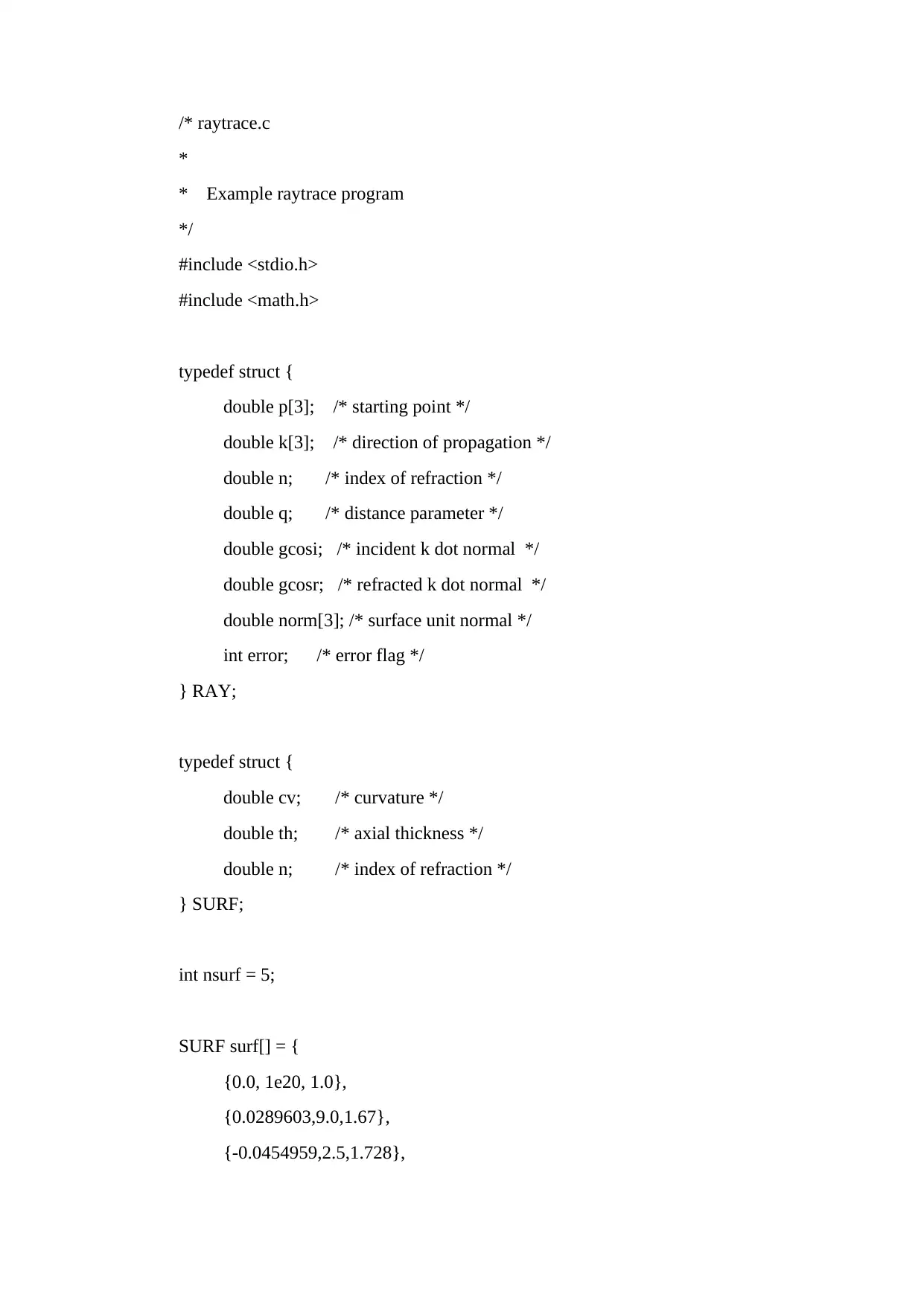
/* raytrace.c
*
* Example raytrace program
*/
#include <stdio.h>
#include <math.h>
typedef struct {
double p[3]; /* starting point */
double k[3]; /* direction of propagation */
double n; /* index of refraction */
double q; /* distance parameter */
double gcosi; /* incident k dot normal */
double gcosr; /* refracted k dot normal */
double norm[3]; /* surface unit normal */
int error; /* error flag */
} RAY;
typedef struct {
double cv; /* curvature */
double th; /* axial thickness */
double n; /* index of refraction */
} SURF;
int nsurf = 5;
SURF surf[] = {
{0.0, 1e20, 1.0},
{0.0289603,9.0,1.67},
{-0.0454959,2.5,1.728},
tabler-icon-diamond-filled.svg

Paraphrase This Document

Need a fresh take? Get an instant paraphrase of this document with our AI Paraphraser
Document Page
{-0.0046592,43.55158,1.0},
{0.0, 0.0, 1.0}
};
int raytrace(RAY *start, RAY data[]);
int trace(RAY *in, RAY *out, SURF *surf);
int print_ray(RAY *ray);
void print_vector(double v[3]);
double dot(double a[3], double b[3]);
void vnorm(double v[3], double norm);
int main()
{
int i, iret;
RAY ray[5], enp[1], *obj;
obj = ray;
/* define object point */
obj->p[0] = 0.0;
obj->p[1] = 0.0;
obj->p[2] = 0.0;
/* define entrance pupil aim point */
enp->p[0] = 0.0;
enp->p[1] = 12.5;
enp->p[2] = 0.0;
/* calculate ray optical direction cosines */
for (i=0; i<3; i++) obj->k[i] = enp->p[i] - obj->p[i];
obj->k[2] += surf->th;
vnorm(obj->k,surf->n);
for (i=0; i<3; i++) enp->k[i] = obj->k[i];
enp->n = surf->n;
Document Page
printf("object point: ");
print_vector(obj->p);
raytrace(enp,ray);
for (i=1; i<nsurf; i++) {
printf("\nSurface %d\n",i);
iret = print_ray(ray+i);
if (iret<0) break;
}
return 0;
}
/*
* Trace ray through optical system
*/
int raytrace(RAY *start, RAY data[])
{
int k, image, iret;
RAY *in, *out;
SURF *sp;
sp = surf+1;
start->q = 0.0;
in = start;
out = data+1;
image = nsurf-1;
for (k=1; k<=image; k++) {
iret = trace(in, out, sp++);
if (iret<0) return iret;
/* set pointers for next set of rays */
in = out++;
}
Document Page
return 0;
}
/*
* Calculate surface intersection and direction of refraction
*/
int trace(RAY *in, RAY *out, SURF *surf)
{
int i;
double rni, rno, cv, q;
double A,B,C,D;
double root, power;
rni = in->n;
rno = surf->n;
cv = surf->cv;
/*
* Transfer to coordinates of current surface.
* on input, in->q should be axial distance to current surface
* on output, in->q will be oblique distance to current surface
*/
out->p[0] = in->p[0];
out->p[1] = in->p[1];
out->p[2] = in->p[2] - in->q;
/* intersect current surface */
if (cv) {
A = cv*rni*rni;
B = in->k[2]-cv*dot(in->k,out->p);
C = cv*dot(out->p,out->p)-2.0*out->p[2];
D = B*B-A*C;
if (D<0.0) {
tabler-icon-diamond-filled.svg

Paraphrase This Document

Need a fresh take? Get an instant paraphrase of this document with our AI Paraphraser
Document Page
out->error = -1; /* missed surface */
return out->error;
}
D = sqrt(D);
q = C/(B+(B>0? D: -D));
}
else {
if (in->k[2]==0.0) {
out->error = -1; /* ray parallel to plane */
return out->error;
}
q = -out->p[2]/in->k[2];
}
in->q = q;
out->q = surf->th;
/* calculate point of intersection */
for (i=0; i<3; i++) out->p[i] += q * in->k[i];
/* calculate surface normal */
for (i=0; i<3; i++) out->norm[i] = -cv*out->p[i];
out->norm[2] += 1.0;
/* refract ray into surface */
out->gcosi = dot(in->k,out->norm);
root = out->gcosi*out->gcosi + (rno+rni)*(rno - rni);
if (root<0.0) {
out->error = -2; /* total internal reflection */
return out->error;
}
root = sqrt(root);
out->gcosr = (out->gcosi>0.0? root: -root);
power = out->gcosr - out->gcosi;
Document Page
for (i=0; i<3; i++) out->k[i] = in->k[i] + power*out->norm[i];
out->n = rno;
out->error = 0;
return out->error;
}
/*
* print ray data
*/
int print_ray(RAY *ray)
{
if (ray->error==-1) {
printf("MISSED SURFACE\n");
return ray->error;
}
printf("surface intersection ");
print_vector(ray->p);
if (ray->error==0) {
printf("optical direction cosines ");
print_vector(ray->k);
}
printf("surface normal ");
print_vector(ray->norm);
printf("q %12.6f gcosi %12.6f gcosr %12.6f\n",
ray->q,ray->gcosi,ray->gcosr);
if (ray->error==-2) {
printf("TOTAL INTERNAL REFLECTION\n");
return ray->error;
}
return ray->error;
Document Page
}
/*
* print vector data
*/
void print_vector(double v[3])
{
printf("%12.6f %12.6f %12.6f\n",v[0],v[1],v[2]);
}
/*
* vector dot product
*/
double dot(double a[3], double b[3])
{
return a[0]*b[0]+a[1]*b[1]+a[2]*b[2];
}
/*
* normalize vector length to specified value.
*/
void vnorm(double v[3], double norm)
{
int i;
double vn;
vn = v[0]*v[0]+v[1]*v[1]+v[2]*v[2];
if (vn==0.0) return;
vn = norm/sqrt(vn);
for (i=0; i<3; i++) v[i] *= vn;
}
chevron_up_icon
1 out of 7
circle_padding
hide_on_mobile
zoom_out_icon
[object Object]