University Health Equity Reflection: Concepts and Application

Verified

Added on  2023/01/17

|4
|716
|37
Journal and Reflective Writing
AI Summary
This reflective paper explores the concept of health equity, defined as ensuring everyone has a fair opportunity to live a healthy life, irrespective of their background. The paper begins with an introduction to health equity and its importance, followed by a discussion of the author's personal understanding before and after reading a report on the subject. The author highlights the impact of social determinants of health on health inequalities and the importance of addressing them to reduce the global burden of disease. The paper accurately outlines the four key steps required to achieve health equity: identifying health disparities, changing and implementing policies, evaluating and monitoring the effects of interventions, and reassessing plans and strategies. The author concludes by reflecting on how they will apply their new understanding of health equity in their future practice to ensure equal access to resources and opportunities for all individuals to live a healthy life. The paper references key resources such as Braveman et al., Ponsford et al., and Richmond et al. to support its arguments.

Document Page
Running head: REFLECTION
Name of the student;
Name of the university:
Author note:
tabler-icon-diamond-filled.svg

Paraphrase This Document

Need a fresh take? Get an instant paraphrase of this document with our AI Paraphraser
Document Page
1
REFLECTION
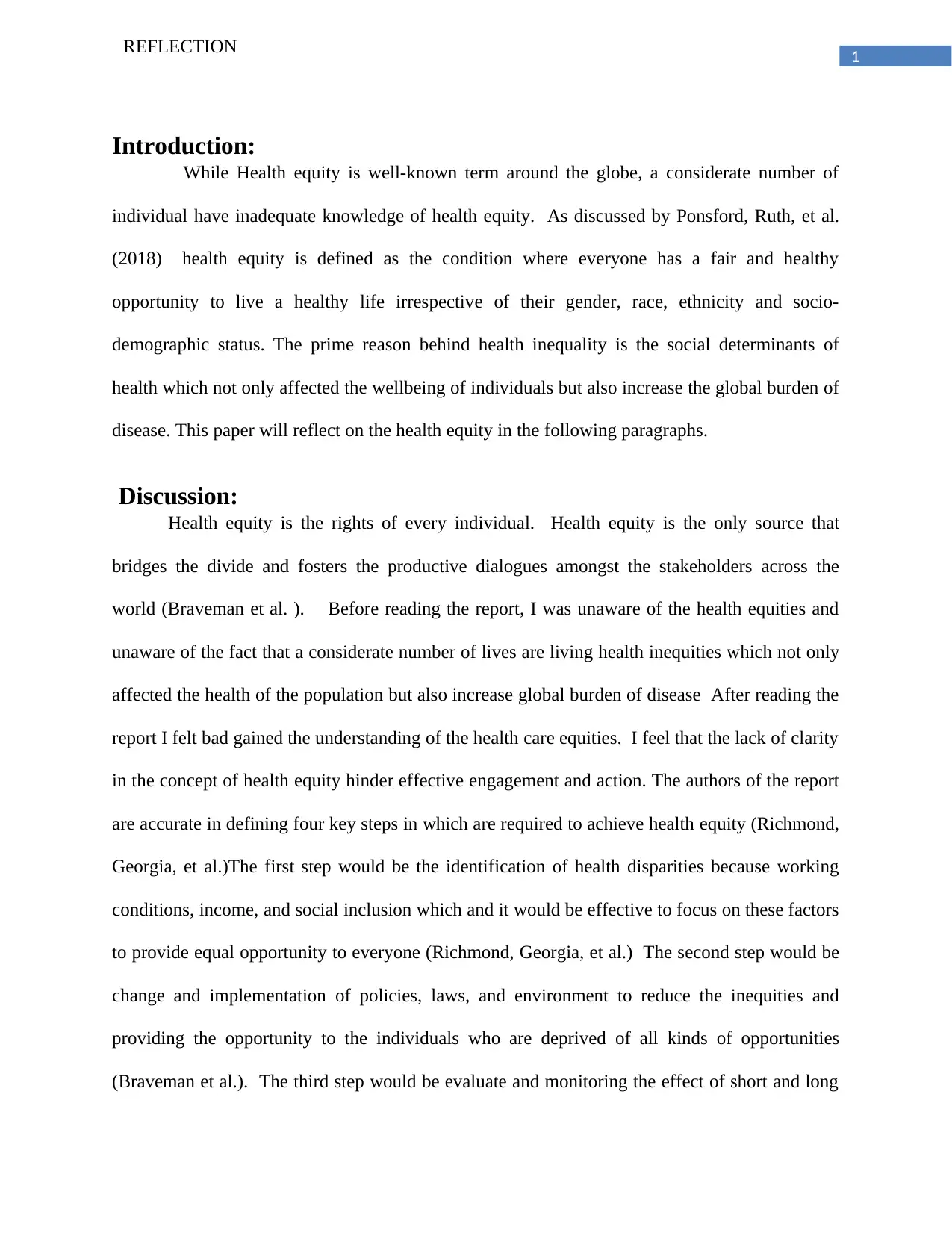
Introduction:
While Health equity is well-known term around the globe, a considerate number of
individual have inadequate knowledge of health equity. As discussed by Ponsford, Ruth, et al.
(2018) health equity is defined as the condition where everyone has a fair and healthy
opportunity to live a healthy life irrespective of their gender, race, ethnicity and socio-
demographic status. The prime reason behind health inequality is the social determinants of
health which not only affected the wellbeing of individuals but also increase the global burden of
disease. This paper will reflect on the health equity in the following paragraphs.
Discussion:
Health equity is the rights of every individual. Health equity is the only source that
bridges the divide and fosters the productive dialogues amongst the stakeholders across the
world (Braveman et al. ). Before reading the report, I was unaware of the health equities and
unaware of the fact that a considerate number of lives are living health inequities which not only
affected the health of the population but also increase global burden of disease After reading the
report I felt bad gained the understanding of the health care equities. I feel that the lack of clarity
in the concept of health equity hinder effective engagement and action. The authors of the report
are accurate in defining four key steps in which are required to achieve health equity (Richmond,
Georgia, et al.)The first step would be the identification of health disparities because working
conditions, income, and social inclusion which and it would be effective to focus on these factors
to provide equal opportunity to everyone (Richmond, Georgia, et al.) The second step would be
change and implementation of policies, laws, and environment to reduce the inequities and
providing the opportunity to the individuals who are deprived of all kinds of opportunities
(Braveman et al.). The third step would be evaluate and monitoring the effect of short and long
Document Page
2
REFLECTION
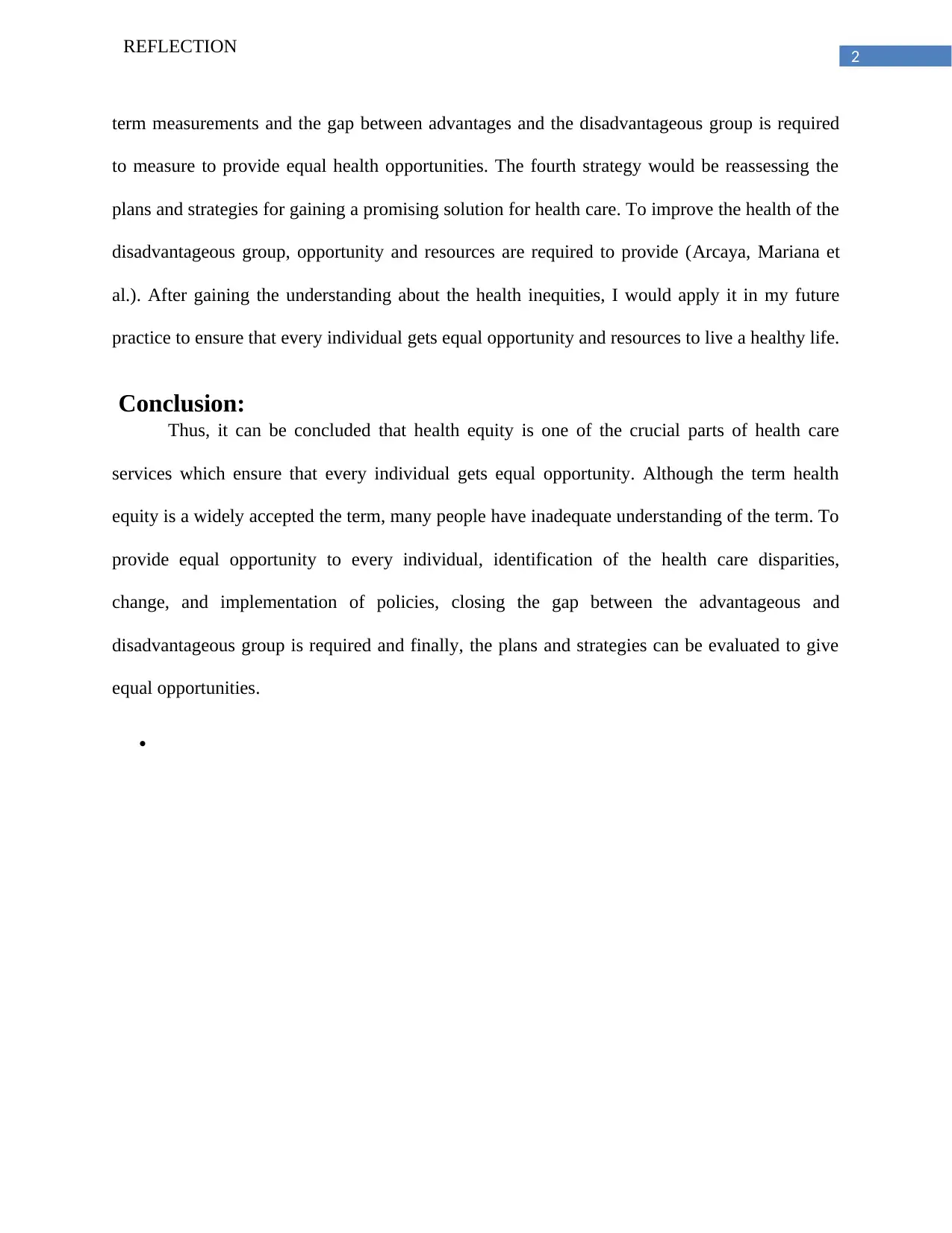
term measurements and the gap between advantages and the disadvantageous group is required
to measure to provide equal health opportunities. The fourth strategy would be reassessing the
plans and strategies for gaining a promising solution for health care. To improve the health of the
disadvantageous group, opportunity and resources are required to provide (Arcaya, Mariana et
al.). After gaining the understanding about the health inequities, I would apply it in my future
practice to ensure that every individual gets equal opportunity and resources to live a healthy life.
Conclusion:
Thus, it can be concluded that health equity is one of the crucial parts of health care
services which ensure that every individual gets equal opportunity. Although the term health
equity is a widely accepted the term, many people have inadequate understanding of the term. To
provide equal opportunity to every individual, identification of the health care disparities,
change, and implementation of policies, closing the gap between the advantageous and
disadvantageous group is required and finally, the plans and strategies can be evaluated to give
equal opportunities.
Document Page
3
REFLECTION
References:
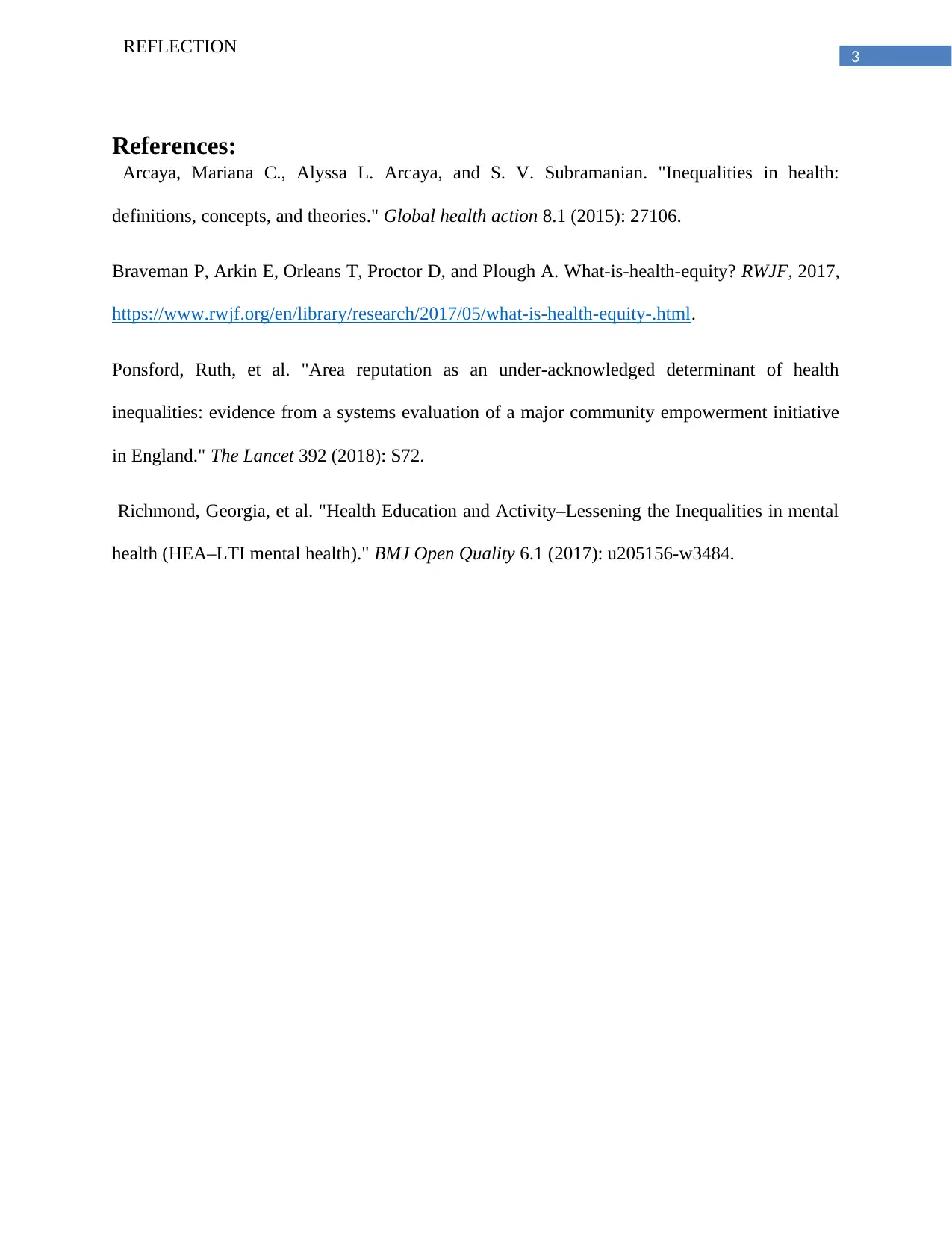
Arcaya, Mariana C., Alyssa L. Arcaya, and S. V. Subramanian. "Inequalities in health:
definitions, concepts, and theories." Global health action 8.1 (2015): 27106.
Braveman P, Arkin E, Orleans T, Proctor D, and Plough A. What-is-health-equity? RWJF, 2017,
https://www.rwjf.org/en/library/research/2017/05/what-is-health-equity-.html.
Ponsford, Ruth, et al. "Area reputation as an under-acknowledged determinant of health
inequalities: evidence from a systems evaluation of a major community empowerment initiative
in England." The Lancet 392 (2018): S72.
Richmond, Georgia, et al. "Health Education and Activity–Lessening the Inequalities in mental
health (HEA–LTI mental health)." BMJ Open Quality 6.1 (2017): u205156-w3484.
chevron_up_icon
1 out of 4
circle_padding
hide_on_mobile
zoom_out_icon
[object Object]