Reflective Report on Business Research
VerifiedAdded on 2019/09/22
|10
|1966
|162
Report
AI Summary
This reflective report evaluates the learning experience gained from previous business research assignments. It details the effectiveness and usefulness of the learning process, objectively describing activities such as problem identification, literature review, data collection, analysis, and decision-making. The report assesses the value of the experience in developing skills like problem identification, situation analysis, data interpretation, and decision-making. It explains how the learning process contributes to successful course completion and future career prospects, outlining a plan for applying the acquired knowledge and skills in future endeavors. The report concludes by emphasizing the enrichment of the researcher's skills and knowledge, highlighting their applicability to future challenges and opportunities.

REFLECTIVE REPORT
1
1

Paraphrase This Document
Need a fresh take? Get an instant paraphrase of this document with our AI Paraphraser
Table of Contents
Introduction:....................................................................................................................................3
Evaluating effectiveness and usefulness of the learning experience:..............................................3
Describing objectively activities in the learning process:...............................................................6
Evaluating the learning:...................................................................................................................6
Explaining the learning process:......................................................................................................7
Plan for applying the learning in future:..........................................................................................7
Conclusion:......................................................................................................................................8
References:......................................................................................................................................9
2
Introduction:....................................................................................................................................3
Evaluating effectiveness and usefulness of the learning experience:..............................................3
Describing objectively activities in the learning process:...............................................................6
Evaluating the learning:...................................................................................................................6
Explaining the learning process:......................................................................................................7
Plan for applying the learning in future:..........................................................................................7
Conclusion:......................................................................................................................................8
References:......................................................................................................................................9
2
Introduction:
Business researches are important for getting a true insight of the larger business world. The
learning from a business research not only helps in carry out particular course or program, but
such experience assist a learner in future activities also (Bryman & Bell, 2015). The current
assignment deals with evaluation of the learning experiences while completing the previous
assignments. The assignment also includes planning on how the learning experience can help the
researcher in future.
Evaluating effectiveness and usefulness of the learning experience:
The learning experience of a business research has multiple benefits. Here, the effectiveness of
the previous assignments done by the researcher is analyzed.
Opinion about the experience: The previous assignments helped the researcher to realize how the
businesses implement latest technologies such as cloud computing in their organizational
activities and how these technologies assist the businesses to gain competitive advantages. From
the assignments, the researcher also became aware of the issues that the organizations face while
implementing the modern technologies and the plans for mitigating those issues are also
identified in the research.
Implementing the latest technological trends into organizational activities is necessary for every
business. An organization requires knowing the right techniques to introduce a new technology
to the organizational activities and get the most benefits from it. Business researches help a
researcher to understand the practical implications of bringing any change to the organization
(Greenland et al. 2016). It can be stated that the business researches help the researcher to realize
the actual scenario within the organizations.
The previous assignments help the researcher to get an insight of the processes which the large
businesses use for implementing the latest technologies. The previous researches also help the
researcher to know the issues that large organizations have encountered while bringing new
technologies.
3
Business researches are important for getting a true insight of the larger business world. The
learning from a business research not only helps in carry out particular course or program, but
such experience assist a learner in future activities also (Bryman & Bell, 2015). The current
assignment deals with evaluation of the learning experiences while completing the previous
assignments. The assignment also includes planning on how the learning experience can help the
researcher in future.
Evaluating effectiveness and usefulness of the learning experience:
The learning experience of a business research has multiple benefits. Here, the effectiveness of
the previous assignments done by the researcher is analyzed.
Opinion about the experience: The previous assignments helped the researcher to realize how the
businesses implement latest technologies such as cloud computing in their organizational
activities and how these technologies assist the businesses to gain competitive advantages. From
the assignments, the researcher also became aware of the issues that the organizations face while
implementing the modern technologies and the plans for mitigating those issues are also
identified in the research.
Implementing the latest technological trends into organizational activities is necessary for every
business. An organization requires knowing the right techniques to introduce a new technology
to the organizational activities and get the most benefits from it. Business researches help a
researcher to understand the practical implications of bringing any change to the organization
(Greenland et al. 2016). It can be stated that the business researches help the researcher to realize
the actual scenario within the organizations.
The previous assignments help the researcher to get an insight of the processes which the large
businesses use for implementing the latest technologies. The previous researches also help the
researcher to know the issues that large organizations have encountered while bringing new
technologies.
3
⊘ This is a preview!⊘
Do you want full access?
Subscribe today to unlock all pages.

Trusted by 1+ million students worldwide
Value of the experience: In the contemporary business world, the organizations face intense
competition (Hair, 2015). To gain competitive advantage the businesses requires changing their
operational activities regularly. However, managing change is crucial for every organization for
obtaining the most benefits from it. The previous assignments provided the researcher to get an
idea on how the large organizations manage change in their activities after implementing new
technologies and obtain competitive advantage from it. Therefore, the learning experience is
valuable as it provides the researcher with a holistic idea on the change management techniques
after introduction of latest technologies in a business. In addition to making the researcher able to
see the real-life business scenarios, the learning experience enriches the researcher with better
ability to analyze situations, identify problems and make more effective decisions.
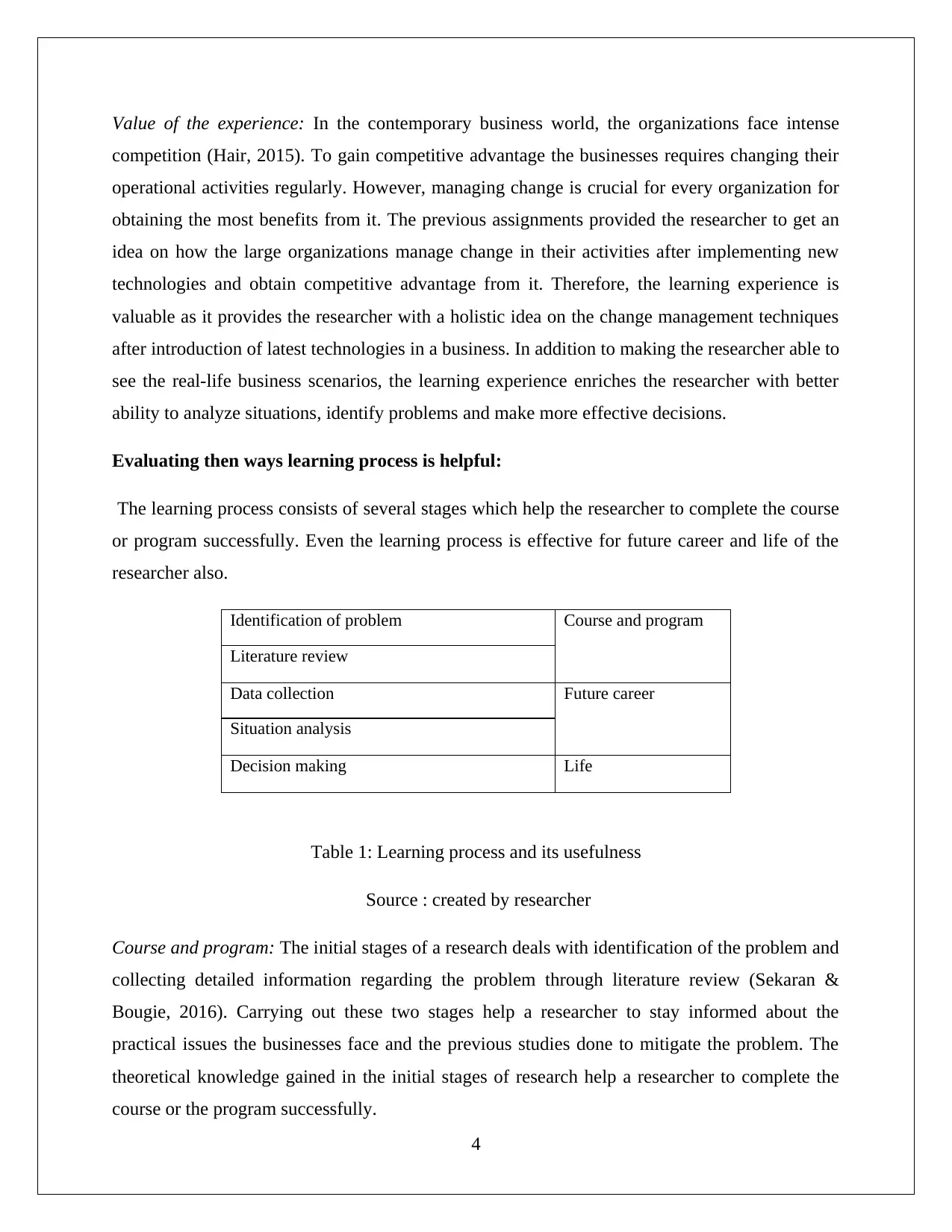
Evaluating then ways learning process is helpful:
The learning process consists of several stages which help the researcher to complete the course
or program successfully. Even the learning process is effective for future career and life of the
researcher also.
Identification of problem Course and program
Literature review
Data collection Future career
Situation analysis
Decision making Life
Table 1: Learning process and its usefulness
Source : created by researcher
Course and program: The initial stages of a research deals with identification of the problem and
collecting detailed information regarding the problem through literature review (Sekaran &
Bougie, 2016). Carrying out these two stages help a researcher to stay informed about the
practical issues the businesses face and the previous studies done to mitigate the problem. The
theoretical knowledge gained in the initial stages of research help a researcher to complete the
course or the program successfully.
4
competition (Hair, 2015). To gain competitive advantage the businesses requires changing their
operational activities regularly. However, managing change is crucial for every organization for
obtaining the most benefits from it. The previous assignments provided the researcher to get an
idea on how the large organizations manage change in their activities after implementing new
technologies and obtain competitive advantage from it. Therefore, the learning experience is
valuable as it provides the researcher with a holistic idea on the change management techniques
after introduction of latest technologies in a business. In addition to making the researcher able to
see the real-life business scenarios, the learning experience enriches the researcher with better
ability to analyze situations, identify problems and make more effective decisions.
Evaluating then ways learning process is helpful:
The learning process consists of several stages which help the researcher to complete the course
or program successfully. Even the learning process is effective for future career and life of the
researcher also.
Identification of problem Course and program
Literature review
Data collection Future career
Situation analysis
Decision making Life
Table 1: Learning process and its usefulness
Source : created by researcher
Course and program: The initial stages of a research deals with identification of the problem and
collecting detailed information regarding the problem through literature review (Sekaran &
Bougie, 2016). Carrying out these two stages help a researcher to stay informed about the
practical issues the businesses face and the previous studies done to mitigate the problem. The
theoretical knowledge gained in the initial stages of research help a researcher to complete the
course or the program successfully.
4
Paraphrase This Document
Need a fresh take? Get an instant paraphrase of this document with our AI Paraphraser
Future career: Collection of data and situation analysis are two critical parts of the research
(Eriksson & Kovalainen, 2015). By undertaking these two stages, the researcher becomes able to
understand the practical issues businesses encounter. It helps them to adjust with the real-life
business situations easily in future career.
Life: In a research, the researcher has to analyse the collected information and making decisions
on basis of it (Cortina et al.2015). It indicates that the learning process in a business research
helps the researchers to develop their decision making skill which can be applied in later stages o
life.
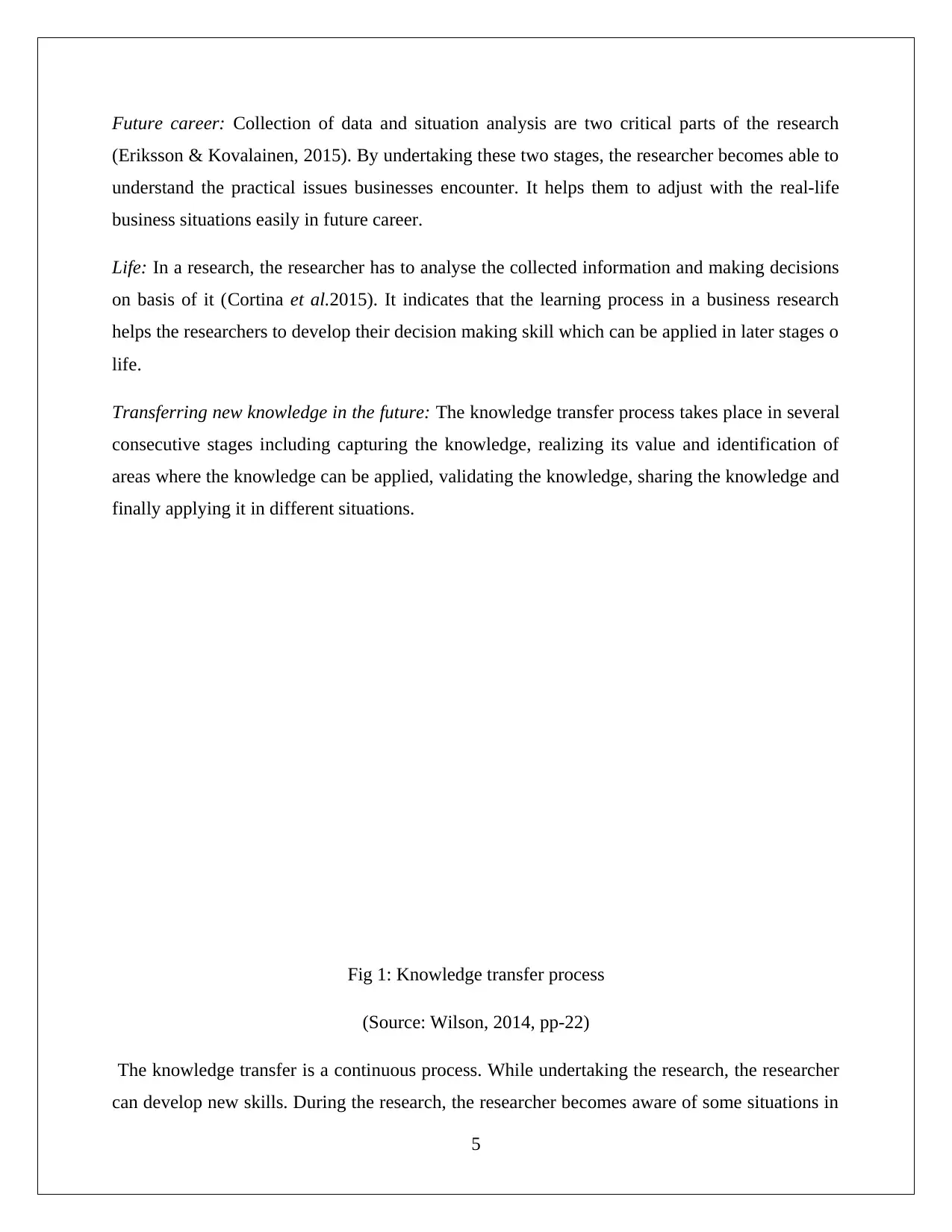
Transferring new knowledge in the future: The knowledge transfer process takes place in several
consecutive stages including capturing the knowledge, realizing its value and identification of
areas where the knowledge can be applied, validating the knowledge, sharing the knowledge and
finally applying it in different situations.
Fig 1: Knowledge transfer process
(Source: Wilson, 2014, pp-22)
The knowledge transfer is a continuous process. While undertaking the research, the researcher
can develop new skills. During the research, the researcher becomes aware of some situations in
5
(Eriksson & Kovalainen, 2015). By undertaking these two stages, the researcher becomes able to
understand the practical issues businesses encounter. It helps them to adjust with the real-life
business situations easily in future career.
Life: In a research, the researcher has to analyse the collected information and making decisions
on basis of it (Cortina et al.2015). It indicates that the learning process in a business research
helps the researchers to develop their decision making skill which can be applied in later stages o
life.
Transferring new knowledge in the future: The knowledge transfer process takes place in several
consecutive stages including capturing the knowledge, realizing its value and identification of
areas where the knowledge can be applied, validating the knowledge, sharing the knowledge and
finally applying it in different situations.
Fig 1: Knowledge transfer process
(Source: Wilson, 2014, pp-22)
The knowledge transfer is a continuous process. While undertaking the research, the researcher
can develop new skills. During the research, the researcher becomes aware of some situations in
5
the business world. In future, the researcher can make decisions easily in similar situations using
the prior knowledge and also help others in better decision making by sharing own experience.
Describing objectively activities in the learning process:
The following activities were performed by the researcher in the learning process:
Identification of problem: In this case, the researcher had gone through different business cases
and identified the issues that businesses are facing.
Literature review and data collection: Literature review is crucial for getting deeper insight of a
business problem (Babin & Zikmund, 2015). In this case, the researcher read different books,
journals and websites to gain knowledge on the research issue. The discussions with the lecturers
also helped a lot to get a clear idea on the research issue. The data collection provides the
researcher with an idea on the real implications of the business issue. Therefore, the researcher
collected data on organizations from websites and journal publications also for getting in-depth
knowledge on the research problem.
Analysis and decision-making: The analysis was made on basis of the previously gained
knowledge. Discussion with the lecturer on the research issue helped the researcher in this case
also.
Evaluating the learning:
Judgements on the observations in business: The business research helped the researcher to
identify issues faced by the organizations in real-life situations. It assisted the researcher to
problem-identification and situation analysis skills. In the research, on basis of the collected data
and practical situation analysis, the researcher has to draw conclusion. It improved the decision
making skill of the researcher.
Usefulness of business research in the research learning process: The business research
facilitates the researcher to analyse practical situations, reviewing the previous studies related to
the issue and make conclusions on basis of that. A business research helps the researchers to
analyse practical situations more effectively (Easterby-Smith et al.2016). Business research also
facilitates the students interpret real-life data effectively and reach conclusions on basis of that. It
6
the prior knowledge and also help others in better decision making by sharing own experience.
Describing objectively activities in the learning process:
The following activities were performed by the researcher in the learning process:
Identification of problem: In this case, the researcher had gone through different business cases
and identified the issues that businesses are facing.
Literature review and data collection: Literature review is crucial for getting deeper insight of a
business problem (Babin & Zikmund, 2015). In this case, the researcher read different books,
journals and websites to gain knowledge on the research issue. The discussions with the lecturers
also helped a lot to get a clear idea on the research issue. The data collection provides the
researcher with an idea on the real implications of the business issue. Therefore, the researcher
collected data on organizations from websites and journal publications also for getting in-depth
knowledge on the research problem.
Analysis and decision-making: The analysis was made on basis of the previously gained
knowledge. Discussion with the lecturer on the research issue helped the researcher in this case
also.
Evaluating the learning:
Judgements on the observations in business: The business research helped the researcher to
identify issues faced by the organizations in real-life situations. It assisted the researcher to
problem-identification and situation analysis skills. In the research, on basis of the collected data
and practical situation analysis, the researcher has to draw conclusion. It improved the decision
making skill of the researcher.
Usefulness of business research in the research learning process: The business research
facilitates the researcher to analyse practical situations, reviewing the previous studies related to
the issue and make conclusions on basis of that. A business research helps the researchers to
analyse practical situations more effectively (Easterby-Smith et al.2016). Business research also
facilitates the students interpret real-life data effectively and reach conclusions on basis of that. It
6
⊘ This is a preview!⊘
Do you want full access?
Subscribe today to unlock all pages.
Trusted by 1+ million students worldwide
also improves the analysis and decision-making skills of the researcher which are useful for other
research activities also.
Explaining the learning process:
Reason for doing the particular activities: The previous activities were undertaken to get
familiar with the larger business scenario. The researcher also aimed to identify the problems
that businesses face while bringing changes in the organization and finding out possible
strategies to mitigate those issues.
The learning process was effective for the researcher in various ways (Hair, 2015). Firstly, it
provided the researcher with new insights on the business situations. As a result, the researcher
became more aware on the bigger scenario in the business world. During the research the
researcher gained knowledge on the broader aspects of the research problem. The knowledge
gained in this phase can be applied in later part of the course also. Finally, the data interpretation
and analysis improved the analytical and decision making skill of the researcher. These skills can
be effective for future career of the researcher.
Plan for applying the learning in future:
The previous researches dealt with analysis on the implementation of disruptive technologies
such as cloud technology in the large organizations and managing the changes associated with
these changes. Undertaking the research helped the researcher to realize the impacts of bringing
a new technology to the organization (Wilson, 2014). On completion of the research, the
researcher also realized the issues an organization faces while implementing new technology and
the possible ways to eliminate the issues. The knowledge on real-life business scenario can help
the researcher to manage similar situations in future career easily. The data interpretation and
analytical skills can also help the researcher to understand a situation in future effectively and
respond quickly. Finally, in the research, the researcher made conclusions on basis of the
interpreted data and the situation analysis. It improved the decision making skill of the researcher
which can be applied in all cases of life.
7
research activities also.
Explaining the learning process:
Reason for doing the particular activities: The previous activities were undertaken to get
familiar with the larger business scenario. The researcher also aimed to identify the problems
that businesses face while bringing changes in the organization and finding out possible
strategies to mitigate those issues.
The learning process was effective for the researcher in various ways (Hair, 2015). Firstly, it
provided the researcher with new insights on the business situations. As a result, the researcher
became more aware on the bigger scenario in the business world. During the research the
researcher gained knowledge on the broader aspects of the research problem. The knowledge
gained in this phase can be applied in later part of the course also. Finally, the data interpretation
and analysis improved the analytical and decision making skill of the researcher. These skills can
be effective for future career of the researcher.
Plan for applying the learning in future:
The previous researches dealt with analysis on the implementation of disruptive technologies
such as cloud technology in the large organizations and managing the changes associated with
these changes. Undertaking the research helped the researcher to realize the impacts of bringing
a new technology to the organization (Wilson, 2014). On completion of the research, the
researcher also realized the issues an organization faces while implementing new technology and
the possible ways to eliminate the issues. The knowledge on real-life business scenario can help
the researcher to manage similar situations in future career easily. The data interpretation and
analytical skills can also help the researcher to understand a situation in future effectively and
respond quickly. Finally, in the research, the researcher made conclusions on basis of the
interpreted data and the situation analysis. It improved the decision making skill of the researcher
which can be applied in all cases of life.
7
Paraphrase This Document
Need a fresh take? Get an instant paraphrase of this document with our AI Paraphraser
Conclusion:
The above discussion indicates that the research learning experience enriched the researcher in
various ways. The researcher has developed skills for problem identification, situation analysis ,
data collection, interpretation and analysis in different stages of the research. The knowledge
gained in the research can help the researcher to complete the course and the program more
effectively. The developed skills can help the researcher to solve problems in future career also.
8
The above discussion indicates that the research learning experience enriched the researcher in
various ways. The researcher has developed skills for problem identification, situation analysis ,
data collection, interpretation and analysis in different stages of the research. The knowledge
gained in the research can help the researcher to complete the course and the program more
effectively. The developed skills can help the researcher to solve problems in future career also.
8
References:
Babin, B. J., & Zikmund, W. G. (2015). Exploring marketing research. Cengage Learning.
Bryman, A., & Bell, E. (2015). Business research methods. Oxford University Press, USA.
Cortina, J. M., Köhler, T., & Nielsen, B. B. (2015). Restriction of variance interaction effects and
their importance for international business research. Journal of International Business
Studies, 46(8), 879-885.
Coviello, N. (2015). Re-thinking research on born globals. Journal of International Business
Studies, 46(1), 17-26.
Easterby-Smith, M., Thorpe, R., & Jackson, P. R. (2015). Management and business research.
Sage.
Eriksson, P., & Kovalainen, A. (2015). Qualitative methods in business research: A practical
guide to social research. Sage.
Greenland, S. J., Combe, I. A., & Farrell, A. M. (2016). Stakeholder preference and stated vs
derived importance satisfaction research. International Journal of Market Research, 58(1), 35-
55.
Hair, J. F. (2015). Essentials of business research methods. ME Sharpe.
Sekaran, U., & Bougie, R. (2016). Research methods for business: A skill building approach.
John Wiley & Sons.
Wilson, J. (2014). Essentials of business research: A guide to doing your research project. Sage.
9
Babin, B. J., & Zikmund, W. G. (2015). Exploring marketing research. Cengage Learning.
Bryman, A., & Bell, E. (2015). Business research methods. Oxford University Press, USA.
Cortina, J. M., Köhler, T., & Nielsen, B. B. (2015). Restriction of variance interaction effects and
their importance for international business research. Journal of International Business
Studies, 46(8), 879-885.
Coviello, N. (2015). Re-thinking research on born globals. Journal of International Business
Studies, 46(1), 17-26.
Easterby-Smith, M., Thorpe, R., & Jackson, P. R. (2015). Management and business research.
Sage.
Eriksson, P., & Kovalainen, A. (2015). Qualitative methods in business research: A practical
guide to social research. Sage.
Greenland, S. J., Combe, I. A., & Farrell, A. M. (2016). Stakeholder preference and stated vs
derived importance satisfaction research. International Journal of Market Research, 58(1), 35-
55.
Hair, J. F. (2015). Essentials of business research methods. ME Sharpe.
Sekaran, U., & Bougie, R. (2016). Research methods for business: A skill building approach.
John Wiley & Sons.
Wilson, J. (2014). Essentials of business research: A guide to doing your research project. Sage.
9
⊘ This is a preview!⊘
Do you want full access?
Subscribe today to unlock all pages.
Trusted by 1+ million students worldwide

10

1 out of 10


Related Documents


Your All-in-One AI-Powered Toolkit for Academic Success.
+13062052269
info@desklib.com
Available 24*7 on WhatsApp / Email
![[object Object]](/_next/static/media/star-bottom.7253800d.svg)
Unlock your academic potential
Copyright © 2020–2026 A2Z Services. All Rights Reserved. Developed and managed by ZUCOL.