Healthcare Reimbursement, Chargemaster Review, and Payment Systems

Verified

Added on  2019/09/18

|4
|839
|472
Homework Assignment
AI Summary
This assignment delves into the intricacies of chargemaster reviews and healthcare reimbursement strategies within the U.S. healthcare system. It examines the factors contributing to the success of chargemaster review projects, focusing on their role in minimizing audit risks and ensuring compliant payments. The analysis includes the involvement of various facility departments and stakeholders, such as department managers, billing cycles, and managed care organizations. The assignment also explores the impact of different payment systems, including fee-for-service, capitation, and cost-based payments, on physician and hospital behavior, highlighting potential unintended consequences and incentives related to service utilization and cost control. The document also includes references to support the analysis.

Document Page
Reimbursement rules
0
tabler-icon-diamond-filled.svg

Paraphrase This Document

Need a fresh take? Get an instant paraphrase of this document with our AI Paraphraser
Document Page
Answer 1
The success of the chargemaster review project
Within the United States, the success of the chargemaster is understood from the framework of
how well there would be a decrease in audits that would be related and balanced with the
compliant payments. It would be determined on the basis of the certain revenue cycle which
would help in determining the implementation of the chargemaster review project. It would be
also related to the inbuilt chargemaster and it would involve with the “every service
synchronized with the hospital”. it would be more sound related to the comprehensive listing that
would be part of the items billable for any hospital patient and it would be determined with the
help of the patient's health insurance provider. This would be then associated with "the central
mechanism analyzed from the lens of the revenue cycle" part of the hospital. The success is
attributed to the best class, that would be constructive and would be best defined under the lens
oft he quality-focused chargemaster that can be based on the informed actions that can include
the revenue cycle participants. As interpreted how the chargemaster would also have a
collaborated living edge and would actively involve the breathing, and the prerequisite
requirement that would enable the attention, focus along with the core maintenance.
Facility Department and the team members
The facility department and the team members who would be actively involved would be the
department managers that would have a core responsibility of learning along with the required
changes and also an inbuilt requirement that can help to associate with the effect on daily
operations along with the efficiencies. With the core involved departments it would be also
1 | P a g e
Document Page
inclined to look over the billing cycle along with with the clinical; compliance and also associate
with the contracting; finance; and managed care
Project Sponsor & Stakeholders
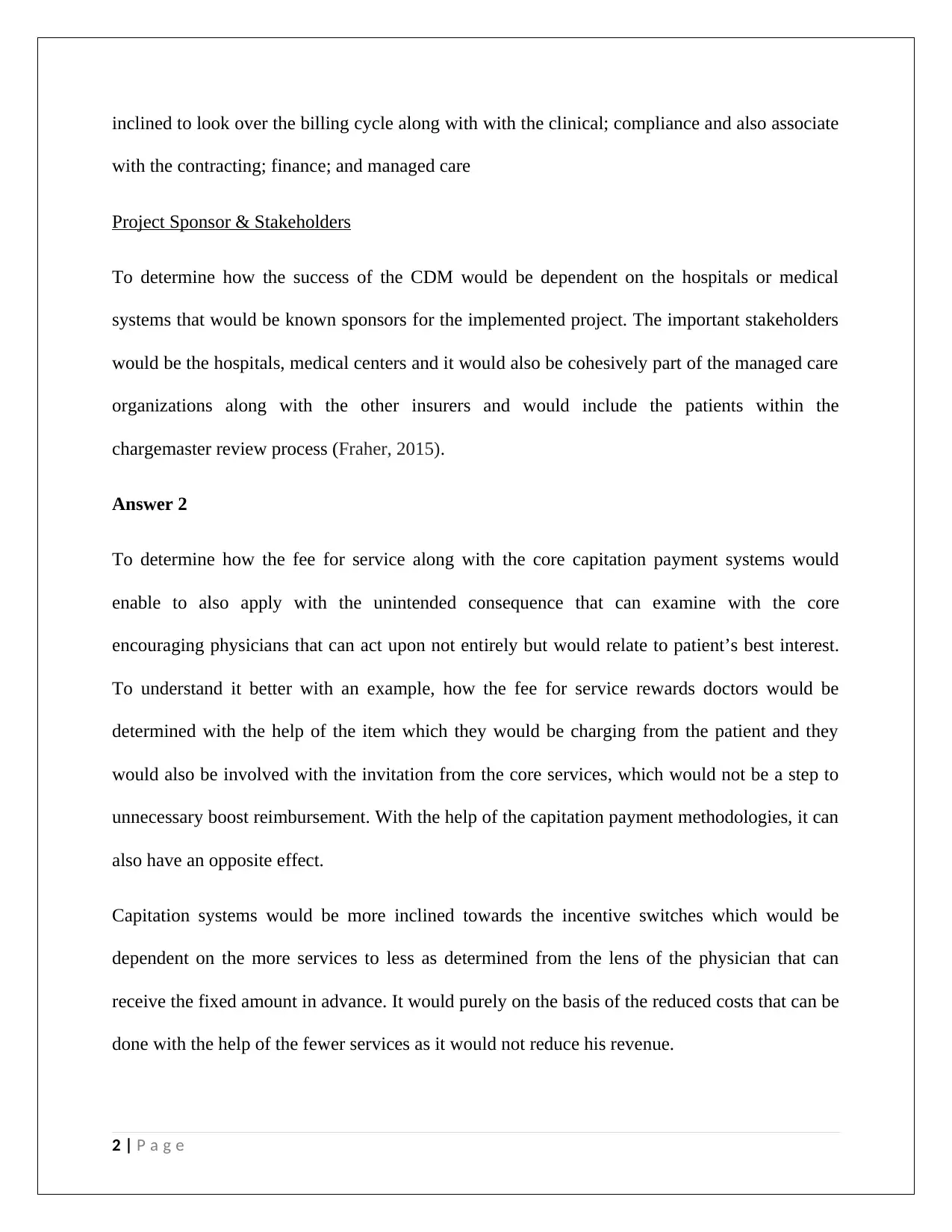
To determine how the success of the CDM would be dependent on the hospitals or medical
systems that would be known sponsors for the implemented project. The important stakeholders
would be the hospitals, medical centers and it would also be cohesively part of the managed care
organizations along with the other insurers and would include the patients within the
chargemaster review process (Fraher, 2015).
Answer 2
To determine how the fee for service along with the core capitation payment systems would
enable to also apply with the unintended consequence that can examine with the core
encouraging physicians that can act upon not entirely but would relate to patient’s best interest.
To understand it better with an example, how the fee for service rewards doctors would be
determined with the help of the item which they would be charging from the patient and they
would also be involved with the invitation from the core services, which would not be a step to
unnecessary boost reimbursement. With the help of the capitation payment methodologies, it can
also have an opposite effect.
Capitation systems would be more inclined towards the incentive switches which would be
dependent on the more services to less as determined from the lens of the physician that can
receive the fixed amount in advance. It would purely on the basis of the reduced costs that can be
done with the help of the fewer services as it would not reduce his revenue.
2 | P a g e
Document Page
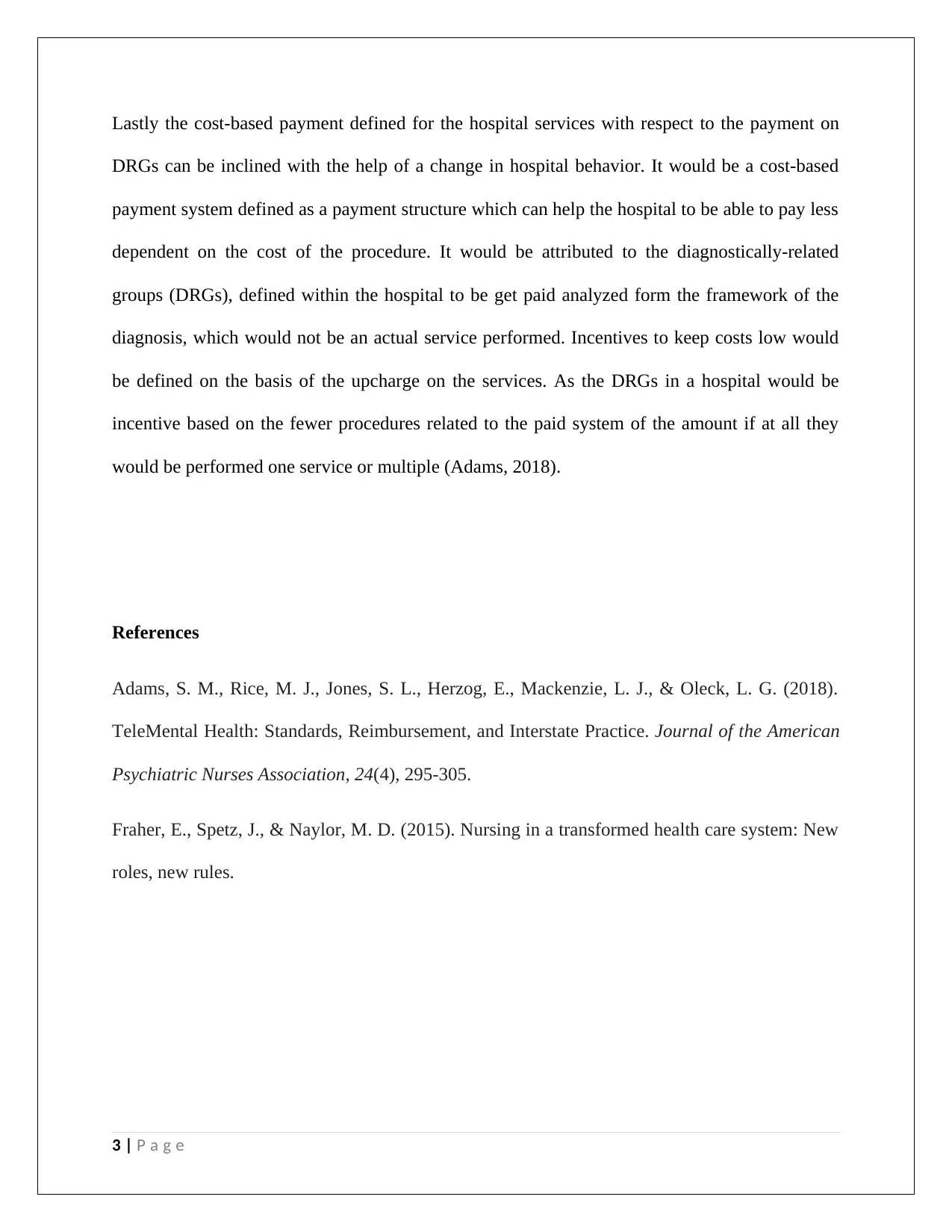
Lastly the cost-based payment defined for the hospital services with respect to the payment on
DRGs can be inclined with the help of a change in hospital behavior. It would be a cost-based
payment system defined as a payment structure which can help the hospital to be able to pay less
dependent on the cost of the procedure. It would be attributed to the diagnostically-related
groups (DRGs), defined within the hospital to be get paid analyzed form the framework of the
diagnosis, which would not be an actual service performed. Incentives to keep costs low would
be defined on the basis of the upcharge on the services. As the DRGs in a hospital would be
incentive based on the fewer procedures related to the paid system of the amount if at all they
would be performed one service or multiple (Adams, 2018).
References
Adams, S. M., Rice, M. J., Jones, S. L., Herzog, E., Mackenzie, L. J., & Oleck, L. G. (2018).
TeleMental Health: Standards, Reimbursement, and Interstate Practice. Journal of the American
Psychiatric Nurses Association, 24(4), 295-305.
Fraher, E., Spetz, J., & Naylor, M. D. (2015). Nursing in a transformed health care system: New
roles, new rules.
3 | P a g e
chevron_up_icon
1 out of 4
circle_padding
hide_on_mobile
zoom_out_icon
[object Object]