Artificial Intelligence: Impact, Advantages, and Disadvantages Report
VerifiedAdded on 2021/02/19
|9
|1240
|305
Report
AI Summary
This report delves into the relationship between science and technology, emphasizing how advancements in technology are built upon scientific understanding. It examines the ethical challenges, issues, and dilemmas that arise with the implementation of new technologies, focusing on artificial intelligence (AI). The report defines AI, its working mechanisms, and its applications, providing examples such as robots, plagiarism checkers, and self-driving cars. It outlines the advantages of AI, including error reduction, efficiency in repetitive tasks, and the provision of rational data. Conversely, it also highlights the disadvantages, such as high investment costs, potential job displacement, environmental risks, and increased dependency on AI. The report further explores the direct and indirect environmental impacts of AI, including its role in weather forecasting, cleaning technologies, and reducing carbon emissions. It also analyzes the positive and negative economic effects of AI, such as increased global GDP and productivity versus potential unemployment and the need for highly skilled labor. The report concludes by summarizing the multifaceted impacts of AI on society, economy, and the environment, referencing various academic sources.
Assignment
Paraphrase This Document
Need a fresh take? Get an instant paraphrase of this document with our AI Paraphraser

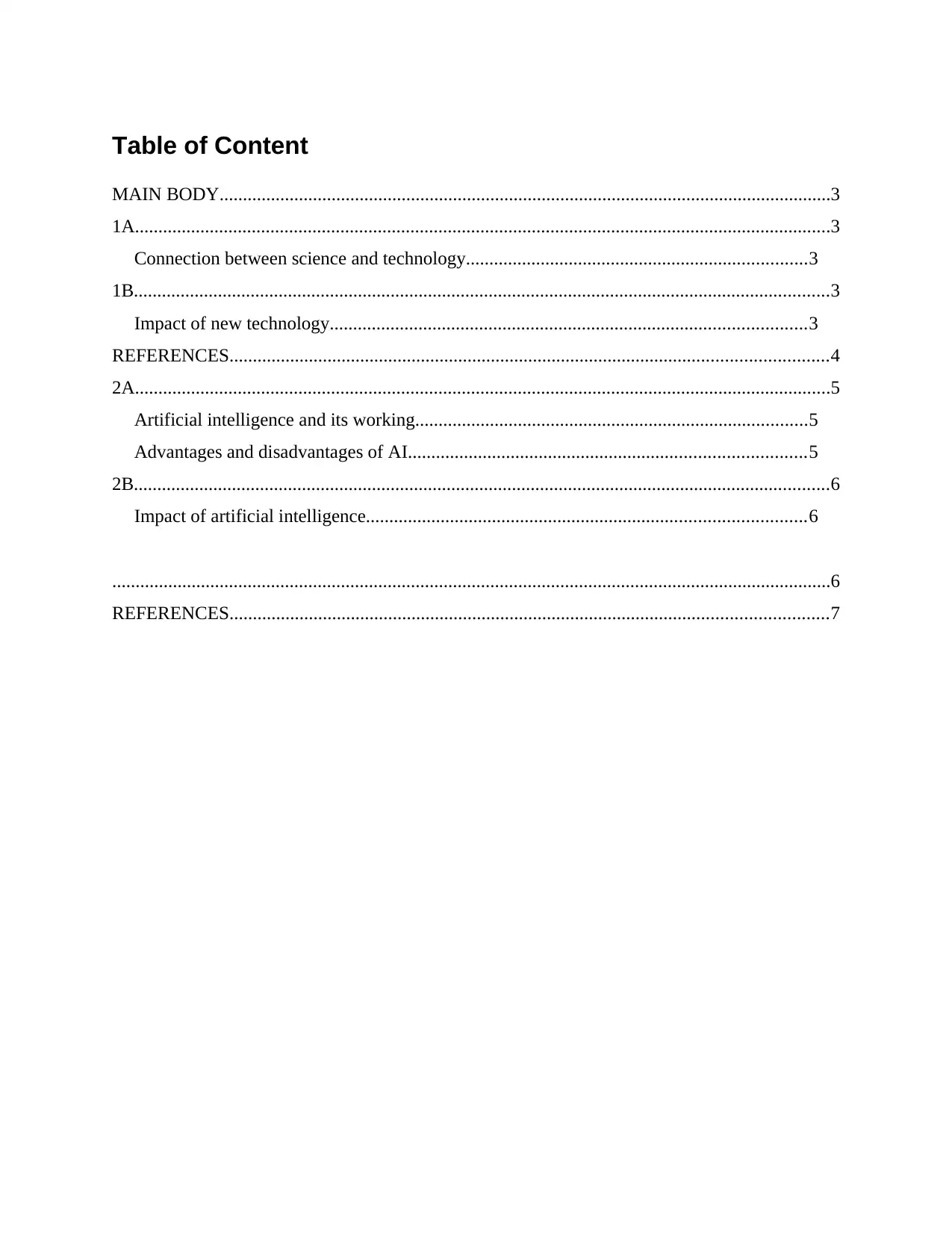
Table of Content
MAIN BODY...................................................................................................................................3
1A.....................................................................................................................................................3
Connection between science and technology.........................................................................3
1B.....................................................................................................................................................3
Impact of new technology......................................................................................................3
REFERENCES................................................................................................................................4
2A.....................................................................................................................................................5
Artificial intelligence and its working....................................................................................5
Advantages and disadvantages of AI.....................................................................................5
2B.....................................................................................................................................................6
Impact of artificial intelligence..............................................................................................6
..........................................................................................................................................................6
REFERENCES................................................................................................................................7
MAIN BODY...................................................................................................................................3
1A.....................................................................................................................................................3
Connection between science and technology.........................................................................3
1B.....................................................................................................................................................3
Impact of new technology......................................................................................................3
REFERENCES................................................................................................................................4
2A.....................................................................................................................................................5
Artificial intelligence and its working....................................................................................5
Advantages and disadvantages of AI.....................................................................................5
2B.....................................................................................................................................................6
Impact of artificial intelligence..............................................................................................6
..........................................................................................................................................................6
REFERENCES................................................................................................................................7

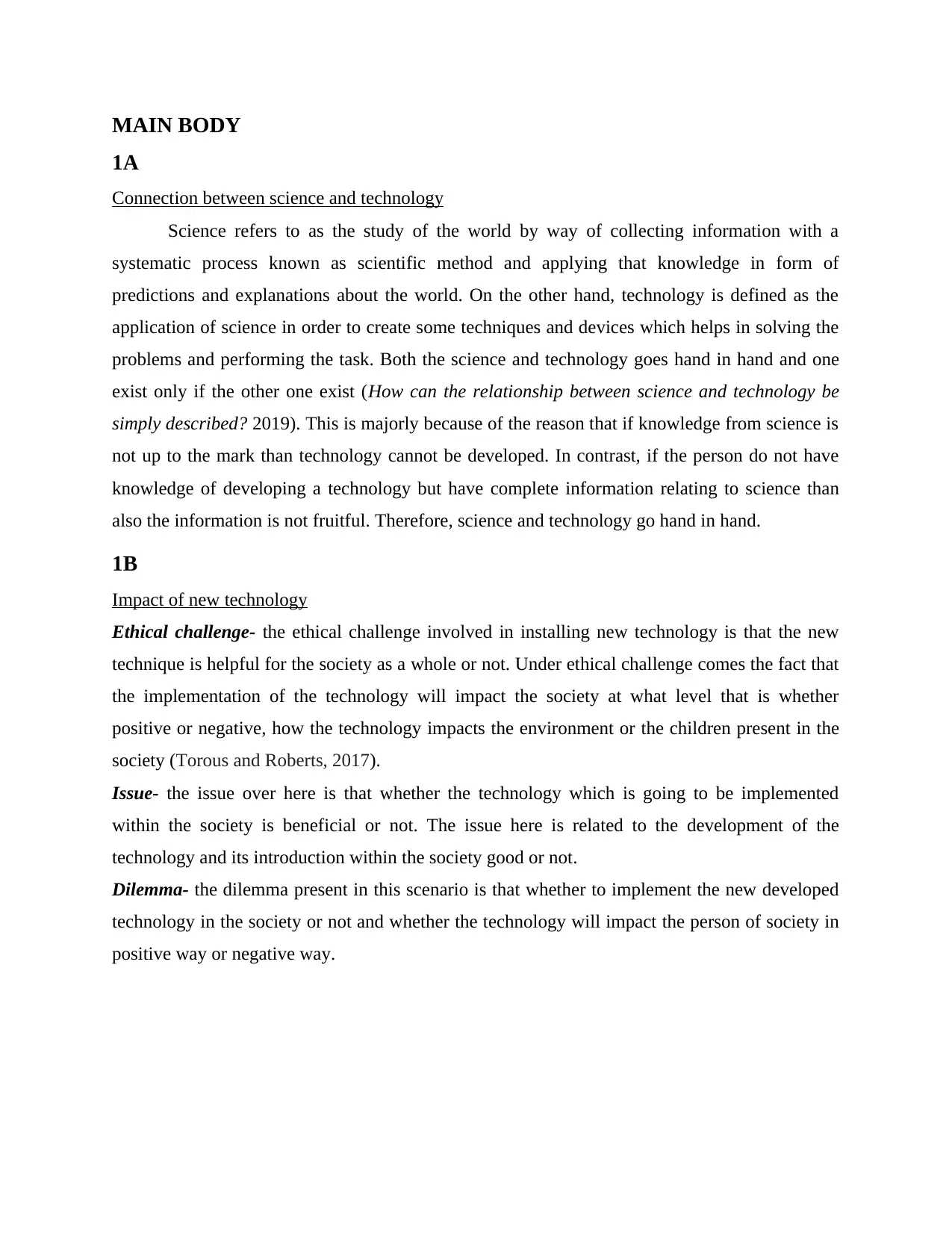
MAIN BODY
1A
Connection between science and technology
Science refers to as the study of the world by way of collecting information with a
systematic process known as scientific method and applying that knowledge in form of
predictions and explanations about the world. On the other hand, technology is defined as the
application of science in order to create some techniques and devices which helps in solving the
problems and performing the task. Both the science and technology goes hand in hand and one
exist only if the other one exist (How can the relationship between science and technology be
simply described? 2019). This is majorly because of the reason that if knowledge from science is
not up to the mark than technology cannot be developed. In contrast, if the person do not have
knowledge of developing a technology but have complete information relating to science than
also the information is not fruitful. Therefore, science and technology go hand in hand.
1B
Impact of new technology
Ethical challenge- the ethical challenge involved in installing new technology is that the new
technique is helpful for the society as a whole or not. Under ethical challenge comes the fact that
the implementation of the technology will impact the society at what level that is whether
positive or negative, how the technology impacts the environment or the children present in the
society (Torous and Roberts, 2017).
Issue- the issue over here is that whether the technology which is going to be implemented
within the society is beneficial or not. The issue here is related to the development of the
technology and its introduction within the society good or not.
Dilemma- the dilemma present in this scenario is that whether to implement the new developed
technology in the society or not and whether the technology will impact the person of society in
positive way or negative way.
1A
Connection between science and technology
Science refers to as the study of the world by way of collecting information with a
systematic process known as scientific method and applying that knowledge in form of
predictions and explanations about the world. On the other hand, technology is defined as the
application of science in order to create some techniques and devices which helps in solving the
problems and performing the task. Both the science and technology goes hand in hand and one
exist only if the other one exist (How can the relationship between science and technology be
simply described? 2019). This is majorly because of the reason that if knowledge from science is
not up to the mark than technology cannot be developed. In contrast, if the person do not have
knowledge of developing a technology but have complete information relating to science than
also the information is not fruitful. Therefore, science and technology go hand in hand.
1B
Impact of new technology
Ethical challenge- the ethical challenge involved in installing new technology is that the new
technique is helpful for the society as a whole or not. Under ethical challenge comes the fact that
the implementation of the technology will impact the society at what level that is whether
positive or negative, how the technology impacts the environment or the children present in the
society (Torous and Roberts, 2017).
Issue- the issue over here is that whether the technology which is going to be implemented
within the society is beneficial or not. The issue here is related to the development of the
technology and its introduction within the society good or not.
Dilemma- the dilemma present in this scenario is that whether to implement the new developed
technology in the society or not and whether the technology will impact the person of society in
positive way or negative way.
⊘ This is a preview!⊘
Do you want full access?
Subscribe today to unlock all pages.

Trusted by 1+ million students worldwide

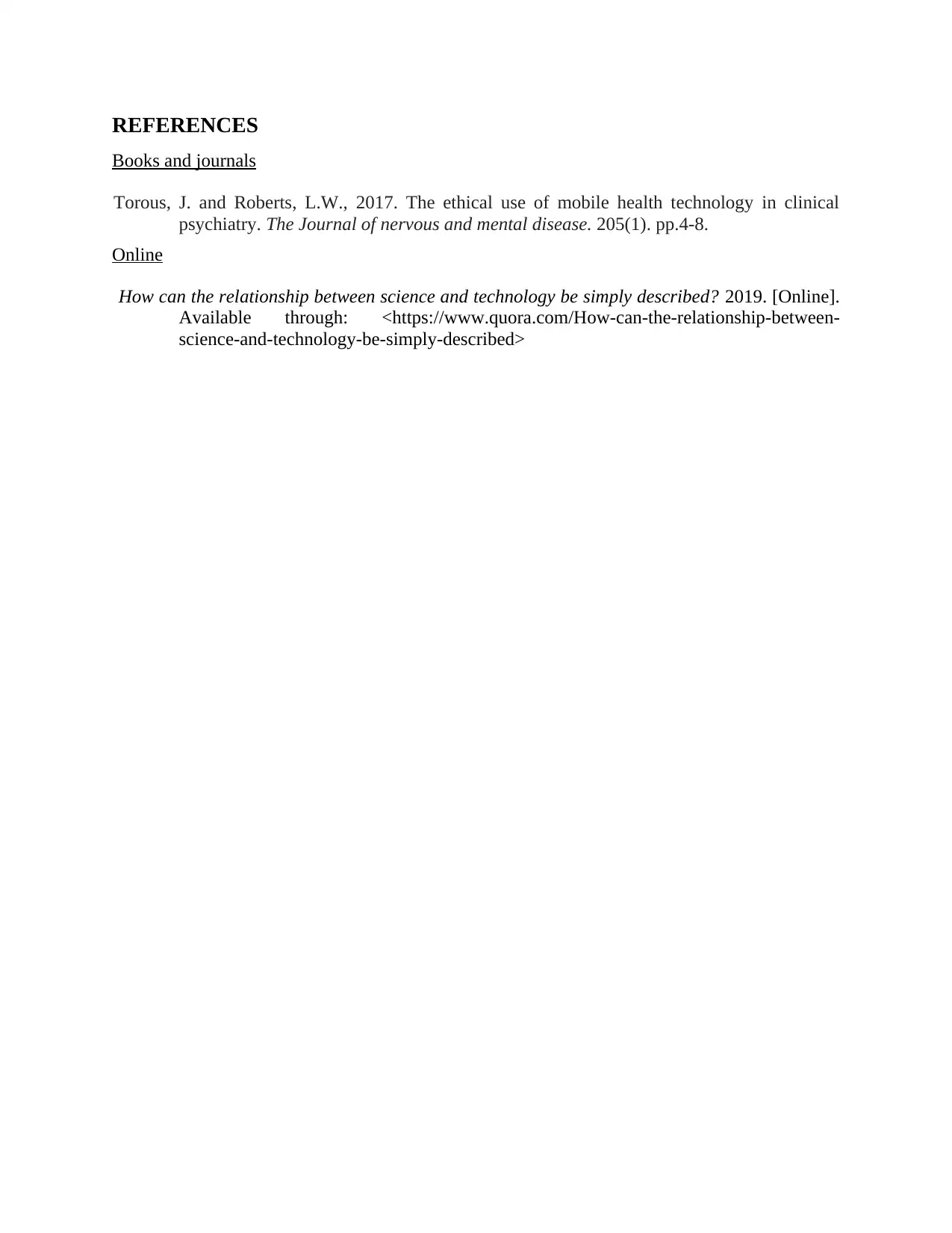
REFERENCES
Books and journals
Torous, J. and Roberts, L.W., 2017. The ethical use of mobile health technology in clinical
psychiatry. The Journal of nervous and mental disease. 205(1). pp.4-8.
Online
How can the relationship between science and technology be simply described? 2019. [Online].
Available through: <https://www.quora.com/How-can-the-relationship-between-
science-and-technology-be-simply-described>
Books and journals
Torous, J. and Roberts, L.W., 2017. The ethical use of mobile health technology in clinical
psychiatry. The Journal of nervous and mental disease. 205(1). pp.4-8.
Online
How can the relationship between science and technology be simply described? 2019. [Online].
Available through: <https://www.quora.com/How-can-the-relationship-between-
science-and-technology-be-simply-described>
Paraphrase This Document
Need a fresh take? Get an instant paraphrase of this document with our AI Paraphraser

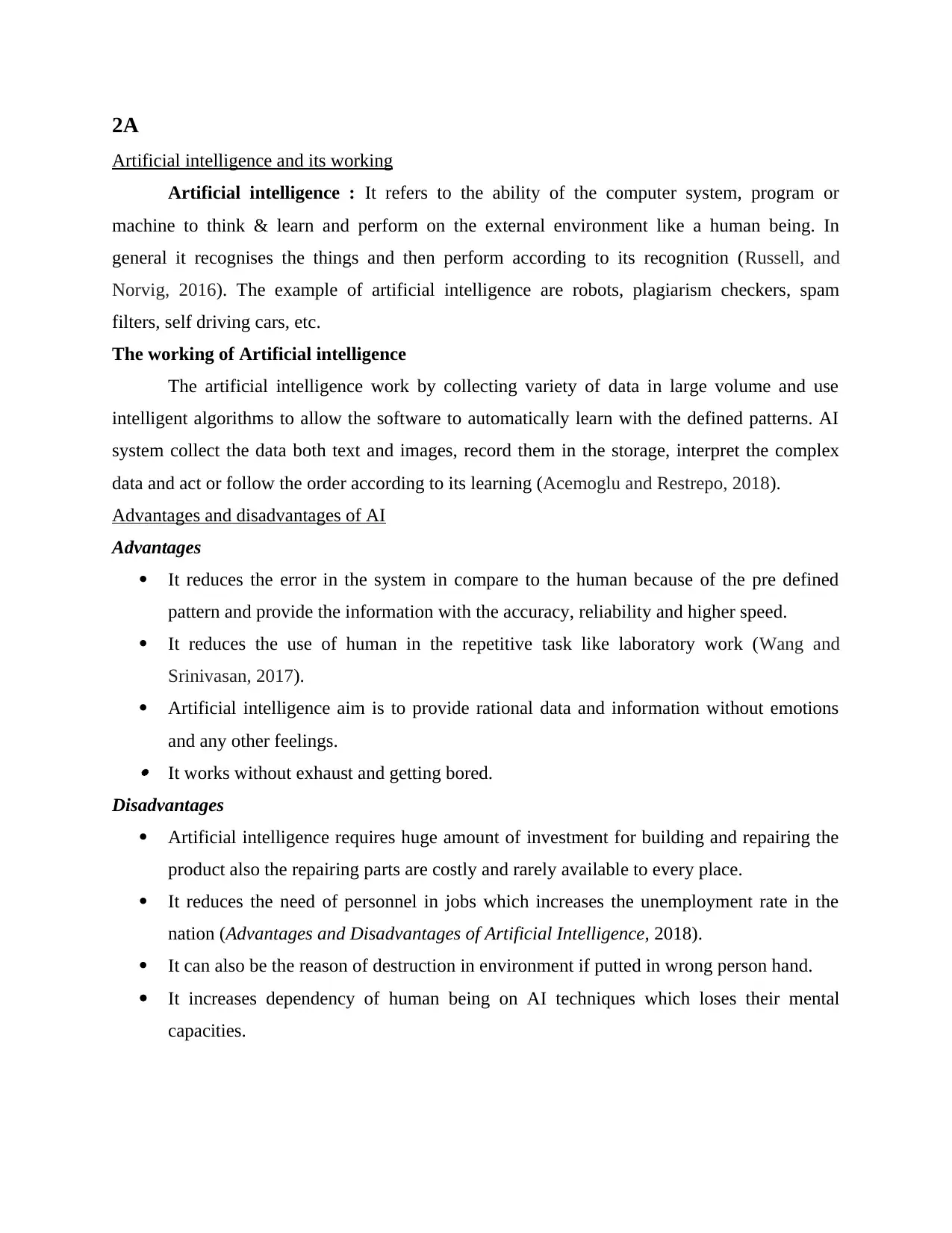
2A
Artificial intelligence and its working
Artificial intelligence : It refers to the ability of the computer system, program or
machine to think & learn and perform on the external environment like a human being. In
general it recognises the things and then perform according to its recognition (Russell, and
Norvig, 2016). The example of artificial intelligence are robots, plagiarism checkers, spam
filters, self driving cars, etc.
The working of Artificial intelligence
The artificial intelligence work by collecting variety of data in large volume and use
intelligent algorithms to allow the software to automatically learn with the defined patterns. AI
system collect the data both text and images, record them in the storage, interpret the complex
data and act or follow the order according to its learning (Acemoglu and Restrepo, 2018).
Advantages and disadvantages of AI
Advantages
It reduces the error in the system in compare to the human because of the pre defined
pattern and provide the information with the accuracy, reliability and higher speed.
It reduces the use of human in the repetitive task like laboratory work (Wang and
Srinivasan, 2017).
Artificial intelligence aim is to provide rational data and information without emotions
and any other feelings. It works without exhaust and getting bored.
Disadvantages
Artificial intelligence requires huge amount of investment for building and repairing the
product also the repairing parts are costly and rarely available to every place.
It reduces the need of personnel in jobs which increases the unemployment rate in the
nation (Advantages and Disadvantages of Artificial Intelligence, 2018).
It can also be the reason of destruction in environment if putted in wrong person hand.
It increases dependency of human being on AI techniques which loses their mental
capacities.
Artificial intelligence and its working
Artificial intelligence : It refers to the ability of the computer system, program or
machine to think & learn and perform on the external environment like a human being. In
general it recognises the things and then perform according to its recognition (Russell, and
Norvig, 2016). The example of artificial intelligence are robots, plagiarism checkers, spam
filters, self driving cars, etc.
The working of Artificial intelligence
The artificial intelligence work by collecting variety of data in large volume and use
intelligent algorithms to allow the software to automatically learn with the defined patterns. AI
system collect the data both text and images, record them in the storage, interpret the complex
data and act or follow the order according to its learning (Acemoglu and Restrepo, 2018).
Advantages and disadvantages of AI
Advantages
It reduces the error in the system in compare to the human because of the pre defined
pattern and provide the information with the accuracy, reliability and higher speed.
It reduces the use of human in the repetitive task like laboratory work (Wang and
Srinivasan, 2017).
Artificial intelligence aim is to provide rational data and information without emotions
and any other feelings. It works without exhaust and getting bored.
Disadvantages
Artificial intelligence requires huge amount of investment for building and repairing the
product also the repairing parts are costly and rarely available to every place.
It reduces the need of personnel in jobs which increases the unemployment rate in the
nation (Advantages and Disadvantages of Artificial Intelligence, 2018).
It can also be the reason of destruction in environment if putted in wrong person hand.
It increases dependency of human being on AI techniques which loses their mental
capacities.

2B
Impact of artificial intelligence
Indirect or direct environmental issues
Artificial intelligence directly affect the environment. The advance tools and techniques help the
weather department to forecast weather and helps to protect the environment. The different
cleaning AI tools helps to clean the environment. AI system reduces the requirement of vehicals
which directly reduces the carbon emission (Seyedmahmoudian, and et.al., 2016).
The AI car help to save environment by reducing the chances of accident which indirectly affect
environment. It helps to track the traffic on the road and allow UPS to reduce the emission of
carbon dioxide which indirectly reduces pollution and protect environment (Kong and et.al.,
2018).
Positive or negative economic effects of artificial intelligence
Positive impact
Artificial intelligence helps to identify and understand the behaviour of companies in the
global market and their contribution in economy.
AI increases the global GDP and aims to increase the GDP by 14% at the end of 2030.
AI positively affect the economy by increasing the productivity, innovation, growth and
job opportunities with the advance systems and techniques (Pistono and Yampolskiy,
2016).
Negative impact
Artificial intelligence reduces the requirement of manpower and increases the
unemployment rate which ultimately affects their purchasing power or income level.
The automation of technology requires the higher skilled labour and workforce to m
maintain the artificial intelligence working which ultimately affect the economy by
increasing the labour retention.
Impact of artificial intelligence
Indirect or direct environmental issues
Artificial intelligence directly affect the environment. The advance tools and techniques help the
weather department to forecast weather and helps to protect the environment. The different
cleaning AI tools helps to clean the environment. AI system reduces the requirement of vehicals
which directly reduces the carbon emission (Seyedmahmoudian, and et.al., 2016).
The AI car help to save environment by reducing the chances of accident which indirectly affect
environment. It helps to track the traffic on the road and allow UPS to reduce the emission of
carbon dioxide which indirectly reduces pollution and protect environment (Kong and et.al.,
2018).
Positive or negative economic effects of artificial intelligence
Positive impact
Artificial intelligence helps to identify and understand the behaviour of companies in the
global market and their contribution in economy.
AI increases the global GDP and aims to increase the GDP by 14% at the end of 2030.
AI positively affect the economy by increasing the productivity, innovation, growth and
job opportunities with the advance systems and techniques (Pistono and Yampolskiy,
2016).
Negative impact
Artificial intelligence reduces the requirement of manpower and increases the
unemployment rate which ultimately affects their purchasing power or income level.
The automation of technology requires the higher skilled labour and workforce to m
maintain the artificial intelligence working which ultimately affect the economy by
increasing the labour retention.
⊘ This is a preview!⊘
Do you want full access?
Subscribe today to unlock all pages.

Trusted by 1+ million students worldwide

REFERENCES
Books and journals
Acemoglu, D. and Restrepo, P., 2018. Artificial intelligence, automation and work (No.
w24196). National Bureau of Economic Research.
Kong, A., and et.al., 2018. The nature of nurture: Effects of parental
genotypes. Science, 359(6374), pp.424-428.
Pistono, F. and Yampolskiy, R.V., 2016. Unethical research: how to create a malevolent
artificial intelligence. arXiv preprint arXiv:1605.02817.
Russell, S.J. and Norvig, P., 2016. Artificial intelligence: a modern approach. Malaysia; Pearson
Education Limited,.
Seyedmahmoudian, M., and et.al., 2016. State of the art artificial intelligence-based MPPT
techniques for mitigating partial shading effects on PV systems–A review. Renewable
and Sustainable Energy Reviews, 64. pp.435-455.
Wang, Z. and Srinivasan, R.S., 2017. A review of artificial intelligence based building energy
use prediction: Contrasting the capabilities of single and ensemble prediction
models. Renewable and Sustainable Energy Reviews, 75, pp.796-808.
Online
Advantages and Disadvantages of Artificial Intelligence. 2018. [Online]. Available through:
<https://data-flair.training/blogs/artificial-intelligence-advantages-disadvantages/>
Books and journals
Acemoglu, D. and Restrepo, P., 2018. Artificial intelligence, automation and work (No.
w24196). National Bureau of Economic Research.
Kong, A., and et.al., 2018. The nature of nurture: Effects of parental
genotypes. Science, 359(6374), pp.424-428.
Pistono, F. and Yampolskiy, R.V., 2016. Unethical research: how to create a malevolent
artificial intelligence. arXiv preprint arXiv:1605.02817.
Russell, S.J. and Norvig, P., 2016. Artificial intelligence: a modern approach. Malaysia; Pearson
Education Limited,.
Seyedmahmoudian, M., and et.al., 2016. State of the art artificial intelligence-based MPPT
techniques for mitigating partial shading effects on PV systems–A review. Renewable
and Sustainable Energy Reviews, 64. pp.435-455.
Wang, Z. and Srinivasan, R.S., 2017. A review of artificial intelligence based building energy
use prediction: Contrasting the capabilities of single and ensemble prediction
models. Renewable and Sustainable Energy Reviews, 75, pp.796-808.
Online
Advantages and Disadvantages of Artificial Intelligence. 2018. [Online]. Available through:
<https://data-flair.training/blogs/artificial-intelligence-advantages-disadvantages/>
Paraphrase This Document
Need a fresh take? Get an instant paraphrase of this document with our AI Paraphraser


⊘ This is a preview!⊘
Do you want full access?
Subscribe today to unlock all pages.

Trusted by 1+ million students worldwide
1 out of 9
Related Documents
Your All-in-One AI-Powered Toolkit for Academic Success.
+13062052269
info@desklib.com
Available 24*7 on WhatsApp / Email
Unlock your academic potential
Copyright © 2020–2026 A2Z Services. All Rights Reserved. Developed and managed by ZUCOL.