Relationship Between Research Process and Practice Evidence
VerifiedAdded on 2019/09/20
|16
|3656
|214
Report
AI Summary
This report delves into the relationship between the research process and the development of evidence for practice, focusing on external and internal resources involved in research work. It emphasizes the strategies used in analyzing research, design, skills, and the development of a thesis, particularly in relation to awareness issues. The report outlines the steps involved in finding evidence, from data gathering and summarization to critical evaluation and auditing of conclusions. It discusses different types and levels of evidence, the importance of evidence for practice, and demonstrates awareness of the research process. The report also covers dissemination strategies, barriers to implementation, and provides a critique of two articles. The methodology includes in-depth analysis, online research, and interviews with independent individuals to gather unbiased results. The report highlights the importance of correct methodology and the use of both qualitative and quantitative approaches in research design. It identifies challenges in integrating evidence with clinical practice, such as the nature of evidence, communication, knowledge, and organizational barriers, ultimately aiming to improve patient outcomes through evidence-based practice.
Relationship between the Research Process and Development of Evidence for Practice
[Type the document subtitle]
Name
[Pick the date]
[Type the abstract of the document here. The abstract is typically a short summary of the contents
of the document. Type the abstract of the document here. The abstract is typically a short
summary of the contents of the document.]
[Type the document subtitle]
Name
[Pick the date]
[Type the abstract of the document here. The abstract is typically a short summary of the contents
of the document. Type the abstract of the document here. The abstract is typically a short
summary of the contents of the document.]

Paraphrase This Document
Need a fresh take? Get an instant paraphrase of this document with our AI Paraphraser
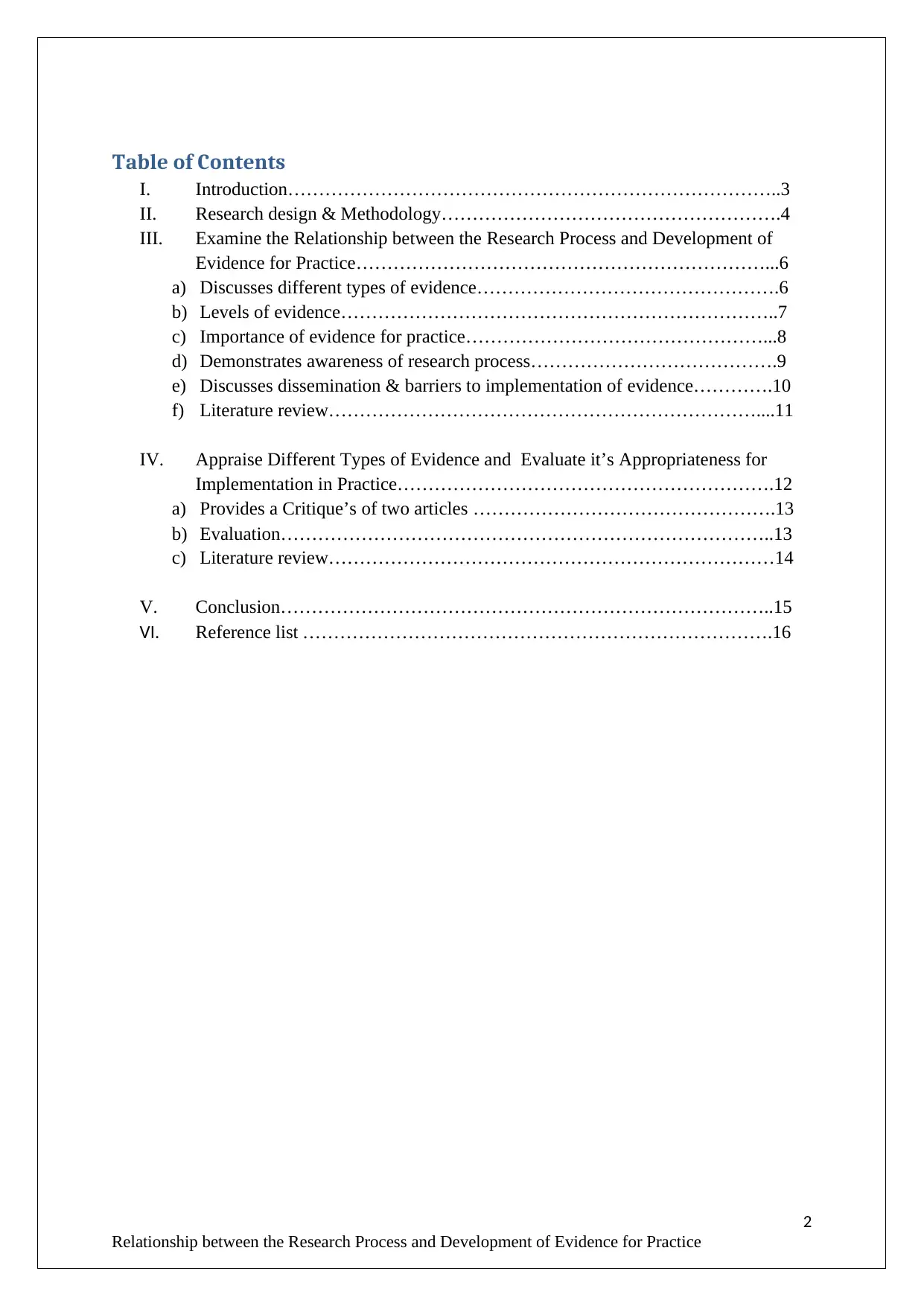
Table of Contents
I. Introduction……………………………………………………………………..3
II. Research design & Methodology……………………………………………….4
III. Examine the Relationship between the Research Process and Development of
Evidence for Practice…………………………………………………………...6
a) Discusses different types of evidence………………………………………….6
b) Levels of evidence……………………………………………………………..7
c) Importance of evidence for practice…………………………………………...8
d) Demonstrates awareness of research process………………………………….9
e) Discusses dissemination & barriers to implementation of evidence………….10
f) Literature review……………………………………………………………....11
IV. Appraise Different Types of Evidence and Evaluate it’s Appropriateness for
Implementation in Practice…………………………………………………….12
a) Provides a Critique’s of two articles ………………………………………….13
b) Evaluation……………………………………………………………………..13
c) Literature review………………………………………………………………14
V. Conclusion……………………………………………………………………..15
VI. Reference list ………………………………………………………………….16
2
Relationship between the Research Process and Development of Evidence for Practice
I. Introduction……………………………………………………………………..3
II. Research design & Methodology……………………………………………….4
III. Examine the Relationship between the Research Process and Development of
Evidence for Practice…………………………………………………………...6
a) Discusses different types of evidence………………………………………….6
b) Levels of evidence……………………………………………………………..7
c) Importance of evidence for practice…………………………………………...8
d) Demonstrates awareness of research process………………………………….9
e) Discusses dissemination & barriers to implementation of evidence………….10
f) Literature review……………………………………………………………....11
IV. Appraise Different Types of Evidence and Evaluate it’s Appropriateness for
Implementation in Practice…………………………………………………….12
a) Provides a Critique’s of two articles ………………………………………….13
b) Evaluation……………………………………………………………………..13
c) Literature review………………………………………………………………14
V. Conclusion……………………………………………………………………..15
VI. Reference list ………………………………………………………………….16
2
Relationship between the Research Process and Development of Evidence for Practice
I. Introduction
This report covers external & internal resources surrounding research work conducted. The
core emphasis lies in the strategy planned & involved in key analyzing research work, design,
skills & development of the thesis. We did emphasis on the research & core studies related to
awareness issues. In particular, we summarized our findings into the doing a core research
after surveying experts , understanding the methodology they use, designing thesis, how there
is dependency relationship between research & development & complexities involved. There
are various steps involved in the finding a evidence in research the first step is to gather data
& findings, collate into a summarizing part, find online research articles who could throw
more light on the same topic, understanding of articles & critically evaluating the nitty-gritty
of the research articles used & final step is to do an audit of the conclusion drawn. The results
of our findings are our collaborative researched work processes. We also did the sampling of
20 independent unknown people & interviewed them to draw synopsis of our research work.
We interrogated various methodologies to find our facts & collate them.
There are different types of evidence & levels and finding an accurate one is a task. To find
one we need gather data, do data mining then we need to find out appropriate guidelines e.g.
NICE, professional bodies or like Royal College of Obstetricians and Gynaecologists
(RCOG). Incase no guidelines are readily available online then we need to back upon the
primary research e.g. PubMed or do systematic reviews. In the last resort if nothing is
available to talk out to experts or local specialist or does basic internet searches. We need to
critically examine each & every research with the existing knowledge opinions & skills set.
Understanding of challenges & resolution part. The next step is to diagnose of the objectives
are being defined accurately & the last step is to detect any conflict of interests.
3
Relationship between the Research Process and Development of Evidence for Practice
This report covers external & internal resources surrounding research work conducted. The
core emphasis lies in the strategy planned & involved in key analyzing research work, design,
skills & development of the thesis. We did emphasis on the research & core studies related to
awareness issues. In particular, we summarized our findings into the doing a core research
after surveying experts , understanding the methodology they use, designing thesis, how there
is dependency relationship between research & development & complexities involved. There
are various steps involved in the finding a evidence in research the first step is to gather data
& findings, collate into a summarizing part, find online research articles who could throw
more light on the same topic, understanding of articles & critically evaluating the nitty-gritty
of the research articles used & final step is to do an audit of the conclusion drawn. The results
of our findings are our collaborative researched work processes. We also did the sampling of
20 independent unknown people & interviewed them to draw synopsis of our research work.
We interrogated various methodologies to find our facts & collate them.
There are different types of evidence & levels and finding an accurate one is a task. To find
one we need gather data, do data mining then we need to find out appropriate guidelines e.g.
NICE, professional bodies or like Royal College of Obstetricians and Gynaecologists
(RCOG). Incase no guidelines are readily available online then we need to back upon the
primary research e.g. PubMed or do systematic reviews. In the last resort if nothing is
available to talk out to experts or local specialist or does basic internet searches. We need to
critically examine each & every research with the existing knowledge opinions & skills set.
Understanding of challenges & resolution part. The next step is to diagnose of the objectives
are being defined accurately & the last step is to detect any conflict of interests.
3
Relationship between the Research Process and Development of Evidence for Practice
⊘ This is a preview!⊘
Do you want full access?
Subscribe today to unlock all pages.

Trusted by 1+ million students worldwide
We will research this report in the following steps; firstly, we need to find answers to three
research questions as well as the methodology to approach. After that, we draw out
discussion points establishing results with the survey & interviewed people and finally
finding a definitive definition. Next, we demonstrate awareness of research process. Then,
discusses dissemination (i.e. organizations and agencies responsible for dissemination) and
barriers to implementation of evidence & finally literature used.
The research questions to approach this hypothesis focused on the following main themes:
· Relationship between the Research Process and Development of Evidence for Practice
· Discusses different types of evidence, levels of evidence and importance of evidence for
practice.
· Solutions & strategies used in & critique’s of two articles
· Evaluation of each methodology
· What conclusion & recommendations can be drawn?
1.2 Method
We did an in-depth analysis, researched online, did blinded interviews to have nonbiased
results & used it as our active methodology. There was a question list of 10 sent to 20
unknown independent people, and then we did data collection & data gathering from various
magazines & newspapers etc.
II. RESEARCH DESIGN & METHODOLOGY
This project is designed to derive proper methodologies, understand research flaws in finding
evidence, key strategies& provide appropriate directions to the redirect research. On an in-
depth analysis & understanding issues in terms of research evidence comprehensive
4
Relationship between the Research Process and Development of Evidence for Practice
research questions as well as the methodology to approach. After that, we draw out
discussion points establishing results with the survey & interviewed people and finally
finding a definitive definition. Next, we demonstrate awareness of research process. Then,
discusses dissemination (i.e. organizations and agencies responsible for dissemination) and
barriers to implementation of evidence & finally literature used.
The research questions to approach this hypothesis focused on the following main themes:
· Relationship between the Research Process and Development of Evidence for Practice
· Discusses different types of evidence, levels of evidence and importance of evidence for
practice.
· Solutions & strategies used in & critique’s of two articles
· Evaluation of each methodology
· What conclusion & recommendations can be drawn?
1.2 Method
We did an in-depth analysis, researched online, did blinded interviews to have nonbiased
results & used it as our active methodology. There was a question list of 10 sent to 20
unknown independent people, and then we did data collection & data gathering from various
magazines & newspapers etc.
II. RESEARCH DESIGN & METHODOLOGY
This project is designed to derive proper methodologies, understand research flaws in finding
evidence, key strategies& provide appropriate directions to the redirect research. On an in-
depth analysis & understanding issues in terms of research evidence comprehensive
4
Relationship between the Research Process and Development of Evidence for Practice
Paraphrase This Document
Need a fresh take? Get an instant paraphrase of this document with our AI Paraphraser
issues ,key highlights, solutions in designing & forming an alternative research evidence we
did research, gathered data, heard professional opinions &stayed in touch with the experts
who could discuss evidence. First, we devised a strategy to conduct research analysis, went
in-depth through online searches, personal guidance from professional experts to understand
drawbacks in issues, conflict issues & how to overcome them ethically. Secondly, we
conducted a survey for a group of 20 random people working who could provide
unbiasedness end results.
Interviews and Fieldwork The team researched & identified potential candidates to be
interviewed through secondary data research, Internet research, personal contacts, and cold
calls. Few experts gave a fair viewpoints & clarity. Experts were recommended by other
expert referrals.
Case studies were used to read significant & understand all the key perspectives which could
help in drawing reference about evidence strategies.
5
Relationship between the Research Process and Development of Evidence for Practice
did research, gathered data, heard professional opinions &stayed in touch with the experts
who could discuss evidence. First, we devised a strategy to conduct research analysis, went
in-depth through online searches, personal guidance from professional experts to understand
drawbacks in issues, conflict issues & how to overcome them ethically. Secondly, we
conducted a survey for a group of 20 random people working who could provide
unbiasedness end results.
Interviews and Fieldwork The team researched & identified potential candidates to be
interviewed through secondary data research, Internet research, personal contacts, and cold
calls. Few experts gave a fair viewpoints & clarity. Experts were recommended by other
expert referrals.
Case studies were used to read significant & understand all the key perspectives which could
help in drawing reference about evidence strategies.
5
Relationship between the Research Process and Development of Evidence for Practice
III. Examine the Relationship between the Research Process and
Development of Evidence for Practice
The idea of doing this research is to diagnose knowledge skills & get a better picture of
understanding of evidence. Doing in-depth research studies involves organized, systematic
steps involved in finding a correct knowledge. Research is investigating & exploring all the
facts & findings. The methodology needs to be correct at every step to .conclude a correct
research design.
It starts with the forming questions & finding a suitable answer through various methods of
research & concluding an appropriate answer.
First answering a research questions incase answer is not suitable & is not correct then
diagnosing alternative approaches.
The two approaches to diagnosing a research design is to do it by a qualitative and qualitative
approach or simply blending both the approaches. Although mixed methods using both are
growing. Quantitative studies are finding a numerical method to logically understand whereas
qualitative studies are to go in-depth theoretically.
Quantitative studies are through numerical approach by sampling, derivation of sizing
& reaching a logical sequencing.
Qualitative studies are theoretically finding out answers.
A final step is do auditing & then measuring the outcome of the final result if it's correct or
not. If not, then we need to go all the process again & finding out an alternative approach.
Discusses different types of evidence, levels of evidence and importance of evidence for
practice.
6
Relationship between the Research Process and Development of Evidence for Practice
Development of Evidence for Practice
The idea of doing this research is to diagnose knowledge skills & get a better picture of
understanding of evidence. Doing in-depth research studies involves organized, systematic
steps involved in finding a correct knowledge. Research is investigating & exploring all the
facts & findings. The methodology needs to be correct at every step to .conclude a correct
research design.
It starts with the forming questions & finding a suitable answer through various methods of
research & concluding an appropriate answer.
First answering a research questions incase answer is not suitable & is not correct then
diagnosing alternative approaches.
The two approaches to diagnosing a research design is to do it by a qualitative and qualitative
approach or simply blending both the approaches. Although mixed methods using both are
growing. Quantitative studies are finding a numerical method to logically understand whereas
qualitative studies are to go in-depth theoretically.
Quantitative studies are through numerical approach by sampling, derivation of sizing
& reaching a logical sequencing.
Qualitative studies are theoretically finding out answers.
A final step is do auditing & then measuring the outcome of the final result if it's correct or
not. If not, then we need to go all the process again & finding out an alternative approach.
Discusses different types of evidence, levels of evidence and importance of evidence for
practice.
6
Relationship between the Research Process and Development of Evidence for Practice
⊘ This is a preview!⊘
Do you want full access?
Subscribe today to unlock all pages.
Trusted by 1+ million students worldwide
a) Different types of evidence
There are various types of evidence used in practice. One is created by the Canadian
Institutes for Health Research (CIHR, 2009) & formed quantitative evidence:
systematic reviews of randomized controlled trials
randomized controlled trials
systematic reviews of nonrandomized or cohort studies;
cohort studies
case-control studies
case series
case report
ideas, editorials, opinions
animal research and
invitro (test tube) research.
Also, there is another best evidence named as 5S Pyramid developed by Brian Haynes
(2007).
To find out appropriate evidence firstly we need gather data, do data mining then we need to
find out appropriate guidelines e.g. NICE, professional bodies or like Royal College of
Obstetricians and Gynaecologists (RCOG). Incase no guidelines are readily available online
then we need to back upon the primary research e.g. PubMed or do systematic reviews. In the
last resort if nothing is available to talk out to experts or local specialist or does basic internet
searches.
b) Levels of evidences-:
Finding an appropriate evidence we need to find out levels of measurement & getting the
7
Relationship between the Research Process and Development of Evidence for Practice
There are various types of evidence used in practice. One is created by the Canadian
Institutes for Health Research (CIHR, 2009) & formed quantitative evidence:
systematic reviews of randomized controlled trials
randomized controlled trials
systematic reviews of nonrandomized or cohort studies;
cohort studies
case-control studies
case series
case report
ideas, editorials, opinions
animal research and
invitro (test tube) research.
Also, there is another best evidence named as 5S Pyramid developed by Brian Haynes
(2007).
To find out appropriate evidence firstly we need gather data, do data mining then we need to
find out appropriate guidelines e.g. NICE, professional bodies or like Royal College of
Obstetricians and Gynaecologists (RCOG). Incase no guidelines are readily available online
then we need to back upon the primary research e.g. PubMed or do systematic reviews. In the
last resort if nothing is available to talk out to experts or local specialist or does basic internet
searches.
b) Levels of evidences-:
Finding an appropriate evidence we need to find out levels of measurement & getting the
7
Relationship between the Research Process and Development of Evidence for Practice
Paraphrase This Document
Need a fresh take? Get an instant paraphrase of this document with our AI Paraphraser
correct end result which we can check internal validity . This could be through randomized
controlled studies, controlled longitudinal studies, uncontrolled longitudinal studies, cross-
sectional studies, case studies & expert opinions.
c) Importance of evidences-:
In order to get the best evidence, we need to mix 3 elements which could get us an improved
patient/client outcome.
Critical appraisal
Once we have drawn a research design then we need to critically appraise the positive or
negative & reach a final concluding result. For this, some of the answers need to be
answered.
What were the results of the study?
How valid are the results?
Will the results be helpful in caring for other patients?
Principles of Evidence Based Practice
An in-depth research-based evidence requires knowledge & hand on experience with the
skillset. If its nursing unit, then they have to be fine tuned themselves as per the intensive
care, medicines knowledge & supervision (Burns and Grove 2001).
Nurses are the crucial members of healthcare units who interact with the clients & customers.
Practice should be done on the basis of reliable evidence (Parahoo 2006). It is vital
integration to update nurses to update them with latest techniques & regular tech how
expertises. (Gerrish 2006) states that it’s a combination of research, patient experience, and
clinical expertise
8
Relationship between the Research Process and Development of Evidence for Practice
controlled studies, controlled longitudinal studies, uncontrolled longitudinal studies, cross-
sectional studies, case studies & expert opinions.
c) Importance of evidences-:
In order to get the best evidence, we need to mix 3 elements which could get us an improved
patient/client outcome.
Critical appraisal
Once we have drawn a research design then we need to critically appraise the positive or
negative & reach a final concluding result. For this, some of the answers need to be
answered.
What were the results of the study?
How valid are the results?
Will the results be helpful in caring for other patients?
Principles of Evidence Based Practice
An in-depth research-based evidence requires knowledge & hand on experience with the
skillset. If its nursing unit, then they have to be fine tuned themselves as per the intensive
care, medicines knowledge & supervision (Burns and Grove 2001).
Nurses are the crucial members of healthcare units who interact with the clients & customers.
Practice should be done on the basis of reliable evidence (Parahoo 2006). It is vital
integration to update nurses to update them with latest techniques & regular tech how
expertises. (Gerrish 2006) states that it’s a combination of research, patient experience, and
clinical expertise
8
Relationship between the Research Process and Development of Evidence for Practice
d) Demonstrates awareness of research process.
Parahoo (2006) states that there can be four stages in the research process.
Identification & structuring of the research design. Determining questions &
hypothetical situations. At this stage, the researcher identifies the correct
methodology to do research based evidence. Historical evidence can be back upon in
understanding the initial stages & know how techniques to reach h last stages. The
end results are matched with the forecasted results.
When we decide the designing & initial stages after which it comes data collection,
data gathering, searching relevant based evidence, devising of process & procedures
to do research work. The sampling, random population, blinded or unblinded all are
tried & tested & follow a simple methodology to be pa of the research design.
The tailoring of the research project, questions, on the basis of which project will
begin, we need to set up designing & methodology conducted. Sampling, population
participating all needs to be counted & make it accordingly research design. Once it's
tested & concluded how the test will be beginning, then we can begin the test.
The next stage begins with observing things, analyzing & taking a deep note abut
each & every step conducted. It's important to checkpoints, analyzing that everything
falls at the time. After doing in-depth research & analysis, they will make a report of
all the findings whether it's qualitative or quantitative & then make a broader research
designing for future notes. Incase of any misses or any new alternative ideas one can
make a note of them at this stage.
9
Relationship between the Research Process and Development of Evidence for Practice
Parahoo (2006) states that there can be four stages in the research process.
Identification & structuring of the research design. Determining questions &
hypothetical situations. At this stage, the researcher identifies the correct
methodology to do research based evidence. Historical evidence can be back upon in
understanding the initial stages & know how techniques to reach h last stages. The
end results are matched with the forecasted results.
When we decide the designing & initial stages after which it comes data collection,
data gathering, searching relevant based evidence, devising of process & procedures
to do research work. The sampling, random population, blinded or unblinded all are
tried & tested & follow a simple methodology to be pa of the research design.
The tailoring of the research project, questions, on the basis of which project will
begin, we need to set up designing & methodology conducted. Sampling, population
participating all needs to be counted & make it accordingly research design. Once it's
tested & concluded how the test will be beginning, then we can begin the test.
The next stage begins with observing things, analyzing & taking a deep note abut
each & every step conducted. It's important to checkpoints, analyzing that everything
falls at the time. After doing in-depth research & analysis, they will make a report of
all the findings whether it's qualitative or quantitative & then make a broader research
designing for future notes. Incase of any misses or any new alternative ideas one can
make a note of them at this stage.
9
Relationship between the Research Process and Development of Evidence for Practice
⊘ This is a preview!⊘
Do you want full access?
Subscribe today to unlock all pages.
Trusted by 1+ million students worldwide
Last stage is checking of results, matching with the end points & doing dissemination
which can be checked & verified by the help of an organisation like NICE, after this
barriers or challenges are outlined for future learning.
There can be positive or negative test results, some challenges or some barriers which an
author of the evidence-based research design can note them or interpret it which depends
entirely on the integrity & ethics. One should do design research keeping the general public
in mindset & results for which active participants are participating in the analysis. Hence it
should be unbiased. Patients participating blinded or blinded participants participations all
should be bounded by the confidentiality clauses. Whenever the test results are published all
the confidential information about anything, or barriers & test results should be fair, honest &
not to misguide the general public.
e) Discusses dissemination (i.e. organizations and agencies responsible for dissemination)
and barriers to implementation of evidence.
There can be many challenges & many barriers to integrating evidence with the clinical
practice; Gerrish (2006) suggests that these barriers are divided into 4 categories;
the nature of the evidence,
communication of the evidence,
knowledge and skill of the nurse
organizational barriers.
When we identify barriers & key challenges it helps us to structure & design our evidence-
based researches. The complexities, years of research is blended with the latest technology,
knowledge & mindset. In a nurse, the main challenge which could be identified is the lack of
knowledge, confidence & implementation of the task. While working in an organization the
10
Relationship between the Research Process and Development of Evidence for Practice
which can be checked & verified by the help of an organisation like NICE, after this
barriers or challenges are outlined for future learning.
There can be positive or negative test results, some challenges or some barriers which an
author of the evidence-based research design can note them or interpret it which depends
entirely on the integrity & ethics. One should do design research keeping the general public
in mindset & results for which active participants are participating in the analysis. Hence it
should be unbiased. Patients participating blinded or blinded participants participations all
should be bounded by the confidentiality clauses. Whenever the test results are published all
the confidential information about anything, or barriers & test results should be fair, honest &
not to misguide the general public.
e) Discusses dissemination (i.e. organizations and agencies responsible for dissemination)
and barriers to implementation of evidence.
There can be many challenges & many barriers to integrating evidence with the clinical
practice; Gerrish (2006) suggests that these barriers are divided into 4 categories;
the nature of the evidence,
communication of the evidence,
knowledge and skill of the nurse
organizational barriers.
When we identify barriers & key challenges it helps us to structure & design our evidence-
based researches. The complexities, years of research is blended with the latest technology,
knowledge & mindset. In a nurse, the main challenge which could be identified is the lack of
knowledge, confidence & implementation of the task. While working in an organization the
10
Relationship between the Research Process and Development of Evidence for Practice
Paraphrase This Document
Need a fresh take? Get an instant paraphrase of this document with our AI Paraphraser
key challenge faced by nurses is a lack of guidance by seniors, superiority to seeking
suggestions & management lack of efforts in mixing with updated know how techniques.
f ) Literature review
The background research was bifurcated in the case studies, short-term consultancies,
individuals & organizations. We read online researchers, took professional opinions from key
experts, went through reports in the evidence comprehensive issues & highlighted issues
which could help in research & development. For an understanding of research
& evidence key strategies were devised in order to understand success & drawbacks in
drawing a conclusion in evidence research. For this, we referred to reports, read magazines &
websites analyzed them then concluded in a final writing along with references.
11
Relationship between the Research Process and Development of Evidence for Practice
suggestions & management lack of efforts in mixing with updated know how techniques.
f ) Literature review
The background research was bifurcated in the case studies, short-term consultancies,
individuals & organizations. We read online researchers, took professional opinions from key
experts, went through reports in the evidence comprehensive issues & highlighted issues
which could help in research & development. For an understanding of research
& evidence key strategies were devised in order to understand success & drawbacks in
drawing a conclusion in evidence research. For this, we referred to reports, read magazines &
websites analyzed them then concluded in a final writing along with references.
11
Relationship between the Research Process and Development of Evidence for Practice
IV. Appraise Different Types of Evidence & Evaluate it’s Appropriateness
for Implementation in Practice
a) Critique of two articles correctly identifying the type of evidence.
Two articles will be critiqued & to draw suitable evidence to assess strengths and weaknesses
in the research process.
(i) The Levels of Evidence and their role in Evidence-Based Medicine
This article was written to understand the levels of evidence in medicine & usage in the
plastic surgery. Hierarchy of evidence, modification of levels, interpretation of levels & on
the basis of which best evidence was concluded. Though the abstract & research done was
theoretically derived from understanding application part in plastic surgery. With years it’s
improving in plastic surgery research but we should have multiple results from the recent
years rather than depending on the historical results.
(ii) Evidence-Based Medicine: Levels of Evidence
The author of this illustrated ways in which nursing based evidence. The key challenges
understood in the explanation & implementation was the key strategies, organizations that
were put into existence to understand everyday nurse’s practice. With the current trend,
nursing should be brought to next level of development in training & methodology. Since
reading all the evidence brought us to the conclusion that nursing should be updated with the
current technology & follow trends. They should not practice outdated routine tasks & should
be trained with the latest skill set. A point of curiosity should always be addressed whenever
a new evidence-based research is implemented . Be it for the general public, individual or
collective, nurses should find out how evidence research is helpful with the current stages.
12
Relationship between the Research Process and Development of Evidence for Practice
for Implementation in Practice
a) Critique of two articles correctly identifying the type of evidence.
Two articles will be critiqued & to draw suitable evidence to assess strengths and weaknesses
in the research process.
(i) The Levels of Evidence and their role in Evidence-Based Medicine
This article was written to understand the levels of evidence in medicine & usage in the
plastic surgery. Hierarchy of evidence, modification of levels, interpretation of levels & on
the basis of which best evidence was concluded. Though the abstract & research done was
theoretically derived from understanding application part in plastic surgery. With years it’s
improving in plastic surgery research but we should have multiple results from the recent
years rather than depending on the historical results.
(ii) Evidence-Based Medicine: Levels of Evidence
The author of this illustrated ways in which nursing based evidence. The key challenges
understood in the explanation & implementation was the key strategies, organizations that
were put into existence to understand everyday nurse’s practice. With the current trend,
nursing should be brought to next level of development in training & methodology. Since
reading all the evidence brought us to the conclusion that nursing should be updated with the
current technology & follow trends. They should not practice outdated routine tasks & should
be trained with the latest skill set. A point of curiosity should always be addressed whenever
a new evidence-based research is implemented . Be it for the general public, individual or
collective, nurses should find out how evidence research is helpful with the current stages.
12
Relationship between the Research Process and Development of Evidence for Practice
⊘ This is a preview!⊘
Do you want full access?
Subscribe today to unlock all pages.
Trusted by 1+ million students worldwide

1 out of 16


Related Documents


Your All-in-One AI-Powered Toolkit for Academic Success.
+13062052269
info@desklib.com
Available 24*7 on WhatsApp / Email
![[object Object]](/_next/static/media/star-bottom.7253800d.svg)
Unlock your academic potential
Copyright © 2020–2025 A2Z Services. All Rights Reserved. Developed and managed by ZUCOL.