Account Management: Stakeholder Analysis, CRM Monitoring and Control

Verified

Added on  2019/09/23

|6
|1254
|305
Report
AI Summary
This report provides a comprehensive analysis of stakeholder management and customer relationship management (CRM) strategies, focusing on an FMCG account. It emphasizes the importance of stakeholder analysis in understanding and meeting the diverse needs of stakeholders, including customers, employees, suppliers, retailers, and the community. The report categorizes stakeholders based on their interest and influence, highlighting the significance of key players like customers and employees. It further explores the concept of monitoring and controlling CRM activities, emphasizing the need for continuous evaluation and improvement. The report discusses methods for collecting feedback, including surveys and social media monitoring, and techniques for analyzing information to assess customer satisfaction. Finally, it identifies the strengths and weaknesses of the CRM system, suggesting areas for enhancement to improve customer relationships and drive business success.
Document Page
Relationship management for account managers
1
tabler-icon-diamond-filled.svg

Paraphrase This Document

Need a fresh take? Get an instant paraphrase of this document with our AI Paraphraser
Document Page
Task 4: Understanding Stakeholder Analysis
There are several stakeholders which are associated with an account. For enhancing
effectiveness of the relationship management strategies, the account managers require managing
all the stakeholders associated with a particular account. The current section deals with a
discussion on the importance of the stakeholder analysis in an organization. The stakeholders
associated with the specific account need to be identified and their requirements should be
analyzed for making the relationship management more effective (Andriof et al.2017). The
current section deals with discussion on the importance of stakeholder analysis for an FMCG
account. All the stakeholders associated with that account are also identified and their
requirements are discussed in this section.
Importance and need of stakeholder analysis:
The stakeholder analysis deals with reviewing and considering the impacts of the stakeholders
on the business. In the highly competitive business environment, the stakeholder analysis is
being increasingly important to remain attractive in the market (Bourne, 2016). As the markets
are becoming increasingly competitive, meeting the requirements of the shareholder partners is
not enough for the organizations. Instead, the businesses also require meeting the needs of the
non-shareholder partners such as the customers, the employees, the communities as well as the
business partners who have significant influence on the organizational activities. The
contemporary organizations require understanding the interest of each group of stakeholders and
act accordingly. For instance, when the businesses identify the requirements of key customer
groups, they can highlight the specific features of their products and services in the marketing
communications for making the particular product or service attractive. Similarly, when the
businesses become aware of the interest of the community within which they work, reshaping the
corporate citizenship related strategies becomes easier for them. The supply chain management
is one of their activities of the businesses. Identification of the needs of the key suppliers in the
organization can help the management to enhance effectiveness of the supply chain activities.
2
Document Page
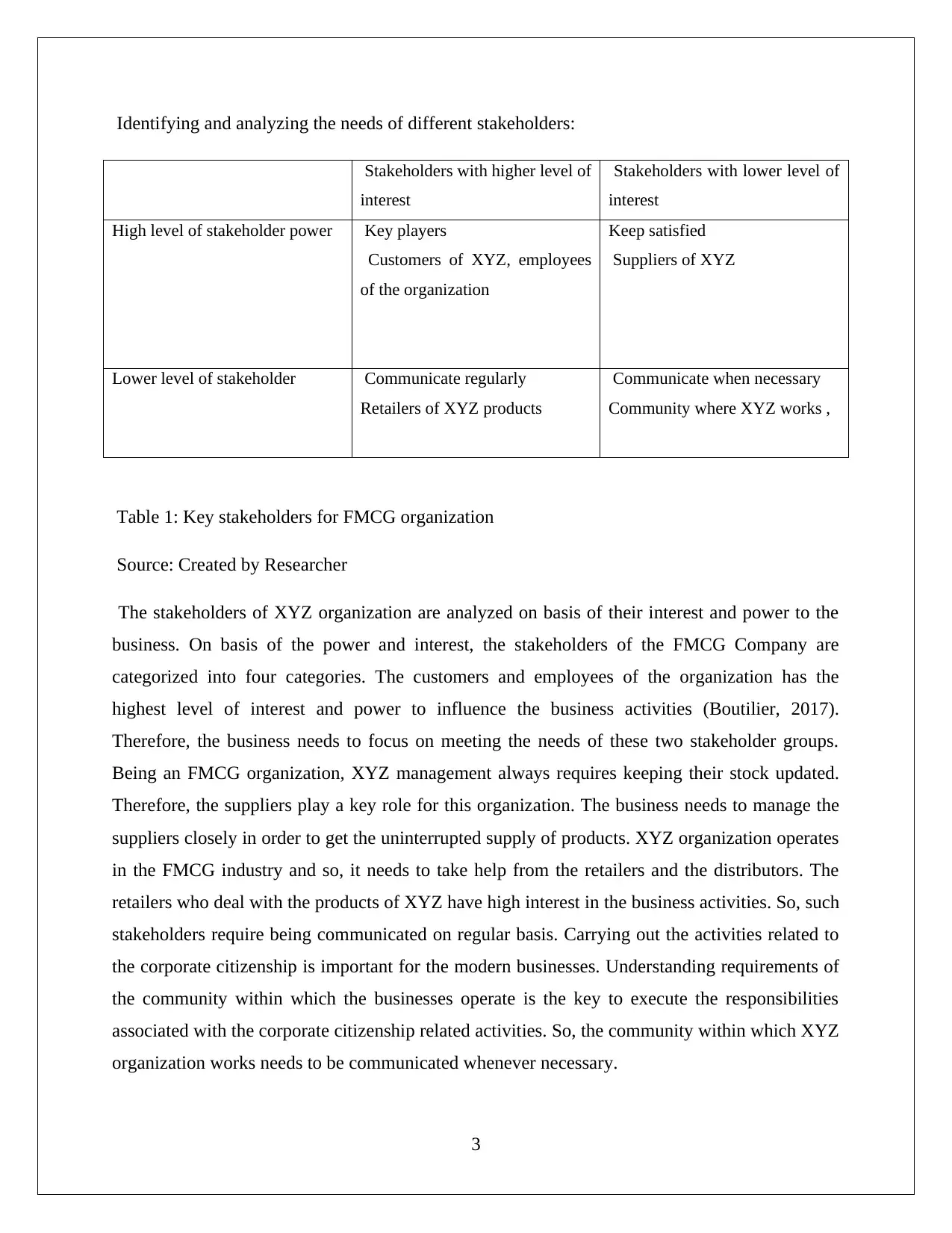
Identifying and analyzing the needs of different stakeholders:
Stakeholders with higher level of
interest
Stakeholders with lower level of
interest
High level of stakeholder power Key players
Customers of XYZ, employees
of the organization
Keep satisfied
Suppliers of XYZ
Lower level of stakeholder Communicate regularly
Retailers of XYZ products
Communicate when necessary
Community where XYZ works ,
Table 1: Key stakeholders for FMCG organization
Source: Created by Researcher
The stakeholders of XYZ organization are analyzed on basis of their interest and power to the
business. On basis of the power and interest, the stakeholders of the FMCG Company are
categorized into four categories. The customers and employees of the organization has the
highest level of interest and power to influence the business activities (Boutilier, 2017).
Therefore, the business needs to focus on meeting the needs of these two stakeholder groups.
Being an FMCG organization, XYZ management always requires keeping their stock updated.
Therefore, the suppliers play a key role for this organization. The business needs to manage the
suppliers closely in order to get the uninterrupted supply of products. XYZ organization operates
in the FMCG industry and so, it needs to take help from the retailers and the distributors. The
retailers who deal with the products of XYZ have high interest in the business activities. So, such
stakeholders require being communicated on regular basis. Carrying out the activities related to
the corporate citizenship is important for the modern businesses. Understanding requirements of
the community within which the businesses operate is the key to execute the responsibilities
associated with the corporate citizenship related activities. So, the community within which XYZ
organization works needs to be communicated whenever necessary.
3
Document Page
Task 5: Monitoring and controlling customer relationship management activities
Evaluating the concept of monitoring and control in customer relationship management:
The customer relationship management is an activity that enables the businesses to operate with
a focus on the customers (Kumar & Reinartz, 2018). The key goal of customer relationship
management is making the customers satisfied and enhancing profitability of the business by
keeping the customers happy. Therefore, the businesses require monitoring the customer
relationship management efforts to check whether the efforts are giving them outcomes or not.
Continuous monitoring facilitates the businesses to identify the areas which require being
improved. So, the concept of monitoring and controlling the business activities help them to
maintain the relationship with customers more efficiently.
Organizational requirement for monitoring and controlling activities:
For FMCG companies, the customers play a key role to enhance profitability of the organization
and so, the businesses need to develop focus for maintaining relationship with them. In case of
XYZ organization, the businesses a can give importance on collecting feedback from the
customers to understand whether their requirements are being met or not.
Evaluating the formal and informal feedback collecting method to monitor key customer
activities:
The XYZ management can collect feedback from the customers by conducting survey among
them or by asking to review the products after purchase. Asking for review or feedback survey
enables the organization to understand the requirement of individual customers. However, in
case of informal feedback collection, the organization can monitor the activities of customers on
social media or forums for assessing their demands (Khodakarami & Chan, 2014). Monitoring
activities of the customers on social media not only helps businesses to get feedback on the
particular products, but it also helps them to identify the future demand for products and
services.
4
tabler-icon-diamond-filled.svg

Paraphrase This Document

Need a fresh take? Get an instant paraphrase of this document with our AI Paraphraser
Document Page
Techniques used to analyze information for monitoring and control:
XYZ management can use the statistical analysis for obtaining idea on the satisfaction level of
customers. Use of statistical analysis can help the business to measure the customer satisfaction
objectively . The organization can use content analysis also for getting in depth idea from the
feedbacks of customers.
Key strengths and weaknesses of the relationship and areas for improvement:
In case of XYZ, the organization need to have well defined customer relationship management
system for getting information on the activities of them. However , XYZ management has
adequate resources to implement the relationship management system and it can be considered as
strength of the organization.
5
Document Page
References:
Andriof, J., Waddock, S., Husted, B., & Rahman, S. S. (2017). Unfolding stakeholder thinking 2:
Relationships, communication, reporting and performance. Routledge.
Bourne, L. (2016). Stakeholder relationship management: a maturity model for organisational
implementation. Routledge.
Boutilier, R. (2017). Stakeholder politics: Social capital, sustainable development, and the
corporation. Routledge.
Kumar, V., & Reinartz, W. (2018). Customer relationship management: Concept, strategy, and
tools. Springer.
Khodakarami, F., & Chan, Y. E. (2014). Exploring the role of customer relationship management
(CRM) systems in customer knowledge creation. Information & Management, 51(1), 27-42.
6
chevron_up_icon
1 out of 6
circle_padding
hide_on_mobile
zoom_out_icon
[object Object]