Evaluating RWA's Success in Renewable Energy for Wastewater Treatment
VerifiedAdded on 2019/09/16
|15
|2667
|319
Report
AI Summary
This report examines the Regional Water Authority's (RWA) implementation of renewable energy technologies at the Urban Wastewater Treatment Directive (UWWTD). It explores the challenges and strategies involved in replacing fossil fuels with renewable sources in the UK. The research analyzes the success of RWA, focusing on the structures, incentives, and technologies suitable for UWWTD. The study addresses the problem of urban wastewater's adverse impact on water bodies, including excessive nutrients. The research aims to analyze and review RWA's success in installing renewable energy, monitoring wastewater discharges, and utilizing sewage sludge. The methodology includes case studies and data analysis to measure the concentration of BOD and COD. The conclusion highlights the need for cost-effective techniques to improve nutrient reduction, energy efficiency, and process stability. References Hastik, R., Lund, H., et al. are used to support the findings.
RENEWable energy
Name
Submitted to
Date
Name
Submitted to
Date

Paraphrase This Document
Need a fresh take? Get an instant paraphrase of this document with our AI Paraphraser
Table of Contents
Introduction...............................................................................................................................................2
Research Background...............................................................................................................................3
Research Problem......................................................................................................................................3
Research Aim.............................................................................................................................................5
Research Objectives..................................................................................................................................6
Research Scope..........................................................................................................................................7
Research Questions...................................................................................................................................7
Literature Review......................................................................................................................................8
Methodology..............................................................................................................................................9
Data Analysis...........................................................................................................................................10
Conclusion................................................................................................................................................11
References................................................................................................................................................13
Introduction...............................................................................................................................................2
Research Background...............................................................................................................................3
Research Problem......................................................................................................................................3
Research Aim.............................................................................................................................................5
Research Objectives..................................................................................................................................6
Research Scope..........................................................................................................................................7
Research Questions...................................................................................................................................7
Literature Review......................................................................................................................................8
Methodology..............................................................................................................................................9
Data Analysis...........................................................................................................................................10
Conclusion................................................................................................................................................11
References................................................................................................................................................13
Introduction
The UK is rapidly replacing fossil fuels with renewable energy sources. Due to it, society of the
country faces a lot of challenges of developing the technologies, financial incentives, and
organizational structures to promote renewable energy. In this paper, a research is conducted to
analyze the success of the Regional Water Authority (RWA) has had installing renewable energy
technology at the Urban waste water treatment directive (UWWTD). UWWTD is considered as
one of the European Union Directive waste water treatment plant that have the objective of the
protecting the environment of water for plants and animals that live in and around water (Lund,
2014). It also engage in the recreation of water and its use as a commerce, sanitation industry,
and drinking water. UBWT directive adopted on 21 May 1991. It is an example of a big facility
that has been able to produce over one third of its energy onsite from renewable sources. It is
critical for the RWA to understand the type of structure and strategy suitable for UWWTD for
implementation of renewable energy technologies. If selected strategy and structure proves
failure it rise a big problem for the organization (Hastik et al., 2016).
The UK is rapidly replacing fossil fuels with renewable energy sources. Due to it, society of the
country faces a lot of challenges of developing the technologies, financial incentives, and
organizational structures to promote renewable energy. In this paper, a research is conducted to
analyze the success of the Regional Water Authority (RWA) has had installing renewable energy
technology at the Urban waste water treatment directive (UWWTD). UWWTD is considered as
one of the European Union Directive waste water treatment plant that have the objective of the
protecting the environment of water for plants and animals that live in and around water (Lund,
2014). It also engage in the recreation of water and its use as a commerce, sanitation industry,
and drinking water. UBWT directive adopted on 21 May 1991. It is an example of a big facility
that has been able to produce over one third of its energy onsite from renewable sources. It is
critical for the RWA to understand the type of structure and strategy suitable for UWWTD for
implementation of renewable energy technologies. If selected strategy and structure proves
failure it rise a big problem for the organization (Hastik et al., 2016).
⊘ This is a preview!⊘
Do you want full access?
Subscribe today to unlock all pages.

Trusted by 1+ million students worldwide
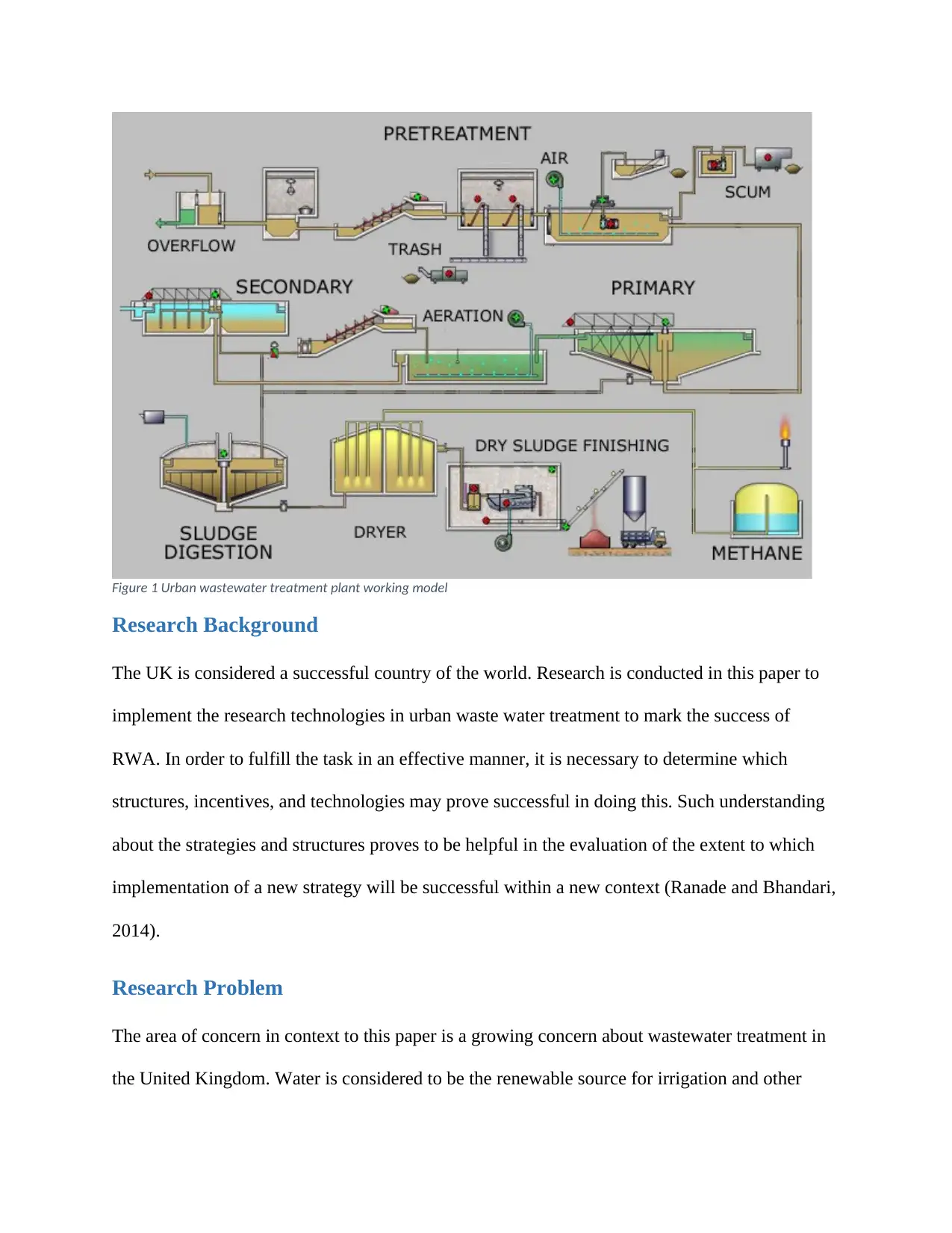
Figure 1 Urban wastewater treatment plant working model
Research Background
The UK is considered a successful country of the world. Research is conducted in this paper to
implement the research technologies in urban waste water treatment to mark the success of
RWA. In order to fulfill the task in an effective manner, it is necessary to determine which
structures, incentives, and technologies may prove successful in doing this. Such understanding
about the strategies and structures proves to be helpful in the evaluation of the extent to which
implementation of a new strategy will be successful within a new context (Ranade and Bhandari,
2014).
Research Problem
The area of concern in context to this paper is a growing concern about wastewater treatment in
the United Kingdom. Water is considered to be the renewable source for irrigation and other
Research Background
The UK is considered a successful country of the world. Research is conducted in this paper to
implement the research technologies in urban waste water treatment to mark the success of
RWA. In order to fulfill the task in an effective manner, it is necessary to determine which
structures, incentives, and technologies may prove successful in doing this. Such understanding
about the strategies and structures proves to be helpful in the evaluation of the extent to which
implementation of a new strategy will be successful within a new context (Ranade and Bhandari,
2014).
Research Problem
The area of concern in context to this paper is a growing concern about wastewater treatment in
the United Kingdom. Water is considered to be the renewable source for irrigation and other
Paraphrase This Document
Need a fresh take? Get an instant paraphrase of this document with our AI Paraphraser
operations related to day to day activities. The current research problem addresses the
significant adverse impact of urban waste water on other water bodies in the environment.
Industrial waste waters, water from toilets, baths, and sinks contain a flock of excessive nutrients
(Cosgrove and Rijsberman, 2014). The discharge of untreated wastewater can lead to dangerous
problems in the environment, and that would be tackled only by denitrification and
dephosphorization, which involves removal of nitrates and/or phosphates from discharges
respectively. The findings have reported that phosphate is considered to be the major problem of
eutrophication of freshwaters, while nitrate plays a lesser role in causing freshwater
eutrophication. Nitrate is seemed to potentially harm saline coastal water with phosphate having
a lesser role in causing the problem of eutrophication (Meng and Qi, 2013).
It is highly essential to dispel excessive concentrations of both nitrates and phosphates from
wastewater discharge as they are considered to be the major cause of not only eutrophication but
can even cause detrimental effects to crops and lives of humans and animals. Implementation of
the European UWWTD Policy proposed by RWA is believed to find the solution to these
research problems.
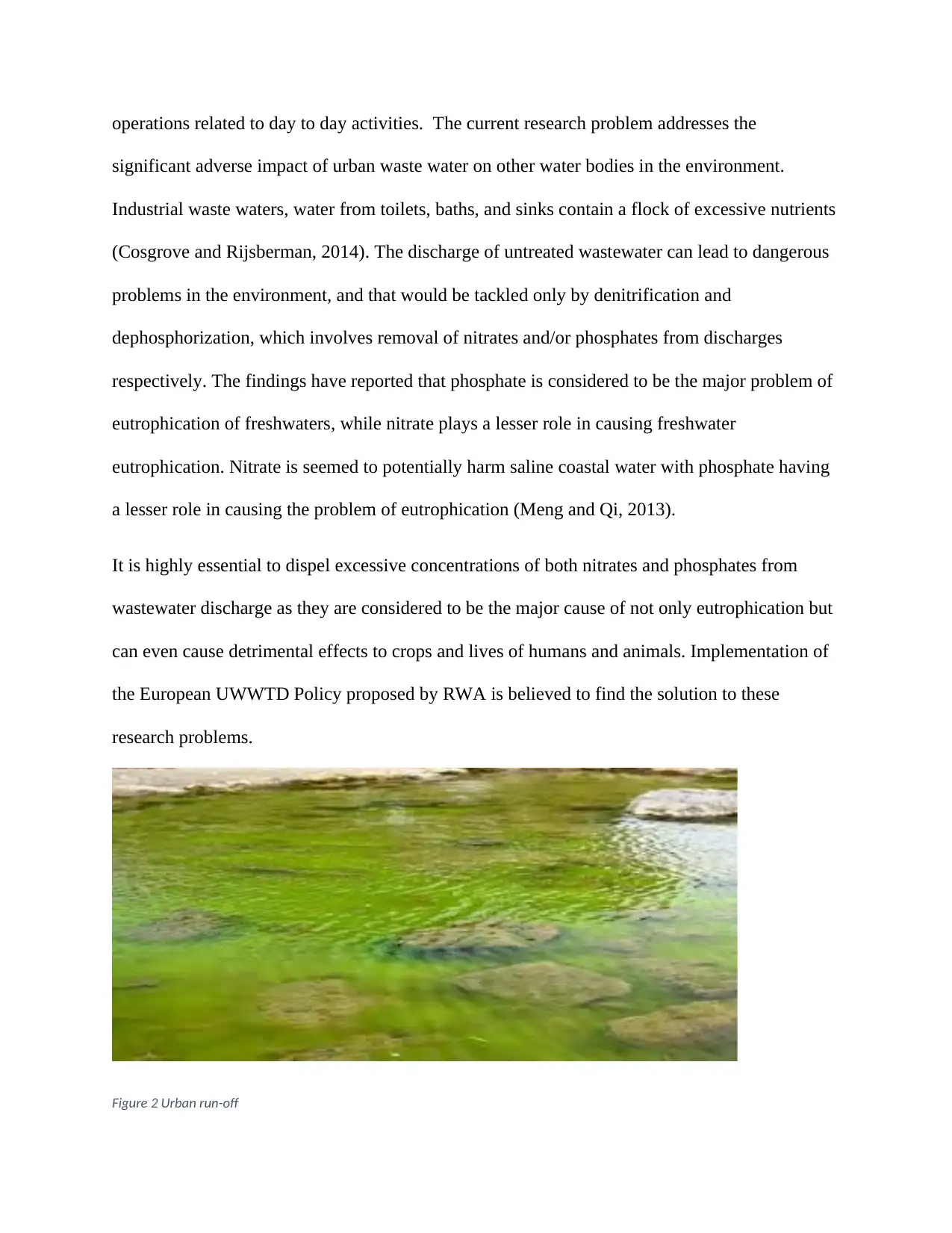
Figure 2 Urban run-off
significant adverse impact of urban waste water on other water bodies in the environment.
Industrial waste waters, water from toilets, baths, and sinks contain a flock of excessive nutrients
(Cosgrove and Rijsberman, 2014). The discharge of untreated wastewater can lead to dangerous
problems in the environment, and that would be tackled only by denitrification and
dephosphorization, which involves removal of nitrates and/or phosphates from discharges
respectively. The findings have reported that phosphate is considered to be the major problem of
eutrophication of freshwaters, while nitrate plays a lesser role in causing freshwater
eutrophication. Nitrate is seemed to potentially harm saline coastal water with phosphate having
a lesser role in causing the problem of eutrophication (Meng and Qi, 2013).
It is highly essential to dispel excessive concentrations of both nitrates and phosphates from
wastewater discharge as they are considered to be the major cause of not only eutrophication but
can even cause detrimental effects to crops and lives of humans and animals. Implementation of
the European UWWTD Policy proposed by RWA is believed to find the solution to these
research problems.
Figure 2 Urban run-off
Research Aim
The overall purpose of the study represented in this paper is to analyze and review the success of
the RWA towards installing renewable energy technology at the UWWTD. While aiming at
analysis part, RWA has first identified some of the sensitive areas where the urban waste water
contamination level is higher than the threshold value, and consequently, chances of damage to
irrigation and water supply are more perturbed. RWA has further aimed to monitor the activity of
wastewater discharges to the environment. It has also implemented some strategies to outdo the
problems by aiming at utilizing sewage sludge and its disposal by keeping the environment safer
and protective for the citizens of UK (Ellabban et al., 2014).
The overall purpose of the study represented in this paper is to analyze and review the success of
the RWA towards installing renewable energy technology at the UWWTD. While aiming at
analysis part, RWA has first identified some of the sensitive areas where the urban waste water
contamination level is higher than the threshold value, and consequently, chances of damage to
irrigation and water supply are more perturbed. RWA has further aimed to monitor the activity of
wastewater discharges to the environment. It has also implemented some strategies to outdo the
problems by aiming at utilizing sewage sludge and its disposal by keeping the environment safer
and protective for the citizens of UK (Ellabban et al., 2014).
⊘ This is a preview!⊘
Do you want full access?
Subscribe today to unlock all pages.
Trusted by 1+ million students worldwide
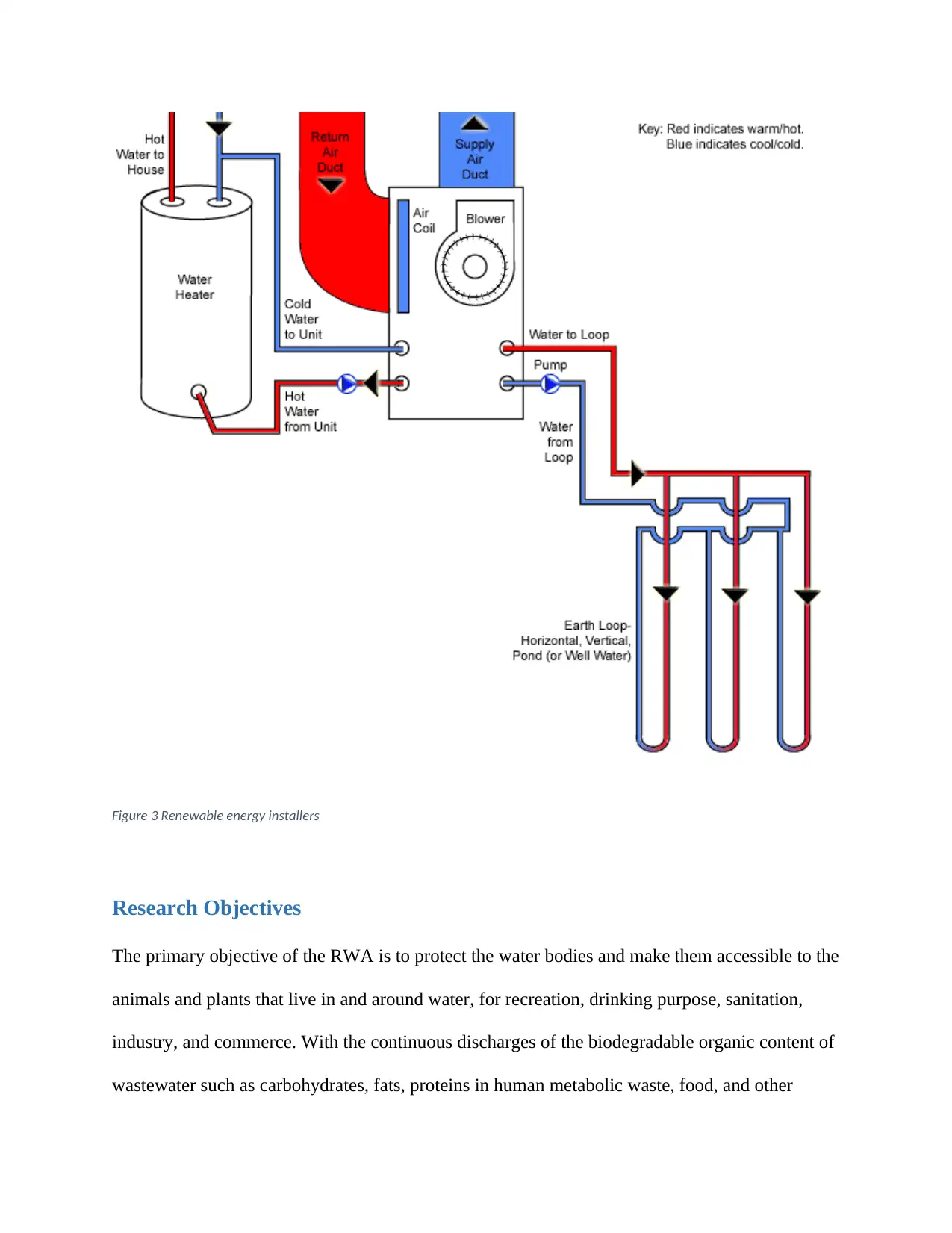
Figure 3 Renewable energy installers
Research Objectives
The primary objective of the RWA is to protect the water bodies and make them accessible to the
animals and plants that live in and around water, for recreation, drinking purpose, sanitation,
industry, and commerce. With the continuous discharges of the biodegradable organic content of
wastewater such as carbohydrates, fats, proteins in human metabolic waste, food, and other
Research Objectives
The primary objective of the RWA is to protect the water bodies and make them accessible to the
animals and plants that live in and around water, for recreation, drinking purpose, sanitation,
industry, and commerce. With the continuous discharges of the biodegradable organic content of
wastewater such as carbohydrates, fats, proteins in human metabolic waste, food, and other
Paraphrase This Document
Need a fresh take? Get an instant paraphrase of this document with our AI Paraphraser
biodegradable waste matter, the chances of urban waste water treatment seem to be more
challenging. As a result, RWA has decided to perform secondary treatment of waste water in
waste water treatment plants to protect aquatic plants and animals from considerably going
beyond the exposure to affected waters. The above-proposed objectives by RWA minimize the
detrimental effects of pollution on receiving waters through meeting standards of UWWTD
objectives (Spellman, 2013).
Research Scope
The specific data used for conducting this research is derived by analyzing the sensitive areas
which are more prone to urban waste water exposure. To analyze the success of the RWA, the
issue of cost-recovery has been diagnosed here as a critical aspect affecting sustainable services.
The action of RWA intended towards developing innovative strategies and processes to tackle
the problem is analyzed using Lifecycle analysis, ecological footprint analysis, and public health
and safety risk analysis. It is also believed that important prerequisites to sustainable water
service delivery are to develop form relationships and partnerships between service providers,
both external and internal, in an attempt to find to find new solutions to critical problems with
the financing and management of essential services such as water supply and sanitation (Pan et
al., 2015).
Research Questions
The proposed research questions are -
1. How to treat insufficient capacity of waste water and increasing sewage generation of disposal
of waste water?
2. How to monitor waste water discharges to the environment?
challenging. As a result, RWA has decided to perform secondary treatment of waste water in
waste water treatment plants to protect aquatic plants and animals from considerably going
beyond the exposure to affected waters. The above-proposed objectives by RWA minimize the
detrimental effects of pollution on receiving waters through meeting standards of UWWTD
objectives (Spellman, 2013).
Research Scope
The specific data used for conducting this research is derived by analyzing the sensitive areas
which are more prone to urban waste water exposure. To analyze the success of the RWA, the
issue of cost-recovery has been diagnosed here as a critical aspect affecting sustainable services.
The action of RWA intended towards developing innovative strategies and processes to tackle
the problem is analyzed using Lifecycle analysis, ecological footprint analysis, and public health
and safety risk analysis. It is also believed that important prerequisites to sustainable water
service delivery are to develop form relationships and partnerships between service providers,
both external and internal, in an attempt to find to find new solutions to critical problems with
the financing and management of essential services such as water supply and sanitation (Pan et
al., 2015).
Research Questions
The proposed research questions are -
1. How to treat insufficient capacity of waste water and increasing sewage generation of disposal
of waste water?
2. How to monitor waste water discharges to the environment?
3. In which way the quality of urban waste water can be improved?
4. What kind of sustainable policies can RWA develop to minimize water pollution in the United
Kingdom?
Literature Review
In an attempt to conduct research to analyze the success of the Regional Water Authority (RWA)
towards installing renewable energy technology at the Urban waste water treatment directive,
literature study is conducted in this paper to understand the efforts of RWA towards upgrading
information regarding the management of wastes from water treatment plants (Esquierro et al.,
2014). Previous literature review section conducted on the work portfolio of various water
treatment organization had discussed about certain laws and regulations, guided in relation to the
waste disposal from various water treatment plants, and other sources to analyze the impacts of
environmental regulations on water plant waste disposal. Russelmann (1968) discussed common
functions of water plant wastes. In addition, he emphasized special characteristics of coagulation
wastes, filter backwashes, ion-exchange brines, and screenings from a few water suppliers. He
concluded that to make generalizations concerning sludge production in terms of millions of
gallons of water treated because sludge production is entirely dependent on raw water quality,
the method of treatment, and efficiencies of the treatment processes. Westerhoff, 1978 proposed
that sludges from water treatment plants is divided into eight major categories: pre-sedimentation
sludge, coagulant sludge, lime sludge, metals and non-metals removal sludge, ion-exchange
sludge (saline waste), activated carbon wastes, spent diatomites, and sludge.
Westerhoff, 1978 made a statement that the treatment and disposal of pre-sedimentation residues
in and of itself is not a major problem as they can be treated and disposed of with other sludge.
4. What kind of sustainable policies can RWA develop to minimize water pollution in the United
Kingdom?
Literature Review
In an attempt to conduct research to analyze the success of the Regional Water Authority (RWA)
towards installing renewable energy technology at the Urban waste water treatment directive,
literature study is conducted in this paper to understand the efforts of RWA towards upgrading
information regarding the management of wastes from water treatment plants (Esquierro et al.,
2014). Previous literature review section conducted on the work portfolio of various water
treatment organization had discussed about certain laws and regulations, guided in relation to the
waste disposal from various water treatment plants, and other sources to analyze the impacts of
environmental regulations on water plant waste disposal. Russelmann (1968) discussed common
functions of water plant wastes. In addition, he emphasized special characteristics of coagulation
wastes, filter backwashes, ion-exchange brines, and screenings from a few water suppliers. He
concluded that to make generalizations concerning sludge production in terms of millions of
gallons of water treated because sludge production is entirely dependent on raw water quality,
the method of treatment, and efficiencies of the treatment processes. Westerhoff, 1978 proposed
that sludges from water treatment plants is divided into eight major categories: pre-sedimentation
sludge, coagulant sludge, lime sludge, metals and non-metals removal sludge, ion-exchange
sludge (saline waste), activated carbon wastes, spent diatomites, and sludge.
Westerhoff, 1978 made a statement that the treatment and disposal of pre-sedimentation residues
in and of itself is not a major problem as they can be treated and disposed of with other sludge.
⊘ This is a preview!⊘
Do you want full access?
Subscribe today to unlock all pages.
Trusted by 1+ million students worldwide
Instead, the cleaning cycle of a pre-sedimentation basin is usually very long, 10 years or more.
The success of water treatment organization is always ensured towards better treatment and
disposal of wastes. The application of wastewater for irrigation has a long history (Mara and
Cairncross, 1989; Shuval, 1990), it is now more significant given the increasing scarcity of fresh
water, especially in many developing countries. No comprehensive figures has yet been proposed
about the extent of wastewater used for irrigation, but available estimates indicate that about ten
lakh hectares of farmland in developing countries are irrigated using wastewater (Raschid-Sally
and Abayawardana cited in Inocencio, et al 2003). The literature review further discusses that
municipal sewage, when properly managed, can be an alternative source of irrigation water
(Khouri et al, 1994; Strauss, 2000). As the benefits of using urban wastewater are many,
example for irrigation purpose including water conservation, nutrient recycling and enabling year
round access to a reliable source of water. For local governments, using treated wastewater for
irrigation can be beneficial, as an economically feasible and environmentally sound method of
disposing municipal wastewater (van der Hoek et al, 2002).
Methodology
In recent years the European Environmental Protection Agency has identified relevant case
studies to highlight the following main efforts of RWA, such as first, internal UWWTD query to
relevant Regional and state staff; the second one is broad gray and white literature review, the
third one talks about reviewing the existing RWA and other guidance documents. The relevant
case studies also involve performing an interrogation of selected industry practitioners; a
supplemental search of clean water needs survey database. The methodology developed to
anticipate RWA steps taken towards identifying a number of relevant, published case studies
through this research is portrayed. However, despite extensive efforts to identify and develop
The success of water treatment organization is always ensured towards better treatment and
disposal of wastes. The application of wastewater for irrigation has a long history (Mara and
Cairncross, 1989; Shuval, 1990), it is now more significant given the increasing scarcity of fresh
water, especially in many developing countries. No comprehensive figures has yet been proposed
about the extent of wastewater used for irrigation, but available estimates indicate that about ten
lakh hectares of farmland in developing countries are irrigated using wastewater (Raschid-Sally
and Abayawardana cited in Inocencio, et al 2003). The literature review further discusses that
municipal sewage, when properly managed, can be an alternative source of irrigation water
(Khouri et al, 1994; Strauss, 2000). As the benefits of using urban wastewater are many,
example for irrigation purpose including water conservation, nutrient recycling and enabling year
round access to a reliable source of water. For local governments, using treated wastewater for
irrigation can be beneficial, as an economically feasible and environmentally sound method of
disposing municipal wastewater (van der Hoek et al, 2002).
Methodology
In recent years the European Environmental Protection Agency has identified relevant case
studies to highlight the following main efforts of RWA, such as first, internal UWWTD query to
relevant Regional and state staff; the second one is broad gray and white literature review, the
third one talks about reviewing the existing RWA and other guidance documents. The relevant
case studies also involve performing an interrogation of selected industry practitioners; a
supplemental search of clean water needs survey database. The methodology developed to
anticipate RWA steps taken towards identifying a number of relevant, published case studies
through this research is portrayed. However, despite extensive efforts to identify and develop
Paraphrase This Document
Need a fresh take? Get an instant paraphrase of this document with our AI Paraphraser
relevant case studies, relatively few met the aforementioned criteria. Relevant data on approach,
performance, and costs are summarized for the case studies that were developed for this project.
These data were then used to develop broader technical information to help water treatment plant
managers, operators, and others to improve the nutrient reduction performance of their plants
(Pullan et al., 2014).
Data Analysis
A number of modifications can be considered for improving nutrient removal at existing non-
advanced WWTPs, including (but not limited to) one or more of the following. Note that many
of the optimization activities described below are complimentary to one another and that control
system additions or modifications are needed for many applicable optimization activities.
For Sensitive areas treatment – Larger than 10.000
For Normal areas treatment – Larger than 2.000 but smaller than 10.000
For Special areas treatment: – Even less than 2.000.
To analyze the success of the RWA towards installing renewable energy technology at the Urban
UWWTD, a data analysis is performed here to measure the concentration of BOD and COD
aimed at investigating the efforts of RWA (Prüss‐Ustün et al., 2014).
Concentration Efficiency (% of reduction)
BOD 30 mg/L 70-90%
COD 130 mg/L 75%
SS 35 mg/L 90%
performance, and costs are summarized for the case studies that were developed for this project.
These data were then used to develop broader technical information to help water treatment plant
managers, operators, and others to improve the nutrient reduction performance of their plants
(Pullan et al., 2014).
Data Analysis
A number of modifications can be considered for improving nutrient removal at existing non-
advanced WWTPs, including (but not limited to) one or more of the following. Note that many
of the optimization activities described below are complimentary to one another and that control
system additions or modifications are needed for many applicable optimization activities.
For Sensitive areas treatment – Larger than 10.000
For Normal areas treatment – Larger than 2.000 but smaller than 10.000
For Special areas treatment: – Even less than 2.000.
To analyze the success of the RWA towards installing renewable energy technology at the Urban
UWWTD, a data analysis is performed here to measure the concentration of BOD and COD
aimed at investigating the efforts of RWA (Prüss‐Ustün et al., 2014).
Concentration Efficiency (% of reduction)
BOD 30 mg/L 70-90%
COD 130 mg/L 75%
SS 35 mg/L 90%
Analysis of progress of RWA towards regulation of discharges of industrial waste water into
receiving waters
Analysis of progress of RWA towards regulation of discharges of industrial waste water into receiving watersColumn1 Column2 Column3 Column4 Column5 Column6 Column7 Column8
Memer state and their
Population (per 1000 habitants)
Normal areas
(1000
population
equivalent)
Sensitive areas
(Agglomeration
in 1000
population
equivalent)
Less sensitive
areas
(Agglomeration
in 1000
population
equivalent)
Total Agglomeration
in 1000 population
equivalent
Pre-treatment
Requirement
Suspended
impurities
removal
efficiency
BOD
redution
efficiency
COD
reduction
efficiency
Belgium; 10131 129 257 0 364
Ability to cope
with ingress of
oil Average Good Average
Denmark; 5300 0 382 0 356
Secondary
filter
requirement Needed
Aeration
tank
functions
as clarifier Needed
Germany; 82334 1220 3750 0 4900
Complexity to
operate and
regulate
Simple,
but not
operator
friendly
Operator
-friendly
Operator
-friendly
Greece; 11442 170 60 86 340
Reliability and
Proven-ness of
technology Average Very good Very good
Spain; 40170 2711 245 370 3300 Capital cost Low Low High
France; 69087 2459 1150 0 3567 Opertaing cost Low Low High
Conclusion
The research conducted over here to analyze the success of the Regional Water Authority
(RWA) has had installing renewable energy technology at the UWWTD is highly commendable.
The technical report was prepared to help fill gaps in published information about improving
nutrient reduction using relatively low-cost techniques. The results of this research illustrate the
receiving waters
Analysis of progress of RWA towards regulation of discharges of industrial waste water into receiving watersColumn1 Column2 Column3 Column4 Column5 Column6 Column7 Column8
Memer state and their
Population (per 1000 habitants)
Normal areas
(1000
population
equivalent)
Sensitive areas
(Agglomeration
in 1000
population
equivalent)
Less sensitive
areas
(Agglomeration
in 1000
population
equivalent)
Total Agglomeration
in 1000 population
equivalent
Pre-treatment
Requirement
Suspended
impurities
removal
efficiency
BOD
redution
efficiency
COD
reduction
efficiency
Belgium; 10131 129 257 0 364
Ability to cope
with ingress of
oil Average Good Average
Denmark; 5300 0 382 0 356
Secondary
filter
requirement Needed
Aeration
tank
functions
as clarifier Needed
Germany; 82334 1220 3750 0 4900
Complexity to
operate and
regulate
Simple,
but not
operator
friendly
Operator
-friendly
Operator
-friendly
Greece; 11442 170 60 86 340
Reliability and
Proven-ness of
technology Average Very good Very good
Spain; 40170 2711 245 370 3300 Capital cost Low Low High
France; 69087 2459 1150 0 3567 Opertaing cost Low Low High
Conclusion
The research conducted over here to analyze the success of the Regional Water Authority
(RWA) has had installing renewable energy technology at the UWWTD is highly commendable.
The technical report was prepared to help fill gaps in published information about improving
nutrient reduction using relatively low-cost techniques. The results of this research illustrate the
⊘ This is a preview!⊘
Do you want full access?
Subscribe today to unlock all pages.
Trusted by 1+ million students worldwide

1 out of 15


Your All-in-One AI-Powered Toolkit for Academic Success.
+13062052269
info@desklib.com
Available 24*7 on WhatsApp / Email
![[object Object]](/_next/static/media/star-bottom.7253800d.svg)
Unlock your academic potential
Copyright © 2020–2025 A2Z Services. All Rights Reserved. Developed and managed by ZUCOL.