Comprehensive Business Environment Analysis: Oxfam and Tesco Report
VerifiedAdded on 2020/01/28
|10
|2824
|185
Report
AI Summary
This report provides a comprehensive analysis of the business environments of Oxfam and Tesco. It begins by contrasting the two businesses, exploring their aims, objectives, and stakeholders. The report then examines the influence of various stakeholders on business purpose and the impact they exert on each organization. A comparison and contrast of Tesco and Oxfam are presented, focusing on their strategic planning, organizational structure, and how these elements contribute to achieving their goals. The second part of the report delves into the influence of economic environments, such as recession and economic growth, on business activities and the challenges faced. It concludes by analyzing the impact of political, legal, and social factors on business activities and stakeholders, and how future changes in these factors may affect business strategies. The report provides valuable insights into the complexities of business operations in different contexts.
The business environment

Paraphrase This Document
Need a fresh take? Get an instant paraphrase of this document with our AI Paraphraser
TABLE OF CONTENTS
INTRODUCTION...........................................................................................................................3
ASSIGNMENT 1.............................................................................................................................3
Task 1...............................................................................................................................................3
1. Two contrasting business........................................................................................................3
Task 2...............................................................................................................................................4
1. Different stakeholders who influence the purpose of business...............................................4
2. Point of view of different stakeholders seeking to influence the aim and objective of
company......................................................................................................................................4
3. Influence that different stakeholders exert in the Oxfam........................................................5
Task 3...............................................................................................................................................5
3. Compare and contrast of Tesco and Oxfam............................................................................5
ASSIGNMENT 2.............................................................................................................................6
TASK 1............................................................................................................................................6
1. The influence of two contrasting economic environment ......................................................6
2. Challenges to selected business activity in two economic environments...............................6
TASK 2............................................................................................................................................7
1. Analyse how political, legal and social factor are impacting upon the business activities and
stakeholders.................................................................................................................................7
2. How future changes in the economic, political, legal and social factor put impact on the
strategy of business.....................................................................................................................7
CONCLUSION................................................................................................................................8
REFERENCES................................................................................................................................1
.........................................................................................................................................................3
INTRODUCTION...........................................................................................................................3
ASSIGNMENT 1.............................................................................................................................3
Task 1...............................................................................................................................................3
1. Two contrasting business........................................................................................................3
Task 2...............................................................................................................................................4
1. Different stakeholders who influence the purpose of business...............................................4
2. Point of view of different stakeholders seeking to influence the aim and objective of
company......................................................................................................................................4
3. Influence that different stakeholders exert in the Oxfam........................................................5
Task 3...............................................................................................................................................5
3. Compare and contrast of Tesco and Oxfam............................................................................5
ASSIGNMENT 2.............................................................................................................................6
TASK 1............................................................................................................................................6
1. The influence of two contrasting economic environment ......................................................6
2. Challenges to selected business activity in two economic environments...............................6
TASK 2............................................................................................................................................7
1. Analyse how political, legal and social factor are impacting upon the business activities and
stakeholders.................................................................................................................................7
2. How future changes in the economic, political, legal and social factor put impact on the
strategy of business.....................................................................................................................7
CONCLUSION................................................................................................................................8
REFERENCES................................................................................................................................1
.........................................................................................................................................................3
INTRODUCTION
Business environment is defined as accumulation of all internal and external factors
which affect the business and all the members of the company including employee, customers,
and management, supply chain demand (Steiner and Steiner, 2005). This report is based on
business of Oxfam and Tesco. Further, an attempt is made to understand how they organize their
business in the country. Apart from that, report focuses on understanding the impact of political,
social and legal factor on the business.
ASSIGNMENT 1
Task 1
1. Two contrasting business
In today's business environment, there are many types of organization which are
operating in the market. They differ in all part related to their aim and objective, purpose,
stakeholders etc. In order to describe business, two organisation are selected i.e. Oxfam and
Tesco. Tesco operates their business in different international country. They sell all their
products and services in different country. On the other hand, Oxfam also operate their charitable
organization in the international country (Xue, Shen and Ren, 2010.).
Tesco is basically a public limited company while Oxfam operate their business in the
private sector.
Main purpose of Tesco is to create value for the customers by providing quality services
to them. On the other hand, purpose of Oxfam is to give solution to people for injustice related to
the poverty.
Ownership of Tesco is closely held by the several partners because it is a public limited
company. While Oxfam is company limited by the guarantee so it is owned by many people.
Key stakeholders of the Tesco are the owners, suppliers, customers, employees, pressure
groups, trade unions, and government etc. of the company. The stakeholders of the Oxfam are
people, customers who donate money in their company (Kot and Brzezinski, 2015).
Business environment is defined as accumulation of all internal and external factors
which affect the business and all the members of the company including employee, customers,
and management, supply chain demand (Steiner and Steiner, 2005). This report is based on
business of Oxfam and Tesco. Further, an attempt is made to understand how they organize their
business in the country. Apart from that, report focuses on understanding the impact of political,
social and legal factor on the business.
ASSIGNMENT 1
Task 1
1. Two contrasting business
In today's business environment, there are many types of organization which are
operating in the market. They differ in all part related to their aim and objective, purpose,
stakeholders etc. In order to describe business, two organisation are selected i.e. Oxfam and
Tesco. Tesco operates their business in different international country. They sell all their
products and services in different country. On the other hand, Oxfam also operate their charitable
organization in the international country (Xue, Shen and Ren, 2010.).
Tesco is basically a public limited company while Oxfam operate their business in the
private sector.
Main purpose of Tesco is to create value for the customers by providing quality services
to them. On the other hand, purpose of Oxfam is to give solution to people for injustice related to
the poverty.
Ownership of Tesco is closely held by the several partners because it is a public limited
company. While Oxfam is company limited by the guarantee so it is owned by many people.
Key stakeholders of the Tesco are the owners, suppliers, customers, employees, pressure
groups, trade unions, and government etc. of the company. The stakeholders of the Oxfam are
people, customers who donate money in their company (Kot and Brzezinski, 2015).
⊘ This is a preview!⊘
Do you want full access?
Subscribe today to unlock all pages.

Trusted by 1+ million students worldwide
Task 2
1. Different stakeholders who influence the purpose of business
Stakeholder is the person who is related to the organisation and is affected by company
decisions. There are many stakeholders of the company who influence the purpose of business
which are as follows:
1. Workers: All employees of Tesco and Oxfam have interest in the business. Company
gives them salary, bonus, rewards so they rise their interest.
2. Managers: Another stakeholder of the company is manager. They also have interest in the
company because they also work for the salary. They make the decisions in the company
so they consider as stakeholder (Harrison, 2013).
3. Customers: Customers expect the good quality of products and services from the
company so they put their interest in company.
4. Local and national communities: All the financial activities which are carried out in the
company affect the economy of the country so local and national companies are
considered as their stakeholder.
5. Suppliers: supplier is the person who gets the order from the company and get the paid
so this automatically put the interest of the supplier in the company.
2. Point of view of different stakeholders seeking to influence the aim and objective of company
All stakeholders of Tesco and Oxfam are important because they influence their aim and
objective:
1. Customers: Customers of the organization wanted good quality of the product and at
very low price which influences the aim and objective of the company (Chaffey and
et.al., 2009).
2. Government: Government also influences aim and objectives of both the organisation
because they wanted the tax, revenues from the company.
3. Suppliers: Suppliers wanted the payment of the raw materials at the right time which
influences the aim and objective.
4. Owners: Owners are considered as the main stakeholders and affect the aims and
objectives of the company because they make decisions in the company related to sales
and profit.
1. Different stakeholders who influence the purpose of business
Stakeholder is the person who is related to the organisation and is affected by company
decisions. There are many stakeholders of the company who influence the purpose of business
which are as follows:
1. Workers: All employees of Tesco and Oxfam have interest in the business. Company
gives them salary, bonus, rewards so they rise their interest.
2. Managers: Another stakeholder of the company is manager. They also have interest in the
company because they also work for the salary. They make the decisions in the company
so they consider as stakeholder (Harrison, 2013).
3. Customers: Customers expect the good quality of products and services from the
company so they put their interest in company.
4. Local and national communities: All the financial activities which are carried out in the
company affect the economy of the country so local and national companies are
considered as their stakeholder.
5. Suppliers: supplier is the person who gets the order from the company and get the paid
so this automatically put the interest of the supplier in the company.
2. Point of view of different stakeholders seeking to influence the aim and objective of company
All stakeholders of Tesco and Oxfam are important because they influence their aim and
objective:
1. Customers: Customers of the organization wanted good quality of the product and at
very low price which influences the aim and objective of the company (Chaffey and
et.al., 2009).
2. Government: Government also influences aim and objectives of both the organisation
because they wanted the tax, revenues from the company.
3. Suppliers: Suppliers wanted the payment of the raw materials at the right time which
influences the aim and objective.
4. Owners: Owners are considered as the main stakeholders and affect the aims and
objectives of the company because they make decisions in the company related to sales
and profit.
Paraphrase This Document
Need a fresh take? Get an instant paraphrase of this document with our AI Paraphraser
5. Employees: Employees also influences the aim and objectives because they wanted the
job security and motivation for the company (Islam, 2015).
3. Influence that different stakeholders exert in the Oxfam
Oxfam include many stakeholders which influence the business of the organization:
1. Customers: They want that Oxfam open various institutions in different parts of the
country which donate the amount to people who are suffering from poverty.
2. Employees: Other stakeholders of the company are employees. Human resource want
that they treat them equally on the basis of age, race, colour etc. so in this way they
influence the business (Morrison, 2006).
3. Government: Government also affects the business of the Oxfam because they provide
various kinds of the support to the charitable organisation and they also want that the
company pay the tax on the regular basis.
4. Donors: Donors put a high influence on Oxfam because and hey donate various things in
the organisation. These donated things of the donor are used by the company in helping
poor people.
Task 3
3. Compare and contrast of Tesco and Oxfam
Tesco’s main motive is to earn high profit while Oxfam main aim is to help poor people
with an objective of earning profit. The main purpose of the Tesco is to earn high profit and
provide quality products and services to customers. On the other hand, the purpose of the Oxfam
is to remove injustice and poverty and help the poor people all over the country.
Strategic planning of the Tesco is to provide comfortable and effortless shopping to the
customers at very low prices which helps the people when they go for shopping. On the other
hand, strategic planning of the Oxfam is to make their company 3rd largest firm in the sector of
the charitable organization (Teece, 2010). They want to work for the poor people and remove
injustice. Further, they also provide home to poor people.
The organisation structure of Tesco is hierarchical. In this structure, they have only few
layers of management. They have only managing director, quality manager and financial
accountant. On the other hand, Oxfam have also a hierarchical structure but within in it they
operate flat structure. In their structure, they include chairman, trustees and employees.
job security and motivation for the company (Islam, 2015).
3. Influence that different stakeholders exert in the Oxfam
Oxfam include many stakeholders which influence the business of the organization:
1. Customers: They want that Oxfam open various institutions in different parts of the
country which donate the amount to people who are suffering from poverty.
2. Employees: Other stakeholders of the company are employees. Human resource want
that they treat them equally on the basis of age, race, colour etc. so in this way they
influence the business (Morrison, 2006).
3. Government: Government also affects the business of the Oxfam because they provide
various kinds of the support to the charitable organisation and they also want that the
company pay the tax on the regular basis.
4. Donors: Donors put a high influence on Oxfam because and hey donate various things in
the organisation. These donated things of the donor are used by the company in helping
poor people.
Task 3
3. Compare and contrast of Tesco and Oxfam
Tesco’s main motive is to earn high profit while Oxfam main aim is to help poor people
with an objective of earning profit. The main purpose of the Tesco is to earn high profit and
provide quality products and services to customers. On the other hand, the purpose of the Oxfam
is to remove injustice and poverty and help the poor people all over the country.
Strategic planning of the Tesco is to provide comfortable and effortless shopping to the
customers at very low prices which helps the people when they go for shopping. On the other
hand, strategic planning of the Oxfam is to make their company 3rd largest firm in the sector of
the charitable organization (Teece, 2010). They want to work for the poor people and remove
injustice. Further, they also provide home to poor people.
The organisation structure of Tesco is hierarchical. In this structure, they have only few
layers of management. They have only managing director, quality manager and financial
accountant. On the other hand, Oxfam have also a hierarchical structure but within in it they
operate flat structure. In their structure, they include chairman, trustees and employees.
TASK 4
4. How organisation structure and strategic planning helps the business in achieving their aim
and objectives
Due to the organisation structure which was followed in the company, it is helpful in
achieving their aim and objective. By proper organisation structure, the management give their
attention on critical decisions which was made in the organization related to the set objective and
aims. They can also easily respond to the client and customer feedback and make improvements
accordingly (Chaffey and et.al., 2009).
Strategic planning assists in attaining the aim and objective of the business because it is
based according to current market condition. Due to strategic planning, the company makes
proper research related to customers, sales, market etc. and it is helpful in attaining objectives as
well as goals.
ASSIGNMENT 2
TASK 1
1. The influence of two contrasting economic environment
The two contrasting economic environment that exists in UK is recession and economic
growth which affects the business of Tesco and Oxfam (Frishammar and Åke Hörte, 2005). The
economic growth gives positive impact on business of both the organization as it helps in
expanding their business. By the economic growth, they can easily expand their goods and the
services in various international countries. It also assists the organization in increasing profit (UK
Interest-rates. 2011). It further aids the company in increasing their demand of the product which
overall increases the profit of both the firm.
On contrasting economic growth, recession is another economic environment which
influences the business. They reduce the cash flow of the company, loss the demand of the
product and staff reduction etc. which reduces the profit of the firm because demand of their
product decreased Chan and Kumar, 2007).
4. How organisation structure and strategic planning helps the business in achieving their aim
and objectives
Due to the organisation structure which was followed in the company, it is helpful in
achieving their aim and objective. By proper organisation structure, the management give their
attention on critical decisions which was made in the organization related to the set objective and
aims. They can also easily respond to the client and customer feedback and make improvements
accordingly (Chaffey and et.al., 2009).
Strategic planning assists in attaining the aim and objective of the business because it is
based according to current market condition. Due to strategic planning, the company makes
proper research related to customers, sales, market etc. and it is helpful in attaining objectives as
well as goals.
ASSIGNMENT 2
TASK 1
1. The influence of two contrasting economic environment
The two contrasting economic environment that exists in UK is recession and economic
growth which affects the business of Tesco and Oxfam (Frishammar and Åke Hörte, 2005). The
economic growth gives positive impact on business of both the organization as it helps in
expanding their business. By the economic growth, they can easily expand their goods and the
services in various international countries. It also assists the organization in increasing profit (UK
Interest-rates. 2011). It further aids the company in increasing their demand of the product which
overall increases the profit of both the firm.
On contrasting economic growth, recession is another economic environment which
influences the business. They reduce the cash flow of the company, loss the demand of the
product and staff reduction etc. which reduces the profit of the firm because demand of their
product decreased Chan and Kumar, 2007).
⊘ This is a preview!⊘
Do you want full access?
Subscribe today to unlock all pages.
Trusted by 1+ million students worldwide
2. Challenges to selected business activity in two economic environments
The two economic environments that are selected are economic growth and recession.
This both the environments gives challenges to business organization like the economic growth
helps the Tesco in expanding their business in various countries. The sales of the company also
increased because the users increased in the organization. If sales of the company enhances then
it helps in raising the profit of the firm. Supply of the Tesco has also increased a lot because the
demand from the customers increased.
Recession also provides various kinds of the challenges to Tesco as it reduces the staff in
the company. All the cash flows of the Tesco are also reduced due to the recession. Tesco also
suffers the problem related to finance in the company (Cavusgil and et. al., 2014). Their demand
and supply of the product has also decreased due to unavailability of the customers and the
finance.
TASK 2
1. Analyse how political, legal and social factor are impacting upon the business activities and
stakeholders
All the companies in UK are influenced by political, social and legal factors because
these factors changes constantly and affect the activities of business. Impact of the political, legal
and social factor is as follows:
1. Political factors: Taxation is the first political aspect that affects the Tesco Oxfam
activities As Tesco is the large organisation they have to pay huge taxes to the
government. These taxes reduce the profit of the company (Gupta, 2013). It also reduces
the return of the stakeholders because the profit of the company is less.
2. Social factor: It includes change in demographic, income, preference and attitude of the
customer (PESTLE Analysis for Tesco discusses its Business Environment, 2014). This
influences the business activities of Tesco and Oxfam in the positive and negative way.
3. Legal factor: UK government has formed many types of law i.e. minimum wage rate,
consumer protection law etc. these affect the consumer of Tesco and Oxfam because all
the consumers get protection by it and they feel safe (Craig and Campbell, 2012). Apart
from that, minimum wage rate also influence on the employees of the Tesco and Oxfam
as they get minimum wage of the work they done in the organization.
The two economic environments that are selected are economic growth and recession.
This both the environments gives challenges to business organization like the economic growth
helps the Tesco in expanding their business in various countries. The sales of the company also
increased because the users increased in the organization. If sales of the company enhances then
it helps in raising the profit of the firm. Supply of the Tesco has also increased a lot because the
demand from the customers increased.
Recession also provides various kinds of the challenges to Tesco as it reduces the staff in
the company. All the cash flows of the Tesco are also reduced due to the recession. Tesco also
suffers the problem related to finance in the company (Cavusgil and et. al., 2014). Their demand
and supply of the product has also decreased due to unavailability of the customers and the
finance.
TASK 2
1. Analyse how political, legal and social factor are impacting upon the business activities and
stakeholders
All the companies in UK are influenced by political, social and legal factors because
these factors changes constantly and affect the activities of business. Impact of the political, legal
and social factor is as follows:
1. Political factors: Taxation is the first political aspect that affects the Tesco Oxfam
activities As Tesco is the large organisation they have to pay huge taxes to the
government. These taxes reduce the profit of the company (Gupta, 2013). It also reduces
the return of the stakeholders because the profit of the company is less.
2. Social factor: It includes change in demographic, income, preference and attitude of the
customer (PESTLE Analysis for Tesco discusses its Business Environment, 2014). This
influences the business activities of Tesco and Oxfam in the positive and negative way.
3. Legal factor: UK government has formed many types of law i.e. minimum wage rate,
consumer protection law etc. these affect the consumer of Tesco and Oxfam because all
the consumers get protection by it and they feel safe (Craig and Campbell, 2012). Apart
from that, minimum wage rate also influence on the employees of the Tesco and Oxfam
as they get minimum wage of the work they done in the organization.
Paraphrase This Document
Need a fresh take? Get an instant paraphrase of this document with our AI Paraphraser
2. How future changes in the economic, political, legal and social factor put impact on the
strategy of business
If in future economic, political, legal and social factor in the UK changes then it will
affect on the strategy of both the business. Like if government reduces the tax rate, and then
Tesco and Oxfam earned a large amount of the profit. The government provide a large support to
organisation then it will be helpful for the Oxfam in reducing poverty and injustice among the
country.
Apart from that, if consumer preference, taste, attitude, demographics has changed a lot
then it will impact Tesco activities because all products in the Tesco is launched according to the
preference of the customer (ai and Yang, 2014). Apart from that, in future if there will be rise in
population of the UK then it increases the profit of both the organization.
If the government has made the changes in minimum wages rate, discrimination act then
it increases the large number of employees in both the organisation. Apart from UK, government
has also made changes in maternity and paternity leave and their pay will also increase will
impact in increasing the number of employee due to which their productivity and profit has been
increased.
CONCLUSION
From the above report a conclusion is drawn that business environment plays a very
important role in all types of business. Above report draws the conclusion that all social, legal
and political factors impact on the business activities. Apart from that, all the stakeholders of the
company also influence the company. So overall it can be said that if organization tries to
achieve success in their business then they have to study the business environment. Further, they
also study the impact of the political, social and legal factors that exists in the country.
strategy of business
If in future economic, political, legal and social factor in the UK changes then it will
affect on the strategy of both the business. Like if government reduces the tax rate, and then
Tesco and Oxfam earned a large amount of the profit. The government provide a large support to
organisation then it will be helpful for the Oxfam in reducing poverty and injustice among the
country.
Apart from that, if consumer preference, taste, attitude, demographics has changed a lot
then it will impact Tesco activities because all products in the Tesco is launched according to the
preference of the customer (ai and Yang, 2014). Apart from that, in future if there will be rise in
population of the UK then it increases the profit of both the organization.
If the government has made the changes in minimum wages rate, discrimination act then
it increases the large number of employees in both the organisation. Apart from UK, government
has also made changes in maternity and paternity leave and their pay will also increase will
impact in increasing the number of employee due to which their productivity and profit has been
increased.
CONCLUSION
From the above report a conclusion is drawn that business environment plays a very
important role in all types of business. Above report draws the conclusion that all social, legal
and political factors impact on the business activities. Apart from that, all the stakeholders of the
company also influence the company. So overall it can be said that if organization tries to
achieve success in their business then they have to study the business environment. Further, they
also study the impact of the political, social and legal factors that exists in the country.
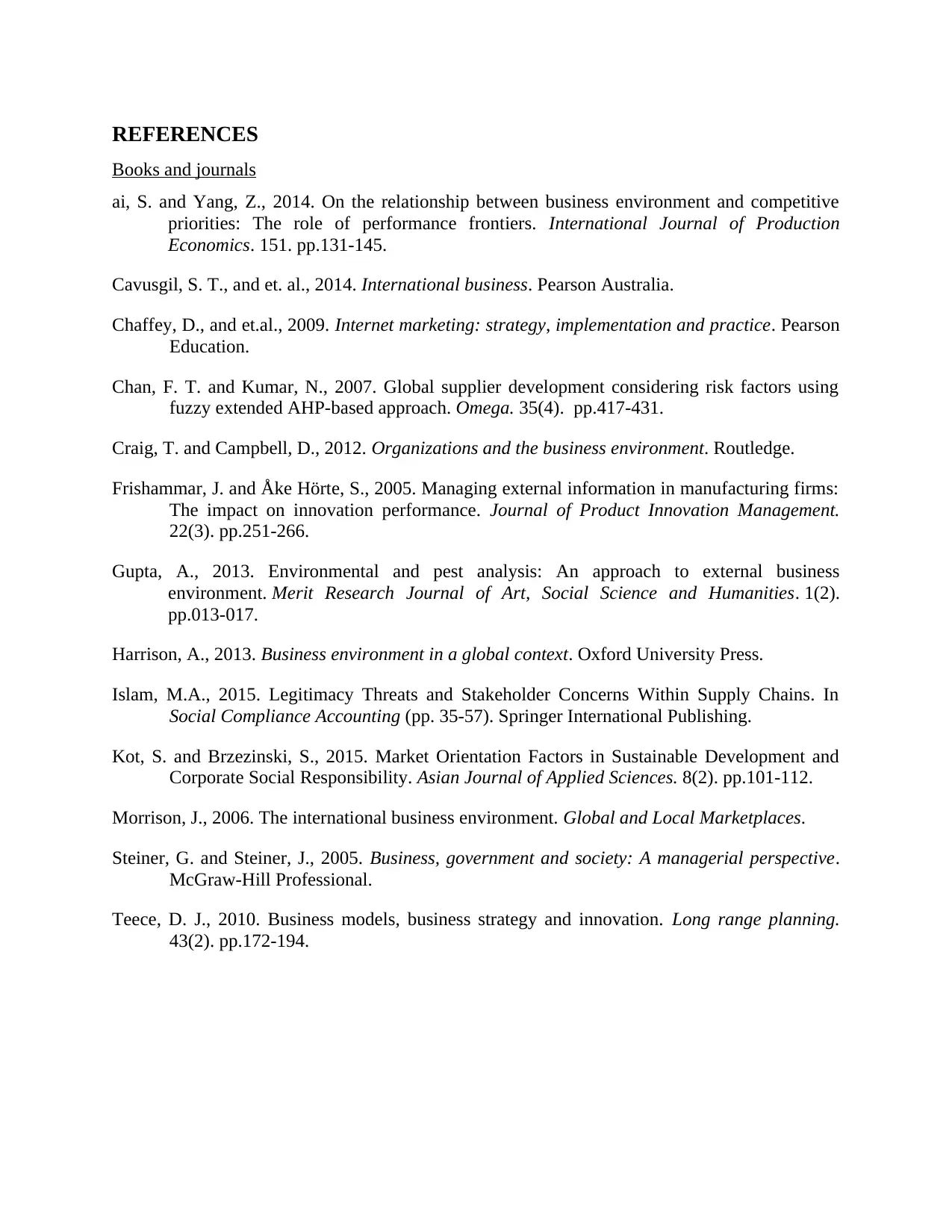
REFERENCES
Books and journals
ai, S. and Yang, Z., 2014. On the relationship between business environment and competitive
priorities: The role of performance frontiers. International Journal of Production
Economics. 151. pp.131-145.
Cavusgil, S. T., and et. al., 2014. International business. Pearson Australia.
Chaffey, D., and et.al., 2009. Internet marketing: strategy, implementation and practice. Pearson
Education.
Chan, F. T. and Kumar, N., 2007. Global supplier development considering risk factors using
fuzzy extended AHP-based approach. Omega. 35(4). pp.417-431.
Craig, T. and Campbell, D., 2012. Organizations and the business environment. Routledge.
Frishammar, J. and Åke Hörte, S., 2005. Managing external information in manufacturing firms:
The impact on innovation performance. Journal of Product Innovation Management.
22(3). pp.251-266.
Gupta, A., 2013. Environmental and pest analysis: An approach to external business
environment. Merit Research Journal of Art, Social Science and Humanities. 1(2).
pp.013-017.
Harrison, A., 2013. Business environment in a global context. Oxford University Press.
Islam, M.A., 2015. Legitimacy Threats and Stakeholder Concerns Within Supply Chains. In
Social Compliance Accounting (pp. 35-57). Springer International Publishing.
Kot, S. and Brzezinski, S., 2015. Market Orientation Factors in Sustainable Development and
Corporate Social Responsibility. Asian Journal of Applied Sciences. 8(2). pp.101-112.
Morrison, J., 2006. The international business environment. Global and Local Marketplaces.
Steiner, G. and Steiner, J., 2005. Business, government and society: A managerial perspective.
McGraw-Hill Professional.
Teece, D. J., 2010. Business models, business strategy and innovation. Long range planning.
43(2). pp.172-194.
Books and journals
ai, S. and Yang, Z., 2014. On the relationship between business environment and competitive
priorities: The role of performance frontiers. International Journal of Production
Economics. 151. pp.131-145.
Cavusgil, S. T., and et. al., 2014. International business. Pearson Australia.
Chaffey, D., and et.al., 2009. Internet marketing: strategy, implementation and practice. Pearson
Education.
Chan, F. T. and Kumar, N., 2007. Global supplier development considering risk factors using
fuzzy extended AHP-based approach. Omega. 35(4). pp.417-431.
Craig, T. and Campbell, D., 2012. Organizations and the business environment. Routledge.
Frishammar, J. and Åke Hörte, S., 2005. Managing external information in manufacturing firms:
The impact on innovation performance. Journal of Product Innovation Management.
22(3). pp.251-266.
Gupta, A., 2013. Environmental and pest analysis: An approach to external business
environment. Merit Research Journal of Art, Social Science and Humanities. 1(2).
pp.013-017.
Harrison, A., 2013. Business environment in a global context. Oxford University Press.
Islam, M.A., 2015. Legitimacy Threats and Stakeholder Concerns Within Supply Chains. In
Social Compliance Accounting (pp. 35-57). Springer International Publishing.
Kot, S. and Brzezinski, S., 2015. Market Orientation Factors in Sustainable Development and
Corporate Social Responsibility. Asian Journal of Applied Sciences. 8(2). pp.101-112.
Morrison, J., 2006. The international business environment. Global and Local Marketplaces.
Steiner, G. and Steiner, J., 2005. Business, government and society: A managerial perspective.
McGraw-Hill Professional.
Teece, D. J., 2010. Business models, business strategy and innovation. Long range planning.
43(2). pp.172-194.
⊘ This is a preview!⊘
Do you want full access?
Subscribe today to unlock all pages.
Trusted by 1+ million students worldwide
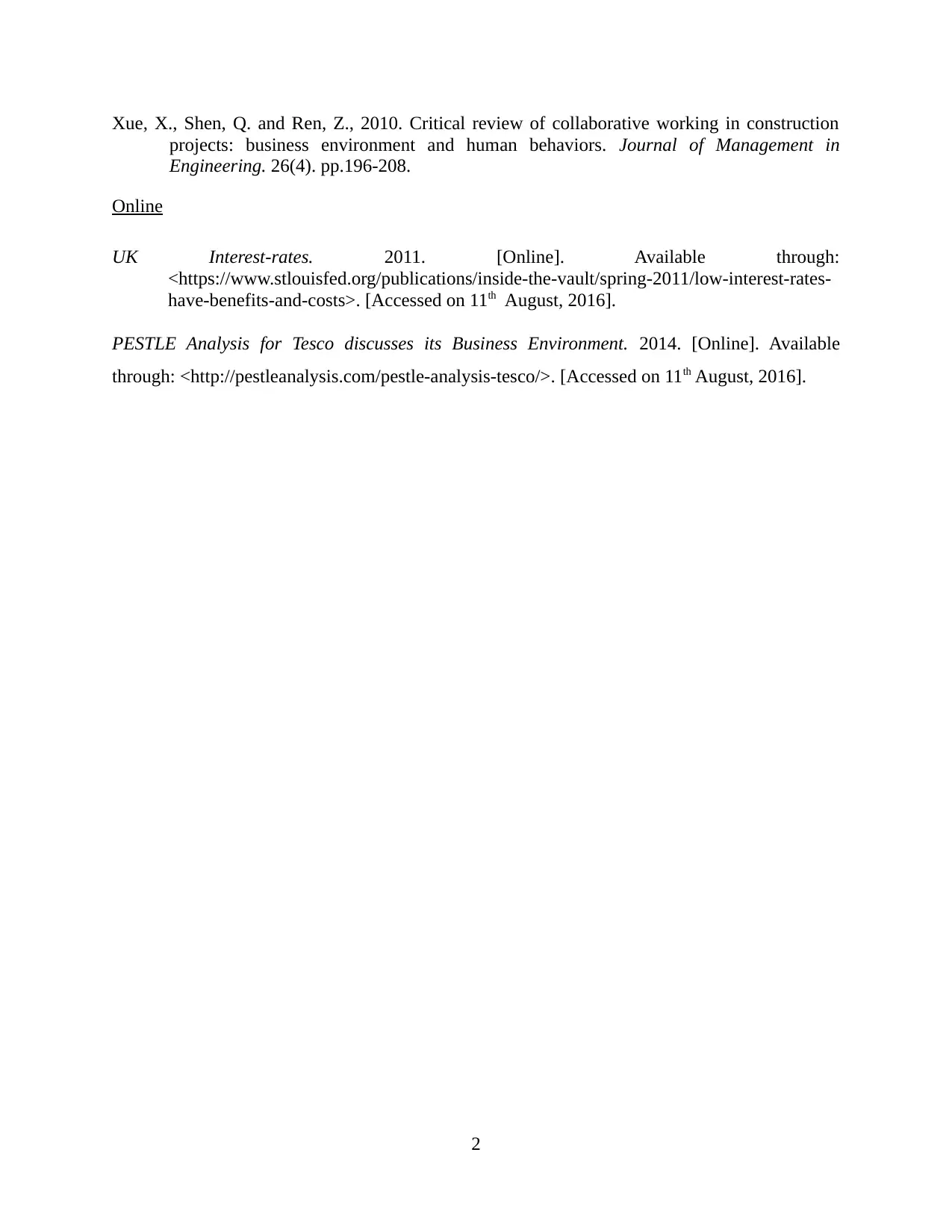
Xue, X., Shen, Q. and Ren, Z., 2010. Critical review of collaborative working in construction
projects: business environment and human behaviors. Journal of Management in
Engineering. 26(4). pp.196-208.
Online
UK Interest-rates. 2011. [Online]. Available through:
<https://www.stlouisfed.org/publications/inside-the-vault/spring-2011/low-interest-rates-
have-benefits-and-costs>. [Accessed on 11th August, 2016].
PESTLE Analysis for Tesco discusses its Business Environment. 2014. [Online]. Available
through: <http://pestleanalysis.com/pestle-analysis-tesco/>. [Accessed on 11th August, 2016].
2
projects: business environment and human behaviors. Journal of Management in
Engineering. 26(4). pp.196-208.
Online
UK Interest-rates. 2011. [Online]. Available through:
<https://www.stlouisfed.org/publications/inside-the-vault/spring-2011/low-interest-rates-
have-benefits-and-costs>. [Accessed on 11th August, 2016].
PESTLE Analysis for Tesco discusses its Business Environment. 2014. [Online]. Available
through: <http://pestleanalysis.com/pestle-analysis-tesco/>. [Accessed on 11th August, 2016].
2

1 out of 10


Related Documents


Your All-in-One AI-Powered Toolkit for Academic Success.
+13062052269
info@desklib.com
Available 24*7 on WhatsApp / Email
![[object Object]](/_next/static/media/star-bottom.7253800d.svg)
Unlock your academic potential
Copyright © 2020–2026 A2Z Services. All Rights Reserved. Developed and managed by ZUCOL.