Requirements Management Plan for 'Our Language Matters' CQU Project

Verified

Added on  2020/03/04

|4
|802
|675
Project
AI Summary
This document presents a Requirements Management Plan for the 'Our Language Matters' project, focusing on the preservation and revitalization of Aboriginal and Torres Strait Islander languages at CQUniversity (CQU). The plan outlines key activities, including stakeholder identification (Traditional Owners, project roles), wording for 'Acknowledgement of Country,' and requirements gathering for translation services. It emphasizes the use of electronic documents for requirements tracking and the MoSCoW technique for requirement prioritization to ensure alignment with project objectives and stakeholder understanding. The plan also includes a project board role designation with names, positions, organization and signatures. References include relevant academic literature supporting the methodologies and approaches employed in the plan. This assignment is contributed by a student and published on Desklib, a platform providing AI-based study tools for students.
Document Page
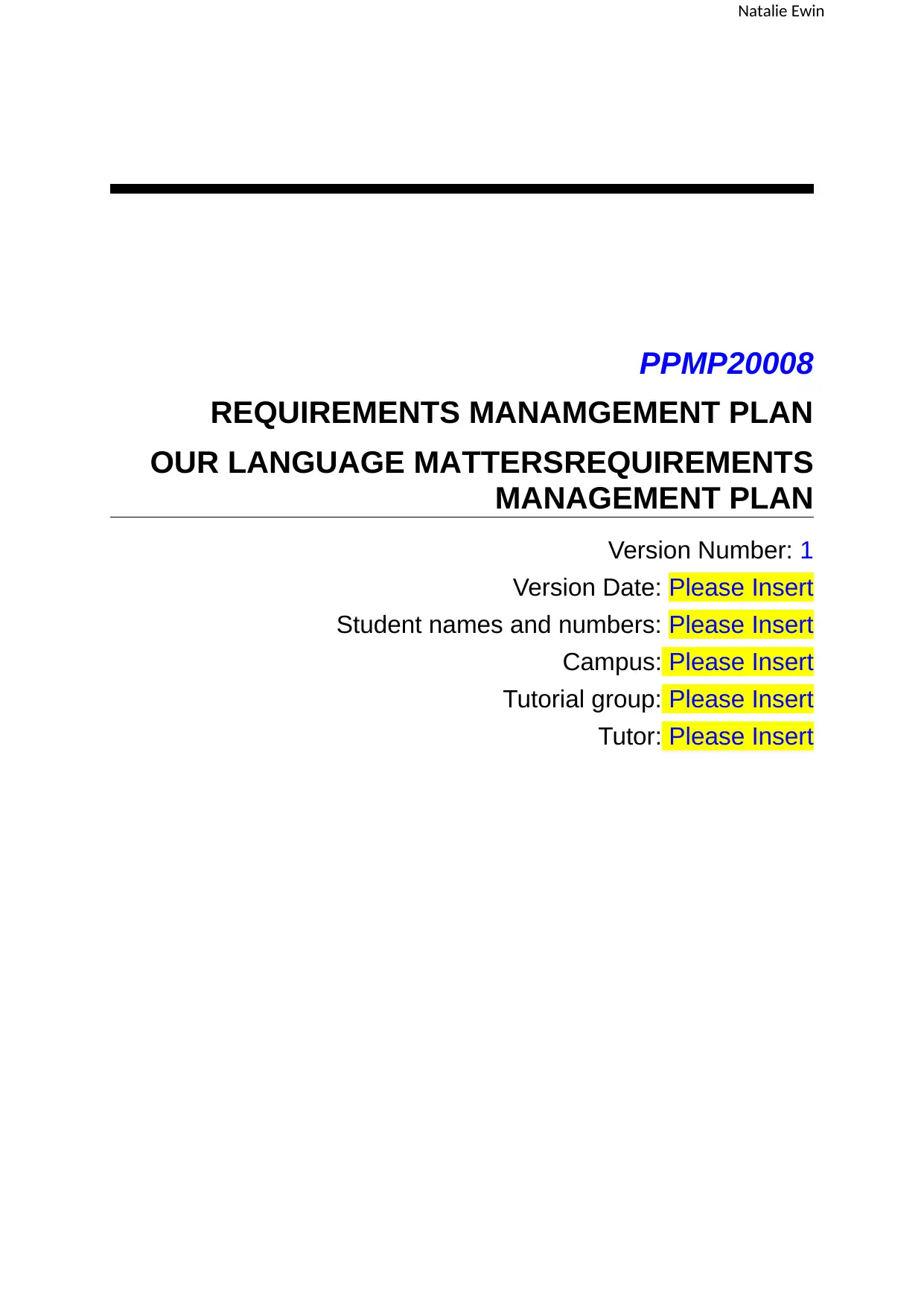
PPMP20008
REQUIREMENTS MANAMGEMENT PLAN
OUR LANGUAGE MATTERSREQUIREMENTS
MANAGEMENT PLAN
Version Number: 1
Version Date: Please Insert
Student names and numbers: Please Insert
Campus: Please Insert
Tutorial group: Please Insert
Tutor: Please Insert
Natalie Ewin
tabler-icon-diamond-filled.svg

Paraphrase This Document

Need a fresh take? Get an instant paraphrase of this document with our AI Paraphraser
Document Page
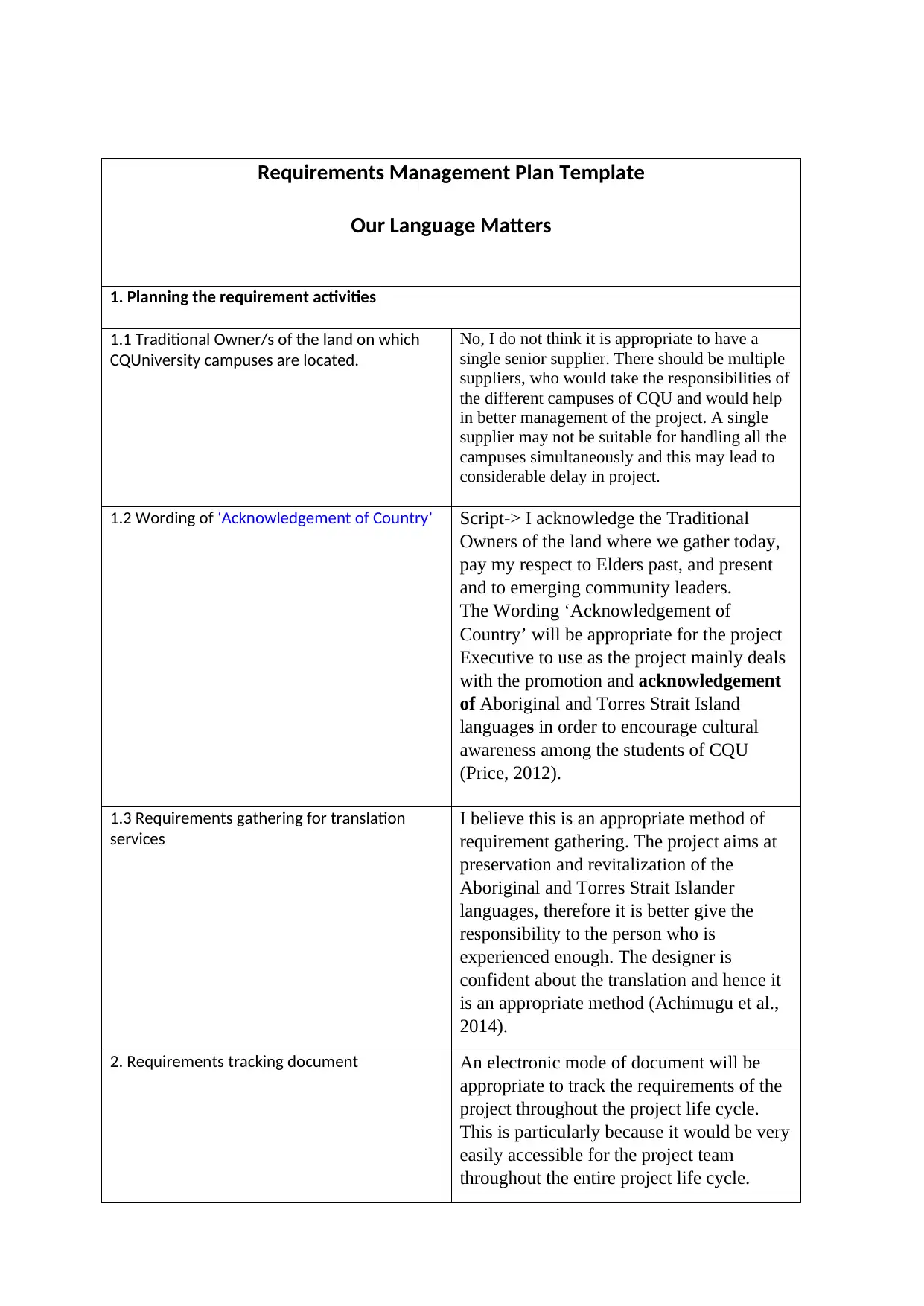
Requirements Management Plan Template
Our Language Matters
1. Planning the requirement activities
1.1 Traditional Owner/s of the land on which
CQUniversity campuses are located.
No, I do not think it is appropriate to have a
single senior supplier. There should be multiple
suppliers, who would take the responsibilities of
the different campuses of CQU and would help
in better management of the project. A single
supplier may not be suitable for handling all the
campuses simultaneously and this may lead to
considerable delay in project.
1.2 Wording of ‘Acknowledgement of Country’ Script-> I acknowledge the Traditional
Owners of the land where we gather today,
pay my respect to Elders past, and present
and to emerging community leaders.
The Wording ‘Acknowledgement of
Country’ will be appropriate for the project
Executive to use as the project mainly deals
with the promotion and acknowledgement
of Aboriginal and Torres Strait Island
languages in order to encourage cultural
awareness among the students of CQU
(Price, 2012).
1.3 Requirements gathering for translation
services
I believe this is an appropriate method of
requirement gathering. The project aims at
preservation and revitalization of the
Aboriginal and Torres Strait Islander
languages, therefore it is better give the
responsibility to the person who is
experienced enough. The designer is
confident about the translation and hence it
is an appropriate method (Achimugu et al.,
2014).
2. Requirements tracking document An electronic mode of document will be
appropriate to track the requirements of the
project throughout the project life cycle.
This is particularly because it would be very
easily accessible for the project team
throughout the entire project life cycle.
Document Page
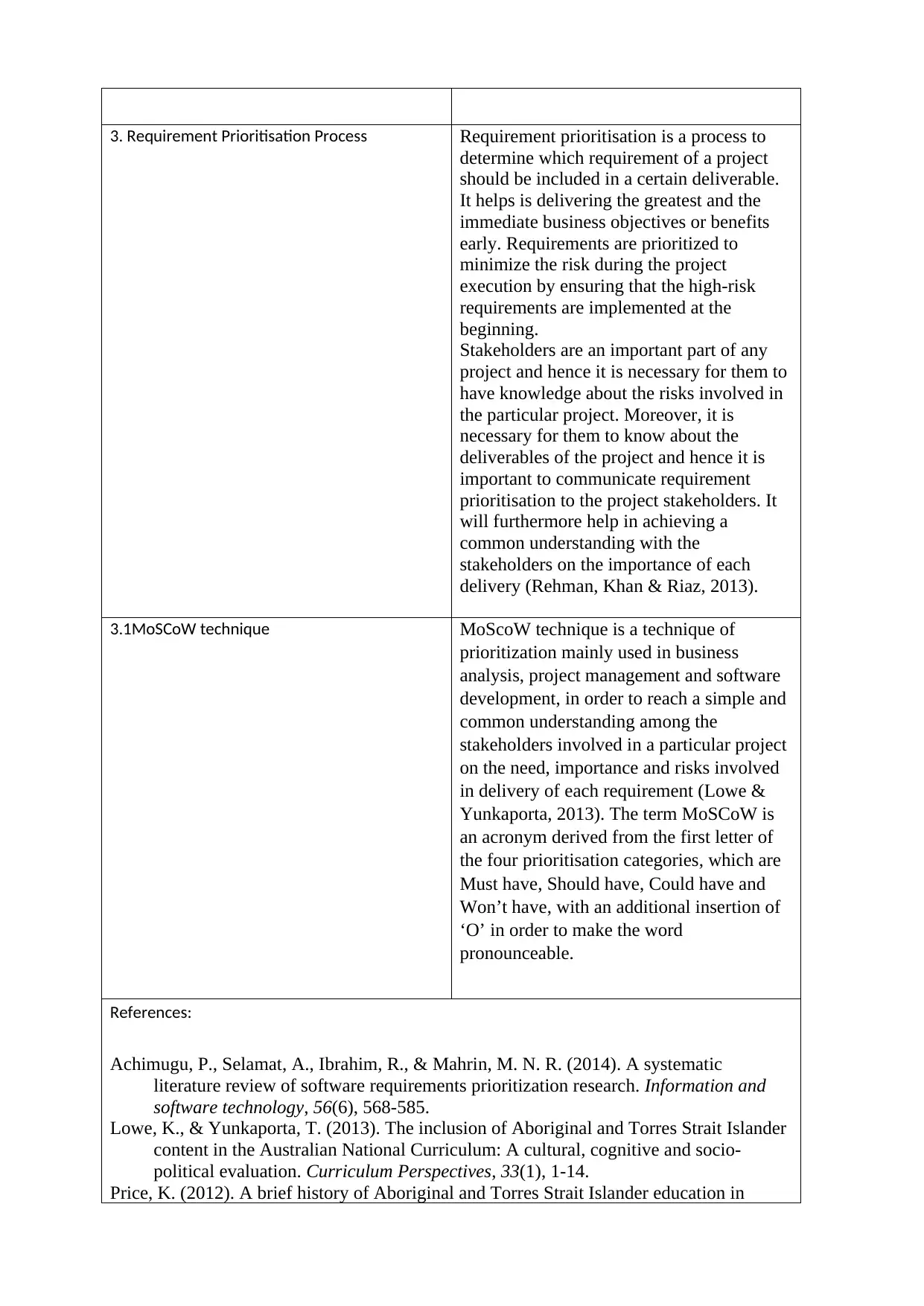
3. Requirement Prioritisation Process Requirement prioritisation is a process to
determine which requirement of a project
should be included in a certain deliverable.
It helps is delivering the greatest and the
immediate business objectives or benefits
early. Requirements are prioritized to
minimize the risk during the project
execution by ensuring that the high-risk
requirements are implemented at the
beginning.
Stakeholders are an important part of any
project and hence it is necessary for them to
have knowledge about the risks involved in
the particular project. Moreover, it is
necessary for them to know about the
deliverables of the project and hence it is
important to communicate requirement
prioritisation to the project stakeholders. It
will furthermore help in achieving a
common understanding with the
stakeholders on the importance of each
delivery (Rehman, Khan & Riaz, 2013).
3.1MoSCoW technique MoScoW technique is a technique of
prioritization mainly used in business
analysis, project management and software
development, in order to reach a simple and
common understanding among the
stakeholders involved in a particular project
on the need, importance and risks involved
in delivery of each requirement (Lowe &
Yunkaporta, 2013). The term MoSCoW is
an acronym derived from the first letter of
the four prioritisation categories, which are
Must have, Should have, Could have and
Won’t have, with an additional insertion of
‘O’ in order to make the word
pronounceable.
References:
Achimugu, P., Selamat, A., Ibrahim, R., & Mahrin, M. N. R. (2014). A systematic
literature review of software requirements prioritization research. Information and
software technology, 56(6), 568-585.
Lowe, K., & Yunkaporta, T. (2013). The inclusion of Aboriginal and Torres Strait Islander
content in the Australian National Curriculum: A cultural, cognitive and socio-
political evaluation. Curriculum Perspectives, 33(1), 1-14.
Price, K. (2012). A brief history of Aboriginal and Torres Strait Islander education in
Document Page
Australia. Aboriginal and Torres Strait Islander education: An introduction for the
teaching profession, 1-20.
Rehman, T., Khan, M. N. A., & Riaz, N. (2013). Analysis of requirement engineering
processes, tools/techniques and methodologies. International Journal of Information
Technology and Computer Science (IJITCS), 5(3), 40.
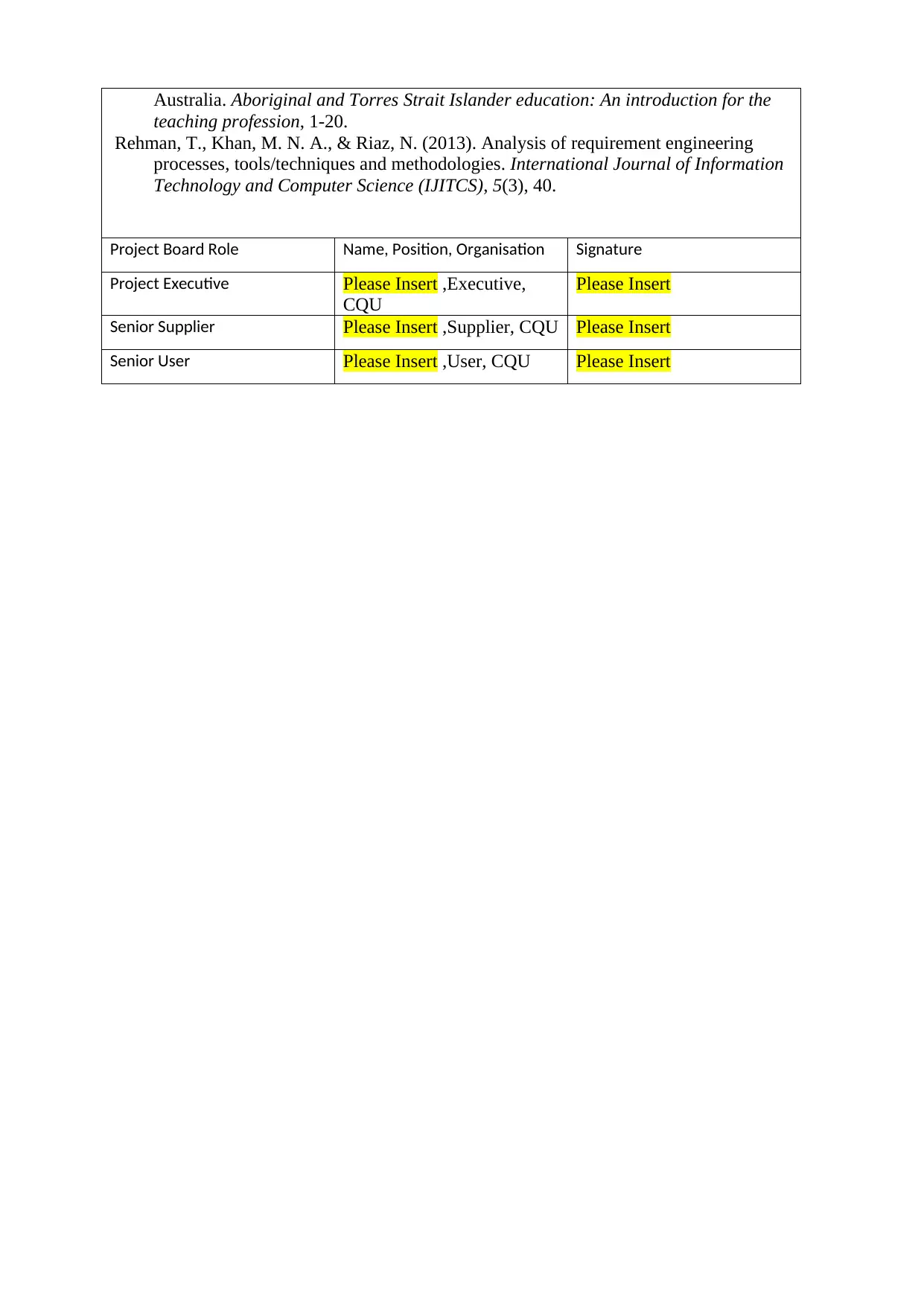
Project Board Role Name, Position, Organisation Signature
Project Executive Please Insert ,Executive,
CQU
Please Insert
Senior Supplier Please Insert ,Supplier, CQU Please Insert
Senior User Please Insert ,User, CQU Please Insert
chevron_up_icon
1 out of 4
circle_padding
hide_on_mobile
zoom_out_icon
[object Object]