Data Science: Graph Databases Research and Data Modeling Report

Verified

Added on  2022/08/28

|7
|1061
|10
Report
AI Summary
This report delves into the realm of graph databases, exploring their fundamental concepts, including their structure as NoSQL databases utilizing graph data models composed of vertices and edges representing relationships between data. The report highlights the need for graph databases, emphasizing their ability to highlight data connections and relationships, and discusses the performance benefits, flexibility, and agility they offer compared to traditional databases. It also examines recent developments such as the increasing application of graph databases in virtual assistants and knowledge graph architectures. Furthermore, the report includes a data modeling task involving the creation of an Entity Relationship Diagram (ERD) for DiscPeezy, a movietainment company that rents out movie discs through branches and kiosks. The ERD encompasses customer registration, rental details, and other relevant data points to be implemented in a relational model, providing a practical application of database design principles.
Document Page
Running head: Assessment item 2 - Research and Data Modelling
Assessment item 2 - Research and Data Modelling
Name of the Student
Name of the University
Author Note
tabler-icon-diamond-filled.svg

Paraphrase This Document

Need a fresh take? Get an instant paraphrase of this document with our AI Paraphraser
Document Page
Assessment item 2 - Research and Data Modelling 1
Table of Contents
Introduction:...............................................................................................................................2
Graph databases:........................................................................................................................2
Reason behind the need:.............................................................................................................2
Developments:............................................................................................................................3
Conclusion:................................................................................................................................3
References:.................................................................................................................................5
Document Page
2Assessment item 2 - Research and Data Modelling
Task 1
Introduction:
The purpose of this paper is to discuss about the graph databases. The paper will
explore the topics of graph databases. The report will also discuss what they are, what the
reason for their need is, and some recent developments that are happening in the area.
Graph databases:
The graph databases are basically the NoSQL databases that utilize the model of
graph data that are comprised of the vertices that is an entity like a place, person, object or
some relevant pieces of edges and data that is having the capability to represent the relation
between 2 nodes (Hall, Murray & Verdonk, 2017). The graph technology is actually a rising
tide to the development team as well as to the business that can not afford for passing up. The
graph databases are the future as well as for a beginner it will be easy to learn.
Reason behind the need:
The graph databases are very much helpful as they can highlight the links as well as
the relationship that is between the data similarity that are relevant. The graph paradigms are
going beyond development of the application and databases. This is a reimagining of the
possible connections that are related to the idea. The reason behind the need of graph
databases are as follows:
Performance: The volume of data will increase in the future definitely. However, what is
going to increase between the data. The big data can get bigger however the data that are
connected can grow exponentially (Ezhilchelvan et al., 2018). With the help of the traditional
databases, the relation-ship queries that come for a grinding halt as the depth and number of
the relationship that are increasing.
Document Page
3Assessment item 2 - Research and Data Modelling
Flexibility: With the help of graph databases, the data architecture and information
technology related teams will move at the speed of business as the schema and structure of
the graph data model is able to flex for the changes in the industry.
Agility: The development with the graph databases technology can align perfectly with the
agile of present days, test driven practices related to the development, allowing the graph
database backed app for evolving with the requirement of business that are changing
(Fabregat et al., 2018).
Developments:
With the growth of the graph databases, it can be expected that the graph based
platforms to become the foundational elements very soon. The next focus area for the
databases can be the practical implementations like building graph based applications and
graph analytics. The graph databases are searching for the application in the virtual assistants
for driving the conversation in the virtual shopping assistant of eBay (Angles, 2018). Even
the knowledge graph architecture is also used by NASA for finding critical data. The number
of graph databases are rising day after day, the meaning of this is the competition for the
graph databases are also rising which is a good thing. The competition will be the reason for
new innovation.
Conclusion:
Thus, it can be concluded from the entire report that the graph database are the
databases which follow the model of a graph. This is a very much flexible data model such as
the value or key store models of database.
tabler-icon-diamond-filled.svg

Paraphrase This Document

Need a fresh take? Get an instant paraphrase of this document with our AI Paraphraser
Document Page
4Assessment item 2 - Research and Data Modelling
Task 2
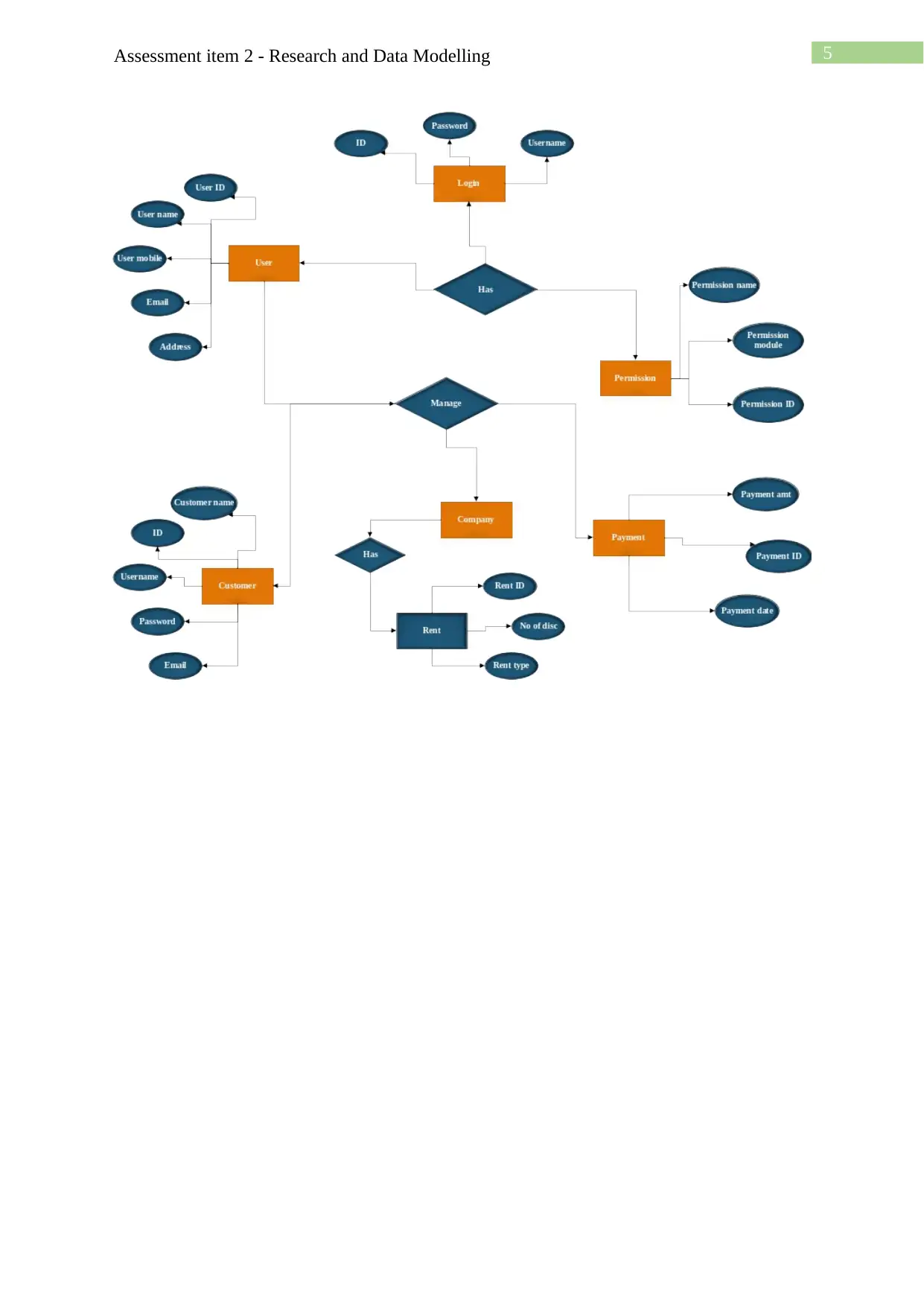
The purpose of this task is to create an Entity relationship diagram (ERD) which can be
implemented in the relational model. According to the scenario, the DiscPeezy is basically a
movietainment organisation, the business of this company is to rent out Blu ray or DVD
movie discs by the branches and the self service kiosks. The company is having a small
number of branches that are located in some of the capital cities of Australia. The location of
all of the kiosks are in the shopping centres. For renting the disc from the company, the
customer have to register first as a member. The process of registration can be taken by one
of the person of a branch or via online by the website of the company. For registering, a
consumer requires to provide the full name of them, credit card details, mail address as well
as the billing address. The date when the member will register, the data will be stored by the
system. Whenever the registration process will be done, a member will be free for renting the
discs, which will be upto five at any one time. For the convenience of the consumer, the rent
date, movie, return date and the daily cost should be stored in the database. The ERD is given
below:
Document Page
5Assessment item 2 - Research and Data Modelling
Document Page
6Assessment item 2 - Research and Data Modelling
References:
Angles, R. (2018). The Property Graph Database Model. In AMW.
Ezhilchelvan, P., Mitrani, I., Webber, J., Ezhilchelvan, P., Mitrani, I., & Webber, J. (2018).
On the degradation of distributed graph databases with.
Fabregat, A., Korninger, F., Viteri, G., Sidiropoulos, K., Marin-Garcia, P., Ping, P., ... &
Hermjakob, H. (2018). Reactome graph database: efficient access to complex pathway
data. PLoS computational biology, 14(1), e1005968.
Hall, R. J., Murray, C. W., & Verdonk, M. L. (2017). The Fragment Network: A Chemistry
Recommendation Engine Built Using a Graph Database. Journal of medicinal
chemistry, 60(14), 6440-6450.
chevron_up_icon
1 out of 7
circle_padding
hide_on_mobile
zoom_out_icon
[object Object]