Research Assignment: Content Analysis and Alternative Hypotheses
VerifiedAdded on Ā 2022/11/25
|6
|1047
|484
Homework Assignment
AI Summary
This research assignment delves into the application of content analysis and the formulation of alternative hypotheses within a business context. The assignment begins by defining research methodology and its role in assembling and evaluating information. The core of the assignment involves constructing five alternative hypotheses based on a given conceptual framework, exploring relationships between green supply chain management practices, green partnerships, and manufacturing firm performance. The report then discusses content analysis, defining it as a method for summarizing content by counting various aspects, and outlines its two main categories: conceptual analysis, which focuses on the frequency of concepts, and relational analysis, which examines relationships between concepts. The importance of content analysis is highlighted, emphasizing its use in both quantitative and qualitative research to gain insights into values, opinions, and behaviors, and to develop forecasts regarding trends. The assignment concludes by summarizing the key findings and conclusions drawn from the analysis.
Research
Paraphrase This Document
Need a fresh take? Get an instant paraphrase of this document with our AI Paraphraser

Contents
INTRODUCTION...........................................................................................................................3
Question 1...............................................................................................................................3
Question 2...............................................................................................................................4
CONCLUSION................................................................................................................................5
REFERENCES................................................................................................................................6
INTRODUCTION...........................................................................................................................3
Question 1...............................................................................................................................3
Question 2...............................................................................................................................4
CONCLUSION................................................................................................................................5
REFERENCES................................................................................................................................6

INTRODUCTION
Research methodology is basically specific technique which are adopted in research process
in order to assemble, collect as well as evaluate information. In addition to this, it is a tool which
are used to collect relevant information within a specific research study. The report will involve
construction of alternative hypothesis on the basis of framework. In addition to this, there is a
discussion about content analysis along with its importance and categories.
Question 1
Alternative hypothesis is a statement that is used in statistical inference experiment. In
addition to this, it is contradictory to the null hypothesis and a statement which an investigator is
testing (Franzois, 2018). It is basically a hypothesis that a researcher wants to prove and reflect
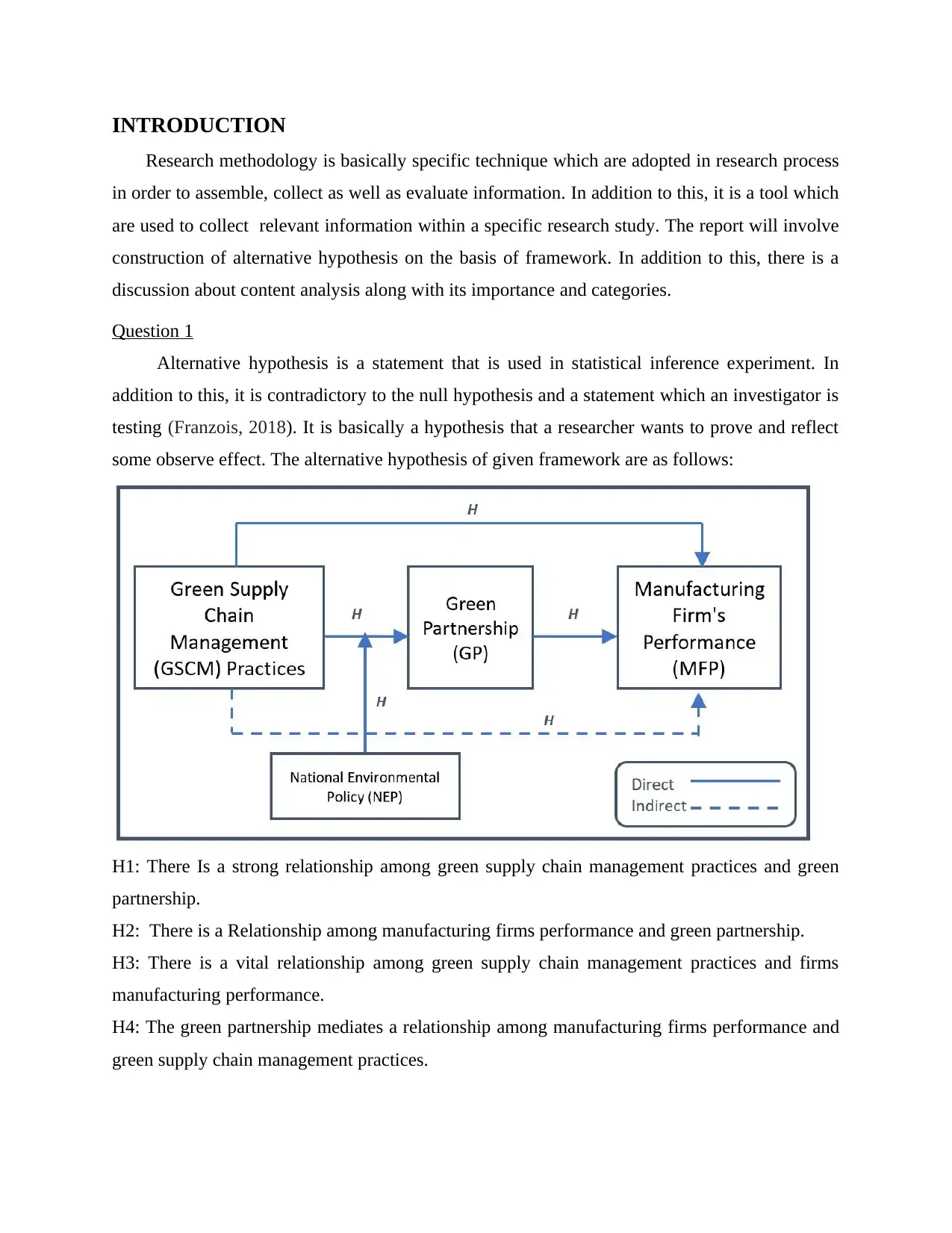
some observe effect. The alternative hypothesis of given framework are as follows:
H1: There Is a strong relationship among green supply chain management practices and green
partnership.
H2: There is a Relationship among manufacturing firms performance and green partnership.
H3: There is a vital relationship among green supply chain management practices and firms
manufacturing performance.
H4: The green partnership mediates a relationship among manufacturing firms performance and
green supply chain management practices.
Research methodology is basically specific technique which are adopted in research process
in order to assemble, collect as well as evaluate information. In addition to this, it is a tool which
are used to collect relevant information within a specific research study. The report will involve
construction of alternative hypothesis on the basis of framework. In addition to this, there is a
discussion about content analysis along with its importance and categories.
Question 1
Alternative hypothesis is a statement that is used in statistical inference experiment. In
addition to this, it is contradictory to the null hypothesis and a statement which an investigator is
testing (Franzois, 2018). It is basically a hypothesis that a researcher wants to prove and reflect
some observe effect. The alternative hypothesis of given framework are as follows:
H1: There Is a strong relationship among green supply chain management practices and green
partnership.
H2: There is a Relationship among manufacturing firms performance and green partnership.
H3: There is a vital relationship among green supply chain management practices and firms
manufacturing performance.
H4: The green partnership mediates a relationship among manufacturing firms performance and
green supply chain management practices.
ā This is a preview!ā
Do you want full access?
Subscribe today to unlock all pages.

Trusted by 1+ million students worldwide

H5: The national environmental policy Controls the relationship among green partnership and
green supply chain management practices.
Question 2
Categories of Content analysis
Content analysis define as a method for summarizing any type of content through
counting various aspects of the content. It can be in any form to begin with but is converted into
written words before it is analyzed (Lindgren, Lundman and Graneheim, 2020). It is also
considered as a research tool which is used to determine the presence of particular words,
concepts, themes within given qualitative Information. The two types of content analysis is given
below:
Conceptual analysis: This analysis take place in order to establish the existence as well
as frequency of concept inside a text. Herein, a specific concept is chosen for the examination
and this is start with determining the research question and then selecting the samples. In
addition to this, it is mainly represented by words or phrases within a text. For example, if an
individual has knowledge about the favourite poet often writes about mindset. By the assistance
of conceptual analysis, the individual is able to determine how many times word such as
mindset, brain, Positivity appear within a volume of poems.
Rational analysis: This analysis builds on conceptual analysis and studies the
relationship among the concepts within a text. It is important to choose that which concept will
be inspected before starting rational anlysis (Selvi, 2019). This concept is mainly famous for its
various techniques and therefore provide flexibility to investigators. It is determined that such
type of analysts prolongs a high degree of statistical rigor and did not lose the detailed
information. Continue with the example of mindset, with the assistance of relational analysis an
individual is able to identify what other phrases or words mindset appear next to and then
analyze what various meanings are emerge as the outcome of this groupings.
Importance of content analysis and identification of content analysis is classified as
quantitative or qualitative.
Content analysis directly looks at the communication by texts and transcripts. In addition
to this, it allow researcher in conduct both quantitative and qualitative. Moreover, it gives
valuable historical insights over the time through analysis of texts. It is determined that content
analysis permits a close relation among texts that can change between specific categories as well
green supply chain management practices.
Question 2
Categories of Content analysis
Content analysis define as a method for summarizing any type of content through
counting various aspects of the content. It can be in any form to begin with but is converted into
written words before it is analyzed (Lindgren, Lundman and Graneheim, 2020). It is also
considered as a research tool which is used to determine the presence of particular words,
concepts, themes within given qualitative Information. The two types of content analysis is given
below:
Conceptual analysis: This analysis take place in order to establish the existence as well
as frequency of concept inside a text. Herein, a specific concept is chosen for the examination
and this is start with determining the research question and then selecting the samples. In
addition to this, it is mainly represented by words or phrases within a text. For example, if an
individual has knowledge about the favourite poet often writes about mindset. By the assistance
of conceptual analysis, the individual is able to determine how many times word such as
mindset, brain, Positivity appear within a volume of poems.
Rational analysis: This analysis builds on conceptual analysis and studies the
relationship among the concepts within a text. It is important to choose that which concept will
be inspected before starting rational anlysis (Selvi, 2019). This concept is mainly famous for its
various techniques and therefore provide flexibility to investigators. It is determined that such
type of analysts prolongs a high degree of statistical rigor and did not lose the detailed
information. Continue with the example of mindset, with the assistance of relational analysis an
individual is able to identify what other phrases or words mindset appear next to and then
analyze what various meanings are emerge as the outcome of this groupings.
Importance of content analysis and identification of content analysis is classified as
quantitative or qualitative.
Content analysis directly looks at the communication by texts and transcripts. In addition
to this, it allow researcher in conduct both quantitative and qualitative. Moreover, it gives
valuable historical insights over the time through analysis of texts. It is determined that content
analysis permits a close relation among texts that can change between specific categories as well
Paraphrase This Document
Need a fresh take? Get an instant paraphrase of this document with our AI Paraphraser

as relationships. Furthermore, it help in gaining knowledge about factors such as values,
opinions, behaviour and so on.
It is analyzed that content analysis is both qualitative and quantitative. The content which is
purely intended towards measuring and counting is a quantitative analysis conducted (Serafini
and Reid, 2019). On the other hand, qualitative analysis is emphasized on understanding as well
as interpreting the texts or recorded patterns within any forms. Quantitative analysis is mainly
deals from the view point of measuring and numbering perspective. Therefore, content analyzed
both quantitatively as well as qualitatively that makes it easier for analysis to develop forecasts
regarding about trends that leads to attainment of positive results.
CONCLUSION
From the above study, it has been concluded that content analysis help researcher to conduct
both quantitative and qualitative study which help in gaining better understanding of a particular
topic in an effective manner. In addition to this, there are mainly two types of content analysis
that is conceptual and rational analysis. Moreover, it is determined that content analysis is both
qualitative and quantitative which help researcher to easily forecast and achieve positive results.
opinions, behaviour and so on.
It is analyzed that content analysis is both qualitative and quantitative. The content which is
purely intended towards measuring and counting is a quantitative analysis conducted (Serafini
and Reid, 2019). On the other hand, qualitative analysis is emphasized on understanding as well
as interpreting the texts or recorded patterns within any forms. Quantitative analysis is mainly
deals from the view point of measuring and numbering perspective. Therefore, content analyzed
both quantitatively as well as qualitatively that makes it easier for analysis to develop forecasts
regarding about trends that leads to attainment of positive results.
CONCLUSION
From the above study, it has been concluded that content analysis help researcher to conduct
both quantitative and qualitative study which help in gaining better understanding of a particular
topic in an effective manner. In addition to this, there are mainly two types of content analysis
that is conceptual and rational analysis. Moreover, it is determined that content analysis is both
qualitative and quantitative which help researcher to easily forecast and achieve positive results.

REFERENCES
Books & Journal
Choi, W.T., and et. al. 2018. DNA content analysis of colorectal serrated lesions detects an
aneuploid subset of inflammatory bowel diseaseāassociated serrated epithelial change
and traditional serrated adenomas. Histopathology. 73(3). pp.464-472.
Jaspal, R., 2020. Content analysis, thematic analysis and discourse analysis. Research methods
in psychology. pp.285-312.
Kim, B., Merlo, A.V. and Seo, C., 2018. Internationality of women specialty journals: content
analysis and survey of editors. Asian Journal of Criminology. 13(3). pp.231-249.
Maschi, T. and Dasarathy, D., 2019. Aging with mental disorders in the criminal justice system:
A content analysis of the empirical literature. International journal of offender therapy
and comparative criminology. 63(12). pp.2103-2137.
Patel, B.G., and et. al. 2020. Content analysis of ACGME accredited urology residency program
webpages. Urology. 138. pp.11-15.
Books & Journal
Choi, W.T., and et. al. 2018. DNA content analysis of colorectal serrated lesions detects an
aneuploid subset of inflammatory bowel diseaseāassociated serrated epithelial change
and traditional serrated adenomas. Histopathology. 73(3). pp.464-472.
Jaspal, R., 2020. Content analysis, thematic analysis and discourse analysis. Research methods
in psychology. pp.285-312.
Kim, B., Merlo, A.V. and Seo, C., 2018. Internationality of women specialty journals: content
analysis and survey of editors. Asian Journal of Criminology. 13(3). pp.231-249.
Maschi, T. and Dasarathy, D., 2019. Aging with mental disorders in the criminal justice system:
A content analysis of the empirical literature. International journal of offender therapy
and comparative criminology. 63(12). pp.2103-2137.
Patel, B.G., and et. al. 2020. Content analysis of ACGME accredited urology residency program
webpages. Urology. 138. pp.11-15.
ā This is a preview!ā
Do you want full access?
Subscribe today to unlock all pages.

Trusted by 1+ million students worldwide
1 out of 6
Related Documents
Your All-in-One AI-Powered Toolkit for Academic Success.
Ā +13062052269
info@desklib.com
Available 24*7 on WhatsApp / Email
Unlock your academic potential
Copyright Ā© 2020ā2026 A2Z Services. All Rights Reserved. Developed and managed by ZUCOL.