How Child Labour Negatively Affects Primary Education: A Report
VerifiedAdded on 2020/11/23
|10
|2611
|121
Report
AI Summary
This report investigates the detrimental effects of child labour on primary education. The introduction defines child labour, its illegality, and its negative impact on children's education. The background highlights education's importance and the interconnected explanations of child labour. The research rationale justifies the study's importance in reducing child labour and enhancing education. The research aims to explore the impact of child labour on education, with objectives to understand child labour, the significance of early education, child exploitation, and solutions. The literature review explores the concept of child labour, the importance of early education, exploitation, and ways to end child labour. The methodology section outlines qualitative research and positivism. The report also includes the resources required, an action plan, and references. The report emphasizes the need to reduce child labour to improve education and economic conditions.
RESEARCH METHODS (2)

Paraphrase This Document
Need a fresh take? Get an instant paraphrase of this document with our AI Paraphraser
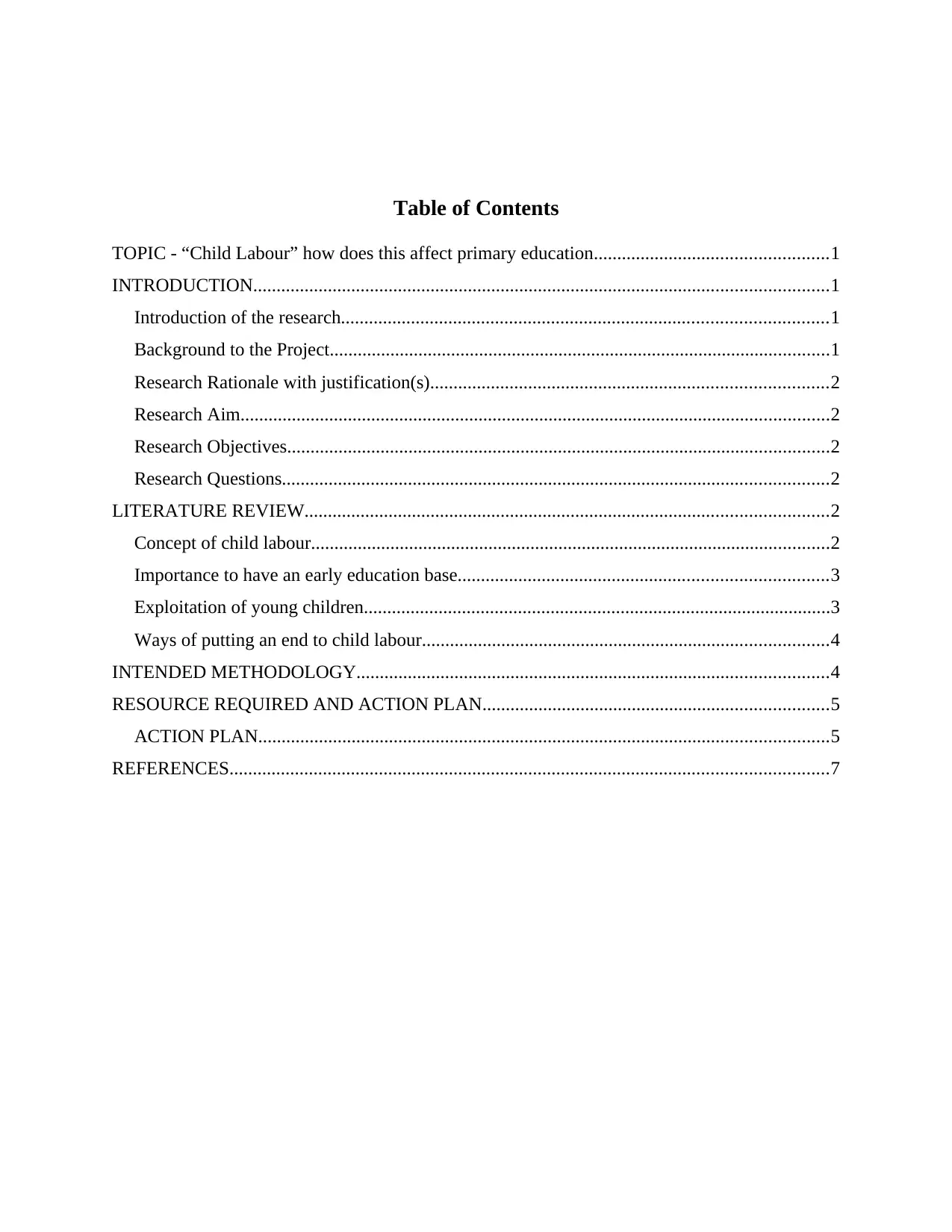
Table of Contents
TOPIC - “Child Labour” how does this affect primary education..................................................1
INTRODUCTION...........................................................................................................................1
Introduction of the research........................................................................................................1
Background to the Project...........................................................................................................1
Research Rationale with justification(s).....................................................................................2
Research Aim..............................................................................................................................2
Research Objectives....................................................................................................................2
Research Questions.....................................................................................................................2
LITERATURE REVIEW................................................................................................................2
Concept of child labour...............................................................................................................2
Importance to have an early education base...............................................................................3
Exploitation of young children....................................................................................................3
Ways of putting an end to child labour.......................................................................................4
INTENDED METHODOLOGY.....................................................................................................4
RESOURCE REQUIRED AND ACTION PLAN..........................................................................5
ACTION PLAN..........................................................................................................................5
REFERENCES................................................................................................................................7
TOPIC - “Child Labour” how does this affect primary education..................................................1
INTRODUCTION...........................................................................................................................1
Introduction of the research........................................................................................................1
Background to the Project...........................................................................................................1
Research Rationale with justification(s).....................................................................................2
Research Aim..............................................................................................................................2
Research Objectives....................................................................................................................2
Research Questions.....................................................................................................................2
LITERATURE REVIEW................................................................................................................2
Concept of child labour...............................................................................................................2
Importance to have an early education base...............................................................................3
Exploitation of young children....................................................................................................3
Ways of putting an end to child labour.......................................................................................4
INTENDED METHODOLOGY.....................................................................................................4
RESOURCE REQUIRED AND ACTION PLAN..........................................................................5
ACTION PLAN..........................................................................................................................5
REFERENCES................................................................................................................................7

⊘ This is a preview!⊘
Do you want full access?
Subscribe today to unlock all pages.

Trusted by 1+ million students worldwide
TOPIC - “Child Labour” how does this affect primary education
INTRODUCTION
Introduction of the research
Child labour can be defined as employment done by young ones within a business
organisation or in a sector. In most of the countries, child labour is being considered as an illegal
activity done by an organisation where government can fine them (He, 2016). When a company
found guilty with the same, it is may be possible that they might get charged with an amount or
their license might also gets cancelled as well. It is being found that, there are ample number of
cases came in front which impacted negatively upon overall education level of children in all
over the world. Primary education basically, grooms child's career which directly impacts upon
there living standards and helps them in surviving real life situations.
Therefore, it can be said that education level is not increasing the way it should. In some
countries, school attendance rates of working children are only about half of those of non-
working children. There is a significant negative correlation between levels of economic activity
of children aged 7-14 years and youth literacy rates is approximately to an age in between 15-24
age. The reason behind this is poverty which basically pushes children to work instead of
attending schools. This directly impacts regularly upon education level of a country and reduces
the chances for public to breaking out of poverty (Hindman, 2016).
Background to the Project
Over the years, education is being considered as a crucial component for every single
individual at a vast level because this enhances the chances of elimination out of child labour. On
the other hand, there are many interlinked explanations came in front related to child labour as
the is one of vital subject to study. Along with this, it is being analysed that there are different
levels linked with many determinations came in front that are linked to child which specifically
becomes child labourer (Honeyman, 2016). On the other hand, children's participation in the
labour force is endlessly varied and infinitely volatile, responding to changing market and social
conditions.
1
INTRODUCTION
Introduction of the research
Child labour can be defined as employment done by young ones within a business
organisation or in a sector. In most of the countries, child labour is being considered as an illegal
activity done by an organisation where government can fine them (He, 2016). When a company
found guilty with the same, it is may be possible that they might get charged with an amount or
their license might also gets cancelled as well. It is being found that, there are ample number of
cases came in front which impacted negatively upon overall education level of children in all
over the world. Primary education basically, grooms child's career which directly impacts upon
there living standards and helps them in surviving real life situations.
Therefore, it can be said that education level is not increasing the way it should. In some
countries, school attendance rates of working children are only about half of those of non-
working children. There is a significant negative correlation between levels of economic activity
of children aged 7-14 years and youth literacy rates is approximately to an age in between 15-24
age. The reason behind this is poverty which basically pushes children to work instead of
attending schools. This directly impacts regularly upon education level of a country and reduces
the chances for public to breaking out of poverty (Hindman, 2016).
Background to the Project
Over the years, education is being considered as a crucial component for every single
individual at a vast level because this enhances the chances of elimination out of child labour. On
the other hand, there are many interlinked explanations came in front related to child labour as
the is one of vital subject to study. Along with this, it is being analysed that there are different
levels linked with many determinations came in front that are linked to child which specifically
becomes child labourer (Honeyman, 2016). On the other hand, children's participation in the
labour force is endlessly varied and infinitely volatile, responding to changing market and social
conditions.
1
Paraphrase This Document
Need a fresh take? Get an instant paraphrase of this document with our AI Paraphraser
Research Rationale with justification(s)
Vital reason behind conducting the investigation on this topic is that, child labour is a
never ending process. There are many researchers has done investigation on the same topic but
there were no clear reasons came in front and to pull out favourable outcomes, researcher has
chosen this topic to investigate further. Along with this, child labour needs to be reduced so that
education can easily be enhanced and this will directly put positive impact upon economic
conditions of a country like United Kingdom (Honeyman, 2016). Furthermore, conducting
research on this topic will help both researcher and readers of this project to improve there
knowledge level.
Research Aim
Present research report is based on the aim "How does child labour affect education''.
Research Objectives
To understand the concept of child labour
To identify the importance to have an early education base.
To analyse the exploitation of young children.
To conduct further research to discover ways of putting an end to child labour.
Research Questions
What does child labour mean?
Why it is important to have an early education base?
What can be considered as exploitation of young children?
What are the ways of putting an end to child labour?
LITERATURE REVIEW
Literature Review is being considered as one of a crucial approach within a research
which helps in looking into different aspects given by researchers in past over a particular topic.
In the same way, researcher has used this section for getting deeper knowledge related to the
developed objectives/questions for the research aim and these are given beneath:
Concept of child labour
As given by Koomson and Asongu, (2016), participation of children within a work at a
business organisation can be considered or defined as child labour. Basically, poverty has been a
crucial factor which led children and their families to go through a range of problems and this
2
Vital reason behind conducting the investigation on this topic is that, child labour is a
never ending process. There are many researchers has done investigation on the same topic but
there were no clear reasons came in front and to pull out favourable outcomes, researcher has
chosen this topic to investigate further. Along with this, child labour needs to be reduced so that
education can easily be enhanced and this will directly put positive impact upon economic
conditions of a country like United Kingdom (Honeyman, 2016). Furthermore, conducting
research on this topic will help both researcher and readers of this project to improve there
knowledge level.
Research Aim
Present research report is based on the aim "How does child labour affect education''.
Research Objectives
To understand the concept of child labour
To identify the importance to have an early education base.
To analyse the exploitation of young children.
To conduct further research to discover ways of putting an end to child labour.
Research Questions
What does child labour mean?
Why it is important to have an early education base?
What can be considered as exploitation of young children?
What are the ways of putting an end to child labour?
LITERATURE REVIEW
Literature Review is being considered as one of a crucial approach within a research
which helps in looking into different aspects given by researchers in past over a particular topic.
In the same way, researcher has used this section for getting deeper knowledge related to the
developed objectives/questions for the research aim and these are given beneath:
Concept of child labour
As given by Koomson and Asongu, (2016), participation of children within a work at a
business organisation can be considered or defined as child labour. Basically, poverty has been a
crucial factor which led children and their families to go through a range of problems and this
2
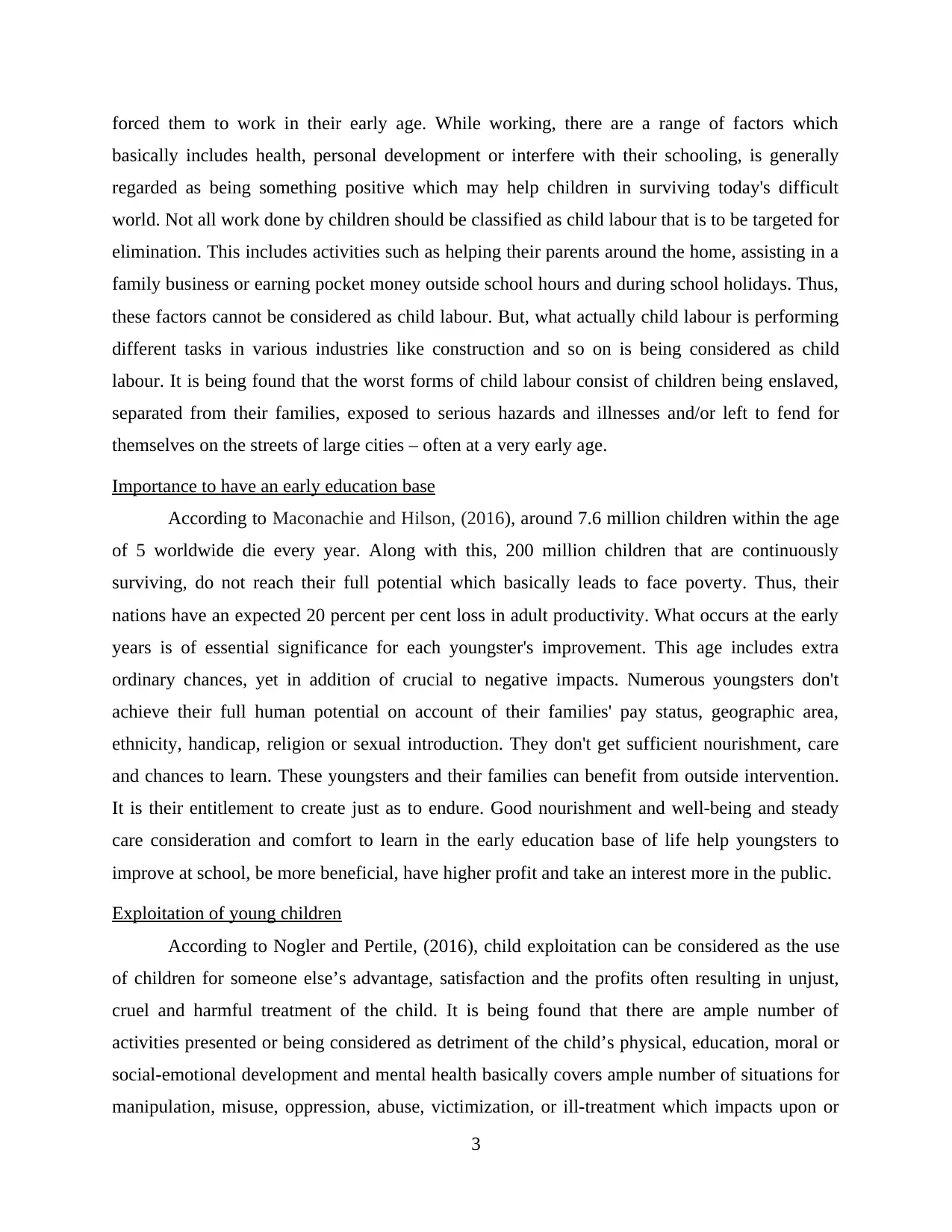
forced them to work in their early age. While working, there are a range of factors which
basically includes health, personal development or interfere with their schooling, is generally
regarded as being something positive which may help children in surviving today's difficult
world. Not all work done by children should be classified as child labour that is to be targeted for
elimination. This includes activities such as helping their parents around the home, assisting in a
family business or earning pocket money outside school hours and during school holidays. Thus,
these factors cannot be considered as child labour. But, what actually child labour is performing
different tasks in various industries like construction and so on is being considered as child
labour. It is being found that the worst forms of child labour consist of children being enslaved,
separated from their families, exposed to serious hazards and illnesses and/or left to fend for
themselves on the streets of large cities – often at a very early age.
Importance to have an early education base
According to Maconachie and Hilson, (2016), around 7.6 million children within the age
of 5 worldwide die every year. Along with this, 200 million children that are continuously
surviving, do not reach their full potential which basically leads to face poverty. Thus, their
nations have an expected 20 percent per cent loss in adult productivity. What occurs at the early
years is of essential significance for each youngster's improvement. This age includes extra
ordinary chances, yet in addition of crucial to negative impacts. Numerous youngsters don't
achieve their full human potential on account of their families' pay status, geographic area,
ethnicity, handicap, religion or sexual introduction. They don't get sufficient nourishment, care
and chances to learn. These youngsters and their families can benefit from outside intervention.
It is their entitlement to create just as to endure. Good nourishment and well-being and steady
care consideration and comfort to learn in the early education base of life help youngsters to
improve at school, be more beneficial, have higher profit and take an interest more in the public.
Exploitation of young children
According to Nogler and Pertile, (2016), child exploitation can be considered as the use
of children for someone else’s advantage, satisfaction and the profits often resulting in unjust,
cruel and harmful treatment of the child. It is being found that there are ample number of
activities presented or being considered as detriment of the child’s physical, education, moral or
social-emotional development and mental health basically covers ample number of situations for
manipulation, misuse, oppression, abuse, victimization, or ill-treatment which impacts upon or
3
basically includes health, personal development or interfere with their schooling, is generally
regarded as being something positive which may help children in surviving today's difficult
world. Not all work done by children should be classified as child labour that is to be targeted for
elimination. This includes activities such as helping their parents around the home, assisting in a
family business or earning pocket money outside school hours and during school holidays. Thus,
these factors cannot be considered as child labour. But, what actually child labour is performing
different tasks in various industries like construction and so on is being considered as child
labour. It is being found that the worst forms of child labour consist of children being enslaved,
separated from their families, exposed to serious hazards and illnesses and/or left to fend for
themselves on the streets of large cities – often at a very early age.
Importance to have an early education base
According to Maconachie and Hilson, (2016), around 7.6 million children within the age
of 5 worldwide die every year. Along with this, 200 million children that are continuously
surviving, do not reach their full potential which basically leads to face poverty. Thus, their
nations have an expected 20 percent per cent loss in adult productivity. What occurs at the early
years is of essential significance for each youngster's improvement. This age includes extra
ordinary chances, yet in addition of crucial to negative impacts. Numerous youngsters don't
achieve their full human potential on account of their families' pay status, geographic area,
ethnicity, handicap, religion or sexual introduction. They don't get sufficient nourishment, care
and chances to learn. These youngsters and their families can benefit from outside intervention.
It is their entitlement to create just as to endure. Good nourishment and well-being and steady
care consideration and comfort to learn in the early education base of life help youngsters to
improve at school, be more beneficial, have higher profit and take an interest more in the public.
Exploitation of young children
According to Nogler and Pertile, (2016), child exploitation can be considered as the use
of children for someone else’s advantage, satisfaction and the profits often resulting in unjust,
cruel and harmful treatment of the child. It is being found that there are ample number of
activities presented or being considered as detriment of the child’s physical, education, moral or
social-emotional development and mental health basically covers ample number of situations for
manipulation, misuse, oppression, abuse, victimization, or ill-treatment which impacts upon or
3
⊘ This is a preview!⊘
Do you want full access?
Subscribe today to unlock all pages.
Trusted by 1+ million students worldwide
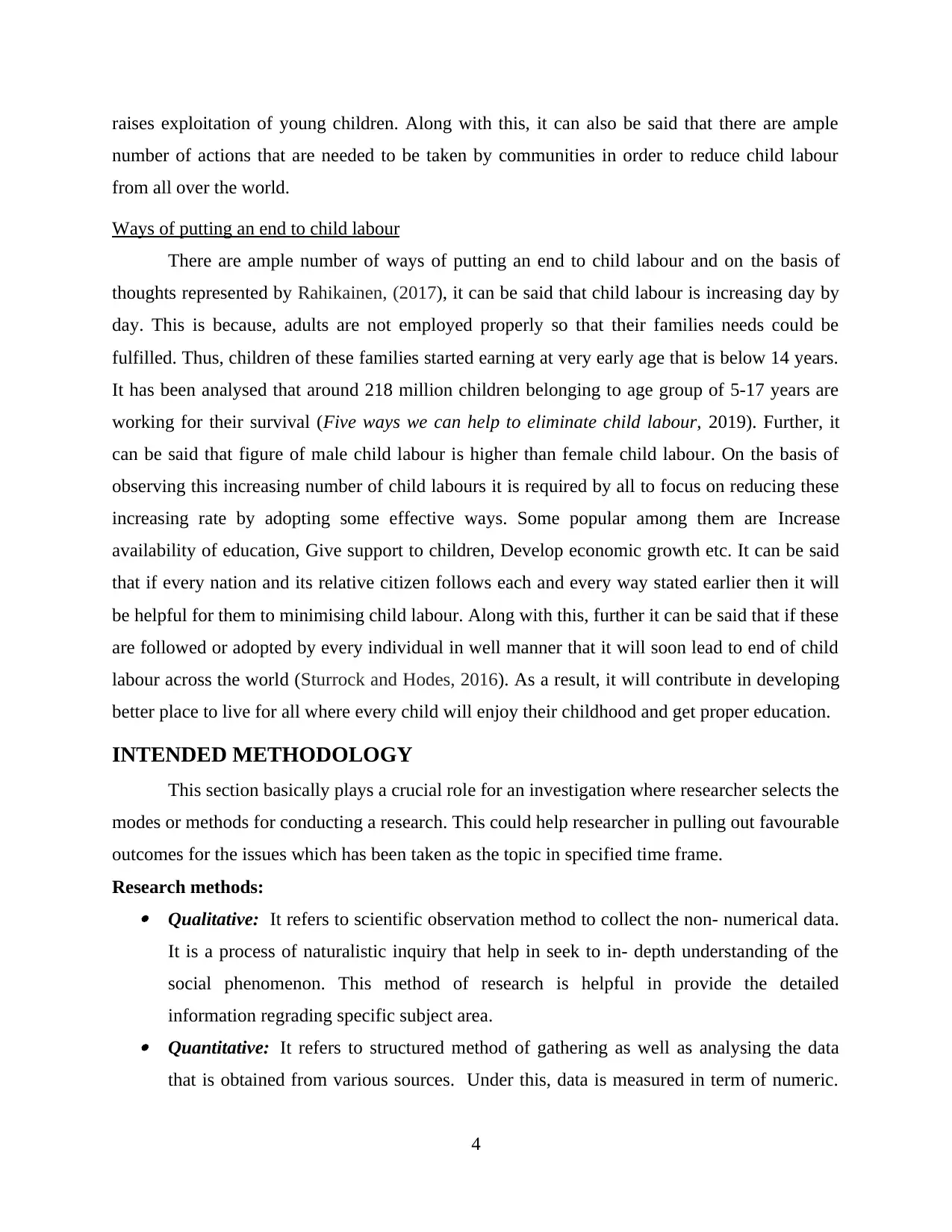
raises exploitation of young children. Along with this, it can also be said that there are ample
number of actions that are needed to be taken by communities in order to reduce child labour
from all over the world.
Ways of putting an end to child labour
There are ample number of ways of putting an end to child labour and on the basis of
thoughts represented by Rahikainen, (2017), it can be said that child labour is increasing day by
day. This is because, adults are not employed properly so that their families needs could be
fulfilled. Thus, children of these families started earning at very early age that is below 14 years.
It has been analysed that around 218 million children belonging to age group of 5-17 years are
working for their survival (Five ways we can help to eliminate child labour, 2019). Further, it
can be said that figure of male child labour is higher than female child labour. On the basis of
observing this increasing number of child labours it is required by all to focus on reducing these
increasing rate by adopting some effective ways. Some popular among them are Increase
availability of education, Give support to children, Develop economic growth etc. It can be said
that if every nation and its relative citizen follows each and every way stated earlier then it will
be helpful for them to minimising child labour. Along with this, further it can be said that if these
are followed or adopted by every individual in well manner that it will soon lead to end of child
labour across the world (Sturrock and Hodes, 2016). As a result, it will contribute in developing
better place to live for all where every child will enjoy their childhood and get proper education.
INTENDED METHODOLOGY
This section basically plays a crucial role for an investigation where researcher selects the
modes or methods for conducting a research. This could help researcher in pulling out favourable
outcomes for the issues which has been taken as the topic in specified time frame.
Research methods: Qualitative: It refers to scientific observation method to collect the non- numerical data.
It is a process of naturalistic inquiry that help in seek to in- depth understanding of the
social phenomenon. This method of research is helpful in provide the detailed
information regrading specific subject area. Quantitative: It refers to structured method of gathering as well as analysing the data
that is obtained from various sources. Under this, data is measured in term of numeric.
4
number of actions that are needed to be taken by communities in order to reduce child labour
from all over the world.
Ways of putting an end to child labour
There are ample number of ways of putting an end to child labour and on the basis of
thoughts represented by Rahikainen, (2017), it can be said that child labour is increasing day by
day. This is because, adults are not employed properly so that their families needs could be
fulfilled. Thus, children of these families started earning at very early age that is below 14 years.
It has been analysed that around 218 million children belonging to age group of 5-17 years are
working for their survival (Five ways we can help to eliminate child labour, 2019). Further, it
can be said that figure of male child labour is higher than female child labour. On the basis of
observing this increasing number of child labours it is required by all to focus on reducing these
increasing rate by adopting some effective ways. Some popular among them are Increase
availability of education, Give support to children, Develop economic growth etc. It can be said
that if every nation and its relative citizen follows each and every way stated earlier then it will
be helpful for them to minimising child labour. Along with this, further it can be said that if these
are followed or adopted by every individual in well manner that it will soon lead to end of child
labour across the world (Sturrock and Hodes, 2016). As a result, it will contribute in developing
better place to live for all where every child will enjoy their childhood and get proper education.
INTENDED METHODOLOGY
This section basically plays a crucial role for an investigation where researcher selects the
modes or methods for conducting a research. This could help researcher in pulling out favourable
outcomes for the issues which has been taken as the topic in specified time frame.
Research methods: Qualitative: It refers to scientific observation method to collect the non- numerical data.
It is a process of naturalistic inquiry that help in seek to in- depth understanding of the
social phenomenon. This method of research is helpful in provide the detailed
information regrading specific subject area. Quantitative: It refers to structured method of gathering as well as analysing the data
that is obtained from various sources. Under this, data is measured in term of numeric.
4
Paraphrase This Document
Need a fresh take? Get an instant paraphrase of this document with our AI Paraphraser
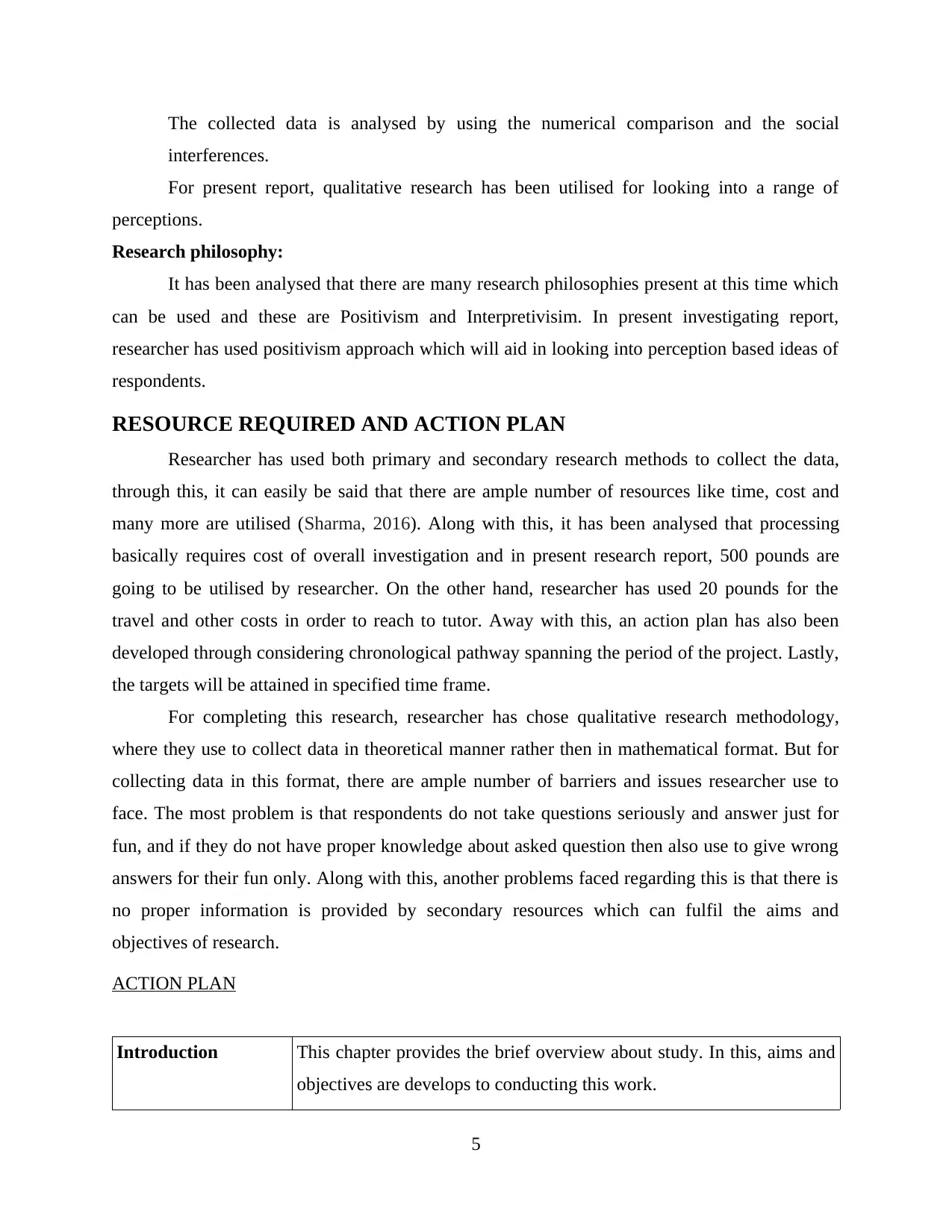
The collected data is analysed by using the numerical comparison and the social
interferences.
For present report, qualitative research has been utilised for looking into a range of
perceptions.
Research philosophy:
It has been analysed that there are many research philosophies present at this time which
can be used and these are Positivism and Interpretivisim. In present investigating report,
researcher has used positivism approach which will aid in looking into perception based ideas of
respondents.
RESOURCE REQUIRED AND ACTION PLAN
Researcher has used both primary and secondary research methods to collect the data,
through this, it can easily be said that there are ample number of resources like time, cost and
many more are utilised (Sharma, 2016). Along with this, it has been analysed that processing
basically requires cost of overall investigation and in present research report, 500 pounds are
going to be utilised by researcher. On the other hand, researcher has used 20 pounds for the
travel and other costs in order to reach to tutor. Away with this, an action plan has also been
developed through considering chronological pathway spanning the period of the project. Lastly,
the targets will be attained in specified time frame.
For completing this research, researcher has chose qualitative research methodology,
where they use to collect data in theoretical manner rather then in mathematical format. But for
collecting data in this format, there are ample number of barriers and issues researcher use to
face. The most problem is that respondents do not take questions seriously and answer just for
fun, and if they do not have proper knowledge about asked question then also use to give wrong
answers for their fun only. Along with this, another problems faced regarding this is that there is
no proper information is provided by secondary resources which can fulfil the aims and
objectives of research.
ACTION PLAN
Introduction This chapter provides the brief overview about study. In this, aims and
objectives are develops to conducting this work.
5
interferences.
For present report, qualitative research has been utilised for looking into a range of
perceptions.
Research philosophy:
It has been analysed that there are many research philosophies present at this time which
can be used and these are Positivism and Interpretivisim. In present investigating report,
researcher has used positivism approach which will aid in looking into perception based ideas of
respondents.
RESOURCE REQUIRED AND ACTION PLAN
Researcher has used both primary and secondary research methods to collect the data,
through this, it can easily be said that there are ample number of resources like time, cost and
many more are utilised (Sharma, 2016). Along with this, it has been analysed that processing
basically requires cost of overall investigation and in present research report, 500 pounds are
going to be utilised by researcher. On the other hand, researcher has used 20 pounds for the
travel and other costs in order to reach to tutor. Away with this, an action plan has also been
developed through considering chronological pathway spanning the period of the project. Lastly,
the targets will be attained in specified time frame.
For completing this research, researcher has chose qualitative research methodology,
where they use to collect data in theoretical manner rather then in mathematical format. But for
collecting data in this format, there are ample number of barriers and issues researcher use to
face. The most problem is that respondents do not take questions seriously and answer just for
fun, and if they do not have proper knowledge about asked question then also use to give wrong
answers for their fun only. Along with this, another problems faced regarding this is that there is
no proper information is provided by secondary resources which can fulfil the aims and
objectives of research.
ACTION PLAN
Introduction This chapter provides the brief overview about study. In this, aims and
objectives are develops to conducting this work.
5
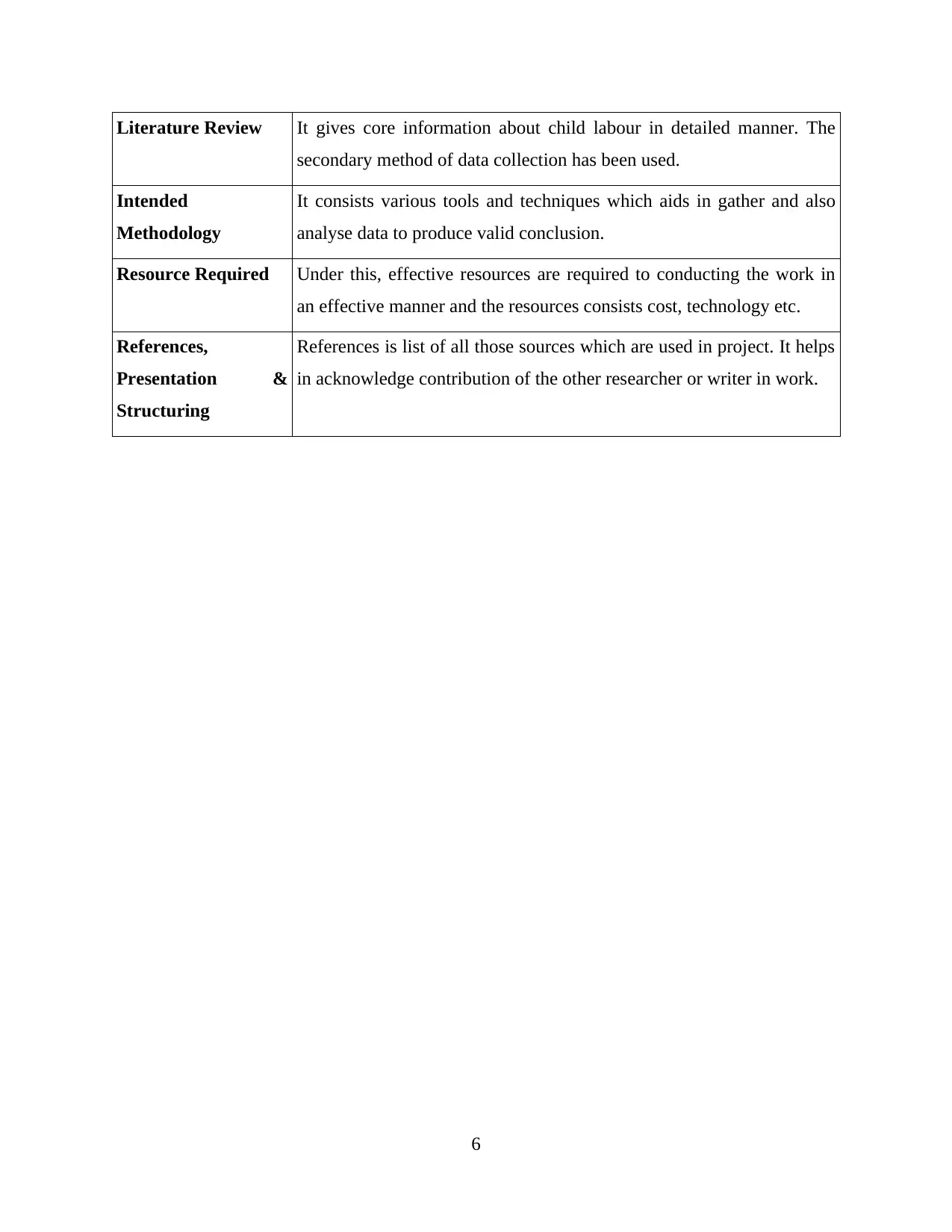
Literature Review It gives core information about child labour in detailed manner. The
secondary method of data collection has been used.
Intended
Methodology
It consists various tools and techniques which aids in gather and also
analyse data to produce valid conclusion.
Resource Required Under this, effective resources are required to conducting the work in
an effective manner and the resources consists cost, technology etc.
References,
Presentation &
Structuring
References is list of all those sources which are used in project. It helps
in acknowledge contribution of the other researcher or writer in work.
6
secondary method of data collection has been used.
Intended
Methodology
It consists various tools and techniques which aids in gather and also
analyse data to produce valid conclusion.
Resource Required Under this, effective resources are required to conducting the work in
an effective manner and the resources consists cost, technology etc.
References,
Presentation &
Structuring
References is list of all those sources which are used in project. It helps
in acknowledge contribution of the other researcher or writer in work.
6
⊘ This is a preview!⊘
Do you want full access?
Subscribe today to unlock all pages.
Trusted by 1+ million students worldwide
REFERENCES
Books and Journals
He, H., 2016. Child labour and academic achievement: Evidence from Gansu Province in
China. China Economic Review. 38. pp.130-150.
Hindman, H. D., 2016. Child labor: an American history. Routledge.
Honeyman, K., 2016. Child workers in England, 1780–1820: parish apprentices and the making
of the early industrial labour force. Routledge.
Honeyman, K., 2016. Childhood and child labour in industrial England: Diversity and agency,
1750–1914. Routledge.
Koomson, I. and Asongu, S. A., 2016. Relative Contribution of Child Labour to Household Farm
and Non‐Farm Income in Ghana: Simulation with Child's Education. African
Development Review. 28(1). pp.104-115.
Maconachie, R. and Hilson, G., 2016. Re-thinking the child labor “problem” in rural sub-
Saharan Africa: The case of Sierra Leone’s Half Shovels. World Development. 78.
pp.136-147.
Nogler, L. and Pertile, M., 2016. Child labour in a globalized world: a legal analysis of ILO
action. Routledge.
Rahikainen, M., 2017. Centuries of child labour: European experiences from the seventeenth to
the twentieth century. Routledge.
Sharma, K., 2016. Trade, Growth and Child Labour Practices in South Asia. In Child Labour in
South Asia (pp. 77-90). Routledge.
Sturrock, S. and Hodes, M., 2016. Child labour in low-and middle-income countries and its
consequences for mental health: a systematic literature review of epidemiologic
studies. European child & adolescent psychiatry. 25(12). pp.1273-1286.
Online
Five ways we can help to eliminate child labour. 2019. [Online]. Available Through:
<https://www.responsiblebusiness.com/news/africas-news/five-ways-we-can-help-to-
eliminate-child-labour/>
7
Books and Journals
He, H., 2016. Child labour and academic achievement: Evidence from Gansu Province in
China. China Economic Review. 38. pp.130-150.
Hindman, H. D., 2016. Child labor: an American history. Routledge.
Honeyman, K., 2016. Child workers in England, 1780–1820: parish apprentices and the making
of the early industrial labour force. Routledge.
Honeyman, K., 2016. Childhood and child labour in industrial England: Diversity and agency,
1750–1914. Routledge.
Koomson, I. and Asongu, S. A., 2016. Relative Contribution of Child Labour to Household Farm
and Non‐Farm Income in Ghana: Simulation with Child's Education. African
Development Review. 28(1). pp.104-115.
Maconachie, R. and Hilson, G., 2016. Re-thinking the child labor “problem” in rural sub-
Saharan Africa: The case of Sierra Leone’s Half Shovels. World Development. 78.
pp.136-147.
Nogler, L. and Pertile, M., 2016. Child labour in a globalized world: a legal analysis of ILO
action. Routledge.
Rahikainen, M., 2017. Centuries of child labour: European experiences from the seventeenth to
the twentieth century. Routledge.
Sharma, K., 2016. Trade, Growth and Child Labour Practices in South Asia. In Child Labour in
South Asia (pp. 77-90). Routledge.
Sturrock, S. and Hodes, M., 2016. Child labour in low-and middle-income countries and its
consequences for mental health: a systematic literature review of epidemiologic
studies. European child & adolescent psychiatry. 25(12). pp.1273-1286.
Online
Five ways we can help to eliminate child labour. 2019. [Online]. Available Through:
<https://www.responsiblebusiness.com/news/africas-news/five-ways-we-can-help-to-
eliminate-child-labour/>
7

1 out of 10


Related Documents


Your All-in-One AI-Powered Toolkit for Academic Success.
+13062052269
info@desklib.com
Available 24*7 on WhatsApp / Email
![[object Object]](/_next/static/media/star-bottom.7253800d.svg)
Unlock your academic potential
Copyright © 2020–2025 A2Z Services. All Rights Reserved. Developed and managed by ZUCOL.