Research Methods: Reflective Essay on Quantitative Analysis of Tesco
VerifiedAdded on 2023/06/10
|7
|1315
|269
Essay
AI Summary
This essay presents a reflection on research methods, employing Gibbs' Reflective Cycle to analyze a quantitative investigation of Tesco's performance and engagement management. The reflection details the research process, including problem definition, literature review, data analysis using ONS data, and the challenges encountered. The author discusses their feelings during the research, what went well and what could have been improved, and outlines an action plan for future research endeavors. The essay highlights the acquisition of skills in quantitative analysis and literature review, concluding with a summary of the research methods used, including positivism philosophy, deductive approach, and mono-method quantitative data collection. Desklib provides a platform for students to access similar solved assignments and past papers.
RESEARCH
METHODS
(Reflection)
METHODS
(Reflection)
Paraphrase This Document
Need a fresh take? Get an instant paraphrase of this document with our AI Paraphraser

Table of Contents
INTRODUCTION...........................................................................................................................1
MAIN BODY...................................................................................................................................1
CONCLUSION................................................................................................................................3
References........................................................................................................................................5
INTRODUCTION...........................................................................................................................1
MAIN BODY...................................................................................................................................1
CONCLUSION................................................................................................................................3
References........................................................................................................................................5

INTRODUCTION
Research is defined as the type of systematic investigation in which study is conducted of
several materials collected so that the development of facts can be conducted using assorted
sources of investigation in order to draw the new conclusions. It is basically the systematic and
creative work which is undertaken to improve the knowledge on the particular topic of research.
It generally involves the collection of data which is converted into relevant information that is
contented in the research report (Cr, 2020). It includes the analysis and organization of the data
to define the issues. It is a project which is the expanded form of the previous researches.
The chosen theoretical model is Gibbs Reflective cycle in order to produce the current
reflective report on the investigation undertaken based on quantitative analysis of data sets.
Gibbs reflective model is defined as the self reflection tool which is managed by the people to
think in a clear manner so that the experiences can be contented in a systematic way (Adeani,
Febriani and Syafryadin, 2020). People describes that what experiences they have gone through
and what activities they are indulged into while undertaking the project in order to draw the
suitable and an appropriate conclusions.
MAIN BODY
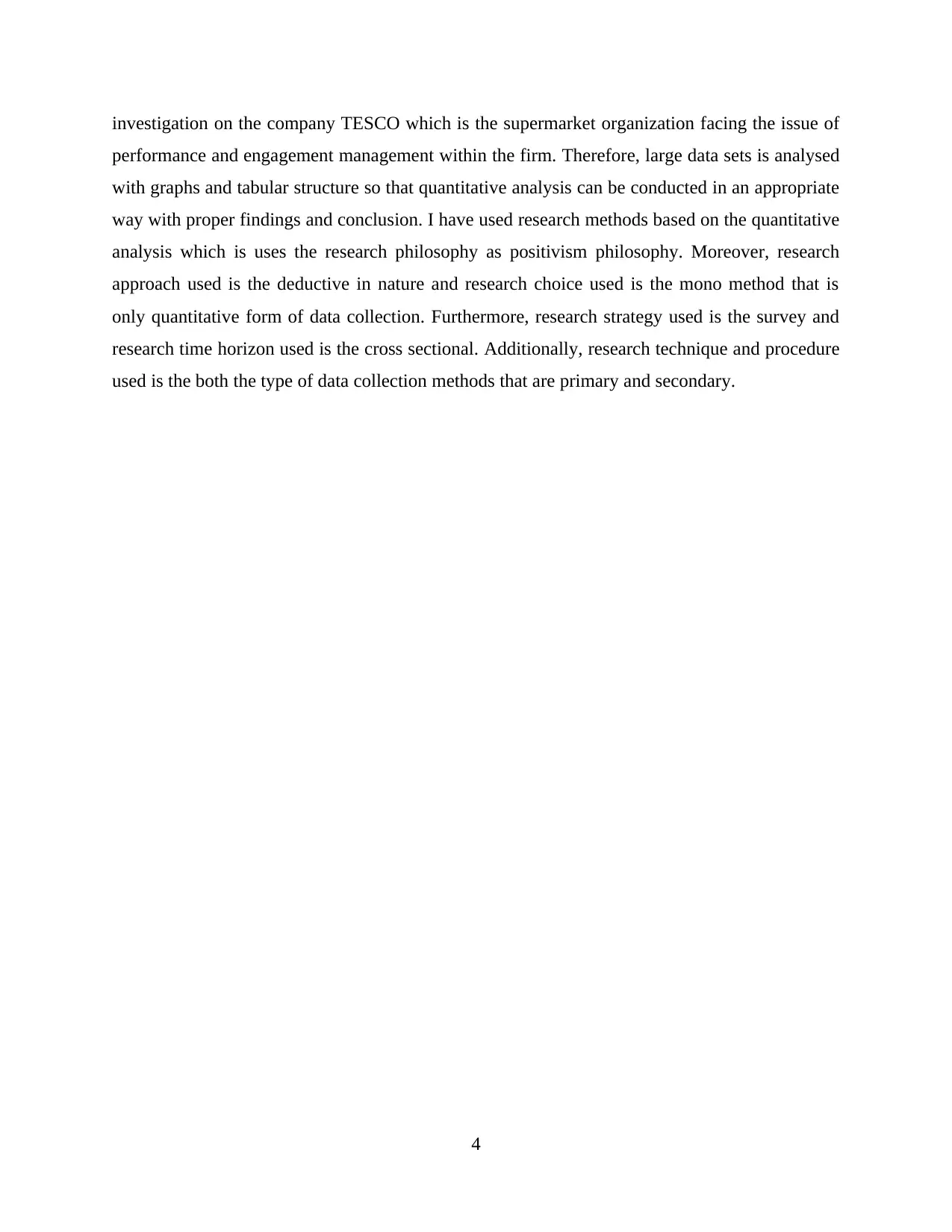
There are several stages of Gibbs reflective cycle with the help of which the reflection is
conducted step by step. Description is the first stage which describes the exactly what happened
at the time of project undertaking (Sekarwinahyu, Rustaman, Widodo and Riandi, 2019). I have
conducted the investigation on on TESCO who is facing the issue of performance and
engagement management within the firm. First I have defined the business problem then
accordingly conducted the literature review, then I have identified the data set sourced from the
ONS website, further I have used the quantitative type of analysis of the data sets while
presenting the visualization of data drawn from the analysis. Then finally I have contented out
the findings and conclusions. Feelings is the second stage which describes that actually what I
am thinking and feeling at the time of research. I was thinking that data analysis is a difficult task
because there large data sets which complicates the analysis. Moreover, I was feeling that I
should break them into smaller data sets so that in depth quantitative analysis can be undertaken.
Quantitative analysis is a type of examination of facts and figures in which numeric data is
considered. Evaluation is the third stage which describes that what was good and bad about the
1
Research is defined as the type of systematic investigation in which study is conducted of
several materials collected so that the development of facts can be conducted using assorted
sources of investigation in order to draw the new conclusions. It is basically the systematic and
creative work which is undertaken to improve the knowledge on the particular topic of research.
It generally involves the collection of data which is converted into relevant information that is
contented in the research report (Cr, 2020). It includes the analysis and organization of the data
to define the issues. It is a project which is the expanded form of the previous researches.
The chosen theoretical model is Gibbs Reflective cycle in order to produce the current
reflective report on the investigation undertaken based on quantitative analysis of data sets.
Gibbs reflective model is defined as the self reflection tool which is managed by the people to
think in a clear manner so that the experiences can be contented in a systematic way (Adeani,
Febriani and Syafryadin, 2020). People describes that what experiences they have gone through
and what activities they are indulged into while undertaking the project in order to draw the
suitable and an appropriate conclusions.
MAIN BODY
There are several stages of Gibbs reflective cycle with the help of which the reflection is
conducted step by step. Description is the first stage which describes the exactly what happened
at the time of project undertaking (Sekarwinahyu, Rustaman, Widodo and Riandi, 2019). I have
conducted the investigation on on TESCO who is facing the issue of performance and
engagement management within the firm. First I have defined the business problem then
accordingly conducted the literature review, then I have identified the data set sourced from the
ONS website, further I have used the quantitative type of analysis of the data sets while
presenting the visualization of data drawn from the analysis. Then finally I have contented out
the findings and conclusions. Feelings is the second stage which describes that actually what I
am thinking and feeling at the time of research. I was thinking that data analysis is a difficult task
because there large data sets which complicates the analysis. Moreover, I was feeling that I
should break them into smaller data sets so that in depth quantitative analysis can be undertaken.
Quantitative analysis is a type of examination of facts and figures in which numeric data is
considered. Evaluation is the third stage which describes that what was good and bad about the
1
⊘ This is a preview!⊘
Do you want full access?
Subscribe today to unlock all pages.

Trusted by 1+ million students worldwide

experience (Pieper, Roelle, vom Hofe and Berthold, 2021). Talking about the good part, I have
learnt that how the quantitative type of data analysis is conducted and how to study the large data
sets in a systematic manner. Talking about the bad part, I had faced problem in the investigation
of literature review part because it contains the theoretical data which was difficult to find out
from the well known authors or from the books and articles. Analysis is the fourth stage which
describes that what else can I make of the situation. I have taken the situation of TESCO in terms
of performance management. Other issues can also be taken such as consumer buying behaviour
and customer satisfaction. This is because qualitative type of analysis can be made in a more
appropriate manner if other issues were chosen with large data sets. Conclusion is the fifth stage
which describes what else could I have done. I would have more focused on the literature review
part so that the authentic data can be contented out as per to the quantitative analysis undertaken.
Action Plan is the sixth stage which describes that if the issue rose again then what could I do
(Othman, Effendi, Kamaruddin and Zainal, 2020). If the issue within TESCO rose again then I
will definitely conduct the research again while applying different methods of research so that
findings and conclusion can be drawn in a proper manner. I would have used the questionnaire
type of quantitative analysis so that personalised opinions can be gathered from the people and
issue can be addressed in a more appropriate manner. Interviews can also be conducted so that
face to face conversation can help in addressing the issue in a detailed manner.
2
learnt that how the quantitative type of data analysis is conducted and how to study the large data
sets in a systematic manner. Talking about the bad part, I had faced problem in the investigation
of literature review part because it contains the theoretical data which was difficult to find out
from the well known authors or from the books and articles. Analysis is the fourth stage which
describes that what else can I make of the situation. I have taken the situation of TESCO in terms
of performance management. Other issues can also be taken such as consumer buying behaviour
and customer satisfaction. This is because qualitative type of analysis can be made in a more
appropriate manner if other issues were chosen with large data sets. Conclusion is the fifth stage
which describes what else could I have done. I would have more focused on the literature review
part so that the authentic data can be contented out as per to the quantitative analysis undertaken.
Action Plan is the sixth stage which describes that if the issue rose again then what could I do
(Othman, Effendi, Kamaruddin and Zainal, 2020). If the issue within TESCO rose again then I
will definitely conduct the research again while applying different methods of research so that
findings and conclusion can be drawn in a proper manner. I would have used the questionnaire
type of quantitative analysis so that personalised opinions can be gathered from the people and
issue can be addressed in a more appropriate manner. Interviews can also be conducted so that
face to face conversation can help in addressing the issue in a detailed manner.
2
Paraphrase This Document
Need a fresh take? Get an instant paraphrase of this document with our AI Paraphraser

How I felt after the first assessment and my beliefs
I have used my existing skills in order to attain the objectives of research such as written
and verbal communication skills along with the research skills and cognitive skills. Moreover, I
have gained further more skills after completing the research such as research skills and
analytical skills along with the time management skills and problem solving skills as well.
Therefore, my personal experience was good as I have learnt many things and according to my
beliefs, research was conducted in a very well manner in a systematic way.
CONCLUSION
I have acquired different types of knowledge while conducting the research such as
earlier I was not known about the proper implementation of the quantitative analysis and also
how the literature review is conducted. But now after completing the module, I can apply my
knowledge in conducting the quantitative analysis and how to research about the well known
authors in order to write the literature review in an authentic manner. I have conducted my
3
I have used my existing skills in order to attain the objectives of research such as written
and verbal communication skills along with the research skills and cognitive skills. Moreover, I
have gained further more skills after completing the research such as research skills and
analytical skills along with the time management skills and problem solving skills as well.
Therefore, my personal experience was good as I have learnt many things and according to my
beliefs, research was conducted in a very well manner in a systematic way.
CONCLUSION
I have acquired different types of knowledge while conducting the research such as
earlier I was not known about the proper implementation of the quantitative analysis and also
how the literature review is conducted. But now after completing the module, I can apply my
knowledge in conducting the quantitative analysis and how to research about the well known
authors in order to write the literature review in an authentic manner. I have conducted my
3

investigation on the company TESCO which is the supermarket organization facing the issue of
performance and engagement management within the firm. Therefore, large data sets is analysed
with graphs and tabular structure so that quantitative analysis can be conducted in an appropriate
way with proper findings and conclusion. I have used research methods based on the quantitative
analysis which is uses the research philosophy as positivism philosophy. Moreover, research
approach used is the deductive in nature and research choice used is the mono method that is
only quantitative form of data collection. Furthermore, research strategy used is the survey and
research time horizon used is the cross sectional. Additionally, research technique and procedure
used is the both the type of data collection methods that are primary and secondary.
4
performance and engagement management within the firm. Therefore, large data sets is analysed
with graphs and tabular structure so that quantitative analysis can be conducted in an appropriate
way with proper findings and conclusion. I have used research methods based on the quantitative
analysis which is uses the research philosophy as positivism philosophy. Moreover, research
approach used is the deductive in nature and research choice used is the mono method that is
only quantitative form of data collection. Furthermore, research strategy used is the survey and
research time horizon used is the cross sectional. Additionally, research technique and procedure
used is the both the type of data collection methods that are primary and secondary.
4
⊘ This is a preview!⊘
Do you want full access?
Subscribe today to unlock all pages.

Trusted by 1+ million students worldwide

References
Books and Journals
Adeani, I.S., Febriani, R.B. and Syafryadin, S., 2020. USING GIBBS’REFLECTIVE CYCLE IN
MAKING REFLECTIONS OF LITERARY ANALYSIS. Indonesian EFL Journal, 6(2),
pp.139-148.
Cr, K., 2020. Research methodology methods and techniques.
Othman, N., Effendi, M., Kamaruddin, M. and Zainal, M.A., 2020. A Special Education
Teacher’s Reflection: Gibbs Reflective Cycle. Solid State Technology, pp.6098-6107.
Pieper, M., Roelle, J., vom Hofe, R. and Berthold, K., 2021. Feedback in reflective journals
fosters reflection skills of student teachers. Psychology Learning & Teaching, 20(1),
pp.107-127.
Sekarwinahyu, M., Rustaman, N.Y., Widodo, A. and Riandi, R., 2019, February. Development
of problem based learning for online tutorial program in plant development using Gibbs’
reflective cycle and e-portfolio to enhance reflective thinking skills. In Journal of Physics:
Conference Series (Vol. 1157, No. 2, p. 022099). IOP Publishing.
5
Books and Journals
Adeani, I.S., Febriani, R.B. and Syafryadin, S., 2020. USING GIBBS’REFLECTIVE CYCLE IN
MAKING REFLECTIONS OF LITERARY ANALYSIS. Indonesian EFL Journal, 6(2),
pp.139-148.
Cr, K., 2020. Research methodology methods and techniques.
Othman, N., Effendi, M., Kamaruddin, M. and Zainal, M.A., 2020. A Special Education
Teacher’s Reflection: Gibbs Reflective Cycle. Solid State Technology, pp.6098-6107.
Pieper, M., Roelle, J., vom Hofe, R. and Berthold, K., 2021. Feedback in reflective journals
fosters reflection skills of student teachers. Psychology Learning & Teaching, 20(1),
pp.107-127.
Sekarwinahyu, M., Rustaman, N.Y., Widodo, A. and Riandi, R., 2019, February. Development
of problem based learning for online tutorial program in plant development using Gibbs’
reflective cycle and e-portfolio to enhance reflective thinking skills. In Journal of Physics:
Conference Series (Vol. 1157, No. 2, p. 022099). IOP Publishing.
5
1 out of 7
Related Documents
Your All-in-One AI-Powered Toolkit for Academic Success.
+13062052269
info@desklib.com
Available 24*7 on WhatsApp / Email
Unlock your academic potential
Copyright © 2020–2026 A2Z Services. All Rights Reserved. Developed and managed by ZUCOL.