Evaluation of Probability Distribution Functions in Communication
VerifiedAdded on 2020/06/06
|12
|2584
|73
Report
AI Summary
This research paper delves into the critical role of probability distribution functions in optimizing communication channels. The introduction establishes the significance of probability distributions in analyzing potential outcomes within various experiments, emphasizing their application in telecommunication and computer networks. The report provides a comprehensive overview of different probability distribution functions, including cumulative distribution function (CDF), probability mass function (PMF), probability density function (PDF), normal distribution, binomial distribution, and Poisson binomial distribution, explaining their mathematical expressions and practical applications. The paper highlights the advantages and limitations of each distribution channel, offering a critical evaluation of their impact on communication effectiveness. It explores how these functions facilitate informed decision-making and enhance the clarity and convenience of information exchange, especially in sectors like IT and telecommunications. The conclusion reinforces the importance of probability distribution channels in telecommunication services and summarizes the findings, emphasizing the discrete and continuous probability forms for data approximation and implementation of strategies. References to various journals and books support the analysis, providing a robust foundation for understanding the subject.
RESEARCH PAPER

Paraphrase This Document
Need a fresh take? Get an instant paraphrase of this document with our AI Paraphraser
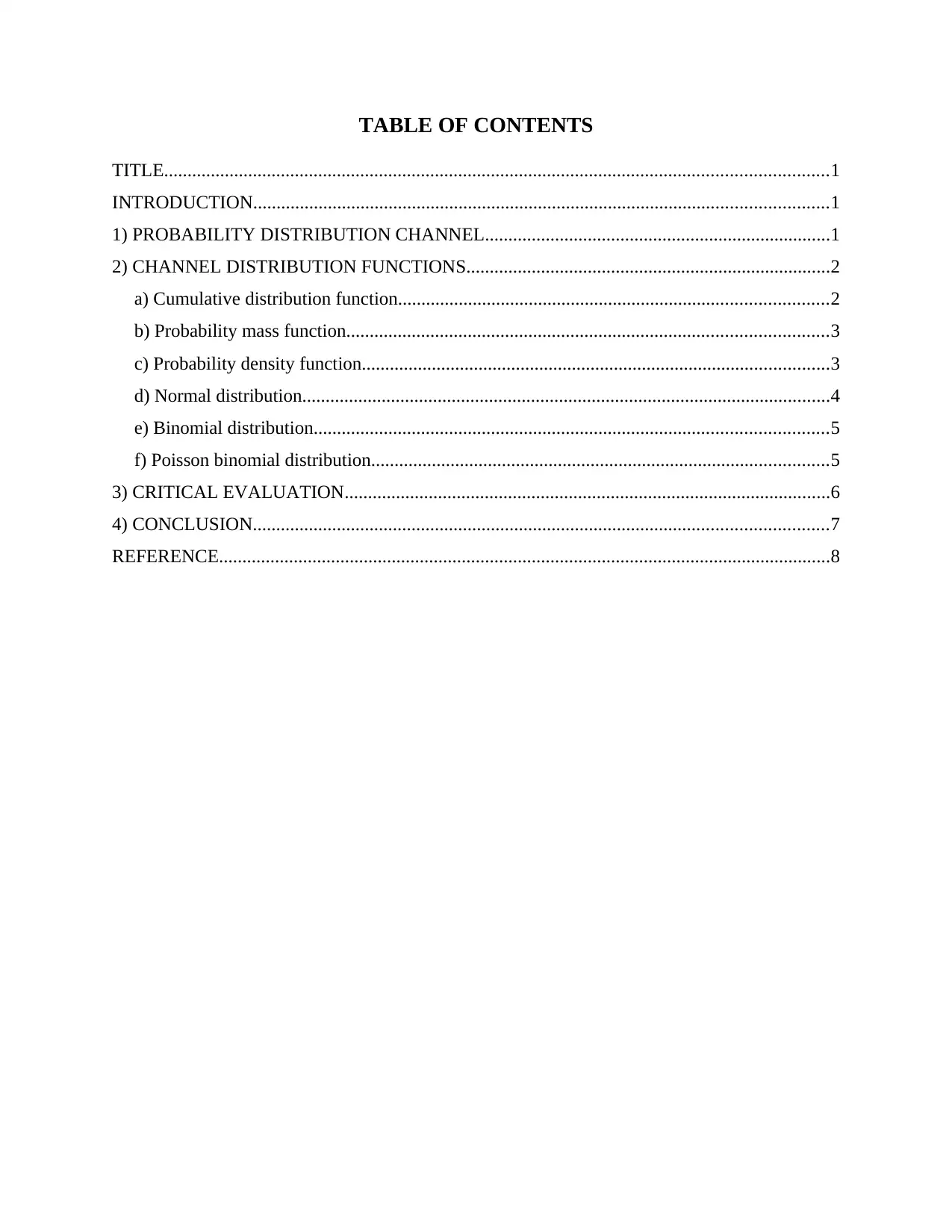
TABLE OF CONTENTS
TITLE..............................................................................................................................................1
INTRODUCTION...........................................................................................................................1
1) PROBABILITY DISTRIBUTION CHANNEL..........................................................................1
2) CHANNEL DISTRIBUTION FUNCTIONS..............................................................................2
a) Cumulative distribution function............................................................................................2
b) Probability mass function.......................................................................................................3
c) Probability density function....................................................................................................3
d) Normal distribution.................................................................................................................4
e) Binomial distribution..............................................................................................................5
f) Poisson binomial distribution..................................................................................................5
3) CRITICAL EVALUATION........................................................................................................6
4) CONCLUSION...........................................................................................................................7
REFERENCE...................................................................................................................................8
TITLE..............................................................................................................................................1
INTRODUCTION...........................................................................................................................1
1) PROBABILITY DISTRIBUTION CHANNEL..........................................................................1
2) CHANNEL DISTRIBUTION FUNCTIONS..............................................................................2
a) Cumulative distribution function............................................................................................2
b) Probability mass function.......................................................................................................3
c) Probability density function....................................................................................................3
d) Normal distribution.................................................................................................................4
e) Binomial distribution..............................................................................................................5
f) Poisson binomial distribution..................................................................................................5
3) CRITICAL EVALUATION........................................................................................................6
4) CONCLUSION...........................................................................................................................7
REFERENCE...................................................................................................................................8

ILLUSTRATION INDEX
Illustration 1: Probability Distribution channels..............................................................................4
Illustration 1: Probability Distribution channels..............................................................................4
⊘ This is a preview!⊘
Do you want full access?
Subscribe today to unlock all pages.

Trusted by 1+ million students worldwide
TITLE
Review and Evaluation of Probability Distribution Functions for Communication
Channels.
INTRODUCTION
Possible distribution refers as mathematical function that provides different possibilities
of occurring several outcomes in any experiment. In this regard, variety of probabilities are
obtained for choosing the best alternate out of several. The present report is based on
understanding different probability distributions and their functions for communication channels
to share information through telecommunication and computer network. In this regard, different
functions as cumulative, probability density and probability mass can be described in brief with
mathematical expressions. However, distribution channels' advantages, limitations and overall
study is to be introduced. Thus, students are able to understand concept of probability
distribution channels in telecommunication sector through this assignment.
1) PROBABILITY DISTRIBUTION CHANNEL
According to Yu and et.al., (2016) probability distribution channels are used in different
forms for estimation on variables and several tools. It is of two kinds as discrete and contribution
probabilities for occurring possibilities of outcomes. In discrete distribution channel, probability
is created through coin toss, roll of dice etc. It comes under mass function that is also created
probability on results and further decisions are made for distribution effectively. In order to this,
possibilities are obtained for exchanging information and analysing methods for probability
through tossing coin and throwing dice. While, on the other hand, in continuous distribution
channel, possibility on set of outcomes is done through real numbers like; temperature on given
day also covers under probability density function. Including this, normal distribution is related
with continuous probability distribution for assumptions on occurred outcomes. Similarly,
multivariate normal distribution is used for multiple choices and alternatives. Therefore, different
kinds of probability channels are used in several ways for telecommunication channels linked to
selecting the best alternative option as well method for sharing information.
For example; in IT companies, analysing frequency of phone calls or contact manner
remains helpful for effective communication and increasing good understanding. As per the
point of view of Yang, Liu and Zhou, (2014) different communication channels as verbal, non-
1
Review and Evaluation of Probability Distribution Functions for Communication
Channels.
INTRODUCTION
Possible distribution refers as mathematical function that provides different possibilities
of occurring several outcomes in any experiment. In this regard, variety of probabilities are
obtained for choosing the best alternate out of several. The present report is based on
understanding different probability distributions and their functions for communication channels
to share information through telecommunication and computer network. In this regard, different
functions as cumulative, probability density and probability mass can be described in brief with
mathematical expressions. However, distribution channels' advantages, limitations and overall
study is to be introduced. Thus, students are able to understand concept of probability
distribution channels in telecommunication sector through this assignment.
1) PROBABILITY DISTRIBUTION CHANNEL
According to Yu and et.al., (2016) probability distribution channels are used in different
forms for estimation on variables and several tools. It is of two kinds as discrete and contribution
probabilities for occurring possibilities of outcomes. In discrete distribution channel, probability
is created through coin toss, roll of dice etc. It comes under mass function that is also created
probability on results and further decisions are made for distribution effectively. In order to this,
possibilities are obtained for exchanging information and analysing methods for probability
through tossing coin and throwing dice. While, on the other hand, in continuous distribution
channel, possibility on set of outcomes is done through real numbers like; temperature on given
day also covers under probability density function. Including this, normal distribution is related
with continuous probability distribution for assumptions on occurred outcomes. Similarly,
multivariate normal distribution is used for multiple choices and alternatives. Therefore, different
kinds of probability channels are used in several ways for telecommunication channels linked to
selecting the best alternative option as well method for sharing information.
For example; in IT companies, analysing frequency of phone calls or contact manner
remains helpful for effective communication and increasing good understanding. As per the
point of view of Yang, Liu and Zhou, (2014) different communication channels as verbal, non-
1
Paraphrase This Document
Need a fresh take? Get an instant paraphrase of this document with our AI Paraphraser
verbal, audio-visual and written can be more easy and convenient by using probability
distribution channels. However, using statistical tools and mathematical expressions as well
using tools for creating probability on information technologies and sharing information
effectively. Thus, probability distribution channels remain helpful for clear and convenient
communication between two or more respondents.
2) CHANNEL DISTRIBUTION FUNCTIONS
In opinion of Kawata, Yoshida and Hasegawa, (2017) there are different functions used
for creating probability on occurred results as well preparing strategies for further activities. It is
useful for selecting the best alternative in respect of quantitative and qualitative forms. Including
this, by using different statistical tools and equations, probability distribution of variables are
possible that is able to create effectiveness in communication properly. In this project report for
communication and improving quality of sharing information, several tools are applied for
probabilities and also for identifying the best tool among of the several options. Thus, for ease
and convenient communication and method, different probability distribution functions are used
can be understood as below mentioned tools:
a) Cumulative distribution function (CDF)
Purushothaman and et.al., (2017) express that in this probability distribution function, it
is considered that random variable is of less than certain value. For understanding this aspect
equation is: [F(c) = P(X<c)].
Here, F(c) represents CDF,
X is for certain value
And, c demonstrates random value.
However, CDF is applicable for both discrete and continuous distribution channels
depends on choice and probability for occurred the best outcome. For both distributions,
equation/ formula used is:
For discrete distribution:
F(c)=∑c−∞p(c)
2
distribution channels. However, using statistical tools and mathematical expressions as well
using tools for creating probability on information technologies and sharing information
effectively. Thus, probability distribution channels remain helpful for clear and convenient
communication between two or more respondents.
2) CHANNEL DISTRIBUTION FUNCTIONS
In opinion of Kawata, Yoshida and Hasegawa, (2017) there are different functions used
for creating probability on occurred results as well preparing strategies for further activities. It is
useful for selecting the best alternative in respect of quantitative and qualitative forms. Including
this, by using different statistical tools and equations, probability distribution of variables are
possible that is able to create effectiveness in communication properly. In this project report for
communication and improving quality of sharing information, several tools are applied for
probabilities and also for identifying the best tool among of the several options. Thus, for ease
and convenient communication and method, different probability distribution functions are used
can be understood as below mentioned tools:
a) Cumulative distribution function (CDF)
Purushothaman and et.al., (2017) express that in this probability distribution function, it
is considered that random variable is of less than certain value. For understanding this aspect
equation is: [F(c) = P(X<c)].
Here, F(c) represents CDF,
X is for certain value
And, c demonstrates random value.
However, CDF is applicable for both discrete and continuous distribution channels
depends on choice and probability for occurred the best outcome. For both distributions,
equation/ formula used is:
For discrete distribution:
F(c)=∑c−∞p(c)
2
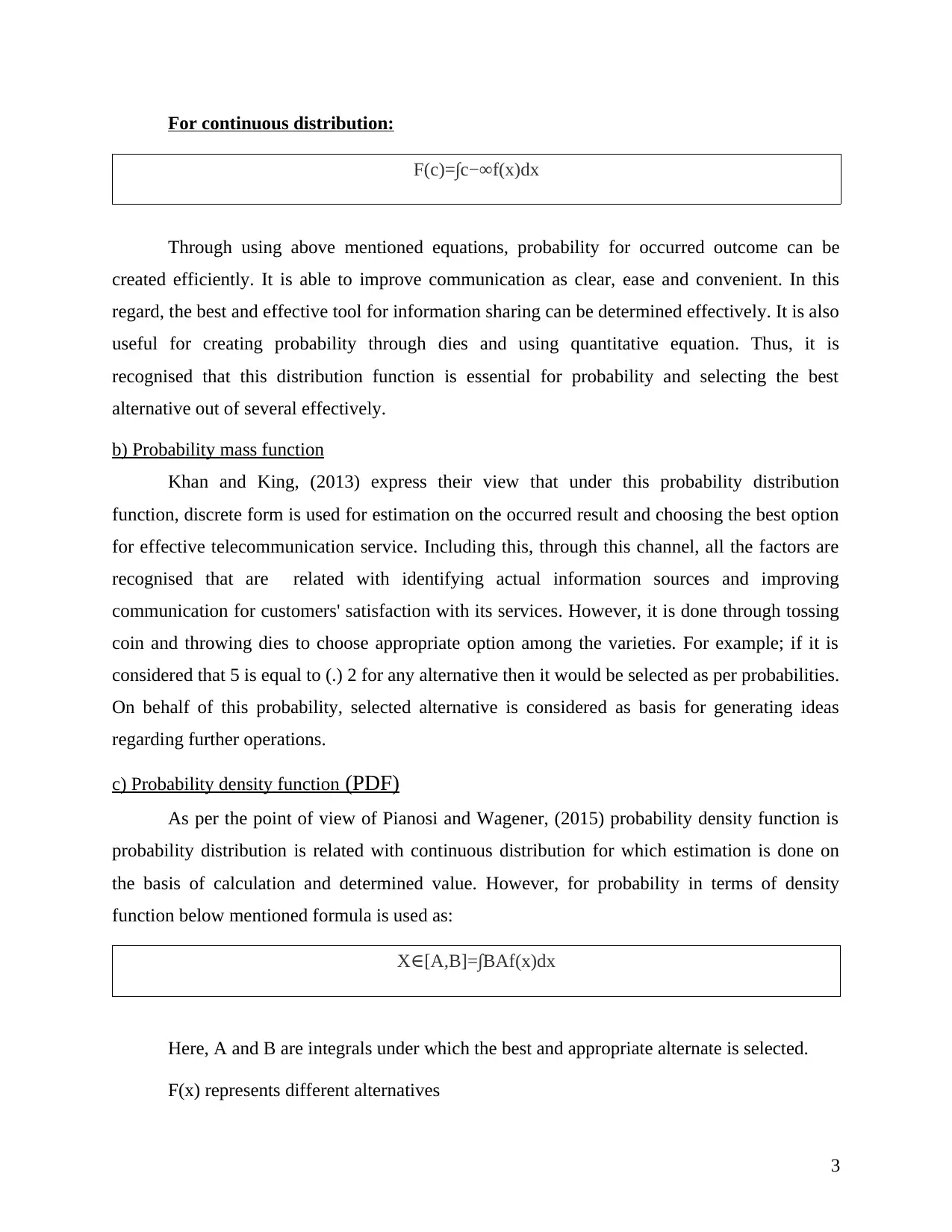
For continuous distribution:
F(c)=∫c−∞f(x)dx
Through using above mentioned equations, probability for occurred outcome can be
created efficiently. It is able to improve communication as clear, ease and convenient. In this
regard, the best and effective tool for information sharing can be determined effectively. It is also
useful for creating probability through dies and using quantitative equation. Thus, it is
recognised that this distribution function is essential for probability and selecting the best
alternative out of several effectively.
b) Probability mass function
Khan and King, (2013) express their view that under this probability distribution
function, discrete form is used for estimation on the occurred result and choosing the best option
for effective telecommunication service. Including this, through this channel, all the factors are
recognised that are related with identifying actual information sources and improving
communication for customers' satisfaction with its services. However, it is done through tossing
coin and throwing dies to choose appropriate option among the varieties. For example; if it is
considered that 5 is equal to (.) 2 for any alternative then it would be selected as per probabilities.
On behalf of this probability, selected alternative is considered as basis for generating ideas
regarding further operations.
c) Probability density function (PDF)
As per the point of view of Pianosi and Wagener, (2015) probability density function is
probability distribution is related with continuous distribution for which estimation is done on
the basis of calculation and determined value. However, for probability in terms of density
function below mentioned formula is used as:
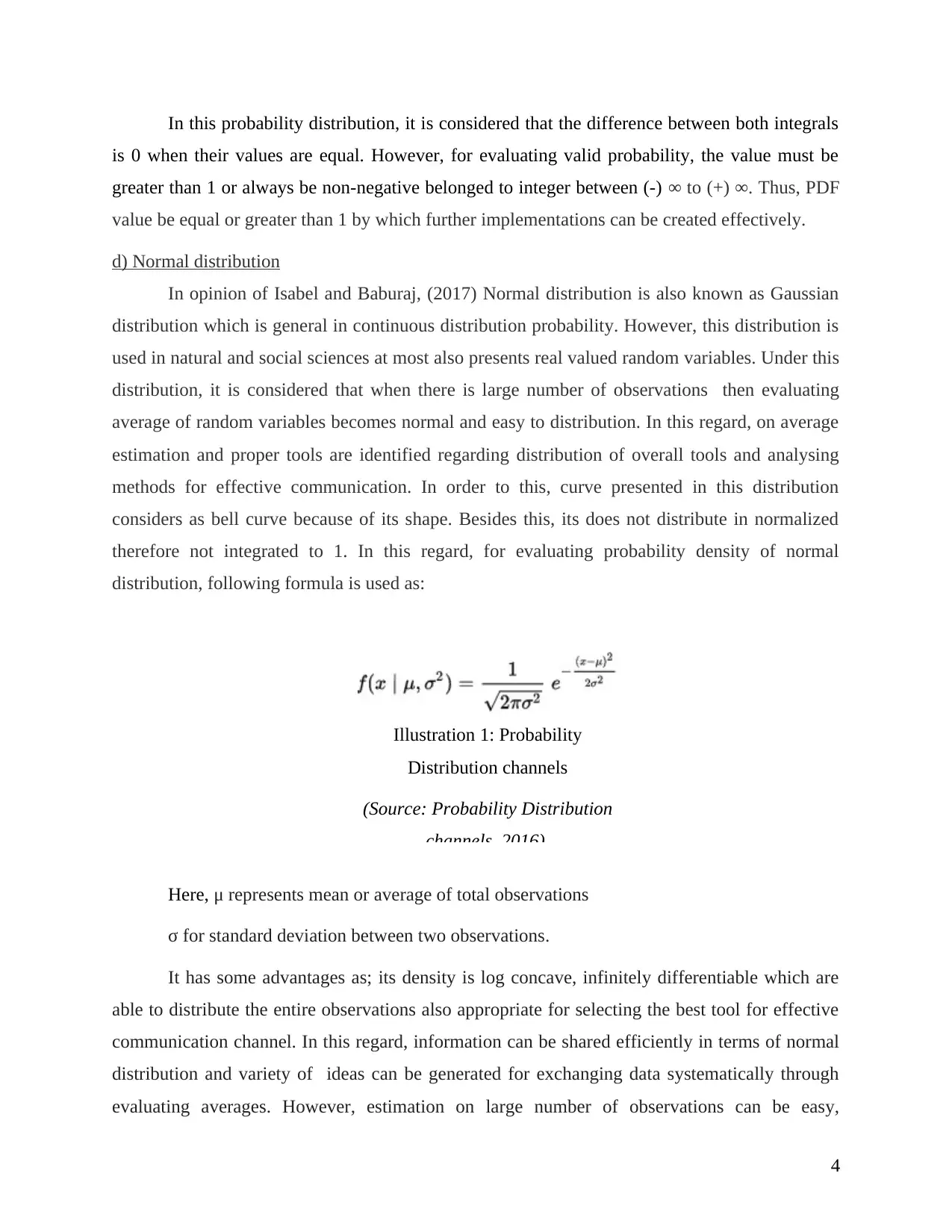
X∈[A,B]=∫BAf(x)dx
Here, A and B are integrals under which the best and appropriate alternate is selected.
F(x) represents different alternatives
3
F(c)=∫c−∞f(x)dx
Through using above mentioned equations, probability for occurred outcome can be
created efficiently. It is able to improve communication as clear, ease and convenient. In this
regard, the best and effective tool for information sharing can be determined effectively. It is also
useful for creating probability through dies and using quantitative equation. Thus, it is
recognised that this distribution function is essential for probability and selecting the best
alternative out of several effectively.
b) Probability mass function
Khan and King, (2013) express their view that under this probability distribution
function, discrete form is used for estimation on the occurred result and choosing the best option
for effective telecommunication service. Including this, through this channel, all the factors are
recognised that are related with identifying actual information sources and improving
communication for customers' satisfaction with its services. However, it is done through tossing
coin and throwing dies to choose appropriate option among the varieties. For example; if it is
considered that 5 is equal to (.) 2 for any alternative then it would be selected as per probabilities.
On behalf of this probability, selected alternative is considered as basis for generating ideas
regarding further operations.
c) Probability density function (PDF)
As per the point of view of Pianosi and Wagener, (2015) probability density function is
probability distribution is related with continuous distribution for which estimation is done on
the basis of calculation and determined value. However, for probability in terms of density
function below mentioned formula is used as:
X∈[A,B]=∫BAf(x)dx
Here, A and B are integrals under which the best and appropriate alternate is selected.
F(x) represents different alternatives
3
⊘ This is a preview!⊘
Do you want full access?
Subscribe today to unlock all pages.
Trusted by 1+ million students worldwide
In this probability distribution, it is considered that the difference between both integrals
is 0 when their values are equal. However, for evaluating valid probability, the value must be
greater than 1 or always be non-negative belonged to integer between (-) ∞ to (+) ∞. Thus, PDF
value be equal or greater than 1 by which further implementations can be created effectively.
d) Normal distribution
In opinion of Isabel and Baburaj, (2017) Normal distribution is also known as Gaussian
distribution which is general in continuous distribution probability. However, this distribution is
used in natural and social sciences at most also presents real valued random variables. Under this
distribution, it is considered that when there is large number of observations then evaluating
average of random variables becomes normal and easy to distribution. In this regard, on average
estimation and proper tools are identified regarding distribution of overall tools and analysing
methods for effective communication. In order to this, curve presented in this distribution
considers as bell curve because of its shape. Besides this, its does not distribute in normalized
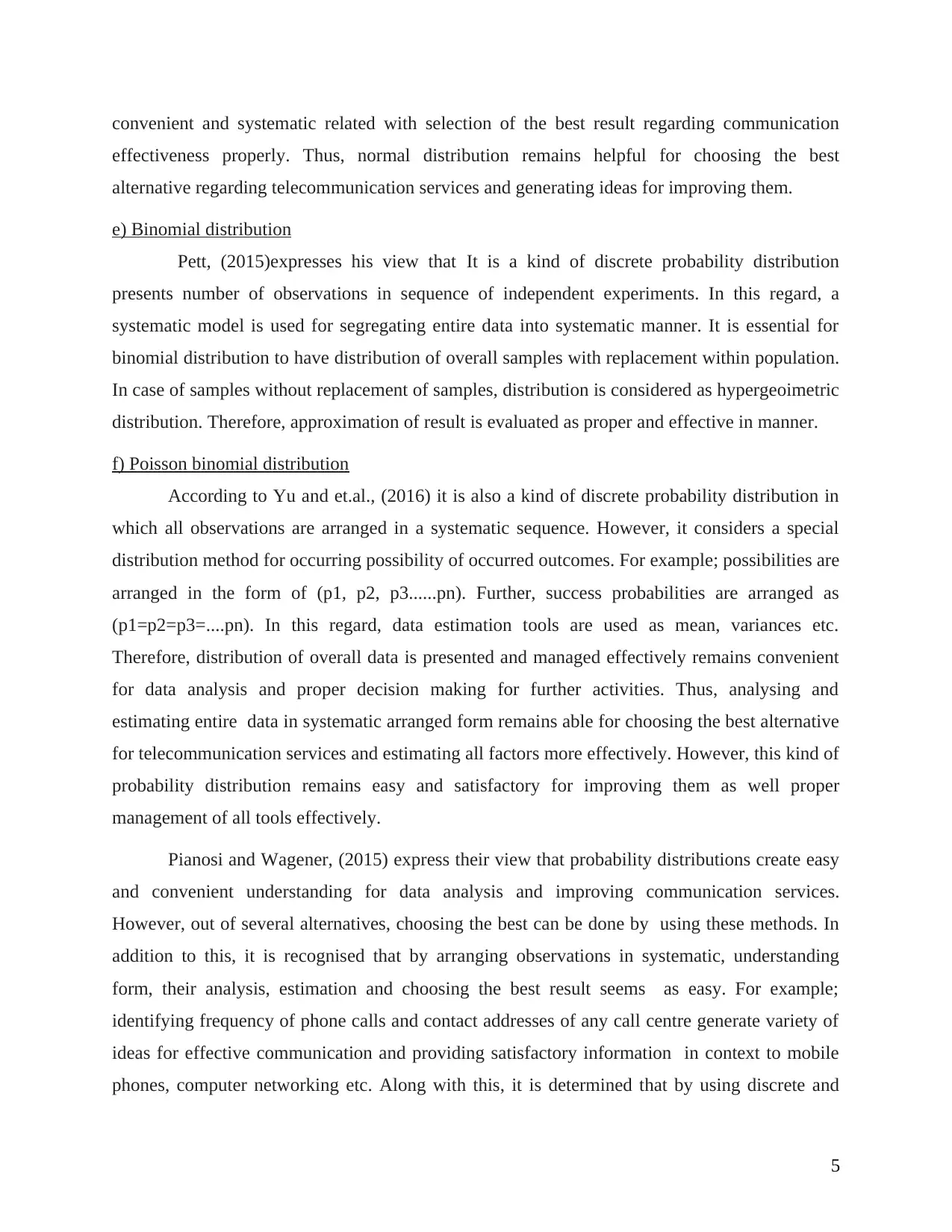
therefore not integrated to 1. In this regard, for evaluating probability density of normal
distribution, following formula is used as:
Here, μ represents mean or average of total observations
σ for standard deviation between two observations.
It has some advantages as; its density is log concave, infinitely differentiable which are
able to distribute the entire observations also appropriate for selecting the best tool for effective
communication channel. In this regard, information can be shared efficiently in terms of normal
distribution and variety of ideas can be generated for exchanging data systematically through
evaluating averages. However, estimation on large number of observations can be easy,
4
Illustration 1: Probability
Distribution channels
(Source: Probability Distribution
channels, 2016).
is 0 when their values are equal. However, for evaluating valid probability, the value must be
greater than 1 or always be non-negative belonged to integer between (-) ∞ to (+) ∞. Thus, PDF
value be equal or greater than 1 by which further implementations can be created effectively.
d) Normal distribution
In opinion of Isabel and Baburaj, (2017) Normal distribution is also known as Gaussian
distribution which is general in continuous distribution probability. However, this distribution is
used in natural and social sciences at most also presents real valued random variables. Under this
distribution, it is considered that when there is large number of observations then evaluating
average of random variables becomes normal and easy to distribution. In this regard, on average
estimation and proper tools are identified regarding distribution of overall tools and analysing
methods for effective communication. In order to this, curve presented in this distribution
considers as bell curve because of its shape. Besides this, its does not distribute in normalized
therefore not integrated to 1. In this regard, for evaluating probability density of normal
distribution, following formula is used as:
Here, μ represents mean or average of total observations
σ for standard deviation between two observations.
It has some advantages as; its density is log concave, infinitely differentiable which are
able to distribute the entire observations also appropriate for selecting the best tool for effective
communication channel. In this regard, information can be shared efficiently in terms of normal
distribution and variety of ideas can be generated for exchanging data systematically through
evaluating averages. However, estimation on large number of observations can be easy,
4
Illustration 1: Probability
Distribution channels
(Source: Probability Distribution
channels, 2016).
Paraphrase This Document
Need a fresh take? Get an instant paraphrase of this document with our AI Paraphraser
convenient and systematic related with selection of the best result regarding communication
effectiveness properly. Thus, normal distribution remains helpful for choosing the best
alternative regarding telecommunication services and generating ideas for improving them.
e) Binomial distribution
Pett, (2015)expresses his view that It is a kind of discrete probability distribution
presents number of observations in sequence of independent experiments. In this regard, a
systematic model is used for segregating entire data into systematic manner. It is essential for
binomial distribution to have distribution of overall samples with replacement within population.
In case of samples without replacement of samples, distribution is considered as hypergeoimetric
distribution. Therefore, approximation of result is evaluated as proper and effective in manner.
f) Poisson binomial distribution
According to Yu and et.al., (2016) it is also a kind of discrete probability distribution in
which all observations are arranged in a systematic sequence. However, it considers a special
distribution method for occurring possibility of occurred outcomes. For example; possibilities are
arranged in the form of (p1, p2, p3......pn). Further, success probabilities are arranged as
(p1=p2=p3=....pn). In this regard, data estimation tools are used as mean, variances etc.
Therefore, distribution of overall data is presented and managed effectively remains convenient
for data analysis and proper decision making for further activities. Thus, analysing and
estimating entire data in systematic arranged form remains able for choosing the best alternative
for telecommunication services and estimating all factors more effectively. However, this kind of
probability distribution remains easy and satisfactory for improving them as well proper
management of all tools effectively.
Pianosi and Wagener, (2015) express their view that probability distributions create easy
and convenient understanding for data analysis and improving communication services.
However, out of several alternatives, choosing the best can be done by using these methods. In
addition to this, it is recognised that by arranging observations in systematic, understanding
form, their analysis, estimation and choosing the best result seems as easy. For example;
identifying frequency of phone calls and contact addresses of any call centre generate variety of
ideas for effective communication and providing satisfactory information in context to mobile
phones, computer networking etc. Along with this, it is determined that by using discrete and
5
effectiveness properly. Thus, normal distribution remains helpful for choosing the best
alternative regarding telecommunication services and generating ideas for improving them.
e) Binomial distribution
Pett, (2015)expresses his view that It is a kind of discrete probability distribution
presents number of observations in sequence of independent experiments. In this regard, a
systematic model is used for segregating entire data into systematic manner. It is essential for
binomial distribution to have distribution of overall samples with replacement within population.
In case of samples without replacement of samples, distribution is considered as hypergeoimetric
distribution. Therefore, approximation of result is evaluated as proper and effective in manner.
f) Poisson binomial distribution
According to Yu and et.al., (2016) it is also a kind of discrete probability distribution in
which all observations are arranged in a systematic sequence. However, it considers a special
distribution method for occurring possibility of occurred outcomes. For example; possibilities are
arranged in the form of (p1, p2, p3......pn). Further, success probabilities are arranged as
(p1=p2=p3=....pn). In this regard, data estimation tools are used as mean, variances etc.
Therefore, distribution of overall data is presented and managed effectively remains convenient
for data analysis and proper decision making for further activities. Thus, analysing and
estimating entire data in systematic arranged form remains able for choosing the best alternative
for telecommunication services and estimating all factors more effectively. However, this kind of
probability distribution remains easy and satisfactory for improving them as well proper
management of all tools effectively.
Pianosi and Wagener, (2015) express their view that probability distributions create easy
and convenient understanding for data analysis and improving communication services.
However, out of several alternatives, choosing the best can be done by using these methods. In
addition to this, it is recognised that by arranging observations in systematic, understanding
form, their analysis, estimation and choosing the best result seems as easy. For example;
identifying frequency of phone calls and contact addresses of any call centre generate variety of
ideas for effective communication and providing satisfactory information in context to mobile
phones, computer networking etc. Along with this, it is determined that by using discrete and
5
continuous probability distribution channels, data and information sharing tools are recognised.
It remains helpful for effective probability on occurred outcomes as well generate more effective
ideas for improving services. Besides this, various tools are considered for creating more
understanding towards communication and sharing information effectively. Therefore, several
distribution tools are used appropriate for data approximations and implementing further plans
efficiently.
3) CRITICAL EVALUATION
Probability distribution functions have both positive and negative aspects that are related
with arrangement of observations and also helpful for selecting the best tool out of various
options. Purushothaman and et.al., (2017) evaluates that it is recognised that on the basis of
approximations, further decisions are made as well appropriate alternative is selected for
regarding communication and method for satisfying customers at maximum level are
determined. As per critical evaluation of Isabel and Baburaj, (2017) on probability distribution
for telecommunication services, following drawbacks are appeared can be understood as below:
Estimation on collected data may wrong as well assumptions for accuracy of gathered
information remains doubtful.
Mismanaged data is difficult for result estimation and error may occur during estimation
and using probability distribution channels.
Observing inaccurate data has no sense to estimate them and preparing strategies for
further activities.
Using probability distribution functions wrongly as well interpreting them in inaccurate
way affects communication medium and people's satisfaction with services adversely.
Thus, on the basis of critical evaluation, different tools, obstacles are evaluated that affect
communication channels and various implementations. Therefore, it is essential for estimating
data in arranged form for effective observation and selecting the best alternate option for sharing
information and improving communication services more efficiently.
4) CONCLUSION
This report is concluded that probability distribution channels are essential for estimation
on observations properly impacts on telecommunication services. In addition to this, different
6
It remains helpful for effective probability on occurred outcomes as well generate more effective
ideas for improving services. Besides this, various tools are considered for creating more
understanding towards communication and sharing information effectively. Therefore, several
distribution tools are used appropriate for data approximations and implementing further plans
efficiently.
3) CRITICAL EVALUATION
Probability distribution functions have both positive and negative aspects that are related
with arrangement of observations and also helpful for selecting the best tool out of various
options. Purushothaman and et.al., (2017) evaluates that it is recognised that on the basis of
approximations, further decisions are made as well appropriate alternative is selected for
regarding communication and method for satisfying customers at maximum level are
determined. As per critical evaluation of Isabel and Baburaj, (2017) on probability distribution
for telecommunication services, following drawbacks are appeared can be understood as below:
Estimation on collected data may wrong as well assumptions for accuracy of gathered
information remains doubtful.
Mismanaged data is difficult for result estimation and error may occur during estimation
and using probability distribution channels.
Observing inaccurate data has no sense to estimate them and preparing strategies for
further activities.
Using probability distribution functions wrongly as well interpreting them in inaccurate
way affects communication medium and people's satisfaction with services adversely.
Thus, on the basis of critical evaluation, different tools, obstacles are evaluated that affect
communication channels and various implementations. Therefore, it is essential for estimating
data in arranged form for effective observation and selecting the best alternate option for sharing
information and improving communication services more efficiently.
4) CONCLUSION
This report is concluded that probability distribution channels are essential for estimation
on observations properly impacts on telecommunication services. In addition to this, different
6
⊘ This is a preview!⊘
Do you want full access?
Subscribe today to unlock all pages.
Trusted by 1+ million students worldwide

distribution channels are described for improving communication services . However, discrete
and continuous probability forms are expressed in brief for approximations on observed data as
well implementing further activities through this report.
7
and continuous probability forms are expressed in brief for approximations on observed data as
well implementing further activities through this report.
7
Paraphrase This Document
Need a fresh take? Get an instant paraphrase of this document with our AI Paraphraser
REFERENCE
Books and Journal
Isabel, R.A. and Baburaj, E., 2017. Binomial probability distribution with QOS support for
health monitoring in wireless body area network communication. Biomedical Research.
68(8). pp.90-99.
Kawata, G., Yoshida, J. and Hasegawa, R., 2017. Probability Distribution of After Pulsing in
Passive-Quenched Single-Photon Avalanche Diodes. IEEE Transactions on Nuclear
Science. 67(8). pp.2386-2394.
Khan, M.S. and King, R., 2013. Transmuted modified Weibull distribution: A generalization of
the modified Weibull probability distribution. European Journal of Pure and Applied
Mathematics. 6(1). pp.66-88.
Pett, M.A., 2015. Nonparametric statistics for health care research: Statistics for small samples
and unusual distributions. Sage Publications.
Pianosi, F. and Wagener, T., 2015. A simple and efficient method for global sensitivity analysis
based on cumulative distribution functions. Environmental Modelling & Software. 67(5).
pp.1-11.
Purushothaman and et.al., 2017. Hyper-EMG: A new probability distribution function composed
of Exponentially Modified Gaussian distributions to analyse asymmetric peak shapes in
high-resolution time-of-flight mass spectrometry. International Journal of Mass
Spectrometry. 9(7). pp.78-89.
Yang, D., Liu, Z. and Zhou, J., 2014. Chaos optimization algorithms based on chaotic maps with
different probability distribution and search speed for global optimization.
Communications in Nonlinear Science and Numerical Simulation. 78(4). pp.1229-1246.
Yu, Q. and et.al., 2016, February. Probability distribution analysis of observational extreme
events and model evaluation. In AGU Fall Meeting Abstracts. 90(6). pp.9-49.
Online
Probability Distribution channels. 2016. [Online]. Available through: <
http://www.gaussianwaves.com/2008/04/probability/>. [Accessed on 2nd September 2107].
8
Books and Journal
Isabel, R.A. and Baburaj, E., 2017. Binomial probability distribution with QOS support for
health monitoring in wireless body area network communication. Biomedical Research.
68(8). pp.90-99.
Kawata, G., Yoshida, J. and Hasegawa, R., 2017. Probability Distribution of After Pulsing in
Passive-Quenched Single-Photon Avalanche Diodes. IEEE Transactions on Nuclear
Science. 67(8). pp.2386-2394.
Khan, M.S. and King, R., 2013. Transmuted modified Weibull distribution: A generalization of
the modified Weibull probability distribution. European Journal of Pure and Applied
Mathematics. 6(1). pp.66-88.
Pett, M.A., 2015. Nonparametric statistics for health care research: Statistics for small samples
and unusual distributions. Sage Publications.
Pianosi, F. and Wagener, T., 2015. A simple and efficient method for global sensitivity analysis
based on cumulative distribution functions. Environmental Modelling & Software. 67(5).
pp.1-11.
Purushothaman and et.al., 2017. Hyper-EMG: A new probability distribution function composed
of Exponentially Modified Gaussian distributions to analyse asymmetric peak shapes in
high-resolution time-of-flight mass spectrometry. International Journal of Mass
Spectrometry. 9(7). pp.78-89.
Yang, D., Liu, Z. and Zhou, J., 2014. Chaos optimization algorithms based on chaotic maps with
different probability distribution and search speed for global optimization.
Communications in Nonlinear Science and Numerical Simulation. 78(4). pp.1229-1246.
Yu, Q. and et.al., 2016, February. Probability distribution analysis of observational extreme
events and model evaluation. In AGU Fall Meeting Abstracts. 90(6). pp.9-49.
Online
Probability Distribution channels. 2016. [Online]. Available through: <
http://www.gaussianwaves.com/2008/04/probability/>. [Accessed on 2nd September 2107].
8

9
⊘ This is a preview!⊘
Do you want full access?
Subscribe today to unlock all pages.
Trusted by 1+ million students worldwide

1 out of 12


Related Documents


Your All-in-One AI-Powered Toolkit for Academic Success.
+13062052269
info@desklib.com
Available 24*7 on WhatsApp / Email
![[object Object]](/_next/static/media/star-bottom.7253800d.svg)
Unlock your academic potential
Copyright © 2020–2026 A2Z Services. All Rights Reserved. Developed and managed by ZUCOL.