Research Proposal: Implementation of Extensive Reading in Indonesia
VerifiedAdded on 2022/12/30
|19
|6672
|334
Report
AI Summary
This research proposal investigates the implementation of extensive reading for foreign language students at the University of Indonesia. The study aims to address the current focus on intensive reading and explore the benefits of incorporating English as a Second Language (ESL) and English as a Foreign Language (EFL) to enhance language acquisition. The research will explore the advantages of extensive reading, identify problems within the university's current approach, and propose solutions. The methodology will involve a qualitative approach with narrative inquiry, using primary and secondary data sources, including student interviews and classroom observations. The research will analyze literature on extensive reading, EFL, and ESL, and consider the methodological choices, ethical considerations, and limitations of the study. The significance lies in providing recommendations to the university for improving language education and potentially contributing to the broader understanding of extensive reading practices.

Running head: RESEARCH PROPOSAL 1
PROSPOSAL
PROSPOSAL

Paraphrase This Document
Need a fresh take? Get an instant paraphrase of this document with our AI Paraphraser
RESEARCH PROPOSAL 2
Abstract
The research proposal has been framed in concern of the extensive reading and the research
has gone through various aspects of the same. The research has taken up the extensive
reading on a broad aspect and it includes the description and analysis of English as second
language and English as foreign language. The research would explore the extensive reading
through exploring the implementation of the same in Indonesia University. The research
would also include the benefits of ESL and EFL usage and how it could be implemented in
the concerned university. The base of the research would be to explore a problem in the
Indonesian University concerning the implementation or the application of Extensive reading
and how it could be beneficial and in which domain t would provide the maximum benefit
would also be addressed. The problem would be marked with number of issues as well. The
research would follow the path of identifying a problem, exploring its base and then
providing the required solutions. The identification of the problem has been done through
acknowledging the workings of the Indonesian University and the courses and the classes that
are held there as well. The exploration brought in focus that the university has been focusing
more on the intensive reading followed by activities and the extensive reading is just
provided with a follow up class at the end of the course. This problem has been identified
with multiple issues and these issues has been presenting the future or the path of the
research. The frame up of the research questions has been done through assessing the issues
marked in the university. The research further explores the literature review and explains
each of the concepts of the research along with it provides accurate information on the
extensive readings. The literature would touch almost all the aspects of extensive reading and
this would explore the application of ESL and EFL in universities, the countries which has
been using these elements, the countries which has been avoiding these elements in its
education system, the steps that needs to be followed by the Indonesian University in order to
apply the extensive reading in the university and making it as equivalent to intensive reading.
The working of the research has also been done in concern of its methodological selection
which has been chosen through regressive analysis of the research methodologies. The
methodology chose for the research has been qualitative and the narrative inquiry tool has
been chosen. The interview of the students has also been taken into consideration and the
research would collect data through primary as well as secondary sources. The sampling of
the research would be done through probability sampling as this would provide some specific
and relevant information and data from the university. The observation of the classes would
2
Abstract
The research proposal has been framed in concern of the extensive reading and the research
has gone through various aspects of the same. The research has taken up the extensive
reading on a broad aspect and it includes the description and analysis of English as second
language and English as foreign language. The research would explore the extensive reading
through exploring the implementation of the same in Indonesia University. The research
would also include the benefits of ESL and EFL usage and how it could be implemented in
the concerned university. The base of the research would be to explore a problem in the
Indonesian University concerning the implementation or the application of Extensive reading
and how it could be beneficial and in which domain t would provide the maximum benefit
would also be addressed. The problem would be marked with number of issues as well. The
research would follow the path of identifying a problem, exploring its base and then
providing the required solutions. The identification of the problem has been done through
acknowledging the workings of the Indonesian University and the courses and the classes that
are held there as well. The exploration brought in focus that the university has been focusing
more on the intensive reading followed by activities and the extensive reading is just
provided with a follow up class at the end of the course. This problem has been identified
with multiple issues and these issues has been presenting the future or the path of the
research. The frame up of the research questions has been done through assessing the issues
marked in the university. The research further explores the literature review and explains
each of the concepts of the research along with it provides accurate information on the
extensive readings. The literature would touch almost all the aspects of extensive reading and
this would explore the application of ESL and EFL in universities, the countries which has
been using these elements, the countries which has been avoiding these elements in its
education system, the steps that needs to be followed by the Indonesian University in order to
apply the extensive reading in the university and making it as equivalent to intensive reading.
The working of the research has also been done in concern of its methodological selection
which has been chosen through regressive analysis of the research methodologies. The
methodology chose for the research has been qualitative and the narrative inquiry tool has
been chosen. The interview of the students has also been taken into consideration and the
research would collect data through primary as well as secondary sources. The sampling of
the research would be done through probability sampling as this would provide some specific
and relevant information and data from the university. The observation of the classes would
2
RESEARCH PROPOSAL 3
also be done being a part of the class as this would be analysed and presented in a narrative
story form which would help in presenting the experience in the most effective and impactful
manner. The experience of being a participant of the extensive class would provide the most
accurate and relevant data which would make the research much more authentic and accurate.
The methodological consideration of the research would be done through hard core
understanding of the results of the research and the path would be followed as per the
requirement. The alignment of research approach, philosophy and design all would be done
in consideration of the methodology. This would be followed by the key assumptions of the
research and this would provide the limitations of the research too.
3
also be done being a part of the class as this would be analysed and presented in a narrative
story form which would help in presenting the experience in the most effective and impactful
manner. The experience of being a participant of the extensive class would provide the most
accurate and relevant data which would make the research much more authentic and accurate.
The methodological consideration of the research would be done through hard core
understanding of the results of the research and the path would be followed as per the
requirement. The alignment of research approach, philosophy and design all would be done
in consideration of the methodology. This would be followed by the key assumptions of the
research and this would provide the limitations of the research too.
3
⊘ This is a preview!⊘
Do you want full access?
Subscribe today to unlock all pages.

Trusted by 1+ million students worldwide
RESEARCH PROPOSAL 4
Table of Contents
Problem Statement and Issues....................................................................................................5
Research Questions....................................................................................................................5
Significance of Research............................................................................................................5
Literature Review.......................................................................................................................6
Extensive reading in learning language..................................................................................6
Extensive reading English as a foreign language...................................................................7
Characteristics of extensive reading.......................................................................................7
Benefits of extensive reading.................................................................................................7
Interactionist hypothesis.........................................................................................................9
EFL reading in different countries.......................................................................................10
Implications of teaching English as a foreign and secondary language...............................10
Comparison of English as Second Language and English as Foreign Language.................11
Literature Gap.......................................................................................................................12
Research Methodology.............................................................................................................12
Data Collection, Sampling and Analysis.................................................................................13
Ethical Considerations.............................................................................................................14
Research Limitations................................................................................................................14
Key Assumptions.....................................................................................................................15
References................................................................................................................................16
4
Table of Contents
Problem Statement and Issues....................................................................................................5
Research Questions....................................................................................................................5
Significance of Research............................................................................................................5
Literature Review.......................................................................................................................6
Extensive reading in learning language..................................................................................6
Extensive reading English as a foreign language...................................................................7
Characteristics of extensive reading.......................................................................................7
Benefits of extensive reading.................................................................................................7
Interactionist hypothesis.........................................................................................................9
EFL reading in different countries.......................................................................................10
Implications of teaching English as a foreign and secondary language...............................10
Comparison of English as Second Language and English as Foreign Language.................11
Literature Gap.......................................................................................................................12
Research Methodology.............................................................................................................12
Data Collection, Sampling and Analysis.................................................................................13
Ethical Considerations.............................................................................................................14
Research Limitations................................................................................................................14
Key Assumptions.....................................................................................................................15
References................................................................................................................................16
4
Paraphrase This Document
Need a fresh take? Get an instant paraphrase of this document with our AI Paraphraser
RESEARCH PROPOSAL 5
Problem Statement and Issues
The research would address the problem as “Intensive Reading has been the main focus of
the Indonesian University which has been keeping the extensive reading as the last reading
course.” The issues here are multiple and it could be stated in the following terms
a. The aim of utilising the extensive reading benefits or outcome gets deteriorated due to
giving it the last preference.
b. English as second language has not been gaining identification in Indonesia
c. Language gap gets created among the people and the tourists which restricts the
flourishing scope of the citizens.
Research Questions
The research would address the following questions
1. What impact or the benefits could be gained by the university through utilising
English as Second Language and English as Foreign Language?
2. How could University of Indonesia utilise extensive reading for foreign language
students in reading class?
3. What steps could be taken by the University of Indonesia to inculcate extensive
reading as its main focus along with intensive reading that is a balance could be
created?
4. What could be suggested for the concerned university to consider for implementing
extensive reading towards foreign language students?
Significance of Research
Extensive Reading has been gaining identification around the world and this has been
providing the research with a scope of being relevant and applicable to the current scenario.
The exploration of the extensive reading would help in providing the readers with a new
prospects of life and the way the global relation could be built up and enhanced which would
provide support to each of the countries. The education department needs to focus on
extensive reading along with the intensive reading so that the students or the generation could
gain versatility and thus, this would make them much more active and a new generation
would be created with new thoughts. The inclusion or the utilisation of EFL and ESL could
provide the people at large with a broad mind set and this would provide Indonesia in
5
Problem Statement and Issues
The research would address the problem as “Intensive Reading has been the main focus of
the Indonesian University which has been keeping the extensive reading as the last reading
course.” The issues here are multiple and it could be stated in the following terms
a. The aim of utilising the extensive reading benefits or outcome gets deteriorated due to
giving it the last preference.
b. English as second language has not been gaining identification in Indonesia
c. Language gap gets created among the people and the tourists which restricts the
flourishing scope of the citizens.
Research Questions
The research would address the following questions
1. What impact or the benefits could be gained by the university through utilising
English as Second Language and English as Foreign Language?
2. How could University of Indonesia utilise extensive reading for foreign language
students in reading class?
3. What steps could be taken by the University of Indonesia to inculcate extensive
reading as its main focus along with intensive reading that is a balance could be
created?
4. What could be suggested for the concerned university to consider for implementing
extensive reading towards foreign language students?
Significance of Research
Extensive Reading has been gaining identification around the world and this has been
providing the research with a scope of being relevant and applicable to the current scenario.
The exploration of the extensive reading would help in providing the readers with a new
prospects of life and the way the global relation could be built up and enhanced which would
provide support to each of the countries. The education department needs to focus on
extensive reading along with the intensive reading so that the students or the generation could
gain versatility and thus, this would make them much more active and a new generation
would be created with new thoughts. The inclusion or the utilisation of EFL and ESL could
provide the people at large with a broad mind set and this would provide Indonesia in
5
RESEARCH PROPOSAL 6
particular with an opportunity to enhance its education environment. The University of
Indonesia has been the main focus of the research and the entire research would provide the
university with huge number of suggestions on how it could actually gain and provide
benefits to its economy through utilising extensive reading along with EFL and ESL. The
research would be important for the country as it would provide a new framework of
education which would be broad and wide in nature and thus, it would provide a scope of
enhancing the country’s economic as well as social scenario. The research would provide a
complete set of information and set of actions required for inculcating extensive reading as
one of the important parts of its education system. These inclusion in the research has made
the research relevant and highly significant. The wide nature of the research helps in
providing other countries too with the facts and the results of utilising extensive reading in its
education system. On exploring the Indonesian university and the importance of extensive
reading along with the utilisation of English as foreign language and English as second
language, the research would present a wide and a broad platform to acknowledge the
benefits that the countries or the education system could gain through it implementation.
Literature Review
Extensive reading in learning language
Extensive reading is a process of reading texts to gather more knowledge of the matter unlike
intensive reading where the reader learns specific parts of a material. For instance, students
are mostly involved in the intensive reading process because they need to no cover their
course in academics. According to (Nation, 2015 p. 138) extensive reading is an effective
tool to encourage the students to participate in the learning process of foreign and secondary
language. Unfortunately most of the academic institutions tend to skip the extensive learning
process as the teachers consider it to be wastage of time since they need to cover a predefined
syllabus within a stipulated time.
According to Day, (2015, p. 295) extensive reading can be initiated with construction of a
classroom library, interactive session on a particular topic or asking the students to write
review on a chosen topic. As stated by Webb & Chang (2015, p.668) dedicating few minutes
from the class time for students to read themselves and encouraging them to raise quarry is a
good approach for extensive reading. The major purpose of extensive reading is to read books
for self pleasure (Davoudi, Zolfagharkhani & Rezaei 2016, p. 550). It helps in developing a
reading habit by reading as much simpler books other that putting more effort in
6
particular with an opportunity to enhance its education environment. The University of
Indonesia has been the main focus of the research and the entire research would provide the
university with huge number of suggestions on how it could actually gain and provide
benefits to its economy through utilising extensive reading along with EFL and ESL. The
research would be important for the country as it would provide a new framework of
education which would be broad and wide in nature and thus, it would provide a scope of
enhancing the country’s economic as well as social scenario. The research would provide a
complete set of information and set of actions required for inculcating extensive reading as
one of the important parts of its education system. These inclusion in the research has made
the research relevant and highly significant. The wide nature of the research helps in
providing other countries too with the facts and the results of utilising extensive reading in its
education system. On exploring the Indonesian university and the importance of extensive
reading along with the utilisation of English as foreign language and English as second
language, the research would present a wide and a broad platform to acknowledge the
benefits that the countries or the education system could gain through it implementation.
Literature Review
Extensive reading in learning language
Extensive reading is a process of reading texts to gather more knowledge of the matter unlike
intensive reading where the reader learns specific parts of a material. For instance, students
are mostly involved in the intensive reading process because they need to no cover their
course in academics. According to (Nation, 2015 p. 138) extensive reading is an effective
tool to encourage the students to participate in the learning process of foreign and secondary
language. Unfortunately most of the academic institutions tend to skip the extensive learning
process as the teachers consider it to be wastage of time since they need to cover a predefined
syllabus within a stipulated time.
According to Day, (2015, p. 295) extensive reading can be initiated with construction of a
classroom library, interactive session on a particular topic or asking the students to write
review on a chosen topic. As stated by Webb & Chang (2015, p.668) dedicating few minutes
from the class time for students to read themselves and encouraging them to raise quarry is a
good approach for extensive reading. The major purpose of extensive reading is to read books
for self pleasure (Davoudi, Zolfagharkhani & Rezaei 2016, p. 550). It helps in developing a
reading habit by reading as much simpler books other that putting more effort in
6
⊘ This is a preview!⊘
Do you want full access?
Subscribe today to unlock all pages.
Trusted by 1+ million students worldwide
RESEARCH PROPOSAL 7
understanding complex language. Extensive reading does not restrict the reader to stick to a
single book. He can skip to next book if he finds uncomfortable in translating in English.
Extensive reading English as a foreign language
Researchers have conducted many researches where there are very less information about the
role of extensive reader in EFL extensive reading. Extensive reading is a learning procedure
that generates global understanding of foreign language. The reading process in personalized
as students can choose their book of interest (Nakanishi, 2015 p. 36). Reading quantity is not
restricted to any absolute number of hours or pages rather it entirely depends on perception of
teacher and student. The nature of extensive reading differs from one another that depend on
number of variables such as reading program or source of gathering information. Extensive
reading in foreign language can be initiated through particular techniques or activities. Hence
the researchers have not coined any hard and fast rule to measure the quantity of study
required for extensive reading (Gotz, 2015, p.33).
Characteristics of extensive reading
As opined by Suk, (2017, p. 77) the reading material is generally lucid that separates
extensive reading from various other approaches of learning foreign language. Extensive
reading is successful only when the written texts are within learner’s competence for the
foreign language (EFL). Readers develop keen interest to learn foreign language when the
words are within comfort zone of the reader. There must be wide variety of reading materials
available to provide the readers with alternative sources. As stated by Stoller, (2015, p.155)
extensive learning awakens desire of the reader to know more. Extensive reading does not
confined only to academic books; it also includes sources such as newspaper, magazines and
fiction in English language that interests individual. As stated by (Nation, 2015 p. 138)
extensive reading also motivated flexibility among readers. An important aspect of extensive
reading is the readers learn as much as possible. This is however can be considered as a
principle as the reader spends more time in reading. But in schools and colleges in many
countries students are not provided the opportunity to read some more.
Benefits of extensive reading
Wide exposure to English language
Extensive reading improves the comprehensive skills of the reader for example; the learner
can understand the logic behind happening of a particular event. According to Davoudi,
7
understanding complex language. Extensive reading does not restrict the reader to stick to a
single book. He can skip to next book if he finds uncomfortable in translating in English.
Extensive reading English as a foreign language
Researchers have conducted many researches where there are very less information about the
role of extensive reader in EFL extensive reading. Extensive reading is a learning procedure
that generates global understanding of foreign language. The reading process in personalized
as students can choose their book of interest (Nakanishi, 2015 p. 36). Reading quantity is not
restricted to any absolute number of hours or pages rather it entirely depends on perception of
teacher and student. The nature of extensive reading differs from one another that depend on
number of variables such as reading program or source of gathering information. Extensive
reading in foreign language can be initiated through particular techniques or activities. Hence
the researchers have not coined any hard and fast rule to measure the quantity of study
required for extensive reading (Gotz, 2015, p.33).
Characteristics of extensive reading
As opined by Suk, (2017, p. 77) the reading material is generally lucid that separates
extensive reading from various other approaches of learning foreign language. Extensive
reading is successful only when the written texts are within learner’s competence for the
foreign language (EFL). Readers develop keen interest to learn foreign language when the
words are within comfort zone of the reader. There must be wide variety of reading materials
available to provide the readers with alternative sources. As stated by Stoller, (2015, p.155)
extensive learning awakens desire of the reader to know more. Extensive reading does not
confined only to academic books; it also includes sources such as newspaper, magazines and
fiction in English language that interests individual. As stated by (Nation, 2015 p. 138)
extensive reading also motivated flexibility among readers. An important aspect of extensive
reading is the readers learn as much as possible. This is however can be considered as a
principle as the reader spends more time in reading. But in schools and colleges in many
countries students are not provided the opportunity to read some more.
Benefits of extensive reading
Wide exposure to English language
Extensive reading improves the comprehensive skills of the reader for example; the learner
can understand the logic behind happening of a particular event. According to Davoudi,
7
Paraphrase This Document
Need a fresh take? Get an instant paraphrase of this document with our AI Paraphraser
RESEARCH PROPOSAL 8
Zolfagharkhani & Rezaei (2016, p.550) extensive learning is more advantageous over
instructional methods. The approach motivates the readers to learn as more they get access.
This is very much effective when it comes to learning of foreign language because traditional
approach includes planned and limited exposure to foreign language. Extensive reading
broadens English language exposure and generates love for the language when there is no
stress for appearing in the exam.
Improved vocabulary
Another great benefit of extensive reading is that it has a big impact on mastering the
vocabulary. Traditional learning process retains limited words in learners mind. In order to
acquire English terminology for long term basis, Extensive reading has proved to be
effective. Extensive reading not only generates interest, it also develops cognitive skills
among students (McLelland, 2017 p. 168). Extensive reading helps the learners to remember
new words hence improves their fluency while communicating in English with people from
different country, religion and culture. Extensive reading helps to develop a conceptual
framework for accommodating new set of English knowledge. Hence this can be seen as
important for acquisition of English as a second language.
Enhance linguistics
Extensive reading improves spelling proficiency. As stated by Day& Robb (2015, pp. 21-25)
students studying ESL are much better spellers. Reading English for pleasure motivates the
students for hitting target words boosting individual spelling ability (Krulatz & Duggan
2018). Hence extensive reading can be considered an efficient approach for improving
spelling skills and minimize grammatical error (Alkaaf & Al-Bulushi, 2017 p. 120). Apart
from spellings, linguistic proficiency is also enhanced. According to Romero, (2016, pp.154-
155) college students having flair for reading English novels are more competent in speaking
and listening abilities. Writing proficiency is reflected for extensive reading for instance, a
person having a broad perspective of English can write well as he has a great idea of words
and their synonyms. As noted by Jeon & Day (2016 p. 245) a person can master writing
knowledge without enrolling for writing course if he reads well. A person’s thought and
knowledge is well reflected when he already has clear concepts of English grammar and
sentence construction.
i+1 hypothesis of extensive reading
8
Zolfagharkhani & Rezaei (2016, p.550) extensive learning is more advantageous over
instructional methods. The approach motivates the readers to learn as more they get access.
This is very much effective when it comes to learning of foreign language because traditional
approach includes planned and limited exposure to foreign language. Extensive reading
broadens English language exposure and generates love for the language when there is no
stress for appearing in the exam.
Improved vocabulary
Another great benefit of extensive reading is that it has a big impact on mastering the
vocabulary. Traditional learning process retains limited words in learners mind. In order to
acquire English terminology for long term basis, Extensive reading has proved to be
effective. Extensive reading not only generates interest, it also develops cognitive skills
among students (McLelland, 2017 p. 168). Extensive reading helps the learners to remember
new words hence improves their fluency while communicating in English with people from
different country, religion and culture. Extensive reading helps to develop a conceptual
framework for accommodating new set of English knowledge. Hence this can be seen as
important for acquisition of English as a second language.
Enhance linguistics
Extensive reading improves spelling proficiency. As stated by Day& Robb (2015, pp. 21-25)
students studying ESL are much better spellers. Reading English for pleasure motivates the
students for hitting target words boosting individual spelling ability (Krulatz & Duggan
2018). Hence extensive reading can be considered an efficient approach for improving
spelling skills and minimize grammatical error (Alkaaf & Al-Bulushi, 2017 p. 120). Apart
from spellings, linguistic proficiency is also enhanced. According to Romero, (2016, pp.154-
155) college students having flair for reading English novels are more competent in speaking
and listening abilities. Writing proficiency is reflected for extensive reading for instance, a
person having a broad perspective of English can write well as he has a great idea of words
and their synonyms. As noted by Jeon & Day (2016 p. 245) a person can master writing
knowledge without enrolling for writing course if he reads well. A person’s thought and
knowledge is well reflected when he already has clear concepts of English grammar and
sentence construction.
i+1 hypothesis of extensive reading
8
RESEARCH PROPOSAL 9
The hypothesis represents extensive reading as an appropriate approach as it seeks to promote
comprehension abilities among students through simplified concepts. A perfect illustration of
application of extensive reading in studying English as a foreign or secondary language is to
initiate SSS program (Johns, 2016 p. 245). SSS program refers to starting the approach with
simple short stories in English. In order to make the students accustomed to their second
language as English, they can be asked to learn short English stories that will make them
participate in SSS program. This is because they will build the habit of reading English and
starting with simple language will make them more interested in the subject. The hypothesis
states the program to be self-explanatory in order to interest the readers. In ESL the program
begins with simplified books and advance the language to higher grades on every steps
proceeded. For instance, once the students get well acquired, they can easily choose to read
little higher level of English language (Alkaaf & Al-Bulushi, 2017 p. 120)
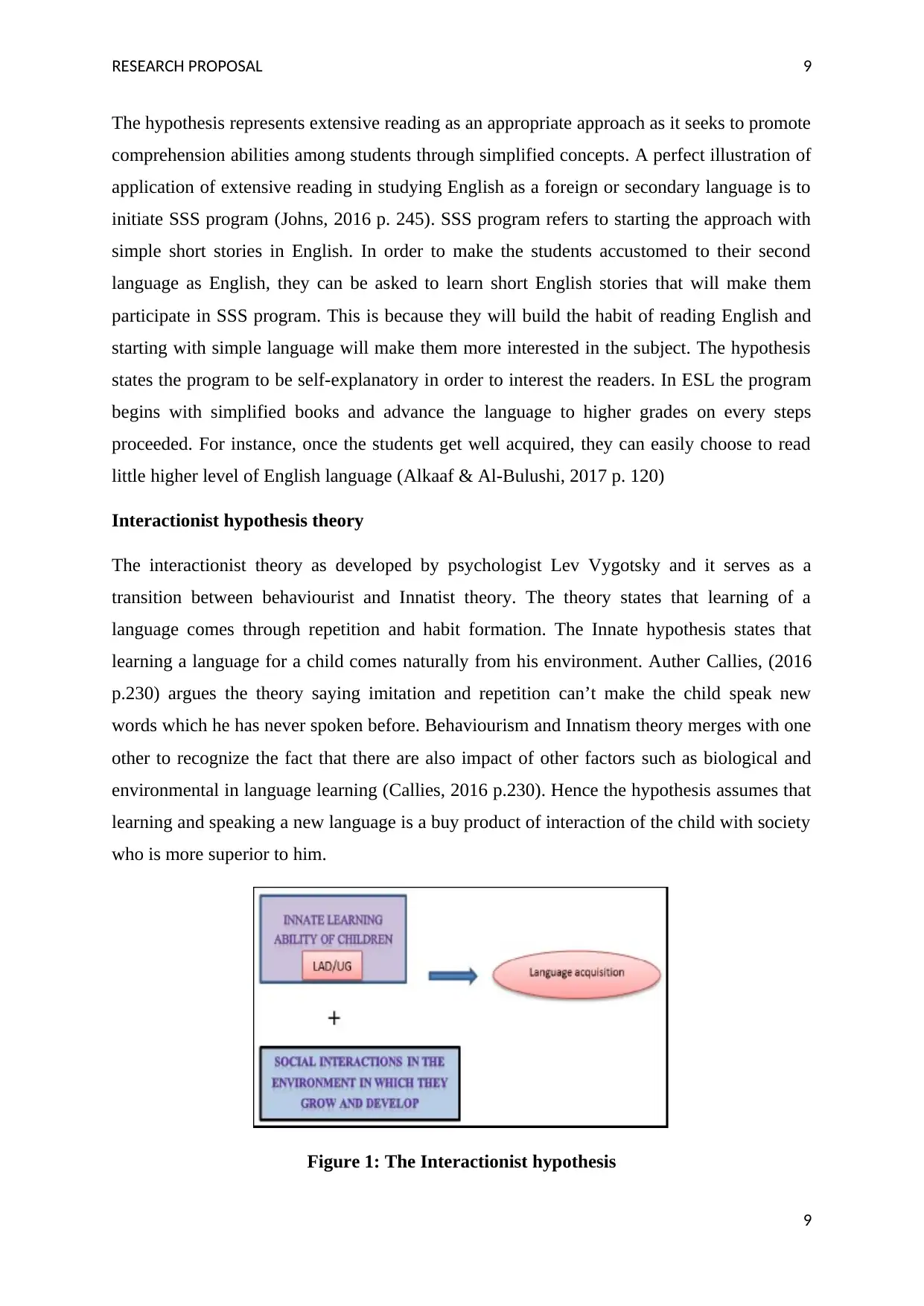
Interactionist hypothesis theory
The interactionist theory as developed by psychologist Lev Vygotsky and it serves as a
transition between behaviourist and Innatist theory. The theory states that learning of a
language comes through repetition and habit formation. The Innate hypothesis states that
learning a language for a child comes naturally from his environment. Auther Callies, (2016
p.230) argues the theory saying imitation and repetition can’t make the child speak new
words which he has never spoken before. Behaviourism and Innatism theory merges with one
other to recognize the fact that there are also impact of other factors such as biological and
environmental in language learning (Callies, 2016 p.230). Hence the hypothesis assumes that
learning and speaking a new language is a buy product of interaction of the child with society
who is more superior to him.
Figure 1: The Interactionist hypothesis
9
The hypothesis represents extensive reading as an appropriate approach as it seeks to promote
comprehension abilities among students through simplified concepts. A perfect illustration of
application of extensive reading in studying English as a foreign or secondary language is to
initiate SSS program (Johns, 2016 p. 245). SSS program refers to starting the approach with
simple short stories in English. In order to make the students accustomed to their second
language as English, they can be asked to learn short English stories that will make them
participate in SSS program. This is because they will build the habit of reading English and
starting with simple language will make them more interested in the subject. The hypothesis
states the program to be self-explanatory in order to interest the readers. In ESL the program
begins with simplified books and advance the language to higher grades on every steps
proceeded. For instance, once the students get well acquired, they can easily choose to read
little higher level of English language (Alkaaf & Al-Bulushi, 2017 p. 120)
Interactionist hypothesis theory
The interactionist theory as developed by psychologist Lev Vygotsky and it serves as a
transition between behaviourist and Innatist theory. The theory states that learning of a
language comes through repetition and habit formation. The Innate hypothesis states that
learning a language for a child comes naturally from his environment. Auther Callies, (2016
p.230) argues the theory saying imitation and repetition can’t make the child speak new
words which he has never spoken before. Behaviourism and Innatism theory merges with one
other to recognize the fact that there are also impact of other factors such as biological and
environmental in language learning (Callies, 2016 p.230). Hence the hypothesis assumes that
learning and speaking a new language is a buy product of interaction of the child with society
who is more superior to him.
Figure 1: The Interactionist hypothesis
9
⊘ This is a preview!⊘
Do you want full access?
Subscribe today to unlock all pages.
Trusted by 1+ million students worldwide
RESEARCH PROPOSAL 10
Other effectiveness
Alkaaf, F., & Al-Bulushi, (2017 p. 120) undertook a comparative study where they
established the effectiveness of introduction of e4xtensive reading in ESL in a challenging
environment. In countries where English is a second language, such as Saudi Arabia or
Indonesia students up-taking extensive reading process resulted remarkable
outcome(Mermelstein 2015 p. 183). Students also can learn English from supporting
environments such as speaking English at home or interacting in English with friends (Alkaaf
& Al-Bulushi, 2017 p. 120).
EFL reading in different countries
Colleges and universities in Indonesia encourage their students to focus on English as a
foreign second language. As reported by many scholars the students of English department
choose English subject for their academic purpose but the classes generally involve
discursion of texts here the students are focused in reading ((Tromans, 2019 p. 112)). The
course curriculum generally follows task accompanied short texts hence put emphasis on
intensive reading (Callies, 2016 p.230). But in some of the institutions students are provided
the opportunity for extensive reading as their last reading course (Nation, 2015 p. 138). This
approach is noted to improve their vocabularies and better knowledge of English culture. As
inferred by Chang & Renandya (2017 p.45) the extensive reading in Indonesia institutions
takes place in both forms outdoor and indoor activities. However in countries such as Japan,
china and Thailand there are minimal English interaction among the students since students
belonging to upper economic class can only afford private courses for English. There are
several arguments in rese4arch where some researchers oppose to such a unitary view.
According to (McLelland, 2017 p. 168) extensive reading can also be persuading through
other media such as internet and television (Callies, 2016, p.230).
Extensive reading in Indonesia
A strong connection between culture and psychological factors promoting EFL reading has
been observed. As stated by Krulatz & Duggan (2018, p.29) students don’t find interest in
their class to read their course materials. The study is confirmed by Mermelstein (2015) here
author has justified the fact that the unwillingness comes from inadequate subject knowledge
and their inability to comprehend the complex texts in simpler forms (Callies, 2016, p.230).
10
Other effectiveness
Alkaaf, F., & Al-Bulushi, (2017 p. 120) undertook a comparative study where they
established the effectiveness of introduction of e4xtensive reading in ESL in a challenging
environment. In countries where English is a second language, such as Saudi Arabia or
Indonesia students up-taking extensive reading process resulted remarkable
outcome(Mermelstein 2015 p. 183). Students also can learn English from supporting
environments such as speaking English at home or interacting in English with friends (Alkaaf
& Al-Bulushi, 2017 p. 120).
EFL reading in different countries
Colleges and universities in Indonesia encourage their students to focus on English as a
foreign second language. As reported by many scholars the students of English department
choose English subject for their academic purpose but the classes generally involve
discursion of texts here the students are focused in reading ((Tromans, 2019 p. 112)). The
course curriculum generally follows task accompanied short texts hence put emphasis on
intensive reading (Callies, 2016 p.230). But in some of the institutions students are provided
the opportunity for extensive reading as their last reading course (Nation, 2015 p. 138). This
approach is noted to improve their vocabularies and better knowledge of English culture. As
inferred by Chang & Renandya (2017 p.45) the extensive reading in Indonesia institutions
takes place in both forms outdoor and indoor activities. However in countries such as Japan,
china and Thailand there are minimal English interaction among the students since students
belonging to upper economic class can only afford private courses for English. There are
several arguments in rese4arch where some researchers oppose to such a unitary view.
According to (McLelland, 2017 p. 168) extensive reading can also be persuading through
other media such as internet and television (Callies, 2016, p.230).
Extensive reading in Indonesia
A strong connection between culture and psychological factors promoting EFL reading has
been observed. As stated by Krulatz & Duggan (2018, p.29) students don’t find interest in
their class to read their course materials. The study is confirmed by Mermelstein (2015) here
author has justified the fact that the unwillingness comes from inadequate subject knowledge
and their inability to comprehend the complex texts in simpler forms (Callies, 2016, p.230).
10
Paraphrase This Document
Need a fresh take? Get an instant paraphrase of this document with our AI Paraphraser
RESEARCH PROPOSAL 11
Unwillingness also arise from unfamiliar words, lack of backdrop knowledge hence EFL is
an effective tool in enhancing their interest to study English literature. According to Meniado,
(2016) many universities of Indonesia have adopted to introduce learning models and
classroom activities in English department. Many authors have argued that there is utmost
necessity for promoting extensive reading in order to improve reading competence and pick
new vocabularies.
Implications of teaching English as a foreign and secondary language
Apart from developing interests in students there are also some criteria that a teacher should
follow. Teachers can offer a good foundation for students to learn English language by
offering graded materials from various publishers (Azkarai & Oliver, 2019 p. 270). However
there are some controversies against the authenticity of the graded materials. Therefore many
critiques suggest the teachers to encourage learners to read English news papers, books and
magazines as this will help the students to hold a grip over English as a foreign language
(Tromans, 2019 p. 112). Learning English as a foreign and a secondary language not always
involve study English as a separate subject. it can be learned even from novels, science
fiction, travel guides and so on. The teachers should discard any resource which has no
authentic facts or evidences (Cheng & Lee 2019 p. 38). Extensive reading aims to involve
multiple learners getting access to appropriate reading materials. The study confirmed by
McLean & Rouault (2017 p. 95) the teacher has sufficient responsibility in encouraging
students to learn English language since it has many befits. Extensive reading holds an idea
of being an individual with maximum achieved results. In order to do so the teacher needs to
communicate more with the students and evaluate the developments. The students can be
given assignments to check their progress so that the teacher can address any issues if
occurred. Such an approach helps the teacher to identify exact problems the student is facing
and resolve the issues (Gries & Deshors, 2015 p. 135).
There are other implications of persuading extensive reading in practicing teaching.
According to Tromans, (2019 p. 112) a teacher should not take tests while practicing the
extensive reading strategy. As stated by Cheng & Lee (2019 p. 38) extensive reading does not
emphasis students to be subjected to stress. Tests and exams serve as a barrier to the learning
process since exams invoke memorizing capacity rather than learning pleasure. The purpose
of utilizing Extensive reading in learning English as a second and a foreign language is to
promote the feeling of in charge among students (Alkaaf & Al-Bulushi, 2017 p. 120). The
11
Unwillingness also arise from unfamiliar words, lack of backdrop knowledge hence EFL is
an effective tool in enhancing their interest to study English literature. According to Meniado,
(2016) many universities of Indonesia have adopted to introduce learning models and
classroom activities in English department. Many authors have argued that there is utmost
necessity for promoting extensive reading in order to improve reading competence and pick
new vocabularies.
Implications of teaching English as a foreign and secondary language
Apart from developing interests in students there are also some criteria that a teacher should
follow. Teachers can offer a good foundation for students to learn English language by
offering graded materials from various publishers (Azkarai & Oliver, 2019 p. 270). However
there are some controversies against the authenticity of the graded materials. Therefore many
critiques suggest the teachers to encourage learners to read English news papers, books and
magazines as this will help the students to hold a grip over English as a foreign language
(Tromans, 2019 p. 112). Learning English as a foreign and a secondary language not always
involve study English as a separate subject. it can be learned even from novels, science
fiction, travel guides and so on. The teachers should discard any resource which has no
authentic facts or evidences (Cheng & Lee 2019 p. 38). Extensive reading aims to involve
multiple learners getting access to appropriate reading materials. The study confirmed by
McLean & Rouault (2017 p. 95) the teacher has sufficient responsibility in encouraging
students to learn English language since it has many befits. Extensive reading holds an idea
of being an individual with maximum achieved results. In order to do so the teacher needs to
communicate more with the students and evaluate the developments. The students can be
given assignments to check their progress so that the teacher can address any issues if
occurred. Such an approach helps the teacher to identify exact problems the student is facing
and resolve the issues (Gries & Deshors, 2015 p. 135).
There are other implications of persuading extensive reading in practicing teaching.
According to Tromans, (2019 p. 112) a teacher should not take tests while practicing the
extensive reading strategy. As stated by Cheng & Lee (2019 p. 38) extensive reading does not
emphasis students to be subjected to stress. Tests and exams serve as a barrier to the learning
process since exams invoke memorizing capacity rather than learning pleasure. The purpose
of utilizing Extensive reading in learning English as a second and a foreign language is to
promote the feeling of in charge among students (Alkaaf & Al-Bulushi, 2017 p. 120). The
11
RESEARCH PROPOSAL 12
teacher can employ efficient tactics such as solving puzzles or learning games that brings a
lot of new words in front of everybody.
Comparison of English as Second Language and English as Foreign Language
According to Bae& Joshi (2018, p. 1830), English as a secondary language classroom is the
one where English has been used as the primary language. On the other hand, English as a
foreign language classroom is the one where English is taken as a non-native language. This
is much more applicable in the European countries where it is a common practice to speak
more than one foreign language. On acknowledging these facts, it has been stated by
Azkarai& Oliver(2019), that these are the reasons for the utilisation of the term ESL in
United States, that is an English speaking nation and on the other hand, EFL is used as a term
of choice in countries where English is not taken as a native language. It could be stated that
ESL students are the ones who learn English as a second language in a foreign country where
the major speaking language is English. It has been supported by Callies(2016), ESL students
are the ones who are already living in the an English speaking environment, the benefit that
they gain is that they learn key words, cultural phrases, features of daily life in U.S. which
makes their activity much more smooth and easy to flow. On exploring the EFL, it could be
stated that English as a foreign language in their home country which is not an English
speaking or environment country (Lee, 2015). The pedagogy for EFL classes is similar to
what Americans with English as their first language would experience when they set out to
learn Spanish, German, or French with an instructor. As EFL students may not have
significant exposure to spoken English outside the classroom environment, they benefit from
enhanced speaking and listening opportunities in their classes. The comparison has been
further explored and stated by Gilquin(2018), that ESL classrooms are the ones where a share
is for a target language whereas for EFL classrooms, they share a native language. The
comparison of the two different concepts has been of immense debatable concern and the
facts that has been provided through the exploration of the various authors it reflects that the
two concepts are completely different. It has also been suggested by Yang& Hung(2018), that
the two concepts that is ESL and EFL if its literal meaning is understood through
understanding the meaning of each of the words than the confusion would vanish
automatically. Thus, it could be stated that the two are completely two poles through
understanding the various concepts and facts provided by various authors.
12
teacher can employ efficient tactics such as solving puzzles or learning games that brings a
lot of new words in front of everybody.
Comparison of English as Second Language and English as Foreign Language
According to Bae& Joshi (2018, p. 1830), English as a secondary language classroom is the
one where English has been used as the primary language. On the other hand, English as a
foreign language classroom is the one where English is taken as a non-native language. This
is much more applicable in the European countries where it is a common practice to speak
more than one foreign language. On acknowledging these facts, it has been stated by
Azkarai& Oliver(2019), that these are the reasons for the utilisation of the term ESL in
United States, that is an English speaking nation and on the other hand, EFL is used as a term
of choice in countries where English is not taken as a native language. It could be stated that
ESL students are the ones who learn English as a second language in a foreign country where
the major speaking language is English. It has been supported by Callies(2016), ESL students
are the ones who are already living in the an English speaking environment, the benefit that
they gain is that they learn key words, cultural phrases, features of daily life in U.S. which
makes their activity much more smooth and easy to flow. On exploring the EFL, it could be
stated that English as a foreign language in their home country which is not an English
speaking or environment country (Lee, 2015). The pedagogy for EFL classes is similar to
what Americans with English as their first language would experience when they set out to
learn Spanish, German, or French with an instructor. As EFL students may not have
significant exposure to spoken English outside the classroom environment, they benefit from
enhanced speaking and listening opportunities in their classes. The comparison has been
further explored and stated by Gilquin(2018), that ESL classrooms are the ones where a share
is for a target language whereas for EFL classrooms, they share a native language. The
comparison of the two different concepts has been of immense debatable concern and the
facts that has been provided through the exploration of the various authors it reflects that the
two concepts are completely different. It has also been suggested by Yang& Hung(2018), that
the two concepts that is ESL and EFL if its literal meaning is understood through
understanding the meaning of each of the words than the confusion would vanish
automatically. Thus, it could be stated that the two are completely two poles through
understanding the various concepts and facts provided by various authors.
12
⊘ This is a preview!⊘
Do you want full access?
Subscribe today to unlock all pages.
Trusted by 1+ million students worldwide

1 out of 19


Related Documents


Your All-in-One AI-Powered Toolkit for Academic Success.
+13062052269
info@desklib.com
Available 24*7 on WhatsApp / Email
![[object Object]](/_next/static/media/star-bottom.7253800d.svg)
Unlock your academic potential
Copyright © 2020–2026 A2Z Services. All Rights Reserved. Developed and managed by ZUCOL.