Research Proposal: Internal Security in Maldives & Military's Role
VerifiedAdded on 2020/05/04
|32
|7115
|348
Project
AI Summary
This research proposal investigates the internal security threats faced by the Maldives and the role of its military in maintaining peace and order. The study aims to understand the nature of terrorism-related threats, analyze the extent of national and transnational terrorism events, assess the military's role in maintaining peace, and identify areas for improvement. The methodology includes exploratory research using secondary data from official sources, news articles, and academic journals. The research employs an interpretivist philosophy and a qualitative approach to data analysis. The proposal highlights the strategic importance of the Maldives, its vulnerability to maritime terrorism, political instability, and the influence of religious extremism. The study seeks to determine the effectiveness of the military in countering terrorism and ensuring national security, while acknowledging limitations in data availability and confidentiality. The research will test the hypothesis that the military is taking effective actions to curb terrorism in the country.
Running head: RESEARCH PROPOSAL
Research proposal on ‘Internal Security Threats to Maldives and Role of the Military in
maintaining peace”
Name of the Student:
Name of the University:
Author note:
Research proposal on ‘Internal Security Threats to Maldives and Role of the Military in
maintaining peace”
Name of the Student:
Name of the University:
Author note:

Paraphrase This Document
Need a fresh take? Get an instant paraphrase of this document with our AI Paraphraser
1RESEARCH PROPOSAL
Abstract
This paper will deal with the role of military in combating terrorism against Maldives.The
efficiency of the military of Maldives in minimizing the terrorism in the country is also discussed
in the paper. . This research would be beneficial to find out if the gap in the effective working of
the military to improve the security condition of the nation. It is necessary to find out the level of
internal security threats which are existing in the country. Moreover, the actions which are taken
by the military of the country to handle these situations to maintain peace in the nation are also
discussed in the paper. The Government of Maldives must try to condemn various self serving
actions which are taken by the individuals so as to combat or defend terrorism. The military has
projected the ambition for various kinds of regional leadership and they defined military alliance
against terrorist in a different way. The capability of the Maldives security forces to counter
various terrorist attacks is important and it is described and analyzed in the paper. Thus, it is
necessary that Maldives must take a proactive role against this terrorism and the military must
play an active role in combating this.
Abstract
This paper will deal with the role of military in combating terrorism against Maldives.The
efficiency of the military of Maldives in minimizing the terrorism in the country is also discussed
in the paper. . This research would be beneficial to find out if the gap in the effective working of
the military to improve the security condition of the nation. It is necessary to find out the level of
internal security threats which are existing in the country. Moreover, the actions which are taken
by the military of the country to handle these situations to maintain peace in the nation are also
discussed in the paper. The Government of Maldives must try to condemn various self serving
actions which are taken by the individuals so as to combat or defend terrorism. The military has
projected the ambition for various kinds of regional leadership and they defined military alliance
against terrorist in a different way. The capability of the Maldives security forces to counter
various terrorist attacks is important and it is described and analyzed in the paper. Thus, it is
necessary that Maldives must take a proactive role against this terrorism and the military must
play an active role in combating this.
2RESEARCH PROPOSAL
Contents
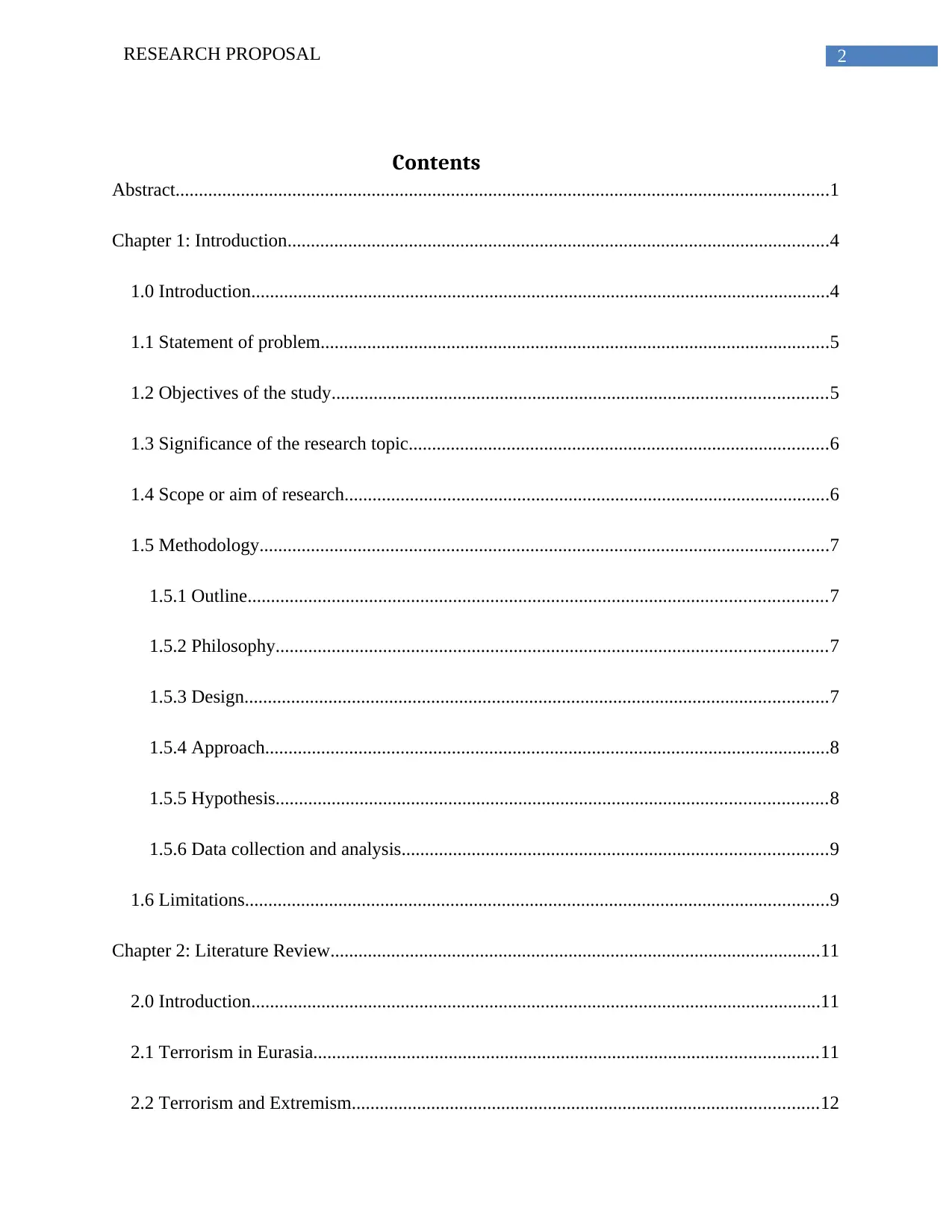
Abstract............................................................................................................................................1
Chapter 1: Introduction....................................................................................................................4
1.0 Introduction............................................................................................................................4
1.1 Statement of problem.............................................................................................................5
1.2 Objectives of the study..........................................................................................................5
1.3 Significance of the research topic..........................................................................................6
1.4 Scope or aim of research........................................................................................................6
1.5 Methodology..........................................................................................................................7
1.5.1 Outline............................................................................................................................7
1.5.2 Philosophy......................................................................................................................7
1.5.3 Design.............................................................................................................................7
1.5.4 Approach.........................................................................................................................8
1.5.5 Hypothesis......................................................................................................................8
1.5.6 Data collection and analysis...........................................................................................9
1.6 Limitations.............................................................................................................................9
Chapter 2: Literature Review.........................................................................................................11
2.0 Introduction..........................................................................................................................11
2.1 Terrorism in Eurasia............................................................................................................11
2.2 Terrorism and Extremism....................................................................................................12
Contents
Abstract............................................................................................................................................1
Chapter 1: Introduction....................................................................................................................4
1.0 Introduction............................................................................................................................4
1.1 Statement of problem.............................................................................................................5
1.2 Objectives of the study..........................................................................................................5
1.3 Significance of the research topic..........................................................................................6
1.4 Scope or aim of research........................................................................................................6
1.5 Methodology..........................................................................................................................7
1.5.1 Outline............................................................................................................................7
1.5.2 Philosophy......................................................................................................................7
1.5.3 Design.............................................................................................................................7
1.5.4 Approach.........................................................................................................................8
1.5.5 Hypothesis......................................................................................................................8
1.5.6 Data collection and analysis...........................................................................................9
1.6 Limitations.............................................................................................................................9
Chapter 2: Literature Review.........................................................................................................11
2.0 Introduction..........................................................................................................................11
2.1 Terrorism in Eurasia............................................................................................................11
2.2 Terrorism and Extremism....................................................................................................12
⊘ This is a preview!⊘
Do you want full access?
Subscribe today to unlock all pages.

Trusted by 1+ million students worldwide
3RESEARCH PROPOSAL
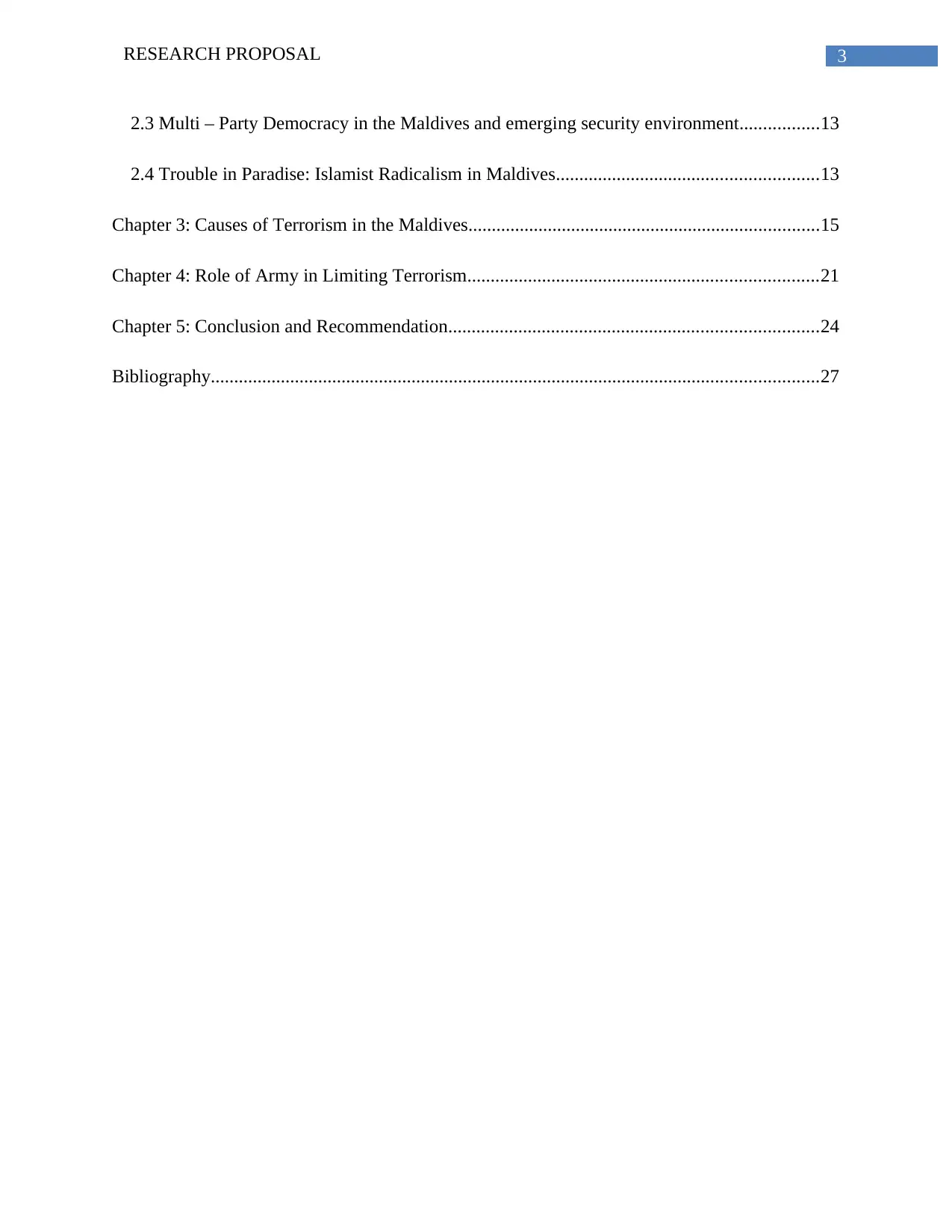
2.3 Multi – Party Democracy in the Maldives and emerging security environment.................13
2.4 Trouble in Paradise: Islamist Radicalism in Maldives........................................................13
Chapter 3: Causes of Terrorism in the Maldives...........................................................................15
Chapter 4: Role of Army in Limiting Terrorism...........................................................................21
Chapter 5: Conclusion and Recommendation...............................................................................24
Bibliography..................................................................................................................................27
2.3 Multi – Party Democracy in the Maldives and emerging security environment.................13
2.4 Trouble in Paradise: Islamist Radicalism in Maldives........................................................13
Chapter 3: Causes of Terrorism in the Maldives...........................................................................15
Chapter 4: Role of Army in Limiting Terrorism...........................................................................21
Chapter 5: Conclusion and Recommendation...............................................................................24
Bibliography..................................................................................................................................27
Paraphrase This Document
Need a fresh take? Get an instant paraphrase of this document with our AI Paraphraser
4RESEARCH PROPOSAL
Chapter 1: Introduction
1.0 Introduction
The research paper aims to find out the extent of internal security threat of Maldives and
the actions taken by the military to maintain peace in the country. Maldives, the island nation, is
situated in the Indian Ocean and consists about total of 1190 islands. Only 200 islands are
populated with 393,500 people. Tourism is open in only 130 islands and rest is open for
agriculture1. Maldives is located in a very strategically important position in the IOR as
numerous shipments traverse through that path. Hence, it is vulnerable to maritime terrorism as
well as many external threats. Being a Muslim country makes the nation more prone to the
conflicts, fought in the name of religion. It has been found that, more than 200 citizens of
Maldives have participated in the foreign conflicts and that has made this nation highest per
capita in the number of people joining in foreign conflicts in South Asia2. The people, who return
from these conflicts, pose a threat for the nation. There is also political instability in the nation,
making it more prone to security threats. Sometimes, the politicians make use of terrorism to
achieve their goals.Therefore, the geo strategic position, religion, political instability and
dependency on tourism, all contribute in the vulnerability of the country towards the terrorism
activities3.
1Kothari, Uma. "Political discourses of climate change and migration: resettlement policies in the Maldives." The
Geographical Journal 180, no. 2 (2014): 130-140.
2Shakeela, Aishath, and Susanne Becken. "Understanding tourism leaders’ perceptions of risks from climate change:
an assessment of policy-making processes in the Maldives using the social amplification of risk framework
(SARF)." Journal of Sustainable Tourism 23, no. 1 (2015): 65-84.
3Kumar, Anand. 2016. "Multi - Party Democracy In The Maldives And The Emerging Security Environment In The
Indian Ocean Region". https://idsa.in/system/files/book/book_democracy-maldives-ior.pdf[Accessed on 31st
October, 2017].
Chapter 1: Introduction
1.0 Introduction
The research paper aims to find out the extent of internal security threat of Maldives and
the actions taken by the military to maintain peace in the country. Maldives, the island nation, is
situated in the Indian Ocean and consists about total of 1190 islands. Only 200 islands are
populated with 393,500 people. Tourism is open in only 130 islands and rest is open for
agriculture1. Maldives is located in a very strategically important position in the IOR as
numerous shipments traverse through that path. Hence, it is vulnerable to maritime terrorism as
well as many external threats. Being a Muslim country makes the nation more prone to the
conflicts, fought in the name of religion. It has been found that, more than 200 citizens of
Maldives have participated in the foreign conflicts and that has made this nation highest per
capita in the number of people joining in foreign conflicts in South Asia2. The people, who return
from these conflicts, pose a threat for the nation. There is also political instability in the nation,
making it more prone to security threats. Sometimes, the politicians make use of terrorism to
achieve their goals.Therefore, the geo strategic position, religion, political instability and
dependency on tourism, all contribute in the vulnerability of the country towards the terrorism
activities3.
1Kothari, Uma. "Political discourses of climate change and migration: resettlement policies in the Maldives." The
Geographical Journal 180, no. 2 (2014): 130-140.
2Shakeela, Aishath, and Susanne Becken. "Understanding tourism leaders’ perceptions of risks from climate change:
an assessment of policy-making processes in the Maldives using the social amplification of risk framework
(SARF)." Journal of Sustainable Tourism 23, no. 1 (2015): 65-84.
3Kumar, Anand. 2016. "Multi - Party Democracy In The Maldives And The Emerging Security Environment In The
Indian Ocean Region". https://idsa.in/system/files/book/book_democracy-maldives-ior.pdf[Accessed on 31st
October, 2017].
5RESEARCH PROPOSAL
The government of Maldives has participated in many activities to control and eliminate
the terrorism in the country. It has established the National Counter terrorism Centre (NCTC) on
25th February 2016 under the “Terrorism prevention Act 2015/32”4. It aims to prevent the
terrorism activities in the nation by formulating policies. However, as the terrorism activities are
increasing globally, Maldives need to put more effort towards minimizing the terrorism and
security threats within the country.
1.1 Statement of problem
Statement of the problem refers to clear and precise description of the issue that needs to
be addressed by the researcher in the research paper. In this research study, the problem
statement is how the military can improve its actions to maintain peace in Maldives. Since, it is a
100% Muslim country; the nation has become very much vulnerable to the terrorism threats.
Although the government of Maldives has established the National Counter Terrorism Center
(NCTC) and has been working with SAARC countries and the United Nations to counter the
terrorism activities, the country is still very much affected from the security and terrorism
issues5. The research paper aims to find out how the threats from terrorism in Maldives should be
addressed and how the military shouldtake actions to control the situation and maintain peace
and security more efficiently.
1.2 Objectives of the study
The objectives of the research paper are as follows:
To understand the nature of terrorism associated threats in Maldives
4Robert, Patrick. 2011. "Trouble In Paradise: Islamist Radicalism In The Maldives". Jane's Intelligence Review.
http://trove.nla.gov.au/work/152999903?versionId=166736163[Accessed on 31st October, 2017].
5Cagua, Edgar Fernando, Neal Collins, James Hancock, and Richard Rees. "Whale shark economics: a valuation of
wildlife tourism in South Ari Atoll, Maldives." PeerJ 2 (2014): e515.
The government of Maldives has participated in many activities to control and eliminate
the terrorism in the country. It has established the National Counter terrorism Centre (NCTC) on
25th February 2016 under the “Terrorism prevention Act 2015/32”4. It aims to prevent the
terrorism activities in the nation by formulating policies. However, as the terrorism activities are
increasing globally, Maldives need to put more effort towards minimizing the terrorism and
security threats within the country.
1.1 Statement of problem
Statement of the problem refers to clear and precise description of the issue that needs to
be addressed by the researcher in the research paper. In this research study, the problem
statement is how the military can improve its actions to maintain peace in Maldives. Since, it is a
100% Muslim country; the nation has become very much vulnerable to the terrorism threats.
Although the government of Maldives has established the National Counter Terrorism Center
(NCTC) and has been working with SAARC countries and the United Nations to counter the
terrorism activities, the country is still very much affected from the security and terrorism
issues5. The research paper aims to find out how the threats from terrorism in Maldives should be
addressed and how the military shouldtake actions to control the situation and maintain peace
and security more efficiently.
1.2 Objectives of the study
The objectives of the research paper are as follows:
To understand the nature of terrorism associated threats in Maldives
4Robert, Patrick. 2011. "Trouble In Paradise: Islamist Radicalism In The Maldives". Jane's Intelligence Review.
http://trove.nla.gov.au/work/152999903?versionId=166736163[Accessed on 31st October, 2017].
5Cagua, Edgar Fernando, Neal Collins, James Hancock, and Richard Rees. "Whale shark economics: a valuation of
wildlife tourism in South Ari Atoll, Maldives." PeerJ 2 (2014): e515.
⊘ This is a preview!⊘
Do you want full access?
Subscribe today to unlock all pages.
Trusted by 1+ million students worldwide
6RESEARCH PROPOSAL
To analyze the extent of national and transnational terrorism events in Maldives
To assess the role of the military in maintaining peace and order in the country
To analyze the scopes of improvement in the role of the military
1.3 Significance of the research topic
Security threat is a big issue for any country. If a government tries to maintain a peaceful
environment in the country, it must handle the security threats and terrorism activities in a
sensitive way and must try to eliminate those. The citizens must feel safe to stay in the country.
The military plays a major role in this context. If the military does not work efficiently, the
threats would not be minimized6. Hence, through this research paper the researcher tries to throw
some light on the efficiency of the military of Maldives in minimizing the terrorism in the
country. This research would be helpful to find out if there is any gap in the effective working of
the military to improve the security condition of the nation.
1.4 Scope or aim of research
Aim or scope of this research paper is to find out the role of the military of Maldives in
dealing with the internal security threats and terrorism in the country. To reach to any
conclusion, the research must find out the level of internal security threats existing in the country
and the actions taken by the military of the country to handle these situations to maintain peace
in the nation.
1.5 Methodology
Research methodology refers to the systematic approach towards conducting the research
work. It consists of research approach, philosophy, design, process of data collection and
6Arnall, Alex, and Uma Kothari. "Challenging climate change and migration discourse: Different understandings of
timescale and temporality in the Maldives." Global Environmental Change 31 (2015): 199-206.
To analyze the extent of national and transnational terrorism events in Maldives
To assess the role of the military in maintaining peace and order in the country
To analyze the scopes of improvement in the role of the military
1.3 Significance of the research topic
Security threat is a big issue for any country. If a government tries to maintain a peaceful
environment in the country, it must handle the security threats and terrorism activities in a
sensitive way and must try to eliminate those. The citizens must feel safe to stay in the country.
The military plays a major role in this context. If the military does not work efficiently, the
threats would not be minimized6. Hence, through this research paper the researcher tries to throw
some light on the efficiency of the military of Maldives in minimizing the terrorism in the
country. This research would be helpful to find out if there is any gap in the effective working of
the military to improve the security condition of the nation.
1.4 Scope or aim of research
Aim or scope of this research paper is to find out the role of the military of Maldives in
dealing with the internal security threats and terrorism in the country. To reach to any
conclusion, the research must find out the level of internal security threats existing in the country
and the actions taken by the military of the country to handle these situations to maintain peace
in the nation.
1.5 Methodology
Research methodology refers to the systematic approach towards conducting the research
work. It consists of research approach, philosophy, design, process of data collection and
6Arnall, Alex, and Uma Kothari. "Challenging climate change and migration discourse: Different understandings of
timescale and temporality in the Maldives." Global Environmental Change 31 (2015): 199-206.
Paraphrase This Document
Need a fresh take? Get an instant paraphrase of this document with our AI Paraphraser
7RESEARCH PROPOSAL
analysis. This is helpful in demonstrating the insight of the researcher towards the research
process7. The methodology for this study is as follows.
1.5.1 Outline
Since, the research proposal is based on the national security threats of the Maldives and
the role of its military, therefore, secondary data would be best suitable to evaluate the situation
and draw a conclusion based on that. The researcher will collect data on the internal threats and
terrorism activities in Maldives, its impacts in terms of casualties and actions of the military in
such situations. These data will be analyzed to get an idea about how the military have handled
these situations and whether there has been any improvement in the security situation of the
nation.
1.5.2 Philosophy
Research philosophy is the approach that helps in the design of the approach of the
research paper. Among the four philosophies of research, interpretivism deals with interpretation
of the social phenomena8. Hence, researcher will be choosing the interpretivism philosophy.
1.5.3 Design
Research design helps to address the research topic logically and unambiguously9.
Research design is of several types, such as, exploratory research, case study, causal design,
action research design, cohort design, explanatory design, historical design, experimental design,
cross sectional design, descriptive design, philosophical design, mixed method design,meta-
7Taylor, Steven J., Robert Bogdan, and Marjorie DeVault. Introduction to qualitative research methods: A
guidebook and resource. John Wiley & Sons, 2015.
8Smith, Jonathan A., ed. Qualitative psychology: A practical guide to research methods. Sage, 2015.
9Taylor, Steven J., Robert Bogdan, and Marjorie DeVault. Introduction to qualitative research methods: A
guidebook and resource. John Wiley & Sons, 2015.
analysis. This is helpful in demonstrating the insight of the researcher towards the research
process7. The methodology for this study is as follows.
1.5.1 Outline
Since, the research proposal is based on the national security threats of the Maldives and
the role of its military, therefore, secondary data would be best suitable to evaluate the situation
and draw a conclusion based on that. The researcher will collect data on the internal threats and
terrorism activities in Maldives, its impacts in terms of casualties and actions of the military in
such situations. These data will be analyzed to get an idea about how the military have handled
these situations and whether there has been any improvement in the security situation of the
nation.
1.5.2 Philosophy
Research philosophy is the approach that helps in the design of the approach of the
research paper. Among the four philosophies of research, interpretivism deals with interpretation
of the social phenomena8. Hence, researcher will be choosing the interpretivism philosophy.
1.5.3 Design
Research design helps to address the research topic logically and unambiguously9.
Research design is of several types, such as, exploratory research, case study, causal design,
action research design, cohort design, explanatory design, historical design, experimental design,
cross sectional design, descriptive design, philosophical design, mixed method design,meta-
7Taylor, Steven J., Robert Bogdan, and Marjorie DeVault. Introduction to qualitative research methods: A
guidebook and resource. John Wiley & Sons, 2015.
8Smith, Jonathan A., ed. Qualitative psychology: A practical guide to research methods. Sage, 2015.
9Taylor, Steven J., Robert Bogdan, and Marjorie DeVault. Introduction to qualitative research methods: A
guidebook and resource. John Wiley & Sons, 2015.
8RESEARCH PROPOSAL
analysis design, longitudinal design, observational design and meta-analysis design10. Among all
these types, the researcher will be choosing exploratory research. In this type of research, the
researcher needs to explore the secondary data and make an interpretation of the data to reach to
a conclusion.
1.5.4 Approach
Secondary data analysis mainly follows the qualitative research approach. This approach
helps in gaining an understanding the underlying causes and opinions. Along with that, the
insights into the topic are also addressed through qualitative research to reach to a conclusion.
1.5.5 Hypothesis
The hypothesis that are to be tested in this paper are:
H0 (Null hypothesis): The military forces of Maldives are not taking effective actions and
making comprehensive and indispensible anti terrorism plans to curb the terrorism activities in
the country
H1(Alternate hypothesis): The military forces of Maldives are taking effective actions and
making comprehensive and indispensible anti terrorism plansto curb the terrorism activities in
the country
1.5.6 Data collection and analysis
The researcher will be using only the secondary data for this research. Secondary data is
the one, which is collected from already published sources, such as, books, journals, official
10Lewis, Sarah. "Qualitative inquiry and research design: Choosing among five approaches." Health promotion
practice 16, no. 4 (2015): 473-475
analysis design, longitudinal design, observational design and meta-analysis design10. Among all
these types, the researcher will be choosing exploratory research. In this type of research, the
researcher needs to explore the secondary data and make an interpretation of the data to reach to
a conclusion.
1.5.4 Approach
Secondary data analysis mainly follows the qualitative research approach. This approach
helps in gaining an understanding the underlying causes and opinions. Along with that, the
insights into the topic are also addressed through qualitative research to reach to a conclusion.
1.5.5 Hypothesis
The hypothesis that are to be tested in this paper are:
H0 (Null hypothesis): The military forces of Maldives are not taking effective actions and
making comprehensive and indispensible anti terrorism plans to curb the terrorism activities in
the country
H1(Alternate hypothesis): The military forces of Maldives are taking effective actions and
making comprehensive and indispensible anti terrorism plansto curb the terrorism activities in
the country
1.5.6 Data collection and analysis
The researcher will be using only the secondary data for this research. Secondary data is
the one, which is collected from already published sources, such as, books, journals, official
10Lewis, Sarah. "Qualitative inquiry and research design: Choosing among five approaches." Health promotion
practice 16, no. 4 (2015): 473-475
⊘ This is a preview!⊘
Do you want full access?
Subscribe today to unlock all pages.
Trusted by 1+ million students worldwide
9RESEARCH PROPOSAL
websites, etc.11 For this research study, the researcher will be collecting secondary data from
official websites from the government of Maldives, news articles, research papers, journal
articlesand books from the Indian Defence Services Staff College Library (DSS). The
interpretation will be done based on the collected data. However, there is not much data on
Maldives and confidentiality must be maintained. In this context, it is important to maintain the
originality of the paper. The data may be already published elsewhere but the analysis and
interpretation must have uniqueness.
Qualitative data analysis will be used to analyze the data. In this type of data analysis,
there is no predetermined expected outcome. The result and analysis are much broader and
contextual, the sampling is flexible and less structured andthe patterns are drawn from insights
and concepts. Illustrative explanations are provided in the result12. Since, the research study
involves a topic that demands an exploratory research; therefore, qualitative analysis is the most
suitable method of analysis in this case.
1.6 Limitations
The major limitation of this study is the unavailability of the data on terrorism threats in
Maldives. Since, the data is confidential; it is difficult to reach the proper sources for the data.
For the proper research, authentic data is required, while being an issue of national security
threats, the data sources are difficult to access.
11Johnston, Melissa P. "Secondary data analysis: A method of which the time has come." Qualitative and
Quantitative Methods in Libraries 3, no. 3 (2017): 619-626.
12Ezzy, Douglas. Qualitative analysis. Routledge, 2013.
websites, etc.11 For this research study, the researcher will be collecting secondary data from
official websites from the government of Maldives, news articles, research papers, journal
articlesand books from the Indian Defence Services Staff College Library (DSS). The
interpretation will be done based on the collected data. However, there is not much data on
Maldives and confidentiality must be maintained. In this context, it is important to maintain the
originality of the paper. The data may be already published elsewhere but the analysis and
interpretation must have uniqueness.
Qualitative data analysis will be used to analyze the data. In this type of data analysis,
there is no predetermined expected outcome. The result and analysis are much broader and
contextual, the sampling is flexible and less structured andthe patterns are drawn from insights
and concepts. Illustrative explanations are provided in the result12. Since, the research study
involves a topic that demands an exploratory research; therefore, qualitative analysis is the most
suitable method of analysis in this case.
1.6 Limitations
The major limitation of this study is the unavailability of the data on terrorism threats in
Maldives. Since, the data is confidential; it is difficult to reach the proper sources for the data.
For the proper research, authentic data is required, while being an issue of national security
threats, the data sources are difficult to access.
11Johnston, Melissa P. "Secondary data analysis: A method of which the time has come." Qualitative and
Quantitative Methods in Libraries 3, no. 3 (2017): 619-626.
12Ezzy, Douglas. Qualitative analysis. Routledge, 2013.
Paraphrase This Document
Need a fresh take? Get an instant paraphrase of this document with our AI Paraphraser
10RESEARCH PROPOSAL
Chapter 2: Literature Review
2.0 Introduction
This chapter addresses various aspects of security threats, terrorism activities and its
impacts andsituation in Maldives with reference to many articles published in the media and
journals, and from some books on terrorism.
2.1 Terrorism in Eurasia
This is one of the most concerning issues of the world, which affects almost all the
people across the borders. In the Eurasia region, the Talibans were the most common group of
terrorists while currently, the Islamic State of Iraq and Syria (ISIS) has become dominant.
Chopra(2001) writes in his book that, while every citizen of every nation has the right to live
peacefully and with proper safety and security, the terrorists use variety of techniques to disturb
the peace around the world. While some countries are badly affected, some countries provide
support to these activities for their own benefits. Hence, some world law must be established to
eliminate the terrorism activities completely13. The entire world has become a victim of terrorism
and every year millions of people are dying everywhere. However, terrorism in Eurasia is neither
a resultant effect of Cold War, nor is it an effect of the terror attack on the USA on 9/11. The
epidemic rise of the ISIShas been affecting the world peace for quite some time now. There are
different nations and different groups of terrorists but the problem is same. The developed
countries of North America and Eurasia are the major targets for terrorist activities in the past
decade. Majority of these activities are conducted by the Muslim terrorists, who are guided by
13Chopra, V.D. 2001. "Rise Of Terrorism And Secessionism In Eurasia". http://gyanbooks.com/index.php?
p=sr&Uc=9788121207386&l=0[Accessed on 31st October, 2017].
Chapter 2: Literature Review
2.0 Introduction
This chapter addresses various aspects of security threats, terrorism activities and its
impacts andsituation in Maldives with reference to many articles published in the media and
journals, and from some books on terrorism.
2.1 Terrorism in Eurasia
This is one of the most concerning issues of the world, which affects almost all the
people across the borders. In the Eurasia region, the Talibans were the most common group of
terrorists while currently, the Islamic State of Iraq and Syria (ISIS) has become dominant.
Chopra(2001) writes in his book that, while every citizen of every nation has the right to live
peacefully and with proper safety and security, the terrorists use variety of techniques to disturb
the peace around the world. While some countries are badly affected, some countries provide
support to these activities for their own benefits. Hence, some world law must be established to
eliminate the terrorism activities completely13. The entire world has become a victim of terrorism
and every year millions of people are dying everywhere. However, terrorism in Eurasia is neither
a resultant effect of Cold War, nor is it an effect of the terror attack on the USA on 9/11. The
epidemic rise of the ISIShas been affecting the world peace for quite some time now. There are
different nations and different groups of terrorists but the problem is same. The developed
countries of North America and Eurasia are the major targets for terrorist activities in the past
decade. Majority of these activities are conducted by the Muslim terrorists, who are guided by
13Chopra, V.D. 2001. "Rise Of Terrorism And Secessionism In Eurasia". http://gyanbooks.com/index.php?
p=sr&Uc=9788121207386&l=0[Accessed on 31st October, 2017].
11RESEARCH PROPOSAL
the false notion of religion. Nalbandov (2012) says that terrorist groups existed from a very long
time, and terrorism was restricted mostly within the national boundaries, in the form of regional
cold war or civil war. After the attack of 9/11, Al Qaeda came in front of the world in a massive
way and changed the way the world thought about terrorism. The Muslim groups became
apparent and some of the Muslim countries gave shelter to these terrorists. It was a very
significant event in the international relations. The Middle East and Eurasia became the center of
such activities and countries around the world started to get affected. The South Asian countries
were also affected due to these activities but those are mostly internal security threats14.
2.2 Terrorism and Extremism
Ahmed Niyaz (2010) mentioned in his paper “Terrorism and Extremism; A Threat to
Maldives Tourism Industry” that, since, the economy of Maldives are extremely dependent on
the tourism and the country is vulnerable to the terrorist activities, the tourism sector can be
highly affected due to these activities and the economy can suffer. The bombing in the Sultan
Park in the Male, Maldives in 2007 by the religious extremists has a bad impact on the tourism
sector as well as on the economy of the nation. Prior to this event, Maldives was marked as a
safe destination for tourists, however, after the bombing, which was mainly targeted at the
tourists from the western countries, changed the perception15. This industry is highly dependent
on the global events, such as, terrorism, natural disasters, economic recessions etc. Hence, it is
important for the economies, which are heavily dependent on the tourism; keep their
environment safe for the citizens as well as for the tourists.
14Nalbandov, R. 2012. "Terrorism 2.0 In Eurasia". CEJISS.Org.
http://www.cejiss.org/static/data/uploaded/13835989521026/Article%2004_1.pdf[Accessed on 31st October, 2017].
15Niyaz, Ahmed. 2010. "Terrorism and Extremism: A Threat To Maldives Tourism Industry". ISSN 1696-2206.
https://revistas.ucm.es/index.php/UNIS/article/viewFile/UNIS1010330221A/26960[Accessed on 31st October,
2017].
the false notion of religion. Nalbandov (2012) says that terrorist groups existed from a very long
time, and terrorism was restricted mostly within the national boundaries, in the form of regional
cold war or civil war. After the attack of 9/11, Al Qaeda came in front of the world in a massive
way and changed the way the world thought about terrorism. The Muslim groups became
apparent and some of the Muslim countries gave shelter to these terrorists. It was a very
significant event in the international relations. The Middle East and Eurasia became the center of
such activities and countries around the world started to get affected. The South Asian countries
were also affected due to these activities but those are mostly internal security threats14.
2.2 Terrorism and Extremism
Ahmed Niyaz (2010) mentioned in his paper “Terrorism and Extremism; A Threat to
Maldives Tourism Industry” that, since, the economy of Maldives are extremely dependent on
the tourism and the country is vulnerable to the terrorist activities, the tourism sector can be
highly affected due to these activities and the economy can suffer. The bombing in the Sultan
Park in the Male, Maldives in 2007 by the religious extremists has a bad impact on the tourism
sector as well as on the economy of the nation. Prior to this event, Maldives was marked as a
safe destination for tourists, however, after the bombing, which was mainly targeted at the
tourists from the western countries, changed the perception15. This industry is highly dependent
on the global events, such as, terrorism, natural disasters, economic recessions etc. Hence, it is
important for the economies, which are heavily dependent on the tourism; keep their
environment safe for the citizens as well as for the tourists.
14Nalbandov, R. 2012. "Terrorism 2.0 In Eurasia". CEJISS.Org.
http://www.cejiss.org/static/data/uploaded/13835989521026/Article%2004_1.pdf[Accessed on 31st October, 2017].
15Niyaz, Ahmed. 2010. "Terrorism and Extremism: A Threat To Maldives Tourism Industry". ISSN 1696-2206.
https://revistas.ucm.es/index.php/UNIS/article/viewFile/UNIS1010330221A/26960[Accessed on 31st October,
2017].
⊘ This is a preview!⊘
Do you want full access?
Subscribe today to unlock all pages.
Trusted by 1+ million students worldwide

1 out of 32


Related Documents


Your All-in-One AI-Powered Toolkit for Academic Success.
+13062052269
info@desklib.com
Available 24*7 on WhatsApp / Email
![[object Object]](/_next/static/media/star-bottom.7253800d.svg)
Unlock your academic potential
Copyright © 2020–2025 A2Z Services. All Rights Reserved. Developed and managed by ZUCOL.