Research Proposal: Investigating Low Employee Morale at Verbeek Export
VerifiedAdded on 2021/04/24
|10
|2594
|397
Project
AI Summary
This research proposal investigates the issue of low employee morale at Verbeek Export, a flower distribution company. The research aims to identify the key factors contributing to low morale and decreased productivity, ultimately impacting the company's profitability. The proposal outlines the research questions, a comprehensive literature review covering topics like employee retention, job satisfaction, and factors influencing morale such as management treatment, unclear expectations, and workload. The methodology section details the use of in-depth, semi-structured interviews for data collection, followed by qualitative data analysis using ATLAS.ti. A non-probability sampling method will target employees considering resignation due to low morale. Ethical considerations, including informed consent and translation services, are addressed. The research is planned over six months, culminating in a final report with recommendations to mitigate the identified issues and improve employee morale and productivity. The expected outcome is to provide actionable insights and suggestions for the company to improve employee morale and productivity.
Running Head: RESEARCH PROPOSAL REGARDING LOW EMPLOYEE MORALE
Research proposal regarding low employee morale
Name of the student:
Name of the University:
Author Note:
Research proposal regarding low employee morale
Name of the student:
Name of the University:
Author Note:

Paraphrase This Document
Need a fresh take? Get an instant paraphrase of this document with our AI Paraphraser
1RESEARCH PROPOSAL REGARDING LOW EMPLOYEE MORALE
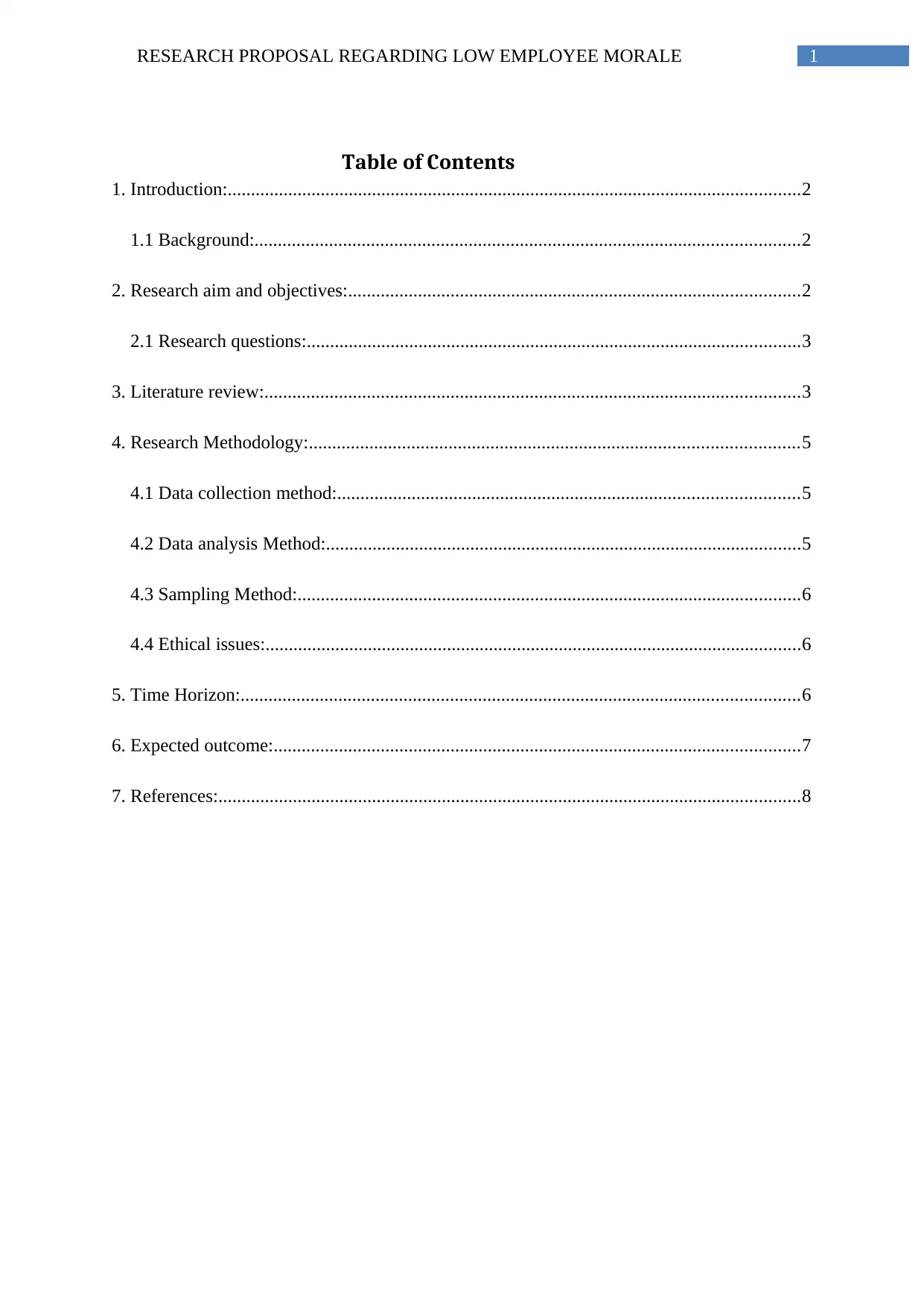
Table of Contents
1. Introduction:...........................................................................................................................2
1.1 Background:.....................................................................................................................2
2. Research aim and objectives:.................................................................................................2
2.1 Research questions:..........................................................................................................3
3. Literature review:...................................................................................................................3
4. Research Methodology:.........................................................................................................5
4.1 Data collection method:...................................................................................................5
4.2 Data analysis Method:......................................................................................................5
4.3 Sampling Method:............................................................................................................6
4.4 Ethical issues:...................................................................................................................6
5. Time Horizon:........................................................................................................................6
6. Expected outcome:.................................................................................................................7
7. References:.............................................................................................................................8
Table of Contents
1. Introduction:...........................................................................................................................2
1.1 Background:.....................................................................................................................2
2. Research aim and objectives:.................................................................................................2
2.1 Research questions:..........................................................................................................3
3. Literature review:...................................................................................................................3
4. Research Methodology:.........................................................................................................5
4.1 Data collection method:...................................................................................................5
4.2 Data analysis Method:......................................................................................................5
4.3 Sampling Method:............................................................................................................6
4.4 Ethical issues:...................................................................................................................6
5. Time Horizon:........................................................................................................................6
6. Expected outcome:.................................................................................................................7
7. References:.............................................................................................................................8
2RESEARCH PROPOSAL REGARDING LOW EMPLOYEE MORALE
1. Introduction:
This research proposal revolves around a company that goes by the name Verbeek
Export. Hans Verbreek established it in the year 1975. The company was initially setup for
distributing flowers. Its range of operations includes Europe and Scandinavia. The research
proposal will identify key reasons that lead to decrease in profit for the company. Following
identification of key reasons, the proposal will develop a methodology for collecting and
assessing data. After assessment, the proposal would be able to provide a recommendation.
Decrease in profit is a business problem, this inhibits growth, and viability of the
business is put under scanner. It was established that due to low morale of employees,
productivity of the company was hit and this resulted in reduction of profit. Additionally, the
proposal would help in providing recommendation that would help to mitigate the business
problem identified.
1.1 Background:
By internal research, it was established that workload in the company is unbalanced.
Employees were showing signs of fatigue by working long hours in the company. This
resulted in poor quality of work. Based on internal feedback, the company decided to
introduce a break of 15 minutes. This solution was not enough as the company faced
employee retention issues. Prior investigation also revealed that a rival company of Verbeek
Export paid higher rates to workers and this contributed to retention issues in the company.
2. Research aim and objectives:
The research aims to find out contributing factors that leads to low morale among
employees. The research also aims to find out underlying causes that leads to lower
productivity.
1. Introduction:
This research proposal revolves around a company that goes by the name Verbeek
Export. Hans Verbreek established it in the year 1975. The company was initially setup for
distributing flowers. Its range of operations includes Europe and Scandinavia. The research
proposal will identify key reasons that lead to decrease in profit for the company. Following
identification of key reasons, the proposal will develop a methodology for collecting and
assessing data. After assessment, the proposal would be able to provide a recommendation.
Decrease in profit is a business problem, this inhibits growth, and viability of the
business is put under scanner. It was established that due to low morale of employees,
productivity of the company was hit and this resulted in reduction of profit. Additionally, the
proposal would help in providing recommendation that would help to mitigate the business
problem identified.
1.1 Background:
By internal research, it was established that workload in the company is unbalanced.
Employees were showing signs of fatigue by working long hours in the company. This
resulted in poor quality of work. Based on internal feedback, the company decided to
introduce a break of 15 minutes. This solution was not enough as the company faced
employee retention issues. Prior investigation also revealed that a rival company of Verbeek
Export paid higher rates to workers and this contributed to retention issues in the company.
2. Research aim and objectives:
The research aims to find out contributing factors that leads to low morale among
employees. The research also aims to find out underlying causes that leads to lower
productivity.
⊘ This is a preview!⊘
Do you want full access?
Subscribe today to unlock all pages.

Trusted by 1+ million students worldwide
3RESEARCH PROPOSAL REGARDING LOW EMPLOYEE MORALE
1. To identify the factors that leads to low morale of employees.
2. To identify the factors that leads to lower productivity.
3. To provide recommendation to mitigate the business problem.
2.1 Research questions:
Q1. What are the factors that lead to low morale?
Q2. What are the contributing factors that lead to low productivity in a company?
Q3. What can be done to solve the business problem?
3. Literature review:
A problem within a business might lead lowering of profit. This can stem from
internal issues such as low morale. Morale of employees is difficult to manage. For any
organization, it is critical to maintain high employee retention rate and this puts focus on how
to increase employee morale (Qureshi et al., 2015). The process of determining employee
satisfaction level for the company is difficult since it is hard to get a read on employees’
feelings. It is widespread believe among top managers that the leading cause of low morale is
money but that is not the case always (Kocakulah, et al., 2016). Lack of development of the
employee, reduced employee morale, and a feeling of detachment from company objectives
leads to lower employee retention rates. It was also established that employees wants to feel
that they are part of something bigger, which actually means their role, has an impact on the
business conducted by the organization (Grissom, Viano & Selin, 2016). This literature
review will provide some top reasons that lead to decrease in employee morale. Morale issues
arise from poor treatment of employees by managers. Employees will not feel motivated if
their managers do not treat them with respect (Fast, Burris & Bartel, 2014). Employees
become increasingly frustrated when goals keep changing. This happens when previous work
1. To identify the factors that leads to low morale of employees.
2. To identify the factors that leads to lower productivity.
3. To provide recommendation to mitigate the business problem.
2.1 Research questions:
Q1. What are the factors that lead to low morale?
Q2. What are the contributing factors that lead to low productivity in a company?
Q3. What can be done to solve the business problem?
3. Literature review:
A problem within a business might lead lowering of profit. This can stem from
internal issues such as low morale. Morale of employees is difficult to manage. For any
organization, it is critical to maintain high employee retention rate and this puts focus on how
to increase employee morale (Qureshi et al., 2015). The process of determining employee
satisfaction level for the company is difficult since it is hard to get a read on employees’
feelings. It is widespread believe among top managers that the leading cause of low morale is
money but that is not the case always (Kocakulah, et al., 2016). Lack of development of the
employee, reduced employee morale, and a feeling of detachment from company objectives
leads to lower employee retention rates. It was also established that employees wants to feel
that they are part of something bigger, which actually means their role, has an impact on the
business conducted by the organization (Grissom, Viano & Selin, 2016). This literature
review will provide some top reasons that lead to decrease in employee morale. Morale issues
arise from poor treatment of employees by managers. Employees will not feel motivated if
their managers do not treat them with respect (Fast, Burris & Bartel, 2014). Employees
become increasingly frustrated when goals keep changing. This happens when previous work
Paraphrase This Document
Need a fresh take? Get an instant paraphrase of this document with our AI Paraphraser
4RESEARCH PROPOSAL REGARDING LOW EMPLOYEE MORALE
fades away because old goals contradict with new goals. The third factor that reduces
employee morale is lack of clarity about expectations. For employees of an organization, it is
particularly discouraging to know nothing about goals (Morrison, See & Pan, 2015). Goals
must be clear for every employee. For an organization, there can be certain set of criteria by
which a performance of employee is measured. Employees are bound to feel frustrated if they
are not able to know the criteria’s by which they are being judged. Lack in communication
among employee and a supervisor will lead to lower morale. Resentment and hatred arises
among employees when they feel they are sidelined. It is critical for a company to have
proper communication channels in the hierarchy. Employee morale will also decrease if their
hard work is not recognized by the organization. Each employee wishes that his or her hard
work were recognized. A simple praise by a supervisor can do a trick. The sixth point will
highlight the lack of employee development plan. If there are no clear development plans
available, then employees will not be able to realize their full potential. Morale can also be
lowered from lack of trust. An employee would not be able to perform his/her abilities to the
fullest if his/her every move is being scrutinized. One of the most important factors that lead
to low employee morale is immense workload. A company should review workload of
employees at regular interval to keep a check on employee morale. Employee morale is
decreased when they are not compensated adequately. If the compensation does not reflect
the amount of work done by the employee then resentment among the employees will be on
the rise (Judge et al., 2017). Productivity of the company is very important and thus, few
points will be discussed. Cash incentives and non-cash incentives such as trips and gifts can
be introduced to increase productivity of the company. Office picnics are a great way to
rejuvenate for the employees. This type of activities helps the employees to unwind and
releases stress which further results in increase in productivity. Team building exercise can be
fades away because old goals contradict with new goals. The third factor that reduces
employee morale is lack of clarity about expectations. For employees of an organization, it is
particularly discouraging to know nothing about goals (Morrison, See & Pan, 2015). Goals
must be clear for every employee. For an organization, there can be certain set of criteria by
which a performance of employee is measured. Employees are bound to feel frustrated if they
are not able to know the criteria’s by which they are being judged. Lack in communication
among employee and a supervisor will lead to lower morale. Resentment and hatred arises
among employees when they feel they are sidelined. It is critical for a company to have
proper communication channels in the hierarchy. Employee morale will also decrease if their
hard work is not recognized by the organization. Each employee wishes that his or her hard
work were recognized. A simple praise by a supervisor can do a trick. The sixth point will
highlight the lack of employee development plan. If there are no clear development plans
available, then employees will not be able to realize their full potential. Morale can also be
lowered from lack of trust. An employee would not be able to perform his/her abilities to the
fullest if his/her every move is being scrutinized. One of the most important factors that lead
to low employee morale is immense workload. A company should review workload of
employees at regular interval to keep a check on employee morale. Employee morale is
decreased when they are not compensated adequately. If the compensation does not reflect
the amount of work done by the employee then resentment among the employees will be on
the rise (Judge et al., 2017). Productivity of the company is very important and thus, few
points will be discussed. Cash incentives and non-cash incentives such as trips and gifts can
be introduced to increase productivity of the company. Office picnics are a great way to
rejuvenate for the employees. This type of activities helps the employees to unwind and
releases stress which further results in increase in productivity. Team building exercise can be
5RESEARCH PROPOSAL REGARDING LOW EMPLOYEE MORALE
undertaken to make the employees socialize with one another. This will also result in
increasing productivity among the employees.
Low employee morale will decrease collaboration between teams, negatively impact
culture of the team and this will affect the way customers are treated. The main problem lies
with the environment. The environment that is created through attitudes, biases and faulty
policies will lead to decrease in morale. Some of the main causes of low employee morale are
lack of clarity, lack of growth, leadership changes and issues with leadership. To deal with
low employee morale the organization must practice transparency, give recognition to
employees, must train managers, must offer growth, should collect feedback and have
extensive team building exercise. The above points mentioned will mitigate the risk of having
low employee morale in the organization.
4. Research Methodology:
4.1 Data collection method:
Before starting this data collection process, the need for qualitative and explorative
study will be established. Data collection method for this research will be in-depth
interviews. Semi structured and long interview method will be followed. Long interview
method will be followed since the area is relatively new for the research to be conducted
upon. Semi structured interviews will be followed when the interview questions will be
varied according to the answers provided by the respondent. Additionally, the long interview
method will provide opportunity to see the world from respondent’s perspective. A research
process is completed with the help of primary and secondary data. Data that is collected by
surveys, interviews and questionnaire is termed as primary data (Hewson & Stewart, 2016).
Secondary data refers to data collected from books and journals that already contains
researched material (Stage & Manning, 2015). Primary data will be collected from the
undertaken to make the employees socialize with one another. This will also result in
increasing productivity among the employees.
Low employee morale will decrease collaboration between teams, negatively impact
culture of the team and this will affect the way customers are treated. The main problem lies
with the environment. The environment that is created through attitudes, biases and faulty
policies will lead to decrease in morale. Some of the main causes of low employee morale are
lack of clarity, lack of growth, leadership changes and issues with leadership. To deal with
low employee morale the organization must practice transparency, give recognition to
employees, must train managers, must offer growth, should collect feedback and have
extensive team building exercise. The above points mentioned will mitigate the risk of having
low employee morale in the organization.
4. Research Methodology:
4.1 Data collection method:
Before starting this data collection process, the need for qualitative and explorative
study will be established. Data collection method for this research will be in-depth
interviews. Semi structured and long interview method will be followed. Long interview
method will be followed since the area is relatively new for the research to be conducted
upon. Semi structured interviews will be followed when the interview questions will be
varied according to the answers provided by the respondent. Additionally, the long interview
method will provide opportunity to see the world from respondent’s perspective. A research
process is completed with the help of primary and secondary data. Data that is collected by
surveys, interviews and questionnaire is termed as primary data (Hewson & Stewart, 2016).
Secondary data refers to data collected from books and journals that already contains
researched material (Stage & Manning, 2015). Primary data will be collected from the
⊘ This is a preview!⊘
Do you want full access?
Subscribe today to unlock all pages.
Trusted by 1+ million students worldwide
6RESEARCH PROPOSAL REGARDING LOW EMPLOYEE MORALE
workers working in similar industry such as flower delivery service. The main data will be
collected from employees of similar industry who are willing to resign because of low
employee morale. Additionally, feedback will be collected from them which will point out
their frustrations and what they want the organization to do in order to eliminate the
resentment in them.
4.2 Data analysis Method:
Interview transcripts will be compiled and analyzed using a computer aided data
analysis software ATLAS.ti (Friese, 2014). Data analysis plan is of two types- first one is
quantitative data analysis and the second one is qualitative data analysis (Graue, 2015). Data
analysis method chosen will be qualitative data analysis since the data gathered from
interviews and transcripts will be evaluated in a qualitative manner. Qualitative analysis of
data is useful when there is no need to conduct mathematical and statistical analysis of an
entire survey.
4.3 Sampling Method:
Two types of sampling method are there for a research process. First one is
probability and the second one is non- probability. For the probability sample method,
respondents and sample are selected on a random basis. It is used to know the complete
response of a group for a given topic. The second one is non-probability method where the
selections of respondents randomly are not allowed. For this specific type of sampling
method, the research focuses on a target group, which is apt for the research (Palinkas et al.,
2015). Non- probability sampling method will be chosen for the research since the target
group is known for the research. The main target groups are the employees on the verge of
resigning because of low employee morale.
workers working in similar industry such as flower delivery service. The main data will be
collected from employees of similar industry who are willing to resign because of low
employee morale. Additionally, feedback will be collected from them which will point out
their frustrations and what they want the organization to do in order to eliminate the
resentment in them.
4.2 Data analysis Method:
Interview transcripts will be compiled and analyzed using a computer aided data
analysis software ATLAS.ti (Friese, 2014). Data analysis plan is of two types- first one is
quantitative data analysis and the second one is qualitative data analysis (Graue, 2015). Data
analysis method chosen will be qualitative data analysis since the data gathered from
interviews and transcripts will be evaluated in a qualitative manner. Qualitative analysis of
data is useful when there is no need to conduct mathematical and statistical analysis of an
entire survey.
4.3 Sampling Method:
Two types of sampling method are there for a research process. First one is
probability and the second one is non- probability. For the probability sample method,
respondents and sample are selected on a random basis. It is used to know the complete
response of a group for a given topic. The second one is non-probability method where the
selections of respondents randomly are not allowed. For this specific type of sampling
method, the research focuses on a target group, which is apt for the research (Palinkas et al.,
2015). Non- probability sampling method will be chosen for the research since the target
group is known for the research. The main target groups are the employees on the verge of
resigning because of low employee morale.
Paraphrase This Document
Need a fresh take? Get an instant paraphrase of this document with our AI Paraphraser
7RESEARCH PROPOSAL REGARDING LOW EMPLOYEE MORALE
4.4 Ethical issues:
Here ethical considerations relates to participants and steps undertaken to protect their
interest and privacy. Participants chosen will be mainly English speaking and for those who
are not English speaking translator will be provided. Special care will be taken to see that the
translator must not alter information provided by the participants (Olteanu, Kıcıman &
Castillo, 2018). Ethical issues may also arise from the fact that limited options are provided
for a question and this indicates biasness. A consent form will be provided to every
participant so that they can withdraw if they feel obligated to do so.
5. Time Horizon:
The first month shall be utilized in selecting the topic and researching about relevant
information from research journals and books. The second month will be utilized in
researching about the topic. Plan of research and the manner in which it will be conducted
will be researched in the third month. Primary data will be collected in the fourth month. Data
will be analyzed by the fifth month. By the end of sixth month, the research proposal will be
drafted.
6. Expected outcome:
Interviews that will be performed as a part of this research will provide insights into
the employee morale. This research will also be able to pin point the reasons that leads to
lower productivity in the company. It can be said that the primary objective of this research
proposal is to identify the factors that leads to low employee morale. Extensive research will
also identify suggestions that will mitigate the risk of low employee morale in similar
industry.
4.4 Ethical issues:
Here ethical considerations relates to participants and steps undertaken to protect their
interest and privacy. Participants chosen will be mainly English speaking and for those who
are not English speaking translator will be provided. Special care will be taken to see that the
translator must not alter information provided by the participants (Olteanu, Kıcıman &
Castillo, 2018). Ethical issues may also arise from the fact that limited options are provided
for a question and this indicates biasness. A consent form will be provided to every
participant so that they can withdraw if they feel obligated to do so.
5. Time Horizon:
The first month shall be utilized in selecting the topic and researching about relevant
information from research journals and books. The second month will be utilized in
researching about the topic. Plan of research and the manner in which it will be conducted
will be researched in the third month. Primary data will be collected in the fourth month. Data
will be analyzed by the fifth month. By the end of sixth month, the research proposal will be
drafted.
6. Expected outcome:
Interviews that will be performed as a part of this research will provide insights into
the employee morale. This research will also be able to pin point the reasons that leads to
lower productivity in the company. It can be said that the primary objective of this research
proposal is to identify the factors that leads to low employee morale. Extensive research will
also identify suggestions that will mitigate the risk of low employee morale in similar
industry.
8RESEARCH PROPOSAL REGARDING LOW EMPLOYEE MORALE
7. References:
Fast, N. J., Burris, E. R., & Bartel, C. A. (2014). Managing to stay in the dark: Managerial
self-efficacy, ego defensiveness, and the aversion to employee voice. Academy of
Management Journal, 57(4), 1013-1034.
Friese, S. (2014). Qualitative data analysis with ATLAS. ti. Sage.
Graue, C. (2015). Qualitative data analysis. International Journal Of Sales, Retailing &
Marketing, 4(9), 5-14.
Grissom, J. A., Viano, S. L., & Selin, J. L. (2016). Understanding employee turnover in the
public sector: Insights from research on teacher mobility. Public Administration
Review, 76(2), 241-251.
Hewson, C., & Stewart, D. W. (2016). Internet research methods. John Wiley &
Sons, Ltd.
Judge, T. A., Weiss, H. M., Kammeyer-Mueller, J. D., & Hulin, C. L. (2017). Job attitudes,
job satisfaction, and job affect: A century of continuity and of change. Journal of
Applied Psychology, 102(3), 356.
Kocakulah, M. C., Kelley, A. G., Mitchell, K. M., & Ruggieri, M. P. (2016). Absenteeism
problems and costs: causes, effects and cures. The International Business &
Economics Research Journal (Online), 15(3), 89.
Morrison, E. W., See, K. E., & Pan, C. (2015). An approach‐inhibition model of employee
silence: The joint effects of personal sense of power and target openness. Personnel
Psychology, 68(3), 547-580.
7. References:
Fast, N. J., Burris, E. R., & Bartel, C. A. (2014). Managing to stay in the dark: Managerial
self-efficacy, ego defensiveness, and the aversion to employee voice. Academy of
Management Journal, 57(4), 1013-1034.
Friese, S. (2014). Qualitative data analysis with ATLAS. ti. Sage.
Graue, C. (2015). Qualitative data analysis. International Journal Of Sales, Retailing &
Marketing, 4(9), 5-14.
Grissom, J. A., Viano, S. L., & Selin, J. L. (2016). Understanding employee turnover in the
public sector: Insights from research on teacher mobility. Public Administration
Review, 76(2), 241-251.
Hewson, C., & Stewart, D. W. (2016). Internet research methods. John Wiley &
Sons, Ltd.
Judge, T. A., Weiss, H. M., Kammeyer-Mueller, J. D., & Hulin, C. L. (2017). Job attitudes,
job satisfaction, and job affect: A century of continuity and of change. Journal of
Applied Psychology, 102(3), 356.
Kocakulah, M. C., Kelley, A. G., Mitchell, K. M., & Ruggieri, M. P. (2016). Absenteeism
problems and costs: causes, effects and cures. The International Business &
Economics Research Journal (Online), 15(3), 89.
Morrison, E. W., See, K. E., & Pan, C. (2015). An approach‐inhibition model of employee
silence: The joint effects of personal sense of power and target openness. Personnel
Psychology, 68(3), 547-580.
⊘ This is a preview!⊘
Do you want full access?
Subscribe today to unlock all pages.
Trusted by 1+ million students worldwide
9RESEARCH PROPOSAL REGARDING LOW EMPLOYEE MORALE
Olteanu, A., Kıcıman, E., & Castillo, C. (2018, February). A Critical Review of Online Social
Data: Biases, Methodological Pitfalls, and Ethical Boundaries. In Proceedings of the
Eleventh ACM International Conference on Web Search and Data Mining (pp. 785-
786). ACM.
Palinkas, L. A., Horwitz, S. M., Green, C. A., Wisdom, J. P., Duan, N., & Hoagwood, K.
(2015). Purposeful sampling for qualitative data collection and analysis in mixed
method implementation research. Administration and Policy in Mental Health and
Mental Health Services Research, 42(5), 533-544.
Qureshi, M. I., Iftikhar, M., Janjua, S. Y., Zaman, K., Raja, U. M., & Javed, Y. (2015).
Empirical investigation of mobbing, stress and employees’ behavior at work place:
quantitatively refining a qualitative model. Quality & Quantity, 49(1), 93-113.
Stage, F. K., & Manning, K. (Eds.). (2015). Research in the college context: Approaches and
methods. Routledge.
Olteanu, A., Kıcıman, E., & Castillo, C. (2018, February). A Critical Review of Online Social
Data: Biases, Methodological Pitfalls, and Ethical Boundaries. In Proceedings of the
Eleventh ACM International Conference on Web Search and Data Mining (pp. 785-
786). ACM.
Palinkas, L. A., Horwitz, S. M., Green, C. A., Wisdom, J. P., Duan, N., & Hoagwood, K.
(2015). Purposeful sampling for qualitative data collection and analysis in mixed
method implementation research. Administration and Policy in Mental Health and
Mental Health Services Research, 42(5), 533-544.
Qureshi, M. I., Iftikhar, M., Janjua, S. Y., Zaman, K., Raja, U. M., & Javed, Y. (2015).
Empirical investigation of mobbing, stress and employees’ behavior at work place:
quantitatively refining a qualitative model. Quality & Quantity, 49(1), 93-113.
Stage, F. K., & Manning, K. (Eds.). (2015). Research in the college context: Approaches and
methods. Routledge.

1 out of 10


Related Documents


Your All-in-One AI-Powered Toolkit for Academic Success.
+13062052269
info@desklib.com
Available 24*7 on WhatsApp / Email
![[object Object]](/_next/static/media/star-bottom.7253800d.svg)
Unlock your academic potential
Copyright © 2020–2025 A2Z Services. All Rights Reserved. Developed and managed by ZUCOL.