A Study on Financial Structure's Impact on Singapore Myanmar Investco
VerifiedAdded on 2022/08/16
|25
|6937
|14
Report
AI Summary
This research report investigates the effect of financial structure on the financial performance of Singapore Myanmar Investco (SMI). The study highlights the significant relationship between financial structure and SMI's performance, noting the use of theories such as static trade-off, trade-off, pecking order, and agency theory. Employing a qualitative approach and secondary research methods, the report analyzes data from company annual reports and other sources. Key findings indicate a positive impact of financial structure on long-term debt, earnings per share, sales, and operating income. The report recommends that SMI focus on effective financial structure strategies to enhance its financial performance. The report explores the relationship between short-term and long-term debt, retained earnings, and financial performance, providing insights for effective financial decision-making within the organization.
Running head: RESEARCH REPORT
“A study on the effect of financial structure on the financial performance of firms: A case study of
Singapore Myanmar Investco”
“A study on the effect of financial structure on the financial performance of firms: A case study of
Singapore Myanmar Investco”

Paraphrase This Document
Need a fresh take? Get an instant paraphrase of this document with our AI Paraphraser
RESEARCH REPORT 2
Executive summary
The key purpose of this report is to identify impact of financial structure on the financial
performance of companies in case of Singapore Myanmar Investco. This report found that
Singapore Myanmar Investco Limited (SMI) operates as an investment and management
firm. It is illustrated that there is significant relationship among financial structure and
financial performance of SMI. It could be also identified that there is a lack of investigations
that compares the financial structure and financial performance of firms in SMI. It is
addressed that different financial structure theories are used by SMI like Static trade-off
theory, trade-off theory, pecking order theory, as well as, agency theory.
It is found that qualitative approach is used for capturing the qualitative information related to
impact of financial structure on financial performance of companies that are concerning
Singapore Myanmar Investco. It is addressed that the secondary research method is used for
collecting the second-hand information related to the research concern. This information is
gathered from different sources such as company annual reports, online websites, and offline
articles. It is identified that financial structure has favourable impact on long-term debt,
earning per share, sales, and operating income. It can be suggested that company should
emphasize on effective financial structure strategies to improve firm’s financial performance.
Executive summary
The key purpose of this report is to identify impact of financial structure on the financial
performance of companies in case of Singapore Myanmar Investco. This report found that
Singapore Myanmar Investco Limited (SMI) operates as an investment and management
firm. It is illustrated that there is significant relationship among financial structure and
financial performance of SMI. It could be also identified that there is a lack of investigations
that compares the financial structure and financial performance of firms in SMI. It is
addressed that different financial structure theories are used by SMI like Static trade-off
theory, trade-off theory, pecking order theory, as well as, agency theory.
It is found that qualitative approach is used for capturing the qualitative information related to
impact of financial structure on financial performance of companies that are concerning
Singapore Myanmar Investco. It is addressed that the secondary research method is used for
collecting the second-hand information related to the research concern. This information is
gathered from different sources such as company annual reports, online websites, and offline
articles. It is identified that financial structure has favourable impact on long-term debt,
earning per share, sales, and operating income. It can be suggested that company should
emphasize on effective financial structure strategies to improve firm’s financial performance.
RESEARCH REPORT 3
Table of Contents
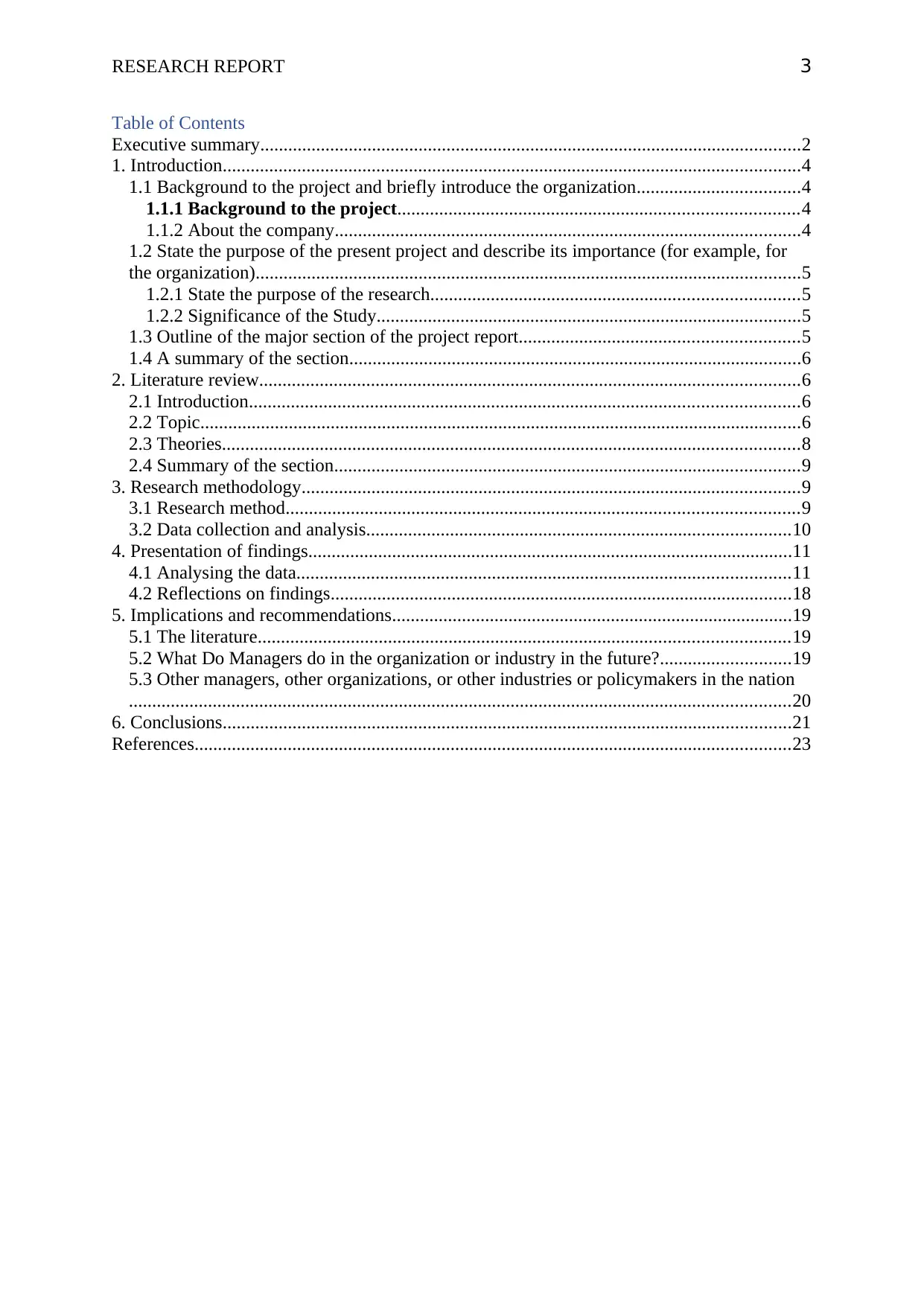
Executive summary....................................................................................................................2
1. Introduction............................................................................................................................4
1.1 Background to the project and briefly introduce the organization...................................4
1.1.1 Background to the project......................................................................................4
1.1.2 About the company....................................................................................................4
1.2 State the purpose of the present project and describe its importance (for example, for
the organization).....................................................................................................................5
1.2.1 State the purpose of the research...............................................................................5
1.2.2 Significance of the Study...........................................................................................5
1.3 Outline of the major section of the project report............................................................5
1.4 A summary of the section.................................................................................................6
2. Literature review....................................................................................................................6
2.1 Introduction......................................................................................................................6
2.2 Topic.................................................................................................................................6
2.3 Theories............................................................................................................................8
2.4 Summary of the section....................................................................................................9
3. Research methodology...........................................................................................................9
3.1 Research method..............................................................................................................9
3.2 Data collection and analysis...........................................................................................10
4. Presentation of findings........................................................................................................11
4.1 Analysing the data..........................................................................................................11
4.2 Reflections on findings...................................................................................................18
5. Implications and recommendations......................................................................................19
5.1 The literature..................................................................................................................19
5.2 What Do Managers do in the organization or industry in the future?............................19
5.3 Other managers, other organizations, or other industries or policymakers in the nation
..............................................................................................................................................20
6. Conclusions..........................................................................................................................21
References................................................................................................................................23
Table of Contents
Executive summary....................................................................................................................2
1. Introduction............................................................................................................................4
1.1 Background to the project and briefly introduce the organization...................................4
1.1.1 Background to the project......................................................................................4
1.1.2 About the company....................................................................................................4
1.2 State the purpose of the present project and describe its importance (for example, for
the organization).....................................................................................................................5
1.2.1 State the purpose of the research...............................................................................5
1.2.2 Significance of the Study...........................................................................................5
1.3 Outline of the major section of the project report............................................................5
1.4 A summary of the section.................................................................................................6
2. Literature review....................................................................................................................6
2.1 Introduction......................................................................................................................6
2.2 Topic.................................................................................................................................6
2.3 Theories............................................................................................................................8
2.4 Summary of the section....................................................................................................9
3. Research methodology...........................................................................................................9
3.1 Research method..............................................................................................................9
3.2 Data collection and analysis...........................................................................................10
4. Presentation of findings........................................................................................................11
4.1 Analysing the data..........................................................................................................11
4.2 Reflections on findings...................................................................................................18
5. Implications and recommendations......................................................................................19
5.1 The literature..................................................................................................................19
5.2 What Do Managers do in the organization or industry in the future?............................19
5.3 Other managers, other organizations, or other industries or policymakers in the nation
..............................................................................................................................................20
6. Conclusions..........................................................................................................................21
References................................................................................................................................23
⊘ This is a preview!⊘
Do you want full access?
Subscribe today to unlock all pages.

Trusted by 1+ million students worldwide
RESEARCH REPORT 4
1. Introduction
1.1 Background to the project and briefly introduce the organization
1.1.1 Background to the project
The identification of the organization’s optimal financial structure is the different one since it
entails an evaluation of different components, key among risk as well as profitability. The
decision is becoming more complicated concerning economics, technological, as well as
political atmosphere wherein the organization functions exhibits higher degree
unpredictability. Hence, the selection among ideal debt proportion as well as the equity that
could affect the value of an organization and financial performance (Allen, Gu, and
Kowalewski, 2018). Besides, it is illustrated that the financial system of the firm consists of
how the organization capitals assets with all their available resources. Usually, the
organization's capital only part of its assets with equity capital while another section is
financed by other capitals named as long-term financial liabilities as well as other short
abilities for illustration trade payables (Lu and Shang, 2017).
It is identified that there is a relationship among profitability and capital structure of listed
firms at Singapore Stock Exchange (SSE) and addressed that there is an effective favourable
association among ratio of short-term debt to total assets as well as, return on equity (ROE).
There is an unfavourable association among the ratio of long-term debt to total assets along
with ROE (Rufus and Ofoegbu, 2017). It can be concluded that there is a significant
favourable relation among short-term debt to total assets and profitability. There are exists
between favourable relations among total debt to total assets as well as, profitability in the
service sector (Zeb, Khan, and Iqbal, 2016).
1.1.2 About the company
SMI (Singapore Myanmar Investco Limited) creates management as well as investment. The
organization concentrates on the travel as well as fashion retail, beverage, construction, auto,
1. Introduction
1.1 Background to the project and briefly introduce the organization
1.1.1 Background to the project
The identification of the organization’s optimal financial structure is the different one since it
entails an evaluation of different components, key among risk as well as profitability. The
decision is becoming more complicated concerning economics, technological, as well as
political atmosphere wherein the organization functions exhibits higher degree
unpredictability. Hence, the selection among ideal debt proportion as well as the equity that
could affect the value of an organization and financial performance (Allen, Gu, and
Kowalewski, 2018). Besides, it is illustrated that the financial system of the firm consists of
how the organization capitals assets with all their available resources. Usually, the
organization's capital only part of its assets with equity capital while another section is
financed by other capitals named as long-term financial liabilities as well as other short
abilities for illustration trade payables (Lu and Shang, 2017).
It is identified that there is a relationship among profitability and capital structure of listed
firms at Singapore Stock Exchange (SSE) and addressed that there is an effective favourable
association among ratio of short-term debt to total assets as well as, return on equity (ROE).
There is an unfavourable association among the ratio of long-term debt to total assets along
with ROE (Rufus and Ofoegbu, 2017). It can be concluded that there is a significant
favourable relation among short-term debt to total assets and profitability. There are exists
between favourable relations among total debt to total assets as well as, profitability in the
service sector (Zeb, Khan, and Iqbal, 2016).
1.1.2 About the company
SMI (Singapore Myanmar Investco Limited) creates management as well as investment. The
organization concentrates on the travel as well as fashion retail, beverage, construction, auto,
Paraphrase This Document
Need a fresh take? Get an instant paraphrase of this document with our AI Paraphraser
RESEARCH REPORT 5
services, as well as logistic segments. Besides, it is illustrated that SMI achieves a cold chain
system as well as the franchisee for the brand of the restaurant (Singapore Myanmar Investco,
2020).
1.2 State the purpose of the present project and describe its importance (for example, for the
organization)
1.2.1 State purpose of investigation
To examine relation between short term debt and financial performance of the
organizations listed Singapore Myanmar Investco.
To address the relation among long term debt as well as financial performance of
company listed Singapore Myanmar Investco.
To evaluate the relationship between retained earnings as well as financial
performance of organization listed Singapore Myanmar Investco.
1.2.2 Significance of the research
This investigation tried to address effect of financial structure on organizational performance.
This research could also lead to examine the relation between long terms debts as well as the
financial performance of the company listed Singapore Myanmar Investco. Moreover, the
result of this study is effective for taking an effective decision concerning finance. It could
directly impact on organizational performance (Ogenche, Githui, and Omurwa, 2018).
1.3 Outline of the major section of the project report
This study mainly discusses many sections named as organizational background, project topic
description, the purpose of this study, literature review, and research methods, findings, and
conclusion and recommendation. Moreover, introduction section could support to examine
the basic knowledge about the research issues. In addition, literature review chapter supports
to examine the relationship between the research matters (Pitulice, et. al., 2016). Herein, the
research methodology section could consider different methods that are considered by the
services, as well as logistic segments. Besides, it is illustrated that SMI achieves a cold chain
system as well as the franchisee for the brand of the restaurant (Singapore Myanmar Investco,
2020).
1.2 State the purpose of the present project and describe its importance (for example, for the
organization)
1.2.1 State purpose of investigation
To examine relation between short term debt and financial performance of the
organizations listed Singapore Myanmar Investco.
To address the relation among long term debt as well as financial performance of
company listed Singapore Myanmar Investco.
To evaluate the relationship between retained earnings as well as financial
performance of organization listed Singapore Myanmar Investco.
1.2.2 Significance of the research
This investigation tried to address effect of financial structure on organizational performance.
This research could also lead to examine the relation between long terms debts as well as the
financial performance of the company listed Singapore Myanmar Investco. Moreover, the
result of this study is effective for taking an effective decision concerning finance. It could
directly impact on organizational performance (Ogenche, Githui, and Omurwa, 2018).
1.3 Outline of the major section of the project report
This study mainly discusses many sections named as organizational background, project topic
description, the purpose of this study, literature review, and research methods, findings, and
conclusion and recommendation. Moreover, introduction section could support to examine
the basic knowledge about the research issues. In addition, literature review chapter supports
to examine the relationship between the research matters (Pitulice, et. al., 2016). Herein, the
research methodology section could consider different methods that are considered by the
RESEARCH REPORT 6
researcher to acquire reliable data with respect to research matter. Furthermore, data analysis
and findings could support examining the gathered information and meeting the aim of the
study. It is the last section of the report which is known as conclusion and recommendation as
it permits the researcher to conclude the whole study. The recommendation section supports
to comprehend an effective way to meet the research purpose (Olusuyi and Felix, 2017).
1.4 A summary of the section
This section is effective to illustrate role of financial structure on performance of finance.
This section also supports to deeply examine the research issue. This section could support to
comprehend the study's purpose. This section is also vital to know why this study is
imperative for the organization.
2. Literature review
2.1 Introduction
To illustrate how firm can finance their assets and the factors that affect these funding
decisions, different models and theories about financial structure is proposed over the years
through several theorists. These models are making efforts for demonstrating the percentage
of equity and debt in firm that not only increases the value of company but also affects firm’s
capability to face rivalry in an ever-transforming environment (Balouei, et. al., 2018). This
investigation is supported through financial structure theories that offer the basis of
investigation variables selection. In specifically, relevance, agency, trade-off, pecking order,
signalling theory, and capital structure irrelevance are reviewed because all of them assist
both the dependent and predictor variables as indicated in conceptual structure (Allen, et. al.,
2018).
2.2 Topic
The financial structure demonstrates the financial outline of a firm that considers debt and
equity implemented to finance company. It is a significant topic among scholars in the
researcher to acquire reliable data with respect to research matter. Furthermore, data analysis
and findings could support examining the gathered information and meeting the aim of the
study. It is the last section of the report which is known as conclusion and recommendation as
it permits the researcher to conclude the whole study. The recommendation section supports
to comprehend an effective way to meet the research purpose (Olusuyi and Felix, 2017).
1.4 A summary of the section
This section is effective to illustrate role of financial structure on performance of finance.
This section also supports to deeply examine the research issue. This section could support to
comprehend the study's purpose. This section is also vital to know why this study is
imperative for the organization.
2. Literature review
2.1 Introduction
To illustrate how firm can finance their assets and the factors that affect these funding
decisions, different models and theories about financial structure is proposed over the years
through several theorists. These models are making efforts for demonstrating the percentage
of equity and debt in firm that not only increases the value of company but also affects firm’s
capability to face rivalry in an ever-transforming environment (Balouei, et. al., 2018). This
investigation is supported through financial structure theories that offer the basis of
investigation variables selection. In specifically, relevance, agency, trade-off, pecking order,
signalling theory, and capital structure irrelevance are reviewed because all of them assist
both the dependent and predictor variables as indicated in conceptual structure (Allen, et. al.,
2018).
2.2 Topic
The financial structure demonstrates the financial outline of a firm that considers debt and
equity implemented to finance company. It is a significant topic among scholars in the
⊘ This is a preview!⊘
Do you want full access?
Subscribe today to unlock all pages.
Trusted by 1+ million students worldwide
RESEARCH REPORT 7
finance sector. It is a combination of debts of firm (short and long term), preferred and
common equity. It is significant regarding how company finances its whole operations
together with, growth through several sources related to funds. Modigliani-Miller (MM)
theories are highly accepted financial structure theory since it is derivation theory that is
implemented by different investigators (Kamran, et. al., 2016).
As per this theory, these financial structure theory deals with the perfect market. Different
assumptions about perfect markets like rational investors, absence of bankruptcy expenses,
no taxes, perfect rivalry, as well as, efficient market. This theory addresses that financial
structure is not associated with its value in perfect environment. In a real situation, the
financial structure of a company is complex in terms of measuring. Financial managers are
complex to accurately evaluate optimal financial structure (Demirel and Eskin, 2017).
Company has concern about different securities in limitless combinations to come in across
specific integrations that could increase for its overall worth. It indicates the optimal financial
structure. It is higher weighted average cost of capital (WACC) and thus increasing firm
worth. Although, optimal financial structure is concern that had highly performed in different
investigations and could not be addressed by any theory that conclusively offers finest
financial structure to company. When there is irrelevancy of financial structure to firm value
in a perfect environment, then inadequacies have existed in reality could cause of its
appropriateness (Mehmood, Hunjra, and Chani, 2019).
The financial structure is highly associated with firm performance. It could be determined by
variables that consider growth, productivity, profitability, and customer satisfaction. These
determinates are associated with each other. Financial dimension is a significant technique
that shows financial strengths, opportunities, weaknesses, and threats. Those dimensions are
about residual income, return on investment (ROI), dividend yield, market capitalization,
earning per share (EPS), growth in sales, and price-earnings ratio (Nassar, 2016).
finance sector. It is a combination of debts of firm (short and long term), preferred and
common equity. It is significant regarding how company finances its whole operations
together with, growth through several sources related to funds. Modigliani-Miller (MM)
theories are highly accepted financial structure theory since it is derivation theory that is
implemented by different investigators (Kamran, et. al., 2016).
As per this theory, these financial structure theory deals with the perfect market. Different
assumptions about perfect markets like rational investors, absence of bankruptcy expenses,
no taxes, perfect rivalry, as well as, efficient market. This theory addresses that financial
structure is not associated with its value in perfect environment. In a real situation, the
financial structure of a company is complex in terms of measuring. Financial managers are
complex to accurately evaluate optimal financial structure (Demirel and Eskin, 2017).
Company has concern about different securities in limitless combinations to come in across
specific integrations that could increase for its overall worth. It indicates the optimal financial
structure. It is higher weighted average cost of capital (WACC) and thus increasing firm
worth. Although, optimal financial structure is concern that had highly performed in different
investigations and could not be addressed by any theory that conclusively offers finest
financial structure to company. When there is irrelevancy of financial structure to firm value
in a perfect environment, then inadequacies have existed in reality could cause of its
appropriateness (Mehmood, Hunjra, and Chani, 2019).
The financial structure is highly associated with firm performance. It could be determined by
variables that consider growth, productivity, profitability, and customer satisfaction. These
determinates are associated with each other. Financial dimension is a significant technique
that shows financial strengths, opportunities, weaknesses, and threats. Those dimensions are
about residual income, return on investment (ROI), dividend yield, market capitalization,
earning per share (EPS), growth in sales, and price-earnings ratio (Nassar, 2016).
Paraphrase This Document
Need a fresh take? Get an instant paraphrase of this document with our AI Paraphraser
RESEARCH REPORT 8
2.3 Theories
Static trade-off theory
As per view of Liaqat et al. (2017), static trade-off evaluated that when investment decisions
and firm assets are held constant. An ideal financial structure is accomplished while tax
benefits of debt equal to leverage related to cost that consider bankruptcy, financial distress,
as well as, agency. The theory determines that more profitable companies have more debt-
serving competency thus, there is a higher debt ratio and vice versa. It presumes the
availability of distinct target leverage for several companies because of specific factors about
the firm. It is identified that firms are already at their supposed goals.
Modigliani and miller (mm) theory
On the other side, Ajibola Wisdom and Qudus (2018) opined that MM theory offers the
seminal in financial structure under some assumptions like homogenous expectations, no
transaction expenses, no taxes, as well as, perfect capital markets. This theory is alias as
capital structure inappropriateness. It evaluates association among capital structure as well as,
the irrelevant cost of capital. It indicates that the increases in debts do not impact on cost of
capital. Consequently, expectation of investors about potential advantages totally impacts on
cost of capital and firm value.
Currently, Hashim and Hassan (2017) evaluated that Modigliani and Miller have initiated
new evidence that cost of capital impact on financial structure. Therefore, there is impact of
firm value that is considering taxes as assumption into deliberation. It is illustrated that
borrowing provides tax benefit since interest would deduct from a tax that outcome is
illustrated as tax shields. It can turn in declining cost of debt and then increasing performance
of company.
On the other side, Echekoba and Ananwude (2016) illustrated that dynamic trade-off theory
states that companies can deviate through their target capital structure. However, they would
2.3 Theories
Static trade-off theory
As per view of Liaqat et al. (2017), static trade-off evaluated that when investment decisions
and firm assets are held constant. An ideal financial structure is accomplished while tax
benefits of debt equal to leverage related to cost that consider bankruptcy, financial distress,
as well as, agency. The theory determines that more profitable companies have more debt-
serving competency thus, there is a higher debt ratio and vice versa. It presumes the
availability of distinct target leverage for several companies because of specific factors about
the firm. It is identified that firms are already at their supposed goals.
Modigliani and miller (mm) theory
On the other side, Ajibola Wisdom and Qudus (2018) opined that MM theory offers the
seminal in financial structure under some assumptions like homogenous expectations, no
transaction expenses, no taxes, as well as, perfect capital markets. This theory is alias as
capital structure inappropriateness. It evaluates association among capital structure as well as,
the irrelevant cost of capital. It indicates that the increases in debts do not impact on cost of
capital. Consequently, expectation of investors about potential advantages totally impacts on
cost of capital and firm value.
Currently, Hashim and Hassan (2017) evaluated that Modigliani and Miller have initiated
new evidence that cost of capital impact on financial structure. Therefore, there is impact of
firm value that is considering taxes as assumption into deliberation. It is illustrated that
borrowing provides tax benefit since interest would deduct from a tax that outcome is
illustrated as tax shields. It can turn in declining cost of debt and then increasing performance
of company.
On the other side, Echekoba and Ananwude (2016) illustrated that dynamic trade-off theory
states that companies can deviate through their target capital structure. However, they would
RESEARCH REPORT 9
demonstrate an adjustment attitude that concerns the target. The existence of supposed target
has required that any deviation through target leverage be familiar at some speed of
adjustment. However, there is the extent of this SOA is distinguished by several companies.
Sivalingam and Kengatharan (2018) stated that the pecking order theory illustrated that
companies have preferred pyramid for financing verdicts with the highest preference that is
being to practice internal financing before resorting to any kind of external funds. They can
visualize an inverse association between financial performance and debt.
Pinto and Quadras (2016) exhibited that agency theory identifies that optimal capital structure
is accomplished through declining costs that result from conflicts among owners, managers,
and debt holders. It is identified that debt could be implemented for controlling the manager’s
behaviour by declining free cash flows within-firm possibly to be misappropriated through
making sure rapid payment about interest payments. This theory is supported by higher debt
as well as, financial performance associations.
2.4 Summary of the section
It can be summarised that there is significant relationship among financial structure and
financial performance of the company. It can be concluded that different theories are related
to financial structure such as Dynamic trade-off theory, Modigliani-Miller (MM), agency
theory, and Static trade-off theory. It could be summarised that financial executives are
complex to accurately assess optimum capital structure.
3. Research methodology
3.1 Research method
This method could permit the researcher for getting information about the research matter.
For collecting the information about investing the role of financial structure on financial
performance, researcher has practiced case study approach that has permitting to examine the
cases of the organization listed Singapore Myanmar Investco and obtains an effective
demonstrate an adjustment attitude that concerns the target. The existence of supposed target
has required that any deviation through target leverage be familiar at some speed of
adjustment. However, there is the extent of this SOA is distinguished by several companies.
Sivalingam and Kengatharan (2018) stated that the pecking order theory illustrated that
companies have preferred pyramid for financing verdicts with the highest preference that is
being to practice internal financing before resorting to any kind of external funds. They can
visualize an inverse association between financial performance and debt.
Pinto and Quadras (2016) exhibited that agency theory identifies that optimal capital structure
is accomplished through declining costs that result from conflicts among owners, managers,
and debt holders. It is identified that debt could be implemented for controlling the manager’s
behaviour by declining free cash flows within-firm possibly to be misappropriated through
making sure rapid payment about interest payments. This theory is supported by higher debt
as well as, financial performance associations.
2.4 Summary of the section
It can be summarised that there is significant relationship among financial structure and
financial performance of the company. It can be concluded that different theories are related
to financial structure such as Dynamic trade-off theory, Modigliani-Miller (MM), agency
theory, and Static trade-off theory. It could be summarised that financial executives are
complex to accurately assess optimum capital structure.
3. Research methodology
3.1 Research method
This method could permit the researcher for getting information about the research matter.
For collecting the information about investing the role of financial structure on financial
performance, researcher has practiced case study approach that has permitting to examine the
cases of the organization listed Singapore Myanmar Investco and obtains an effective
⊘ This is a preview!⊘
Do you want full access?
Subscribe today to unlock all pages.
Trusted by 1+ million students worldwide
RESEARCH REPORT 10
solution towards the research purpose. For conducting this study, the researcher has selected
some online websites of Singapore Myanmar Investco to comprehends the financial situation
(Fletcher, 2017).
It will also lead to getting the reliable and valid research outcome. The researcher has
selected different sources named company websites annual reports, and financial statements
not know the situation and make a financial decision towards the organization (Glesne,
2016).
In this study, the researcher will imply qualitative data over the quantitative method. It is
because this tool will allow the researcher to getting theoretical information concerning the
research matter. The qualitative data could be gathered by considered existing sources named
as books, magazines, and online and offline sources can be considered. From the evaluation,
it is addressed that this method is more suitable as compared to another research method
because this tool is easy as compared to the other method (Mohajan, 2018).
3.2 Data collection and analysis
The data gathering method could permit the researcher to obtain data regarding investigation
matter. In this investigation, there are some kinds of techniques that could be incorporated as
the data gathering methods such as primary data gathering method as well as, secondary
method. For conducting this study, the researcher has considered different sources of data
collection methods named a company annual report, industry data, and industry magazines.
These sources aid to obtain specific data related to investigation concern (Silverman, 2016).
Data analysis
The data analysis section could support to examine the collected information and meet the
research matter. Different sources are considered by the researcher to examine the data and
address an effective way to solve the research problem. These methods were known as
qualitative analysis methods and quantitative data evaluation methods. For conducting this
solution towards the research purpose. For conducting this study, the researcher has selected
some online websites of Singapore Myanmar Investco to comprehends the financial situation
(Fletcher, 2017).
It will also lead to getting the reliable and valid research outcome. The researcher has
selected different sources named company websites annual reports, and financial statements
not know the situation and make a financial decision towards the organization (Glesne,
2016).
In this study, the researcher will imply qualitative data over the quantitative method. It is
because this tool will allow the researcher to getting theoretical information concerning the
research matter. The qualitative data could be gathered by considered existing sources named
as books, magazines, and online and offline sources can be considered. From the evaluation,
it is addressed that this method is more suitable as compared to another research method
because this tool is easy as compared to the other method (Mohajan, 2018).
3.2 Data collection and analysis
The data gathering method could permit the researcher to obtain data regarding investigation
matter. In this investigation, there are some kinds of techniques that could be incorporated as
the data gathering methods such as primary data gathering method as well as, secondary
method. For conducting this study, the researcher has considered different sources of data
collection methods named a company annual report, industry data, and industry magazines.
These sources aid to obtain specific data related to investigation concern (Silverman, 2016).
Data analysis
The data analysis section could support to examine the collected information and meet the
research matter. Different sources are considered by the researcher to examine the data and
address an effective way to solve the research problem. These methods were known as
qualitative analysis methods and quantitative data evaluation methods. For conducting this
Paraphrase This Document
Need a fresh take? Get an instant paraphrase of this document with our AI Paraphraser
RESEARCH REPORT 11
study, the researcher has implied the qualitative data assessment tool as it enables to identify
the theoretical data of the investigation and facilitate to complete the whole study efficiently
(Mohajan, 2018).
4. Presentation of findings
4.1 Analysing the data
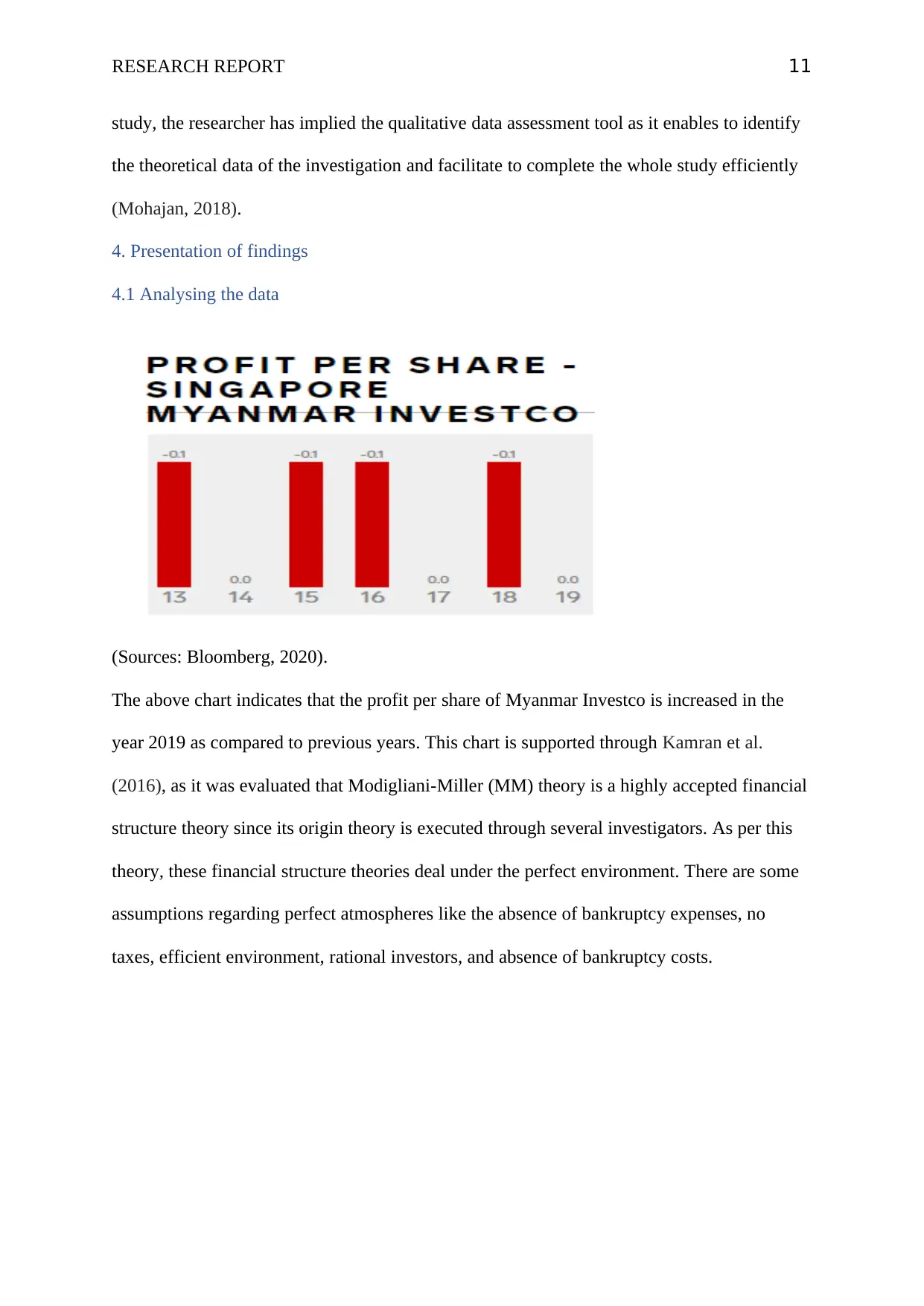
(Sources: Bloomberg, 2020).
The above chart indicates that the profit per share of Myanmar Investco is increased in the
year 2019 as compared to previous years. This chart is supported through Kamran et al.
(2016), as it was evaluated that Modigliani-Miller (MM) theory is a highly accepted financial
structure theory since its origin theory is executed through several investigators. As per this
theory, these financial structure theories deal under the perfect environment. There are some
assumptions regarding perfect atmospheres like the absence of bankruptcy expenses, no
taxes, efficient environment, rational investors, and absence of bankruptcy costs.
study, the researcher has implied the qualitative data assessment tool as it enables to identify
the theoretical data of the investigation and facilitate to complete the whole study efficiently
(Mohajan, 2018).
4. Presentation of findings
4.1 Analysing the data
(Sources: Bloomberg, 2020).
The above chart indicates that the profit per share of Myanmar Investco is increased in the
year 2019 as compared to previous years. This chart is supported through Kamran et al.
(2016), as it was evaluated that Modigliani-Miller (MM) theory is a highly accepted financial
structure theory since its origin theory is executed through several investigators. As per this
theory, these financial structure theories deal under the perfect environment. There are some
assumptions regarding perfect atmospheres like the absence of bankruptcy expenses, no
taxes, efficient environment, rational investors, and absence of bankruptcy costs.
RESEARCH REPORT 12
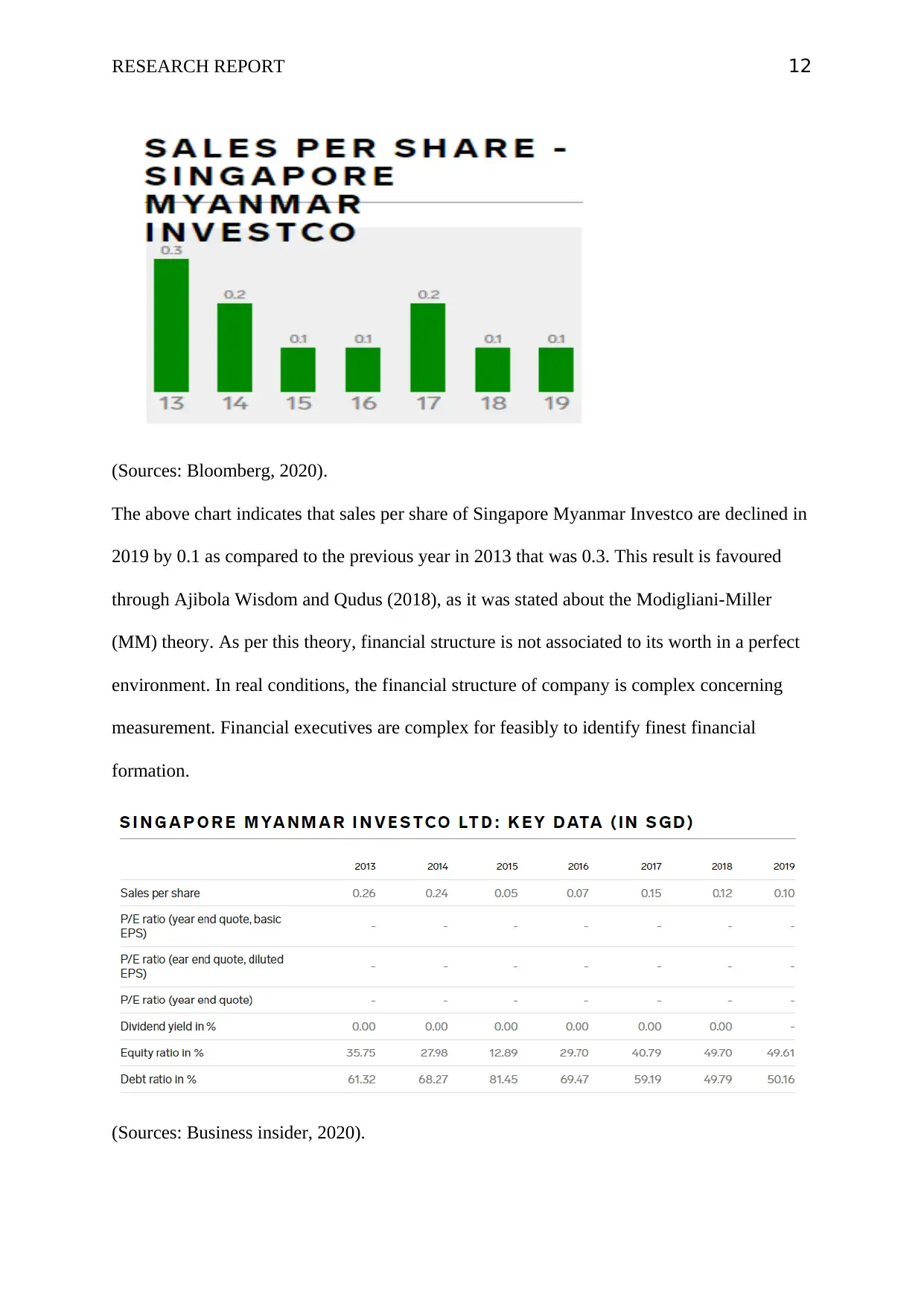
(Sources: Bloomberg, 2020).
The above chart indicates that sales per share of Singapore Myanmar Investco are declined in
2019 by 0.1 as compared to the previous year in 2013 that was 0.3. This result is favoured
through Ajibola Wisdom and Qudus (2018), as it was stated about the Modigliani-Miller
(MM) theory. As per this theory, financial structure is not associated to its worth in a perfect
environment. In real conditions, the financial structure of company is complex concerning
measurement. Financial executives are complex for feasibly to identify finest financial
formation.
(Sources: Business insider, 2020).
(Sources: Bloomberg, 2020).
The above chart indicates that sales per share of Singapore Myanmar Investco are declined in
2019 by 0.1 as compared to the previous year in 2013 that was 0.3. This result is favoured
through Ajibola Wisdom and Qudus (2018), as it was stated about the Modigliani-Miller
(MM) theory. As per this theory, financial structure is not associated to its worth in a perfect
environment. In real conditions, the financial structure of company is complex concerning
measurement. Financial executives are complex for feasibly to identify finest financial
formation.
(Sources: Business insider, 2020).
⊘ This is a preview!⊘
Do you want full access?
Subscribe today to unlock all pages.
Trusted by 1+ million students worldwide

1 out of 25


Related Documents


Your All-in-One AI-Powered Toolkit for Academic Success.
+13062052269
info@desklib.com
Available 24*7 on WhatsApp / Email
![[object Object]](/_next/static/media/star-bottom.7253800d.svg)
Unlock your academic potential
Copyright © 2020–2026 A2Z Services. All Rights Reserved. Developed and managed by ZUCOL.