PLG 1: System Overload Evaluation and Decision Tree Analysis

Verified

Added on  2023/04/20

|6
|1124
|206
Creative Assignment
AI Summary
This creative assignment delves into the critical issue of system overload, particularly within the context of aeronautical science, addressing the challenges posed by the increasing volume of data in modern information systems. The paper presents a scenario involving human operators and two interacting computer systems designed to detect system overload, focusing on how overload can arise, such as through traffic peaks or system failures, and the role of service brokers. A literature review explores existing research on system overload and its impact, emphasizing the need for effective decision-making strategies. The assignment proposes a cognitive decision tree to resolve overload conditions and recommends priorities in system architecture, including identifying key overload indicators and configuring overload protection behavior. The research highlights the importance of proactive measures to prevent the recurrence of overload, offering insights into system design and component realignment to enhance the system lifecycle. The conclusion emphasizes the significance of the proposed strategies and suggests avenues for future research.
Document Page
Running head: RESOLVING SYSTEM OVERLOAD 1
Resolving System Evaluation
Student
Tutor
Institutional Affiliations
Date
tabler-icon-diamond-filled.svg

Paraphrase This Document

Need a fresh take? Get an instant paraphrase of this document with our AI Paraphraser
Document Page
RESOLVING SYSTEM OVERLOAD 2
Resolving System Evaluation
Introduction
The ever-growing data due to the modern information system IS has led to a breakdown
in cognitive decision making especially in aeronautic science. Given the overabundance of the
information technology, it is not surprising that the system overload is increasingly experienced
in aeronautical science among other domains. Despite much of the literature on decision making,
a few works of literature have explored the aeronautical science domain. This has precipitated
the need for this article to venture into this critical subject of study. This will be archived with
the aid of a scenario involving human operators and two interacting computer system that detect
system overload.
Problem statement
The system components and how overload occurs
For the purpose of this research paper, consider a scenario involving two computers for
detecting system overload, during certain cases for example traffic peaks or the unexpected
failure from the entities of the system. This may lead to the rise on the service broker thus
causing a situation called system overload. The service broker modules will have insufficient
resources to attend to new sessions. This will require an effective decision making strategy to
overcome the system overload.
Literature overview
Only a few works of literature have attempted to link decision maker experience and the
background to the system overload. Early findings hold that system overload is likely to have an
Document Page
RESOLVING SYSTEM OVERLOAD 3
impact on the productivity of the workers, the majority of research in this particular domain,
however, have been conducted in laboratories where the real decision problems are not dealt
with. Benselin, & Ragsdell (2016) is, however, an exception, the authors conducted a study
involving information overload in depth and report in their study that the subjects who are not
overloaded perform much better than those that are overloaded with information. However, those
that were not overloaded were less satisfied compared to the subjects that were overloaded.
Many research on system overload tends to view system load with respect to criteria
instead of alternatives as seen from multiple criteria decision making perspectives. Thus
suggesting that system overload is more focused on extra information about choices rather than
extending the choices like more criteria (Walker, 2016). This notion is interesting, especially
when compared with Jia et al. (2011) findings that the decision makers seem to need a few signs
for example criteria in order to make a consistent decision.
As more findings on system overload increased, a few methods of dealing with it also
evolved. For example, Dean & Webb (2011), suggest that we can recover from information
system overload by organizing a complex problem into a simple structure for example by
structuring problems by an analytic hierarchy process method. The examination of literature
suggests that certain problem structuring methodologies favors quality decision making and
reduces the use of decision heuristics, however, the issue arises in problem structuring in general
(Dean & Webb, 2011). Additionally, most of the suggested decision making approaches do not
address the cognitive and construction of decision making tree diagram as well as system
overload. This research, on the other hand, intends to look into decision making strategy taking
into account all these aspects and priorities in system architecture.
Priorities in system architecture to prevent system overloading from recurring
Document Page
RESOLVING SYSTEM OVERLOAD 4
In order to handle the increased amount of traffic/system overload, it is essential to
consider some priorities for overload protection in the information system. The first priority, in
this case, is to find out the key overload indicators (Lee, Son, & Kim, 2016). There are many
service brokers offering gauges that act as system overload indicators. Moreover, the service
brokers also provide overload prevention according to the values offered by these indicators. The
most important thing that should be put into consideration to avoid such overload is the
configuration of the overload protection behavior (Bollen, Knijnenburg, Willemsen & Graus,
2010). Service brokers always continue to handle active sessions and stop accepting new
sessions while identifying system overload. During this step, the response of the service broker
to the diameter of the network entities that may cause sessions when the system is overloaded
can be configured and dealt with. Moreover, overload protection can be prevented by the use of
either the service broker configurations or an admiration console.
Conclusion
In summary, the research has analyzed various system overload protection strategies with
the help of different literature. The examined priorities for mitigating the system overload have
been proven to be essential in mitigating the problems on system overload. It is recommended
that future research look into the downsides of these strategies for reducing system overload.
tabler-icon-diamond-filled.svg

Paraphrase This Document

Need a fresh take? Get an instant paraphrase of this document with our AI Paraphraser
Document Page
RESOLVING SYSTEM OVERLOAD 5
References
Benselin, J. C., & Ragsdell, G. (2016). Information overload: The differences that age
makes. Journal of Librarianship and Information Science, 48(3), 284-297.
Bollen, D., Knijnenburg, B. P., Willemsen, M. C., & Graus, M. (2010, September).
Understanding choice overload in recommender systems. In Proceedings of the fourth
ACM conference on Recommender systems (pp. 63-70). ACM.
Dean, D., & Webb, C. (2011). Recovering from information overload. McKinsey Quarterly, 1(1),
80-88.
Jia, H., Wang, M., Ran, W., Yang, S. J., Liao, J., & Chiu, D. K. (2011). Design of a
performance-oriented workplace e-learning system using ontology. Expert Systems with
Applications, 38(4), 3372-3382.
Lee, A. R., Son, S. M., & Kim, K. K. (2016). Information and communication technology
overload and social networking service fatigue: A stress perspective. Computers in
Human Behavior, 55, 51-61.
Walker W. (2016). PC System overload Problems & Workarounds. Retrieved on 11th February
2019 from: < https://www.soundonsound.com/techniques/pc-system-overload-problems-
workarounds>
Appendix
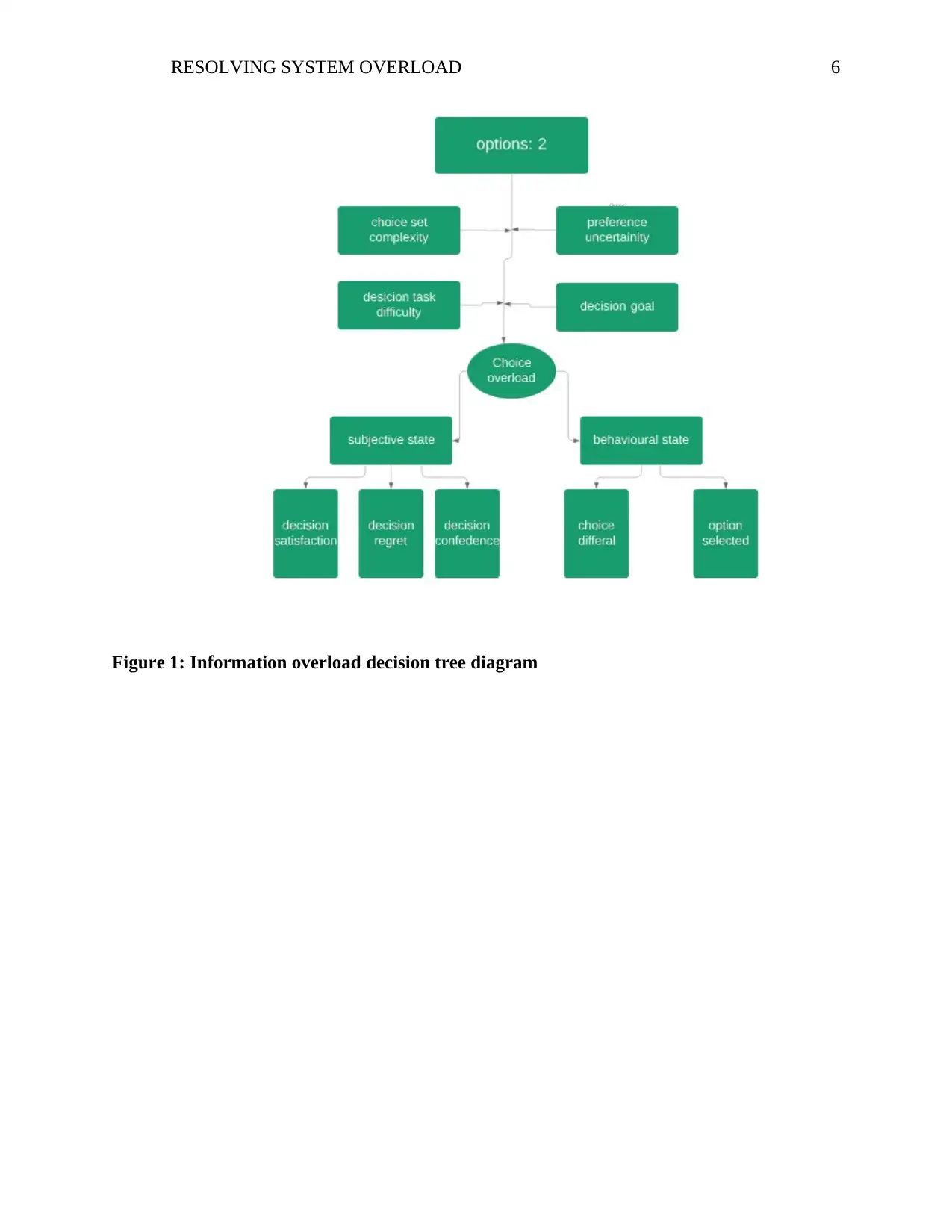
Decision Tree diagram
Document Page
RESOLVING SYSTEM OVERLOAD 6
Figure 1: Information overload decision tree diagram
chevron_up_icon
1 out of 6
circle_padding
hide_on_mobile
zoom_out_icon
[object Object]