Exploring Science and Traditional Knowledge in Resource Management

Verified

Added on  2023/04/06

|4
|552
|274
Essay
AI Summary
This essay delves into the relationship between science and traditional knowledge within the context of resource management. It examines the foundations of both systems, highlighting how Western science often overshadows indigenous knowledge despite the latter's efficacy. The essay further explores the power dynamics that emerge when these two knowledge systems interact, particularly in environmental and resource management. It uses examples to illustrate how indigenous communities can be marginalized even when their knowledge contributes to scientific advancements, ultimately benefiting external entities rather than the communities themselves. The essay concludes by emphasizing the need for a more equitable recognition and integration of traditional knowledge in resource management practices. Desklib offers a variety of resources, including essays and solved assignments, to aid students in their studies.
Document Page
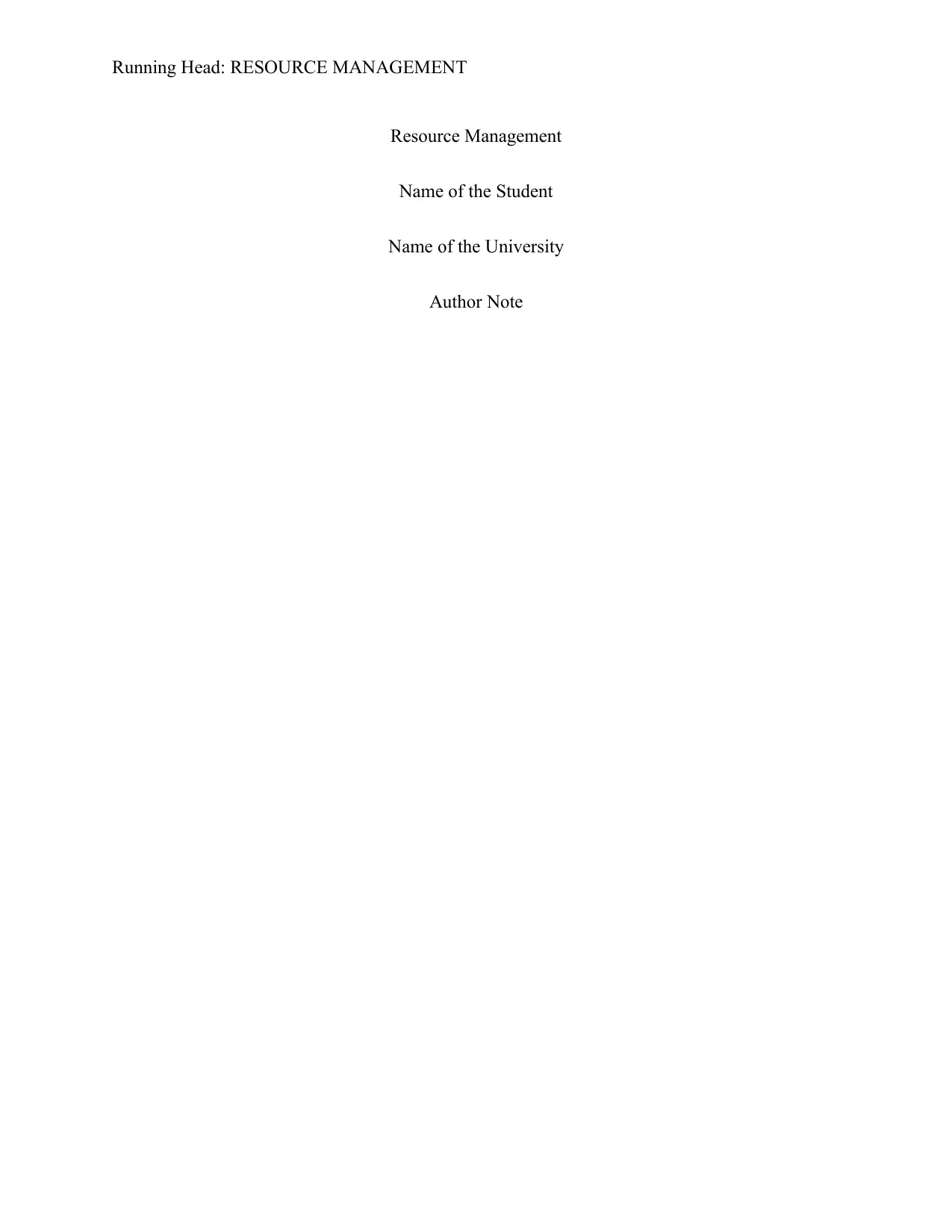
Running Head: RESOURCE MANAGEMENT
Resource Management
Name of the Student
Name of the University
Author Note
tabler-icon-diamond-filled.svg

Paraphrase This Document

Need a fresh take? Get an instant paraphrase of this document with our AI Paraphraser
Document Page
1RESOURCE MANAGEMENT
What is the basis of science / traditional knowledge?
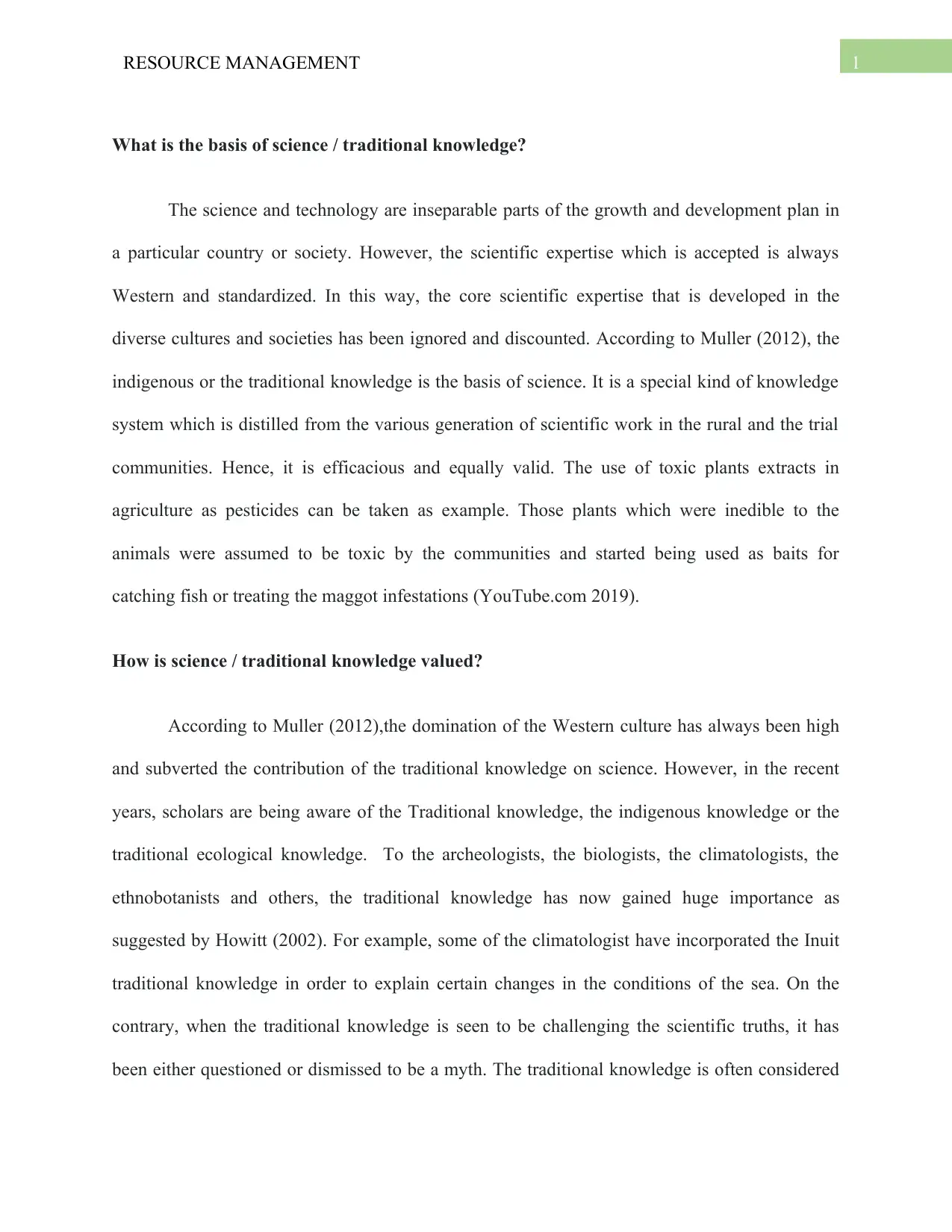
The science and technology are inseparable parts of the growth and development plan in
a particular country or society. However, the scientific expertise which is accepted is always
Western and standardized. In this way, the core scientific expertise that is developed in the
diverse cultures and societies has been ignored and discounted. According to Muller (2012), the
indigenous or the traditional knowledge is the basis of science. It is a special kind of knowledge
system which is distilled from the various generation of scientific work in the rural and the trial
communities. Hence, it is efficacious and equally valid. The use of toxic plants extracts in
agriculture as pesticides can be taken as example. Those plants which were inedible to the
animals were assumed to be toxic by the communities and started being used as baits for
catching fish or treating the maggot infestations (YouTube.com 2019).
How is science / traditional knowledge valued?
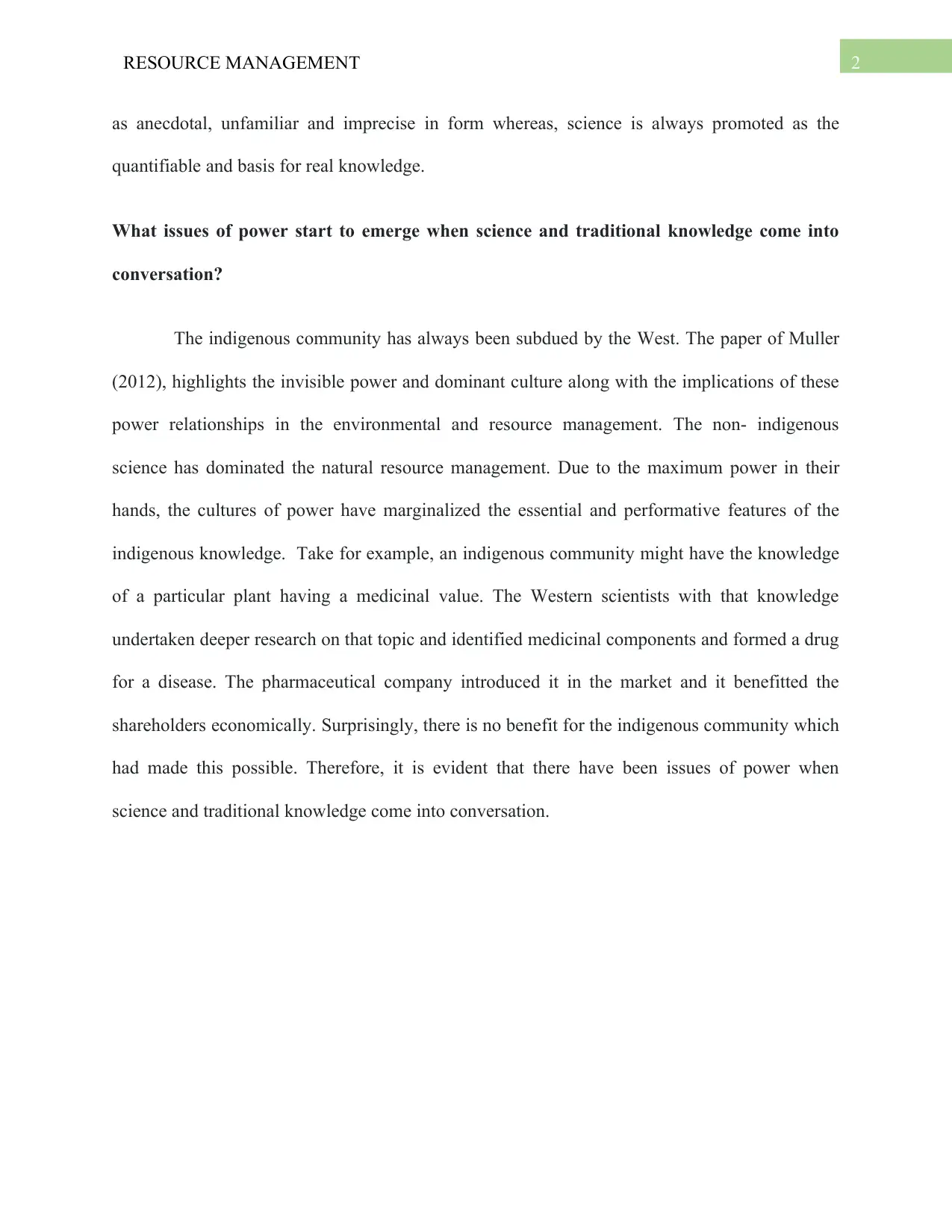
According to Muller (2012),the domination of the Western culture has always been high
and subverted the contribution of the traditional knowledge on science. However, in the recent
years, scholars are being aware of the Traditional knowledge, the indigenous knowledge or the
traditional ecological knowledge. To the archeologists, the biologists, the climatologists, the
ethnobotanists and others, the traditional knowledge has now gained huge importance as
suggested by Howitt (2002). For example, some of the climatologist have incorporated the Inuit
traditional knowledge in order to explain certain changes in the conditions of the sea. On the
contrary, when the traditional knowledge is seen to be challenging the scientific truths, it has
been either questioned or dismissed to be a myth. The traditional knowledge is often considered
Document Page
2RESOURCE MANAGEMENT
as anecdotal, unfamiliar and imprecise in form whereas, science is always promoted as the
quantifiable and basis for real knowledge.
What issues of power start to emerge when science and traditional knowledge come into
conversation?
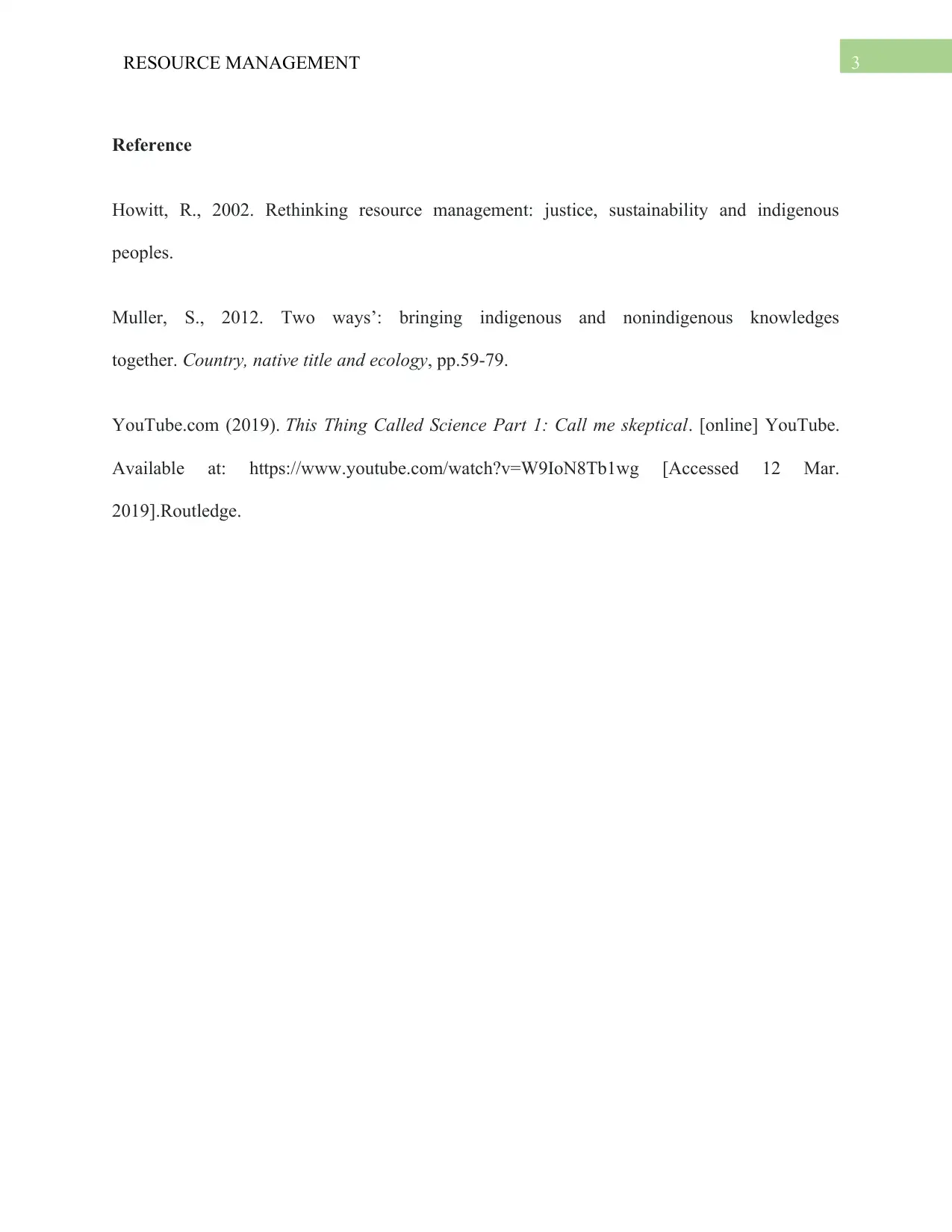
The indigenous community has always been subdued by the West. The paper of Muller
(2012), highlights the invisible power and dominant culture along with the implications of these
power relationships in the environmental and resource management. The non- indigenous
science has dominated the natural resource management. Due to the maximum power in their
hands, the cultures of power have marginalized the essential and performative features of the
indigenous knowledge. Take for example, an indigenous community might have the knowledge
of a particular plant having a medicinal value. The Western scientists with that knowledge
undertaken deeper research on that topic and identified medicinal components and formed a drug
for a disease. The pharmaceutical company introduced it in the market and it benefitted the
shareholders economically. Surprisingly, there is no benefit for the indigenous community which
had made this possible. Therefore, it is evident that there have been issues of power when
science and traditional knowledge come into conversation.
Document Page
3RESOURCE MANAGEMENT
Reference
Howitt, R., 2002. Rethinking resource management: justice, sustainability and indigenous
peoples.
Muller, S., 2012. Two ways’: bringing indigenous and nonindigenous knowledges
together. Country, native title and ecology, pp.59-79.
YouTube.com (2019). This Thing Called Science Part 1: Call me skeptical. [online] YouTube.
Available at: https://www.youtube.com/watch?v=W9IoN8Tb1wg [Accessed 12 Mar.
2019].Routledge.
chevron_up_icon
1 out of 4
circle_padding
hide_on_mobile
zoom_out_icon
[object Object]