Feminist International Relations: An Analysis of Three Articles
VerifiedAdded on 2023/01/13
|5
|1846
|30
Essay
AI Summary
This essay provides an analysis of three articles related to feminist international relations. The first article, by Carol Cohn, examines the language and imagery used by defense professionals, highlighting the euphemisms surrounding sex and death. The second article, by Laura J. Shepherd, explores the significance of gender in global politics and how it shapes our understanding of bodies and power. The third article, by Chandra Talpade Mohanty, critiques Western feminist scholarship's approach to third-world women and colonial discourses, highlighting the tendency to homogenize the experiences of women in the Global South. The essay discusses the strengths, weaknesses, and counterarguments presented in each article, drawing comparisons and contrasts between the authors' perspectives and overall arguments. The analysis emphasizes the interconnectedness of gender, power, and international relations within a feminist framework.
Articles:
In this response paper I will analyse and explore three articles relating to feminist
international relations. The first article which is selected investigates the language and imagery
which is used by defence professionals. The second article discusses about how and why the
gender matters within political practices. While article third is about critic over the Western
feminist scholarship's approach to the third world women.
Article 1: Sex and Death in the Rational World of Defence Intellectuals
The first article which I aim to explore is by Carol Cohn (1987). In this article, Cohn has
divided her experience of interaction with defence intellectuals in four stages. In the first stage,
she has presented her experience of listening to the language which defence intellectuals used in
their day. In the second section, Cohen discussed her experience while learning to this language
with the aim of effective converse with defence professionals. The third and fourth section of this
article were revolved around interpreting this language and understand the terror behind it. This
article has emphasised on euphemisms which is used by these professionals for sex and death.
The main question which is being addressed in this article is the reason behind euphemism and
bluntness behind sensitive topics such as sex and death by defence intellectuals. The core
argument presented by the author in this article is that defence professionals are surrounded by
nuclear bombs and deaths all day due to which they have become abrupt about death. Author has
also justified this argument with the language which defence people use; as human death is often
referred as “collateral damage” by these professionals (pg. 691). Another argument which author
has highlighted in this article is that the reason behind euphemism for sex is the dominance of
males in defence mechanism. Majority of the defence intellectuals are males due to which they
use a language in which they ate used to communicate. In section one, Cohn shared her
experience of communicating with a defence professor where he referred India’s explosion of a
nuclear bomb as “losing her virginity”. Author has also argumented that learning technostrategic
language is a transformative process rather than addictive as it helps an individual to add a new
set of words in vocabulary.
Along with the arguments highlighted above, there were few assumptions as well which
author has made in her article. Cohn has stressed in her article that if a statement is made by an
intellectual having precise knowledge and experience then their statements cannot be distorted.
In this response paper I will analyse and explore three articles relating to feminist
international relations. The first article which is selected investigates the language and imagery
which is used by defence professionals. The second article discusses about how and why the
gender matters within political practices. While article third is about critic over the Western
feminist scholarship's approach to the third world women.
Article 1: Sex and Death in the Rational World of Defence Intellectuals
The first article which I aim to explore is by Carol Cohn (1987). In this article, Cohn has
divided her experience of interaction with defence intellectuals in four stages. In the first stage,
she has presented her experience of listening to the language which defence intellectuals used in
their day. In the second section, Cohen discussed her experience while learning to this language
with the aim of effective converse with defence professionals. The third and fourth section of this
article were revolved around interpreting this language and understand the terror behind it. This
article has emphasised on euphemisms which is used by these professionals for sex and death.
The main question which is being addressed in this article is the reason behind euphemism and
bluntness behind sensitive topics such as sex and death by defence intellectuals. The core
argument presented by the author in this article is that defence professionals are surrounded by
nuclear bombs and deaths all day due to which they have become abrupt about death. Author has
also justified this argument with the language which defence people use; as human death is often
referred as “collateral damage” by these professionals (pg. 691). Another argument which author
has highlighted in this article is that the reason behind euphemism for sex is the dominance of
males in defence mechanism. Majority of the defence intellectuals are males due to which they
use a language in which they ate used to communicate. In section one, Cohn shared her
experience of communicating with a defence professor where he referred India’s explosion of a
nuclear bomb as “losing her virginity”. Author has also argumented that learning technostrategic
language is a transformative process rather than addictive as it helps an individual to add a new
set of words in vocabulary.
Along with the arguments highlighted above, there were few assumptions as well which
author has made in her article. Cohn has stressed in her article that if a statement is made by an
intellectual having precise knowledge and experience then their statements cannot be distorted.

Paraphrase This Document
Need a fresh take? Get an instant paraphrase of this document with our AI Paraphraser
By exploring each section of this article, it has been seen that this article has various strengths as
it highlights the inner world in which defence intellectuals live. These strengths are the
explorative evaluation of language dialogues which these professionals use which is often
referred as sexualised language. Some of these dialogues are even reconnoitred by Cohen such as
erector launchers and deep penetration. Apart from the lingual strengths, the efforts of Cohen to
understand this language has provided her article a strength as well. There are few weaknesses of
this article as well which can include excessive use of metaphors and jargons.
The exploration of this article has highlighted a counter argument that what if even after
learning defence intellectuals’ language, one can notice no relevance. This counter has created to
the argument presented by a professional to Cohen which she has presented in her article (pg.
716). From overall analyses of this article it has concluded that the strengths of this article can
easily overcome weakness of this article.
Article 2: Sex or Gender? Bodies in World Politics and Why gender matters
This paper is written by Laura J. Shepherd (2015), over the article named as Sex or
Gender? Bodies in World Politics and Why gender matters. The main question behind this article
is that why and how the gender matters while interrogating several conception of body in global
politics. This article put emphases over the gender matter within the global politics. As it is not
possible to ignore the manner gender inform as well as affect the practices related with the world
tourism. This is so because a gender is not only about the identity or the manner in which people
look at the world as per the gandering global politics but also depend over the logic which is
related with the global politics.
Laura J. Shephered strengthen this article by exploring the issue of gender or body by
suggesting that the relationship between gender and sex is not as much simple or straightforward
which is commonly presented by people in politics. Further explain it by providing his
assumption that the human beings are divided into two distinct category that are based on
physical form (morphism). This difference mainly develop the world in which one think about
the social as well as political event and kind of relationship that people mainly conceive of being
to do with body such as parenting, marriage ceremonies etc. As the separation mainly occurs at
sub conscious level and the preconceptions related with bodies directly influence what we eat,
sports we like to play, people that can remain in our circle etc.
it highlights the inner world in which defence intellectuals live. These strengths are the
explorative evaluation of language dialogues which these professionals use which is often
referred as sexualised language. Some of these dialogues are even reconnoitred by Cohen such as
erector launchers and deep penetration. Apart from the lingual strengths, the efforts of Cohen to
understand this language has provided her article a strength as well. There are few weaknesses of
this article as well which can include excessive use of metaphors and jargons.
The exploration of this article has highlighted a counter argument that what if even after
learning defence intellectuals’ language, one can notice no relevance. This counter has created to
the argument presented by a professional to Cohen which she has presented in her article (pg.
716). From overall analyses of this article it has concluded that the strengths of this article can
easily overcome weakness of this article.
Article 2: Sex or Gender? Bodies in World Politics and Why gender matters
This paper is written by Laura J. Shepherd (2015), over the article named as Sex or
Gender? Bodies in World Politics and Why gender matters. The main question behind this article
is that why and how the gender matters while interrogating several conception of body in global
politics. This article put emphases over the gender matter within the global politics. As it is not
possible to ignore the manner gender inform as well as affect the practices related with the world
tourism. This is so because a gender is not only about the identity or the manner in which people
look at the world as per the gandering global politics but also depend over the logic which is
related with the global politics.
Laura J. Shephered strengthen this article by exploring the issue of gender or body by
suggesting that the relationship between gender and sex is not as much simple or straightforward
which is commonly presented by people in politics. Further explain it by providing his
assumption that the human beings are divided into two distinct category that are based on
physical form (morphism). This difference mainly develop the world in which one think about
the social as well as political event and kind of relationship that people mainly conceive of being
to do with body such as parenting, marriage ceremonies etc. As the separation mainly occurs at
sub conscious level and the preconceptions related with bodies directly influence what we eat,
sports we like to play, people that can remain in our circle etc.
But the weakness of this article is that the researcher made an argument which is right
that it is very comforting that body is something that one can not change or it is something that
doesn't affect the the social as well as political lives. The conventional contemporary theories of
international relation not tell much about the bodies because individual mainly do not matters as
it consider only collectives of individual such as nations feature. But in reality the body or
gender is consider by the people while taking some action toward the political practices.
Additionally the global politics take body seriously as it require that one must think carefully
about ways in which body manifests within our understanding of international relations.
From the evaluation of this article the counter argument has been identified that there
remains different perspectives over the relationship between the gender and sex. With the help of
providing this information, researcher wants to encourage people to develop a feminist curiosity
regarding the study as well as global politics.
Article 3 : Under Western Eyes: Feminist Scholarship and Colonial Discourses
This article is written by Chandra Talpade Mohanty (1988), over a title Under Western
Eyes: Feminist Scholarship and Colonial Discourses. The main question over which research put
emphases is that the Western feminist scholarship reduced all women top a third world into a
singular or collective at another point. Hence the article is depend over the approaches to the
third world women as well as feminism. While performing this study it put light over some facts
that the Western feminism holds a habit of treating 3rd world women as homogeneous group
which means that the feminist scholars use to see this third world women essentially same.
It mainly focuses over the counter argument where it is claimed that the homogeneous
approach to the non-western women toward the act of colonialism within the Western feminist
discourse. This concept is defined as the relation of the structural domination and suppression of
the heterogeneities of women within the third world, colonizing related with the forming into the
homogeneous category related with the western scholarship to use.
The strengths of Mohanty’s (1998) includes the critique which author has done. In this
article, author has critiqued various scholars including Fran Hosken, Juliette Minces, Maria
Cutrufelli Beverly Lindsay, and Patricia Jeffery which has made this article reliable for its
readers. Other strengths of this article includes the use implied model by which author as focused
upon relationship among power and struggle through which females of third world go through.
Apart from these strengths, there were few weaknesses in this article as well which were
that it is very comforting that body is something that one can not change or it is something that
doesn't affect the the social as well as political lives. The conventional contemporary theories of
international relation not tell much about the bodies because individual mainly do not matters as
it consider only collectives of individual such as nations feature. But in reality the body or
gender is consider by the people while taking some action toward the political practices.
Additionally the global politics take body seriously as it require that one must think carefully
about ways in which body manifests within our understanding of international relations.
From the evaluation of this article the counter argument has been identified that there
remains different perspectives over the relationship between the gender and sex. With the help of
providing this information, researcher wants to encourage people to develop a feminist curiosity
regarding the study as well as global politics.
Article 3 : Under Western Eyes: Feminist Scholarship and Colonial Discourses
This article is written by Chandra Talpade Mohanty (1988), over a title Under Western
Eyes: Feminist Scholarship and Colonial Discourses. The main question over which research put
emphases is that the Western feminist scholarship reduced all women top a third world into a
singular or collective at another point. Hence the article is depend over the approaches to the
third world women as well as feminism. While performing this study it put light over some facts
that the Western feminism holds a habit of treating 3rd world women as homogeneous group
which means that the feminist scholars use to see this third world women essentially same.
It mainly focuses over the counter argument where it is claimed that the homogeneous
approach to the non-western women toward the act of colonialism within the Western feminist
discourse. This concept is defined as the relation of the structural domination and suppression of
the heterogeneities of women within the third world, colonizing related with the forming into the
homogeneous category related with the western scholarship to use.
The strengths of Mohanty’s (1998) includes the critique which author has done. In this
article, author has critiqued various scholars including Fran Hosken, Juliette Minces, Maria
Cutrufelli Beverly Lindsay, and Patricia Jeffery which has made this article reliable for its
readers. Other strengths of this article includes the use implied model by which author as focused
upon relationship among power and struggle through which females of third world go through.
Apart from these strengths, there were few weaknesses in this article as well which were
⊘ This is a preview!⊘
Do you want full access?
Subscribe today to unlock all pages.

Trusted by 1+ million students worldwide
highlighted due to uncritical use of methodologies. Author has categorised women in this article
and referred them as victims of male violence and of colonial process. This biased approach of
Under Western Eyes is the most influential weakness of this article.
By effective exploration of this article, a counter argument has been created that not only
the married women but also the unmarried women are also the victims of familial system and
colonial process. This counter has been made to the argument which Mohanty has presented in
the article (pg. 68).
For this reading, my overall conclusion is that author has exaggerated the victimisation of
women by colonial process.
All the three readings which are explored above are related as their main argument
revolved around the feminist international relations. The similarities which were seen in all three
articles was its female author which sees the world from their third eyes in which women are
generalised as victims. Approach used by each author are contrasting in their nature as all the
authors has their own viewpoints. According to my opinion, the arguments of first article by
Cohen undermine the argument of third article by Mohanty as Cohen has supported the male
hypocrisy to support the defence profession but Mohanty has opposed this hypocrisy for male
dominant world. These articles are precisely contrasting to each other and are convincing at their
own levels.
and referred them as victims of male violence and of colonial process. This biased approach of
Under Western Eyes is the most influential weakness of this article.
By effective exploration of this article, a counter argument has been created that not only
the married women but also the unmarried women are also the victims of familial system and
colonial process. This counter has been made to the argument which Mohanty has presented in
the article (pg. 68).
For this reading, my overall conclusion is that author has exaggerated the victimisation of
women by colonial process.
All the three readings which are explored above are related as their main argument
revolved around the feminist international relations. The similarities which were seen in all three
articles was its female author which sees the world from their third eyes in which women are
generalised as victims. Approach used by each author are contrasting in their nature as all the
authors has their own viewpoints. According to my opinion, the arguments of first article by
Cohen undermine the argument of third article by Mohanty as Cohen has supported the male
hypocrisy to support the defence profession but Mohanty has opposed this hypocrisy for male
dominant world. These articles are precisely contrasting to each other and are convincing at their
own levels.
Paraphrase This Document
Need a fresh take? Get an instant paraphrase of this document with our AI Paraphraser
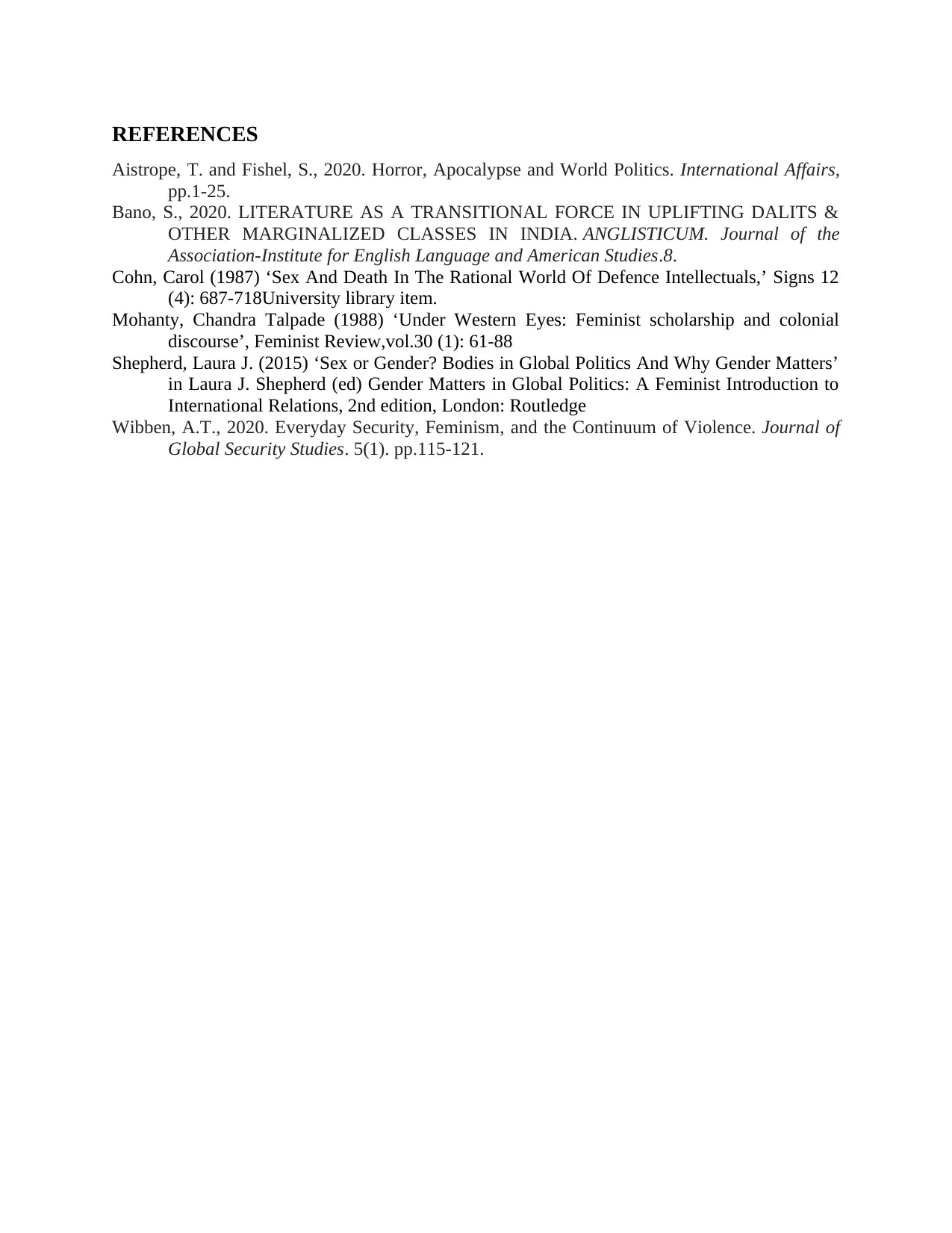
REFERENCES
Aistrope, T. and Fishel, S., 2020. Horror, Apocalypse and World Politics. International Affairs,
pp.1-25.
Bano, S., 2020. LITERATURE AS A TRANSITIONAL FORCE IN UPLIFTING DALITS &
OTHER MARGINALIZED CLASSES IN INDIA. ANGLISTICUM. Journal of the
Association-Institute for English Language and American Studies.8.
Cohn, Carol (1987) ‘Sex And Death In The Rational World Of Defence Intellectuals,’ Signs 12
(4): 687-718University library item.
Mohanty, Chandra Talpade (1988) ‘Under Western Eyes: Feminist scholarship and colonial
discourse’, Feminist Review,vol.30 (1): 61-88
Shepherd, Laura J. (2015) ‘Sex or Gender? Bodies in Global Politics And Why Gender Matters’
in Laura J. Shepherd (ed) Gender Matters in Global Politics: A Feminist Introduction to
International Relations, 2nd edition, London: Routledge
Wibben, A.T., 2020. Everyday Security, Feminism, and the Continuum of Violence. Journal of
Global Security Studies. 5(1). pp.115-121.
Aistrope, T. and Fishel, S., 2020. Horror, Apocalypse and World Politics. International Affairs,
pp.1-25.
Bano, S., 2020. LITERATURE AS A TRANSITIONAL FORCE IN UPLIFTING DALITS &
OTHER MARGINALIZED CLASSES IN INDIA. ANGLISTICUM. Journal of the
Association-Institute for English Language and American Studies.8.
Cohn, Carol (1987) ‘Sex And Death In The Rational World Of Defence Intellectuals,’ Signs 12
(4): 687-718University library item.
Mohanty, Chandra Talpade (1988) ‘Under Western Eyes: Feminist scholarship and colonial
discourse’, Feminist Review,vol.30 (1): 61-88
Shepherd, Laura J. (2015) ‘Sex or Gender? Bodies in Global Politics And Why Gender Matters’
in Laura J. Shepherd (ed) Gender Matters in Global Politics: A Feminist Introduction to
International Relations, 2nd edition, London: Routledge
Wibben, A.T., 2020. Everyday Security, Feminism, and the Continuum of Violence. Journal of
Global Security Studies. 5(1). pp.115-121.

1 out of 5


Your All-in-One AI-Powered Toolkit for Academic Success.
+13062052269
info@desklib.com
Available 24*7 on WhatsApp / Email
![[object Object]](/_next/static/media/star-bottom.7253800d.svg)
Unlock your academic potential
Copyright © 2020–2026 A2Z Services. All Rights Reserved. Developed and managed by ZUCOL.